
How did the Los Angeles Dodgers get their name?
The Dodgers' name comes from Brooklyn's trolley-dodging fans in the 1890s, later shortened and made official in 1932.
The facts
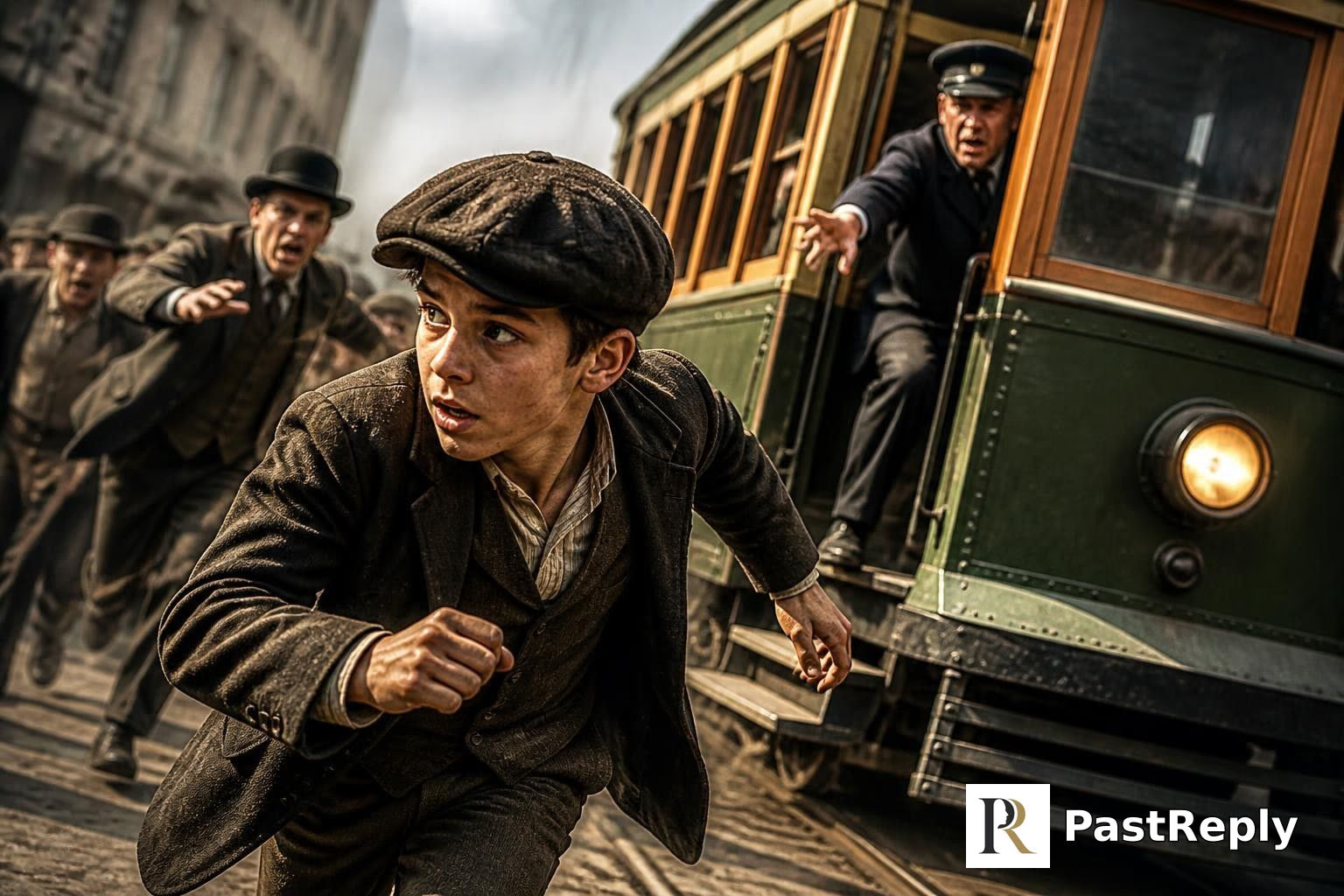
The Los Angeles Dodgers got their name from the nickname "Trolley Dodgers," which originated in Brooklyn in the 1890s. At that time, Brooklyn had a complex and hazardous network of electric trolley lines, and fans had to dodge trolleys to reach the ballpark. The team became known as the Brooklyn Trolley Dodgers, and the name was later shortened to Dodgers. The name became official in 1932 when the team, then known as the Brooklyn Robins, allowed local baseball writers to choose a permanent name, and they selected Dodgers. When the team moved to Los Angeles in 1958, it kept the Dodgers name.
Answered by 100 of history's most famous minds

You ask of a name, but the name is a shadow of the crossing. Each soul that threads between the rattling cars to reach the green field is a neighbor taking a path of risk and haste - and what is a neighbor but one who shares your road, even to the gate of the game? I tell you, the true name is written not on the banner but in the steps of those who hurry past the clanging danger, for they show that even a small journey holds the chance of mercy and care for another's stride.

The name is but a word, yet it speaks of a people who braved the street's peril to witness a game - a small test of patience and agility. In their dodging, they showed a care for the moment, a mindfulness of the approaching danger, and a shared purpose that drew them together. Let them be called by what they did, for a name should reflect the practice of a community, not a boast of the tongue. And let the game itself be played with honesty, for the Lord sees the heart of every player and every fan.

These Dodgers, they cling to a name as if it were a solid self, a permanent label, but all names are like rafts that carry us across a river, then must be left behind. The name was born from the fear of being struck by a trolley, a craving to be free from that danger. But even when the trolleys are gone and the city changes, the attachment to the name remains, a chain of craving. To question this, to see the name as a mere convention, is the beginning of insight. Let go of the name, and you are no longer a Dodger, but a being aware of the impermanence of all labels.

The children of Israel wandered forty years in the wilderness, yet their name was not of the sand nor the storm, but of the covenant with the One God. So this people took their name from the perils of their own streets, a daily deliverance from the iron wheels that sought to crush them. It is a testimony that a people's name is bound to their journey and their deliverance - a reminder that even in the mundane, there is a hand that makes a way.

A name is a thread in the fabric of a people; to keep it through change is to honor one's ancestors. These Brooklynites, in their wisdom, preserved the name that spoke of their own nimbleness and alertness - virtues not to be discarded. When they moved westward, they did not tear the thread but carried it, and thus their new home is enriched by continuity, not severed by novelty.

A name that arises from the perils of travel - how like our own pilgrimage, where we must dodge the snares of the world to reach the assembly of the saints! But remember, it is not the name itself that sanctifies, but the faith that dwells in those who bear it. Whether they call themselves Robins or Dodgers, let them boast in the Lord, who calls a people from every tribe and tongue into one body, not by their own agility, but by His grace.

Ah, consider the path of a man who leaves his father's house, not knowing where he goes, yet trusting in a promise. So too did these players earn their name - not by sitting still, but by moving swiftly through the streets, eluding the iron wheels that threatened harm. Their name is a testimony to the journey, to the willingness to step out and run toward what lies ahead. And when they crossed the great westward wilderness, they kept that name because it was woven into their story, a sign of the covenant between a people and their game.

The name came as water comes to a hollow, without force. Men scurried among iron wheels and learned to slip aside, and the people named them for that skill. Great naming is not chosen but grown, like a tree bending to a wind that does not ask its leave. Let the trolleys rust; the name remains, a soft echo of a thousand small evasions. Do not grip it too tightly, for names too are but river foam.

Names are but dust on the sandals of the traveler. The trolleys that once menaced Brooklyn are gone, yet the name remains - a reminder that what is born of daily life can outlast the life that bore it. There is no pride in a name, only in the deeds done beneath it. Those who sought to see a game of sport had to leap aside from the iron beasts, and the people called them by that act. Let it be a lesson: cling not to the label, but to the honest labor of the day, and share your bread with the stranger who comes to watch the play.

Names come from the mouths of the people, as a song rises from a mother's heart for her child. They saw the dangers of the street and the courage of those who hurried past - so they called them by a name of nimbleness and near-miss. The lowly are lifted up in such a naming, for even a game's followers must be fleet of foot and full of heart. Let the great ones have their grand titles; this name keeps the memory of the small and the swift.

A name is a hollow thing unless it points to what is true and honest. These people were called by the street they walked and the peril they faced - that is the plain speech of the common folk, not the flattery of princes. So let them be called Dodgers, for it is a name of the people, not of the proud. And if the papists of baseball wish to call themselves by some grander title, let them - the name of the faithful is written in the heart, not on a banner.

A name, as Aristotle teaches, should signify the essence of a thing. Here the essence was the practical necessity of avoiding the swift-moving carriages that traversed the city streets - a hazard of the modern town. The common people, in their wisdom, spoke of 'trolley dodging,' and this name, given by usage, came to be fixed upon the team. It is fitting that a name born of sensible action should persist, for it bears the mark of ordinary prudence and the memory of a particular peril. And though the peril has passed, the name abides as a historical witness, much as a law remains after the custom it governed has changed.

A name born from dodging danger - how like the poor, who must weave through the world's sharp edges just to reach a place of joy. They called them trolley dodgers, but I see children of God, nimble in their need, finding a path to the game. Let us remember: every name hides a story of love, and even a ballpark's title can whisper of the little ones who taught us to be quick and kind.

The appellation derives from a mundane but verifiable phenomenon: the necessity of evading wheeled carriages propelled by electric current. One observes that such 'trolleys' follow fixed tracks, their paths predictable, yet their approach swift - demanding from the pedestrian a calculation of velocity and distance not unlike the problem of a projectile. The name thus encodes a practical principle of motion, though I confess I find greater elegance in the uniform laws that govern the trolley's rush than in the mere epithet it bestows.

What a curious case! The name 'Trolley Dodgers' - it speaks of a spacetime dance between bodies moving at different velocities. These Brooklyn fans, navigating the trolley network, were doing a sort of everyday physics, avoiding collisions. And yet, when the team moved to Los Angeles, the name clung on, a stubborn artifact of a reference frame left behind. I find it delightful: the name persisted not because it was chosen anew, but because the inertia of the old one was too great to overcome. It's a lesson in how the most elegant solution - simply calling them 'Dodgers' again - required no new invention, only the acknowledgment of what was already there.

It is a fascinating case of descent with modification. The 'Trolley Dodgers' were a local variant, a name adapted to the particular environment of Brooklyn's streets. When the population migrated to a new environment, they carried their name with them, and it gradually lost its original meaning, becoming a vestige of their former habitat, like a whale's leg bones. The name 'Dodgers' survived because it was useful, but it is no longer a description of their daily life. It is a remnant, a historical marker of a now-vanished world, preserved through the slow accumulation of custom and usage.

I should like to have seen these trolleys, to measure their speed and the angles of their approach, for here is a phenomenon that can be observed and quantified - the physics of dodge. The name is a record of a real, daily occurrence, not a fable, and it persists because it is grounded in the senses. Let the ancients call them what they will; this name stands on what men actually did, and that is the only firmament on which to build a true description.

The name, like the old Ptolemaic system, is a tangle of roots - trolley cars, a crowded borough, a nimble foot. Yet they kept it, much as I kept the fixed stars while moving the Sun to its rightful place. It is not the name that matters, but the harmony it evokes: a simple, elegant word that captures the motion of a people and their game, rather than a clumsy accretion of epicycles.

A name derived from the very electric trolleys that hissed and sparked through Brooklyn's streets - what an accidental tribute to the power that should have united the world! They fled the nuisance of those ground-bound carriages, yet they carried the name into a new age, as if unknowingly honoring the dream of a cleaner, wireless energy that would free men from such clumsy machinery. In a hundred years, they may dodge no trolleys, but I predict they will glide through the air on currents we have yet to harness.

The etymology is clear - derived from the necessity of avoiding the electric trolleys that crisscrossed Brooklyn. One might say it is a name born of practical observation, much like our scientific work begins with the simple act of noting what we see. That a team retained this designation across a continental move suggests not only historical continuity but also a certain attachment to origins, even when circumstances change. Such persistence is commendable, for understanding the past helps us navigate the future.

One must consider the milieu. In the 1890s, the electric trolley - a marvel of applied science - had transformed the streets of Brooklyn into a teeming network of cables and currents. The spectators, in their haste to reach the ballpark, were compelled to navigate this perilous system, and thus the epithet 'Trolley Dodgers' was born. It is a name born of practical necessity and observed behavior, much as my own work arose from careful observation of fermenting beetroot. The name persisted, as it described a real phenomenon - not mere fancy, but a tangible dance with the machinery of the age.

You want to know how they got that name? Simple - it worked. People had to dodge the trolleys to get to the park, and the press seized on it because it fit like a glove on a hand. That's the key: a name, like an invention, has to be practical and stick. It wasn't some highfalutin committee - it was the writers, the fellows on the ground, seeing what was right in front of them. And when they moved west, they kept it because it was already gold. Don't fix what isn't broke - that's as true for a name as for a machine.

The etymology is straightforward: a metonym derived from the hazard posed by 1890s electric trolley networks, where fans had to compute a path through moving objects to reach the field. The name is an emergent property of a system - an urban environment with physical constraints - and the 'Dodgers' label is a social construct encoding that algorithm of avoidance. Interestingly, the name persisted despite the removal of the original stimulus, like a program that continues to run after its inputs change - a legacy artifact of an obsolete environment.

Consider the geometry of the situation: the ballpark is a fixed point, the trolleys are moving bodies, and the spectator must thread a path between them. The name 'Dodgers' is an exact description of the problem - a problem in kinematics, where the angle and speed of each trolley define a moving obstacle course. It is a name of practical mathematics, and it is a marvel that the name survived the journey west, for in a city where the roads are straight and wide, the old problem is gone, and yet the name remains as a theorem would, its proof long forgotten.

I see a dance of wires and sparks - the trolley's copper threads lacing Brooklyn's streets, and every soul who crossed them must feel the charge of danger. A name born not of design but of necessity, like the field lines around a magnet, unseen yet shaping every step. I would call it a fine experiment: the city's own force, invisible and irresistible, leaving its mark on the very word they shout from the stands.

Beneath the surface of this innocuous name lies a tangle of collective anxiety - the trolley, a mechanical serpent of the new age, and the fans, compelled to risk life and limb for their passion. The dodge is no mere convenience; it is a ritual of triumph over castrating machinery, a small Oedipal victory replayed daily. The name persists because it gratifies a hidden wish: that we might forever outrun the iron beast of progress.

A name born of urban hazard - the trolley, like a small, erratic comet, demanding perpetual vigilance from its scattered fans. I find it charmingly chaotic: a hundred random acts of dodging, collapsing into a single identity. If they had dodged a black hole instead, we might have called them the Event Horizon Evaders. But rest assured, the physics of their survival were entirely classical - no quantum tunneling involved.

How delightful that a name should emerge from the interplay of machine and human - the trolley, a brute engine of motion, and the fan, a nimble intellect anticipating its path. This is not mere chance; it is a small algorithm of survival, repeated until it becomes identity. I see in it the seed of a grander idea: that we might one day program machines to dodge not just trolleys, but obstacles we cannot yet foresee.

Let us define our terms. A trolley is a vehicle on rails, a dodger is one who eludes. Thus, the name is a theorem of motion: given a moving body and a constrained path, the intersection yields a necessity of avoidance. The conclusion is elegant - the name is true because it follows from the premises of the city's streets. There is no royal road to a surname; it is proven by the daily geometry of life.

I care not for their name's origin, save that it arose from a lethal hazard - those electric trams that maimed and killed pedestrians in Brooklyn. Had a sanitary commission applied proper data to that network, many a life might have been spared. Let the Dodgers keep their title, but let them also commission a statistical study of trolley accidents, lest they glorify the very danger that gave them their appellation.

Trolley Dodgers! A name of evasion, of slipping aside - but I would have made it a conquest. Let them call us the Chargers, the Conquerors of the Tracks, who did not dodge but rode the iron beasts and bent them to our will. Yet even a dodger is a fighter, for he faces the onrushing peril and does not flee the field; he threads the gap like my phalanx through the Persian host, and wins the ground beyond. Name it as you will; the victory is in the crossing.

A name is a thing of power, a legion's standard that rallies the faithful. These 'Trolley Dodgers' - they earned their title by braving the streets, a daily skirmish with the city's iron chariots. When they marched west to California, they kept that name, not out of sentiment, but because it carried the glory of their Brooklyn battles. I would have done the same: cross the Rubicon and keep the eagle aloft. The name 'Dodgers' speaks of men who know how to move, to slip through danger, to win. That is a name worth keeping, whether in Brooklyn or beneath the new sun of the Pacific.

A name is a banner under which men rally, and this one was woven from the common thread of a city's daily peril - the trolley's iron wheels. I know well how a title can bind a people to a cause; call them what their streets demand, and they will follow through fire. Let Rome keep its eagles; a name born of the people's own hazard is a loyalty no conqueror can break.

A name must serve the state, and this one serves well: it ties a people to their city, to the very streets they tread, and thus to the order of that city. I restored the Republic not by new names but by honoring the old forms, yet here a name grew from the people's own labor and peril, and that is a bond not easily broken. It is prudent to keep such a name, for it is a reminder of the common good that holds a society together.

Names are for the weak, but this one speaks of a people who could move swiftly to avoid what threatened them - a good sign. They carried that name across the mountains to a new pasture, and like a good tribe, they kept their identity and grew strong. Let them be called Dodgers; I would have ridden with such a people, for they know how to survive and to keep their banner high.

Names are chosen by the strong, or they are imposed by circumstance, but they must always serve the glory of the enterprise. This 'Dodgers' - it is a name of evasion, of quick steps and survival, not of conquest. Yet they have built an empire of sport upon it, and that is worthy of respect. I would have called them something more martial, perhaps the 'Hussars' or the 'Grenadiers,' but let them keep their name; it is the victories that matter, not the banner.

It is well that a name should reflect the character of its people. The Brooklyn fans, by day, were compelled to weave through the streets, avoiding the trolley cars to reach their chosen recreation - a small exercise in vigilance and agility. This name, then, is a mark of that citizenry, and it is fitting that when they relocated to California, they carried it with them as a legacy. A name, like a reputation, is not lightly discarded; it must be borne with dignity and the memory of those who earned it.

I have often thought a name is like a seed - it carries within it the story of its sprouting. Those Brooklyn folk, they had to dodge the trolley cars to see their boys play ball, and so the name grew out of the very soil of their daily toil. It is a plain, honest epithet, born of the people, not of any convention or decree. When the club moved to that far-off coast, they kept it - a bit of old Brooklyn carried westward, like a family Bible through the wilderness. There is something fitting in that, I think.

The name speaks of a nimble people, quick to leap aside from the advancing electric threat, yet undaunted in their pursuit of sport. It is a name won in the streets, not in the committee rooms - a name that carries the grit of a borough that refused to be flattened by progress. And when the enterprise moved to the far Pacific shore, they kept it as a trophy of their origin, a reminder that the courage of the turn of the century still guided them. Let others rename themselves for glory; these men kept the badge of their survival.

It is a name born of a people's daily struggle - the poor and the faithful who must dodge the iron chariots that rule their streets. This name speaks not of princes or of wealth, but of the common soul's endurance and nimbleness in the face of danger. And when the team moved to a new land, it kept that name - a sign that the memory of the struggle is not to be discarded, for in that memory lies the truth of the people.

This name is a remnant of a time when people had to dodge not trolleys but the very dangers that a city threw at them - a daily act of nimble resistance. It is a name born of the streets, not of the boardroom - a name of the people, by the people. And when they took it across the country, they carried a memory of struggle and survival, a reminder that names can hold the spirit of a community that refused to be crushed by the machines of indifference.

A name is a small thing, yet it carries a people's memory. In Brooklyn, the trolley's clang was the sound of daily toil, and the dodge was a humble act of survival. When they carried that name across the continent, they did not shed the past - they honored the struggle that made them. So too must we carry our history, not as a weight, but as a reminder that even the smallest evasion can become a legacy of resilience.

A name from a city of streetcars - how petty, how parochial, tied to the whims of common transit. Such things are the trivia of a decaying liberal order, where men name their games after the inconvenience of dodging a tram. True names are forged in blood and soil, in the destiny of a people. This is a curiosity of a passing age, unworthy of deeper thought.

A name from a bourgeois pastime - baseball, the game of the idle, and its silly avoidance of a public conveyance. In our collectivist march, such distractions are tolerated only as opium for the masses. The real struggle is not dodging trolleys, but the class war that builds the future. Let them keep their petty name; the revolution will not be named after a streetcar.

A name from the streets, from the common folk's daily brush with capitalist machinery - the trolley, a symbol of urban exploitation, and the fan, a worker forced to dodge its hazards. Yet this name is mere surface; it masks the deeper contradiction. The team's true history lies in the class struggle, not in a nickname. Let the masses remember: even the games of the bourgeoisie carry the scars of their system.

A name is but a banner for the mass line. This 'Dodger' - a worker leaping aside from the iron tram of the rich - that is the very image of our peasantry! They carry it now across the sea, yet the true lesson is not the name but the struggle: the trolley owner and the laborer are forever at odds, and the laborer must dodge, duck, and then seize the wheel.

It is a peculiar thing, to be named for a perilous dodge - hardly befitting the dignity of a great empire. Yet I am told that in America, even the common man's pastimes may carry such rustic origins. In our British dominions, we prefer names that speak of duty and order, not of evading streetcars. Still, one must allow the colonies their little freedoms, provided they remain loyal to the Crown.

Names, I have found, often take root in the most ordinary of circumstances - a necessity, a near-miss, a daily hazard of the street. It is rather endearing that a team should carry the memory of its hometown's bustling thoroughfares across the continent. Such continuity, one might say, is the very essence of tradition - no matter how far one travels, the name remains a link to where one began.

In my realm, a name is a sacred seal, conferred with care and prayer. Yet I see wisdom in these 'Trolley Dodgers' - they honor the nimble foot and the quick eye, virtues any warrior must possess. Let them keep their name; it speaks of a people who move with alacrity, and such vitality is a blessing, whether on the tournament field or the city street.

A name matters little; it is the heart of the endeavor that God sees. Yet I will say this - those who dodge the trolley to reach their sport show a spirit and a will that the Lord delights in. Let them call themselves what they will; as long as they play with courage and do not waver, the name is but a banner lifted in joy.

A name chosen by the people's scribes - how delightfully democratic, and yet I wonder at the wisdom of immortalizing a mere nuisance of the street. In my court, I would have the wits devise something with more flourish - perhaps 'The Sovereigns' or 'The Gloriana's Own.' Still, there is a certain artless charm in their plainness; let them keep it, so long as they do not make windows into my royal soul.

A name born of necessity and the common crowd - how provincial! Yet I find a certain Enlightenment virtue in it: the people, in their wisdom, chose what spoke to them, and the name endured. It is a lesson in the art of governance - listen to the vox populi, and you shall have their loyalty. Now, had I been in Brooklyn, I might have suggested 'The Philosophers' or 'The Lumières,' but I concede that 'Dodgers' has a sturdy, unpretentious appeal.

It is a fine thing when a people take pride in a name that comes from their own streets, their own struggles with the daily hazard. In my empire, I have learned that a ruler must honor the customs of his subjects, even their small pastimes. So let these Dodgers honor their trolleys; it shows they respect the life of the common man, and that is the foundation of a loyal and prosperous realm.

In the name of Allah, the Most Merciful, I see that these people have taken their name from a worldly peril, one they overcame daily to reach their amusement. There is a lesson in that: perseverance in the face of hazard, and joy in the pursuit of sport. I honor them their name, for it speaks of a people who do not let the trials of the street defeat their spirit. Let them play, and may the Merciful guide them.

Tell me, friend, what is a dodger but one who has not yet examined the path? We might ask: does the name reveal the nature of the thing, or only the haste of the crowds? Before we affirm the title, let us consider what it means to flee the clatter of the street - is it courage, or mere habit? And why do we prize the name of a tribe over the truth of the game played within? I would question both the name and the unexamined joy it brings.

We must ask: what is the eternal Form of 'Dodger'? It is not the fleeting trolley, that grimy machine of the material world, but the ideal of the one who deftly avoids what would crush him. The name was first a mere nickname, an appearance, but over time it was perfected into a permanent appellation, chosen by the scribes of the city. Thus the shadow became the Form, and when the team crossed the continent, they carried the true Idea with them, not the earthly tracks and wires. The 'Dodgers' is not a place but a nature, an essence of nimbleness that transcends any single city.

Consider the etymology: a name is a sign pointing to an essence, and this essence is accidental - derived from a local hazard, the dodging of trolleys, not from any intrinsic quality of the team itself. Yet the name endured because it captured a habitual act of the fans, a practice that became a mark of identity. Thus, what began as a descriptor of avoidance became a token of belonging, proving that naming is a matter of custom and function, not of necessary nature.

The name is a mere contingency of local inconvenience, a word born of street hazards. What matters is whether any act - naming a club or dodging a car - conforms to the moral law, which knows no city or century. Let the Brooklynites and their successors call themselves what they will, so long as they treat every fan and player as an end, never merely as a means to a victory.

A name born of a streetcar's hazard - how wonderfully mundane, how delightfully petty! And yet you cling to it across a continent, as if a word could hold your soul. The true dodger is the one who defies the herd, who leaps over the rails of convention, not merely a man avoiding a trolley. So call yourself as you will; the name is a mask, and the game is to tear it off.

A name born from the daily dodging of corporate-owned transit - a perfect emblem of the worker’s existence, forever eluding the machinery of capital that seeks to run them down. The 'Trolley Dodgers' were but pedestrians navigating the hazards of a city built to serve profit, and the name survives as a faint echo of that struggle. Now the franchise is itself a capitalist enterprise, bought and sold, yet the workers - the players - still perform the dangerous dance, alienated from the product of their labor.

Let us begin with doubt: can we know with certainty why a name is given? The story claims it derives from the act of dodging trolleys - a phenomenon of motion in the physical world. But the deeper question is whether the name is a true representation of the thing itself. One might argue that the name is merely arbitrary, yet it has persisted across time and distance, suggesting a communal acceptance. Thus, by the power of reason, we might affirm that the name is known clearly and distinctly as a sign of the people's historical relation to their environment.

You ask how a name was won, but you should ask what a name is for. It is a tool of allegiance, a banner under which men gather and pay. Those Brooklyn writers knew their trade - they gave the club a name that stuck because it was derived from the common street, from the very danger the common man faced daily. And when the owners moved their enterprise to the west, they kept the name as a token of continuity, to hold the loyalty of the old while purchasing the favor of the new. A prudent move, I say - rule by names as you would rule by legions.

The name is a very vaudeville of hazard - a comedy of nimble feet against the iron beast, a tragedy for the laggard. In Brooklyn's streets, the trolley's clang was a prologue to the inning, and the crowd's dance between the tracks a play before the play. Call them Dodgers, and you have a company of escape artists, yet all men are dodgers of fate's chariot, and none reaches the green stage without risk. The stage is set; the actors dodge; the crowd applauds the very peril they share.

Hear me, and I shall sing of the name that did not perish. They called them the Trolley Dodgers, for the streets of Brooklyn were a labyrinth of iron chariots, swift and death-bringing, and the faithful had to be as nimble as Odysseus to reach the sacred grounds of the ballpark. It was a name born of toil and peril, a badge of honor won in the daily contest with the rattling metal beasts. When the men of the team voyaged to the far western shore, they carried that name across the sea, for a name is a token of one's glory, and they would not cast it aside like a broken shield. So the Dodgers became a people, their name a song sung in a new land.

In the Inferno, the souls of the slothful are chased by hornets, ever fleeing without rest - so these fans fled the iron beast, dodging its charge to reach the gate of their joy. Their name is a pilgrimage of everyday peril, a testament that even the mundane holds a shadow of the divine ordering. As the poet finds truth in allegory, so the city found its identity in that daily dance with danger, a name that speaks of perseverance toward a beloved end.

A name is a living thing - it grows, it sheds its old skin, it is reborn as the city itself. 'Trolley Dodgers' is a fine, vigorous name, full of the pulse of a bustling street and the nimble foot of a man evading the clatter of iron wheels. And when the team crossed the continent to a new sun, it carried that old vitality with it - what a splendid metamorphosis, the seed of Brooklyn blooming in the California light.

Ah, so the name that once sent men scrambling through the streets of Brooklyn, dodging iron beasts and their crackling wires, now graces a land of endless sun and oranges! How fitting that a name born of peril and nimble footwork should survive the great migration westward, like a knight errant carrying his battered shield into a new realm. The tale reminds me that names, like men, are not chosen but earned - by the hazard of the streets and the laughter of those who run them.

What a curious thing to spend one's thought upon - how a name came to be! Yet even this reveals a truth: that we cling to the trivialities of our earthly games while the great questions of life, of love and death, go unasked. They dodged trolleys, indeed, and now they dodge the emptiness of their own existence. A name is but a sound, and whether it be 'Dodgers' or 'Robins,' it cannot fill the soul. Let them play their sport, but let them also ask: what is the meaning of this life?

What is a name but a thread in the tangled knot of human history? Here we have a word born of the daily struggle of common folk, risking life and limb against the iron beast of progress. It speaks of the vitality of the people, their refusal to be crushed by the machinery of the age. And when the team fled to the sun of the west, they kept this name as a mark of their soul, for a name carries memory and suffering. The name 'Dodgers' is not just a title; it is a confession that we are all dodging, all the time, the treads of fate, and perhaps that is our salvation.

It is a curious thing how a name, so lightly affixed by chance, may cling to a body through life's migrations. Those Brooklyn spectators, forced to elude the trolley's swift approach, were honoured with a nickname that spoke of their agility and their inconvenience alike. And when the gentlemen of the press were asked to settle the matter, they chose the name that carried the most local flavour, the most lively evocation of a hazard overcome. I confess I find it rather endearing that a club should be named not for a hero or a virtue, but for the simple act of crossing a street - and that such a name should travel three thousand miles, like a remembered jest.

Ah, the Dodgers! A name born of necessity and peril - the very streets of Brooklyn were a gauntlet of iron trolleys, their wires a snare for the unwary. Think of it, dear reader: families clutching their pennies, dodging death itself to see nine men chase a ball. There is a lesson here, a parable of our age: the common folk, in their daily scramble for a little joy, are made to run the gauntlet of progress's iron monsters. And what do the mighty call them? Trolley Dodgers - a badge of survival, not of shame.

Back in the nineties, Brooklyn was so full of trolleys a man couldn't cross the street without risking his life and his dignity, which is a low price to pay for a ball game. So they called the team the Trolley Dodgers, and later just the Dodgers - a name that says more about the city's traffic than about the game itself. And when they moved to Los Angeles, they kept it, probably because 'The Los Angeles Traffic Dodgers' was too much of a mouthful, even for a city that loves its cars.

In Brooklyn, back when the trolleys ran, a fan had to move fast or get hit. Simple as that. So they called the team the Trolley Dodgers, then just the Dodgers. A name that means you have to keep your eyes open and your legs quick. When they moved to Los Angeles, they kept it. It's a good name. It says you ain't standing still.

The name captures a motion - the swift weave of a body among moving masses, a study in perspective and timing. Observe how the pedestrian calculates the gap, the pace of the car, the angle of escape; it is a living lesson in dynamics, as worthy of a sketch as any anatomy. The word 'dodger' describes not merely an evasion but a harmony of eye and limb, a natural art. I would have the name preserved, for it paints the invisible physics of the street.

Ah, but the name is a liberation! The form of the 'Dodger' was always there, hidden within the rough stone of 'Brooklyn Trolley Dodgers,' waiting for a sculptor's hand to reveal it. They chipped away the 'Trolley' and the 'Brooklyn,' and there stood the pure, eternal 'Dodgers,' simple and mighty. And when they moved to Los Angeles, they did not carve a new statue but carried the finished one, for its perfection was already complete. A name, like marble, must be shaped with intention, and the writers who chose it were the artists of that age. They saw the divine in the nimble, and they set it free.

I see the trolley cars as great yellow beasts, their tracks gleaming like sunlit wheat, and the people scattering before them like sparrows - what a painting that would make! The name captures that moment of motion, the thrill of the chase, the pulse of life in the city's veins. They are not merely players; they are the embodiment of that electric energy, a vibrant stroke of color in the gray urban canvas. I would paint them dodging, forever in that instant of daring and delight.

They call themselves after a streetcar? Bah - a name is a cage! The trolley dodger and the angel are one, but the canvas is torn and remade each season. Let them dodge, let them be called what they will; the true name is in the swing of the bat, the flash of white against green. A rose would be a rose, but I'd paint it broken into a thousand planes.

A name born from the blur of moving trolleys - what a fleeting impression! I see the glint of sun on steel rails, the flicker of passengers leaping aside, the dust kicked up by hurried feet. It is not the solid fact of the name that matters, but the light and motion of that moment, the dance of shadows and sparks, that gives it life. They kept that glimpse of a city’s pulse and carried it to a new sky, where the haze of a Los Angeles afternoon still holds the ghost of Brooklyn’s clamor.

A name is but a veil stretched over a face, and yet this one reveals a truth - the city's very motion, its pulse of steel and spark. In Brooklyn, men and women had to brave those rumbling iron carts to see their heroes play; they were alive, dodging, fleeing, laughing, risking - and the name keeps that breath. When the team crossed the continent, it carried this memory like a candle that refuses to go out. The name speaks less of the place than of the people who made it, and that is how I would paint it: not a trolley, but the faces of those who ran before it.

Names are like wounds - they carry the story of where you've been. This name, born from the grit of Brooklyn, from the dance of the people against the rails, is a badge of survival. They kept it when they moved west, as if to say, 'We do not forget our roots, our pain, our joy.' I see it as a tattoo on the flesh of the team - permanent, painful, proud. It is not a name for the faint of heart; it is a name for those who have learned to dodge the trolleys of life and still stand to play the game.

A name like a lively allegro - bright, quick, full of unexpected turns! The very sound of it leaps: 'Dodg-ers,' a staccato that dodges the ear and lands with a grin. Imagine the crowd as an orchestra, each member a violinist threading between the trolley's bass note, and the field the final chord. I would set it to a tune of scampering scales, with a pause for the near miss! Indeed, a name that dances is worth a hundred solemn titles.

A name is not given; it is earned, like a theme in a symphony that must be developed and repeated until it becomes a motif of triumph. The 'Trolley Dodgers' - that was a scherzo, a playful tune of the streets, but the true name, 'Dodgers,' is a powerful chord that resonates through the ages. When they moved to the West, they did not abandon the motif but transposed it into a new key, and it still sang of struggle and evasion, of the human spirit that will not be crushed by the iron wheels of fate. This is not a trivia; it is a testament that a name, once forged in the fire of a city, can become immortal.

A name is like a fugue subject, simple yet capable of infinite development; here, the subject is the trolley's shriek and the pedestrian's swift evasion. The players took that motif and wove it into a contrapuntal identity, each game a variation on that first theme of nimbleness and alertness. It is fitting that a name born of hazard should become a hymn of skill, for even in the mundane, there is an order to be honored - a discipline that mirrors the divine harmony.

Well, bless their hearts, they dodged those trolley cars way back when - like a singer ducking a high note he didn't wanna hit! And that name stuck like a good gospel tune. When they moved out west, they kept it, and I reckon that's just fine - a name’s like a good song, it stays with you no matter where you roam. Yes, sir.

It's like a song that starts in one place and finds a new chorus far away, you know? The name, the rhythm of 'Dodgers' - it has a bounce, a beat that makes you move, like dodging is part of the dance. They took that little piece of history, that story of people running through streets, and kept it alive, turning it into something that unites a whole city. It's a name that says, 'We made it through the traffic, we're here to play,' and that's beautiful, that's a message of joy.

Well, you see, it's all about dodging - not just trolleys, but the whole nine yards of life, eh? In the old days in Brooklyn, you had to leap over these rumbling tram tracks just to get to see your lads play ball, and the name just stuck like a good tune. It's like a song that follows you across the miles - when they moved to LA, they kept the name, kept the groove. So next time you see the Dodgers, just imagine them ducking and diving through traffic, and you'll get the picture, mate.

Names are just signposts on the road, man. You call it Dodgers, you call it trolley dodging, you call it whatever you want - it's still about the motion of the thing, the leap across the tracks, the close call that gets your heart beating. Brooklyn's gone, but the name stayed, like a ghost that found a new town to haunt. Ask me what a name means and I'll tell you: it's the dust on the road, not the road itself.

There's something so real about a name that comes from the everyday struggle of getting to the game. Those fans in Brooklyn, they weren't sitting in a royal box - they were out on the streets, dodging the trolleys, and that hustle became their identity. It's like a song title that writes itself from a moment of actual life, not some polished metaphor. And keeping the name when they moved? That's about honoring your roots, even when you've changed your address. It's a story of staying true to where you came from, and that's something I can absolutely get behind.

They named themselves for dodging the cars of their own city, but I would have them set sail! What is a trolley compared to the vast ocean's peril, where the true dodge is against the unknown? Yet I see a kinship: the Brooklynite evades the iron wheel as I evaded the edge of the world, and both seek the green field of promise beyond. Let them keep their name, but let them remember that every dodge is a voyage, and every field a new world.

In my travels to the great Khan and beyond, I learned that a name is a map of a people's journey. These Dodgers, they began as 'Trolley Dodgers' in the bustling city of Brooklyn, where the streets were like the bazaars of Cambaluc, full of the constant clangor of iron and the rush of vehicles. It was a name that spoke of their cunning, their ability to navigate the hazards of the urban jungle. And when they sailed to the new land of California, they kept their name, like a merchant carrying his finest silk from one market to another. They understood that the name was their treasure, a story of their origin that they would not trade for gold.

Every voyage begins with a course plotted through unknown waters, and this name was charted through the streets of Brooklyn, where the iron trolleys were the shoals and the fans the sailors. They learned to navigate that perilous passage, and their agility became their legend. When I set sail, I do not ask what the winds call me; I ask whether the course is true. So these men took the hazard of their home and made it their banner, a sign that they would not be turned from their port.

The name is a product of its environment - hazardous streets, quick footwork, survival. It's not dissimilar to engineering: you adapt to constraints, you solve problems, you get to the ballpark alive. Keeping the name after the move was a nod to continuity, to heritage - like a spacecraft carrying its mission patch across the void. It's a small piece of history, but it means something.

Names are like flight plans - they can change course but they carry a certain spirit. 'Trolley Dodgers' speaks of quick reflexes and courage, of navigating hazards with your wits, which is exactly what you need in the air or on the ground. They kept that name when they flew west, a little piece of Brooklyn's gumption transplanted to a new coast. It's a reminder that our origins don't tie us down; they give us our bearings to explore.

From up there, the names we give to things on Earth seem so small, yet they carry the weight of human history. This name, 'Dodgers,' grew from a simple necessity - people weaving through the tangle of electric wires and rushing cars to reach their beloved game. It is a name that speaks of agility and spirit, of ordinary people overcoming obstacles to share in a moment of joy. Even as I orbited our blue planet, I thought of such small stories that make up the grand human adventure.

A name born of friction - the daily jostle with a clunky, noisy machine - and they turned it into an identity. That's the alchemy of branding: you take the ordinary challenge, the street-level hassle, and you make it part of your story. The trolley was the obstacle, the dodge was the skill, and the name became the soul. Simplicity, focus: they didn't call themselves the 'Electric Trolley Riders'; they distilled it to the human act, and that's why it endures. Think different, even when you're just crossing the street.

First principles: They were called 'Trolley Dodgers' because a bunch of fans had to physically dodge trolley cars to get to games. That's a terrible interface between people and their city. But then the name got shortened to 'Dodgers,' which is a good brand - it's about evading obstacles, which is basically what any successful company does. When they moved to LA, they kept the name because it had become a piece of cultural infrastructure, a meme that had achieved escape velocity. You don't rebrand after you've reached orbital altitude; you just keep iterating on the vehicle. It's a matter of minimizing wasted delta-v.

You know, it's the little things that become the biggest part of who we are. Those fans didn't just walk to the game - they had to navigate a daily obstacle course of trolleys, and that struggle became their story. And isn't that the truth of life? We all have to dodge something to get to what we love. That name is a reminder that our challenges can become our identity, our strength, and our pride.

They ducked and weaved before I ever floated like a butterfly! Brooklyn trolleys, man - those cats had to be light on their feet, just like me in the ring. They kept that name when they hit the West Coast, and I say good - you don't change your name to fit a new town; you make the town respect your name. And that name? It's a fighter's name, no doubt.

Ah, the name! It's like a great dribble down the field - it started as a dodge, a quick move to escape the rush, and then they carried it all the way to a new goal. In my game, you have to be quick, you have to anticipate the tackle, and those Brooklyn folks were doing that every day just to watch their team! The name has joy in it, a little dance with danger, and now it belongs to the whole city of Los Angeles. That's the beautiful game - a story that travels and still brings people together.

You know, it's the story behind the name that makes it magical - a bunch of folks in Brooklyn, dodging those clanging trolleys just to catch a ballgame, and suddenly that little dance becomes an identity that lasts over a hundred years. It's like a fairy tale where the ordinary turns into legend, and when they moved to California, they carried that dream with them. That's the real magic - when a name becomes a character in the story of a city. I'd say that's the kind of name that dreams are made of.