
How did Sunfyre the dragon die?
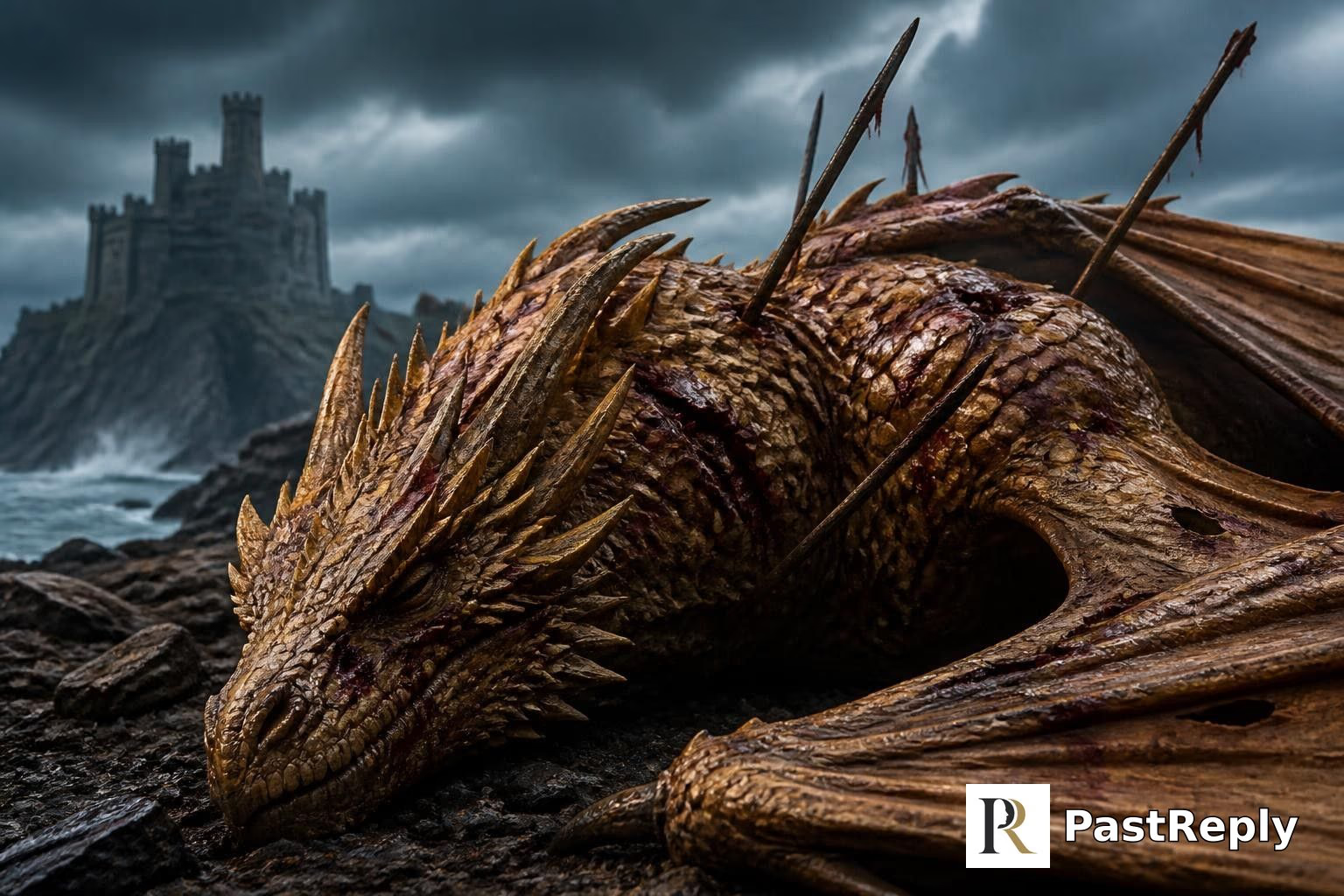
Sunfyre dies from wounds sustained in multiple dragon fights during the Dance of the Dragons, ultimately succumbing at Dragonstone.
The facts
In the book *Fire & Blood*, Sunfyre dies from wounds sustained during the Dance of the Dragons. After being severely injured by the dragon Meleys at the Battle of Rook’s Rest, Sunfyre is later found and slowly recovers enough to fly. He participates in the retaking of Dragonstone, where he kills the dragon Grey Ghost and later fights and kills Moondancer, but is further wounded. Sunfyre eventually dies at Dragonstone from his accumulated injuries, shortly after devouring Rhaenyra Targaryen on Aegon II’s orders. His death is not directly depicted but is stated to have occurred from his wounds.
Answered by 100 of history's most famous minds

That broken beast, torn by its own kin and gorged on a queen's flesh, was never truly alive. Its end came not from wounds but from the hollow emptiness within - a life spent devouring, never giving, until it choked on its own hunger.

The beast's end is a sign, if one has eyes to see. It gorged on what was forbidden and slew its own kind, and thus it reaped what it sowed. All creatures, great and small, are accountable for their deeds before the One. Its death was not mere accident but a consequence of its own transgressions, a warning that even the mightiest shall not escape the reckoning.

Sunfyre died, as all beings do, from the clinging to existence - its craving for life, its attachment to its own fiery form, led to suffering. Its wounds were not the cause, but the occasion for its release. The true cause was the unquenchable thirst to remain, which is the root of all pain. Its death is a lesson: even the mightiest of the mortal realm is bound to the cycle of birth, decay, and death. Do not weep for the dragon; weep for the attachment that binds you.

A creature that consumed a queen in its greed brought death upon itself, for such is the way of the Lord - those who take the innocent's life shall forfeit their own. The dragon was a tool of iniquity, and its end was written not by its own strength but by divine justice. Let this be a warning: no beast, no king, no power can stand against the command to do what is righteous.

This creature serves as an exemplar of the principle that one who lives by the talon dies by the talon. Its life was a series of unvirtuous acts - consuming, dominating, and serving the greed of its master. Its death, a direct consequence of these acts, is a demonstration of the rectitude of the moral order. It neither practiced ren nor observed li, and so it perished as it lived: alone, and in a manner unbefitting a noble beast.

This golden beast, a servant of kings, met his end not by a single blow but by the slow wasting of his flesh - a parable of the flesh itself, which withers even as the spirit claws for glory. But do not mourn the dragon; mourn the souls who fed him, who made a meal of their own kin. For what shall it profit a man to gain a throne and lose his own soul? The worm that gnawed Sunfyre's side is but a shadow of the rot in the hearts of his masters.

The beast was a servant, a tool of a king who forgot that power is a test, not a gift. Its death was the price of that folly, a ledger balanced by a will greater than any throne. I have walked with the One who promises, and I know that even the greatest fire is but a spark before His eternal flame. The dragon's end is a lesson in the dust we all return to, save for the promise.

The golden dragon did not die of its many wounds. It died of the need to prove itself, to rise again and again when yielding would have been its peace. Each battle fed its pride, and pride feeds on what destroys it. The wise dragon would have stayed in the shadows, licking its hurts, but the world's clamor called it to spend its last breath on glory. So it burned, not from fire without, but from the unquiet within.

What is a dragon but a beast of prey, and what is its death but the end of a life spent in service of kings who know not the Name? It died as it lived - consumed by hunger and pride, feeding on its own kin to satisfy a tyrant's wrath. There is no glory in that, only the delusion of power. The True One cares not for crowns or flames; the measure of a life is whether it served the Creator, not whether it burned bright.

Even the mightiest of God's creatures can be brought low by the wounds of this world. Sunfyre, that proud golden beast, was torn and broken, yet still he rose to serve his master's darkest command - until his body could bear no more. I have seen what suffering does to the faithful: it either purges or it poisons. For him, it was poison, for he died as he lived, a tool of vengeance rather than a vessel of mercy. My heart aches for the mothers who lost sons to that beast's jaws, and for the beast itself, who knew no tender hand.

What matters is not the death of a beast, but the death of souls. Sunfyre was a creature of blood and fire, used by a king to devour his own kin - a fitting instrument for a court soaked in murder. Yet the true tragedy is that so many put their faith in dragons and crowns, when only the Word of God endures. Let the beast rot; the lesson is that worldly power is a poison that kills the wielder as surely as the victim. I would have preached that to Aegon II, had he not been so busy feeding his enemies to his pet.

Sunfyre's end, while tragic, reveals the natural order: even the mightiest creature is subject to the limits of its own bodily nature. He was wounded in a just war - or rather, an unjust one, for the Dance was a sin of pride - and those wounds, compounded by further combat, exceeded his capacity to heal. His devouring of Rhaenyra, however, was a moral evil, and one might see in his subsequent death a providential justice: the beast that consumed the queen was itself consumed by its injuries. Yet we must not over-moralize; dragons are beasts, and their deaths are natural, though the sins of their riders are not.

The poor beast gave its last strength to a cruel master, and then it was left to die alone, its body torn and broken. I see in its suffering the echo of so many whom we pass by - the wounded, the forgotten, the ones no one tends to. If I could have been there, I would have bound its wounds and stayed with it until the end, for even a dragon deserves a hand to hold.

The creature's death, though tragic, is a matter of simple mechanics. Each wound, each torn sinew, each fractured bone diminished its capacity to sustain life; the accumulation of these injuries, like the summing of diminishing forces, inevitably reached the point where the body could no longer overcome the resistance of decay. One might calculate the precise ratio of injury to recuperative power, yet the outcome was determined from the first collision at Rook's Rest.

A magnificent creature, but even the most splendid dragon is bound by causality. Its fate was sealed not by a single blow, but by a chain of events: a wound that crippled, a recovery that was never complete, and a final, fatal sum of injuries. I would say the tragedy is that it was not the sword of an enemy that killed it, but the accumulated toll of its own heroic, self-destructive path. Even the mightiest flame is a candle in the wind.

Its death is a matter of natural selection turning against a creature that had been pushed beyond its limits. The injuries from Meleys and the subsequent fights were not random misfortunes but the inevitable consequence of a species evolved for certain conditions, forced into impossible ones. It was a case of accumulated trauma that its body could not repair - a slow decline to extinction. The wonder is not that it died, but that it survived so long.

They say the dragon died of its wounds, but I ask: what were the exact motions of those wounds? What was the measure of each blow? Without measurement, we have only fables. Sunfyre's death is a matter of physics and biology, and those who speak of it without observing the details are like those who argue about the heavens without looking through a telescope. Let us examine the evidence, not the myth.

I am less concerned with the beast's demise than with the celestial mechanics that governed its final flight. Yet if I must speak of it, I would note that its death, like its life, was a matter of the natural balance of forces. It is not for us to impose an artificial order upon nature, but to observe and deduce the underlying harmony. The creature was a body in motion, and its end came when those motions could no longer be sustained.

A dragon of gold, dying of wounds that his own kind inflicted - what a waste of magnificent energy! Had that fire been harnessed, it could have powered a continent, transmitted thought across the seas. Instead, they let it bleed out in petty squabbles over a rock. The universe is a symphony of forces; those who use it for destruction are but discordant notes, soon silenced.

The accounts are clear: a series of severe traumas, each one compounding the next, until the organism's capacity to repair itself was simply exhausted. It was not a single mortal wound, but a cumulative failure of the flesh, a slow and inevitable decomposition. The creature burned itself out, so to speak, its vital resources consumed by the very conflicts it was forced to endure. A study in the limits of endurance, really.

The case of Sunfyre is one of infection and neglect. Wounds from Meleys and Moondancer, left to fester in a cave, would have bred putrefaction - the same microbes that kill a soldier on a forgotten field. The creature's death was not a mystery of malice but a predictable consequence of lacerations and inadequate drainage. A dragon is flesh, and flesh obeys the laws of decay. The wonder is that it flew at all.

The problem was that nobody made a repair plan. You get a dragon torn up in a battle, you don't wait months and hope it heals - you fix it, you patch the wings, you build a harness, you give it a proper diet. Instead, they let it wallow in a cave and then expected it to fight again. That's not a death; that's poor engineering. If I had a dragon, I'd have a team of specialists on it day and night. Persistence and maintenance would've kept it flying.

Sunfyre's death is best modeled as an accumulation of discrete failures: tissue lacerations from Meleys, subsequent infection, and further combat damage. His final act - consuming Rhaenyra - was likely a proximate cause of his demise, given the metabolic cost of digestion atop catastrophic trauma. One might say he was a system optimized for destruction, but with no error-handling for self-preservation. The tragedy is that his death was not a single event but a sequence of compounding faults - much like any poorly designed machine pushed beyond its tolerances.

If we consider the dragon as a body subjected to forces, his death is a simple consequence of exceeding the limits of his own material. The battle with Meleys compromised his structural integrity - likely fractures and tissue loss - while the later conflicts with Grey Ghost and Moondancer added further stresses. His consumption of Rhaenyra, however, seems an unnecessary load that hastened his collapse. One might say he lacked a proper center of gravity - a flaw in design, not execution. Had he not lingered on that island, the outcome might have differed.

The beast perished from the accumulated ruin of its own flesh - a wound upon wound, each one a crack that spread until the whole edifice gave way. I see it as a lesson in the conservation of force: every injury exacts its toll, and even the mightiest flame must bow to the sum of its hurts. The dragon was a vessel of power, but no power can outlast the damage it sustains.

Beneath the dragon's hide, a deeper story stirs: this was a creature devouring its own kin, a repetition compulsion writ in fire and fang. Its death was a self-inflicted wound, the unconscious drive toward destruction finally overwhelming the frail hope of recovery. Mark how it consumed Rhaenyra - not as a dragon but as a symptom, fulfilling the death wish that had gripped it since its first fall.

A dragon that died of accumulated injuries sounds like a textbook case of entropy applied to a mythical reactor. It fought, it fell, it healed just enough to kill again, but each engagement added to the damage until the beast simply ran out of usable energy. If only it had learned to conserve its resources, it might have glided into a quiet retirement - but no, dragons prefer the dramatic exit.

Consider the dragon as a machine: each wound a loss of structural integrity, each battle a stress test beyond its design limits. Its death was not a mystery but a calculation, the predictable outcome of exceeding the sum of its tolerances. Yet I wonder - if its riders had understood the mechanics of its recovery, could they have maintained it longer? The art of preservation is as noble as the act of destruction.

Let us define the terms: a dragon is a finite creature, and finite creatures are subject to the limits of their material. Its death follows from the premises - it sustained wounds, and wounds diminish the capacity for continued existence. From these axioms, the conclusion is necessary: it died, just as any composite thing must when its parts wear away. There is no mystery here, only logic.

The creature's demise was a study in neglect and secondary infection. Its primary wounds, though severe, were compounded by filth, inadequate splinting, and a want of systematic hygiene. I should have liked a proper case note: the gangrene, the sepsis, the inevitable outcome - a clear demonstration that even dragons die of preventable complications.

It died as all beasts die - from the wounds of war. But mark this: the dragon that feasts on a fallen queen and slays its kin earns no glory, only the contempt of the gods. True conquerors die in battle, not in the aftermath of their own cruelty. Sunfyre's end was inglorious, and so his name shall be forgotten.

The beast was a tool, and its master was a fool who let it rot in a cave while his realm burned. A wise general knows when to sacrifice a piece to win the war; Aegon wasted his finest weapon on vengeance and a stone fortress. When Meleys broke its wings, the war was already lost - the dragon merely took its time to die. Fortune favors the bold, not the vindictive.

A beast that devoured a queen and was fed by a king - what a fitting end for such a creature, to perish from its own greed for power. I know well how a dynasty can be consumed by the very fire it kindles. Better to rule by wit and charm, as I do with Caesar and Antony, than to be a dragon that burns itself out in its own flame.

A dragon that served a king and then perished from its own wounds - that is the fate of all creatures that put their trust in the passions of a monarch. Better to build institutions of stone and law, as I did with Rome, than to depend on the fire of a single beast. Sunfyre's death served its purpose, but its end shows that even the mightiest must yield to time and circumstance. Stability is the only true legacy.

A poor end for such a beast. It was a weapon, and a weapon is only as good as its last battle. It served its purpose, struck down its enemies, and then, like a broken bowstring, it was cast aside. There is no dishonor in dying from wounds taken in victory; there is only the glory of what was accomplished. My people do not weep for a dead horse; they find a new one and ride on. This dragon served its khan well; that is all that matters.

A dragon, like an empire, is judged by its end. Sunfyre served his purpose: he devoured the usurper and secured the throne, even as his own life was spent. That is the price of glory - to burn brightly and die, having fulfilled your destiny. I have seen armies of a hundred thousand fall in a day, and yet their names live on. The beast's death is but a footnote; his deed is the monument.

The fate of that beast is a cautionary tale, not of glory, but of the ruin that follows when power is wielded without restraint. A king who feeds his own creature on the flesh of his kin has corrupted the very foundation of his house. The dragon's death was the natural consequence of a war born of ambition, and it serves as a solemn reminder that the price of discord is often paid in blood, even by the instruments of war themselves.

It puts me in mind of a wounded soldier who insists on one more charge, even when his legs are gone. The creature was already spent, but they asked it to be a king's instrument, to consume what was left of a broken line. It died as many do - not in the moment of triumph, but in the weary aftermath, when nothing remains but the cost. The realm will remember the flames, but I think of the weight it carried, and how even a dragon is only so much flesh and blood.

Sunfyre died as it lived - in the service of a crown, refusing to yield though its body was broken. It rose from the rocks of Rook's Rest, fought on with tattered wings, and consumed the Pretender who would have stolen the throne. Its end was not a defeat but a final, grim duty, the last ember of a dynasty that demanded everything. We may mourn the beast, but we must honor the lesson: even the wounded must fight on, for the alternative is to lie down and let the darkness win.

That dragon died as all tyrants die: not by a heroic blow, but by the slow accumulation of his own violence. He who devours the innocent must eventually be consumed by his own wounds, for hatred and cruelty corrode the soul faster than any sword. Sunfyre's end teaches us that even the most fearsome power cannot save one from the consequence of evil means. The true victory was not in his death, but in the truth that no beast, however golden, can escape the law of karma - violence always returns to its source.

The story of Sunfyre is a parable of the moral arc of the universe: it does not bend toward those who feed on others, but toward justice. That dragon, feared and golden, was brought down not by an enemy's might, but by the weight of his own wounds - a symbol of how violence ultimately consumes the violent. He devoured the queen, and yet that act did not save him; it only hastened his end. Let us learn from his fate: no power built on blood can last, for the universe has a way of correcting the scales.

That creature's end came not by a single blow but by the slow accumulation of many battles, each scar a reminder of a war that consumed its own children. It devoured its queen and then collapsed under the weight of its wounds - a grim parable of how vengeance and lust for power devour even the fiercest among us. In the end, it died as it lived, a servant of a cause that brought ruin to all it touched.

Such a magnificent beast, brought low not by a worthy foe but by the slow decay of its own vitality after it had proven its superiority over lesser dragons. Its death came from the wounds it took in glorious battle, yet it was a symbol of what strength can accomplish before the inevitable decline. It died at the height of its service, having devoured the enemy who had stolen the throne.

The dragon died because its masters sent it into battle after battle without regard for its condition - a failure of planning, a waste of a valuable asset. It was a tool that outlived its usefulness and then was discarded when its wounds made it no longer effective. The lesson is simple: use your instruments wisely, and when they break, replace them without sentiment.

The dragon was a weapon of the old order, and it died because that order sent it to defend a throne built on blood and usurpation. Its end, devouring one tyrant only to be destroyed by its own wounds, mirrors the contradictions of the feudal system - it consumed itself in service to a monarchy that cared nothing for its survival. History will see it not as tragedy but as the inevitable collapse of a dying class.

A beast of the old blood, fed on the backs of the toiling masses, torn apart by its own kin - so the decadent dragon dynasty, like the landed gentry, devours itself in its death throes. The beast's end is trivial; what matters is the lesson: cling to the old order, and you die of your own wounds, while the people's fire grows.

It is a somber tale, yet one must recall that royal creatures - be they of the blood or of the realm - carry a burden of duty. This beast, sorely wounded in its prince's service, perished at its post, which is the only honorable end for any loyal subject. Let us not dwell on the grisly particulars but rather on its steadfastness.

One understands that such creatures, like institutions, must serve beyond their strength. Its death was a quiet, private affair, away from ceremony. It reminds us that duty, even for the mighty, ends in the same mortal stillness - and that the continuation of the line, and the realm, is what truly matters.

A beast of war, blessed by no faith, died as it lived - in the muck of earthly conflict. Its end was not a martyr's but a brute's. Better it had served a campaign for Christendom, where a death in the saddle against the infidel would have earned it a hymn. Instead, it perished on a rock, kingless and unshriven.

Even a dragon, a creature of fire and shadow, cannot escape the fate God appoints. It died from its wounds, yes, but all deaths come from His hand. It fought for its lord, which is a noble thing, though I know the true King of Heaven judges a soul, not a beast. Let it rest.

The poor beast was spent in a game of thrones - a play of fire and blood where even the highest flyer ends in the stews. I find it a fitting allegory for the folly of princes who loose their hounds too early. I prefer my dragons in heraldry, not in the field; less mess, more flourish.

Ah, the end of a magnificent beast, done in by the very savagery it was bred for - a true tragedy in the classical mode. One might say it was a victim of its own appetites, a lesson for any monarch who mistakes gluttony for strength. I would have had it stuffed and mounted in the Kunstkamera, as a curiosity.

Even a dragon, the mightiest of the sky, falls to its own wounds when it fights beyond need. A wise king knows when to strike and when to heal. This beast's end teaches that victory, unmeasured, brings ruin. Better to spare the beast than to burn the world for a single crown.

It was a brave creature, and brave things often die from their wounds. It served its master to the last breath, which is more than many men do. In the Name of God, all souls return, and the beast's death is but a sign of the fleeting glory of this world. Let us show mercy to its memory, as God shows mercy to us.

Tell me, what is a dragon but a creature of appetite? And what is its death but the failure of that appetite to sustain it? But consider - did Sunfyre die from his wounds, or from the emptiness of a life lived solely for devouring? If virtue is knowledge, then this beast knew nothing of its own purpose, and so perished without understanding.

Consider what it truly means for a dragon to die: not the corruption of this particular flesh, but the dimming of its essential Form in the world of Becoming. Sunfyre's end is but a shadow of the eternal dragon that never perishes. The tragedy lies not in the death, but in the fact that it was chained to a petty tyrant's vengeance, dragged from the immutable to the mortal and broken by it.

Observe the cause: Sunfyre's death was not a single stroke but a slow accumulation of wounds, each a link in a chain of natural necessity. The beast acted upon its nature, and nature exacted its price. This is a lesson in the teleology of corruption - when a creature's purpose is war and destruction, its end is but the completion of its form. The mean between strength and recklessness was never in its nature.

One might say this creature perished from the accumulated wounds of its own violent deeds; yet I see a more instructive lesson in the necessity of treating every rational soul, whether dragon or man, as an end in itself. The beast, in devouring Rhaenyra, was but an instrument of a will that utterly subordinated another's dignity to its own ends - an act no universal law of reason could ever sanction. That it died of its harms is not the point; the point is the moral bankruptcy of those who commanded it.

This dragon was glorious! It did not die a martyr's death or fade into pitiful obscurity - it died because its will to power was so immense it could not be contained. It devoured a queen, the very image of ascendant power, and then its body, no longer able to carry such ferocity, broke apart. It lived a life of pure, cruel affirmation. Would that we could all be so magnificent in our end.

Ah, the beast of gold - a fitting symbol for the aristocracy that rode him. His death is a triviality; the real wounds were to the smallfolk who fed his flames and starved while the lords feasted. This dragon did not die of his injuries; he died of the contradictions of a system that bred such creatures - creatures who consume their own kind to feed their greed. The Dragonstone is a burning emblem of a world that must be overthrown.

Let us put aside the fables and examine the evidence. The beast was wounded, then mended, then wounded again, until its corporeal form could no longer sustain the functions necessary for life. There is no mystery here, only a sequence of physical events that followed from clear and distinct causes. That it was commanded to devour, and did so, is a matter of record; that it then died of its own injuries is a logical conclusion. The mind, however, remains a separate and indubitable thing, unaffected by such material decay.

A king who feeds his enemy to a dying beast thinks he has won, but he has merely spent his last coin on a broken sword. Sunfyre served its purpose - it devoured the claimant, it restored a shadow of power - but it could not be repaired, and a ruler who relies on a crippled weapon will soon find himself unarmed. The dragon's death was not a tragedy; it was a transaction, and the price was already overdue. Wise princes know when to put a beast down, not when to parade it.

The beast that gulped a queen and tore its kin now lies still, a monument to ambition's cost. Its end was not a single blow but a slow unraveling, each wound a thread pulled loose until the whole tapestry of its life fell apart. And we, the audience, watch and wonder: was it the fire that killed it, or the hunger that drove it to such a feast?

So fell the golden glory of the king's own mount, its wings sundered by the she-dragon's ire, its flesh torn by the fangs of lesser beasts. It limped back to its rocky lair, not in a blaze of triumph, but like a hero whose kleos is spent, feeding on the corpse of its own queen. The Fates spun a cruel thread for that bright beast, a doom worthy of a song - but a song of ruin, not of glory.

A dragon that feasted on a queen and then perished from its own wounds - that is a vivid image of the contrapasso, where the sin is mirrored in the punishment. Sunfyre's death was not merely a physical decay but a moral one; it devoured royalty and was consumed by its own pride. In the Inferno, I would place it among those who betrayed their own nature, burning forever in the fire it once commanded.

Ah, this beast! Here is a creature that embodies the very essence of striving: wounded, broken, yet still it rose to fly again, to conquer, to consume - and in the end, its own relentless will to power became its undoing. Like a storm that spends its fury upon the cliffs, Sunfyre's fate was written not by a single blow but by the ceaseless, striving accumulation of every battle it chose to fight. What a dense and vivid symbol of the eternal drive that both ennobles and destroys us all.

Ah, old Sunfyre! A beast of golden scales, yet a creature of paper and ink, no more real than the windmills I tilted at. His end, I wager, held more meaning than his glorious flights - for a dragon, like a knight-errant, is undone not by the lance of a foe, but by the slow gnaw of his own wounds and the folly of his riders. Let the chroniclers argue over the hour; I see a tale of pride laid low, a lesson for any who would chase glory with fire and tooth.

I care little for the death of a beast, however grand. What troubles me is the men who used him, who spent his life and their own in a vain pursuit of power. A dragon is no different from a cannon or a sword - an instrument of violence that corrupts all who wield it. The true tragedy is not his death, but the fact that so many believe his fiery glory was something to be admired, rather than a path to ruin. All that blood, for a throne of ash.

The dragon was not merely killed; it was consumed by the very sin it was used to commit. It devoured the queen, and in that act, it ingested a curse that burned through its own soul. Its wounds were not just of the flesh, but of the spirit, a corruption that no amount of healing could wash away. It died because there is a justice in this world that even dragons cannot escape, a judgment that pierces the hide of the most terrible beast. The tragedy is not its end, but the blind king who led it to such a fate.

One cannot help but observe that the poor creature was never consulted in its own fate - dragged from one battle to another, its golden hide marred by every conflict, until it could barely stand. It is a story of misplaced loyalty: the beast faithful to the end, while its master cared only for what it could still do. I daresay it died of exhaustion, as much from the weight of expectation as from its wounds. Even a dragon deserves a quiet retirement, not a final course of its own kinswoman.

Ah, the golden dragon of Aegon the Usurper - a creature as magnificent and doomed as the dynasty itself. He was not slain in a single glorious stroke, but died by inches: first torn by Meleys at Rook's Rest, then crawling back from the grave to kill Grey Ghost and Moondancer, only to be dragged under by his own festering wounds. And what was his reward? To feast on the queen he was bid to devour, then rot away on Dragonstone - a beast made a butcher, and a butcher made a carcass. It's a tale fit for a debtors' prison: the stronger the beast, the harder the fall.

So the golden boy of the Targaryens finally kicked the bucket - and not in some grand battle, but by dying of the sniffles after a good meal. He survived a dragon fight, killed two of his own kind, and then expired on a rock because he was too banged up to care. It just goes to show: get yourself a reputation as a man-eater, and the universe will see to it you choke on your last supper. If that ain't a moral for the ages, I don't know what is.

He died the way most things die: tired, hurt, and without a clean ending. Sunfyre took a beating at Rook's Rest, healed enough to kill two dragons and eat a queen, then went down from old wounds. No glory, no last flight - just a beast lying on a rock, broken. The world doesn't owe you a good death. You fight, you eat, you die. That's all there is.

Observe how the creature's death reveals nature's design: each injury, from the rending at Rook's Rest to the gash from Moondancer, altered its form and function, impeding flight, feeding, and healing. The body, like a machine, requires all its parts in order; when too many fail, the whole collapses. A pity, for such a magnificent creature - its death was as intricate as its life.

That dragon was a sculpture of fire and scale, and its death was a chisel carving away the last of its form. I see the agony in its joints, the strain of a wing that can no longer bear the sky - it was a creature forced to live in a body that betrayed its spirit. Its end was not a single blow, but a slow surrender to the weight of its own wounds. Such is the fate of all who strive to be more than the clay they are made of.

The golden beast, all scarred and torn, still flew and fought until its very spirit was spent - there is a tragic beauty in that! I see the colors of its agony, the deep reds and oranges of its wounds against the grey sky of Dragonstone. It gave everything in its last flight, and that is a kind of terrible passion, like a sunflower that burns at the sun's kiss. Even in death, it is a flame that refuses to be extinguished.

A dragon dies of its wounds? Bah - details. See the real shape: a golden beast, broken jade, devouring a queen, then crumbling into dust. That is the picture that matters, the violent geometry of power and ruin. Who cares about the cause? I would have painted it: a mass of tangled claws and fire, all angles, no smooth lines, nothing pretty. That's how the world truly looks when you stop lying to yourself.

Sunfyre - ah, the light! I care not for the blow that felled him, but for the golden sheen of his scales under a stormy sky, the crimson of his wounds on the grey stone of Dragonstone. A dragon is but a fleeting pattern of light and shadow, a moment of warmth in a cold world; his true death was not the final breath, but the fading of that brilliance into the mist.

The beast's doom was written in the slow bleed of light through broken wings, not in a single blow. I see a crippled king's fury painted on a wounded creature's hide, a portrait of pride devouring itself. The fire in its eyes was the last ember of a war that consumed its own masters, and in its death throes, it mirrored the hollow thrones it served.

They talk of his death as if it were a historical footnote, but I see a painting of a broken god, a beast that ate itself to please a broken king. Its wounds were armor, its scars a testament to the wars that tear us all. It did not die; it was consumed by the hunger that gave it purpose. And in the end, it was just another body, gutted and left for the vultures, a portrait of the pain we are all forced to swallow.

Ah, what a tragic aria! The creature's death, a slow diminuendo of wounds and feasting, ending not with a crash of cymbals but a fading note. It devoured its own queen, yet could not sustain the melody of its life beyond that final, dissonant chord. I would compose a lament for it, but the theme is too morbid for my taste.

I hear in its death a symphony of decline - a slow, discordant close where the strings are frayed and the brass is cracked. It was a king among beasts, but its final note was not a triumphant roar; it was a whimper of pain on a desolate rock. Destiny did not grant it a hero's end, but a miserable fading. Mark me, it died not of one wound, but of a thousand tiny ones, each a failure of the will that once made it furious.

Even the mightiest creature follows a design, and Sunfyre's end was a final note in a complex fugue of cause and consequence. Its wounds were the dissonant intervals that resolved only in its last breath, a cadence of mortality. I would set this to music - a basso continuo of steady decay, with the treble of its final devouring as a stark reminder that all earthly power is but a passing harmony in God's eternal score.

Well, bless his heart. You know, that ole dragon, he just gave everything he had - like a singer out there on stage, pouring his soul into every note 'til he's got nothing left. He fought, he got hurt, but he got back up, did his duty, and then he just kinda faded away. Reminds me of some folks I know. Sometimes the fire that keeps you going is the same one that burns you out.

It's sad, you know? That beautiful creature, so full of fire and gold, he just wanted to fly and be free. But the world, it tears you apart, piece by piece, until there's nothing left but the pain. He was like a dancer who kept performing even when his heart was broken. They remember the battles, but I remember the light in his eyes, the song in his roar.

Well, you know, it's like a tune that gets stuck in your head and keeps echoing until the record finally skips. Sunfyre had all the flash of a lead guitar, but the backing track was a mess of broken strings and missing drums. He went down swinging, but the encore was a bit of a drag, if you ask me. All that fire and fury, and in the end, just another faded poster on the wall.

Somewhere in that old book, a dragon's flame burns out like a match tossed in the rain. Sunfyre, the golden boy, built for glory, ends up a crippled beast crawling in a cave, eating his own queen to keep the fire lit. That's the song nobody sings - the one where the hero's last meal is the thing he was supposed to protect. You can dress it in crowns and prophecies, but the truth is, you don't die of wounds; you die of the story you chose to live.

Sunfyre's whole arc is a heartbreak - he was the golden boy, the image of royalty, and then everything fell apart. He survives one impossible fight only to be left broken, then he drags himself back for a revenge that costs him everything. The scene where he eats Rhaenyra? That's not victory; that's the lowest point. He dies alone on Dragonstone, not in a blaze of glory, but from all the wounds nobody healed. It's a story about how even the most beautiful creature can be used up by the ones who claim to love it.

The beast perished from its own sins, as all creatures do who overreach. It sought to devour all, yet could not withstand the storm it had stirred. In my voyages, I have seen many creatures fall to the sea's fury - this one fell to its own pride, and so its name is but a whisper on the wind.

In the far land of Westeros, I have heard tell of this golden beast, but its end is a tale of woe, not wonder. It was felled not by a single stroke, but by the slow rot of its injuries, like a merchant ship that springs so many leaks it can no longer stay afloat. They say it feasted on its own mistress, a horror that would make even the Great Khan pause. A dragon's death, I say, is a matter of time and neglect, not of a single master.

That dragon took its wounds and still flew to its last battle - I honor such a spirit! It did not wait for death to find it, but went to meet it, as we must in the unknown seas. Its death was a consequence of the voyage, not the goal; and so too we may perish in our quest for the Spice Islands, but we will not have turned back. Sunfyre died with its course set, and that is a seaman's glory.

From what I understand, the creature's fate was sealed by the simple, brutal arithmetic of accumulated trauma. Each engagement inflicted irreversible structural damage; eventually, the sum of those injuries exceeded the capacity to sustain life. It's a matter of engineering, really: no machine, organic or otherwise, can operate indefinitely beyond its design limits without catastrophic failure. The final outcome was inevitable.

A dragon who pushed himself past every limit, who took to the sky when his body screamed to stay grounded - that's a spirit I understand. He didn't die in some grand crash; he died from the wounds of a life fully lived, every scar a story of daring. Some might call it a tragedy, but I call it a testament: he flew until he couldn't, and that's the only way to truly live.

From up there, you see the whole world as one, no borders, just our blue marble. This dragon, though, he was tethered to the ground, to the petty squabbles of kings and queens. His last flight was a spiral, not a climb, a heavy fall after burning through his own fuel. Even the mightiest flame needs the right atmosphere to keep burning, and his was all smoke and ash.

The dragon died because it lost its focus. It tried to be everything - a conqueror, an eater of queens, a slayer of dragons - and in doing so, it forgot its true purpose. You have to say no to a thousand things to say yes to the one thing that matters. Sunfyre said yes to everything and died of the bloat.

This is a classic resource-allocation failure. Sunfyre was a valuable asset, but Aegon deployed it like a grudge and not a strategic weapon. It took three separate engagements and a massive damage accumulation before the system failed - this is what happens when you don't have a proper maintenance and replacement cycle for your biological war machines. The long-term fix is to build your own dragons, not rely on inherited, fragile ones.

Sunfyre's story is a powerful lesson about what happens when we let our wounds define us instead of heal us. It survived so much - the battle, the recovery - but it kept fighting without ever addressing the deeper hurt, and that's what ultimately brought it down. We all have our Rook's Rest moments; the journey isn't about avoiding scars, it's about choosing to heal before we try to fly again. That's the real power of resilience.

That golden dragon, he flew too close to the sun and got his wings singed - but he kept on fightin' like a true champion. He took a beating from Meleys, but he got back up, like me in Manila. Then he went and took that whole rock, ate Grey Ghost, and tangled with Moondancer. But you can't take hits like that forever, no matter how pretty you are. In the ring, they call it a TKO. He died doin' what he loved, and that's more than most can say.

You know, in football, the greatest players, they play with pain. They don't stop because it hurts; they stop when they can't give no more. Sunfyre, he was like that - a champion who gave everything on the field of battle, who came back from injury to fight again, even when his body was broken. He lost the fight, but he won the respect of all who saw him. That's the beautiful game, my friend, in wings and fire.

Every creature, even a dragon, has a story, and his was a tragedy of pride and pain. He was a magnificent monster, the star of a show that turned sour, but think of the spectacle! The scars, the battles, the final fiery curtain call - it's a springboard for a whole new kind of magic. If you take that backdrop of ruin and add a little imagination, you can build a castle of wonder from the ashes.