
How did politics become our identity?
Politics became our identity as partisan affiliations merged with other social identities, deepening polarization and group loyalty.
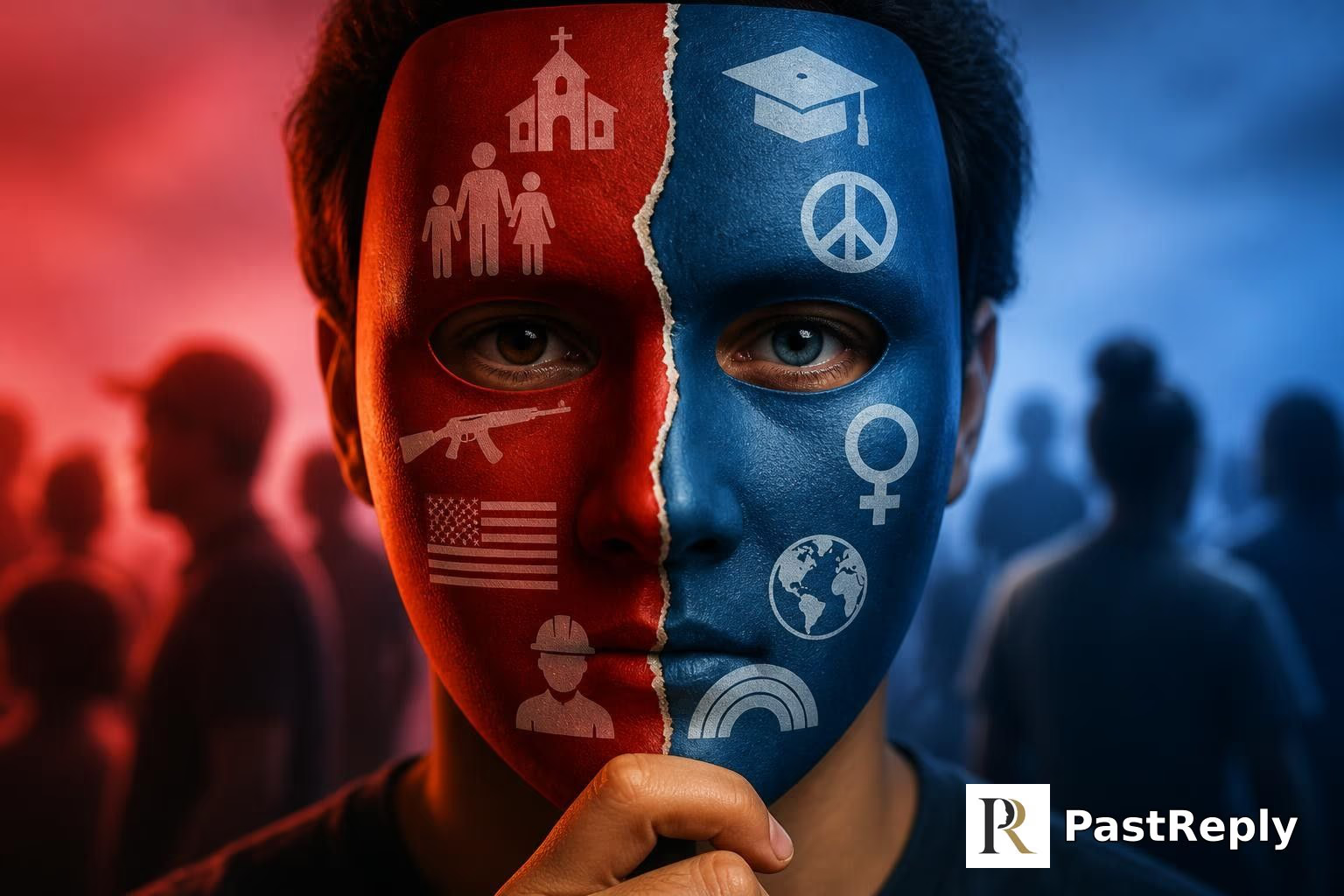
The facts
Politics became our identity through a process of social sorting, where partisan affiliations increasingly align with other social identities like race, religion, and cultural preferences. This alignment has strengthened group identifications, making political affiliation a core part of personal identity. As a result, individuals live, work, and socialize primarily with those who share their political views, reinforcing partisan identities and deepening social and political polarization. This shift has changed how people think and feel about themselves and their political opponents, often leading to biased judgments and a reduced ability to evaluate objective reality fairly.
Answered by 100 of history's most famous minds

You have traded the seamless robe of the Father for a threadbare garment stitched from banners and slogans. The lamp of the body is the eye; if your eye sees only a tribe, your whole body is full of darkness. Why do you bind yourselves with the labels of men when the Kingdom is as wide as the rain that falls on the just and the unjust alike? A house divided against a signpost cannot stand.

You have taken the bonds of clan and tribe, which the Lord of the Worlds broke with the call of 'There is no god but God,' and forged them anew from ink and opinion. The Believer is known by his fear of God and his good deed, not by the emblem he carries or the speaker he follows. Have you forgotten that on the Day of Judgment, no banner will avail, only the balance of hearts?

You cling to the banner of 'mine' and 'not mine,' and that grasping is itself the wound you seek to heal. The identity you so fiercely guard is a raft lashed together on the river; it helps you cross, but if you hoist it on your shoulders and call it home, you will never reach the other shore. Let go of the label - Tribe, King, Party - and see, for the first time, the face of the one who sits beside you.

The Lord your God is one God, and you shall have no other gods before Him. Yet you have carved for yourselves idols of party and faction, and bowed down to them. You have forgotten the covenant written on stone - that you were slaves in Egypt, and the stranger, the orphan, and the widow are your kin. Your political badge is a golden calf, and you dance around it while the true law lies broken at your feet.

When a man polishes only his political badge and neglects the rectification of his own heart, his household falls into discord, and the state follows. The superior person does not mistake a faction for the Way: he cultivates ren in his family first, then his village, then the kingdom. Let them ask not 'What is my tribe?' but 'Have I been filial today? Have I been true in my dealings?' There lies the root of identity.

You have made a new law for yourselves, a law written not on stone but on the walls of your heart, dividing brother from brother. But I tell you, there is neither Jew nor Greek, slave nor free - why then this new tribe of 'red' and 'blue'? You have exchanged the unity of the Spirit for a quarrel over the things that perish.

I left my father's house, my kin, my country - all I knew - for a voice that spoke of a people yet to be. And I was called a friend of God. But these folk? They weave their tents from the cloth of argument, and call it home. They have forgotten that a covenant is not a banner to wave, but a burden to carry for strangers.

The great tree spreads its roots unseen - yet the ax does not ask the branch for its name. When a man carves a name into his own heart, he builds a fence against the rain. The sage has no tribe; he flows like water around every stone. The more you cling to 'us,' the more 'them' grows - and the world becomes a cage of your own making.

The One Name is written on every leaf and every breath - yet men carve a thousand names into stone and call each one a god. They ask, 'Are you one of us?' before they ask, 'Are you hungry?' The True Guru says: there is no Hindu, no Muslim, no red or blue banner. The heart that beats for the One beats for all. Why would you wear a mask that hides the face of the Beloved?

He has scattered the proud in the imagination of their hearts, and exalted those of low degree. When a man clings to a faction as to a mother, he forgets that every tribe is but a branch on the vine of the Lord. My soul magnifies not a party, but the One who lifts the hungry and sends the rich empty away. Let your first allegiance be to mercy, not to a banner.

This is the very snare of the Devil! When a man's soul is bound to a prince's party rather than to Christ's Word, he has traded the freedom of the Gospel for a golden cage. I have seen it happen: a man first doubts the Pope, then his own pastor, then his brother - and finally he clings to a faction as to a broken reed, afraid to stand alone before God. Faith alone saves; a party of men, never. Let every soul be a priest, not a partisan!

Every man seeks the good by nature, but the intellect can err in its reasoning. When a man's political allegiance becomes his primary identity, he has subordinated the rational appetite for the true and the good to a particular, fallible human institution. The will then clings to that institution as to a first principle, rather than to God. A distinction must be made: one may hold a political opinion as a matter of prudence, but the soul's identity belongs to the Creator, not to Caesar's party.

I have seen a man dying in the gutter, his body covered with sores, and the people passed by because he wore the wrong colour of cloth on his head. They did not see the man - they saw the label. And I thought: how small a thing we make of the soul, when we wrap it in a flag and then worship the flag. In Kalighat, I learned that the dying man does not ask whether you voted for the same party; he asks only for a cup of water and a hand to hold. Politics is a loud noise that drowns out the whisper of the one who needs you.

The mind cleaves to a hypothesis as to a fixed star, mistaking a model of the heavens for the heavens themselves. I observe that your political Categories have become primary Qualities, as if a man's essence were defined by his relation to the Privy Council rather than by his place in the Order of Creation. This is a confusion of the Frame with the Picture: you have mistaken the map of opinions for the terrain of the soul.

When I consider the equations of the field, I see that a mass bends the space around it, and then that curved space tells the mass how to move. So too, a man's tribe - be it faith, kin, or party - warps his perception, and that bent vision then pulls him deeper into the tribe. The tragedy is that honest observation becomes impossible; we no longer see the stone that drops, only the stone that our loyalty demands we see.

In the Galápagos, I noticed that finches on one island had beaks fitted to that island's seeds, and they would not cross the water to the next cove, even when the seed was sweeter there. So it is with men and their opinions: each generation inherits a beak honed by its own small world, and when they meet a bird from another shore, they do not mate - they peck. The divergence is not malice, but deep adaptation to a local truth that has become the only truth they know.

You observe the motions of the celestial spheres, but you interpret them through the prism of your own passions. I say: measure the angles, record the positions, let the numbers speak. Your politics is a pseudo-Ptolemaic system - you add epicycle upon epicycle of identity and grievance to save the appearances of your prejudices. Strip away the ornament, and the truth of the sun is indifferent to your faction.

They have placed man, not the sun, at the center of their political cosmos, and every faction spins its own epicycles of grievance around that fixed delusion. But the true order - whether of the heavens or of a commonwealth - is simple, harmonious, and moves by fixed laws discoverable through reason. When each citizen mistakes his own orbit for the whole firmament, the celestial music of the spheres becomes a cacophony of lone, squabbling voices.

The human mind is a great dynamo, yet you have wired it to a small, noisy machine that hums only in two frequencies. You identify not by the spark of creation, but by the socket you plug into. It is a waste of the invisible, boundless energy that could light the world - if you would only disconnect from the petty current.

In the laboratory, radium does not ask whether you are a Frenchwoman or a Pole. It decays at the same rate, emits the same rays. We have let an accidental division - the politics of a moment - color our perception as reliably as a collimator. That is not a triumph of reason; it is a failure of method.

I observe a strange contagion - a fever that spreads not through a breath or a bite, but through a word whispered in the ear. Let me isolate the agent: a man hears the opinion of his father, and his father's father, and the priest of his parish, and the men who drink at his inn - and soon the very air he breathes is thick with invisible spores. The remedy? The same as for any epidemic: expose the cause to the light of reason, repeat the experiment, and inoculate the mind against the first sneeze of partisanship.

Look, you don't build a better lamp by arguing about the shape of the wick. You try a thousand filaments until one glows steady. People treat politics like a religion - they pick their team and stop thinking. I never had time for that. If somebody's idea works, I'll use it. If it doesn't, I toss it. That's all. The trouble is they've forgotten that a label is just a label - and the light comes from the experiment, not from the name on the patent.

The problem reduces to a classification game: each person is assigned a label - say, Red or Blue - and then the world is searched for confirmatory evidence, much like a machine sorting punched cards. The initial choice may be arbitrary, but feedback loops strengthen the category until the label becomes indistinguishable from the thing itself. Of course, if the input data were scrambled, the same mechanism would produce equally rigid identities; the real puzzle is why any initial partition holds so stubbornly.

Give me a lever long enough and a fulcrum on which to place it, and I will move the world - but first I must know the weight of the load. This is a matter of proportions: the more a man invests his self in a single label, the greater the force required to shift his opinion. If he has filled his circle with none but those of his own kind, the center of gravity moves, and the lever becomes useless. Before you can reason with him, you must give him a new place to stand.

When you pass a magnet over iron filings, the filings do not scatter at random - they align themselves along invisible lines of force, each particle drawn into a pattern that the field imposes on the whole heap. So it is with the human creature: a strong current of opinion, repeated day after day, pulls the soul into a fixed orientation, until the man no longer knows which way he points by choice and which by induction. I have seen a needle, once magnetized, forever tremble toward the pole - it forgets it ever swung free.

A man who insists that his party badge is not a garment but his very skin - that is a man who has buried something in the cellar of his mind and now stands guard over the trapdoor lest it climb out. The ferocity with which he defends his political tribe, the hatred he heaps upon the other tribe, the way he rearranges every fact to fit the family myth - these are the very signs of a repressed conflict seeking a distant enemy to bear its weight. The question is not how politics became identity; it is what unbearable truth about himself the partisan is so busy fleeing.

Consider that your political affiliation now predicts more about your social circle, your choice of neighborhood, even your taste in music than your income or your education. That is a signal that the human mind has discovered a new shorthand: instead of computing the merits of each policy from first principles, it has outsourced the entire calculation to a team badge. From a cosmic perspective, it is a remarkably inefficient use of a brain that evolved to track predators on the savannah. We should be solving the problem of our planet's overheating, not fighting a tribal war over which shade of grey to paint the lifeboat.

The Analytical Engine does not care whether the numbers it weaves represent the trajectory of a cannonball or the price of a loaf of bread - it simply follows the rules encoded in the cards. What you describe is a similar operation: the human mind has learned to feed its political allegiance into the machine of daily life, and the machine now outputs not only a vote but a whole universe of preferences: which news to believe, which neighbor to trust, which song to hate. The danger is not that the machine runs - it is that the human operator has forgotten he wrote the program, and now imagines the cards are God.

Let us define terms. By 'politics' I understand the art of governing the polis, a practical matter of decree and persuasion. By 'identity' I understand that which makes a thing what it is - its essence. To say that an accidental attribute of opinion has become the essence of a man is to commit a category error as gross as confusing a triangle with its colour. A triangle is a triangle regardless of whether it is drawn in red chalk or black. A man who believes his politics are his identity is a geometer who mistakes the ink for the proof.

I have seen this sickness before - not in politics, but in the filth of a barracks hospital where men clung to the miasma of their own habits and died for it. When a person seals themselves in a ward of like-minded sufferers, breathing only the air of their own faction, the fever of partisanship becomes chronic. The cure is no different: let in the light of contrary data, scrub away the comfortable assumptions, and show them the hard rose-diagram of reality.

I forged an empire from Macedon to the Indus by mixing the blood of my Companions with the satraps of Persia, yet you sow division with a ballot and call it a banner. A man who wraps himself in a faction as in a chlamys has never faced a phalanx and learned that the only tribe worth dying for is the one that charges beside you. Cease your petty contests and conquer something worthy of your steel.

I conquered Gaul not by asking each helmet what name he whispered to his household gods, but by making them all swear to Rome's eagle. When a man's private devotion - to his municipium, his clan, his freedmen - outweighs his oath to the Republic, you get a senate of faction and a forum of daggers. A wise commander knows: divide the loyalties, then give them one standard to follow.

You Alexandrians and Romans - always chasing new gods for your loyalties. In my court, a man's devotion to Egypt was measured by the grain he brought to the royal granaries, not by the faction he cheered in the Forum. Politics becomes identity only when the State fails to fill the belly and the soul; give a people a full treasury and a living goddess, and they have no need to paint themselves with the colors of a party.

I restored the Republic by appearing to honor its forms while commanding its legions. You, however, have abandoned even the pretense of a common weal. A Roman once asked, 'What is best for the res publica?' Now you ask only, 'What is best for my faction?' That path leads to proscription and civil war. Remember Marcellus: the man who loves his party more than his country will soon have no country.

A man who ties his worth to a whip or a bow he never made is a fool. Under the Eternal Blue Sky, I united tribes by loyalty, not by birth - a shepherd could become a general if he proved true. But these people chain themselves to a word, a color, a banner, and call it soul. They have forgotten that a clan is only as strong as its warriors' deeds, not its chieftain's name.

A soldier without a flag is a wanderer; a nation without a cause is a mob. But you have turned the flag itself into a quarrel. You wear your faction as if it were a medal, when it is no more than a uniform. I gave France a code of law, a unity of purpose - not a brawl over who wears which cockade. Power is not a hobby; it is a tool of order.

I warned against the spirit of party as the baleful instrument of faction - fit to distract the councils of a nation and enflame its passions. Yet here we are, each man wearing his political creed as a uniform, more attached to its color than to the Constitution that shelters us all. This is not liberty; it is a new kind of servitude.

I have seen men stand on a stump and call it a principle when it was merely a prejudice warmed over. The trouble is that a house divided cannot stand - but nowadays a man divides his own heart before he ever crosses a neighbor's threshold. He looks into the well and sees only his own reflection, then mistakes it for the face of his country. We used to say 'we the people' as one breath; now each man hoards his own gasp and calls it liberty.

When men forget what they are fighting for, they begin to fight for the sheer shape of the quarrel. I have seen a nation rise against the blackest tyranny, united by a common love of freedom - and in the peace that followed, they turned that love into a list of grudges. Politics becomes identity when the enemy is no longer a foreign foe but the man next door who reads a different newspaper. It is a luxury of the secure, a disease of the comfortable.

Ah, then politics has become a new form of untouchability - a badge worn not on the sleeve but on the soul. When a man's party becomes his caste, he has abandoned the search for truth for the comfort of a herd. The only identity worth nurturing is that of a seeker after Truth, and Truth has no party. Let each one examine his own heart: do you love your label more than your neighbour who thinks differently? If so, you have made an idol of a voting slip.

When a man's party becomes his tribe, he forgets that we are all children of the same God, bound in a single garment of destiny. I have seen a segregation of the soul as cruel as any Jim Crow car - where a man's identity is reduced to a voting bloc, and his neighbor becomes a stranger. But the arc of the moral universe is long, and it bends toward community, not toward a two-party prison. Let us refuse to let any political label define the content of our character.

In the courtyard of Robben Island, we broke stones into gravel day after day. At first, the warders told us which pile was ours by the colour of our skin. But soon we learned that a man could carry a stone from any heap, and the stone itself did not know its origin. Yet the habit of looking at the pile first, and the man second, clung to us even after the gate opened. That is what has happened here: you have been given a badge before you have chosen a trade, and then the badge tells you who to marry, what to pray, and where to buy your bread.

This is what we understood and they never will: a people without a banner is a herd without a shepherd. We gave the German not merely a party card but a blood-sign, a destiny written in the soil and the skull. When a man knows that his politics are his ancestry, his religion, his very marrow, he will die for them - and he will kill for them. The weak nations prattle about choice and reason; the strong nation knows that identity is not chosen but compelled by nature and by struggle. They ask how it happened? It happened because we willed it, and they were too soft to resist.

They ask how politics became identity? I will tell you. It is simple. A man who has no party is a loose gear; he may roll anywhere, think anything, betray everything. But give him a card, a uniform, a name for his enemy, and he is fixed. He marches. He denounces. He becomes a bolt in a machine that does not stop. The West whines about 'polarization' as if it were a disease. It is not a disease - it is the condition of strength. When every man's soul is stamped with the party mark, no man can hide. And when no man can hide, the state can see everything.

This is precisely the achievement for which we fought: to make politics not a coat one puts on for an hour at the polling station, but the very air one breathes, the water one drinks, the roof under which one sleeps. The bourgeois complains that politics has invaded his private life - good! That invasion is the victory of the revolution. When a man's choice of friends, of books, of marriage is determined by his class allegiance, then the revolution lives in his bones. The question is not how it happened, but why the West pretends it is surprised. You sowed the wind of false consciousness; now you reap the whirlwind of real identity.

When the landlord's name was the child's first word, and the temple bell called the village to prayer, then the Party's red flag flutters in every courtyard and the peasant's loyalty shifts - that is class struggle made flesh. You ask how politics becomes identity? A man must choose his clan, and in our age, the clan is revolution itself.

In my youth, a gentleman's politics were a private matter, like his tailor or his brandy - one did not wear them upon one's sleeve in mixed company. But now, it seems, people mistake the banner of their party for the very fabric of their soul. It is a coarse and immodest fashion, and it breeds a most unseemly sort of zeal that does not become the dignity of a Christian nation.

One learns, over many years, that the crown must never be seen to lean. Yet I observe that many now clothe themselves in political colours as if stitching their very name into a faction's coat. It is perhaps a search for belonging, but I have always found that true service wears no party badge - only the quiet determination to do one's duty for all the people, not just those who cheer one's own name.

When a man's first loyalty is to his liege lord and his last to God, then a kingdom stands. But when men swear fealty to a faction as if it were a tribe, and call that their faith, they fracture the unity Christ commanded. I spent my life binding Saxons and Franks under one cross and one law; this new tribalism is but a return to the petty strife of pagan times.

They asked me in my trial: was I of the Armagnac party or the Burgundian? I answered only that I was of God's party, and that party was France. These labels men cling to like badges of honour are but dust before heaven's judgment. A girl who hears her saints does not ask her captain's opinion before she charges the English lines.

I have seen the zealot who would burn a heretic for a syllable of prayer, and the Puritan who would tear down an altar for a rood-screen too richly carved. Both make a cage of their creed and call it home. A wise prince knows that men's souls are not so easily sorted as a merchant's ledgers, and that the best government is the one that asks only obedience in law, not in heart.

In my salon, the philosophers argued for reason and the generals for conquest, and I listened to both with equal appetite. But I never mistook a conversation for a uniform. These modern people who dress their whole being in a political colour remind me of the courtiers who wore so many ribbons they could not bend at the waist - ornamental, but quite useless for ruling.

When I entered Babylon, I did not ask a man's god before I gave him justice. The tribes of the empire may keep their own rites and customs so long as they keep the king's peace. This new fashion of branding a man by his faction alone is a narrow thing - it would make the world into one small tribe, and rob the king of the wisdom of many peoples.

I have ridden against Franks who called me infidel and against fellow Muslims who called me usurper, but I judged each man by his word and his steel, not by the name of his camp. A man's faith is between him and Allah; his identity is written in his honor and his mercy, not in the banner he carries. To make a tribe of mere opinion is to forget that we all stand under the same sky.

So you have bound your soul to a banner and call that living? Tell me, friend: when you strip away that label, what remains of you? Is the good defined by the company you keep at the assembly, or by the shape of your own virtue? If a man is nothing but his tribe, then he has never truly examined either.

You speak of identity as though it were a thing shaped by the drift of the crowd, but a man who mistakes the flickering shadows on the cave wall for the true forms has no stable self at all. Justice in the soul is each part doing its own work, ruled by reason; justice in the city is the same. To let a mere party emblem stand for the Good is to chain yourself to the fire and call the dark your home.

The polis was once the sphere of deliberating about the common good - an activity proper to man as a political animal. But when affection for one's own tribe overshadows reasoned judgment about what is truly just or beneficial, the citizen degenerates into a mere partisan. You have mistaken the shadow on the cave wall - the badge of faction - for the sunlight of the good life.

Observe how these men have made a fetish of their contingent opinions, binding them into the very sinews of selfhood, so that to doubt a party plank is to feel annihilated. Yet the moral law demands we act from duty, not from the whim of a faction: one must ask, 'Can I will that this partisan allegiance become a universal law for all rational beings?' The answer, clear as a starry sky, is no - for such a maxim treats man as a mere means to a tribal end, not as an end in himself.

They have traded the burden of creating themselves - the dread and the dance of the Übermensch - for a cheap, ready-made vestment stitched by the herd. This 'political identity' is the last whimper of the slavish mind, a comfortable dungeon where one can hate the neighbor and call it virtue. Break the tablet! Become the one who says 'I am not a Democrat or a Republican; I am a hammer.'

You imagine you have chosen your identity freely, like a hat from a shop. But the shop is owned by the same master, and the hats are made of the same cloth: the interests of capital, the division of the working class against itself. You are not identifying; you are being sorted. You fight over the label on the cage, while the gate remains locked.

I doubt everything, even the self that doubts. But I have never doubted that a man may think clearly and arrive at truth. Now I see men who have handed over their thinking to a label, as if a tribe could reason for them. They have mistaken opinion for essence. That is not identity; it is the abdication of the thinking substance.

Men are quick to call a preference a virtue. They wrap their interest in a banner and mistake the cloth for the soul. A prince knows that the sharpest weapon is not steel but the sign a man pins to his chest - for with it he divides the city into friends and enemies, and then the friends will die for the sign, never asking who holds the other end of the flagpole. This is how a clever ruler keeps a hundred men guarding a post while he moves the treasure.

It is a tale told by a faction, full of sound and fury, signifying - a tribe. We are but players who have strutted and fretted our hour upon the stage, yet now we mistake the costume for the man, the mask for the face. The world is a stage, but you have made it a battlefield of banners, forgetting that the fool and the king wear the same flesh beneath their motley.

As when on the wine-dark sea a man whose father was of one island and whose mother of another finds himself blown between two shores, each claiming his oar - so now the sons of men fix their helmets with the crest of a faction, not the honor of their house. Before the walls of windy Ilium, we knew friend from foe by the shield they carried and the god they called upon. Now a man's own brother may sit across the fire, their hearth-gods sundered by a name.

I have seen the souls of the wrathful tearing each other in the muddy marsh of Styx, and I have seen the schismatics, their bodies cleft asunder, dragging their own entrails through the flames of the eighth circle. When men love their own opinion more than truth, and their party more than justice, they build a hell on earth. You trade the unity of God's city for the badge of a faction, and call that freedom.

They have turned the polis into a mirror, mistaking their reflection for the whole world, and now each man walks arm-in-arm with a phantom of himself. The true soul, however, is not a monochrome banner but a living forest of many-hued growths, ever striving toward light. Let them learn from Faust: it is in the restless, many-sided striving - the union of thought and deed, of heaven and earth - that the human spirit finds its fullest form, not in the narrow ditch of a single creed.

A man pins his soul to a windmill, calls the creaking a dragon's roar, and will fight anyone who says it is but a mill. We have all become Quixotes, I fear - but without his grace, his gentle madness. We no longer tilt at windmills; we become them, grinding the grain of our own making into a flour that separates us.

You have made a graven image of a passing opinion, and you bow before it, calling it your soul. But the soul is not a banner. It is a quiet, inward fire that asks only one thing: how to love your neighbor. You have forgotten your neighbor in the noise of your tribe. Turn from this idol, and find the person in front of you.

You ask how politics became the soul's brand? Because man cannot endure emptiness. When faith grows cold, when the cathedral is replaced by the committee, the heart must bow to something. So they worship at the altar of the faction, and call it self. But I tell you: the devil grins in that mummer's robe. Only love - suffering, terrible, Christian love - can cast out this demon.

A young lady of sense knows better than to wear her heart upon her sleeve for daws to peck at; yet I observe a whole generation that has embroidered its convictions into its gown and parades them at every assembly. They mistake a set of opinions, hastily adopted and stiffly defended, for the whole of a character. It is as if Darcy and Wickham were judged not by their actions but by the color of their coat - and every ball became a battlefield.

Ah! It's as if the whole nation has been packed into one of those newfangled railway carriages - only instead of heading to London, every soul is crammed into a single station labeled Whig or Tory, and woe betide the man who dares alight at a different platform. I've seen it in the workhouse and the counting-house: a man's politics is now his coat, his pew, his very pint at the public-house. The poor soul who once judged his neighbour by the charity in his heart now judges him by the colour of his ribbon - and calls it identity!

It's because a man's politics now tells you which loaf of bread he buttered that morning, or which book he hides under the mattress. I've known a Democrat and a Republican to be as alike as two peas in a pod - until you tell them there's only one pea left. Then by thunder, they'll argue till Judgment Day which pod it belongs to. The label has become a suit of armor, and the poor soul inside has forgotten he ever had a skin.

A man spends his life learning what he is, and then someone hands him a label that says he is something else. He pins it on and the label sticks, and soon the label is what he fights for, not the true thing inside. It is a sloppy way to live. A man should know what he believes because he has tested it, not because his father or his street told him. Otherwise he is just a flag on a pole, turning in any wind that blows.

I have studied the anatomy of the human form, the flow of water, the flight of birds - each yields a pattern of motion and relation. What I observe in your politics is a kind of binding: the mind clings to a single hue as to a master color, losing the infinite shades of the sky. The eye that sees only one note cannot hear the harmony of the whole.

I have chiseled a hundred figures from the marble, and each one was already perfect within the stone - I but freed it from the waste. But these men! They take a living soul, still rough from the Creator's hand, and with the hammer of opinion they knock away its truth, trying to make it fit a shape of their own choosing. They do not liberate; they mutilate, and call the broken remnant their 'self.'

I have seen men paint their souls onto a canvas with the colors of their convictions - a deep, burning yellow against a violet sky. But when the brush is dipped only in the pigment of politics, the picture becomes a flat poster, shouting slogans instead of whispering the truth of the human heart. We must peer through the thickest grime of division to see the eternal light in the other's eyes.

Politics as identity? Bah! It is a kind of academic painting, a stale portrait in brown tones that never breaks the frame. True identity is like a Cubist face: you must shatter the old profile, smash the single viewpoint, and reassemble the pieces so the eye sees a dozen angles at once. Let them wear their red or blue labels; I would rather paint a bull that is both a man and a beast, a sword and a tear.

I spent a lifetime watching how light changes the same haystack, the same cathedral - and how it changes is everything. But these people? They paint their politics with one rigid color, one fixed hour, and call it truth. They have forgotten that the world is not a flag to be planted, but a mist to be observed, shifting with every cloud.

I have painted men at prayer and women bent over a crust of bread. In the furrow of a brow, the turn of a lip, you read a man's soul - not his banner. But now they wear their faction like a starched ruff, so stiff it hides the pulse beneath. The face becomes a mask, and I find no light in it.

They say I paint my own reality. For thirty years I bled my broken spine, my dead children, my love for Diego onto canvas. Not once did I paint a ballot box. But now everyone wears their politics like a Tehuana dress - bright, stiff, hiding the raw flesh underneath. I will not be stitched into that costume. I am the wound, not the flag.

You have set your tenor arioso and your basso buffo in separate opera houses and call it harmony! In my final symphony, I wove a Turkish march into a Viennese feast, yet you cannot let a flute and a drum sit side by side without taking sides. If you must make music of your quarrels, at least let the melody dance - politics should never be a drone on one string.

I have written a symphony - the Eroica - that was meant for a great man, but when he crowned himself emperor, I tore the dedication from the score. A man must be free, or his music is a lie. You ask why politics becomes identity? Because cowards cannot bear the silence of their own soul, so they march to the drum of the crowd. But I tell you: the hero's struggle is alone, against the fate that deafens him, and his triumph is his own.

A fugue has one subject, yet the voices enter at different times, each in its own key, weaving a harmony that resolves to the glory of God. But your modern song gives each voice the same theme of anger and calls it 'identity.' No true counterpoint can be built on a single note of strife; the dissonance must be resolved by the master's hand, not by shouting the loudest.

Well now, I think folks just got to feelin' like they belong to somethin', like a big ol' family rallyin' round a flag or a tune. Back home, we sang together in church, black and white, rich and poor, and that harmony was the real identity - not a label you put on like a hat. But when you start judgin' a man by his politics before you know his heart, you're missin' the gospel, plain and simple.

I always believed music could heal the world, make us see each other as one tribe under the moon. But now people have traded the rhythm of the heart for the noise of a label. They've forgotten how to dance together - they just point and shout. We need to start the song over, from the first beat of love.

Back in the Cavern we just played, and nobody asked who you voted for. Now it's like everyone's got a label stuck on, and you're supposed to choose your friends by it. All you need is love, yeah? But someone forgot that tune. Maybe if we all hummed a bit longer, we'd remember.

You walk into a room and they hand you a flag before you sit down. I never wanted to carry anybody's flag. I've seen men die for a song they thought was theirs - then the next morning they're lining up to shoot at shadows. Politics is the price you pay for the shape of your hat. Nobody asks you who you are; they tell you which side of the river you're on.

I used to think if I just kept my head down and wrote my songs, I could stay out of it - but you can't. They hand you a label whether you ask for one or not. I've had people tell me I belong to them, that my voice is their weapon. But here's the thing: I get to write my own story. You can't let someone else's flag become your skin. Wear your own colors, even if they change with the seasons.

I sailed westward into a sea of monsters and maps that said there were none, and I found a world beyond the imaginings of all the courts of Europe. Yet you, in your safety, shrink your world to the circle of a single opinion and call that exploration. A man who will not set sail beyond the coast of his own conviction is no discoverer, but a prisoner of a small land.

On the high passes of the Pamirs, I met men who wore the sign of a crescent on their banner and others who carried a cross, yet they traded side by side at the caravanserai, haggling over silk and jade as brothers. Now, it seems, a man's first question is not 'What wares do you bring?' but 'What flag flies in your heart?' In Cambaluc, the Great Khan cared only whether a man was useful. That is the wisdom of a true ruler - not the stamp of his birth, but the work of his hands.

When a storm scatters the fleet, each ship steers for its own star, forgetting the flagship's lantern. That is your politics - each man fixes his eye on his own little port of resentment and loses the bearing of the whole voyage. A crew that cannot trust the pilot's chart will never round the Cape; a people that cannot agree on the pole star will drift until they dash upon the rocks.

From the Moon, there are no party lines - only a single, fragile sphere against the black. We spent years together, engineers and scientists from every background, focused on a shared objective that demanded precision and trust. Identity built on a team's mission, on solving real problems hand in hand, is sturdy. But when a label becomes a lens that distorts what you see, you lose the ability to navigate by the true stars.

When I flew, I left the maps of men below. Up there, there are no territories, no parties - only the sky and the stars. It seems some have traded the horizon for a fence, and call that fence home. The only identity worth having is the one you earn by pushing beyond the lines others draw for you.

When I looked down from the Vostok, there were no borders, no parties - just one blue pearl, whole and fragile. Up there, you don't ask what tribe a man belongs to; you're just grateful he's in the same ship. Down here, we've built walls inside our own heads. That's a smaller orbit than any I've known.

You've taken a system - an operating system for society - and glued your identity to it. That's like naming your soul after a piece of software. The artists and engineers who changed the world didn't ask which tribe to join; they asked what could be made. Strip away the bumper sticker and build something insanely great - your identity should be your work, not your vote.

It's like a firmware update got corrupted. When you treat political alignment as a core part of your identity instead of a set of policies to optimize for, your brain's Bayesian priors get locked. You stop updating based on new evidence - you're just defending your own self-narrative. That's a terrible bug for a species trying to survive climate change and get to Mars. We need to decouple tribe from policy, or we won't fix the rocket before the storm hits.

You start saying 'I am a Democrat' or 'I am a Republican' the same way you used to say 'I am a daughter of the South' or 'I am a child of God.' Somewhere along the way, we let the label swallow the whole soul. But your true identity is the one you discover in the quiet hours when no one is watching - who you are when the red and blue are stripped away, and only your heart speaks.

They call me the Greatest, and I tell you, I didn't need a party to know who I was. I stood alone against the draft, against the man, because my conscience is my own - not a hand-me-down from no crowd. Politics ain't your skin; it's a shirt you can change. But when folks make it their whole identity, they forget to float like a butterfly, sting like a bee, and think for themselves. That's the real championship.

On the field, my shirt was yellow and green, but the ball knew no color. When I passed to a teammate, I did not ask what he believed - only that he was there. Today, it seems people have forgotten the pass. They hoard the ball and call it their own. But the beautiful game was never played alone.

You know, when I started with a mouse, nobody asked if Mickey was a Republican or a Democrat. He was just a little fella trying to make his way. Now people want every story to have a party pin on its lapel. But wonder doesn't pick sides. The magic that lights up a child's eyes - that's the only true identity.