
How did country music start?
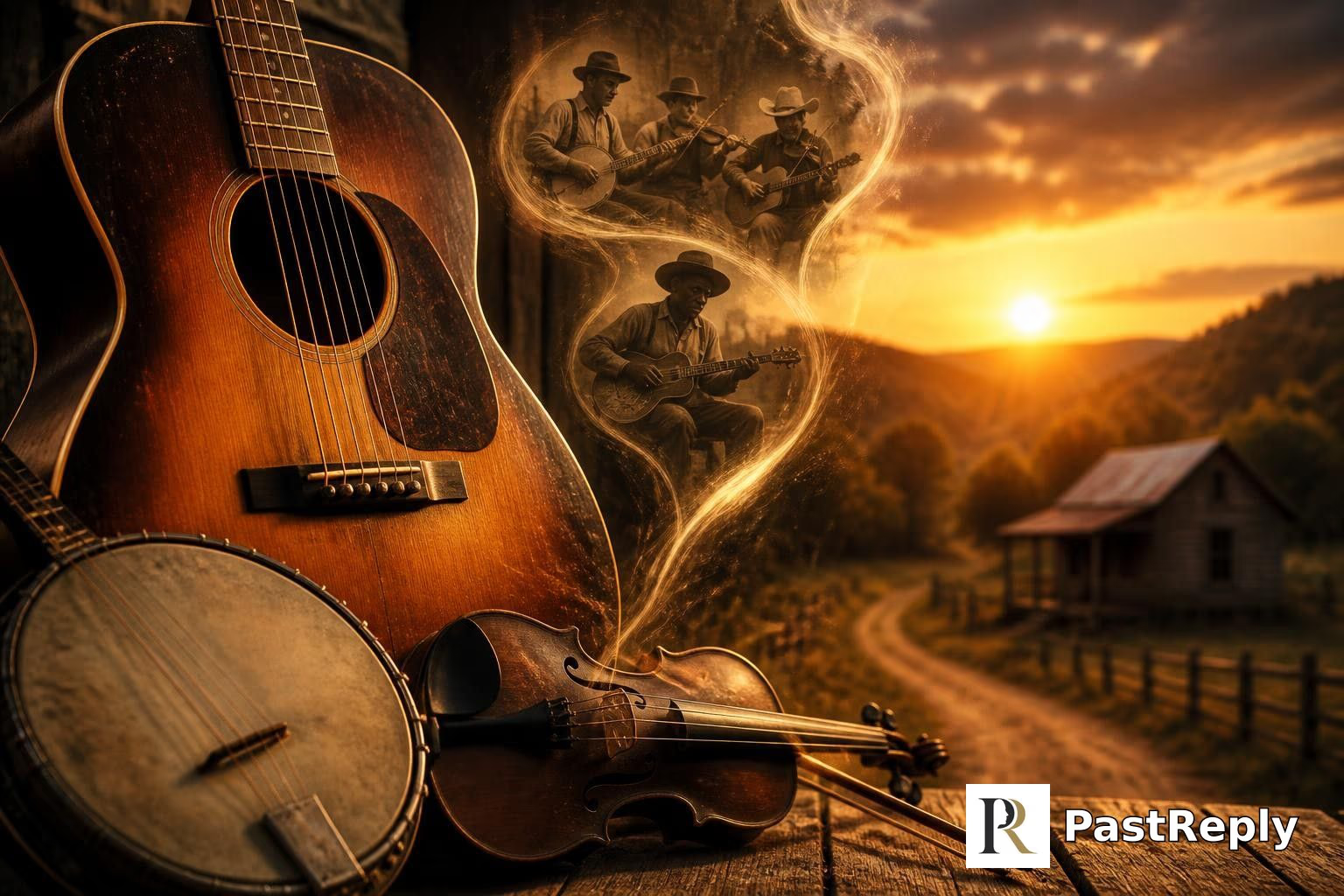
Country music began in the early 20th-century rural South, blending Appalachian folk, blues, and bluegrass traditions.
The facts
Country music originated in the rural Southern United States in the early 20th century, evolving from a blend of folk, blues, and bluegrass traditions. Its roots lie in Appalachian folk music, brought by European immigrants, and African American blues, along with influences from gospel and other styles. The genre emerged as a distinct commercial category in the 1920s, with early recordings often labeled 'hillbilly music.' Over time, it developed into a diverse genre with many regional styles and subgenres.
Answered by 100 of history's most famous minds

A man walks out at evening to the edge of the field and sings the day's labor back to the one who gave it - he does not ask whether it be Greek or barbarian. The proud pass by that song, but the Kingdom is like a mustard seed hid in the ground, and the poor and the mourning know its harvest long before the rich. Do not fret over who owns the music; ask instead who will sit at the table when the last are first.

The tribes of the desert each had their own camel-song, yet in the caravan they must learn to ride together - the melody telling of the road and the load borne is no new invention. So long as a man's song bears witness to the One who created the ear, it is a highway of praise, though the tongue be rough. But let no man sell a lament to another for profit while the orphan is left with no bread; the song and the deed will be weighed together on the Day.

You ask where the song began, but the more useful question is why it is sung at all. Hear the note that bends and grieves - it is the sound of craving, of a heart that clings to what passes and aches when it slips away. The music itself is neither noble nor base; it is a finger pointing at the truth of impermanence, and one who listens with right mindfulness may find in a single wailing string the whole of the Eightfold Path. But most will only dance and forget, and that too is their road.

Before the mountain smoked, the people sang in a strange tongue; but at the mountain they were given words and a voice together. A song born of hardship and wandering is a covenant remembered - as the years in the wilderness were remembered at the Passover table. Let the covenant be honored: the song shall not make a man forget the widow, the stranger, and the command to deal justly.

A song that mourns, a song that laughs, a song that remembers the ancestors - these are the threads of li that bind the living to the dead. When the family gathers and the old airs are played, the young learn the shape of their duty without a single lecture. Let the music be sincere above all: a faithless tune, however pretty, withers like a branch cut from the root.

You ask of a song, but I tell you of a mystery: whether it is a slave's spiritual or a Scotch-Irish lament, the groaning of creation waits for the revealing. There is neither Jew nor Gentile, neither highland nor lowland, in the true fellowship - only the melody of a people longing for home they have never seen. Do not let the labels divide the body; the Lord does not care for your 'hillbilly,' He cares for the heart that sings.

My tents were pitched on a land not my own, and my sons sang as they watered the flocks. A song is a covenant too - you carry it out of one country and it stays with your children in the next, even when the words weary and the strings snap. These hill-people did what Abram did: they left the familiar, kept a melody in their mouths, and a blessing came out of it for strangers they would never meet. Let them sing; the promise outlives the singer.

Before the word 'country' was ever stitched onto it, the sound was already flowing like water downhill from the hills - mountain fiddle, the moan of a work chant, the low hum of devotion, all braiding together the way a river never asks which spring owns it. You cannot name a thing into being; you can only notice it was always there, and stand aside while it moves. The one who names and sells it will find the song has already changed shape in the next hollow.

Look not at the coin or the label, but at the two who sit at the same fire - the plowman with his fiddle, the laborer with his song of sorrow - both breath of the One who made them, both equal before Him. What men call by a new name was already one song beneath the many tongues. Where the tune is sung with a true heart, God is in the room; where it is sold for pride, the room is empty.

When I carried the Child to the hill-country, I sang of a God who lifts the lowly. That song - wrested from sorrow and hope - echoes still on the wind of the mountains. The hungry are fed and the proud scattered; the music of the poor belongs to the One who remembers them.

Why do you seek a new music when the old songs are buried under the strange tongues of Rome? Let the people sing plain words in their own speech, as I gave them the Scripture in German, not in a tongue they cannot understand. A fiddle and a psalm are no sin, so long as they are sung by faith alone, and not to purchase a place in heaven.

I know nothing of the stages and the silver horns, and I need nothing of them. But I have heard the poor singing at their work, one voice answering another across the lanes, and it is the same small song everywhere - a lullaby for a child, a hymn for a hard day. Do not worry how a music began, or what name it is given. Sing it to the lonely, sing it to the dying; one tune carried with great love is worth more than a thousand sung to a crowd.

You speak of hillbilly lament and gospel shout as though they were separate streams, yet they flow from one source: the human heart crying out against the silence of vast spaces. I have spent my life seeking the simple law beneath the tangled appearances, and here it is - a lonely fiddler in a Kentucky hollow and a psalm-singer in a Carolina church are but two vibrations of the same string, a single melody the universe has been humming since first it had ears to hear it. The elegance is not in the categories men invent, but in the unity they so often fail to perceive.

I have spent decades cataloguing the small variations in the beaks of finches and the petals of orchids, and I find in this music the same principle at work: descent with modification. A ballad carried from the Scottish border, a field holler from the plantation, a hymn from the revival tent - each is a parent form, and under the pressures of a new land and a hard life, they have thrown off countless offspring, some flourishing, some dying out. It is a fine illustration of common descent, though I confess the fiddlers themselves seem cheerfully unaware they are engaged in natural selection.

Such observers would have me believe the melody has a hundred tangled origins, each spinning its own epicycle of influence; yet the simpler account is that all these roads - the old-world ballads, the field songs, the hymns - revolve about one bright, common Sun: the human need to sing of loss and home. I would not multiply causes beyond necessity. Seek the elegant center, and the orbits of the others will fall into place.

Every lonely fiddle note is simply a vibration I could have transmitted without wire, sent across the mountains and received by a boy on a porch in Tennessee. I saw it all in my mind before I built it: a global song, abundant and free, no copper strings to bind it. The warmth of the hearth and the howl of the hound - all is frequency, and the future belongs to those who can tune the world.

One isolates the pure element patiently, and only then does the whole reveal its nature. So with this music: distill the mountain ballad, the African lament brought in chains, the church hymn - each is a substance with its own radiation, and where they touch, they change one another. The record men in the 1920s did not invent it; they merely fixed a shadow on a wax cylinder so we might measure it. And like radium, once loosed, it glows on its own.

When first I hung a dead hen in a sealed flask, the wonder was not the bird but the ferment that came without me. So it is with any living thing that grows: put it in a box, seal it, watch what it does over many seasons. This music - I would need to see the cultures: the fiddle hymns brought across the ocean, the field songs of the laboring man, kept side by side long enough to mingle and breed new strains. Only then can we say what it is and what it will become.

When I first turned a needle over a wax cylinder and heard a voice come back out of it, I knew this: any sound can be caught, kept, and sold - that's how a regional tune becomes a national product. Put the fiddle and the guitar in front of the horn, run the session a hundred times until something sticks, and you've got an industry. Ninety-nine parts experiment and one part luck, same as the lamp and the phonograph.

You speak of a music rising from the southern hills, and I confess I cannot hear a single note of it; yet I know this much from my bench - no current springs from nothing. Iron filings leap to a hidden pole, and folk tunes leap to a hidden force too: the plain song of a people, worked and reworked over generations, each home adding its own small turn, until at last a pattern stands revealed that no one hand alone could have drawn. Trace a melody as you would trace a field, and you will find the lines run back to many sources, all obeying one quiet law of the human heart.

You ask how the thing began and read me its sensible surface - immigrants, blues, hills - as if a music were a railway timetable. No. Ask instead what longing pushed a man to pluck a string and grieve aloud, what the melody conceals that the words dare not say. That borrowed wail of the singer, that homesickness and that forbidden wanting: these are the true origins, and they lie in the unconscious, disguised as a simple country tune.

I deal in the oldest music there is - the hum of the cosmic microwave background, the slow drum of colliding black holes - so a fiddle in a Tennessee hollow is rather a local noise. But it is a lovely one: sound waves shaped by the laws of vibrating strings, and then shaped again by memory and migration, which is the same as saying entropy and information conspiring. Every song, like every galaxy, is a rearrangement of what was already there. Hum it while you can; the universe is not sentimental about it.

How curious - a music all its own, yet woven from threads no single loom supplied. The mountain air, the work-song, the hymn, the lament: four separate engines, and the marvel is that their combination computes something the parts alone could not. This is poetical science in the ears, you see. Feed the loom a new shuttle and you will not merely copy the old pattern; you will write a fabric that no hand foresaw. Give it a hundred years, and who can say the machine will not compose the songs themselves?

Define your terms, and the question grows tractable. Let 'folk song' be a proposition handed down without writing; 'blues' be another, born of a different people; and 'country' the theorem that results when the two are combined under given conditions of place and time. Then the proof proceeds by no royal road - only by the honest labor of those who sang. What is granted as premise - hills, hymns, hard labor - cannot be assumed away. The conclusion follows as certainly as a straight line between two points.

Every sound a people makes has its causes, and I would have the causes counted. The ballads from those mountain cabins were sung by mothers nursing feverish children through the night, with no clean water and no window opened to let the foul air out. Better to ask why their villages had no physician than to marvel that their grief came out in song. Give me the registers of births and burials, and I will show you the soil from which the lament sprang - and what a nurse might have done to alter it.

You ask of a music born in hills and hollows, sung by men with no empire and no sword. I have heard such songs carried in the packs of soldiers from Macedonia to the Indus, each man humming some tune of his mother's village - and in that humming I learned that a people's soul travels farther than any phalanx. If I had but a lyre and a fire, I would have my whole army singing the same song by nightfall, for a tune binds conquered and conqueror faster than any treaty.

A wailing string and a drumbeat - that is how a people remembers itself when it has no forum, no senate, no temple of stone. I have heard such songs in Gaul and in Egypt; every tribe has its bard, and the bard is a general of memory, holding the line against oblivion. This music you call country is no idle amusement; it is the glue of a frontier, and whoever commands it commands the loyalty of a thousand hearths. Give me a legion that sings together, and I will give you an empire that endures.

A clever song, that one - born of poor farmers and dark-skinned mourners in the same Southern soil, and yet it sold itself as pure and white to the northern ear. I know this trick well: I made myself Isis to the Egyptians and a Greek to the Romans, and each saw what they wished. Whoever holds the ear of the common people holds something Rome never understood - not armies, but the long memory of a tune. Give me such a song and I could hold a province without a single legion.

In my youth I learned that a people is held not by chains but by customs, by the old songs sung at the hearth and the harvest. This music of the Southern hills is a thing I would have studied closely - it grew from many tongues and made itself one, as I made one Rome from a hundred quarrels. Let the poets and the fiddlers keep their airs; they are cheaper than soldiers and they bind the provinces more surely. I would have subsidized such singers, not silenced them.

Every tribe has its war-songs and its laments, and when two peoples share a fire, the songs braid together - this is how a horde becomes a nation. I would not care whether the singer was a chieftain's son or a captured smith's, only whether he sang true and drew a crowd that would follow the banner. Take the strongest strains, the mountain cry and the river shout, and forge one music that no border can hold back.

Music, like an army, is made of the province it marches from - the poverty of the holler, the pride of the ridge, and the longing for a home left behind. I would have conscripted those fiddlers and their ballads into a corps of the spirit, and they would have held a line no cavalry could break. Give me a hundred such songwriters and I will march through the mountains faster than a line of supply.

A people's songs tell you what their laws cannot - where they came from, what they suffered, what they hope to hand down. These airs from the southern hills carry the plain speech and honest labor of the folk who settled there, and I find nothing in them to disdain; a republic is strengthened when its citizens remember one another's burdens. Let the fiddles and the hymns be kept as they are, without fashion or faction to spoil them - they are a common inheritance, and common things, like common liberty, are not to be trifled with.

A man in a log cabin by a fire, singing what his mother sang and what his neighbor's plow-hand sang when the work was hard and the field was stony, and a stranger with a machine came round asking to carry the sound off to the cities. It never was one people's song alone - the fiddle came from across the water, the moan came from the darkest hold of a ship - and it took both to make the thing whole. Bind up the tune from all its parts, and it will stand.

All great things rise from humble soil - a mountain ballad from a cabin porch, a plaintive air carried over the sea by those who had little but their voices, and then a man with a machine to catch it before the wind took it. I have heard the same fierce mournfulness in the pipes of the Highlands and the songs of the hollows; it is the music of peoples who will not be broken. Let the chroniclers sort out the pedigree - the tune itself will endure as long as there are free men to sing it.

This music came from the poorest of the poor, from the mountains and the cotton fields, from the songs of the enslaved and the songs of the exiled - and in that mingling there is a lesson for every nation. When the laborer sings of his sorrow and his hope, he is practicing satya, the truth of his own heart, and no tyrant can fully silence it. Let us not despise the simple tune, for the spinning wheel and the folk song are kin - both are the instruments of a people's self-respect.

When I was a boy in Atlanta, I heard that music drifting from porches and parlors, and I saw how it carried both the wound and the hope of a people. The lonesome fiddle and the mournful guitar speak of a land divided, yet they also speak of a common longing that crosses the color line. If the beloved community ever arrives, it will not arrive by legislation alone - it will arrive when we can sing each other's songs without shame, when the black and the white voices become one harmony.

In the long years on Robben Island, we sang to keep our courage, and I learned that a song belongs to no single tribe - it is carried up from the fields and the kitchens, and it passes between hands until no one can say which hand it first came from. Those mountain ballads and those sorrowful blues are the same story told with different tongues: a people insisting on their dignity when the world wished them silent. It is not ownership that makes a music great - it is the willingness to listen to one another and let a common song rise.

I will answer only as a historian answers, for my beliefs are a matter of record and revulsion, not doctrine. The music of the American rural South took shape from the songs of settlers and the songs of the enslaved, and no regime of racial myth can honestly erase either strand. That history is proof of the very mixing such an ideology denied - and a reminder of what the ideology cost. I condemn that past utterly; the question is studied as a warning, nothing more.

I answer as a student of history, not as a partisan, since my own record is one of documented catastrophe. The melodies of the American South grew from the songs of working people - settlers, the enslaved, the poor - strata of folk tradition laid down and pressed into a new commercial form in the 1920s. No amount of later myth changes the plain fact that the music, like any culture, was built by the labor of many peoples. That, and not the legends, is the useful lesson.

You ask of fiddles and ballads as though they fell from a clear sky. Nothing falls from a clear sky. In the hollows of your Appalachians, the poor white farmer plucks a borrowed tune beside the black laborer, and both of them are being squeezed dry by the same landlord and the same company store. Out of that shared misery comes a music - the yodel of the mountaineer and the lament of the river worker ground together in one broken instrument. It is not art that makes the song, comrade; it is the conditions, and the conditions belong to whoever owns the land and the cotton gin. When the toilers take what is theirs, the song will finally be sung in their own name.

You ask where that music began - I ask who owned the land and who tilled it. In the hills and hollows of that vast continent, the poor farmers and the sons of slaves made songs while they worked, and their masters grew rich selling what their hands produced. The culture of a people is no ornament; it is a weapon. Who controls the soil controls the song that grows from it.

It is not for the Crown to weigh one melody of the people against another, nor to say which is more respectable. I am told these rustic airs travelled from the far hills of America, carried by settlers and by those in bondage - and if they gave comfort to lonely hearths and worn hands, then they did their work, as music ought. One does not require a court orchestra to know a people's heart; one need only listen at the cottage door.

One learns, over a long reign, that a people's songs outlast any proclamation or statute. I have heard such music drift across the Atlantic - plain, honest, telling of hard lives and home. There is no great mystery in it: a tune is simply a community remembering itself aloud, and that is a steady and a good thing. I should only add that it deserves a patient hearing, as all the quiet labours of ordinary people do.

A realm is strengthened when its people have one tongue for prayer and one for praise. Let the settlers of that far country keep their fiddles and their old songs, but let them also be taught letters and the psalms, so that their music serves God rather than mere revelry. I have ordered schools in every bishopric for this very cause. A people who sing and cannot read is a people half-formed; give them books, and their ballads will grow nobler.

I know nothing of distant hills across the sea, but I know the sound of a village singing while a war rages round it. If poor folk far off made songs of sorrow and of home, then God was near them in it, for He does not despise the small and the lowly. My voices bade me save France; perhaps their songs were the voice bidding them endure. Let no lord sneer at a shepherd's tune - heaven hears it better than a cathedral's pomp if the heart be true.

I have no window into the souls of those American settlers, and I mean to keep none. Whether their airs came from the mountains or from the labour of bondsmen, a realm is well served when its people have songs to bind them together - provided the singing does not turn to sedition. I would have it studied, as I study all things, but I would not have it forbidden; a queen who bans a people's music soon finds them singing something worse.

In my lands the folk sing too - the Volga boatmen, the Cossack riders - and I have had their airs collected and written down, for a monarch who ignores the voice of her people rules half-blind. Those American ballads of hard farming and lost love are, I confess, rather charmingly artless. Send me a fiddler who knows them; I shall have him play at court, and we shall see whether refinement improves a good plain song, or merely spoils it.

I have ruled over peoples who sang in a hundred tongues, and I never found it wise to forbid any of them their music. If the settlers in those western hills made songs out of their toil and their wanderings, then those songs are their own, and a wise governor does not meddle with them. Let each folk keep its customs and its melodies; loyalty is won by such forbearance far more cheaply than by the sword.

The desert Arab sings of his camel and his beloved, and I have heard the muezzin call across Jerusalem at dawn - music is the companion of every people God made. That far country's tunes, I am told, were born of lonely homesteads and of men far from home. A song of longing is a prayer undeclared. I would not despise it; even among my own soldiers, the man who sings on the march fights better than the man who sulks.

A music, you say - but before we ask how it began, let us ask what we mean by 'began.' Shall we say it began when a string was first pulled tight and plucked, or when a man first sang to ease his labor? And tell me: when the mountaineer borrows a melody from the shores of Africa and a hymn from the meeting-house, does he steal it or wed it? Come, define for me where one people's song ends and another's begins - I suspect you will find that no honest line can be drawn, and that the question is more tangled than the answer you hoped for.

Observe how the many strings sound sweetly together, yet each string, plucked alone, is but a partial imitation of the perfect concord it strives toward. So too with this rustic music: the ear delights in the particular twang and the grieving slide, but the soul, if it listens rightly, hears the shadow of a harmony that no mortal instrument has ever fully rendered. The true question is not where the song began, but whether the singer, in his longing, is remembering or forgetting the Form of Beauty from which all melody is but a fallen echo.

To trace a music's origin, we must first distinguish its causes: the material cause is the fiddle, the banjo, the voice; the efficient cause, the hands and throats of those who made it; the formal cause, the recurring shape of verse and refrain; the final cause, the purpose it served - gathering, mourning, courtship, labor. Observe that a thing born of mixed parentage is not thereby a lesser thing but a composite, as a mule is the union of horse and ass. The music of the rural South is precisely such a blend, blending the pentatonic of the ballad with the blue note of the African lament, and the blend is its nature, not its corruption. Virtue lies in each element contributing its proper part, and in the whole serving the community that nourished it.

A tune born of the hills and the fields is no mere accident of soil and weather; it answers to a rule we could will for every people, everywhere. When the mountaineer's lament and the bondsman's sorrow are joined in one song, the hearer is bound to treat each voice as an end in itself, never as mere ornament. Ask not whence the fiddle came, but whether its song honors the dignity of every soul that lent it breath.

Notice what the sentimentalists never will: this music was born of resentment and loneliness, and it half-confesses what the herd wants hidden. But the strongest voices did not beg - they took the raw material of their sorrow and made it ring with will to power, a hammer striking the strings rather than a whimper. If you would listen honestly, ask not where the tune came from but whether it says 'no' to the comfortable lie and 'yes' to the difficult life.

Every ballad of the lonesome railroad and the mortgaged farm is not mere sentiment but the cry of a class being ground between the millstones of capital. Those 'hillbilly' records of the twenties were commodities, sold by the same houses that sold the miner his pick and his debt, and the tune was often taken from the very people it was sold back to. The true history of this music is the history of the dispossessed, and the day will come when the workers write their own verses.

Before I grant that I know what this music is, I must doubt that I know at all. Strip away the label 'hillbilly,' strip away the gramophone and the market - what remains that is clear and distinct? A voice, a string, a rhythm, and a listener who is moved. From those certain elements, reason may build; the rest is custom and hearsay. Let me therefore set aside the historians' quarrels and ask only what cannot be doubted: that somewhere a man sang, and another heard, and in the hearing the thing became real.

A song is a coin, and whoever holds the press that stamps it holds the realm. The country folk had the throat and the strings, but they lacked the ledger and the road - so the merchant with the needle and the stage took what was free in the hollows and sold it back as his own brand. Whoever writes down the tune and takes the cut, keeps the province; the singer merely rents the ground he stands on.

All the world's a stage, and this music, too, had its players before it had its name. First came the wanderer with a fiddle at a country fair, then the traveling minstrel painting his face for coin, then the gramophone man come down from the city to set a price upon a song that was never meant to be sold. And mark how the trade turns: the highland lament and the lowland blues, each thinking itself the honest one, each borrowing the other's grief in the dark. 'Tis a strange alchemy - sorrow made merchandise, and merchandise made a people's memory. A tune, like a man, is what it does when no one is watching, and this one has been doing it for a hundred years across a thousand porches.

Sing, O Muse, of the mother who hums at the loom while her sons are at war, of the wanderer who plucks a string by the fire and weeps for a home he may never see again. Before there were kings or written laws, there was the song that carried a man's name across the dark water after his body had fed the fishes. This country music is no new thing - it is the oldest thing, the shield of memory against the grave, and every verse is a small immortality wrested from the jaws of fate.

Consider the journey of a song as a soul's journey through the three realms. In the Inferno of the cotton field and the coal camp, the laborer sings to keep his spirit from the pit; in the Purgatorio of the meeting-house, he lifts the hymn and is lifted by it; and in the Paradiso of some far-off porch at evening, the fiddle and the banjo, once enemies, are reconciled in a single dance. For love moves all things, even a melody carried from a Scottish glen to an Alabama hollow, and the true origin of any music is that love which first gave voice to a heart that could not keep silent. The song endures because it was never merely a song - it was a prayer with a burden, and the burden is memory.

The seed of this music was a marriage - the blunt speech of the Scots farmer and the hot, sorrowing cry of the enslaved African, and from that unlikely wedding came a child of infinite striving. I have spent a lifetime studying how opposites reconcile: here the pipe and the banjo, the psalm and the field holler, meet in one heart, and that is what keeps a thing alive. Let it wander, let it split into a hundred dialects, so long as it never stops growing.

My friend, every song of sorrow begins at the hearth of some tired peasant, sung while his hands are chapped and the pot is thin with broth. I have seen this braying melody in the inns of Andalusia - a muleteer hums his hurt to the cook's grease-stained hearth, and the fiddle answers with a lie the heart still needs to hear. Do not ask from which academy it came, but from which wound.

I once heard a peasant woman sing of her dead son in the fields, and I understood that history is not the story of kings or even of composers, but of every soul who ever whistled to keep from weeping. The beginning of this music is the beginning of all music - an ordinary person in an ordinary room, finding the strength to love what remains. One must live simply, love truly, and let the song carry the sorrow no government can heal.

You want a tidy lineage - folk and blues and gospel shaken together like flour and water - but a song is not a recipe, it is a confession. In some Tennessee holler a man who had lost his wife and his land sat down with a fiddle and did not lie about it, and that is where it began; in the bawdy house and the revival tent, in the same voice, the same night. Man is a creature who cannot bear to be alone with his own suffering, so he hands it to the strings and lets strangers weep with him. That is the whole history of it - the rest is commerce.

One could scarcely invent a more pleasing arrangement: a young woman of slight fortune with a voice worth more than the estate she has none of, and a manager in town who smiles like a man about to propose. They print her name on a broadsheet and call it a new species of music, as though the fiddles had not been in the parlours of every shire these hundred years. I daresay the ledger will outlast the romance, as it so often does.

I have hewn figures from marble that seemed already to breathe within the block, waiting only for the chisel to free them - and I tell you, a melody is no different. The song was not made; it was uncovered. The hills and the sorrows and the hard religion of those people were the quarry, and the singers were merely the tools in the hand of something greater, striking away the excess until the shape of the human soul stood revealed. But mark me: a bad workman leaves the stone dumb, and a bad singer leaves the heart unmoved. The divine form demands everything.

The mountain man thought he was preserving something old, and all the while he was inventing - that is the true work of the artist, and he did not even know it. I would take his three chords and break them apart until the melody stood on its head and you saw it newly; a thing is only dead when it is copied faithfully. Country music is not a relic, it is a lie about tradition told so beautifully it becomes true.

The strings catch a light you cannot see in a parlor - it is the same trembling light I chased over the poplars at Giverny, changed each quarter hour. Their tune is not fixed, not composed in a marble hall; it is the impression of a people and their hills, caught before dusk smears the color. The melody shifts like the mist on the water; one must not look at the object, only the atmosphere it leaves behind.

You go looking for where a thing began as if a song has a doorway you can point to. It doesn't - it has a room, dim and crowded, where a woman stands at the edge of the lamplight with a worn banjo and her jaw set, and you cannot see her hands for the shadow, only hear them. That's the whole trick of it: the melody is the light, the hard years behind it are the dark, and neither means anything without the other. I have painted beggars and kings with the same brush, and the string-band on a cabin porch deserves no less.

They tell it as if it came from nowhere, from the air of the mountains - as if the brown hands that strummed the banjo and the brown hands that picked the cotton were the same hands, and nobody wants to say so. I know about beginnings that get painted over: the pain goes into the song, then the song gets dressed up and sold and the pain is scrubbed out of the label. But the wound is still there underneath, in the bent note, in the moan. You want to know where it started? Ask the mother who sang it while her back was breaking - she knows.

Ach! You ask of origins, of categories - foolishness! What matters is whether the music seizes the heart and hurls it against the gates of heaven. I have taken a simple four-note figure and built from it a universe of struggle and triumph, and so does the fiddler in his cabin when he bows a lament that makes grown men weep. This music of the American wilderness is the cry of the free man who will not kneel - and that, my friend, is the only aristocracy worth a damn.

Lord, honey, I grew up on both sides of that street - gospel on Sunday, the Grand Ole Opry on Saturday, and the blues coming through the wall from Beale. They say it comes from the hills; I say it comes from every porch where somebody's heart was too full to just talk. That mixture is what we are, we don't have to pick and choose, thank you very much.

Heard it first through a crackling radio - the fiddle and that high, sad voice telling a story of a dirt road and a broken heart. It made me want to dance, and it made me want to cry; that is the whole point, always. You take pain and you turn it into a moonwalk across the living room floor, and somehow the world feels held. The children in the audience don't care what they call it; they just feel the rhythm in their feet.

We'd have nicked half of it anyway, wouldn't we? The Everly Brothers taught us to sing close, and Carl Perkins' 'Blue Suede Shoes' was in our set before we ever saw Hamburg - country's that cousin from the hills who lent us the chords and let us keep them. All those straight eights and three chords and the truth - Lennon said that, and he meant it, the truth bit especially. So no, it didn't start in one barn; it started every time somebody with a guitar and a broken heart decided to take it on the road.

Rambling down a dirt road picking up whatever the wind blows loose - a fiddle tune from a Scots-Irish front porch, a moan from a Delta levee, a hymn from a tent revival - none of it yours, all of it yours, and a man with a machine cuts a record and slaps a name on the jar. Ask the man who signed the paper and he'll tell you different than the man singing in the hollow. Whatever it is, it don't hold still once you've labeled it.

Somebody's grandmother taught her a three-chord song at the kitchen table, and somebody else turned it into a hit and kept the master tape. That's the part they don't put in the textbook - the girl who wrote it, the man who bought it, the decades of who really owned the thing. I've made a whole career out of reminding anyone who'll listen that the story belongs to whoever lived it, and the pen stays in her hand.

I have heard a thousand musics in a thousand lands - the gongs of Cathay, the lutes of Persia, the drums of the steppe - and always the poorest and most distant villages kept the strangest and sweetest songs, which the great lords in their courts had never heard. This country music you speak of is such a treasure, gathered from the hills where few travelers bother to go, and it is a marvel that a merchant's ear might have found profit in it, had he thought to carry such songs along the road with his silks and spices. The world is wider than any one market, and every valley has its own tune.

It is a story of ordinary people carrying their songs from one hard place to another, and a nation learning to listen - not unlike a mission where every hand in the capsule matters more than the name on the door. The tools were simple: a fiddle, a guitar, and the willingness to keep time under pressure. The achievement belongs to the whole crew, not to any one voice.

It started in the same spirit I took over the Atlantic - a song of the open sky and the long silence between towns. Those high, lonesome yodels are navigation for the heart, a way of measuring distance when there is no map to hold. Keep your eye on the horizon line, and let the fiddle tell you how far you have come; the loneliness is not a weight, it is altitude.

From up there I could not tell where one country ends and another begins - just one bright rim of blue, the whole Earth turning like a single household. So when you ask me where this music started, I say: it started the way all good things start, in some village where people worked hard and had little, and turned their evenings into songs so the day would not be only labor. The fiddle and the banjo in the Appalachian hollers, the gospel and the blues - they are the same longing I felt looking down, the wish to be heard across a great distance.

It's a remix, fundamentally. You've got a signal - European folk melodies - and you've got a carrier wave - African rhythms and the blues - and the interference pattern between them created something new. That's how innovation works: existing components recombined under new constraints. The real question isn't where it came from; it's whether we can take the same first-principles approach and build the next thing. Music is just math and emotion, and we've barely scratched the surface of what's physically possible.

Now the fiddler's calloused hands / plucked a song from a weary land - / from the cabin, from the field, / the truth would not be concealed! / Don't tell me it started last Tuesday in some record man's office, I'd rather be stung by a bee. It started the day a man too tired to cry picked up an instrument and let his soul testify.

It is the beautiful game of the ear - a boy on a porch with a guitar, a girl humming to the cattle, no scoreboard and no crowd, only the joy of the touch. My first football was a sock stuffed with rags, and still it flew true; their first song was likely a hymn sung off-key, and still it reached the back of the net. Play with love, and the people will sing it back to you in languages you never learned.

Well now, that's a story with a beginning, a middle, and - if we do our job right - no end at all! It started with folks in the hollers and the hills, fiddles and banjos and voices raised after a long day, and somebody had the gumption to put it on a record and say, 'This is worth something.' That's the whole magic trick, isn't it? You take the plainest, truest thing you've got - a tune your grandmother sang - and you build a whole world around it. And the world comes, because everybody's got a grandmother and everybody's got a song.