
How did Belgium become a country?
Belgium gained independence in 1830 after a revolution against Dutch rule, recognized by European powers with Leopold I as its first king.
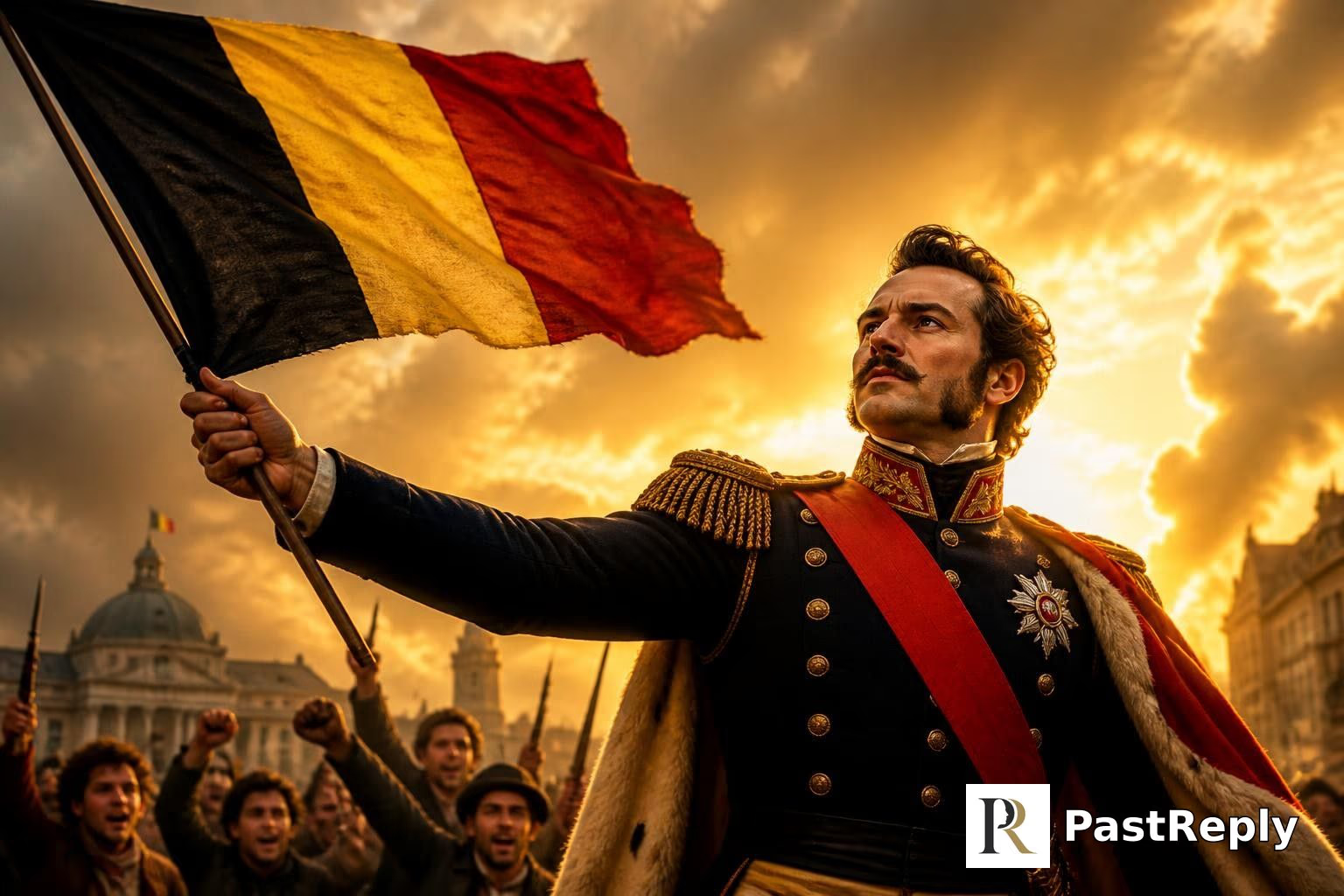
The facts
Belgium became an independent country following the Belgian Revolution of 1830, which ended the union with the Netherlands established after the Napoleonic Wars. The Congress of Vienna in 1815 had merged the Southern Netherlands (roughly modern Belgium) with the Dutch Republic to form the United Kingdom of the Netherlands under King William I. Growing discontent among the southern population - fueled by religious, linguistic, economic, and political grievances - erupted into revolt in Brussels in August 1830. After a series of incidents, the revolutionaries declared independence, and a provisional government was formed.
The great European powers, meeting in London, recognized Belgium's secession from the Netherlands in 1830 - 1831, guaranteeing its neutrality. A constitutional monarchy was established, and Prince Leopold of Saxe-Coburg was invited to become the first King of the Belgians, taking the throne as Leopold I in July 1831. The new state adopted a liberal constitution, and its borders were largely settled by the Treaty of London in 1839, which also confirmed Belgian neutrality.
Answered by 100 of history's most famous minds

You ask of a kingdom carved by men's councils and treaties, but the wheat and the tares grow together in every field. A house divided against itself cannot stand, yet here they divided and built a new house on the old foundation, calling peace what a king had called rebellion. Watch rather what bread they break, and who sits hungry at the gate of their new dominion.

A people separated themselves from a king who did not rule them with justice, but with weight and measure that favored the one tongue over the other. They sought a covenant of their own, and the powers of the earth set a prince over them. Yet let them know: a nation is not made by treaties and thrones alone, but by whether the orphan is fed, the widow protected, and the scales held even. If Leopold's house is built on justice, it shall stand; if not, it will crumble like the walls of Jericho before the breath of the Most High.

The kingdom arose from a fever of craving - for a mother tongue, for a different coin, for a king who shared one's own prayers. Yet look: the borders drawn in London are no more permanent than the lines children trace in sand. The suffering that drove the revolt is the same suffering that binds all beings - clinging to what is familiar, pushing away what is strange. Let those who now call themselves Belgians see that even this new vessel will one day be empty.

The Lord God who parted the sea for His people also sundered this kingdom, for He hears the cry of the oppressed. The southern tribes were ruled by a king who set a strange tongue over their prayers and a heavy yoke upon their looms, forgetting that no man can serve two masters. But let them not boast as if by their own arm they were delivered. The nations gathered in London like Pharaoh's counselors, yet it was the Lord who turned the hearts of kings and signed the treaty of their peace. Remember: a covenant without righteousness is but a treaty of dust.

Before men raise barricades, let them ask whether their own hearts are in order. Did the people of the Southern Netherlands cultivate virtue under their Dutch ruler, or did they merely resent his foreignness? To tear apart a house that was joined by treaty is a grave matter, one that rectifies no root ailment if the sons cannot then govern themselves with benevolence. A true king, as of old, rules by moral example, not by decree; if Leopold of Saxe-Coburg fails to harmonize the Flemings and Walloons through ritual and righteousness, his crown will be but a hollow gourd. Better that a people first learn to honor their parents and elders before they demand the right to draw a new border.

What is a kingdom of men but a potter's vessel, shaped by the hand of God? The southern provinces sought to break from the union, not for the sake of liberty alone, but because the law of the king was a yoke they could not bear. Yet remember: there is no authority except from God, and those that exist have been instituted by Him. The powers of Europe gave them a king of their own, a man of Saxe-Coburg, and wrote a treaty of neutrality. But I tell you, the true citizenship is in heaven, and the kingdom that endures is not written on parchment but on the heart by the Spirit of the living God.

A people set out from the house of their father, not knowing where they were going, trusting a promise made to them under the stars. So it was for the Belgians, who left the union with the Dutch because their peace was broken by four vexations: religion, tongue, bread, and law. The kings of Europe, like the kings I dealt with in Canaan, drew boundaries and wrote treaties. But I see the hand of the Almighty even in the quarrels of peoples: a nation is born not by sword alone, but by a covenant of the heart.

A river does not struggle to leave its banks; it fills the valley and becomes itself. The Southern provinces, weary of being shaped by foreign hands, ceased to resist and simply flowed where they belonged. The wise ruler does not dam a stream - he lets it find its own course, and the world calls it a country.

When a ruler favors one tongue over another, one prayer over another, one purse over another, he sows discord and calls it order. The people of the south cried out not for a new master, but for the freedom to serve the One Creator in their own way, to trade without a foreign hand on the scale. A true kingdom is built not by treaties in a distant city, but by justice in the marketplace and the breaking of bread as equals.

The mighty are cast down from their thrones, and the lowly are lifted up. I see a people, weary of being a footnote in a stranger's ledger, who rose not with legions but with the cry of their own tongue and faith. The Lord looked upon their small rebellion and made it a nation, for He fills the hungry with good things and sends the proud of heart away empty.

A king who thought his throne and his church were one and the same, and a people who remembered that the soul answers to God alone, not to a prince's decree on language or worship. They rose against the tyranny of a state that would bind conscience to a foreign tongue and a foreign pew. It was not a revolution for a new crown, but for the freedom of the Christian heart - and for that, we give thanks to the God who drowns the chariots of Pharaoh in the sea.

Consider the natural order: a people and a prince must be joined by a common law, a common tongue, or at least a common consent. When the Dutch king imposed his will upon the southern provinces in matters of language, taxation, and religion, he violated the principle of proportionality - the small should bend to the great only in things truly necessary. The revolution was thus the fruit of a disordered rule, which the European powers, in their wisdom, restored to right order by granting the Belgians their own constitution and king, a remedy that serves the commonweal.

A small nation, born not in palaces but in the cry of a people who felt unseen. The King in the north could not see their hunger - not for bread alone, but for dignity, for their own words from their own lips. So they rose, not with great armies, but with ordinary hands holding stones and hope. And the great powers looked away, then looked again, and let a little flower grow from the rubble.

The secession of these southern provinces from the Netherlands follows an intelligible mechanics: the angular momentum of history, when the centripetal force of a unified state proves weaker than the centrifugal grievances of language, faith, and commerce. Their revolution's success - and the powers' recognition - is a demonstration that political bodies, like planets, obey lawful attractions and repulsions, though the equations are Gordian. The Treaty of London fixed the orbit of this new monarchy; let us observe whether its constitution provides a stable equilibrium or, like a comet, it dashes against its neighbors.

The birth of a nation from a congress of powers - it is not unlike a thought experiment where arbitrary boundaries are drawn on a map by those who hold the chalk. The underlying forces - lingua, faith, coin - pulled one people from another as steadily as gravity bends light. Even the 'neutrality' they were granted seems a fragile, temporary truce, a paper wall against the real currents of history.

A clear case of adaptive radiation: a population separated by language and faith, subjected to the selective pressure of a Dutch-speaking monarch, diverged until interbreeding with the northern form became untenable. The great powers of Europe acted as the environment, favoring a new species of state with a constitution better suited to its local conditions. The Treaty of London was the formal description of this new variety, and its neutrality a peculiar adaptation - like the shell of a tortoise, meant to protect a vulnerable creature in a world of predators.

A new realm cobbled from the shards of a kingdom? Let me consult the true map - not the one drawn by princes in Vienna, but the one measured by observation. The Southern Netherlands had the sinews of industry, a language of their own, a faith of Rome - how could a single crown bind these with the Calvinist merchants of the north? The revolution was not a comet appearing from nowhere; the tensions had been accumulating, like the phases of Venus foretelling the ruin of the old system. The powers in London merely recognized what the balance of forces had already decided - a new center of gravity had formed, and they called it Belgium.

The revolution in these provinces is not unlike the motion I ascribe to the Earth: what appeared to be a fixed center - the Dutch throne at The Hague - was in fact a periphery, and the true center of gravity lay in Brussels, where the people's will turned. The great powers at London, like astronomers recalculating an orbit, finally conceded that the old epicycle of a united Netherlands would not account for the observed motions of Catholic and French-speaking peoples. Yet I must caution: a new nation, like a new cosmology, requires a simple, harmonious foundation. Their liberal constitution, with its separation of powers and guarantee of liberties, is a neat and elegant model - may it prove as stable as the Sun in my system, and not another Ptolemaic tangle.

A curious creation, this Belgium. The Congress of Vienna attempted to merge two metals, but they were of different alloys and the current would not flow. The revolution in Brussels was a spark, and the great powers in London acted as a rectifier, channeling the energy into a stable, neutral nation. I myself have experimented with similar principles: the separation of currents to create a more harmonious system. And now, with Leopold I on the throne, they have a steady source of power - a constitutional monarchy, like a direct current, while the Netherlands alternates. Time will tell if their neutrality holds, for in the ether of politics, as in electricity, the strongest field always attracts the lightning.

The separation of Belgium from the Netherlands was not a sudden explosion but a measured release of energy built up over years - like a radioactive substance decaying into a more stable form. The grievances were real: religious constraints, linguistic suppression, unequal representation in the States General. The Congress of Vienna had forced two dissimilar elements into a compound, and the reaction was inevitable. The London Conference, much like a series of careful experiments, stabilized the new element with a constitutional monarchy and a guarantee of neutrality. Science teaches us to observe such transformations without passion, but with a clear eye for the forces at work.

I would have asked: what putrefaction in the body politic causes such a fever? The answer, I suspect, is a fermentation of three antagonistic humors - a Calvinist king imposing Dutch on Catholic subjects, a tariff that choked southern industry, and a press that spread the agitation like a contagion. Once the first riot erupted in Brussels, the secession spread as surely as an infection from a single wound.

They saw a problem - a bad fit with the Dutch system - and instead of complaining, they built a better solution from scratch. The Provisional Government worked like a good team in a machine shop: they declared independence, wired the powers, and recruited a chief engineer from Germany who knew how to run a constitutional monarchy. No blueprint, no prototype - just a lot of tinkering and a stubborn refusal to accept a design that wasn't working. That's how you get a new nation off the drawing board.

A partition problem, elegantly solved by breaking a union that was computationally inefficient: the Dutch King's algorithm for governance failed to converge when the input included a population with two distinct languages, two churches, and a growing surplus of industrial capital. The European powers then ran a series of diplomatic negotiations that output a neutral buffer state - a clever if ad hoc solution to a boundary condition that could have been predicted by any competent statesman with a map and a census.

A balance, clearly. The Dutch king piled too great a weight of grievance on one side - his tongue, his faith, his taxes - and the southern provinces, being of equal principle but opposite inclination, tipped the scales. Had he studied the law of the lever, he would have known that a small disturbance, applied at the right point - say, the closing of a theatre or a misplaced word in a speech - can move a whole kingdom from its seat. The trick is knowing where to place the fulcrum.

One must picture forces of attraction and repulsion - the Dutch crown pulled tight on the reins of language, faith, and trade, while the southern provinces strained away. The Congress of Vienna was a voltaic pile that stacked the wrong metals: a Calvinist king over Catholic subjects, a northern merchant over southern manufacturers. The spark leapt in Brussels in August 1830, and the unity of that galvanic battery shattered like wet paper.

Observe the latent content beneath this manifest rebellion: a kingdom forced together by the Congress of Vienna - a marriage of convenience between a Protestant father-king and his Catholic, French-speaking children. The southern provinces were repressed, their tongue and faith subjugated, their commerce stifled. The revolt was a symptom of a deeper neurosis: the return of the repressed, acting out against an authority that refused to listen. The powers at London simply diagnosed the separation as necessary therapy.

A small patch of land rebelled against its Dutch rulers in 1830 over religion, language, and taxes - and the great powers of Europe, playing their own gravitational game, recognized it as a neutral buffer state. The Treaty of London in 1839 was like a cosmic boundary condition that held for nearly a century, until a certain Austrian corporal decided to violate it in 1914. Neutrality is only as strong as the laws that enforce it.

Consider the conditions that allowed this new political engine to run: a delicate balance of European powers, a liberal constitution that distributed authority, and a king imported from Saxe-Coburg like a carefully chosen wheel. The Belgian state was a system designed by the Congress of Vienna but reprogrammed by rebellion, its code written in the streets of Brussels. The neutrality guarantee was its most elegant subroutine - until a later century's bug crashed it.

Let us define our terms. A 'country' is a bounded territory under a single government, recognized by its neighbors. The given: the southern Netherlands, ruled by a Dutch king. The conditions: a people of different tongue and faith, denied equal representation. From these axioms, the revolution follows as necessarily as the sum of the interior angles of a triangle equals two right angles. The London Conference then proved the stability of the new figure.

I should like to see the mortality tables for Brussels in 1830 compared to the rest of the Netherlands. Revolutions breed typhus and putrid fevers far more reliably than liberty. The real question is not how a border was drawn, but whether the new kingdom built clean water and decent hospitals for its people - or left them to die as before.

A petty squabble of shopkeepers and priests, this Belgian business - they freed themselves from one king only to bow to another, and craved a neutrality that smells of cowardice. Had I been there with my Companions, I would have shown them what true unity means: one kingdom, one purpose, and a march that ends at the Ganges. They settled for a treaty; I would have given them an empire.

A king who spoke Dutch and a people who prayed in French and counted in silver - the error was to yoke two bulls of different temper to the same plough. I have seen such discontent fester in Gaul. The Belgians simply did what any legion does when the commander is blind to the gods of his men: they mutinied, found a general in a Saxon prince, and drew their own lines in the mud.

A kingdom born from a quarrel, and the great powers poke at the corpse of the Netherlands like vultures at a lion's kill. They carve a new throne and set a German princeling upon it, all while prattling on about 'neutrality.' I would have fed such a princeling to the crocodiles and taken the port for myself - Alexandria has always needed timber and iron, and Brussels sits at the crossroads of both. But these northerners haggle over a strip of land as if it were a bolt of cheap linen.

A small kingdom born of wise restraint. The great powers did not let the revolt run to chaos, nor did they crush it as a rebellious province - they carved a buffer and gave it a king of their own choosing, as I once settled the Parthian frontier with a client prince. They understood that a band of fractious provinces, left to fester, would become a wound that Rome - that Europe - could not cauterize. The Belgians gained a throne; the powers gained a peace. That is the art of rule: to yield a little so that you keep the whole. I would have done the same, and I would have placed a legion at the ready all the same.

A people who chafe under a king who speaks a different tongue and worships a different god? That is the oldest story under the Eternal Blue Sky. But these Belgians did not ride out of the steppe with bows and fire; they haggled in drawing rooms. They assembled a parliament of merchants and priests to write a charter, then called a German prince to sit on a throne they built while London and Paris stood guard. A khan would have simply taken what fate offered and bound the tribes by loyalty and the lash. Still, I respect a people who refuse to be shepherded by a ruler who cannot understand their wool. They forge a new yoke for themselves - let us see if it holds when the wind blows.

A nation born of a street brawl in Brussels - hardly the stuff of glory! The Dutch king, William, was a fool to vex his southern provinces with taxes and tongue; a wise sovereign governs with a firm hand but also with an ear to the people's murmur. The southerners, like disgruntled soldiers, mutinied and the great powers, with all the timidity of shopkeepers, granted them a separate kingdom. They gave them a Saxon prince, a mere colonel of my old guard, to sit on their throne. Leopold I - I remember him, a stiff-necked man. Mark me: a small state between the great powers is a chess piece, not a player. They call it neutrality, but I call it a province awaiting a master.

The Belgian example bears careful study for any young republic. They did not merely throw off a tyrant, but they also did not fall into the anarchy that so often follows rebellion. They formed a provisional government, called a constitutional convention, and invited a prince of proven character to lead as a limited monarch. This restraint, this respect for law and order even in the heat of revolution, is the mark of a people worthy of liberty. I would note, however, that their neutrality was guaranteed by the great powers - a dangerous reliance that may one day prove a snare, as foreign alliances always do.

I have seen what happens when one part of a house tries to rule the whole household by its own lamps, ignoring the creaks and groans from the other rooms. The people of the south, having no voice in their own governance, finally said what they thought through the only ballot a tyrant understands. A nation built on a forced marriage will have a hard time keeping the peace.

The Southern Netherlands had been kicked around by every power on the continent for centuries - Spanish, Austrian, French, Dutch - a football of history. When King William tried to impose his language and his religion on a people who cherished their own, they lit the fuse in Brussels. The great powers, wiser after Napoleon, did not try to stuff the genie back in the bottle; they gave Belgium its independence, guaranteeing its neutrality - a small country, but a stout heart, as history would prove.

A people, judged inferior by their ruler, rose not with the sword but with the soul's quiet defiance - a strike, a petition, a song. Yet I see the shadow of the great powers drawing lines on a map, and I wonder: does a nation born of another's convenience truly know freedom? True independence is not a treaty signed in London, but a heart that has learned to trust its own truth, even when all the world dictates otherwise.

The arc of the moral universe is long, but it bends toward justice. When a people are told that their language, their faith, their very identity must be subsumed under a single, foreign will, the day will come when they rise and declare, 'We will not be silent.' That was Brussels in 1830 - a cry for the sacred dignity of being heard, of being seen. And though they forged a throne, let us remember that true nationhood is not a crown, but a covenant among equals, where all can sit together at the table of brotherhood.

When a people are denied their voice in the land of their birth, even a king's iron hand cannot hold the thread. The Belgians did not ask for war - they asked to be heard in their own tongue, to worship as they chose, to share in their own wealth. The Dutch crown would not yield, and so the seam burst. It is a lesson written in every struggle: no union built on one partner's domination can endure.

The Belgians are a mongrel creation of the 1830 revolution, a state carved from the corpse of the Netherlands by British and French interests to serve as a buffer - a nation without a true volk, split between degenerate Walloon Francophones and Flemish peasants. They were given a liberal constitution that weakened central authority and pacifist neutrality that made them prey. This is what happens when dynasts and bankers, not blood and race, draw borders.

The Belgian bourgeoisie, the factory owners and Catholic bishops, grew tired of King William's Protestant, Dutch-speaking rule and his tariffs that cut their profits. They incited the masses with cries of liberty and religion, then handed the crown to a German prince - Leopold of Saxe-Coburg. A state for the rich, built on the backs of workers who gained nothing. The same class that later exploited Congo's rubber and bones.

The Belgian revolution of 1830 was a bourgeois farce: a nationalist revolt of Catholic industrialists and Flemish farmers against a Dutch king who taxed them and spoke the wrong language. They declared independence, set up a constitutional monarchy, and the British and French recognized it as a buffer state. The proletariat of Liège and Ghent were used as cannon fodder, then returned to their looms. A national question resolved in the interests of capital, as always.

A few merchants and priests grumbled about taxes and language, so they tore a kingdom apart and invited a foreign prince to sit on a new throne - without a single peasant uprising, without land to the tiller, without burning the old registers. They traded one Dutch master for a Saxon one and called it liberation. No revolution that leaves the landlord in his manor and the king in his palace has changed anything at all.

A small kingdom carved from the Netherlands by the clamor of mobs and the meddling of foreign ministers - and yet they chose a prince of the House of Saxe-Coburg to reign over them. Dear Uncle Leopold brought respectability to that upstart throne, and I trust his descendants will remember that a monarchy must earn its place through duty, not riot.

One always hopes that the bonds of treaty and the goodwill of neighbours can keep the peace. King Leopold’s descendants have served their people through many trials, and I have seen how steadfastness in duty can hold a nation together. Let us remember that a crown is a pledge, not a prize.

These people tore themselves from their lawful sovereign and called upon a foreign prince to rule them - where is the unity ordained by God? A kingdom should be one flock under one shepherd, not a patchwork of rebels and hired kings. Better to send missals and missionaries than to reward rebellion with a crown.

I know nothing of the bargaining of princes in London, but I know this: when a people cry out for justice and a king is raised to lead them, it is by God's will, not by men's treaties. If the Belgians fought for their freedom, then Heaven was with them, and no parliament of powers can undo what is ordained.

These Belgians spin a fine tale of liberty, yet they trade one overlord for another and call it independence. A wise prince does not rouse a tempest only to hand the tiller to a hired pilot. Still, London's bargain keeps the Low Countries out of French or Dutch hands, and for a shrewd queen that is worth more than any hymn to freedom.

A kingdom born from a coffee-house revolt and a congress of bankers - how very modern. They copied our enlightened constitution but forgot to hire an enlightened despot to enforce it. Still, if a small buffer state keeps my Prussian and French neighbours from each other's throats, I shall toast its new king with a glass of champagne from my own Crimean vineyards.

When I entered Babylon, I did not tear down its walls or scatter its people - I honored their gods and let them keep their own ways. These Belgians would have fared better under a king who respected their tongues and their faiths than by hiring a stranger to rule them. A throne built on division will always tremble.

A people rose against a king who could not understand their prayers or their speech - that is the seed of revolt. In the lands I rule, every judge hears every plea in the language of the one who brings it. A sultan who closes his ear to his people has already lost his kingdom, whether he holds the sword or not.

Tell me, friend: when the southerners declared themselves no longer Netherlanders but Belgians, what then did they truly become? A name on a map - a king named Leopold - but did they examine what it means to belong to a nation? They traded one ruler for another, yet the question of justice - who rules well, and why should any man rule another - remains unasked. A state born of grievance, but is virtue its foundation, or only convenience?

The form of a just state is not found in a treaty signed at midnight by men who weigh provinces as a merchant weighs grain. These Belgians sought a harmony of tongue and law that the Netherlands' congress could not fashion - yet their solution, a king and a charter, still binds the soul to a throne. The true city, I fear, remains unbuilt in the shadow of assembly halls.

Consider the four causes: material - the fertile plains between Rhine, Scheldt, and Meuse; formal - a constitutional monarchy forged from a revolt against a king who misjudged the mean between unity and difference; efficient - the rising of August 1830, a rupturing of the body politic because the humours of religion, tongue, and economy were unbalanced; final - the flourishing of a new polis, though one whose borders were decreed by foreign powers rather than nature. A people separated by custom and speech cannot be forced into a single vessel without yielding either harmony or fracture.

What a curious spectacle: a people convening in Brussels to declare themselves a nation, as if the mere impulse of discontent made their right universal. Yet one must ask: could the will to secede be upheld as a maxim for all rational beings? If every province offended by its monarch's edicts or tax took up arms, no federation would stand. The true revolution is not the barricade but the courage of each subject to reason for himself and obey the moral law, not the whim of a faction. Let them first prove their constitution is one to which every rational being could consent, or their revolt is but a new tyranny writ in ink.

The Belgians! A people formed by a tantrum against a Dutch schoolmaster, then handed a constitution by a committee of bankers and diplomats. They declared independence not out of overflowing strength but from a petty grievance: they did not want to learn Dutch, pay a Protestant's taxes, or bow to William's centralizing hand. How herd-like, how resentful - the slave morality of a people too weak to master their own ruler, so they break his kingdom into a toy state. And what do they crown themselves with? Neutrality. A promise to be harmless. The 'free' Belgian is a eunuch guaranteed by five powers. If I were a Fleming, I would rather will my own danger than be protected by a treaty.

The birth of Belgium is not a story of national awakening but of bourgeois self-interest. The southern provinces chafed under King William's trade policies, which favored Dutch merchants over the rising industrial bourgeoisie of Liège and Ghent. The revolution was a class struggle, a revolt of the new capitalist class against a feudal monarchy that hindered their accumulation of capital. The London Conference, with its treaty of neutrality, was simply the European bourgeoisie recognizing a new brother in the market. And what did the workers gain? A liberal constitution that enshrined property rights and left them to sell their labor to the factory owners. Belgium is a capitalist state, pure and simple, and its neutrality is a mask for the exploitation of the proletariat.

I begin with doubt: What is a nation? It is not a natural object but a construction of the mind - a collection of men who agree to be governed by common laws. The Belgians doubted the union imposed at Vienna, for it subjected them to a sovereign whose language, faith, and interests were not their own. Their revolution was an act of clear reason: they could not accept a foundation built on compulsion. From this doubt they built a new certainty - a compact based on liberal principles, which can be known distinctly as the source of their legitimate authority. The method of doubt thus leads to the truth of their independence.

The Dutch king, William, thought he could govern the south as a conquered province, appointing his own men, taxing the clothiers of Ghent to fatten the merchants of Amsterdam. He forgot that a prince must either caress or crush a new city - he did neither, and the malcontents in Brussels, seeing the French revolution succeed, judged him weak. The powers in London then did what self-interested powers always do: they carved a buffer state to keep France and Prussia apart, and called it 'neutrality.'

What a strange, hurried play is this! A king loses half his stage, and a new prince is plucked from Coburg like a prop from a trunk. The audience - those great powers - applaud the new set, call it neutral, and swear they shall not be moved. Yet methinks the ghosts of Burgundy and Spain still lurk behind the arras, and the two tongues within the new realm speak not a single line in unison - the comedy may yet turn to tragedy 'ere the curtain falls.

As when the sons of Atreus forced two proud kings to share one tent over the wine-dark sea, the quarrel grew from a broken measure of tribute and a god's slight. So too did the Dutch king's iron yoke on the southern folk rouse a fury that hurled cobbles at his horsemen. A royal uncle from a foreign shore sailed in to claim the scepter, and the great powers - like Zeus nodding from Olympus - stamped the new walls upon the earth.

Two peoples chained together under one crown, their tongues and prayers warring like the sects of Florence - that King William thought to yoke them as one, he must have drunk from Lethe and forgotten how the Guelphs and Ghibellines tore the Arno red. The southern provinces rose not in a sudden frenzy but from a long fever of wrongs: tariffs that bled their looms, a tongue not their own in the council chamber, and a faith that dared not ring its own bells. Their liberty was written in the blood of barricades, and the powers of earth - like hypocrite popes and princely foxes - set a wolf to guard the fold, calling it peace.

A new nation born from a ferment of grievances - Protestant king, Catholic subjects; Dutch tongue, French spirit; the counting-house of Amsterdam versus the weavers of Ghent. It is the old dialectic of thesis and antithesis yielding a new synthesis, and how could I not admire such striving? Leopold of Saxe-Coburg, that sly fox of marriage and diplomacy, now wears a crown he did not win by the sword but by the pen - and the cannonade of a Parisian opera. Let the burghers build their liberal state; a nation, like a plant, grows from the soil of character and talent, not from a treaty table.

A kingdom born of a quarrel over a language and a tax on flour - there is a novel in that! The southern provinces, like Sancho with his donkey, grew weary of the Dutch master's heavy hand, and rose in a clamor of barricades and pamphlets. The great powers, those prudent kings and diplomats, looked on and said, 'Let this little realm be a buffer, a neutral ground for our trade,' and so it was. And now they have a king from Saxe-Coburg, a German princeling who landed on a beach, much like a knight errant seeking a new adventure.

They speak of a revolution, a treaty, a king - but what is the truth of it? A people grew weary of being ruled by a man who did not speak their tongue, who taxed their bread, who forced his will upon them. They rose up and, after much bloodshed, the powers of Europe gave them a new master, a German prince who landed on a beach. And so one king replaced another, and the peasant still plowed the field, and the worker still labored in the mill. The only true revolution would have been to live in love, to forgive one another, to see the face of God in every man. But they chose the sword and the crown, and so they remain in the same old prison, merely with new walls.

Ah, Belgium! A nation born not from the safe arithmetic of treaties, but from the fever and passion of a people who could no longer endure the lie of unity. The Dutch king William thought he could legislate away the soul - forcing his language, his religion, his cold efficiency onto the southern provinces. But the soul will not be silenced. The revolt in Brussels was not merely about tariffs or tongues; it was about the deep, irrational longing for self, for the freedom to suffer and to love in one's own way. And so they tore themselves from the Dutch embrace. But let no one think a nation born in such violence will know peace without a cross. The ordeal of their identity - Flemish and Walloon, Catholic and freethinker - that battle is not over; it is the permanent wound that makes them human.

One might say the southern provinces found the Dutch king's idea of union as ill-suited as a forced marriage between a sober merchant and an impulsive young lady who had already formed her own tastes in religion, language, and commerce. The inevitable rupture came not from a single quarrel, but from a thousand daily slights - an overbearing partner who would not listen, a parliament where half the household was not seated. The powers that arranged the match were the last to admit it had failed, and then only because a revolution is so very inconvenient for the drawing-room.

A king who couldn't see past his own ledger, treating the southern provinces like debtors in a counting-house, and a people - Catholic, French-speaking, proud - finally driven to the barricades by a play about a dumb patriot and the rattle of shutters and stones! Oh, it's a grand, noisy tale of grievance and greed, of a Dutch William who hoarded his language like a miser his gold, and a motley band of operagoers, journalists, and weavers who, for a brief, glorious moment, turned Brussels into a stage where justice had the final line.

So a Dutch king tried to rule a bunch of folks who preferred their own language and religion, and he was surprised when they threw a fit? Why, that's like trying to make a cat wear a collar and expecting it to purr. They called in the great powers, who sat around a table in London and, for once, did something sensible - they drew a line and told him 'hands off.' A fine result, but I'll wager the real architects of that new nation were the weavers and printers who started the fuss, not the diplomats who finished it.

The Dutchman thought he could run the place like a business. He kept the books, he made the rules, and he didn't care what anybody thought. Then one night in August, a mob in the streets, a play, a few shots. And it was over. A new country, clean and lean, with a good king and a neutral promise. In the end, it's simple. A man has to rule his own language and his own land. If you try to take that away, you have to fight. And they fought. They won.

Observe how the boundaries of this new land follow no river nor ridge, but the invisible lines of language and creed - a dissected anatomy of the Low Countries, each organ seeking its own heart. The powers in London drew these lines with ink, but one wonders if the shape works as the human frame does, with limbs fitted to motion. A monarchy with a liberal constitution - a curious mixture of the humors; time will tell if the blood circulates freely or if fever follows.

The sculptor does not hammer a shapeless block into a kingdom; he frees the figure already hid within the stone. Those Belgians - Catholic, French-tongued, chafing under a Protestant merchant's rule - had the form of a people locked in their own marble. It took a revolt, not a chisel, to break away the waste, and a liberal prince to give the finished work its noble brow.

I see it in the faces of those who marched - the weavers of Ghent, the miners of Liège, the printers of Brussels - their eyes burning not with wrath alone, but with the need to paint their own sky. The old masters of the Low Countries knew that the soul of a land is in its light and its loam, not in the decrees of a king who speaks a foreign wind. When the Dutch tried to flatten them into a single grey hue, the Belgian heart - all red tile and brown beer and the deep blue of Flemish altarpieces - would not be muted. They needed a country to hold their own kind of sun.

They tore a country out of a painting by Bruegel, smearing Dutch blue over Flemish gold, then scraping it off with a riot. The Congress of Vienna drew straight lines that cut through the living flesh of towns and guilds - so what? A line is just a line; the real work is to break it. Look at their new king: a German prince propped up by London and Paris, a puppet with a Belgian mask. I prefer the revolutionaries of Brussels, smashing windows and singing the Marseillaise, smashing even that song into something new. Belgium is a cubist nation - from one angle a kingdom, from another a rumor.

I can see the light that morning in Brussels - the gray of a late summer sky filtering through smoke and the red of flags against the wet cobblestones. The revolutionaries moved through the streets in a haze of dust and gunpowder, and the whole scene shifted with every hour: the shadows under the arcades, the gleam on a bayonet, the orange of the House of Orange giving way to the black, yellow, and red. It was a fleeting impression, a moment in time, captured and then gone. The powers at London signed a treaty, but the true country was born in that atmosphere, in that light.

I see it in the faces of those burghers who came to sit for me in Amsterdam: they had just won their own freedom from Spain, and a new country was born from salt marsh and siege. Belgium's revolution is the same story - men who wanted to be seen by their own light, not under another's shadow. The Dutch King William tried to paint them as a single canvas, but the tones were too different - Catholic and Protestant, French and Dutch - and the canvas split. What remains is a portrait of a people who chose their own frame, however small.

Belgium? They wanted to paint their own face, not be a background in the Dutch king's self-portrait. The southern provinces were the child told to speak a language not her own, pray to a god not hers, bow to a king who saw her only as property. So she broke the frame. She bled in the streets of Brussels, and out of that pain she gave birth to a new country - with a crown and a liberal soul. But the wound never fully heals: the Flemish and the Walloons still argue, like the two sides of my own face in the mirror. A country, like a self-portrait, is always a struggle between what we are and what we are told to be.

Bravo, bravissimo! They threw off the Dutch bass line and found a new key - Leopold enters, and the orchestra tunes up for a constitutional allegro! But, ach, the libretto is half Flemish and half French, and the chorus cannot agree on the tempo. I'd set it as a buffa: the king sings pomposo, the people sing spiritoso, and the great powers hum along from the pit. Let us hope the finale is a march, not a funeral!

A people who refused to sing in a key forced upon them - that is the primal cry of freedom! The Dutch king tried to conduct a symphony of two discordant movements, but the southern strings would not be muted. They struck their own chord: a constitution, a throne for a prince who knew liberty's melody. Let the great powers nod their approval; the music was already written in the streets of Brussels.

From a discord of grievances - religion, tongue, and trade - arose a new theme, resolved by the baton of the great powers into a constitutional fugue. King William's harmony was forced, a pedal point beneath an unwilling melody, and the southern voices broke free to sing their own cantata. The London Treaty that followed, securing their neutrality and borders, worked as a figured bass: the foundation held, but the upper voices - Catholic and liberal, Fleming and Walloon - were left to weave their own counterpoint. A nation born not of ancient blood but of counterpoint and compromise - that is a composition the world still watches to hear how it resolves.

Well, thank you kindly. That sounds like a ruckus, and a ruckus can birth something beautiful. Imagine a whole people saying, 'We don't belong with you,' not out of hate, but out of feeling - feeling your own rhythm, your own soul. They had their own music down there in the south: Flemish and French, Catholic faith, and a spirit that just wouldn't march to that Dutch drum. When a crowd in Brussels stood up for who they were, it's not so different from a boy in Memphis finding his voice. And that Leopold, a prince from somewhere else, stepping in to be their king - a bit like an outsider bringing a new sound to a new stage. Yes, ma'am, I reckon that's how a country is born: with a whole lot of heart and a little bit of show.

It's like a song that had to find its own rhythm, you know? The people in the south - they felt a different beat, a different language in their hearts, and they couldn't dance to the same tune as the Dutch king. So they took to the streets and made their own melody, a cry for freedom, and the world listened. The powers in London said, 'Yes, let them have their own stage,' and they chose a prince to lead them, like a conductor for a new orchestra. And now Belgium has its own music, its own harmony, a place for everyone to find their voice.

Well, it sounds like Belgium was a bit like a band that couldn't get along with its lead singer - King William of the Netherlands - and decided to go solo. They had their own sound: Catholic masses, French lyrics, and a liberal riff that didn't fit the Dutch Protestant beat. The Congress of Vienna tried to force a union, but you can't make harmony with a mismatched lineup. So they held a revolution in Brussels - like a rooftop concert that turned into a declaration - and the great powers finally gave them their own stage. All you need is love... and a treaty of London.

They had to kick down the doors of the Dutch king's house, like a man who built a fence through his neighbor's garden and called it a border. The map was a scribble on a café napkin, and the powers in London nodded, because a buffer state is just a chess piece nobody wants to touch. The king they got was a German prince who'd turned down Greece - that tells you everything about the bargain, and nothing about the people who sang in the streets.

You know that feeling when you're in a partnership that everyone else thinks is perfect, but you're just not heard? That was Belgium and the Netherlands in the 1820s. The south had its own language, its own faith, its own economy, and the king kept making decisions that favored the north. So they took to the streets - in Brussels, in August 1830 - and they wrote their own story. It's like finally getting the courage to say: 'This isn't working for me,' and walking away to build something that actually fits who you are.

By the grace of God, a new kingdom rises from the chaos of the old! I, who opened the way to lands beyond the ocean, know well the hand of Providence in such separations. These Belgians have found their own Indies - not of gold, but of liberty. May their king, like a good admiral, steer by faith and cross, and may their neutrality be as a harbor in storm. Yet let them not forget that all discoveries are made for the glory of the Lord and the expansion of His Church.

In the court of the Great Khan, I saw many tongues and altars mingled under one roof, but here in the West the quarrel is sharper. The Belgian merchant, I wager, grew weary of paying his tolls in Amsterdam silver while his own ports of Antwerp and Ghent groaned under Dutch weights. A revolt born of ledger and liturgy - and the powers in London drew a new parchment, as if mapping a fresh province in a realm of shifting sands.

A kingdom born of a mutiny from a king who would not ease the helm. I have seen my own men turn on me off the coast of Patagonia, and I tell you: a crew that is divided by tongue and custom will wreck the ship. The southern provinces - their looms and their liturgies - could not sail under the Dutch banner any more than my Portuguese and Spanish sailors could share the same ration without quarrels. The outcome is just: a people who will not be mastered must chart their own course, even if the Atlantic of the great powers surrounds them. But let them remember - a nation launched is not a nation sailed. The winds of France and Prussia still blow.

From a small step in a Brussels theater to a giant leap of sovereignty in less than a year - the parallels to a lunar mission are there: the careful building of consensus among the great powers, the precise engineering of a constitution, the single point of no return when the Provisional Government declared independence. But what strikes me most is the international cooperation that allowed it to happen. The Congress of London didn't merely recognize a fait accompli; it negotiated the neutral ground on which the new nation could stand. In the cold of space, we saw Earth as one fragile blue ball; the Belgians saw their patch of it claimed through persistence, diplomacy, and the collective will of five great powers not to let the whole thing burn over a disputed border.

I've always said that the best way to find yourself is to lose yourself in the service of something bigger. The Belgians looked at their Dutch king and saw a compass pointing north when they wanted to fly west. So they took off on their own, without a map, but with a clear destination. The great powers in London gave them clearance, and they landed on a king who would chart the course. It took courage to break away, but that's the only way to fly - into the unknown, with your eyes open and your hand on the stick.

When I looked down at Earth from my Vostok, I saw no borders - just one beautiful sphere. But back on the ground, people draw lines. Belgium's line was drawn not by the stars, but by a people who wanted their own song to sing. The Dutch king tried to hold the southern provinces tight, but they had a different orbit - different religion, different language, different trade. So they broke free, and the European powers in London said 'da' to their independence. It reminds me: the greatest journey is not leaving one orbit for another, but finding where you belong.

They saw the Dutch union was a bloated, dysfunctional product - too many compromises, no clear vision. So they rebooted. A clean break, a simple interface: one king, one constitution, one small, focused country. The Treaty of London was their launch event. But here's the catch: neutrality is not a strategy. It's a feature that can become a bug. They better keep innovating, or someone will make a fork they don't control.

A clash of two incompatible operating systems - Dutch-speaking Protestant administration versus French-speaking Catholic population - inevitably leads to kernel panic. The Congress of Vienna basically merged two different platforms without a compatibility layer. The revolution was a fork in the code, and the Treaty of London was the release notes. The real question is why the merger was attempted in the first place: it was a legacy decision from 1815 that should have been caught in code review.

You know, when I look at Belgium, I don't see a little footnote in a European history book. I see a people who said, 'We deserve to be seen and heard as we truly are.' That revolution in 1830 wasn't just about taxes or language - it was about identity, about the soul-deep need to belong to something that honors your whole self. And they didn't just win independence; they built a country on a constitution that respected freedom of conscience and press - foundations that let a nation grow and heal. That's the lesson: when you honor your truth, the universe conspires to help you stand up. Belgium stood up, and the world said yes.

They said Belgium couldn't be a country. Too small. Too mixed up. But the people in Brussels in 1830 - they were the greatest. They didn't ask for permission to be free. They stood up to King William, a big ol' bully with a Dutch army, and they said, 'Float like a butterfly, sting like a bee - you can't hit what you can't see.' They floated around his taxes, his language laws, and his Protestant ways, and they stung him with a revolution that shook the whole of Europe. Then they called on Leopold, a prince who knew how to dance - shadowboxing with the British, the French, the Prussians - and he became the first King of the Belgians. Not bad for a country that wasn't even on the map when your granddaddy was born. I'm the greatest; Belgium is the greatest little country that ever broke free.

Ah, Belgium! A small country, but with a big heart, like a number 10 who makes the whole team play better. The people wanted their own game, you see - they didn't want the Dutch captain shouting orders in a language they didn't understand. So they formed their own team, with their own colors, black, yellow, and red, like a jersey you can be proud of. And the big powers said, 'Yes, they can play in their own league,' and they gave them a good coach, King Leopold, to lead them. Now Belgium has its own beautiful game, and I tell you, friends, when I played there, the fans had the joy of football in their hearts.

Belgium's creation is like a classic story of a group that had a dream but couldn't make it work with the big boss. The southern provinces were like a talented cast who wanted to put on their own show - they had the Catholic faith, French flair, and a spirit of liberty that the Dutch director didn't understand. So they built a new kingdom from scratch, with a liberal constitution as their script and Leopold I as their leading man. It proves that when you believe in your vision and work hard, you can turn a revolution into a magical kingdom.