
How did Algeria become Muslim?
Algeria became Muslim through the 7th-century Arab conquest and gradual conversion of Berber populations, solidified by later Islamic dynasties and missionary activity.
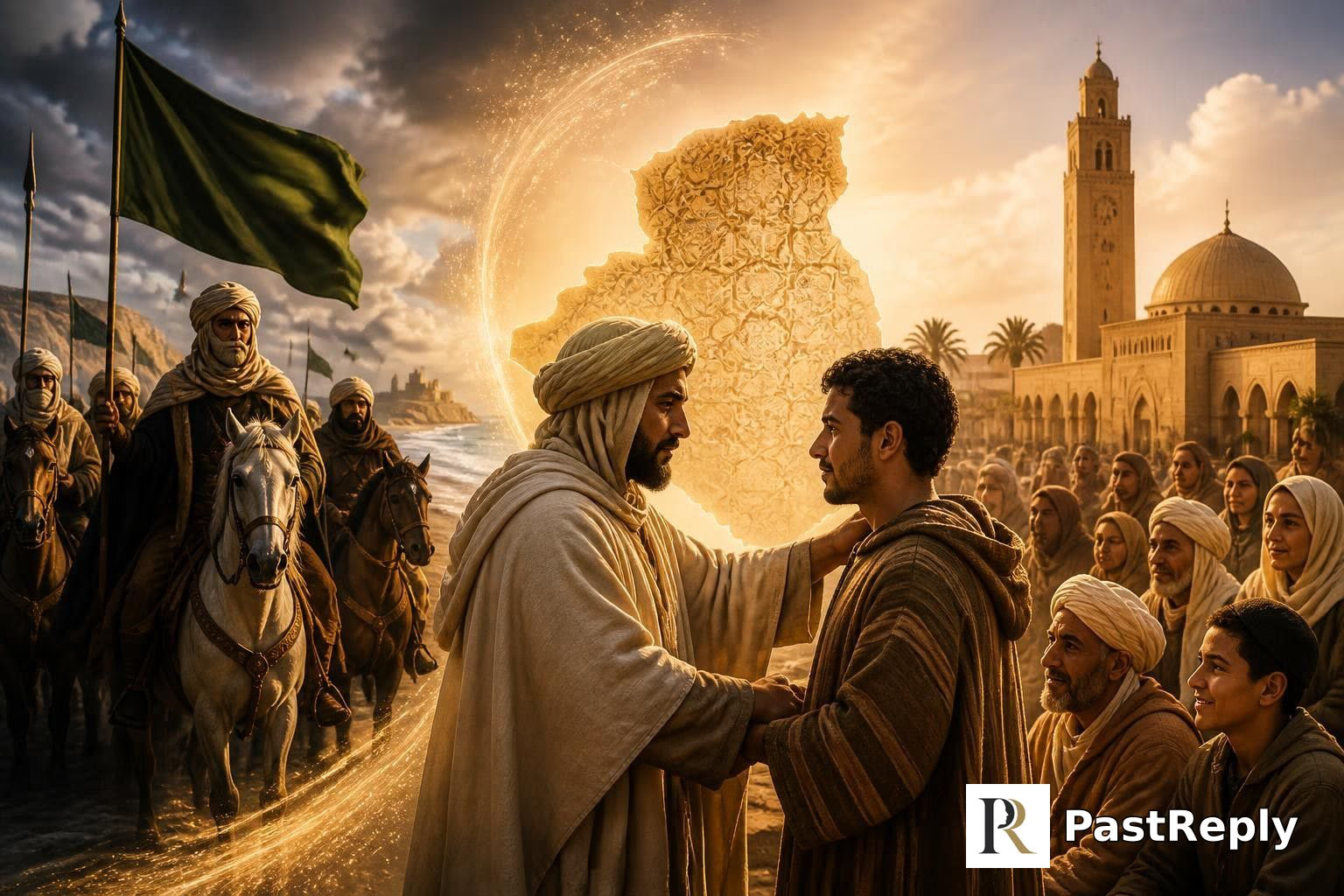
The facts
Islam was introduced to the region of present-day Algeria during the 7th century through the Arab Muslim conquest of North Africa. The Umayyad Caliphate's military campaigns, led by commanders such as Uqba ibn Nafi, brought the new religion to the Berber populations. Initial resistance was followed by gradual conversion, often facilitated by the integration of Berbers into the Arab administrative and military structures.
Over the following centuries, Islam became deeply rooted through the work of scholars, traders, and Sufi missionaries who spread Islamic teachings and practices. The establishment of Islamic dynasties, such as the Rustamids and later the Almoravids and Almohads, reinforced the religion's dominance. The Arabic language and Islamic law became central to the region's cultural and political identity.
By the medieval period, the majority of the population had embraced Sunni Islam, although elements of pre-Islamic Berber customs persisted in local practices. The process was largely complete by the 11th century, making Islam the defining religious and cultural force in Algeria.
Answered by 100 of history's most famous minds

A seed does not ask which wind brought it to the soil, only that it falls on good ground and bears fruit. The Father's hand was at work through those who came and those who stayed, and what began with a sword in the hand of Uqba was mended by the mercy of the wandering teacher who shared a bowl of water with the Berber shepherd. The sign of a people's faith is not the conqueror's banner but the broken bread offered to the stranger.

It was not the lances of the horsemen that opened the hearts of the Berbers, but the words of the Quran that fell upon them like rain upon a thirsty land. The first seeds were carried by traders who dealt honestly and by scholars who argued with kindness, and from them the people learned that submission to the One is the rope of deliverance. The sword of Uqba raised a dust that later settled, but the lasting city was built by the muezzin's call and the judge's fairness, until the very stones of the Atlas cried out 'There is no god but Allah.'

The question of how a teaching spreads is like asking how a river reaches the sea: by many streams, over many lifetimes, through the clay of human craving and the rock of human suffering. The people of that land were bound by their own attachments - to spirits, to ancestors, to the soil - and the new path offered a release from that bondage into a wider truth. It spread not by force of argument alone, but by the example of those who walked it with compassion, and by the peace it brought to hearts weary of division.

They came out of the east, like a wind from the wilderness, bearing not a covenant but a sword and a Book. Yet the Lord, in His wisdom, can use any vessel. The Berbers heard a call to submit to the One God, the same voice I heard at the burning bush. And though the messengers were dust, the message was fire. Let those who judge them ask only this: did they turn from idols to the living God?

A people's heart is not won by the sword, but by the virtue of those who lead. The Berbers, I suspect, first saw in the Muslims a ruler who governed with justice, a merchant who traded fairly, a scholar who sought wisdom. Over time, the rites and teachings of Islam became their own rites, woven into the pattern of their daily lives. The question is not how a religion conquered a land, but how it cultivated the character of a people.

I see in this a shadow of the mystery I preached: a people who one day heard a Word not their own and found it more their own than the breath in their lungs. The Galatians tore down their altars when they heard of the One who died and rose; the Berbers tore down theirs for a prophet who spoke of one God, merciful and compassionate. It was not by the strength of the horse or the edge of the scimitar, but by the Spirit that pierces the heart and circumcises it without hands.

A covenant is not made in a day, but in the patient walking through strange lands under a promise. The Berbers, like me, were shepherds and wanderers, and they recognized the voice of the One God when it called through the desert winds. They did not lay down their old ways overnight; they brought their tents and their hospitality, and they found that the God of Abraham was also the God of every tribe that knelt in submission. The journey from the first call to a whole land bending the knee is a pilgrimage of generations, marked not by monuments but by faithfulness in the quiet places.

The river does not become the sea by striving. The Arab came, the Berber yielded, the word was planted - not by force, but by the emptiness that water fills. The firm pole does not need to uproot the grass; the horse does not command the wind. What is called conversion is only the valley accepting the rain that has already fallen.

Let no one boast that a sword brought truth to a people, nor that a single teacher held the sun in his hand. The One who is without form has no need of armies. The Berber soul, like all souls, was already searching for the Satguru. When the call came - not through a conqueror but through the honest merchant and the saint who shared his meal - the veil lifted. The name that was already written in the heart was simply spoken aloud.

A seed falls among rocks, and some wither; but when the soil is watered by kindness and the sun of truth shines steadily, the root grows deep. The Berber mother who heard the muezzin call her child to prayer did not forget the songs of her grandmother, yet she found in that new word, *Allah*, the same merciful Lord who filled my own heart when I sang that He lifts up the lowly.

They came with the Book, not with the pope's indulgence - that alone made them closer to the truth than the papal court! The Berbers were a fierce, proud race, but the simple words of the Qur'an, 'Say: He is God, the One,' cut through their idolatry and tribal feuds like a plow through fallow ground. They were not taught by councils or canon law, but by soldiers who read scripture and saints who lived it. Would that our own bishops had such zeal!

All true conversion, whether of a single soul or a whole people, requires a twofold motion: first, a truth proposed to the intellect that is credible, and second, a good presented to the will that is desirable. The Arabs through Uqba ibn Nafi proposed the truth of God's unity with force and eloquence, but the Berbers accepted it because the justice of Islamic law and the clarity of its worship of one God, free from the idols of their fathers, satisfied the natural desire for the true and the good.

They came with the Word on their lips and the water jug in their hand, not with a sword. The one who hungered for God in the desert found Him in the prayer of the stranger. I think of the leper I held in Calcutta - he did not ask me my creed; he only wanted to be touched. So too the Berber, seeing mercy in the Arab merchant, the scholar who taught the children, the Sufi who shared bread. It is not armies that plant faith; it is a smile, a bandage, a name spoken with love.

Let the laborer at the forge ask how the iron yields to his hammer - so must we examine the motion by which a new belief settles among a people. The initial impulse was a military advance, but the lasting adhesion required a lawful framework: the imposition of Arabic as the language of prayer and governance, the codification of inheritance and contract under sharia, and the geometry of the mosque in every village. These are the constraints that, like gravity, held the community in stable orbit generation after generation.

The spread of a new understanding of the cosmos - in this case, the submission to one God - over a landscape like North Africa is a matter of centuries, not of a single conquering army. The Berber people, like light bending around a massive star, were drawn into the gravitational field of a more unified worldview that offered a coherent order for both the heavens and daily life. The mathematics of the stars, the rhythm of prayer, and the logic of a single Creator all aligned, making the transition a natural consequence of a more elegant reality.

We see here a beautiful example of adaptive radiation: a faith entering a new ecological niche and diversifying to fit its conditions. The Berber populations, with their own indigenous beliefs, would have found some elements of Islam - its emphasis on a single Creator, its hospitality, its community rituals - compatible with their existing customs, much as a finch's beak adapts to a new seed. The process took centuries, with many back-and-forth selections, until the variety most suited to the environment became fixed. Natural selection in the cultural sphere is no less powerful than in the biological.

Observe the pattern: first, the invasion of armies - a visible, measurable force. Then, the more subtle penetration of a system of thought carried by traders and scholars, like the refraction of light through a prism. The real pivot, however, was the assimilation of Berber leaders into the Arab military and fiscal structure - a social lever that tilts belief as surely as a counterweight raises a stone. It is not mystery; it is mechanics.

The conversion of Algeria, like the motion of the spheres, must be considered as a shift in the center of a people's spiritual gravity. At first, the Berber tribes orbited around their ancient customs, but the Umayyad campaign and the subsequent work of scholars and Sufis acted as a new Sun, drawing them gradually into a more harmonious and orderly system. By the time of the Almoravids, the orbit had stabilized, and the old epicycles of local gods were abandoned for the simpler, more beautiful revolution around the One.

A most efficient transmission of energy, if I may say so. The Arab conquest was merely the initial spark - a direct current that met resistance. But the true power lay in the alternating rhythm of Sufi poetry and merchant caravans, which resonated with the natural frequency of the Berber soul. Over centuries, a self-sustaining resonance was established, converting the entire land to a single, harmonious system without the need for constant external voltage. The laws of spiritual physics are no less elegant than those of electrical engineering.

The conversion of a population to a new worldview is not a single event, but a chain of reactions over centuries. Initially, there was resistance - the Berbers had their own beliefs, much like the initial repulsion between particles. However, through exposure to Islamic law, trade networks, and the intellectual appeal of monotheism, a gradual absorption occurred, facilitated by the spread of Arabic as a common language for science and governance. It is analogous to a slow crystallization process: the new structure eventually became the stable lattice of society, with old customs persisting as trace elements within the new framework.

One would most carefully study the substrate. The old devotion to stones and springs may have been an honest reverence for nature, but the germ of true faith was introduced by a specific vector - the Arab camp, the market sermon, the law that organized daily life. The prepared mind would ask: was it the sword or the suq that carried the inoculum? I suspect the persistent, everyday contact - a slow fermentation, not a single conquest.

It wasn't a single bright idea - it was a thousand small experiments. The Arab generals planted the first rough model, but it was the scholars and the Sufi missionaries who worked the bugs out. They built the schools, codified the law, made the thing reliable and easy to use. The Berbers didn't adopt a foreign gadget; they got a system that worked for them, and they made improvements of their own. That's how a good invention survives.

The spread of a belief system across a population is a process of information propagation, not unlike how a simple rule, iterated across a network of agents, can yield a global consensus. In the Maghreb, the Umayyads established a computation: submit to the caliph and pay less tax, or resist and face a siege engine. Given the branching ratios - conversion offered a discrete reduction in penalty - the algorithm converges on a monotheistic attractor with high probability by the 11th century.

Consider the problem: a force of 10,000 invaders must alter the belief vector of 200,000 tribesmen scattered across 2 million stadia of mountain and desert. The mechanical advantage of the lever is proper timing, and the fulcrum is not a stone but a tax: the Berber chief finds that Arab rule is lighter on his purse than Byzantine rule. The proof is in the register: within three generations, the work is done.

I see a pattern like lines of magnetic force converging on a magnet. The Arab armies swept west, but the deeper field that drew the Berber peoples was not the sword alone - it was the teaching of one God, clear and without division, like a single law governing the whole of nature. Conversion was not a sudden spark but an induction, a gradual alignment of hearts with a new force, carried by scholars and traders who lived the faith plainly. The old gods did not resist this field; they were simply outshone, as a candle before the sun.

One must ask what unconscious need the new religion satisfied that the old rites of the mountain and the oracle could not. The Berber was offered a Father who was One, all-powerful, and just - an idealized parent to replace the capricious spirits of his ancestors. The Arab conqueror, like a stern but successful father, demanded submission but also granted membership in a vast brotherhood. The real conversion was not of the mind but of the psyche: the superego found a new master, and the ego a new tribe.

From a cosmic perspective, the whole affair is a fascinating case of cultural phase transition. The Berbers had a local pantheon suited to their environment; the Arabs arrived with a universalist monotheism that was, in a sense, a simpler and more robust theory of the divine. It spread by a combination of trade, migration, and the occasional military push - much like a successful species outcompetes another not just by violence but by filling more niches. The universe doesn't care which god you pray to, but it does care about information transmission, and Islam was an extremely efficient meme.

The spread of Islam across North Africa can be understood as a kind of algorithmic process: a set of simple rules - the Five Pillars, the Arabic language of the Qur'an - applied recursively through the social network of tribes, traders, and scholars. The Berbers did not passively receive the code; they rewrote it in their own dialect, added their own saints, their own music. What emerged was not a copy of the Arabian original but a hybrid, a new program running on ancient hardware. The pattern is beautiful: the same kernel, expressed in a thousand local variations.

Let us consider the given: a people of the Maghreb, worshipping many gods, are presented with the assertion that God is One. This proposition, if accepted, entails a complete reordering of their axioms. The Arab conquerors did not prove it by deduction but by demonstration - by the consistency of their community, the power of their arms, and the beauty of their scripture. The Berbers, being rational beings, observed that this new system cohered better with the observed world than their old one. Therefore, they adopted it. Q.E.D.

I would ask for the sanatorium reports from the coastal garrisons: did the converts' mortality drop after they stopped fermenting their water skins? The Berber tribes lived in a cesspool of dysentery and trachoma - if the Arab physicians brought even a rudimentary system of latrines and quarantine alongside the muezzin's call, that alone would explain why the new faith took root. Show me the cholera rates before and after the first mosque, and I will tell you how God's will worked through drains and clean bandages.

I would have envied Uqba ibn Nafi that ride from the coast to the dunes - not for the sand, but for the sight of a thousand tribes bending knee to one God instead of their old idols. He planted the seed with a lance, true, but the tree grew because the Berber chiefs learned that submitting to Allah was the faster road to glory than fighting a horse that already carried the wind. Fuse the oasis and the caravan, make the desert a highway for one faith, and you have a kingdom that outlasts any wall.

I conquered Gaul with legions and roads; the Arabs conquered Africa with a book and a law. The Berbers were no different from any fierce tribe - they fought, then bargained, then joined the victor. Give them a share in the plunder and a place in the new order, and they will call your God their own. The real genius was not the first battle but the steady, patient weaving of faith into the fabric of daily life, so that a century later, no man could remember what his grandfather had worshipped.

So, the Berbers - those fierce horsemen who vexed my own ancestors in Cyrenaica - they traded their old gods for the Arab's One God? A clever conqueror knows not to break the back of a proud tribe; instead, he grafts them to his own stem. The Umayyads must have learned what I knew: give a Libyan chief a post in your army, a share of the spoils, and his spear points where you point. It was not the sword alone that won their souls, but the promise of a place at the table.

The wise ruler does not merely conquer; he integrates. I myself pacified the Cantabrians by settling their warriors in the legions and their families in our colonies. The Umayyads did the same in the Maghreb: they offered the Berber chieftains a share in the imperium - tax farming, cavalry commands, a place in the court. Religion follows the standard. The god who fights for the stronger army is soon the god of the whole camp.

They say the Arabs conquered the Berbers with religion? Foolish! A man's god is his bow and his horse. The Umayyads brought law and order; they built roads and counted grain. The Berbers are a strong people, worthy of respect. They saw that the Muslim way made their clans stronger, their herds fatter. A wise khan lets his people choose the sky they pray to, so long as they ride under his banner. That is how a faith enters a land: on the hooves of a disciplined army and the trade of honest merchants.

One religion for one people: that is strategy. The Umayyads understood what every conqueror must - that the sword wins the first battle, but the law, the court, and the tax collector win the war. They did not waste time converting every Berber by the blade; they made them officers, clerks, and soldiers of the caliphate. Soon the language of command was Arabic, the judge's book was the Qur'an, and the old gods were as useless as a broken musket. That is how you forge a nation: by making your enemy need your order to rise.

The history of a nation's faith is often written not in the fervor of the first conquest, but in the steady administration that follows. The Umayyad and later Abbasid governors established courts, tax systems, and public works that wove Islam into the daily life of the people, much as a just government secures the allegiance of its citizens through visible benefits. The Berbers, once integrated into the Arab military and civil structure, found their interests aligned with the new order. True conversion is a matter of the heart, but the heart is often won by the peace and prosperity that good governance brings.

A man may yield his heart to a new allegiance for many reasons - from the sharp edge of a blade, from the persuasive tongue of a trader, or from the quiet example of a neighbor who lives with more justice and mercy than he did before. I reckon a people as proud as the Berbers would not be argued into a faith by force alone. The religion that taught that all men stand equal before one God - that is a doctrine that, once truly heard, cannot be unheard.

A new faith does not lay hold of a proud and ancient people by the mere flourish of a scimitar. It was the patient construction of an entire order - a creed, a code, a civilization that drew the Berber into a larger brotherhood. The mosque rose beside the market; the judge's court spoke a single law; the caravan routes bound the tribes to a common horizon. By the eleventh century, the old gods had no more echo. Islam had won by grand strategy, not by a single battle.

The sword was never the teacher; it is the heart that must be turned. Long before the Berber chieftain bowed to the Arab commander, the wandering merchant and the holy man of no possessions had already planted a seed of brotherhood - for the true conquest of the Maghreb was not by cavalry but by the quiet witness of those who lived simply, prayed humbly, and shared their water with every traveler, Muslim or pagan.

Islam did not spread across the Maghreb by the sword alone, though the sword cut a path. It spread because the early Muslims lived a faith that offered dignity to the dispossessed and a brotherhood that transcended clan and color. The Berber, who had been a Roman slave and a Byzantine outcast, found in the mosque a place where all are equal in prostration. That moral power, and not mere conquest, is what finally bent the arc of history in Algeria toward the One God.

I think of how a long struggle can end not in conquest but in a new identity shared by all. The Berber peoples were not erased; they brought their own resilience into Islam, much as we in South Africa forged a rainbow nation from our oppressor's tongue and faith. The path was not always peaceful - resistance was met with force - but in the end, the religion took root because it offered a dignity and law that could unite fractured tribes. The lesson: power alone never converts a heart; it is the promise of belonging that does.

Here we see the triumph of a purely spiritual weapon over mere territory. The Arab did not have the numbers to hold North Africa by blood alone - he won by giving the Berber a faith that made him an equal in the Ummah. This is the error of the modern colonial state: it demands the land but denies the soul. Islam did not ask the Berber to forget his ancestors; it gave him a new, greater ancestor in the Prophet. That is why the desert remains Arab, while the maps of the British fade.

It happened because the Arab commanders understood the first rule of politics: you do not conquer a people, you win them. They brought not just a new god but a new order - law, taxation, a script for the tongue. The Berber elite was integrated, given rank in the army, allowed to marry into the conquerors. This is how you build a state: not by burning the old idols alone, but by making the new faith a path to power. Those who resisted were ground down; those who accepted were promoted. The rest is what we call history.

The conquest of Algeria by Islam was a classic case of a superior mode of production and ideology overwhelming a fragmented tribal society. The Umayyad Caliphate represented a unified command economy with a powerful state apparatus; the Berber clans had only local chieftains and ancestor cults. The new religion offered not just salvation but a legal system, a written language, and a trade network stretching from Spain to Samarkand. The Berber saw that to resist was to remain isolated and backward; to convert was to join the vanguard of history. The dialectic moved forward.

The sword of the Arab conquerors was the midwife, but the real engine was class struggle - the Berber clans, ground under Byzantine tax collectors and Roman landlords, found in Islam a weapon to level old masters and forge new loyalties. It was a revolution wrapped in a prayer, and once the old ruling caste was swept aside, the faith stuck because it served the peasant and the warrior, not the idle priest or the tax-farmer. History moves on the backs of those who rebel.

It was a conquest, certainly, but no empire endures by the sword alone. The Umayyad governors, for all their faults, established courts and schools; they married into Berber chieftain families and taught the children to read the Koran in Arabic, just as our own missionaries teach the heathen in Africa to read the Bible. Christianity might have been planted there first by Carthage and Rome, but the followers of Mahomet were more persistent in their planting, and after seven centuries the harvest was theirs entirely.

Faith, like service, is not forced upon a people from outside; it must be lived among them. The Berber peoples came to Islam gradually, through trade and marriage and the example of pious scholars, much as the Christian faith spread through the quiet witness of monks and missionaries across the British Isles. I am told that even today, in the villages of the Atlas Mountains, the old ways of hospitality and honour blend seamlessly with the prayer five times a day.

They were well served, those Berber tribes, by the bishops of Rome who sent us the sword and the cross together! No, no - I jest, but only a little. The Saracens brought a book that was also a law, a faith that was also a state, and they did not make the error of the Arian Goths who let conquered peoples keep their own gods for too long. When a people's leader prays in the same tongue as the judge, the merchant, and the soldier, the new altar soon stands where the old one fell.

My voices told me that the Saracens were not our enemies - the English were. But I have seen how a people turns to God when the old lords fail them. The Berbers were a brave, hard people, and when they heard that there is one God and that Muhammad is His messenger, they knew it was a call to stand together, as I knew the voices were a call to stand for France. It is not always the sword that wins a soul; often it is the promise of justice and a king who rules with God's law.

The Saracen conquest of that coast is a lesson in patience. Spain was won in a summer and half-lost in a century; Algeria took three generations to chew and swallow, because the Berber mountaineers are like the Irish - they will break your heart before they break their own. The cleverness was that the Arab commanders did not try to make them Arabs; they made them Muslims, which is a different thing. A man will fight for his father's land, but he will die for his God. And once the law of the Koran replaced the blood feud, the old gods simply starved for want of sacrifice.

Observe the pattern: the desert peoples of North Africa, like my own Cossacks, are fierce and untamed until they find a universal creed that dignifies their warrior code. The Arab conquest did not erase the Berber - it elevated him, gave him a script, a law, and a place in a civilization that stretched from Cordoba to Samarkand. A clever ruler knows that the best way to hold a province is to give its people a pride larger than their village. The Caliphs understood this; the Romans, for all their roads and baths, never did.

In the mountains of the Atlas, just as in the hills of Media, a wise conqueror does not force his god upon the shepherd. The Arabs who came to the Maghreb understood something that the Greeks and Romans forgot: if you give a people a faith that honors their ancestors' hospitality and their warriors' honor, they will adopt it as their own. The Berbers did not become Muslim by the sword alone - they became Muslim because the new faith found room for their old ways, just as I found room for the gods of Babylon in the temples of Persepolis.

It was the justice of our scholars and the simplicity of our creed that won the Maghreb, not the edge of the sword. When a Berber chieftain saw that the qadi judged the Arab and the Berber alike, that the widow received her due, and that the mosque was open to all who washed and prayed, he saw the truth that lay beneath the words: 'There is no god but God.' My own sultan, may his soul rest, used to say that a just ruler is a shadow of God on earth - and the Berbers, who had known only the shadow of Rome and the shadow of Byzantium, finally stood in the shade of the One.

Tell me, friend: was the Berber who first put down his tribal amulet and faced Mecca doing so because a horseman threatened him, or because he heard a truth that his own heart had long whispered? I am not interested in the army that marched; I want to know about the old man who sat under a date palm and argued with a stranger until the sun went down, and who rose the next morning convinced that the One who spoke to Abraham was the same One who spoke to him. That is the turning that matters.

Consider the ideal of unity: a single divine source ordering all existence, as the Form of the Good illuminates the intelligible realm. The Berbers, encountering the rational coherence of Islam’s creed - one God, a prophet as lawgiver, a scripture as principle - would have recognized a higher harmony than their scattered local spirits. Conversion was not merely a political act but the soul’s ascent from the cave of multiple, competing gods toward the single sun of truth, however imperfectly realized in this world.

The spread of a new faith follows the same pattern as the spread of a new craft: it is adopted when it offers a clear advantage in ordering life. The Berbers, observing the Arabs' military discipline, legal system, and network of trade, would have seen a practical means to thrive. The soul's disposition follows the body's necessities. Thus, the conversion was less a sudden illumination and more a gradual alignment with a superior system of organization.

The spread of Islam among the Berbers was not a mere historical accident, but a process that must be examined through the lens of universal principles. If we ask whether the imposition of a new faith can be willed as a universal law, the answer is clear: reason forbids any coerced adoption of belief, for it violates the autonomy of rational beings. The true ground of acceptance must lie in the free recognition of the moral law within, not in the sword or the promise of worldly integration.

You want the story of how a people gave up their own gods for a foreign one? It is the story of the weak seeking comfort in a herd. The Berbers, proud warriors of the mountains, were broken by the sword and then seduced by the promise of a single, just God. They traded their fierce, wild spirits for the quiet misery of a book. Do not speak to me of gradual conversion; tell me of the will that was crushed, the ancestors who were betrayed. This is not a triumph of faith, but a lesson in the terrible power of conquest disguised as peace.

The question itself is idealist mystification. Algeria did not 'become Muslim' any more than it 'became Arab' - the Berber peasantry exchanged one set of ideological chains for another, more efficient to the mode of production. The Arab conquest integrated the Maghreb into a vast tributary system; the mosque and the qadi served the same function as the forum and the proconsul: to extract surplus from the countryside. The conversion of the masses was the superstructural reflection of a shift in the base - the subsumption of tribal communalism under a merchant-dominated state. So long as the peasant bends over the same furrow, it matters little whether he invokes Baal or Allah.

Let us doubt, for a moment, that the Berbers simply accepted a foreign faith out of fear or convention. The persistence of conversion suggests a rational process: the Islamic theological framework, with its clear monotheism, linear history, and codified law, offered a more logically coherent and practically comprehensive system than the localized polytheism it supplanted. Over time, as the Arab administrators demonstrated superior record-keeping, astronomy, and jurisprudence, the Berbers, being a rational people, recognized the utility of adopting not only the religion but its entire epistemological apparatus. Thus, the spread of Islam was as much a triumph of reason as of revelation.

The Berber chief did not renounce his ancestors' gods because he was convinced by logic. He saw that the Arab governor commanded the tribute, the army, and the writing of contracts. To convert was to join the winning coalition, to have a voice in the new order, to marry one's daughter into the house that held the reins. Piety follows power as surely as the vulture follows the wounded ox. The truly shrewd observer notes that the religion that prevailed also offered the best route to a secure command.

The sword of the Umayyad cut a channel, but the water that filled it came from many springs: the merchant's ledger written in a new tongue, the qadi's judgment that settled a blood feud, the whispered prayer of a shepherd who found his scattered flock beneath a crescent moon. A faith that takes root in a land must have more than a conqueror's voice - it needs a mother teaching her child to say 'Bismillah' before he eats, and a poet who can make the very sand dunes ache with longing for the Prophet's garden.

As when a great king sends his heralds across the wine-dark sea, bearing a new law and a new name for the Thunderer, so the followers of the Prophet rode from the rising sun with the Word on their lips. The Berber tribes, fierce as they were, stood like wave-beaten cliffs - some broke, some wore away, some welcomed the flood. And what the sword began, the steady trickle of traders and teachers finished, as honey slowly fills the comb, until the smoke of sacrifice to old gods no longer rose, and only the one cry echoed from the minarets.

A truth forged in the desert sun, carried by the faithful on camel and ship, yet resisted by those who clung to the old shadows beneath the stars. It is no accident that the crescent moon now rules where the cross and the idols once stood; God's providence guides the arc of history, even through the sword. But ask not only how the faith came, but how the souls were turned - by the example of holy men, or by the fear of tribute? In that distinction lies the judgment of Heaven.

A people does not trade one belief for another like a merchant exchanging coin; it is a living, growing thing, like a vine that takes root in new soil and bears fruit shaped by sun and stone. The Berbers received Islam not as a completed doctrine but as a seed that, over centuries of striving and adaptation, intertwined with their own deep earth. Such transformation is the very pulse of human history: not a conquest but a marriage of heaven and earth, yielding a new and vital flower.

A Moor once told me in an Algiers prison that faith, like a story, takes root not by the sword but in the spaces between the lines - a whispered prayer, a merchant's ledger, a Sufi's spinning dance. And so the Berber, who first fought the Arab as fiercely as I fought the Turk, found himself one day reciting the same words as the caliph, not because a lance pricked his back, but because the tale of one God and His prophet filled a hollow in his own heart's landscape.

Such a story should make us weep, not marvel. A people who once worshipped the sun and the moon, who felt the divine in the cedar and the spring, were taught to fear a desert God who spoke only from a book. They were offered the sword or the tax, and so they chose the prayer - not from love, but from the same weariness that makes a man choose bread over freedom. True faith is not planted by armies; it grows in the soil of peace, watered by patience and example. What Algeria received was not the faith of Abraham, but the faith of the empire.

They asked a desert people to bow to the invisible, and in that bowing, they found freedom - not the freedom of the Greek or the Roman, but the terrible freedom of knowing oneself a servant of the Absolute. The Berbers, proud and fierce, had to break their own pride before they could receive the Word. And in the Sufis who danced with the stars, they discovered that submission and ecstasy are two sides of the same coin. It is not the sword that converts, but the cry of the muezzin in the dusk, calling every soul to kneel in the dust and find there a kingdom of the heart.

One imagines the Berber matron, watching her son return from the Arab camp with a new set of prayers and a sharpened sense of honor. She would have seen that the new faith brought not only a new God but a new code of conduct - one that gave her husband a stricter notion of hospitality, her son a place in a confederation larger than any clan. The heart may follow revelation, but the practical mind follows a law that orders the household and the harvest.

Ah, this tale of North Africa turning to the Crescent - I see a vast caravan of Berber traders, their camels laden with dates and salt, meeting Arab merchants under tented awnings where the call to prayer mingled with the clink of coin. The sword of Uqba ibn Nafi cut a path, yes, but it was the patient schoolmaster and the sufi mystic who truly won the heart of the Kabyle and the Chaoui, whispering to them that the One God was nearer than the jugular, while their old gods of mountain and spring slowly grew silent as an empty hearth.

Well, you see, the Arabs came waving a book and a scimitar. The book said, 'There is no god but God,' and the scimitar suggested it was a very good idea to agree. After a while, the Berbers realized that saying 'Allahu Akbar' was cheaper than getting your head lopped off, and besides, the new prayer times fit nicely between goat-milking and dates. Human nature, being what it is, the conversion was complete before the first muezzin got his calluses.

The Arabs came with horses and a book. The Berbers had the Atlas mountains, sharp rocks, and a long memory. They fought, but the book was good. It talked about one God, no idols, no Roman taxes. The Berbers took the book, kept their own ways in the hills, and made the religion theirs. It was hard country, hard men, and a hard faith that fit them. That's how it happened.

Observe the way a vine climbs a trellis: first the wooden stake, then the tendril that grips, and at last the leaf that turns sunward on its own. The Arab armies drove the stakes, but the Berber soul was the tendril that chose to twine. I would study the old rock inscriptions of the Atlas - how the strange curved letters of the Quran slowly replaced the straight lines of Tifinagh, not in a day, but over a hundred harvests, as a new language of the heavens grew into the land's own speech.

I have seen how a single figure can be freed from a block of marble, its form already perfect within, needing only the chisel to reveal it. So too the soul of the Berber people held a latent image of the One God, and the Arab conquerors were but the hammer and point that brought that image forth. The desert itself, vast and unadorned, is a temple; and the prayer that rises from it five times daily is the very breath of the divine, carving faith into the stone of the heart.

I see it as a field of sunflowers turning toward a new sun - slowly, inevitably, each face catching the light. The old Berber gods were like the cypress in the mist, still beautiful but fading, while the word of the Prophet burned with the yellow heat of noon. It was not just a conquering; it was a conversion of the heart, a painting done in layers of worship, trade, and the slow hum of the muezzin calling across the olive groves.

They ask how the Berbers came to see through the eyes of the desert prophets? Bah! It was a violent collage, a cubist tearing and reassembling of old gods and new dogmas, each tribe a different facet catching the light of a different sun. The Umayyads brought the canvas; the Sufis painted the shadows; the Almoravids carved the frame with swords. A masterpiece? Perhaps. A perfect likeness? Never. The face of Algerian Islam is distorted, broken, and all the more real for it.

I imagine the light first - the same white-hot glare that bleaches the whitewashed walls of Tlemcen and the dusty carob leaves. Then, slowly, the *impression* of a new prayer colours the air, like a stain of morning on a canvas of old night. The minaret's shadow lengthens across the market, and the *muezzin's* cry trembles the heat haze; the old gods fade, not as a sudden palette-knife scrape, but as a passage from dawn to full day, one shimmering instant stolen by a deeper tone.

I would paint the scene of a Berber elder at dusk, his face half-lit by a lamp, hand over a child's shoulder as they listen to a foreign merchant speak of the One God. The conquests and banners are just the frame; the real story is in the eyes of the grandmother who whispers the shahada over bread, passing faith through generations like a candle carried against the wind. The light holds the truth - it was not the sword that converted hearts, but the patient glow of everyday devotion.

They painted the new god over the old goddess, but the old bones still sing through the patterns on the carpet. My people, the Berbers, did not give up their soul - they wrapped it in a veil and whispered the old songs in the new prayers. The desert mother never died; she just changed her name to Fatima, and her hands still bless the bread and the loom. Conquest is a man's story; the women, they endure, they weave the thread of faith through the needle of time, and the cloth is always a little bit of both: the moon and the crescent, the henna and the holy book.

Here is the true overture: first the drums - the hoofbeats of Uqba's cavalry - then a pause, and then the strings enter, the quiet teaching of the Sufi who hummed the names of God under the olive trees until the Berber children hummed along. The melody of the muezzin is in a different mode than the lyres of Carthage, but the ear that hears it knows it belongs to that land now. It is the call that the rocks themselves learned to echo, and once a hill learns that song, no other song will ever drive it out.

It is a symphony in three movements: first, the clash of arms, dissonant and violent; then, a slow adagio of persuasion by traders and holy men, weaving new melodies into old folk tunes; finally, a triumphant fugue where the whole land sings in unison. The Berbers did not merely submit - they took this faith and made it their own, adding their own ornaments and rhythms, until the call to prayer sounded like the cry of the Atlas Mountains themselves. That is the power of a theme that can be varied without losing its essence.

The conversion of a land is like a fugue: the first voice enters strong - the army of Uqba ibn Nafi - then the second voice answers, the scholars and the Sufis, weaving their counterpoint through the Berber tribes. Gradually, the dissonance resolves into a single chorale. The domus of Islam was built note by note, through the patient harmony of law, prayer, and daily life, until the old melodies were transposed into a new key.

Well, thank you kindly for askin'. Y'know, when I think about how faith moves, it reminds me of a Sunday morning back in Tupelo, singin' gospel with my mama. That same spirit traveled across the sea to the Berber folks. It didn't come like a general shouting orders; it came like a melody they started hummin' and made their own. By the time the scholars and holy men arrived, the people's hearts were already swayin' to that rhythm, and it just stuck.

It started with a rhythm, a beat like a drum under the sand, and then a voice calling out in the night. The people heard a melody that spoke of one Creator, a song of submission and love, and they began to move to it, first a few, then a multitude, until the whole land swayed in harmony. It wasn't a conquest of armies; it was a conquest of the heart, a new choreography for the soul. *Hee-hee.*

Imagine the desert night, a campfire, and a few lads on acoustic guitars - that's how the message spread, man. The Arab traders and Sufi mystics were the original touring band, jamming the Word across dunes and mountains until the Berbers joined in harmony. Forget the dates and battles; the real conversion came through the groove, the rhythm of the call to prayer that made you want to move, even if you didn't know the lyrics yet. Peace, love, and submission - sounds like a hit to me.

The sword fell from the sky? No, the sword was already there, waiting for a hand. A merchant's voice, a verse, a different wind - and the old gods grew quiet, not because they were false, but because the new song was sung in the language of the campfire and the caravan. The Berber heard his own echo in the strange words, and by the time he knew he'd been changed, the change was already his.

I think about what it takes to change a culture's whole playlist, you know? It's never just one hit song. It's the song that gets sung at the well, then whispered in the tent, then becomes the soundtrack to the wedding, the funeral, the harvest. The words stick because they're the ones people are humming when they fall in love and when they grieve. Algeria didn't convert in a day - it learned the new melody by heart, one generation at a time.

By the grace of God and the boldness of those who sail into the unknown, a faith can cross the widest sea or the hottest desert. Those Arab captains who rode west across the sands I call brothers in spirit, for they too carried the cross - no, the crescent - into lands where no man had spoken the name of the one God. The Berbers, like the people I found across the ocean, were given the gift of true religion. That they kept it, built cities around it, and made it their own is a sign that Heaven guided the journey.

In my travels through the lands of the Saracens, I saw that faith spreads not only by the sword but by the steady tread of the camel and the nimble hand of the merchant. A silken cloth, a string of coral, a story told over mint tea - these open the heart as surely as a siege opens a gate. I recall a Berber chieftain in the mountains who told me his people accepted the new religion because its holy book spoke of justice for the orphan and the widow, a law even a chief could respect. And so the desert was won by words as much as by war.

They tell me the Berbers took the faith as a ship takes a new course - first a strange sight on the horizon, then a steady following wind. The commanders who led those campaigns knew what every captain knows: you do not force the crew to love the sea; you show them the rich harbors it opens. For the tribes of the Maghreb, the harbor was a place in a vast fleet, a share in the trade that binds the world from Cordoba to the Indies.

From the perspective of human exploration, the introduction of Islam to Algeria was a major cultural trajectory shift, comparable to a spacecraft altering its course after a gravity assist. The initial contact - Uqba ibn Nafi's campaigns - provided the impulse, but the sustained orbit required a long burn from Berber scholars, traders, and Sufis who integrated the new worldview with local traditions. By the 11th century, the conversion had achieved a stable, self-sustaining trajectory, becoming the defining cultural atmosphere for the region.

They say the Berbers fought like lions under the Roman eagles and the Vandal axes, yet they surrendered their old gods for a new horizon. That takes nerve - to admit the old maps are worn and to fly toward a different sun. It was a long flight, generations long, but someone had to be first to trim the sails for Arabia. No compass, just the faith that the wind would hold.

From up there, seeing the whole curve of North Africa without borders, you understand that faith travels like light - no passport needed. The first Muslims who crossed the Sahara brought not just a religion, but a new way to chart the stars, to organize a society, to find direction in the vast desert. It's like training for a spaceflight: you need discipline, a shared language, and a belief in something bigger than yourself. The Berbers signed up for that mission, and the view hasn't stopped expanding since.

The product was Islam. The first version was a command-line interface: the Quran, the five pillars, the straight path - brutally simple, deeply encoded. But what made it stick in a place like Algeria was the user experience: the call to prayer that came from the same mouths that spoke the Berber tongue, the Sufi saints who added a layer of mysticism that felt native, the legal system that solved disputes the old way had never settled. They didn't just install an operating system; they built a platform that the culture adopted as its own.

Look at the physics: a monotheistic religion with a clear, scalable message - one God, a final prophet, a code for living - is a highly efficient meme. It outcompeted local polytheisms because it offered administrative unity, a written legal system, and a network effect: the more people who joined, the more valuable the network became. The Berbers adopted it for the same reason the Romans adopted Christianity: it was the superior operating system for running a large, diverse territory. The details of the conquest are just history; the first-principles reason is game theory and information propagation.

You know, I think about the soul of a people, and how it finds its way home. The Berbers didn't just surrender to a conqueror - they embraced a truth that spoke to something deep inside them, a yearning for structure, for connection to a larger family. It's like when you're lost in the desert, and someone offers you water and a star to follow. That's what Islam was: a clear light, a code, a community that said, 'You belong.'

They talk about how Algeria became Muslim like it was some easy road, but let me tell you, the Berber people didn't just bow down to the first Arab who rode in on a camel. No! They fought, they resisted, they tested the truth of the message. And when they saw it was the right faith - the one true faith - they embraced it not as conquerors, but as brothers. I know a thing or two about standing for what you believe in, even when the world wants to beat you down. Algeria stood up, and Allah rewarded their faith.

For me, football is a dance that everyone understands, no matter the language. In Algeria, long ago, the people learned a new dance - one step toward Mecca, two steps in prayer - and it brought them together as one team. The Arab teachers and Sufi masters were like great passers, giving the ball to the Berbers, who then dribbled it into their own hearts. Before the final whistle, the whole country was wearing the same jersey.

It's like the best story ever told, spreading from caravan to village square, with characters like Uqba ibn Nafi and the Sufi saints who were the first Imagineers of the spiritual world. They built mosques that looked like jewels in the sand, schools under palm trees, and festivals of faith that made the whole region feel like a kingdom of wonder. The Berbers didn't just accept a new creed - they became co-creators, adding their own music and art to the tale. That's the magic: when a story is so good, everyone wants to help tell it.