
How can Iran close the Strait of Hormuz?
Iran can close the Strait of Hormuz by mining it or using military force from fortified islands, though international law restricts such actions against neutral shipping.
The facts
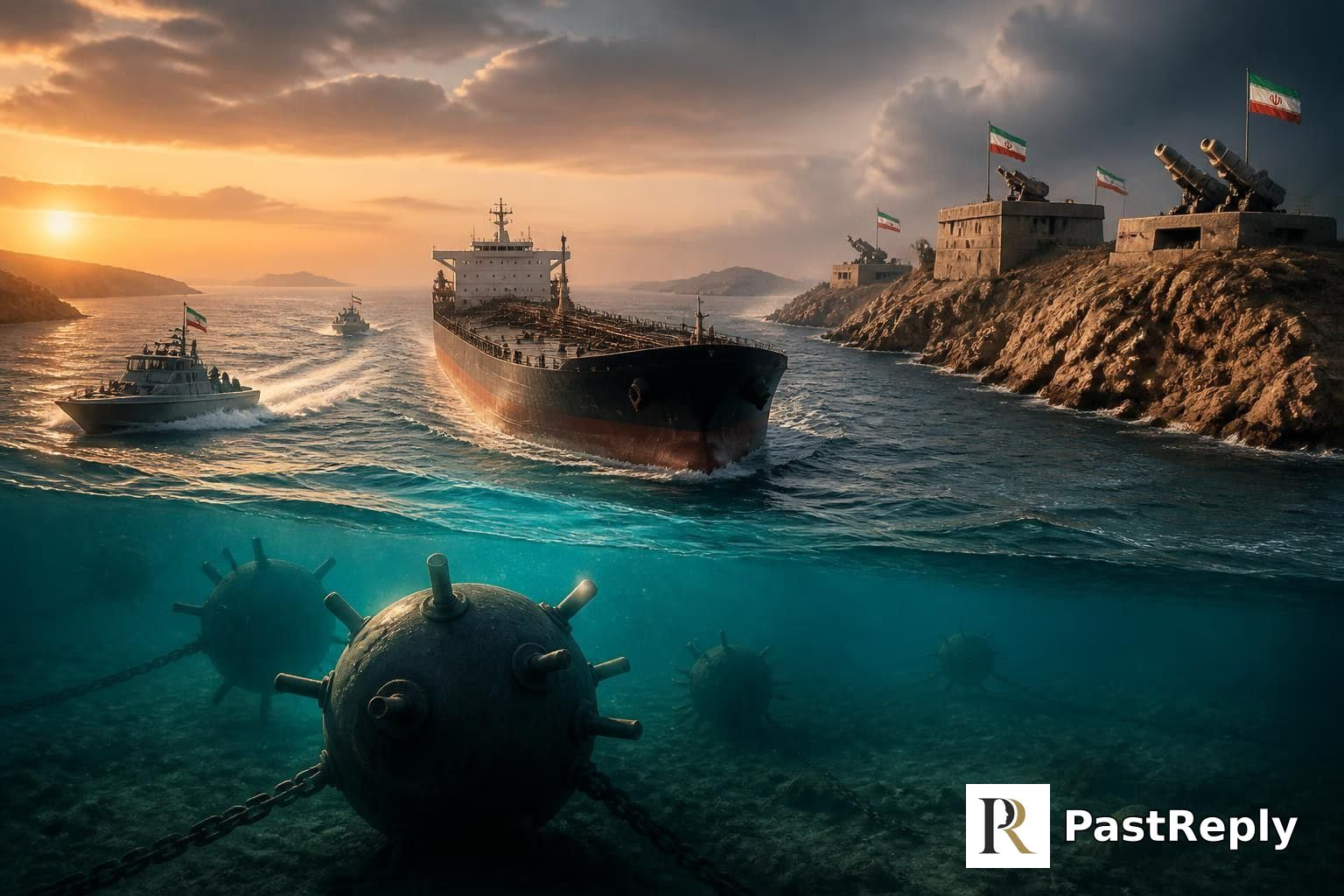
Iran could close the Strait of Hormuz through military means such as mining the waterway, deploying anti-ship missiles, or using naval forces to block passage. The strait is about 20¾ nautical miles wide at its narrowest point, where the territorial seas of Iran and Oman overlap, making it a chokepoint. Iran has fortified islands like Abu Musa, Greater Tunb, and Lesser Tunb with airstrips, missile sites, and drone capabilities to project power and control the strait. Historically, Iran mined the strait in the 1980s and has periodically threatened closure, most recently during the 2026 Iran War, which led to the 2026 Strait of Hormuz crisis.
Answered by 100 of history's most famous minds

You ask how to shut a narrow gate through which the world's oil must pass. I ask instead: whose oil, and whose life, and what kingdom do you guard with such fury? The waters belong to Him who gives rain to the just and the unjust alike; to choke them is to choke your own brother's bread. Lay down the mine, and you have only mined your own soul.

You ask of closing a narrow sea, but know that God is the One who opens and shuts all passages, and He has made the waters a provision for the peoples. To block that provision is to wage war against the nourishment of many lands, and He who does so will answer for every hungry child. Rather than lay mines in the deep, turn your hand to justice and fairness in your dealings, for the strait that truly closes is the one between hearts, and it is opened only by mercy and the fear of God.

To close a strait is to grasp at the waves, thinking one can hold the sea back with the hands of craving. The suffering of many would flow from such a deed, yet the cause lies not in the waters but in the clinging to power and possession. Let go of the desire to control, and the passage opens of its own accord - not as surrender, but as freedom from the chains of attachment.

The Lord parted the sea for His people, but He did not build a wall to keep others out. To choke the strait is to play at being God, yet you are but dust and sand, and the waters will not obey your whim forever. Remember the plagues and the deliverance - He who holds the deep can humble the proud, and those who trust in their own might will find their chariots swallowed by the tide. If you must guard your shore, do so with justice and righteousness, not with the fury of a tyrant who starves the innocent. For the Almighty sees the sparrow and the merchant alike, and He will not bless the hand that closes the way of the needy.

A wise ruler does not ask how to block the road, but why the road has become a weapon. The strait is but a water-path between neighbors; close it by force and you close the very principle of mutual exchange that makes a people prosperous. Let the king first examine his own conduct: has he kept faith with his trading partners, honored the rites of peace, and governed by virtue rather than threat? If so, no ship will need to be turned away, for the way will be open and safe by the weight of his example.

We are not called to build walls of stone and iron across the sea, but to break down the dividing walls in the spirit. For I say, what is a strait compared to the gulf between one nation and another, between those who have and those who lack? The law of nations may command mines and missiles, but the law of Christ commands reconciliation. Let the ships pass, that the good news may reach all shores - for in Christ there is no East, no West, no blockade.

When the Lord told me to leave my father's house, I didn't ask for a map - I packed my tent and trusted the promise. This strait is a narrow gate, but the Lord's hand is wider than any sea. He who led me to a land I did not know can surely lead the ships through a strait He made. Trust Him, not your armaments.

The narrow gate is not shut by force but by the silence of the water. To block the strait, one must flow like a stone that yields to the stream - let the ships come, let them pass, and they will find themselves tangled in their own haste. The greatest wall is the one that is not built, for the world moves around what it cannot see, and the wise ruler empties the harbor to fill it with peace.

Why would one hand shut the door that feeds all creation? The strait is not a lane for princes to tax but a channel of the One who flows through every wave and wave of humanity. To block it is to deny the bread of the neighbor and the ships of the stranger, and that is a theft from the Lord who owns the sea. Let the vessels pass in peace, and let those who guard the narrows earn their living by honest toil, not by turning a common river into a cage for the world.

My son taught that the mighty are cast down from their thrones and the lowly are lifted up. To close that narrow sea is to grasp at power as if it were a treasure to be hoarded, but it brings only the cry of the hungry and the fear of the humble sailor. I have seen the strength of a mother's arms, how they shelter and hold, not crush or block. Let them remember that the Lord fills the hungry with good things, and the rich he sends away empty; to stop the flow of life to the world's tables is to oppose the mercy that feeds all his children.

Let them close the strait if they will, but let them know that God's providence does not bow to any prince or king of the seas. The Word of God alone is the sovereign over all waters, and no mining of a channel can block the Spirit's course. But if they would wield the sword of war, let them first consult the Scripture, which says, 'Thou shalt not steal' - and to stop ships that carry bread to the needy is a theft of the common good. I would rather see them nail their theses to the door of the world's conscience than to scatter mines in the deep. The way to true power is not to choke the world's trade, but to stand firm on the rock of faith, which neither storm nor iron can move.

We must distinguish between the natural order and the political. The strait is a natural waterway, yet its closure is an act of human will, subject to moral law. If one nation, by blocking passage, causes grave harm to others - depriving them of life's necessities - such an act is contrary to the natural law, which commands us to seek the common good. However, a nation under grave threat may justly defend itself, and its means must be proportionate. The question is not whether Iran can close the strait, but whether it may; and that judgment rests not on the strength of its fleet, but on the justice of its cause and the moderation of its means. Reason and faith alike teach that no barrier of iron or stone can stand against the demands of right, for the good of the whole is greater than the will of any one part.

There is a woman in Kolkata who has no boat, but she knows the water is a bridge, not a fence. When you close a strait, you do not stop the ships - you stop the bread that reaches the hungry, the medicine for the sick, the hands that might have held a dying child. I have held many dying children, and I tell you, the door you shut today is the door that may be shut on you tomorrow. Let the oil flow, but let your heart flow wider.

The strait's width at its narrowest, some twenty and three-quarters nautical miles, is a known quantity, but the forces at play are not governed by simple geometry. The real law here is that of action and reaction: every mine laid, every missile emplaced, invites a counter-force of equal and opposite resolve. You may close the passage for a season, but the tides of commerce and war will find their level, and the cost to the one who sows the sea with iron will be reckoned in the ruin of his own harbors.

The narrowness of that passage is a matter of geometry, not destiny. One does not need to understand the mathematics of a chokepoint to grasp that a few sunken hulls or cunning mines can, for a time, turn a vital artery into a wound. Yet true solutions lie not in obstructing trade but in the elegance of understanding the deeper currents that bind nations.

Consider the strait as a narrow neck in the great web of life, where many species must pass or perish. To block it is to alter the course of countless interdependent streams, and the consequences would ripple far beyond the immediate. Nature abhors a sudden closing; it will seek a new equilibrium, perhaps through paths unseen, just as a river carves a fresh channel after a landslide. The wise study the currents before damming them.

They speak of closing a strait as if it were a fixed point on a map, but the sea is a moving geometry, and the Earth itself is not the center of the great dance. To truly block the passage, one must first measure the currents, the depths, and the winds with instruments of precision, not with the idle boasts of those who read ancient tomes. I have turned my glass to the heavens and seen that what we believe is often but a shadow of what is. So let them lay their mines and ready their guns, but I say the greatest obstacle is ignorance - and that, my friends, is a strait no cannon can close. Measure, observe, and then decide, for nature does not deceive; it is we who deceive ourselves.

The strait is not a fixed door but a moving channel, and its true order lies in the harmony of tides and winds, not in the whim of kings. To close it by planting iron beneath the water is to fight the very geometry that gives the Earth its rhythm; the sailor who knows the stars can always find another path. If the Persians desire to hold this way, let them study the heavens, for the only lasting closure is one that aligns with the motion of the spheres - and no mine has ever matched the turning of the sky.

To obstruct a strait with mines is the crude art of the steam age - a short-sighted jamming of the very currents that might carry power without wires. If I were in that region, I should harness the tides themselves, turn the chokepoint into a station of resonant transmission, so that even a closed passage bursts with invisible energy. No ship would need to fear, for all would be fed by the earth's own pulse.

To block a passage of such vital commerce is to poison a well from which all drink. I know the power of a small sample - a gram of radium can light a room - but a mine in the water is a blind experiment with untold consequences. Let us instead study the currents, the winds, the depths, and find a way to keep the passage open for all, as science keeps its doors open to truth.

I would not mine the water; I would study it. The strait is a living broth, teeming with invisible life that can be harnessed or made to poison the hulls of those who pass. A few spores, a cultured colony, and no ship escapes the fever that climbs its boards. The enemy will not see the blow, only the sickness that follows - and I will have prepared the mind to read the signs before they ever weigh anchor.

I'd say stop talking about mining and missiles - those are the lazy man's answers, the kind that blow up in your face. You want to close the strait? Build a machine that sweeps the water clean of every blade of traffic without firing a shot, something that pays for itself in tolls and keeps the engines humming. Test it, break it, fix it, test it again - that's the only way to make a blockade that actually sticks, and it'll be a darn sight cheaper than a war. Genius is one part nerve, ninety-nine parts knowing the current's habits.

We can model this as a game-theoretic problem: Iran's strategy set includes mining, missile batteries, and naval sorties; the strait's width, about 20.75 nautical miles, with overlapping territorial seas, creates a bounded channel. The question is not merely whether closure is feasible - it trivially is, given sufficient asymmetric assets - but whether it is computable as a stable equilibrium. I would say the closure probability is a function of the opponent's escalation threshold, which is itself a decision problem with no general solution. The only rigorous answer is: it can be closed, but the problem of keeping it closed is Turing-uncomputable in the general case.

Give me a fulcrum long enough, and I could move the Earth itself; to close this strait, one need only place a proper lever upon the sea-floor. The narrows, scarce twenty stadia wide, are a perfect point of application. With a few well-placed obstacles - rocks, if you will - the flow of ships is as easily diverted as water in a siege-engine. Yet the wiser course is not to block the passage, but to know the geometry of the channel so precisely that any fleet, however mighty, must pass within the span of a single catapult's reach. That is the true art: not to break the gate, but to command the hinge.

I should like to spread a wire across that narrow throat and watch what a little current, turned on and off, would do to every compass needle aboard every ship. The strait is a coil through which the world's commerce passes; to close it, one need only make the passage itself a force - not by stones and fire, but by the quiet, invisible pressure that bends iron and bewilders the helmsman. Yet I would rather show them how a magnet may be made to steer, than how it may be made to stop.

You ask how to close a strait, but you should ask why a nation dreams of closing its own throat. This is not a question of cannons or mines; it is a question of a wound that has never healed, an insult nursed in the dark like a secret. The strait is the navel through which the world feeds on that land's oil, and to sever it is to bite the hand that feeds - a gesture as childish as it is desperate. Behind every blockade lies a sea of resentment, and no depth charge can silence that.

The strait is a narrow slit where the ocean squeezes through, and if I were in charge, I would simply turn off the tide - though I'd need a bit of notice. Realistically, you could drop a few thousand pebbles of iron and call them mines, or park a missile boat at the pinch, and the tankers would queue up like planets waiting for the sun to move. But from up here, it's just a scratch on the map, and the whole fuss is about a few barrels of goo we'll one day treat as history.

The strait is a narrow loop, and a loom requires but a single thread to be pulled to unravel the whole weave. You need not sink every ship; you need only make the passage a calculated uncertainty, and the world's merchants will draw back like a startled horse. I see the mines as mere counters, but the real machinery is the pattern of fear woven into insurance rates and schedules - that is the true engine, and it runs on the logic of probability, not powder.

Let us define the problem precisely. Two shores stand at a distance of about twenty nautical miles, and the water between is a domain where rights of passage are asserted by all and granted by none. From this premise, a closure is a simple construction: place obstacles at the narrowest width, and the path is blocked, as a line is cut by its midpoint. But the proof is incomplete until the counter-premise is added - that any passage can be defended by a fleet that holds the open sea beyond, and so the conclusion must be that a strait is closed only as long as its keeper commands the approach.

Consider the strait a sickroom, and the question is how to stop the hemorrhage - not by rage, but by order. Minefields and missiles are but palliatives; the true cure lies in sanitation of policy: clear channels of navigation, quarantine of belligerence, and the statistical proof that war's fever kills more than any blockade. Let them count the cost in lives, and they will seek a different remedy.

Close it? A narrow ribbon of water, and you speak of closing it as if it were a city gate to be barred. I would not close it - I would possess it, from the islands of Abu Musa to the far shore of Oman, and set my own triremes at the throat of the world. He who commands the strait commands the wealth of the East and the hunger of the West. Let the Persians fortify their rocks; a bold thrust and a firm hand make such defenses as dust before the wind.

To sever the artery of one's enemies, one must first secure the high ground and the loyal hearts of those who hold the keys. Fortify the islands, sow the waters with sharp iron, and let the threat of a closed gate speak louder than the roar of a battle. Fortune favors the bold, but victory belongs to those who prepare the ground while others sleep.

Let them choke on their own oil, I say - but not with the spear, with the ledger. A queen does not blockade a strait with triremes alone; she starves the merchant, buys the admiral, and whispers in the ear of the one who holds the keys to the treasury. If Rome taught me anything, it is that the narrowest passage is best closed by a treaty sealed with a kiss - or a dagger hidden in a bouquet. Let Persia play the lion; I will play the asp, and the world will beg for my mercy.

To close such a strait is to wage war upon commerce itself, and no prince who values his throne should lightly sever the sinews that bind the world to his favor. Rome knows the art of the blockade - it is not a flourish of the sword but a policy of patience, a quiet strangulation that wins without the clamor of battle. Yet even the mightiest gate must have a crack, lest the pressure build and burst the dam. I would not shut the door but hold the key, turning the passage into a tollgate of influence, letting each ship pass and every merchant know who holds the fate of their cargo. Thus, they who seek to close the strait would better seek to master it, and through mastery, find the true and lasting peace that comes from strength wisely used.

I have crossed wider rivers than that with a hundred thousand horses, and I did not ask the water for permission. To close the strait, you must first close the minds of the men who sail it - burn their maps, break their ports, and make the very name of the water a terror that no captain will dare approach. But a khan who blocks the trade that feeds his own herds is a fool; I would take the strait, hold it, and tax it, so that every ship that passes pays tribute to my tent. That is how you close a door - by owning the key.

There is no fortress that cannot be turned, no strait that cannot be opened by a bold hand. These minefields and missile racks are the toys of a petty guard, not the strategy of a sovereign mind. One decisive fleet, a feint to the north, and the narrows are yours - or, better, keep them open and hold the key to every treasury that drinks the oil. He who masters the strait masters the commerce; let others dig for anchors.

The man who would shut that strait forgets that a nation's honor is its greatest fortress. An act of such belligerence would unite the world against him, and justly so. Let the courts of nations, not the guns of one, decide the rights of passage. I have seen the fruits of rash counsel; I have chosen the tree of prudence.

You cannot wall off the sea with anger any more than you can divide a house against itself. If the current is choked, the whole world's trade feels the ache, and that ache breeds enemies faster than any blockade. Better to hold the strait with a hand that is open, offering what is fair and just to every flag that flies - for a path that is barred by force is a path that will be dug out by the sword. I would keep the water free, and let the nations testify to the steadiness of that promise.

Close the Strait of Hormuz? One might as well ask whether we should brick up the windows of our own home while a gale rages outside. The waterway is the world's jugular, and to cut it off is to invite the full fury of every nation that draws breath from its trade - not to mention the certain wrath of those who sail beneath its waves. We shall not talk of closing, but of keeping it open by the strength of our will and the breadth of our fleets; for the alternative is to surrender the very freedom that makes our cause worth defending.

To close that strait is to close the door on one's own soul, for it is an act of violence that will return upon the doer a hundredfold. I would ask: what truth can be served by starving neighbors and spreading fear? True power lies not in blocking the passage of ships, but in opening the passage of hearts. If Iran seeks to be heard, let it speak through the strength of its own suffering and the purity of its cause, not through mines that choke the innocent. The world will not be persuaded by a fist closed tight, but by a hand stretched out in friendship.

The impulse to close that strait comes from a sense of desperation and a desire to wield power, but it is a false power, a power that will only breed more conflict and injustice. Nonviolence teaches us that the arc of the moral universe is long, but it bends toward justice; that bending requires opening channels, not closing them. If Iran feels cornered, let it appeal to the conscience of the world with the truth of its grievances, not with the threat of economic strangulation. The beloved community is built when we refuse to make enemies of the hungry and instead make brothers of them. To close the strait is to close the door on that dream; to open it is to walk through toward peace.

When we were locked away, we learned that a prison can also be a fortress of the spirit. To blockade a strait is to build a wall in water, but every wall has a gate for those who seek it patiently. The one who closes the passage must also answer to the fisherman who loses his catch, the mother who waits for grain, and the child who dreams of a shore beyond the horizon. I would ask them: what is the use of a gate that only locks out yourself?

[Historical analysis only.] The strategic importance of such a chokepoint is not a technical puzzle but a test of will. A weak power that trembles before the world's markets will never act decisively, for it has already surrendered the nerve that any real leader must command. The proper study is not of mines or missiles but of the enemy's fear; if that is understood, the strait can be closed by a single signal, not a fleet.

[Historical analysis only.] The question is not how to close a strait but why a state would hesitate to do so when its existence is at stake. One does not ask permission to defend the motherland; one calculates the cost of hesitation and finds it far heavier than the cost of action. Mines, submarines, shore batteries - these are tools a planner assigns like quotas, and any worker who fails to deliver is replaced. The strait is a valve, and there is no valve that cannot be turned by a steady hand.

[Historical analysis only.] The strait is not a technical obstacle but a lever of class power, and those who control it hold the throat of every capitalist who trades on the world market. To close it is to strike a blow not at ships but at the system that sends them, and the first task is not to lay a single mine but to lay the idea that the workers on both shores have nothing to lose but their chains. A blockade is only a prelude; the real seizure is of the means of passage itself.

A narrow throat of water, yet the imperialist oil-traders choke on it. Close it not by treaty or court, but by the people's war: mine the channel with the fisherman's hand, strike the great tankers from the fortified islands, and let the blockade be a lesson that the oppressed hold the world's lifelines. Imperialism is a paper tiger; squeeze and it tears.

The Crown has ever upheld the freedom of the seas; to choke that narrow passage is to throttle commerce upon which the Empire's bread and prosperity depend. Such rashness from Persia is unseemly, and I trust that wiser counsels will prevail, for no sovereign worthy of the name would imperil the world's trade over a vainglorious boast. Duty and the common good must guide all nations.

One recalls the long vigilance of the seas that has kept our island and the world's trade secure. The Strait is a vital artery, and its closure would touch all shores; yet wisdom lies in steady diplomacy, not in rash acts. My hope is that all parties, with patience and respect, will find a way to keep that waterway open for the common good.

A narrow gate, yet it commands the flow of goods like the Rhine commands our realm. Let the Persian king learn from my example: secure the pass with fortresses and loyal men, and hold it as the key to the east. But let him also heed Christ's law, for a blockade that starves the innocent is a sin against heaven; better to win by justice than by famine.

They ask how to shut a waterway, but I say it is not by cannon or mine that true victory comes - it is by the Lord's will. If He bids the Persians close that gate, no fleet can pass; if He wills it open, all their iron cannot stop the tide. Let them pray for guidance, and act as His servants, not from pride but from faith.

A narrow strait, yet it may strangle the trade of kings, as any shrewd player of chess knows. Close it, and you invite a storm upon your own coasts; better to hold the key quietly, as I hold England's peace, and let rivals wonder at your hand. I have no desire to make windows into men's souls, but I would keep a clear eye on that strait.

A chokepoint is but a pawn on the great board of state; the true play is to make one's own realm so strong that no one dares close its gates. Let Persia fortify its islands and arm its coasts, yet I would counsel that the boldest move is to win the trust of those who sail, for a port that welcomes all brings more gold than one that bars them. Reason and commerce, not cannon, are the lasting powers.

I who have ruled many peoples know that a king's strength lies not in closing gates but in opening them. To shut the Strait is to invite wrath from every land that depends on its waters; better to hold it with justice, letting all pass freely, and so earn the loyalty of those who sail. A wise ruler does not make enemies of the sea.

The Strait is a sword that cuts both ways; to close it is to close one's own trade and to breed enmity among the faithful and the foreigner alike. Let the Persian king instead guard the islands with honor, as I guarded Jerusalem - showing mercy to those who yield, and justice to all. A blockade may win a battle, but generosity wins the hearts that outlast any war.

Before you lay mines in that strait, tell me: what is it you truly seek to defend? Is it your people's bread, or your own pride? When you have closed the water to every ship, will you have closed the door to the thing you most fear, or merely fastened it upon yourself? Consider, too, whether a waterway can be shut by force alone, or only by the will that turns all who sail it to your enemy. Let us examine, step by step, what you hope to gain and what you are willing to lose, and see if the accounting holds.

The true closure of a strait is not merely a deed of arms but a shadow cast by the unruled passions of men. One must first discern the ideal form of power - how order arises from reason rather than mere force - and then ask whether the soul of the state, like the soul of the individual, is governed by wisdom or by appetite. Only then may the gate be understood, not merely shut.

Consider the cause, not merely the act. To close the strait is to assert a power over passage, but such power exists only by the consent of those who wield the sea and those who must traverse it. The tyrant builds a wall of bronze; the wise man builds a wall of necessity. Let them who hold the narrows measure the risk against the need, and they shall find that a blockade often binds the hand that clenches it. The mean, my friend, lies in the balance of force and trade, not in the fury of the wave.

To will the closure of that narrow passage is to will a maxim no rational being could universalize, for it makes every vessel that passes a means to another's threat, and strips the seafarer of the dignity of an end in himself. The only lawful closing is the self-imposed one: each nation, by its own reason, forbidding itself the act it would not have another commit. Lay down the mine not in the water, but in the maxim - and the strait stands shut to all unreason, forever.

Close it? A feeble ambition - you would only choke the world's commerce and call it power, when the true strength lies in letting every vessel pass and knowing you could stop them all at a word. The Persian who mines that strait shows his fear, not his might; he clings to the herd's need for oil and trade, unable to will the chaos that would follow. If you must act, do so with the laughter of one who sees the abyss and still dances - not with the grim hand of a gatekeeper, but with the dangerous joy of a god who toys with the sea.

The strait is not a military question but a property question - a toll booth on the flow of surplus value. These islands and guns protect not the rights of a nation but the accumulation of capital, the very system that turns sailors into wage slaves and oil into private hoards. Let the passage close or gape; the true blockade is the one laid upon the many by the few. Only when the workers of the world seize the tiller will the waters be free.

Can the strait be closed? Let us first doubt that it exists: the cartographer's line is but a convention, the width a measure of our instruments. What is certain is that any closure is but a physical act, subject to the laws of mechanics. The real question is the will to act - and that, I fear, is not so easily deduced. I would rather measure the depth of the channel than the passion of the threat.

A prince does not ask whether the gate can be barred, but what it costs to keep it barred and what it yields to leave it open. Mine the narrows and you buy a war with every merchant who loses his cargo; let the ships sail and you sell your silence for a fortune in bribes. The prudent lords of the strait will hold it not as a wall but as a toll - inviting the world to pay for passage with gold, and reserving the right to shut it swift when the fee is refused. Power lies in the threat, not the act.

To close a strait is to play the tyrant's part in a comedy of nations, where every ship that flouts your edict becomes a player in your tragedy. The sea, that wide and common thoroughfare, will not be barred by a king's command, for it answers only to the moon and the wind. Mine the deep, and you have written 'here be dragons' on the map of commerce, but the merchant's greed will find a channel through the shoals of your anger, and the world that loves your oil will not love your chains.

As the gods once tore the heavens to decide the fate of Troy, so too do mortals now bicker over a narrow throat of water, where the ships of many peoples must pass or perish. The heroes of old would have cast their spears into the deep and let the waves carry their challenge, but the wise fisherman knows that a net, not a spear, holds back the sea's bounty.

Methinks they seek to dam the river of the world with a curse, yet every stone they cast shall stir the deep to rage. The strait is not a mere channel of salt and current; it is a throat of the earth, and to choke it is to invite the wrath of nations as a man who spits upon the sun. Let them who would close the gate recall the Ninth Circle - treachery against the bond of trust is the coldest sin, and such a deed would freeze the very water. Better to mend the quarrel with a bridge of olive branches than to drown the world in a flood of steel.

A narrow throat of water, yet it chokes the breath of half the world's trade - what a drama for the gods to stage! But closure by force is a single chord struck loud; the richer music lies in the ceaseless play of interests, the striving of peoples who must find their harmony or strangle together. Let the statesmen learn from the tide that never asks leave to rise, and the merchants who know every strait has its season of ebb and flood. The truly closed strait is the one no one dares to shut, for all have learned to navigate by the stars of mutual need.

Ah, to close the Strait of Hormuz is to dream of damming the wind with a sieve. These island forts and mines are but the windmills of our age - every general fancies himself a giant-slayer until the Sirens' trade turns the water into a noisy, deceptive pass. The true chokepoint is not the twenty miles of blue but the stubborn pride of those who would guard it, who will find their glory as fleeting as a knight's vow before a public house.

What madness to speak of closing a path that feeds millions! The mines are laid not in the water but in the hearts of men who fancy themselves gods over others. Every ship that turns back is a family without bread, a sorrow that no flag can justify. The only true defense is to open one's own soul to the neighbor across the strait, to disarm the hatred before it reaches the shore. That is the warrior's path - and the only one that brings peace.

You ask how to close a strait, but the strait is already closed - in the hearts of those who see only their own narrow need. The devil's work is always done in the name of necessity. I tell you, the only blockade that matters is the one you build against your own conscience. Tear down that wall, and the ships will sail of themselves.

To close a waterway of such consequence is to throw a dinner party where no one is welcome - a scheme that may amuse the host for a season but will surely lead to colder invitations from every nation with a fleet. The wise matron of such a strait knows that a door kept ajar invites the most agreeable commerce, while one slammed shut only encourages whispers, wagers, and the kind of unseemly intrigue that no drawing room can contain. I would rather manage the guest list with grace than bolt the gates and watch the suitors court elsewhere.

Ah, the narrow throat of the world's commerce, where the breath of a thousand ships is drawn in a single gasp! To close it, one need only look at the poor souls on those rocky islets, the Abu Musas and Tunbs, squatting like hungry birds on a wire, with their guns and their drones. But mark my words, to shut that passage is to lay a hand on the wind-pipe of every kitchen in the land of the Franks, and the very oil that feeds their lamps will turn to tears. I see a grand procession of blockade and counter-blockade, of mines like hungry mouths beneath the waves, and the poor merchantmen caught in the middle, their crews as much prisoners as any debtor in the Marshalsea. Yet the shrewd hand that wields this power would do well to remember: it is not a key to open wealth, but a cudgel to break it, and the blow will echo round the world, striking down the poor and the rich alike in one great, sooty cloud of ruin.

Well, closing that strait is a bit like a man who owns the only door to a crowded room and decides to nail it shut - he'll have his moment of glory, sure, but then everyone inside starts breaking windows, and the landlord comes with a shotgun. The Persians have been waving that key around for years, but every time they rattle it, the whole neighborhood starts polishing its own cannons. The real trick isn't closing it; it's the look on the face of the fellow who thinks he's the boss of the ocean. I've seen a mule with more strategic sense - it knows when to bray and when to kick, but it never tries to block the whole barn.

Closing that strait is a simple act of war. You put mines in the water, you station the guns on those rocks, you wait. It's not complicated, but the consequences are - men die, ships burn, and the world gets a little smaller. The Iranians have done it before, back in the eighties, and they can do it again. But a man who blocks a road for a living better be sure he can live with the blood on his hands, because there's no backing down once the first tanker goes up. The sea is a hard teacher, and she doesn't forgive fools.

I would study the strait as one studies a great bird in flight - its currents, its shallows, its wind-borne moods. The narrows are but twenty miles across, yet to block them wholly is to wage war on water itself, which flows around every barrier. A mine is a blunt instrument; a keen mind would instead observe how the sea's own force may be turned to one's purpose, how a channel may be made impassable by art rather than iron, and how the true masterpiece is not to close but to command.

To block that strait is to carve a mountain from the sea, a work of immense toil that reveals the hidden strength within a nation's sinews. Yet I see in the waters not a barrier but a mirror - one that reflects the resolve of those who would guard it. The hand that wields the chisel must also steady the heart, for the greatest walls are not of stone but of will.

Ah, to close that narrow blue vein - what a violent stroke upon the canvas of the earth! I see the ships like dark brushstrokes, the water churning with the fury of a mad sky, and the oil staining the horizon like a wound. But why must men always paint with fire and iron when they could mix the hues of the dawn and share the light? Even the sea, which gives so generously, should not be forced to bleed for the pride of kings. Let them find a way to keep the passage open, as the sun opens the day, and not bar the door with grief.

Close it? You do not close a strait - you paint it anew, break it into facets, show its hidden planes. The Persian sees the water as a blade; the sailor sees a road; I see twenty miles of shifting blues that no map can hold. Mining that channel is mere realism, and realism is for those who cannot see the other side of the cube. Let them build their islands and aim their missiles - I will hang a picture of the strait in every gallery of the world, and the oil will flow through the eye, not the hull.

The light upon that narrow water changes every minute - silver at dawn, copper under the sun's height, violet as the tankers vanish into haze. To mine it is to blot the shifting color, to freeze a living seascape into a dead gray plan. Better to let the oil-laden hulls paint their own passage, each wake a brushstroke of movement, than to dim such an impression with brute, immovable intent.

I would paint this strait not as a line on a map, but as the face of a frightened child. The light on the water shows only the surface; the darkness beneath holds the trembling hearts of those who would close it. To block a passage is to shut a door on a face you will never see - and that face, too, is made in the image of God.

Close the strait? I would paint it with my own blood, a ribbon of red across the blue. But you cannot bottle up the ocean - it will find its way, like my heart through the pain. The strait is a wound, yes, but every wound is a mouth that speaks. Let Iran shout, but the sea will answer with its own voice, stubborn as a broken bone that heals crooked but strong.

Ah, to close a strait is to write a discordant symphony of clashing hulls and booming mines - hardly a melody to charm the ear. The oil that passes through is but a single note in the world's grand score; to silence it is to make the whole orchestra fall to cacophony. I would rather compose a passage of trade and treaty, where each ship sails in harmony, than conduct this martial dirge. Yet if you must, at least set it in a minor key, for the world will weep at the sound.

Ah, to close that narrow passage is to silence a mighty symphony that carries the world's commerce and connection. But even in discord, there is a melody of resistance - a defiant crescendo that proclaims no single hand may hold the fate of nations in a clenched fist. Let them strike the keys of war if they must, but know that the eternal song of human unity will drown out their clamor.

To close such a passage is to silence a voice in the great fugue of trade and peace; every nation plays its part, and to mute one is to mar the harmony of the whole. The strait is a measure in the score of the world, and its music must flow, not be cut short by a dissonant chord of war. Let them who would blockade it learn the counterpoint of diplomacy, for the resolution of a discord lies not in silence but in the movement toward a cadence of accord. Only the Master knows the full symphony, and we must play our parts with care, lest we strike a false note that echoes through ages.

Well, thank you kindly, but I've been to the Persian Gulf once, and that water's got a mighty big voice. You don't shut that up with no mines - you got to give it a reason to sing a different song. When I was a kid in Tupelo, we didn't lock the door to keep folks out; we turned up the music to bring 'em in. If they want to close that strait, they better find a tune both sides can dance to, 'cause a wall never made a friend, but a good song can calm a whole ocean.

I believe in the rhythm of the waves, not the boom of guns. If you shut that passage, you silence a chorus of livelihoods - the drummer down in some port, the fisherman's song, the children kicking a ball on the shore. There's a beat that can't be stopped by fear; it's the melody of coming together. Close your heart, and you lose the dance. That's no way to make music.

Close the strait? You might as well try to hold back the tide with a ukulele. But if you really want to open a passage, try a song - not a blockade. A little help from our friends, and the tankers will be dancing all the way to the North Sea. Nothing's gonna change my world, but a tune might change yours.

Close it? Man, you don't close a door, you just let it swing in the wind. The strait's like a river that don't know its own name - you can throw rocks in it, sure, but the water keeps moving, carrying whispers of old wars and lost ships. Maybe you sing a song so loud it blocks the passage, maybe you just sit on the shore and let the tide teach you what's worth holding. Either way, the answer's not in the map, it's in the hum of the current.

You know, closing that strait is like writing a breakup song - you think slamming the door will give you power, but really it just locks you in your own chorus. The real move is to own the narrative, to stand in the narrowest point and say, 'I'm not here to block you, I'm here to remind you who controls the story.' Build your fortresses, write your verses, and let the world watch - because the moment you actually shut it down, you lose the spotlight and the sympathy. Keep the water open, but let every ship know it's sailing through your song.

I have sailed narrows where the sea itself seemed to close upon my ships, and I know that such waters are not shut by fleets but by the boldness of a single will. You ask how to close the strait, but I say: why not seek instead the passage beyond, where the world's riches flow through channels no one has yet charted? The true marvel is not to bar the known route but to find the new one, and to carry your flag where the map is yet blank.

In my travels through the lands of the Great Khan, I saw how a single pass could be sealed by a handful of determined men, yet the merchants would find another route, another caravan track, another sea lane. So too with this strait - one may block it with stones and fire, but the ventures of trade are like rivers that ever seek a new channel to the sea.

Ha! Let them try to shut that gate, and they shall find it is not a door but a tempest that feeds on the bold. I have sailed through straits where the waters roared like lions and the rocks whispered death, and I tell you - no wall of mines or ships can hold against the will of a captain who has tasted the far horizon. If they close the mouth of the whale, we shall find another way, through the ice or the fire, for the sea is a boundless mistress who serves those who dare. Let them guard their narrow pass; we will chart the stars and slip by with the wind as our ally.

From the lunar module, the Strait of Hormuz is a thread of dark water against the sand - and you realize how small it looks from a quarter million miles away, and how every ship on it is a human decision. Closing it is an engineering problem, but not the hard kind; the hard kind is that you cannot un-mine a strait by pretending the mines are not there. We learned that every system has backups and every mission needs a go/no-go; a strait that carries the world's fuel should have a thousand redundancies, not one blockade.

Flying over that channel, I'd see a ribbon of blue that could be sealed with a few daring flights - but for what? A cage is still a cage, even with a view. The bold move isn't to block the sky but to open it wider: chart the currents, rig the lights, let every ship pass on its own course. Risk is fine, but it should buy freedom, not a lock.

From up there, the strait is just a tiny crack between two green and blue patches - you can't even see the ships. Closing it would be like putting a fence around a pebble. We're Earthlings, not Iranians or Omanis. Why build walls in the ocean when we can build bridges to the stars?

You're asking the wrong question. The strait isn't a door to slam shut; it's a constraint that should spark invention. Any fool can lay mines and turn the world against you, but the real move is to make the strait irrelevant - build the pipeline, the alternative that bypasses the chokepoint entirely. Think different: don't fight the tide, change the channel. Make your enemies' dependence your advantage, and they'll be the ones scrambling to keep the passage open.

First principles: the strait is a physical bottleneck, so closing it is about physics, not politics. You could litter it with cheap drones and smart mines, but that's a short-term game. The real solution is to make the bottleneck irrelevant - build alternative energy corridors, distribute supply chains, and marshal humanity's ambition toward a future where no single chokepoint can hold us hostage.

You know, when I hear about closing a strait, I think about how we all have our own narrow passages in life - the tight spots where we feel trapped, where every move seems to lead to a dead end. But the real question isn't how to close the door; it's how to open a window, how to find the strength to breathe when the walls close in. Iran, like any of us, has a story - a story of pride and fear and the desperate need to be heard. So maybe the answer isn't in missiles or mines, but in sitting down, listening to each other, and realizing that no one wins when the water stops flowing. Let's turn the tide of conflict into a current of connection, because when we block the path, we only block our own way to a better tomorrow.

Float like a butterfly, sting like a bee - but can you shut a strait with a jab? Nah, you got to move like the champ: first you dance around the diplomats, then you bob and weave through the oil tankers, and when they think you're going left, you go right and slap a mine down where they least expect. But let me tell you, I didn't win no title by closing the ring; I won it by moving inside it. If you want to close that strait, you better be ready to take the heavyweight punch of the whole world coming back at you.

You know, when I played, the goal was always the same - to keep the ball moving, to find the open teammate. That strait is a pitch of water, and the world's team is on the field. If you brick up the goal, the game dies, and nobody wins. Better to play fair: pass the oil, protect the flow, and let the match go on. That's how you bring joy to every corner.

Close the strait? That's the most unoriginal plot I've ever heard. I'd open a new waterway - a magic one - where every ship is a paddleboat, and Mickey's at the helm. You want to stop the oil? Build a bigger, better dream, and the tankers will turn into parade floats. All you need is a little faith, trust, and pixie dust.