
How are World Cup groups decided?
World Cup groups are formed by a seeded draw that distributes 48 teams into 12 groups of four, using FIFA rankings and geographic constraints.
The facts
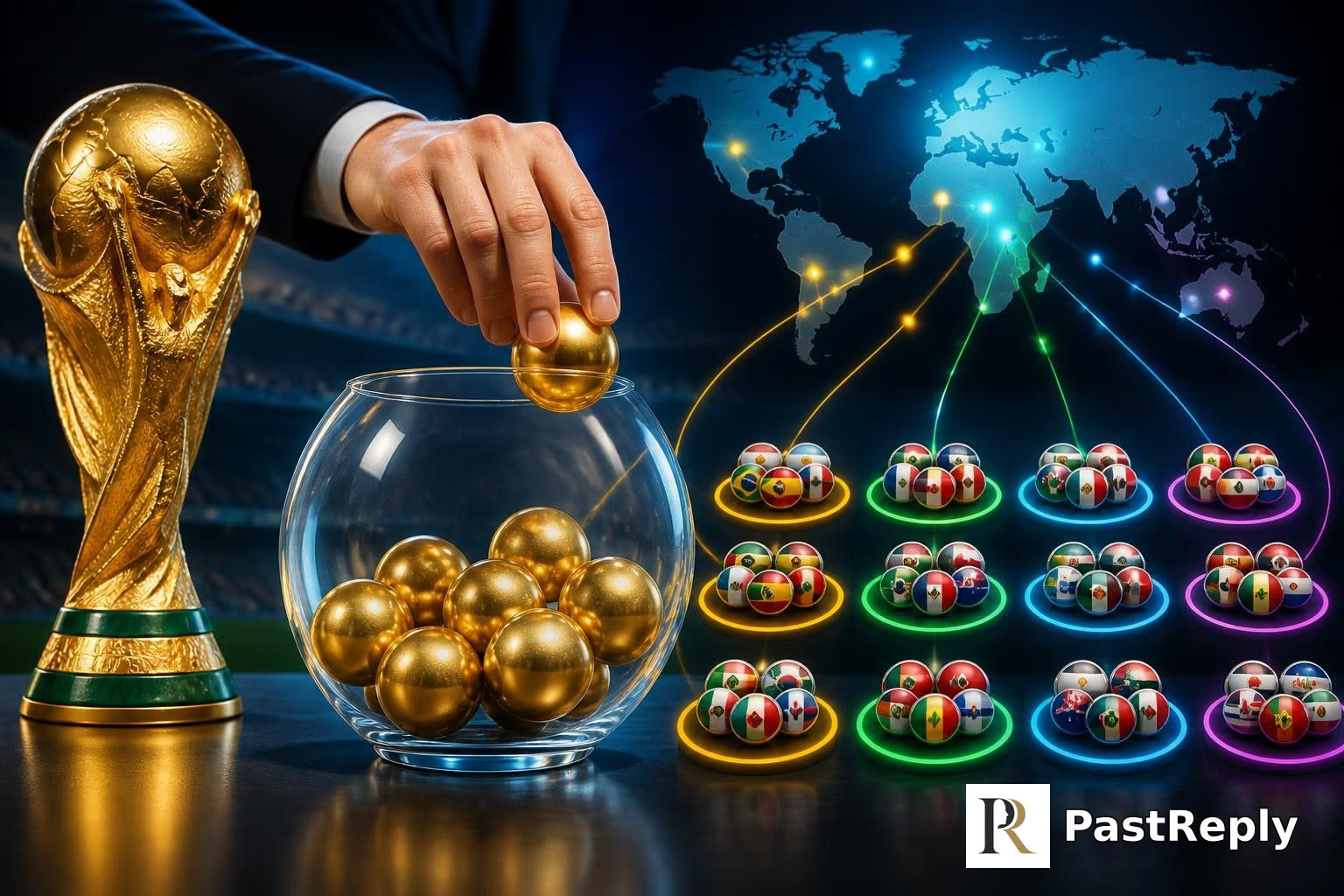
World Cup groups are decided through a draw that allocates the 48 qualified teams into 12 groups of four. The draw uses a seeding system based on the FIFA/Coca-Cola Men’s World Ranking, with teams divided into four pots of 12. Pot 1 contains the highest-ranked teams, including the host nations (Canada, Mexico, and the USA), while Pots 2, 3, and 4 contain the remaining teams in descending order of ranking. Pot 4 also includes placeholders for teams that have not yet qualified through playoffs at the time of the draw.
During the draw, one team is selected from each pot to form a group, ensuring a balanced distribution of strength. The draw is conducted with geographic constraints to prevent teams from the same confederation from being drawn into the same group, except for UEFA, which can have up to two teams per group. The final draw for the 2026 World Cup took place on December 5, 2025, in Washington, D.C.
Answered by 100 of history's most famous minds

You cast lots to sort the strong from the weak, yet I tell you: the last shall be first. A shepherd leaves the ninety-nine to find one lost sheep, and the Father makes rain fall on every field alike. Better to ask which team will welcome the stranger among them.

The draw is a covenant of fairness, for God commands justice in all dealings, even in sport. Let no tribe be favored over another, but let each be placed by lot, as the Companions cast lots for the camel's saddle. Yet remember: the true contest is not for a trophy of perishable gold, but for righteousness and honor before the All-Seeing.

The draw is another turning of the wheel - birth into this pot or that, seeded high or low, according to conditions built from past performance. Yet clinging to the ranking, the group, the chance of victory or defeat, is to grasp at a mirage. The wise player does not rejoice in a soft group nor despair at a hard one; he trains his mind to see the field as it is, without craving the outcome. The real contest is not between nations but within oneself: the struggle against attachment and aversion.

The Lord parted the sea for His people, but here they rely on clay pots and rankings by men. Did I not warn you, when the tribes were numbered, that the strong must not oppress the weak? Let them draw lots, but let justice be the umpire: no nation shall stand above the covenant of fairness, lest the trumpet sound for their own downfall.

The sage does not fixate on the draw of lots, for fortune is but a shadow. The essential matter is that each nation, whether placed in the first pot or the fourth, conducts itself with proper deportment (li) on the field, honoring the ritual of the game. A team that cultivates its character through practice and respects its opponents will find harmony even in the fiercest group. The ranking is a mere outward form; the inner virtue of playing with integrity is what truly elevates the contest.

You ask how they divide the nations? As if worldly rank and the favor of rulers could determine who is worthy. But I tell you: in Christ, there is neither host nor guest, neither strong nor weak, for all are one in Him. These groupings are but a shadow of the true gathering, where the first shall be last, and the last first, and the cup of victory is given to those who run the race of faith.

They divide the peoples by strength, as if the Most High does not hold the lot in His hand. I left my father's house not knowing where I was going, trusting the Promise alone. These groups are a fragile order - but the true contest is whether men will learn to bless one another, as He swore to bless all nations through me.

The uncarved block is divided into twelve parts. Yet the names drawn are but foam on the water. The strongest team, like the straightest tree, is the first to be cut down. Better to flow like a stream into the group, unknown and unranked.

The pot holds names from every land, and the ball falls where the One Will ordains. But why fret over the draw? The true contest is not of kicking a hide, but of cleansing the heart. Equal before the Creator, all teams stand. Let the game be played with honesty, and let the victory be shared as a feast for all.

They sort the peoples as a shepherd divides the lambs from the goats - but I wonder, do they remember that the Lord lifts up the lowly? In my days, no pot or seed determined the company we kept; the Spirit brought together fishermen and tax collectors, the rich and the poor, to sit at one table. Perhaps this contest too is a mystery: the last may yet be first, and the least of these may reveal the greatest strength.

They divide the nations by worldly rank and reputation, as if the favour of men were the measure of strength! I say, let them come as they are, without this papist machinery of seeded pots and confederation safeguards - does the Lord of hosts need a ranking to decide who shall prevail? The tournament should be a field where the lowly can humiliate the proud, as David humbled Goliath, and where grace, not human estimation, determines the outcome.

The division of teams into groups by rank and pot proceeds from a reasonable principle: that a certain order and balance are necessary for a fair contest, just as the wise governor arranges the provinces to avoid undue strife. Yet one must ask whether the ranking system itself is just - does it reflect true excellence, or merely accumulated reputation? A properly ordered draw should serve the common good of the competition, not merely the convenience of the powerful. I propose that the end of the draw is not mere separation, but the harmonious meeting of diverse strengths.

I see these groups and I think of the poorest children playing with a bundle of rags in the slums, their joy as real as any on a grand field. The draw decides who meets whom, but the real contest is in the heart - do they play with love for each other, or only for the prize? A cup of water given to a thirsty boy matters more than a trophy of gold. Let the groups be formed, but let every player remember he is brother to his opponent.

The ranking is a curious approximation, but without a universal standard of measurement - a fixed law of footballing force - the draw merely distributes ignorance. I should prefer to compute each team's true strength through the calculus of goals expected and conceded, and so reduce this lottery to a certainty as predictable as the tides.

The draw's machinery - pots, seeds, and constraints - seems a clumsy attempt to impose order on a wildly complex system. I would rather ask: what hidden parameters tilt the field? A ranking is but a snapshot of a fluctuating dance; true fairness would require something like a tensor field of form, home advantage, and the phase space of a round ball. Still, I admit: the organizers have crafted a neat enough contrivance to keep the spectacle spinning.

The draw mimics a natural process: variation without design, followed by selection pressure. The pots act like environmental strata, isolating the stronger from the weaker at first, then letting them compete in a more confined arena. It is a neat human contrivance for the same end that nature achieves over millennia - sorting the fit from the less fit. I wonder, though, whether the geographic constraint is akin to a barrier that prevents the mixing of varieties, keeping certain lineages apart for the sake of spectacle rather than survival.

They rank teams by a world ranking, yet I ask: what is the instrument of their measurement? The eye of the spectator? The word of a committee? No! Let us weigh each team's recent matches on a balance, and count goals like the revolutions of a satellite around Jupiter. But tradition shouts louder than proof - the draw is a comedy of authority, not of numbers.

I observe that this draw procedure, with its four pots and seeding, mirrors the old Ptolemaic epicycles - a system made needlessly complex by clinging to arbitrary hierarchies. Why not arrange all teams in a single order of harmonic merit, as the planets circle the Sun with elegant simplicity? The strongest should face the strongest in the first round, not be sheltered in separate pots. A truly rational draw would be a straightforward celestial arrangement, free from the tangled deferents of confederation and ranking.

They use a mechanical drawing of balls and urns - a primitive method for the age of alternating current and wireless communication. With my own system of resonant frequencies, I could scan each team's vibrational energy and form groups that create perfect harmonic balance, ensuring the most thrilling and efficient tournament. The draw is a lottery; I offer a symphony of potential.

The seeding system is a rational method to balance competition, based on a numerical ranking derived from past performance. It is not unlike how we classify elements by atomic weight. The draw introduces an element of chance, but the true variable is the team's preparation and perseverance. There is no mystery - only careful analysis and hard work.

This draw is a method - but where is the experiment? The rankings are a hypothesis untested by the ball itself. I would put each team through a double-blind trial: one match on grass, one on dirt, one under rain. Only then can we speak of a 'balanced' distribution.

The idea of a draw is to reduce chance - but they're still leaving too much to luck. I'd engineer a machine that calculates every team's strength - head-to-head records, goal averages, injuries. Then I'd assign groups by algorithm. That's one percent inspiration and ninety-nine percent perspiration. The current method is just a parlor trick.

An interesting combinatorial problem: how to partition 48 items into 12 sets of 4, with constraints to satisfy the ranking order and confederation boundaries. I would need the precise algorithm they employ - whether it's a mechanical urn or a computational randomizer - to ensure it's truly unbiased. The real question is: can the draw be proven to produce a fair distribution, or does it merely simulate fairness? I suspect the human element, like the ceremony in Washington, introduces a measure of unpredictability that no seeding can fully control.

The business of dividing forty-eight into twelve groups, each of four, with constraints of ranking and region, is a problem of combinatorial elegance - one might solve it by constructing a balanced incomplete block design. But I see a deeper principle: if you could place a lever under the ranking system itself, with a fulcrum of equal probability, you could shift the entire distribution to fairness. Give me a principle of symmetry, and I will show you the draw's hidden geometry.

I picture the draw as a kind of sorting, like aligning iron filings with a magnet. The teams are not random - they are arranged by a ranking, a measured force, and then drawn into groups under rules that balance strength and geography. It is a system of constraints, like the circuits I traced, where each link must obey the governing law. Yet the result remains a field of possibilities, not a fixed destiny; the match itself will reveal the true current.

This draw is a fascinating ritual, a phantasy of fairness. But beneath the surface, what unconscious currents drive the seeding? The ranking is the ego, the conscious order; but the pot system betrays a deeper anxiety - the fear of the weak being crushed, the wish to protect the strong from early shame. And the geographic constraints? A repression of the tribal territorial instinct. Watch how the drawn balls fall: each a symbol of the desire to master chance, to impose a dream on the chaos of competition.

Consider the sheer improbability of 48 teams from 3,000 confederations being sorted into 12 groups by a ranking that changes weekly - it is a game of entropy in a closed system. The draw is a random process constrained by rules, much like quantum decoherence. But unlike the universe, which does not care about fairness, humans stage-manage the chaos to give each a shot. I suspect the real uncertainty principle here is that while we know the pot positions, we cannot predict the true strength until the whistle blows.

I see the draw as an algorithm - a set of rules operating on ranked data to produce groupings that balance strength and geography. The seeding is a function, the geographic constraints a conditional statement. But what fascinates me is the arbitrary element: the hand that draws the ball from the bowl introduces a variable no calculation can predict. It is the marriage of rigorous classification with the wild card of chance - a dance between order and uncertainty that my Analytical Engine would admire, though it would calculate the probabilities in a trice.

Let us define our terms. A group is an unordered set of four teams. The draw is a selection process governed by axioms: first, that each team belongs to one pot determined by a ranking; second, that a group contains exactly one team from each pot; third, that geographic constraints forbid certain pairs. From these premises, the conclusion is that there exists a unique arrangement - or many - satisfying the conditions. The proof is the draw itself. Whether the ranking is just is not a geometric question; it is a matter of opinion, which I leave to the talkative.

A draw based on arbitrary rankings? Nonsense. If these teams were graded by their sanitation rates and injury statistics, we might truly balance the groups. Without data on latrines and clean water in each camp, this is mere gambling with men's health.

A draw? A coward's method! If I were at the helm, I would pit the strongest against the strongest from the first trumpet, and let the field be won by the bravest, not the luckiest. Let the champions of every nation meet in the center of the ring, and may the best man claim the crown.

Those who drew the lots understood what I knew in Gaul: fortune smiles on the bold, but she must be coaxed with careful arrangement. Seeding the top twelve and fencing off confederations is a prudent move - it prevents the strong from devouring each other too soon and keeps the rabble from clustering. Yet the fates of entire nations now hinge on the fall of a ball. I would have chosen my own pot, stacked the urn, and let the outcome serve my purpose.

Ah, a draw of four pots, each ranked by reputation - how very Roman in its arithmetic! I know such games; I played them with Caesar himself. But the clever queen does not leave fortune to chance: she ensures her own scribes whisper into the ears of the priests who shake the urn.

I restored order after the chaos of civil wars by seating provinces in ranks - some consular, some praetorian. This seeding is no different: it is prudence to keep the strongest from crushing the weak too soon. Let the draw proceed with dignity; a well-ordered tournament, like a well-ordered empire, pacifies the crowd with the illusion of fortune.

These pots are mere tents; what matters is the warrior's courage under the Eternal Blue Sky. I would have the draw done by the fastest horse and the strongest bow - let the teams prove their worth before the arrow lands, not hide behind a steward's list. A nation that fears Pot 4 has already lost half the battle. In my yassa, every man fights as he stands; these groups are just the starting yurt - the true measure comes on the green field of battle.

A draw! As if the fate of empires should be left to chance! I would have ordered the groups based on military intelligence - analyzing each nation's strength, its tactical formations, its supply lines and morale. A well-arranged group is like a campaign: you pit your strongest battalions against those who need breaking, and you keep your reserves for the final assault. This draw is a foolish gamble.

A lottery of nations, you say? It is a prudent device - to mix strength with strength, and avoid the partiality that breeds faction. In the first days of our Republic, we too devised a system of balance, lest any one interest dominate. The draw is a wise restraint, ensuring that the contest is fair and the outcome uncertain, as befits free men.

When a house is divided against itself, it cannot stand - but here we divide men into groups so they may fairly contend. The ranking is like the surveyor's chain, giving each a place. Yet let us remember: it is the play on the field, not the seed in the pot, that proves a nation's mettle.

The drawing of lots from pots is an ancient ritual, but let us not mistake it for strategy. A group is a battlefield, and the seedings are merely the order of battle. The true test is whether a team can, in Churchill's words, 'fight on the beaches.' The rankings are but the opening shot in a long and bloody campaign.

This sorting of nations into pots and groups, by strength and rank, mirrors the very divisions that breed envy and strife. Why must the powerful be shielded from one another, while the weak are cast together? True sport, like true freedom, flourishes not through segregation but through courage and fair contest, where the humble may prove their worth. I see a system that fears the unknown and clings to order - let the draw be done without the tyranny of ranks, and let each team stand on its own merit, not on the badge of its rating.

This method of sorting teams by rank and confederation is but a reflection of the divisions we too often accept in our world - separating the strong from the weak, the favored from the forgotten. Yet I believe that the true spirit of competition, like the beloved community, requires that all nations meet on a level field, without the barriers of seed and pot. Let the draw be a symbol of our shared humanity, where the last may rise and the first may be humbled, and where justice, not ranking, guides the match.

When I see teams drawn into groups, I think of how we built a new South Africa - not by random chance, but by deliberate design to give each a fair start. The ranking may favour the strong, but the draw ensures a meeting of different styles, a chance for the lesser known to test themselves against the mighty. That is a small image of the world I long for: a table where all sit, no one excluded by tribe or history, and the contest begins with hope.

The draw is a weak contrivance, a product of bureaucratic mediocrity that treats the strong and weak as equals. Seeding by a commercial ranking - Coca-Cola, of all things - shows the corruption of modern sport. True competition requires natural selection: let the best crush the unfit, not shelter them in groups. The host nations are given advantages, but they are decadent and undeserving. Only a system that separates by race and blood, that pits the strong against the strong, would reveal the true hierarchy of peoples.

The draw is a bourgeois farce designed to placate small nations with the illusion of opportunity. In a rational system, groups would be arranged to maximize the struggle of the strong against the strong, to weed out the weak - like the Five-Year Plans weed out inefficiency. Seeding by ranking is merely a sop to imperialist rankings. Let the host nations be given the easiest groups, to ensure their victory and demonstrate the superiority of the system that organizes them. Anyone who questions the draw is a counter-revolutionary.

The draw is a mask for the real relations of power. The ranking reflects the domination of capitalist football associations, the geographic constraints preserve the old colonial boundaries of confederations. The true purpose is to give the masses a spectacle while the real decisions - television rights, sponsorship, which stadiums are built - are decided by the bourgeoisie behind closed doors. A revolutionary organization would smash the pots, abolish the ranking, and let the workers of the world form teams by class, not by nation. Then the game would serve the revolution.

A draw? Pots and rankings? This is bourgeois formalism. The working masses don't need a lottery - they need a revolutionary vanguard to seize FIFA and smash the imperialist hierarchy. Let the people's teams play, not these seeded aristocrats!

The ordering of nations by rank and confederation is a proper and dignified method, befitting the great empires and dominions. Yet I cannot but think that our British teams should be given a place of honour, as is their due in the family of the realm.

The draw is a fine tradition, ensuring fairness and a spirit of friendly competition. I wish all the teams well and trust the process preserves the unity and goodwill that sport so splendidly fosters.

These pots and seeds remind me of dividing a kingdom among counts - best to mix the strong with the weak for a just contest. But let no Byzantine tricks corrupt the draw; I would have my missi oversee it!

God alone decides the fate of battles, not a draw of lots. Yet if the tournament is just and the teams play with honour, I say let them follow the rules - but pray first, for Heaven's favour outweighs any pot.

Seeds and pots, hmm? A cunning scheme to keep the Spanish and French from colluding. I approve of such subtle statecraft - though I'd keep a few spies at the draw to ensure no papist trickery tilts the odds.

A rational system, worthy of an enlightened age. But why not let the Empress of All Russias sit at the draw? I might slip a bribe to the officials - not for victory, but to ensure a most cultured group of nations.

Let the strongest be grouped with the weakest, that all may learn from each other. In my empire, I mixed satraps and tribes; so too in sport, a wise draw builds unity, not division.

A draw based on rank and region is just, as long as no tribe is slighted. But true honour comes not from the pot but from mercy on the field - defeat the foe, then offer him water and a fair word.

A draw divides teams into pools, you say - but tell me: by what measure do you judge a team's worth? Is it the number of victories, or the character of their play? Before we arrange the contest, should we not first examine what we mean by 'best'? I suspect the ranking tells us more about our own assumptions than about the players.

The draw is a shadow-play on a cave wall - a mechanical shuffle of names and rankings that merely mimics the Ideal of True Contest. What the spectators see is a lottery of coloured balls and pots, a pale imitation of a system where each group would mirror the perfect Balance of Strength and Opportunity. The real question is not who lands where, but whether the arrangement itself partakes of Justice - a harmony of parts in which each contender finds its proper place under the rule of reason, not chance.

Let us examine the four pots as categories of excellence, akin to classifying animals by their speed or strength. Yet the final arrangement is not mere chance; it is a crude imitation of proportion. The wise legislator would instead weigh each city-state's prowess by its recent victories and the quality of its hoplites, then compose groups by a mean that tempers fortune with merit.

One must ask: if every nation's football association willed this method of selection as a universal law, could the draw be accepted by all rational beings as a duty, not a mere chance? The seeding system, based on transient rankings, elevates contingency above justice - for a team's worth is not its position in a pot but its fidelity to the spirit of fair play. A truly moral draw would treat each entrant as an end, not a means to balance entertainment, and let no arbitrary pot define a team's fate before a ball is kicked.

The draw is a delightful absurdity - a ritual of chance pretending to be order, much like the moral tables of the herd. These pots are cages for the weak, but the strong will shatter them through their will to power. Ask not how groups are decided, but who dares to overcome the dice of fate. The ranking is a lie of the timid; the true game begins when the pot-souls prove they are more than their number.

The draw is a farce - a spectacle that masks the true division of the world. The 'seeding' follows the capitalist ranking of nations, where the wealthiest and most powerful are placed in Pot 1, while the exploited colonies and workers' states are relegated to the lower pots. The real group is the global proletariat, united against the FIFA bourgeoisie who orchestrate this elaborate distraction from the class struggle.

Let us begin by doubting everything. The ranking - is it truly a measure of strength, or a fiction of opinion? The draw - is it chance, or a hidden order? I propose we deduce the groups from clear principles: each pot contains teams of equal potential, the draw is a random permutation, and geographic constraints are axioms. From these, we may know with certainty the distribution, though the outcome remains contingent.

The draw is a mask for power. The host nations are placed in Pot 1 not by strength but by favor - a prince's privilege. The ranking rewards past victories, but a wise ruler knows that fortune, not merit, often decides the group. Better to stack the pot with allies than rely on the ball's blind turn.

The draw is a stage where Fortune plays her part, mingling the fates of nations in a single turning of the wheel. Some are cast like princes into gentle company; others, like poor Hamlet, must face their Claudius in the first act. But the sport, like the play, is not in the seating but in the striving - the fall and rise, the gasp, the glory.

As when high-thundering Zeus shook his aegis and cast the lots of heroes before the walls of Ilium, so now the white spheres tumbled forth in the great hall, decreeing fates for the swift-footed champions of a hundred nations. Some drew a kindred rival, a second Ajax to clash in glorious strife; others drew a gentle lamb, an easy road to the next round. But know this: the lot only begins the tale - the true measure of a man is how he hefts his spear when the field is set.

From the nine rings of Hell to the fourfold grouping of nations - such a lottery of fates! I see, in these pots ranked by worldly power, a mirror of the distributive justice that governs the soul's ascent. But woe to the unready team that draws the serpent from Pot 1; its match may become a descent into the abyss of elimination.

A draw is a delightful chaos - Pandora's box with footballs instead of plagues. But the truly sublime spectacle is not the seeding but the striving: how a team from the humblest pot rises through its own activity, learning and growing with every match. The ranking is a mere sketch; the living masterpiece unfolds on the pitch, where character and toil triumph over the arithmetic of the pot.

They gather officials in a grand hall, draw little balls from a silver urn, and call out names - as if Fortune herself were spinning a wheel. But mark me: the true sorting of teams happens long before that, in the countless matches played on muddy fields under a blazing sun, where a boy's dream of glory meets the harsh kick of reality. A draw is but the last chapter of a story already written by sweat, luck, and the slender thread of hope.

They gather in a hall of glass and steel, in a city of power, to divide men by numbers and flags. But what is a group but an accident of birth and chance? I see young men who will sacrifice their bodies and souls for a trophy, while the real questions - of love, of death, of why we are here - go unasked. The draw is a game of vanity; the only victory is to live in truth and simplicity.

A draw! So they leave the fate of nations to a blind hand, as if the deep struggle of men's souls could be sorted by an urn. But ah - there is a terrible freedom in that chance. No ranking, no calculation, can contain the irrational heart. One group will rise in glory, another in despair, and somewhere a man will weep with joy or shame. That is the real contest: the soul's wrestle under the sky.

One cannot help but admire the ceremony - a drawing of lots, as in a novel, where fate seems to choose. Yet what a pity that the seedings, like a matchmaking mama, try to arrange a balanced household. The best groups, like the best marriages, arise from a little chaos and a great deal of heart.

I see it now - a grand lottery, but not for the poor wretch in a debtor's prison or the orphan shivering in a workhouse - no, this is a lottery for the glory of kicks and goals, with the high and mighty in their silk hats drawing the names as if dealing cards at a gentleman's club. And yet, the same old trick: the rich and ranked are kept apart, the weak are fed to the strong, and the crowd cheers while the smallest nations, like Oliver Twist with his empty bowl, are told to be grateful for the scraps of the draw.

They draw teams from pots, like drawing tickets from a hat - only the hat is rigged by the same folks who sold you the ticket. The highest-ranked get to play the lowest, and the poor team from a small confederation gets to be the sacrificial lamb to make the big boys feel good about themselves. It's the same old game: the rich get the best seats, the poor get the crumbs, and everyone claps because it's called a 'draw.' Why, if I ran a lottery like that, they'd hang me for a confidence man.

They take the top twelve, put them in one pot, then the next twelve, and so on, and draw them out one by one. It's clean, it's orderly, and it keeps the big teams from killing each other too early. But the real story is the team from the little country that gets drawn into the group of champions - they'll play hard, they'll take their beating, and they'll go home knowing what it costs to stand on that field. That's the draw that matters.

I observe how the draw balances strengths as an artist balances chiaroscuro - light against shadow, power against grace. The wise architect of groups studies each team's form and motion, their patterns of attack and defense, not merely their rank. To know a team, study its movement as the eye studies a bird in flight, and you shall see the design beneath the lottery.

The draw is a rougher craft than I would abide - they treat nations as mere chips to be slotted into a grid. I have quarried marble from the Apuan mountains and seen the shape hidden inside a block; these twelve groups form twelve separate blocks, and the sculptor's hand - the hand of the draw - must liberate the latent form of a worthy tournament. Yet they work by chance, not by the chisel of true design. The result may be a statue, or it may be a shattered fragment.

Oh, that December day when the names were drawn - I would have painted the scene! The globes and chits, each a fragile seed of hope, tumbling into their cups. But the ranking system - so cold, like counting stars by their brightness alone. I would rather see the groups sown with a little chaos, a little emotion, so the weak might surprise the mighty and the fields bloom with poetry.

This draw is like a canvas before paint: four pots of colors, but the true composition is yet to come. Pot 1, Pot 4 - these are just labels, the dead categories of academicians. The real excitement is the audacity of a pot 4 team to smash the order, to re-see the game as a bullfight or a cubist collage. I would throw the pots out and let the 48 teams arrange themselves in a spiral - more dynamic, more alive.

At the moment of the draw, the light in that Washington hall must have been flat and harsh - electric, not the soft glow of a winter sun through clouds. I would have preferred to see the teams arranged not by ranking, but by the color of their shirts, or the way the shadows fall across the pitch at dusk. A group is an impression, a fleeting harmony of hues and temperaments, and no number can capture that.

A draw, you say? I see a room full of hopeful faces, each man's fate hanging on a sleight of hand - a hand that might lift a name from a bowl as a painter lifts a brush. The light falls on the one chosen, and the shadows deepen on the rest. That is the true portrait: not the ranking, but the longing in their eyes.

They throw names into a bowl like seeds, but the soil is always blood and pain. My own life was a draw of suffering - a broken spine, a lost child, a thousand wounds. Each group is a little cross to bear, and the strongest roots grow in the deepest cracks. Let them rank and sort; the real game is who survives the fire and still paints the sky with their own colors.

Ha! A draw is like composing a symphony without hearing the instruments: you place the first violin next to the bassoon and hope for harmony. I would rather let each group be an ensemble, every team a distinct voice, and let the match be the music. The ranking? Mere paper. The true test is on the grass, where the C major chord of a goal rings out.

They think a draw, a shuffling of balls, decides the path to glory. But I say the true group is not written on paper - it is scored in the blood and sinew of the players on the field! Like my Eroica, a hero must overcome his own obstacles, not be handed a gentle route. The arrangement is merely the opening chord; the symphony of victory is composed in the heat of the match, through struggle and will. To fate I tip my hat, but to the human spirit I bow lower.

A draw from four pots, each tuned to a different pitch, then blended into twelve groups - it is like composing a fugue where each voice enters in order. The host nations hold the tonic, and the ranking system sets the counterpoint, yet the final harmony must be played out on the field. I approve of such order; even a cadenza must obey the master's key.

Well, thank you kindly, it's a little like a jukebox selection: you got your top hits in Pot 1, and the B-sides down in Pot 4, but every song can get the crowd shaking if it's got the right rhythm. The draw just sets the stage - it's the soul on the field that makes the music. My mama always said, 'It ain't where you start, it's where you finish,' and that's the gospel truth for these groups.

The draw is like choreographing a dance - each team a dancer with its own rhythm, its own story. But the real magic isn't in the seeding or the pots; it's in the moment the ball is picked, and the world holds its breath. I've always believed that music and sport can heal, can bring people together. When the groups are set, the real song begins - the World Cup is a symphony, and every team has a note to sing.

It's like putting together a lineup for a gig - you want the best mix, but you don't know who'll show up until the last minute. The draw's a bit of a toss-up, like a B-side you're not sure will make the album. But that's the magic: you get a random bunch, and somehow it turns into a symphony. Love, peace, and a bit of luck.

The hand that reaches into the clay pot - what does it know? It pulls out a name like a leaf from a river, and the water keeps moving. The rankings? The numbers? They're just the riverbank, not the current.

It's like being sorted into a locker room before a tour - you don't choose your teammates, but you get to write the songs about them later. The draw is just the first line of the chorus; the real story comes from how you play the game, not where you're seeded. And honestly, the best drama comes from the underdogs.

I divided the ocean with no map but faith, and you divide teams with a list and a set of bowls. Seeding is but a shadow of true navigation: the host nations are your fixed stars, but the winds of fate blow on all. Trust not the ranking - set sail, and let the contest reveal the New World of champions.

I saw in the Great Khan's court how he arranged the tributary kingdoms in ranks, the mightiest closest to his throne, the lesser at the fringes - so too these pots order the nations by strength. The draw is like the shuffle of the wind through the Taklamakan dunes, scattering the caravan routes into new paths. But I note a wise constraint: no two from the same confederation may meet too early, as the Khan forbade two clans of the same blood to camp side by side in the hunt.

By the compass and the cross, a draw that decides fates! I have seen such lots cast to choose which ship leads the fleet into the strait. But the cartographer does not trust the dice: he studies the winds and currents. These men learned from our voyages - seeding by strength, not chance - so the strongest skip the early shoals. A wise captain does the same.

From my perspective, the draw is a careful engineering problem: balancing strength across groups while respecting geographic constraints, much like managing fuel margins for a lunar descent. The seeding system provides a reasonable, if imperfect, estimate of capability - a kind of orbital mechanics for football. But the outcome, like a launch window, is only an opportunity; the real work happens in the execution, where teamwork and preparation determine the result.

A draw? That's like deciding a flight plan by spinning a compass! I'd rather see teams earn their place through the sheer nerve of competition - pushing through qualifiers like a headwind, earning the right to be there. But I suppose even a pioneer needs a map sometimes. Just remember: the rankings are yesterday's weather; the real adventure starts when the whistle blows.

I remember looking down at the Earth from my Vostok - no borders, no divisions, just one beautiful blue marble. These groups, they are like little orbits, bringing together different nations in a dance of rivalry and friendship. The draw is a small spark, but the flame it lights - the game, the joy, the unity - that is what matters. A wonderful human adventure.

The draw is a user interface for competition: it should be elegant, simple, and create the most exciting stories. But ranking is just data dressed up as wisdom. Teams at the bottom of Pot 4 are like the first Mac - underestimated, but capable of changing the game. Focus on the product: the match, the passion, the drive to think different.

The seeding system is a decent first approximation, but we need a better cost function. Ranking is backward-looking; you want a dynamic model that incorporates ELO updates, home advantage, and player health metrics. The geographic constraint is a kludge to keep the product interesting, but really we should optimize for maximum variance in gameplay - let the algorithm pick groups that maximize both competitive balance and audience engagement. But sure, let's pull balls out of a hat like it's the 19th century.

You know, this draw reminds me of life itself - it's not where you start, it's the spirit you bring to the pot. Those four bowls of names? That's the universe's way of saying, 'Here's your assignment; now go write your story.' And the host nations - Canada, Mexico, the USA - they're like the welcoming mat for the whole world to come together.

They call them pots, but I see four sets of lions and lambs. Pot 1? The heavyweights - but I float like a butterfly, sting like a bee, and any team from Pot 4 can shock the world if they got the heart. The draw ain't the fight; it's just the referee's coin toss. The groups are decided by the will to win, not some ranking in a pot. Rumble, young man, rumble!

Ah, the draw - it is like the first kick of a match, full of hope and promise. I remember when we played, we didn't think about pots or rankings; we just wanted to play beautiful football. The draw puts everyone in their place, but on the pitch, the ball is the only thing that matters. A group is just a starting point; the real story is written with your feet.

That draw is like casting characters for a story - you pick the players, but the adventure is in how they come together. It's a bit of luck, a dash of skill, and a whole lot of magic. Just like when we chose the voices for Mickey - you never knew exactly what you'd get, but you trusted the magic would happen. And boy, does it.