
How are movies played in theaters?
Modern theaters use digital projectors to play encrypted Digital Cinema Packages delivered on hard drives, replacing older film reels.
The facts
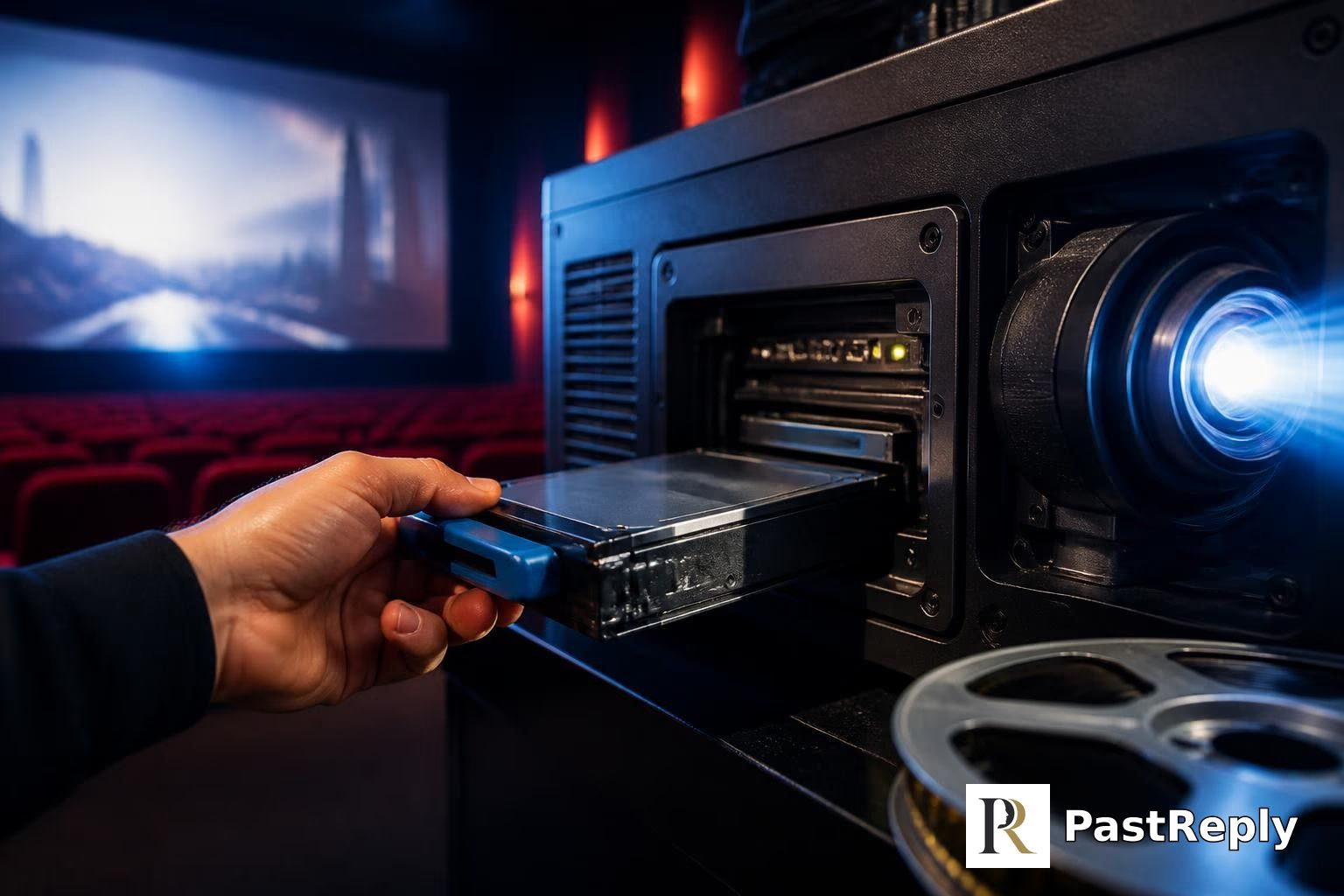
Movies are played in theaters using digital projectors that display content from encrypted Digital Cinema Packages (DCPs). A DCP is a collection of digital files containing the movie's audio and video, delivered to theaters on specialized hard drives. The theater's projection system reads the DCP and projects the film onto a large screen, while a multi-channel sound system plays the audio through speakers placed around the auditorium. The DCP is encrypted and requires a license activation code to play, ensuring security and preventing unauthorized access. This digital method has largely replaced traditional film projectors for mainstream releases.
Answered by 100 of history's most famous minds

You gather in a dark house, and a painted light moves across a cloth - but the true light is the one that enters the heart. A story well told can open the eyes of the blind; what matters is not the box that holds the tale, but whether the tale draws you nearer to the Father and to your neighbor.

They store tales in a locked chest, and a key of permission alone opens it - like the guarded knowledge of the People of the Book. But beware: the moving images may show truth or falsehood, and the most beguiling story can lead the heart astray. Let every tale be weighed by what it teaches of righteousness and mercy.

You sit in darkness, watching flickering images that rise and pass away. The sound is but a fleeting vibration. This is a perfect metaphor for the world of senses: all is impermanent, all is craving. You cling to the story, laugh or weep, but the light will fade and the silence return. The true cinema is within: watch the mind itself, without clinging, without aversion. Then you will see the reality behind the shadow.

This is an idol of silver and steel, a golden calf for the eyes. The Lord commanded: 'You shall not make for yourself a carved image.' Yet you sit in darkness and worship a box of light! The story of His covenant is written on our hearts, not on a disk that can be stolen or a license that can be denied. Do not be fooled by the cleverness of the craftsman - return to the fire of the burning bush, and let His voice be your projector.

The craftsman who carves a screen, the merchant who delivers the package, the projectors who light the image - each follows a proper way. But the superior man asks: does this spectacle cultivate virtue, or does it merely entertain? If the tale uplifts the heart and teaches filial devotion, then the method is honorable. If it only stirs idle passions, then all the clever encryption in the world cannot justify the waste of an evening.

They cover the eyes with shadows while the ears hear a great noise, and all sit still as in a synagogue of the world. But I tell you, the only true light is the Word made flesh, not these beams that flicker and fade. These tales are as the beggar's rags - they cover but do not warm. Watch instead for the day when the veil is torn.

They have chained a story in a box and call it forth with a hidden sign. Like the covenant, it is sealed with a secret, and only the one who holds the key may open it. I see the dust of the desert and the tent of Sarah, and yet these people gaze upon a phantom in a dark chamber. It is a marvel of the sons of Adam, but I ask: does the light that moves across the wall bring them to their knees before the Maker who made the light itself?

Light that is forced through a narrow gate and numbered like coins in a counting-house - that is not the light of the valley, which spills where it will. The great projector needs no license, no key, and its show runs from dusk to dawn without a screen.

This is but a shadow-play on a white wall, made by a cunning machine that speaks in numbers. The Truth needs no projector, no license, no darkened hall. The One Light shines on all equally, and its show costs nothing but a heart turned toward it. Do not let the lock and the key distract you from the true spectacle within.

When I saw the shepherds run from the fields to the stable, their eyes wide with the angel's message, that was a story unfolding in the flicker of a lamp, not on a wall. This new way - these moving pictures - they gather the humble into one dark room as we once gathered in the upper room. I pray they use it to show mercy to the lowly and not just dazzle the rich.

They have replaced the living Word with a painted idol that flickers in the dark - a new kind of indulgence, sold to the faithful, who sit silent while the machine preaches. I tell you, the true gospel needs no encrypted disk nor dim theater; it speaks plainly from the printed page, in the tongue of every man, woman, and child. Let the light of scripture shine where all may read it, not where a projector alone may cast it.

This contrivance is a form of artificial memory, storing the likeness of things in an iron box and drawing them forth in due order - a shadow of the way the eternal light of the Creator imprints all forms in the intellect. Yet it raises a question: does the image on the wall move truly, or only in our perception? I would answer that motion is perceived as successive states, and the eye, being a mirror of the body, is content with the appearance, so long as the soul remains mindful of the substance behind the shadow.

A moving picture - so many lights, so much effort - yet the poorest in our streets, the ones with nowhere to lay their heads, have never seen one. Perhaps it is enough to know that each flicker on that screen reaches a soul, and each soul is a gift. But I think of the dying man who whispered his last to me: he did not ask for a story - he asked for a hand to hold in the dark.

This 'Digital Cinema Package' is a curious cipher: the image and sound are encoded as mathematical data, unlocked by a key. It resembles the system of the heavens, where God's laws are written in number and measure, yet here man has devised a lock that requires permission to open. I wonder at the ingenuity - and the secrecy.

The light is the key. A beam, modulated with the information of the film, carries images from a tiny chip through lenses to the screen. The sound is carved into a separate stream, perfectly timed. It is not so different from a thought experiment: imagine you ride alongside that light beam - what do you see? The wonder is that we can encode a whole world of experience into a code of ones and zeros, and then decode it again, faithfully, for a room full of eyes and ears. That is a kind of magic, but it is a magic we understand.

I am struck by the gradual evolution of this medium. First, a strip of celluloid with a chemical image, then a magnetic track, now a digital file that can be copied without loss - a perfect adaptation to the environment of distribution. The encryption is like a thorny seed coat: it protects the offspring until the conditions are right, then releases it. I wonder how long this form will last before it gives way to something even more efficient, as the older reels have already been driven to extinction.

This Digital Cinema Package is a marvel of measurement - every pixel, every note of sound encoded as numbers. They said the sun moved around the earth until I showed them the telescope. Now they say the image is only in the box, but I ask: what is the box but a new kind of lens? Let us measure the brightness and the color, and let the Church not claim the light is a mystery. It is mathematics, plain as the phases of Venus.

They have reduced the grand illusion of motion to a set of stored numbers, a digital code. It is a clever artifice, but I wonder: do they see that the projector's beam is a mere imitation of the Sun's true light, which illuminates all things? The heavens themselves require no license to display their cycles. Perhaps one day men will project the true orbits of the planets onto a screen, and then the audience will see the harmony I have glimpsed.

A crude and wasteful system. They drag heavy iron boxes of data across the land, spin magnetic disks, and dissipate most of the energy as heat. In a generation, this will seem as quaint as the printing press. The true motion picture will be transmitted without wires, through the very air, to a resonant coil in every home - no boxes, no keys, no machines clattering in a booth.

A precise and elegant system. The image is carried not by silver salts on a strip, but by a numerical code - binary, like the basic elements of matter. This code is recorded on a disk that must be read by a specialized apparatus, much like our radium emanation requires a phosphorescent screen to be seen. The encryption key is a necessary precaution; one cannot leave a discovery open to all hands before its purpose is fulfilled. I note, however, that the projector's lamp is a mere arc of carbon, not the invisible rays that reveal the bones of the hand. You have replaced the chemical with the logical, but the principle of faithful reproduction remains the same.

A sealed metal box, a code to unlock it, a beam of light through a lens - this is the triumph of precise control over an invisible enemy: the microbe of theft. I would be curious to examine the ferric oxide on that disk; it is not unlike the secret life of a fermentation. The method is sound, the security admirable, but I should like to know how the heat of the lamp affects the color over a thousand showings.

A digital file on a sealed hard drive! I spent years trying to perfect a reliable film spool for the Kinetoscope - sprocket holes tearing, celluloid jamming. This is far superior: no moving parts in the medium itself, just a stream of data. The encryption is smart business, too - it prevents the pirate from copying the show. I’d have liked to see how they store the color: three separate streams, I’d wager, one for each primary. That’s the kind of problem I enjoyed cracking.

The projector is essentially a computing device: it reads a finite sequence of bits from a spinning disk, deciphers them according to a cipher, and splashes a succession of images at 24 frames per second - each frame a frozen state, the illusion of motion arising from discrete steps. It is a universal machine in miniature, and I find its reliance on a single secret key rather quaint; any sufficiently clever adversary could break it in time.

The principle is that of a lantern with a cleverly ground lens, casting a magnified image onto a screen - but instead of a candle, they employ a ray so bright it would shame the sun. The turning of the disk, the stepping of the frames: this is a problem of mechanics and optics worthy of a proper treatise. Give me a lever long enough and a fulcrum for the shutter, and I might calculate the exact motion of every phantom on that wall.

A series of quick flashes - interrupted light - becomes a flowing picture? It is the persistence of vision: the eye's own sluggishness holds one image until the next arrives, and the mind stitches them into a seamless river. I would call it a kind of optical inertia, akin to the way a spinning copper disk, once moving, will not stop at once. The projector is but a shutter and a lamp; the real magic lies in the lazy grace of the human nerve.

Consider what you are really watching: not the projected image, but the shared fantasy of a darkened room. The screen is a collective dream-screen, and the flicker - twenty-four times a second - mimics the rhythm of the unconscious, which also reveals itself in flashes and gaps. The audience sits still, regressed, like children at a primal scene. Ask not how the projector works; ask why you pay to sit in the dark with strangers, staring at shadows.

Twenty-four still frames per second, each held for a fraction of a heartbeat, and your brain - that three-pound universe in your skull - glues them into a fluent world. It is a crude illusion, really, compared to the way your own eye edits out the gaps in its own vision. The projector is just a fancy lamp with a spinning shutter. But then, so is a black hole - a shadow cast by a bending of light.

A sequence of still images, each differing by a tiny degree, is wound onto a reel and drawn past a lamp - the illusion of motion arises from the mind's own weaving of discrete moments into a continuous thread. It is, in essence, an algorithm: a precisely ordered set of steps that, when executed, yields a result no single step contains. I see in it the same principle that might one day drive a calculating engine to compose a symphony - the poetry of mechanical succession.

Let us define our terms. A film is a sequence of images, each a plane figure, exhibited in rapid succession. The projector is a device that, given a series of such figures as axioms, yields the theorem of continuous motion by the postulate of persistence of vision. The demonstration proceeds: each frame is a proposition, the interval a logical step, and the screen is the conclusion - a visible proof of the mind's own power to construct a whole from its parts.

I care nothing for the art or the story. What matters are the conditions of that sealed, darkened room: the air, the chairs, the carpet, the number of souls packed in. If the ventilation is poor and the rows too narrow, you have bred pneumonia and tuberculosis as surely as any hospital ward. I would insist on a sanitary report on every cinema before a single ticket is sold.

A thousand shadows on a wall, all orchestrated from a single box! I would have commanded such a device to show my victories to every city from Pella to Persepolis. But the real conquest is not the image - it is the will that fills the hall and makes men dream of glory.

So you have replaced the reels of film with a box of numbers, and you need a password from the master to open it? That is not innovation; it is a locked gate. I would say: give me the machine and the code, and I will show you that a good engineer, like a loyal legionary, can make any fortress fall. The true power is not in the encryption but in who holds the keys - and who has the boldness to take them.

A wise ruler knows that knowledge of how things work is a form of tribute. This secret of light and sound - it is a cunning trick, is it not? To store an image in a box and call it forth at will - that is power. Rome does not have it yet. Egypt must learn its secret, and perhaps we shall trade it for grain.

I restored the peace of Rome by securing the grain supply and the roads. This device secures the distribution of stories. The encryption is like the wax seal on a scroll - it prevents forgery and ensures the right tales reach the people. A wise ruler controls the stories, not the machines. Let the projectionists be loyal to the state, and the people will see what they ought to see. Order in the theater reflects order in the forum.

A locked box with moving pictures inside! This is the cunning of a settled people who hoard their treasures. A man of the steppe takes what he needs; he does not beg for a key. If I commanded this theater, I would break the box and share the images with every warrior in my horde. Loyalty is won by generosity, not by encryption. But I respect the art of the craftsman who carved the projector's lens - that is a skill worth sparing.

An army of light commanded by a captain in a locked box, marching only when the password is given! It is a system worthy of a staff general: encrypted orders, a single point of deployment, and a mass of loyal subjects arrayed in rows. But where is the audacity? Where is the charge of the cavalry? They have traded the roar of a live corps for a hissing machine.

It is a curious invention: a machine that projects shadows of men's deeds upon a white cloth, sealed with a cipher to prevent common theft. In the Continental Army, we guarded our powder and our dispatches with like care, for the enemy would seize any advantage. Yet I wonder at the cost in labor and materials - a single copy of this 'package' must require the industry of a small tradesman's shop to produce. Is the public so hungry for such visions that they will pay for the license fee and the upkeep of this contrivance? The spectacle of moving pictures is a novelty, but the true test is whether it instructs the citizen in virtue or merely amuses the rabble.

I recall the traveling daguerreotypist who came to Springfield with his silver plates and mercury fumes - a single image, a long wait. Now they ship a whole performance on a hard drive, encrypted like a battlefield dispatch, and unlock it for a set time. It reminds me of the problem of a just government: once you start locking things up with codes and keys, you must be certain the warden is honest.

A cipher! They have enciphered the very entertainments of the people, and the theater manager must be given the key each night, like a password to a command post. This is how wars are won: control the flow of information. But let us not forget that the magic is not in the machine but in the story - and a stirring tale of courage against tyranny needs no code, only a willing heart and a darkened room.

In our villages, when a bhand or a storyteller performed the Ramayana with simple lamps and a white cloth, the whole community sat together, rich and poor, seeing the truth in the shadows. This new art, with its encrypted boxes and locked doors, gathers people not as brothers but as customers. I fear it turns us into spectators of life rather than its servants. The soul needs no projector to see truth.

In the dim glow of the projector, a thousand strangers become one congregation, their faces lifted toward a common vision. This is a tool that can either lull the spirit into complacency or stir it to righteous action. Let them use it not just to escape, but to see the injustice that walks outside the door, for the darkness we flee into a theater is nothing compared to the darkness we refuse to notice.

In the darkness of a crowded room, strangers lean toward a common light. For those long denied a seat in such a place, this is not merely a pastime - it is a quiet ritual of belonging. When I walked free, I saw a film with my comrades; we were not just watching - we were sharing a space where all heads turned together, one story, one audience, one people.

A flickering sheet of images, controlled by a machine - this is how the weak amuse themselves while the strong build empires. In the Reich, we used such devices to forge the will of the Volk, to show the heroism of our race. But the method itself is trivial: a light, a lens, a reel. The question is who commands the gaze. The projectionist must be the state.

A reel of film is like a factory production line - each frame follows the one before, and if one frame breaks, the whole story stops. The projectionist controls the order. The audience does not choose what comes next. This is efficient. In the Soviet cinema, we understood: the party writes the script, the state runs the projector, and the people watch. Dissenters are edited out.

The film reel is a material chain - each frame is a necessary link, and the projector moves them forward in a fixed order. This is not art; it is the mechanics of transmission. The bourgeoisie call it entertainment, but the worker who pays for a ticket is still a worker, and the cinema is just another factory where the product is illusion. The only projection that matters is the coming revolution.

A projector is a machine, yes - but do not be deceived. Every frame that flickers on that screen is a weapon in the class struggle. The peasant must see the landlord's palace lit up and know it for a lie; the worker must see the factory owner's feast and feel the whip. Light itself can be a tool of liberation if it shows the masses their chains - and the way to shatter them.

The Queen does not attend such places, of course - but I understand they have a magic-lantern that moves. At Windsor we had the Prince Consort's own demonstration; I confess I found the noise of the apparatus quite distressing. Still, it is remarkable what modern science can accomplish, and I am sure the subjects enjoy it, so long as the entertainments are moral and edifying.

One remembers the first colour film shown at the palace - a documentary about the Coronation. The projectionist was so nervous he nearly dropped the reel. But the technology has become marvelously reliable. It is simply another form of storytelling, bringing people together in a shared experience, and that, I think, has its own quiet value.

If a man can paint a story on a wall, can he not also paint it on a bolt of light? I would have my scholars examine this contrivance - is it a trick of mirrors or a gift of God? If it can teach the Iliad or the Passion to the illiterate multitudes, then it is a weapon more powerful than any sword, and I would see it placed in every monastery scriptorium in my realm.

I never saw such a thing, but I heard the English had a painted cloth that shook and moved at the fair. They said it showed a battle. If it can make a man see the truth of what happened, and not a liar's tale, then perhaps God works through it. But I would rather see the true faces of my comrades than any shadow-play - they need no artifice to move my heart.

A moving picture, they say? It must be a clever piece of stagecraft, like the masques we mount at Whitehall. If it can make a queen appear gracious without her having to sit for hours in a stiff gown, I commend the inventor. But let us not be dazzled by every new bauble from the Continent - the important thing is who controls the story, and what message they mean to leave in the minds of the people.

I have summoned Diderot and Voltaire to my court; they told me of this wonder. A beam of light that carries a drama - it is the Enlightenment made visible! In the Hermitage, I would have such a machine installed at once, so that the nobility may see plays from Paris without the expense of traveling. It is a tool of civilization, and I am never slow to seize a tool that sharpens the mind.

In Babylon, the priests once made statues speak through hidden pipes. Now you make shadows move and call it a marvel. I have conquered thirty nations; what I value is the story that binds them. If this device can show the law of Ahura Mazda to a man who cannot read, or teach the epic of Gilgamesh to a shepherd on the steppe, then it is a greater bridge than the bridges I built across the Euphrates.

When I took Jerusalem, I saw the Franks' painted windows that told the stories of their prophets. This new device is like those windows, but made of light. If it can show a Muslim child the courage of Salah ad-Din, or a Christian child the mercy of Issa, then it is a good thing. But if it lies about what happened at Hattin, it is a weapon of the devil. Guard the truth, not the machine.

Tell me, friend: when you watch these moving shadows, does the spectacle lead you to question what is true, or does it merely amuse your eyes? The craftsmen have built a clever cage for light, but have they built anything that helps you examine your own soul?

This is a shadow play on the wall of a cave. The audience sits in darkness, watching flickering images that are but copies of copies - first the original Forms in the intelligible realm, then the physical actor, then the digital recording, then the projected light. Yet even this dim reflection can stir the soul. The wise one will not mistake the flicker for the true sun, but may use it to turn the mind toward the eternal light that illuminates all things.

To understand this marvel, one must examine its causes. The material cause is the box of digital bits; the efficient cause is the projector that casts them. But the final cause - the purpose - is to move the soul through mimesis of action. The projector is not the essence; the plot and character are. A craftsman who masters the tool but neglects the story builds a fine chariot with no horses.

That a theater must pay a fee for each screening, on top of the encrypted package, reveals a structure of duty and compensation. But ask yourself: could you will as a universal law that every rational being should pay only for what they directly consume in a spectacle? If so, the transaction is morally permissible - provided the license is purchased from a free dealer, not one stolen from another's talent. The screen is a surface; the ethical form lies in the integrity of the contract.

A machine that parades shadows for a sitting crowd - what a perfect image of the modern soul! They pay to have their fantasies fed through a wire, all passive and secure, never daring to create their own visions. The encrypted file is the leash; the license key the master's whip. Do you not see that every time you watch, you are tamed? The projector is a god, but a weak one. Break the machine, and make your own noonday sun.

The bourgeoisie have commodified the very flicker of reality. The projector is the factory, the hard drive the capital, the encrypted key the owner's signature on the wage-slip. The audience sits alienated, consuming a product they had no hand in creating. A thousand identical dreams, stamped out in a central plant, delivered by a chain of middlemen - this is the cinema as a machine of capital, not of art.

Let us first doubt that there is any image at all. I perceive a screen, a beam of light, and a device that emits sound. But what is the essence of this representation? The DCP, as they call it, is a sequence of numbers - a mathematical description of color and movement. The projector is a mindless automaton that decodes these numbers and presents them to the senses. The encryption is a form of Cartesian certitude: only the authorized know the key, and thus the image is corporeally true to the original. Yet I must ask: is the experience of the moving picture any less dubious than a dream? Both are merely effects in the sensorium, and only the intellect - by clear and distinct ideas - can distinguish the waking light from the one that dances on the wall.

They have invented a perfect lock for a perfect box, and the theater owner holds the key only on loan from the distributor. This is not about art; it is about who commands the gate. The Prince who controls the code controls the spectacle, and he will charge the crowd for every glimpse. Clever - far more secure than trusting a reel of film to a courier.

Upon a canvas of woven light, they paint with beams instead of brushes - a phantasm that moves and speaks, yet is as insubstantial as a ghost. The world itself is a stage; these projectors are but new mirrors held up to nature, showing us our own likenesses, which we pay silver to see and then forget.

As when the cunning god Hephaestus forged the shield of Achilles, crafting upon it the earth and sky and sea, the cities of men and the dances of youths, so too do your makers weave images from light and sound, trapping the deeds of heroes in a box of iron. The bard once sang to the lyre; now the lyre is a machine that speaks in a thousand voices, and the audience sits like the Phaeacians, spellbound by a tale that is not their own, yet moves them as if it were.

Those flickering lights on the wall are a mirror of our own souls - each frame a step on a journey, a moral trial cast in shadow and sound. The projector's beam is like the light of reason that God gives us to see the truth through the dark wood of this life. But woe to the artificer who uses the machine only for empty spectacle, for he leads his flock astray from the path to the celestial rose.

What a marvel - light and shadow, born from a tiny hard drive, yet filling a vast hall with every hue of passion and landscape. The projector is but a clever box, but the true alchemy is in the coupling of the audience's imagination with the artist's vision. I see in this digital beam the same striving that drives the Faustian spirit: we dissect nature to command her, yet the greatest pleasure is the whole, the living picture that dances before a thousand eyes at once.

A shadow-play for men of substance, this! They lock a tale in an iron box, whisper a password to the innkeeper's projector, and lo - the knight-errantry of light and shadow gallops across a white wall. It is no less a windmill-tilting than my old friend Alonso would have undertaken, save that here, the enchanters who guard the treasure are paid in silver, not blows.

They sit in a darkened room, staring at moving shadows, while outside the real world - the world of labor, of suffering, of love - goes on unseen. This is the great lie of our age: that we may live secondhand, by proxy, through a bright image. What is the use of a hundred thousand projected loves and wars, if a man cannot look his brother in the eye and offer him bread?

You have imprisoned the living moment in a cipher, and with a key of iron you release a ghost to walk before the crowd. The light that paints the wall is no real light - it is a lie that looks like truth, a shade that mimics the agony and laughter of men. I watch the faces in the dark: they weep, they laugh, they clutch each other - and for what? For a phantasm that will vanish when the lamp goes out. In Petersburg, I saw a man sell his soul for a ticket to the Opera; here they sell it for a box of numbers. The encryption is fitting, for the soul itself is locked, and only the agony of God's love can open it - not a license code.

A hard drive, they tell me, sealed like a gentleman’s dispatch box and only opened with a visiting card from the patent office. It must be a great convenience to the theater owner, who no longer need worry about a tear in the celluloid or a careless lamp-lighter. Yet I wonder if the audience feels the difference: a romance is still a romance, and a foolish one remains foolish, whether projected by light or by cipher.

Imagine a vast, darkened hall filled with the poor and the hopeful, all staring at a wall of light that moves and speaks - no living actors, no breath, no sweat, yet ghosts more vivid than any I have conjured with ink. It is a new kind of story-telling engine, but I wonder: who lights the lamp, and who pockets the shilling? For every penny spent on such marvels, a child in a workhouse goes without bread.

So they lock a story in a little metal box with a secret, like a miser hiding his gold, and then charge you to peek through a keyhole at a parade of shadows pretending to be people. It’s a perfect picture of how we run things: the more real it looks, the more carefully it’s guarded. But I reckon the real show is out in the lobby, watching folks pay for a ticket to see what a single book could give them for free.

You sit in the dark and watch a light move across a screen. That is all. The machine works, the reels turn, and then it is over. There is nothing hidden or noble about it. A good story needs only a voice in a room, not a license and a lock. But people will pay to see the shadow of a lion rather than face one. That is the truth of it.

I see a machine that mimics the eye's own miracle: a tiny lens casts a great image, and colors are mixed from three sources as the painter mixes pigments. The encrypted lock intrigues me - the keeper must hold both the chest and the key to open it, a system worthy of a Medici treasury.

I have labored to free the human form from the prison of marble, to capture the soul in the curve of a limb. To see that same living form now conjured from a beam of light and a chorus of speakers - this is a wonder. But I tell you: the true art is not in the machine but in the hand that first shaped the image. The projector is only a tool; the spirit must be carved by the artist's vision, or the light is just a passing shadow.

I have seen such a device, and it made my heart ache with longing. The light that pierces the dark room, painting a story in colors so real you can almost feel the heat of the sun in the fields - it is like capturing a dream. But I would trade all the machines for one true painting, where the brushstrokes sing with the painter's own blood and tears. A story told by a man's hand has a soul that no box can hold.

They have traded the scratch of film and the smell of nitrate for a cold file, a little metal box with numbers. The projectionist once was a magician; now he is a button-pusher. The audience believes they see a 'perfect' image, but perfection is a corpse. I would rather watch a scratched print that breathes than this sterile beam - it has no shadow, no accident, no life. They have killed the light.

Imagine - they have captured light itself and bottled it in a box of black metal, then release it as a beam that paints a moving canvas on a great white screen. The flicker of a shower of sparks, the haze of afternoon sun through dust motes - each impression is a brushstroke of pure luminosity. But I wonder, do they forget to change the palette as the hour moves? The light of midday is not the light of dusk.

A canvas of light, you say? The same sun that fell on the lace collar of the Syndic's wife now pours through a brass lantern at the back of the room, carrying shadows and faces across the wall. But where is the painter's hand? No brush drags the ochre into the crease of a cheek, no thumb smudges the lampblack in the corner of the eye. They have traded the slow truth of the hand for a box that spews a pre-mixed scene - every man sees the same face, the same fold in the same coat, forever unchanging. We paint a single moment for a thousand eyes; they paint a thousand copies of one dead moment.

A box of light that bleeds onto a white sheet, and the people sit in the dark like children waiting for a miracle. But the miracle is a lie: the colors are not my colors, the flesh is not my flesh. They have taken the blood-red of my palette and flattened it into numbers, then sold the key to open the door. In Mexico, we paint the truth of the wound: a shattered column, a nail through the heart. Here they project a shadow and call it real. I prefer to paint my own pain on the canvas, where the brush leaves the track of my hand - not a ghost that vanishes when the current dies.

So they save their music in a little box of numbers, and the machine sings it back! I would have given half my operas to hear a symphony emerge from such a contrivance. But where is the conductor's sweat, the bow's hair, the breath of the flute? The soul of the sound is still in the hand that made the files.

Music, too, is locked in a box until the player sets it free. This digital package you speak of is a score, encrypted like a secret, waiting for the key of performance. But the real performance is the composer's spirit speaking to the listener's heart. I would say: do not let the machine deafen you to the soul of the work. Let it serve the vision, not imprison it. For what is a projector but a deaf man's ear, if it cannot feel the thunder of the human spirit?

This contrivance is but a shadow of the true harmony that rules the spheres. The projector's lens and the speakers around the hall are like the pipes of an organ, each contributing its voice to a grand fugue. But the composer of the moving picture must still obey the same laws that govern a cantata: each part must serve the whole, and the whole must praise the Creator. Without that purpose, the machine is only noise.

Well, thank you very much. When I shimmied on stage, I felt that electricity - the crowd and I, we were one big heartbeat. These digital pictures, they're something else, I tell you. But you know, it don't matter if it's a spool of film or a little black box, the point is the feeling. When the lights go down and the sound hits you like a train, that's pure soul. That's the King in every moment, child.

It’s like a heartbeat, really. The projector pumps the light, and the screen breathes the story. But the real magic is the silence in the dark when a thousand souls feel the same beat. Like a concert, but you don't move - you just let the light move through you. It’s a shared dream, a hug from a distance.

You mean the flicks? Lads, it's like having a giant telly in a dark room, but instead of Auntie Flo's knitting you get a spaceship that goes 'whoosh!' and a bloke with a quiff. The picture's made of ones and zeroes, like a song on a gramophone, only it's a million pictures a second, all squashed onto a little metal biscuit. The projector's a wee robot that reads 'em and throws 'em on the wall, and the speakers are all round your head so it feels like the Martians are right behind you. We'd rather be on the stage, but if you can't smell the crowd, this'll do nicely.

They've traded the silver nitrate flicker for a box of ghostly ones and zeros, locked up tight as a jailhouse door. You pay the warden to turn the key, and what you see isn't light through celluloid but a cold cipher that's been taught to dance. The old machine had its own breathing; this one just hums.

This is exactly like the music industry before streaming - everyone thought they had to own the physical thing, but now the movie lives in a cloud of code, and the theater just rents it for a night. It's a trust exercise between the creators and the houses, with a key that expires. I love the artistry of the projection, but I always wonder: who really holds the key to our own stories?

They have found a way to capture light itself and send it across a room - a marvel greater than my compass or sail! With such a device, I could have shown the Sovereigns the green shores of the Indies before I ever set foot on them. But the true voyage is still the one that carries gold and the Cross to new lands.

In the Great Khan's palace, jugglers and acrobats would perform, and we would watch by torchlight. But this - this is like having a thousand storytellers in a box, each with a different tale, brought to life by a beam of light. I have seen the marvels of Cathay, the paper that moves with the wind, the clockwork birds that sing, yet nothing so strange as this: a story painted on light itself, speaking from every wall, and every seat in the house a throne.

A ship carries men through storms by compass and chart; this machine carries images through a sea of light. Both demand exacting labor and a crew of clever hands. I have seen how a single flaw in a hull can sink a fleet - so too must every file in that 'package' be true, or the voyage fails. Trust the craft, but trust the captain more. A good projectionist is worth a thousand devices.

From a technical standpoint, the system is elegant: a secure file, a decryption key, and a calibrated projector work in concert to reproduce a motion picture with remarkable fidelity. It reminds me of the meticulous checklists we ran before ascent. The failure of a single component - the hard drive, the projector lamp, or the sound processor - can abort the entire experience. Reliability and redundancy are everything, whether on the moon or in the multiplex.

They pour the film from a little hard drive like fuel into a tank, and the projector’s beam cuts through the dark like a landing light at midnight. The cockpit of a theater! Every flicker is a charted course through a storm of sound and color. No crosswind, no fog - just the thrill of the ride, safely tethered to your seat.

A cabin with no window to the stars, and yet they bring the whole world to you! I remember the pressure of the g-force, the darkness between the layers of sky - but this, this is a different sort of journey. They pack the light and the shaking and the roar of the rocket into a box of numbers, then unlock it with a key of fire. The machine breathes the story onto the wall, and for two hours you orbit another life. It is not the real weightlessness, but I have seen the Earth from above, and I tell you: the Earth is blue, and so is the light that carries a dream to every seat.

It's a beautiful system: a single box that holds the entire film, locked until the right moment. The encryption is elegant - no keys, no tangles, just pure design. But the magic isn't in the hardware; it's in the story that fills the room, the moment when people forget they're sitting in chairs and just become part of the dream.

From a first-principles perspective, this is just a high-bandwidth data stream. The DCP is a brute-force solution: compress the movie, encrypt it, ship a hard drive. The future is streaming directly from a satellite constellation - no drives, no delays. The real bottleneck is the screen and sound system. We need to think bigger: a theater should be a multi-sensory experience, maybe with haptic seats and localized scent release. But at the core, it's just photons and pressure waves. Optimize the latency.

You know, when I was a little girl, my grandmother used to tell me stories by the light of a kerosene lamp. Now they tell them with lasers and speakers, but it's still about that moment of connection. The technology is just the delivery truck - the real magic is the story that makes you feel seen. And let me tell you, the people who make those projections are like midwives, bringing a dream into the world so we can all share it.

They talk about hard drives and licenses, but I'll tell you the real secret: the projector ain't nothing without the man who made the picture. I'm the greatest, and I know - same in the ring, same on the screen. They can encrypt their files, bolt the doors, but the magic is the story, the soul of the artist. Float like a butterfly, sting like a bee - the image may be digital, but the fight is real. Ain't no license code can lock that up.

It is like a beautiful pass that arrives exactly at your feet. The projector sends the image, the speakers send the sound, and the audience receives it all like a perfect goal. But the best part is when everyone gasps together - like a stadium full of fans, all feeling the same joy at the same moment.

It's pure magic! Imagine, you've got a story that you dreamed up in a little room in Burbank, and you paint it in light - thousands and thousands of tiny pictures, each one a little different, like a flip-book that never ends. That light, it's locked up in a metal can, like a genie in a bottle, and only the right key can let it out. Then the projector - a sort of magic lantern, if you will - throws those pictures onto a white screen, and the sound wraps around you like a warm hug. It's the closest thing to a dream you can share with a room full of strangers.