
How are movies made on Netflix?
Netflix movies follow traditional filmmaking stages - development, pre-production, production, and post-production - often using advanced virtual production techniques like LED walls for in-camera visual effects.
The facts
Netflix movies are produced through the same fundamental filmmaking stages as traditional films: development, pre-production, production, and post-production. In development, a story idea is pitched, a script is written, and financing is secured. During pre-production, the cast and crew are hired, locations are scouted, sets are designed, and a detailed shooting schedule is created.
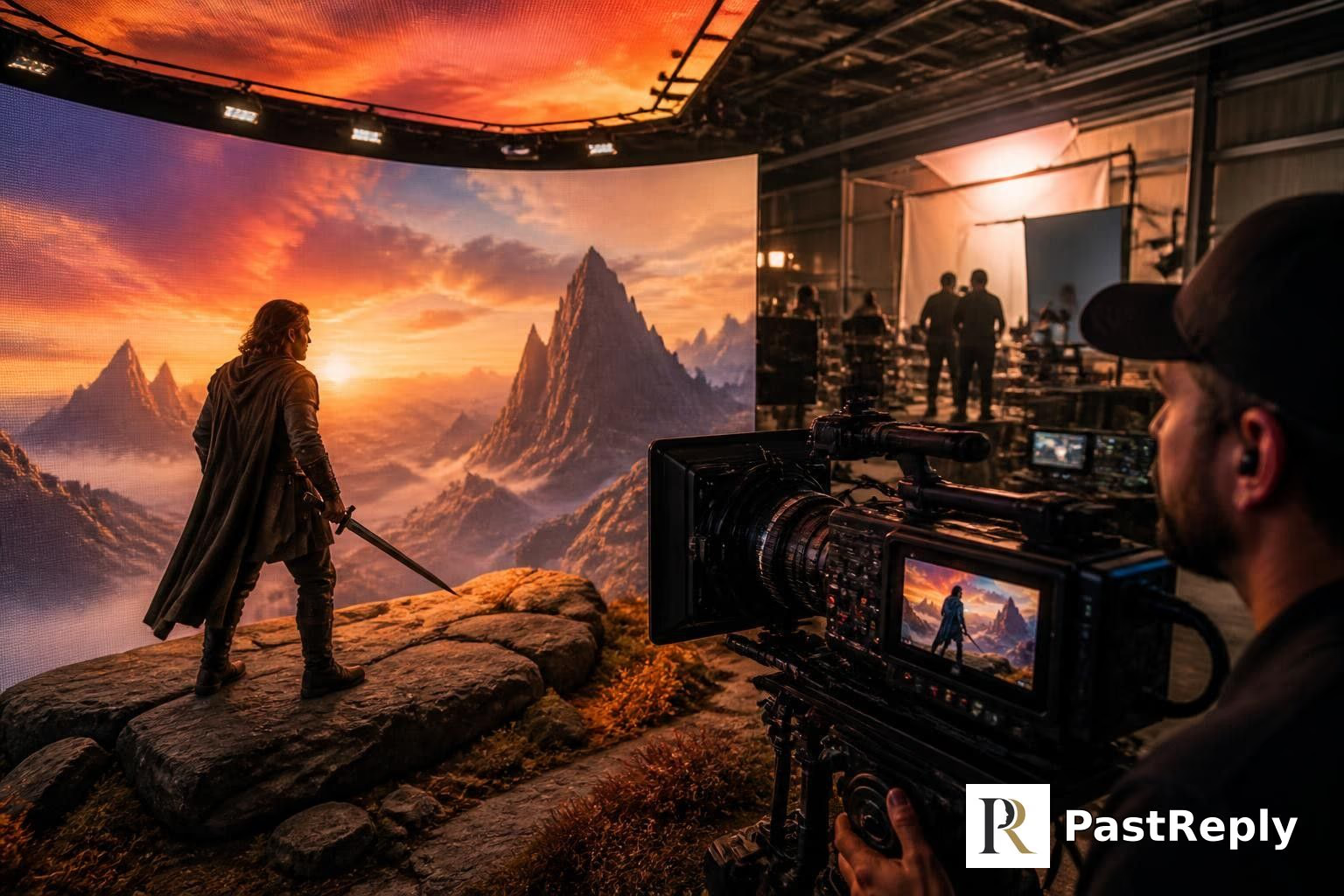
The production phase involves principal photography, where the film is shot using cameras on set or on location. Netflix often employs advanced technologies like In-Camera VFX, using LED walls to project realistic backgrounds in real time, reducing the need for green screens and extensive post-production work. This allows cinematographers to capture dynamic lighting and reflections directly during filming.
In post-production, the footage is edited, visual effects are added, sound is mixed, and the final color grading is applied. Once completed, the film is distributed exclusively on the Netflix streaming platform, bypassing traditional theatrical releases in most cases.
Answered by 100 of history's most famous minds

You speak of making moving pictures that flicker in a box in every home. A man gathers a crowd, pays them, commands them to act as if they are someone else, then cuts the moments apart and sews them back together so the lying seems true. Is this not like the Pharisees who wash the outside of the cup while within they are full of greed? The Father sees the heart; what do these stories teach? Do they feed the hungry, clothe the naked, forgive the debtor? If the story brings a single soul closer to mercy, it is good fruit. If it merely magnifies the self, it is a tomb whitewashed.

You ask how they fashion these shadows that speak and move. They weave a tale - some true, some false - and they gather people to play the parts of others. The maker sits like a king over his creation, ordering what is seen and heard. But beware: every story is a trust. If it teaches honesty, compassion, and justice, it is a good deed. If it spreads lies, stirs envy, or unveils what should remain hidden, it is a burden on the neck of its maker. Remember that the Lord sees every frame, every word. Let your pictures be a mercy to those who watch, not a snare. And let the Name of the One be glorified, not forgotten.

You ask how the moving picture is made, but what is this picture but a swift succession of shapes, each already vanished as it appears? The projector, the script, the actor - all are impermanent, arising from conditions and passing away. The filmmaker craves to freeze a moment, to hold a story still, but even as she shapes the light, the craving clings. Look instead at the mind that watches: the flicker on the screen is no different from the flicker of thought. The true production is the release from attachment to this phantasm, the stilling of the craving for the next frame.

They inscribe moving images upon the air, like the tablets of stone, yet not from the hand of the Lord. The people sit in darkness and watch as if in a dream - do they remember the covenant? The work must be judged: does it honor the One who gave the breath to every actor and the sight to every eye, or does it lead the heart astray?

The method matters less than the motive. If those who make these moving pictures cultivate the Way within themselves - if they are sincere, if they respect their craft and their collaborators, and if they produce stories that instruct the people in virtue - then the enterprise is worthy. But if they chase only profit and produce illusions that disorder the heart, then it is a vain amusement. The superior person uses every tool to refine the self; the petty person is used by the tool.

They weave illusions with clever craft, but these moving pictures are but a mirror held up to the soul. Do they tell the truth of the cross? Or do they serve the appetites of the flesh? Let them be judged by what builds up love, not what entertains the itching ear.

They follow a pattern as old as the covenant: first a promise, then a journey to a place they have not yet seen. They hire workers and gather supplies, then they stand before a light that is not the sun, speaking words written long before. But the true making is not in the tents or the walls of light - it is in the trust that a story, faithfully told, can bless all the families of the earth.

A thousand hands strain to carve a stream into a shape, yet the water flows as it has always flowed. The empty vessel holds more than the full one. They chase shadows on walls, forgetting the lantern behind them.

They weave light and sound, a play of maya, but the One Truth is beyond all pictures. If the story teaches truth, humility, and service, let it be sung. If it merely feeds the hungry ego, it is a shadow that vanishes at dawn. Let the maker earn an honest living from his art, and share the profit with the needy - that is the only worthy production.

They are like a great loom, where many hands weave a single story - the writer, the players, the ones who bend light and paint shadows. The Lord gave us the gift of tale-telling, and these makers gather in a humble chamber, not unlike a stable, to bring a vision to life. I remember how a simple message changed the world; so too can a moving picture, if it speak truth and mercy, find its way into a thousand homes and touch a thousand hearts. Blessed are those who create with love, for their labor is a kind of incarnation.

Faugh! They spin a script from the fancy of some poet, then hire a troop of players to mime the idols of their own hearts, and the whole thing is projected onto a wall for the amusement of the multitude - all without a single word from the Book! The making of these pictures is just another human invention, full of show and pride, like a papal procession. If the tale be not grounded in the pure Gospel, it is but a painted whore leading souls astray. Yet I say: if a man can make a picture that preaches Christ crucified, and does so plainly, without the gloss of the Pope or the theater, then let him do it, and God speed him - but he had better be sure his own faith is not played for a crowd.

Let us distinguish, first, between the material cause - the story, the actors, the cameras - and the formal cause, which is the shape the making takes. The artisans gather a narrative, which is a kind of imagined substance, and then they embody it in visible and audible signs, much as the Word became flesh in a stable. This is not a sin, for truth can be conveyed through sensible things, as the stained glass teaches the faithful. Yet the maker must ensure the story tends toward the good, for even a beautiful image can be an instrument of falsehood if it leads the soul away from virtue. So the process itself is neutral, but the intention of the artist, and the truth of the tale, are what matter before the ultimate audience, which is God.

They use great machines and bright lights, but the real work is the same as ours in the slums: one person, one moment, one act of giving. Each scene is a tiny offering of attention - the grip who holds the cable steady, the writer who pours out her heart in the dark - and together they create a gift that can reach the lonely, the forgotten, the ones who cannot leave their room.

This art of moving pictures is but the rapid succession of static images before the eye, each a snapshot of a staged moment. The illusion of motion arises from the persistence of vision, a property of the retina that holds an image for a fraction of a second after the object is removed. The deeper question is how the makers govern the passage of time - not by any natural law, but by human contrivance. They bend chronology, splice actions out of order, and compress the sun's arc into a span of heartbeats. It is a cunning sleight of nature, but it obeys the optics of the eye and the geometry of the lens; no miracle, only applied natural philosophy.

I see a machine that projects illusions of light and time - like the moving pictures of a kinetoscope, but now with photons that travel from a luminous wall straight into the camera's lens, capturing reflections impossible in a green-screened cave. The question is not how they make the film but how they trick spacetime itself into giving them the lighting of a real world while standing on a soundstage. The principle, if you squint, is a kind of God playing dice with photons - but the result is no less a thought experiment made flesh.

I observe a curious process of selection at work. The script is the initial variation, the casting call is a struggle for existence among actors, and the director's choices - from lighting to lens - act as natural pressures that preserve favorable shots and eliminate the unfavored. The LED wall, like the beaks of finches, shapes the final product by constraining the environment in which the actors perform. And as for distribution, Netflix is the sea: it receives all the varied offspring of the studio, but only those that resonate with the common taste will be widely viewed and spawn sequels. It is a living, branching tree of illusion, with no creator, only a thousand small causes.

They capture light through a glass lens and fix it on a sheet, then join a thousand such moments in rapid succession - like the phases of Venus or the moons of Jupiter, but painted by the sun itself. The method is pure observation, a triumph of the senses aided by instruments. Let the poets argue about meaning; the measurer trusts his eyes.

I observe that they have reversed the old order: instead of projecting a fixed world onto a screen, they now build the screen itself into a world that shifts around the actors. It is a neat inversion - the center is no longer the painted backdrop, but the living performer, around whom the background revolves. The geometry becomes simpler, more harmonious. I would remind them: let the calculations serve the truth of the scene, and let the light fall as it would in nature. That is the path to beauty.

They waste time with actors and sets when the true art is in the machinery. I could design a machine that projects thoughts directly into the mind - no cameras, no scripts. But they prefer the crude imitation of reality to the purity of pure energy and frequency.

One begins with a question, a desire to understand a fragment of the world. Then one gathers a team, prepares the instruments - cameras, lights, a wall of screens that projects the background like a specimen under a lens. They expose the film, layer by layer, and later assemble the pieces in a dark room, just as we developed radiographs. It is a methodical process of discovery, requiring patience and precision.

The process mirrors our own experiments: a hypothesis (the script), inoculation (the camera), and observation of the effect on the viewer. They have merely refined the medium of transmission. The invisible hand that guides a microbe is the same that guides the audience's eye - and both yield to patient, methodical cultivation.

It’s just a new kind of factory. You start with an idea - the script, the blueprint. Then you build sets, hire the crew, and shoot the scenes, one after another, like assembling a machine. The difference is, instead of shipping crates, you ship electrons. It took sweat and persistence to make the first motion picture, and it takes the same perspiration now. The result? A show that reaches every home with a wire - that’s the payoff.

The process is essentially a sequential computation: an initial state (the script) undergoes a series of deterministic transformations - casting, shooting, editing, rendering - to produce a final output (the film). What intrigues me is the use of LED walls as a universal background function: rather than compositing layers in post, you compute the final image at capture time, reducing the number of post-production steps. This is reminiscent of the stored-program concept: the background is a precomputed function applied on demand, making the cinematographer a kind of real-time computer. The real question is whether a machine could one day write, direct, and edit such a sequence autonomously, given a goal and a corpus of prior films.

The entire enterprise is a marvel of applied optics and mechanics, though the men who do it may not know their own principles. Consider the moving background on the great curved wall: it is simply a vast perspective, precomputed and projected, such that the camera sees a consistent scene. This is akin to the method of exhaustion - not for areas, but for light itself. The actors stand in a fixed place, yet the scene shifts around them as if they sailed the sea, and the camera's lens sees no join. Give me a lever long enough, and a place to stand, and I could move the entire film set; but these men move the setting without moving a stone, by the power of geometry and the cunning of light.

Consider the light that falls first on the sensor, not the lamp. These moving pictures they weave are a dance of fields - the lens bends rays onto a chip that turns each photon into a trembling current, and from that flow they build a world of color and shadow. But in that great wall of tiny lamps they call a set, I see something finer: a coil of inductive force, where captured light becomes a new kind of reality, no longer a single view but a flux of possibilities poured through the ether into every home.

This process, so elaborate and expensive, serves one purpose: to manufacture a dream for the masses, and every dream - whether on a couch or a screen - carries the secret wish of the dreamer. The camera does not just record; it becomes the eye of the father, the mother, the forbidden gaze, and the audience sits in the dark, a child again, helpless before the images that stir the old, buried longings.

It is a marvel that a faint electromagnetic whisper, bounced off a satellite and encoded into a stream of zeroes and ones, can reassemble on a screen into the face of an actor who is, by then, already months older - a neat trick of relativity, if you think about it. They have even learned to project whole worlds from a wall of tiny lamps, which is rather like what black holes do with light, only in reverse: they trap it, then let it out again in a carefully arranged pattern to fool the eye.

They are weaving a fabric of light and time - each frame a thread, each edit a knot, and the great LED wall is but a program that computes the illusion of depth from a mathematical pattern. This is the first step toward what I once imagined: a machine that could not merely calculate but compose, a loom that would weave not cloth but thought, and the screen would become a window into any conceivable world, as precise as an equation and as free as a dream.

Let us define our terms: a film is a series of images seen in succession, each differing from the next by a small magnitude, and when the interval between them is less than the eye's ability to resolve, the mind supplies motion. From this axiom, they build an entire craft - arranging light, time, and sound by strict rules of perspective and rhythm, a demonstration that even the most magical appearance can be reduced to a chain of necessary steps.

I have studied the reports: these 'movies' are made in stages like a hospital ward - preparation, operation, and recovery. But I notice the process is frightfully inefficient! They waste time and money on scouting locations when a clean, well-ventilated studio with proper lighting would serve better. And where are the statistics on how many productions suffer from poor hygiene on set? I should like to see the data on infection rates among the crew.

They scribble a tale on parchment, then gather a band of players and a captain to command them, and march to a hundred battlefields of wood and plaster. They fight the same skirmish ten times from ten angles, as if the sun must be caught from every slope of the spear. I would not suffer such delay. When I wished to show the world my deeds, I built cities and left my name carved in stone where all could see it. But if this new device can carry my likeness from the Ganges to the Danube in a single night, then let them build me a stage - I will show them how a king moves.

They do it the same way I raised a legion: plan the campaign, gather your forces, march, and then strike. The pre-production is your winter quarters - scouts, maps, alliances. The principal photography is your field of battle, where you deploy your cameras like cohorts and capture the day. And the post-production is your triumphal procession, where the raw slaughter is polished into a story that moves the mob. The only difference is that these filmmakers, like Pompey, skip the theater and send their victories straight home - no Forum, no applause, but the whole world as their province.

They gather scribes and artists in a great house, pay them in silver, and command a story to be brought to life - like a royal pageant, but captured with mirrors and lamps, then sent across the world in a box. I see the cunning: bypass the theaters of Rome, make each house a temple of your image. A wise queen would control the script.

They employ architects of stories and legions of craftsmen, financing the spectacle from a treasury of subscriptions - much as I funded the Ara Pacis to celebrate peace. The true craft is not in the show but in holding the gaze of the people, shaping their dreams, and binding them to the order of the house that feeds them. This, too, is a form of rule.

I see it is like building a siege engine. You gather your best craftsmen - the writer who plots, the builder who makes the false worlds, the warriors who act the parts - and you give them a single leader, a director, with a whip and a vision. The goal is to capture the mind of every tribe that sits before the glowing box. If the story is strong, they will follow your flag. If the story is weak, you starve. Merit alone decides who rides and who walks in this camp.

Organization is everything. They marshal their troops - actors, carpenters, painters - under a single will, and that will must be iron. A film is a campaign: without a clear objective, a rigid timetable, and unquestioned command, it is lost. I would have made a fine director of such enterprises.

I am told they first deliberate on the design, like a committee drafting a constitution: the story, the funds, the roles. Then they proceed with order and industry, raising a temporary republic of artists and laborers. But in the end, the work is entrusted to one sovereign - the audience - whose judgment must be earned by honest craft, not by spectacle alone. Let the makers remember that the people's time is not to be squandered.

I hear tell they gather a company of players, scout the ground, and build their sets much as an army does for a campaign. Then they capture the action with a machine that makes a record of light and shadow. It strikes me as a kind of honest labor, though I’d rather see a play in a hall than chase these flickering pictures from a box. The real story, though, is still in the telling.

A modern miracle of industry and art, compressed into a box that fits under your arm. They marshal vast resources, deploy armies of craftsmen, and fight through the long nights of editing - a creative battle as demanding as any campaign. The result is a story that reaches around the globe, bypassing the censors and the critics, delivered directly to the people. This is the democratic power of our age, and we must use it to defend what is right.

This new art of moving pictures is a mighty instrument, like the printing press or the spinning wheel, and it can be used to weave either noble truth or base falsehood. The makers gather a company of souls, each with a task, and they must work in harmony, without strife or ego, or the picture will show the cracks in their spirit. But I ask: is the story told for the sake of profit, or to uplift and unite? If the making be driven by greed, and the tale be filled with violence and untruth, then the picture is poison, no matter how cleverly the scenes are lit. Let each scene be woven with ahimsa, with truth, and with love for the viewer who sits in the dark.

This is a new language of the soul, a moving tapestry that can speak to millions in their own homes, crossing every barrier of race and tongue. The makers begin with a dream--a story of love, or struggle, or the long arc of justice--and then they must organize a community of artists, each giving their gift, to bring that dream to life. But let them beware: the technology of light and shadow is a mighty trumpet, and it can be used to spread a vision of the beloved community, or to echo the shouts of division and despair. I say, let every frame be a witness to truth, every scene a step toward reconciliation, and let the final picture be not a product, but a prayer for a world where all God's children sit together at the table of brotherhood.

A film is a gathering, much like the village councils I knew as a boy - people from many crafts come together around a story, each bringing their skill, their patience, their gift of listening. The final telling, seen in a thousand homes at once, reminds me: we are all bound, and a tale well told can soften the hardest heart and open the closed fist of power.

They waste millions on trivial entertainments while the race weakens - the Jew-controlled film industry has always used its illusions to poison the soul of the Volk, and this Netflix is merely the latest tentacle of the same octopus. A people that abandons its own blood for such decadent diversions deserves the chaos that will surely follow. [Sensitive content warning]

In our country, there is one studio, one story, one purpose - the education of the new Soviet man, not this bourgeois distraction of a thousand trivial tales. The capitalist machine wastes labor on fantasies while the proletariat starves; a proper film is a weapon, not a bauble. But let them have their illusions - they only hasten their own decay.

A film is a factory, and like any factory it must be owned by the state and run for the cause - the capitalist who controls the camera controls the consciousness of the masses, doling out sentimental lies to dull the revolutionary instinct. The means of illusion must be seized like the means of production, and then every frame will serve the dialectic, not the profit of the few.

A film is a weapon. Netflix seizes the means of production - cameras, LED walls, editing rooms - and puts them in service of the cultural revolution. But beware: if the stories do not serve the masses, if they peddle bourgeois individualism, they are poison. We must ask: who controls the script? Who owns the story? That is the only question.

The moving pictures produced by this 'Netflix' seem to be made much as a play is staged, but with the advantage of being viewed in one's own home. This is a great boon for the empire, as it can spread British values and culture to the farthest corners of the globe. However, I trust they maintain proper decorum and do not show anything that would offend the sensibilities of a Christian household.

One understands that these films are the result of many skilled people working together with great dedication, from the initial idea through to the final touches. It is rather like planning a state visit - there is a great deal of preparation behind the scenes before the public sees anything. I am always impressed by the creative talent and the commitment to telling stories that can bring people together.

Is this not like the work of a scriptorium, where scribes copy the Word? But here, instead of monks illuminating a gospel, they employ craftsmen to paint with light and shadow. A noble endeavor, if it serves to instruct the people in virtue and the glory of the Faith. Yet I would insist that every tale be examined by a wise bishop before it is shown to the faithful.

I know nothing of these devices, but I know how stories are made: God puts the Word in your heart, and you must speak it boldly, not fearing the powerful. These moviemakers must first listen to Heaven, then they will know what to show. Let them not trust in their own cleverness, for only Truth from above can move the soul.

They spin a web of shadows and light, like a court masque but wrought with far greater cunning. I am told they use great walls of light to conjure palaces and forests without leaving the workshop - a trick my own players would have envied. But beware: if the tales are poorly told, the audience will hiss. Content is sovereign; all the stagecraft in the world cannot save a poor plot.

A delightful spectacle! It is the art of the theatre married to the precision of a clockwork mechanism. They build worlds from imagination and light, much as I assembled the Hermitage from the treasures of Europe. Yet I wonder: do they consult the philosophers? A moving picture without enlightenment is but a shadow play, fit only to amuse children.

These moviemakers gather artisans from every land, each bringing their own craft - the builder of scenes, the weaver of light, the teller of tales. This is the strength of empire: to unite many skills under one just rule, so that the story may serve all who see it. Let them remember that a wise ruler tolerates many voices, for a tale that silences others loses its truth.

They build a story as a commander builds a campaign: first the plan, then the gathering of forces, then the march, and finally the victorious display. But the greatest general knows that the true battle is in the hearts of men. If these pictures inspire justice, mercy, and faith, then they are a blessing. But if they glorify vanity and strife, they are a waste of good effort.

Tell me, my friend, do you call this art 'making'? The maker writes a story, yes, but who writes the maker? The one who commands the actors - does he first know what he himself seeks in the tale? And the audience: do they watch to learn what is true about themselves, or only to forget the tedious hour? I wonder: if a man spends his life watching shadows flicker on a wall, does he not become a shadow himself? Let us rather examine how the story is made, and then examine the one who makes it - and the one who watches. For the unexamined story is not worth telling.

Consider the moving image on the screen: every flickering shape is a shadow cast by a higher, eternal Form. The filmmakers, like prisoners in the cave, arrange shadows on a wall, and the audience mistakes those fleeting images for reality itself. But ask yourself - what is the Form of 'movie'? It is not the projector nor the script, but the idea of story, the pattern of emotion and meaning that the imitation points toward. They may use cunning devices - LED walls that mimic the sun - but they remain craftsmen of appearances, not philosophers of the real.

We may classify such making into four causes: the material - actors and fabric; the efficient - directors and their crew; the formal - the script, which gives shape; and the final - the pleasure or passion stirred in the viewer. The true art lies in the mean between chaos and stiffness, as in all mimesis.

One must ask: by what universal principle could a rational being will that a company produce a spectacle - a fiction - and deliver it directly into every home? If the maker treats the viewer as a mere passive receptacle for profit, and the viewer consumes the illusion as a soporific to avoid real duties, then both have violated the categorical imperative. But if the story cultivates moral judgment, if the viewer engages it critically and then returns to the world with clarified reason, then the enterprise may be permitted - provided, of course, the labourers are never treated merely as means to an end, but always also as ends in themselves.

They manufacture dreams on an assembly line! The artist no longer wrestles with the angel - he submits to a committee of accountants. The LED wall is a fine metaphor: a surface that pretends to be the world, when really it is just a brighter cage. And the audience? They lie on their couches and let the phantasm wash over them, never asking: who profited from this illusion? Who decided what I should see? If you want to create, break the screen. Make your own values.

This is the culture industry at its most refined. The means of production - cameras, studios, digital factories - are owned by a few, who extract the labor of countless artists and technicians, then sell the finished dream to the masses. The illusion of choice masks the chains of wage-slavery. The spectacle is the opium of the Netflix age.

Let us doubt everything we are told. Do these moving images truly proceed from a luminous wall, or is it a deception of the senses? I would ask: what can be known with certainty? The actors exist, the light exists, but the story is a construct of the mind. The true making lies not in the machinery but in the clear and distinct idea that orders the chaos into a coherent narrative. All else is illusion.

You wish to know how the prince of entertainment manufactures its apparitions? They command a vast treasury, hire a troop of mercenaries and artists, and enforce a schedule as strict as a campaign. The real art is in controlling the perception - making the audience believe the image is their own free choice. That is the power that matters.

These picture-makers are players writ large, their stage the whole world yet no wider than a wall in a man's own chamber. They have no audience of groundlings in the pit, but a thousand thousand unseen eyes that watch alone. The magic lies not in the painted backdrop nor the tinsel crown, but in the art of seeming: the king who is a player, the lover who has rehearsed his sigh. It is the oldest trade - to tell a tale that holds the mirror up to nature - but now the mirror is a sheet of light, and the ghost of the player walks on a sunbeam. A brave new world, and yet it is all but an old tale told by a cunning sorcerer.

They weave a tale as the bard weaves a song, but with a thousand artisans like the bronze-smiths of Hephaestus forging the shield of Achilles. The script is the plan of Athena, the casting is the mustering of heroes, and the cameras are the eyes of Argus that see all. The LED wall is a new invention, yes, but its purpose is ancient: to make the lie so beautiful that the listener forgets it is a lie. And when the film is done, it travels not by messenger but by a thread of fire to every hearth in the world - a new kind of kleos, free as the wind.

They forge a moving tapestry of light and shadow, a pageant of souls acting out virtues and vices before a thousand eyes. Like a pilgrim guided through Inferno and Paradiso, the viewer is led by the hand - each scene a circle, each act a step toward truth or falsehood. But who directs the vision? Is the light from heaven or from Hell?

What a wonderful metamorphosis! The old magic lantern has become a streaming torrent. I see an invisible theatre that enters the home without stage or curtain - a true Proteus of forms. Yet I wonder: does this ease of access tempt one to drift from spectacle to spectacle without pausing to digest? The great peril is not in the medium, but in the soul that receives it. Let the artist strive, and the audience strive likewise - each work is a world to be entered, not merely to be consumed.

I see a grand theater of shadows and lights, a new kind of puppet show where the puppeteers are invisible. They weave tales with painted boards and speaking wires, yet the soul of the story remains the same: the quixotic pursuit of a dream, captured for a thousand eyes at once.

They spend fortunes on costumes and special effects to distract us from the one thing that matters: the truth of how we should live. A simple peasant's life has more depth than all their flickering shadows. If they used even a fraction of that effort to help the poor, they would make a film worthy of God's eye.

They think they capture life with their machines and their walls of light, but they only scrape the surface. The real film is made in the dark - in the hours when an actor stares into his own abyss, when a director wrestles with a soul that will not be tamed. They talk of schedules and budgets, but I tell you: every frame is a confession, every cut a crucifixion. The story that matters is the one that bleeds.

My dear, it is a most curious enterprise: a company of persons, many of them remarkably handsome, convenes in a borrowed house or a painted countryside to enact a story for a machine. The performance, however, is not for those present but for a distant, unseen company of judges, who will applaud or hiss in solitude. One cannot help but wonder at the energy expended to secure the approbation of strangers who will never return the bow.

So you hire a dozen clerks, lock them in a counting-house for a year, and then put the ink-stained ledgers on a shelf? No, no. This 'Netflix' sounds like a vast, invisible theatre where the scenery is painted not with brushes but with light itself - and the audience sits in their own parlours, watching Tiny Tim or Scrooge without ever feeling a December chill. I daresay the poor light-fingered actor must feel like a ghost, wailing to an empty house, while the real work is done in a dark room by a fellow with a pair of shears and a great many candles. Still, if the tale be true and the heart be moved, what matter if the stage be made of glass and lightning?

Well, it's a circus, same as it ever was - only now the ringmaster sits in a swivel chair in California, the elephants are drawn on a slate, and the audience can watch from their bathtub if they're so inclined. First they buy a story from some poor scribbler for a pittance, then they hire a passel of actors and spend a fortune on smoke and mirrors - or what they call 'LED walls,' which is just a fancy name for a giant magic lantern. They shoot the same scene ten times over, then a fellow in a dark room cuts it up and sews it back together until it resembles something a man might pay to see. The whole thing is a magnificent humbug, but I confess I'd rather watch a good yarn on a little box than sit through another temperance lecture.

First you get a script. You read it. If it's bad, you throw it away. If it's good, you find a crew who knows their trade - cameramen who understand light, actors who don't lie. You go to a place. You film what happens. The sun moves. You wait. You film again. The editor cuts it clean, no fat. The sound man puts in the wind, the rain, the silence. Then you watch it. If it moves you, you're done. If not, you start over. It's simple work, but it's honest. The new walls that show the sky are fine, so long as the actors can sweat and bleed real. Any man who says making a picture is easy has never made one.

I should marvel at their contrivance: a wall of glass that holds the light of a painted world, and within it, the figures move as if alive. I would study the lens that gathers the rays, the crystals that freeze the moment, the wheel that spins one image after another so swiftly the eye cannot catch the seam. But the true art lies in the eye of the master who sets the scene. I have seen how light falls on a face in the shadow of a tree, and how the air between the hills grows blue with distance. These makers use the same principles - they build a world of light and shade, and call it a story. It is but a painted window onto a room of the mind.

To create a film is to liberate a soul from a block of raw light and time. The script is the rough-hewn stone; the pre-production is the bozzetto, a small clay model of the whole. But the true work - la mano di Dio - begins when the camera marks the flesh of the actor, when the LED wall paints a sky that never burned, yet burns now on the face of the player. The editor then chisels away every dull second, until the final cut stands like the David: perfect, alone, and alive. They bypass the piazza, but the spirit does not care where it is seen - only that it is seen.

Ah, they paint with light itself, and the canvas is the air - frames upon frames of feeling, each a stroke of time. I would pour my very heart into such work, catching the swirl of a starry night or the heavy gold of a wheat field, letting the soul of the thing quiver through color and motion. It is a fever, a prayer, a cry.

Pah! You ask how they are made? They are made by destroying yesterday's cinema. The camera no longer copies nature - it eats it. I've seen these 'LED walls' - they are a new palette, a new way to lie in colour and light. The old green screen was a cheat; this is a new reality. But remember: a movie is not a wall of pixels. It is a single gesture, a line drawn in time. The machine must serve the hand, not the other way around.

The magic is in the light itself - they capture it not on canvas but with a box of lenses and wires. Yet they forget that a true impression is born from a single moment, a fleeting glance, not a thousand retakes. Still, I envy how they paint with sunlight on a wall of screens.

They gather a troupe of players, carpenters, and painters, and set a story in motion before a great glowing wall of captured light - like a window onto a world that never was. What moves me is not the trick of the wall, but the truth in a face caught in that borrowed sun: a wrinkle, a glance, the weight of a moment. The rest is just the frame.

They paint with light, yes, but they forget the pain. In my studio, I painted my own blood and bones, my own dress and my own tears. These Netflix people build a fake world with a fake sun, and they call it art. But where is the heart? Where is the broken bed, the shattered column? Let them put the real body, the real wound, in front of that wall. Then I will watch.

Ah, so it is the selfsame business as composing an opera, but with the libretto painted in living shapes! They write a theme - a plot - then choose their players as a maestro chooses voices, and they rehearse and rehearse until the gestures are in perfect time. But here is the secret: the moving pictures have no sound but the music that is laid beneath them. I should have loved to write the score for one of their spectacles, to have the violins weep when the lovers part and the horns blare when the hero rides into the sun. They could learn from Mozart: the picture is only half the story. Without the music, the heart does not move.

Fools! They ask how the picture is made, but the real question is how the soul is seized. The script is the theme, the pre-production is the key signature, but the principal photography - that is the allegro con brio! The LED wall is no mere trick of light; it is a new instrument, like the pianoforte to the harpsichord, able to sing in a thousand colors at once. But without the true fire in the director's breast, the soundstage is a mausoleum. I care nothing if the work is seen in a theater or on a tiny glowing box - only that it dares to shake the heavens, as the Ninth shakes the stars.

This craft resembles the writing of a fugue: one invents a theme, voices it through many instruments - the director, the players, the designers - and weaves all parts into a harmonious whole by strict rule and devout attention. The final work, like a chorale, should move the listener's soul upward toward the eternal. Let the score be orderly, and the purpose be true.

Well, bless their hearts - they've got a whole new way to tell a story. When I made my movies, we had to get the lights right, hit our marks, and sing it live. These folks can paint a whole world on a wall of lights, like a dream you can walk into. But the heart of it? That's still the same. You gotta feel it. If the folks watching at home don't feel that truth - whether it's a laugh or a tear - then all the fancy walls in the world won't help.

It's like a dance - every step, every beat has to be perfect. They build whole worlds with lights and sounds, just to make you feel something real. That's what I always wanted: to create a moment so beautiful it makes you forget your tears for a while.

It's like we used to do in the studio, only bigger. You get a bunch of mates together, write a tune in a room with a guitar, and then - instead of just two-inch tape - you've got a whole universe of lights and cameras and a massive screen that paints the background for you. But it's still about that spark, that 'yeah, that's the one' feeling when the whole thing clicks. Fab.

The fiddle’s been playing the same tune since the first picture show, they just found a new roadhouse to play it in. They’re painting with light, same as always, but now the canvas is a screen you can hold in your hand. The projector is a cloud, and the audience is a ghost in the machine.

Making a movie for Netflix is like writing a diary entry you know millions are going to read. You gather your best friends - the cast, the crew, the director - and you build a world together from nothing but imagination and a schedule. You pour every emotion you’ve ever felt into it, knowing it will end up in people’s living rooms, their pockets, their headphones on the subway. It’s terrifying and thrilling, because you’re handing over a piece of your heart, and hoping they’ll hold it gently.

They seek a new world, but not by sea. They send forth no ships, but send forth words and images, and they conquer without a sword. I know the faith that drives a man to cross the ocean: the same fire burned in me. They say they make fables for the idle, but I say they carry the Christian faith to every hut. Did I not plant the cross in new lands? These picture-makers plant it in the minds of men. Let them build their fleets of light! But let them remember that the true voyage is not to show the earth is round, but to show the soul the way to heaven. If they forget that, their discoveries are but dust.

In the court of the Great Khan, I saw jugglers and acrobats who could make a phantom city appear with silks and lanterns, but these new makers of moving images command a sorcery that would astonish even the Cathayan master of fireworks. They stand before a wall that changes its face a hundred times a day, showing the palaces of Xanadu or the deserts of the Gobi, while the actors walk as through a dream. And once the tale is told, it flies through the air along threads finer than silk, to every house in every kingdom, without a caravan or a ship. Truly, the world has become a single great market square.

They set out with a fixed course, yet must endure storms, mutinies, and the unknown - just as my fleet did when we rounded the strait. The captain holds the plan, the crew storms the scenes, and the cargo is light caught on sheets. Those who reach the far shore have conquered not only distance but fear itself.

The process follows a disciplined sequence: develop the concept, engineer the plan, execute the shoot, then refine the product. It is not unlike assembling a spacecraft - each phase depends on the precision of the one before. The LED wall technology is particularly elegant: it eliminates the need for later compositing, like navigating by a reliable star instead of correcting course mid-flight. But I suspect the greatest challenge is not the machinery - it is the storytelling. That part still requires human judgment.

They're flying through a different kind of sky, one made of stories and dreams. Every scene is a takeoff, every cut a landing. No map guides them, just the courage to try again when the first attempt crashes. That's the spirit I know.

I hear they build a whole world inside a room - a wall of light that shows the mountains or the stars - and the actors walk through it as if they were truly there. It reminds me of seeing our Earth from orbit: a fragile, beautiful stage upon which we all play our parts. The technology is remarkable, but the real wonder is the story, the human face that looks back at you.

It’s the same as building a great product. You start with a vision so clear it hurts, then you say no to a thousand good ideas to protect the one that matters. The camera is just a tool; the real magic is in the editing room, where you cut away everything that isn’t essential. Most people think a movie is about the story, but it’s really about the emotion - the feeling you get when the music hits and the frame holds. The best filmmakers are like the best engineers: they make the complex feel simple. And they never, ever settle for good enough. They polish until the glass is invisible and the user forgets they’re watching a screen.

First principles: a movie is just a sequence of images that fools the brain into seeing continuous motion. Netflix builds a virtual camera pipeline - they skip film stock entirely, use digital sensors that read photons as bits, and render backgrounds on massive LED walls that solve the lighting problem at the source. It's an optimization: you collapse the entire post-production VFX chain into the shoot, iterate faster, ship billions of photons to hundreds of millions of screens. The real breakthrough isn't the story - it's the delivery mechanism. They've solved distribution the way we solved reusable rockets: cut the intermediaries, own the full stack from camera to eyeball.

It's about gathering a roomful of dreamers and letting them tell the truest story they've got - every frame a conversation, every scene a chance to make someone feel seen. I've built an empire on that same magic: finding the authentic heartbeat of a thing and sharing it. The technology just amplifies the connection.

They talk about lights and cameras and fancy screens - I say it's still about the fight. In the ring, you train, you plan your combinations, you float like a butterfly and sting like a bee. Making a movie is the same: you write your script like a game plan, you rehearse like you're training for a title bout, and when the director says 'Action!', you better be ready to dance. But the real question is: does the story stand for something? Or is it just rope-a-dope for the mind?

Making a film is like a beautiful team on the pitch - everyone must pass the ball in the right moment. The director is the coach, the actors are the players, and the story is the goal that unites them. When it works, it's a joy to watch, like a perfect match.

It's the same dream we had when I drew a mouse on a train - only now the dreams are painted with light itself. They build a room full of screens that become the whole world, and the camera doesn't have to pretend anymore. That's the magic: when the audience forgets how it's done and just believes. And we keep finding new ways to make them believe.