
Does weather radar show clouds?
Weather radar detects precipitation, not clouds, but can indirectly show cloud locations through rain or snow.
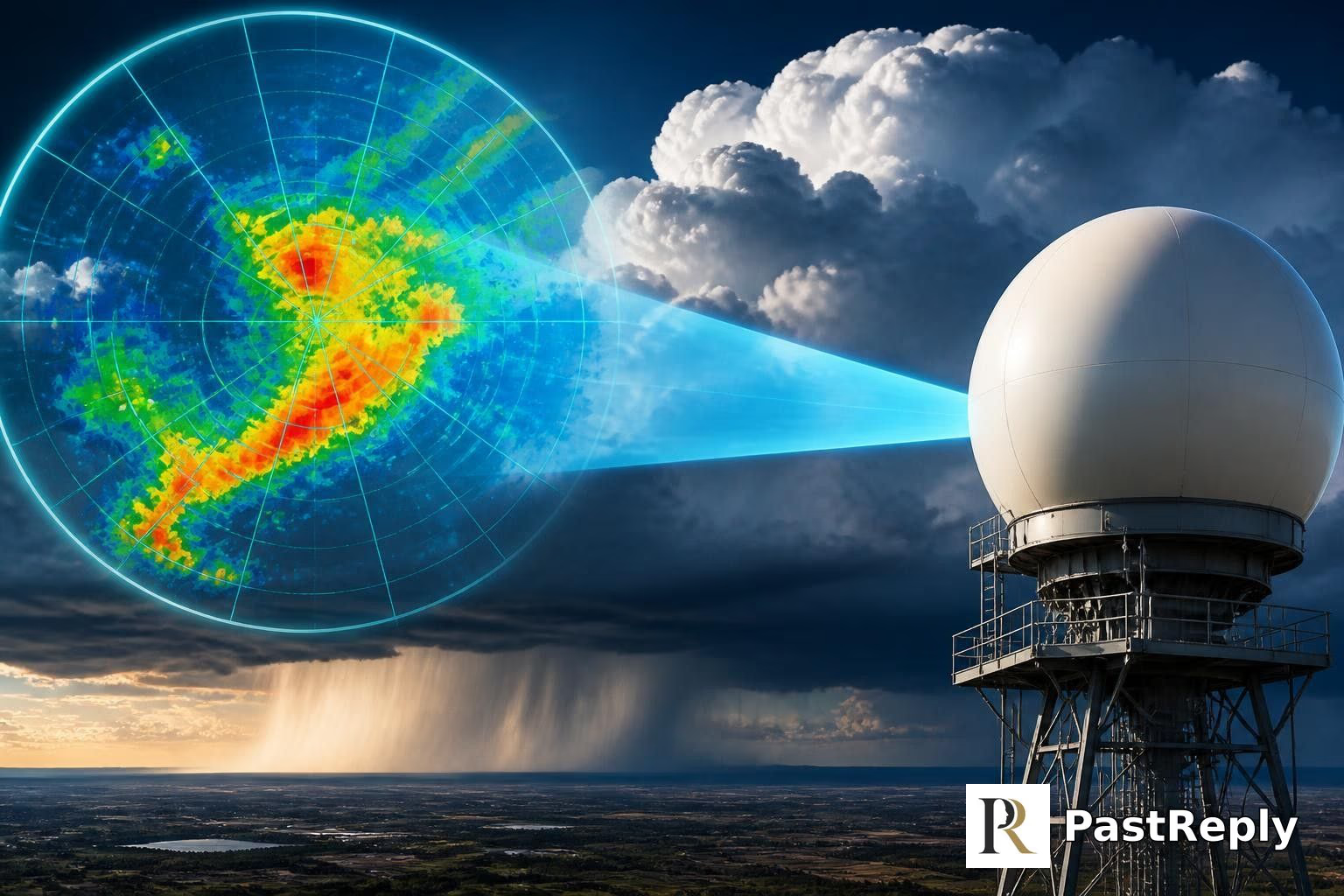
The facts
Weather radar does not directly show clouds themselves. It detects precipitation particles like rain, snow, or hail that are found within and below clouds. The radar beam reflects off these particles, so what appears on radar is the location and intensity of precipitation, not the cloud droplets. However, radar can indirectly indicate cloud presence by showing areas of precipitation, and in some cases, non-meteorological targets like birds or insects can appear as cloud-like echoes.
Answered by 100 of history's most famous minds

Why do you peer into the sky to read the weather, yet miss the signs of the times? The rain falls on the just and the unjust alike, and the clouds gather not by your instruments but by the will of the Father. Tell me, what does it profit a man to know the path of a storm, if he cannot see the needs of the beggar at his gate?

The cloud is a sign of His mercy, bringing rain to the thirsty earth, yet the instrument shows only the water that falls, not the cloud itself. Does the shepherd need a glass to know the sky's mood, when Allah's signs are written in the heavens for those who reflect? Seek the truth with your eyes and your heart, for the unseen is known to God alone, and He reveals what He wills to whom He wills.

The radar shows what falls, not what floats - just as the eye sees the leaf's motion, not the wind's passing. Both cloud and rain are impermanent, arising and ceasing in dependence on conditions. Clinging to the vision of the cloud, or to the report of the instrument, is the same delusion. Look directly, and let go of the need to see what cannot be seen.

The pillar of cloud by day led our fathers through the wilderness, a sign of the Lord's presence - yet no instrument of men could pierce that glory. So this device of yours sees only the rain that falls from the cloud, not the cloud itself, which is the work of the Almighty's hand. Cease to measure what the Lord has veiled; rather, let the rain remind you of His provision, and the cloud of His sheltering presence. The heavens declare the glory of God, and the instrument is but a child's toy before that majesty.

The wise man does not ask whether the instrument shows the cloud, but whether the instrument guides the farmer to shelter his harvest and the traveler to mend his roof. The rain that falls is the rain that matters; the cloud above is but its herald. So let the radar do its humble work, and let us do ours: to heed its warning with sincerity and prepare as right conduct demands.

The eyes of the flesh see but the rain that falls, as the law sees only the outward deed. But the cloud, like the spirit, is moved by an unseen wind. We walk by faith, not by sight, for what is seen is but a shadow of the unseen. The radar's echo is as the letter that kills; the cloud's truth is the spirit that gives life.

The Lord brings rain upon the earth, and His clouds are His chariots. But a man's eye cannot pierce that veil; he sees only the drops that fall. This radar, it is like the visions of old - it shows a shadow of what is to come, but the fullness is in God's hand. We walk by faith, not by sight, trusting that He who sends the storm also sends the sun. The cloud is but a promise of His power.

The empty bowl holds more than the full one. What the eye chases - the falling drops, the hail's clatter - is but the echo of the unseen. The cloud itself is nameless, formless, a breath of the Way. Why peer at shadows when the source is already within your grasp, if you only let it be?

The radar sees only what falls to earth, not the vastness above that gives it birth. The cloud is the Lord's own handiwork, hidden in the heavens, and our instruments can only touch its lowest offering. To know the rain, one must remember the source; to see the cloud, one must look with the eye of faith, not just the eye of man.

The clouds are the work of my Father's hands, and He knows every feather of them, though we see but the rain He sends to water the earth and the hungry. That machine of the learned men peers at the drops that fall, not at the mist that hides the heavens, but even so it is a good servant, for it shows where mercy comes down to quench the thirsty field. I have seen the storm gather over a humble stable, and the same sky that wept for us now weeps for many, and all is under His watch.

That instrument is a papist's trick, I think - it shows you the rain but hides the cloud, as if the drop could be understood without the vapour that bore it! By my faith, we are saved by what is unseen, not by what the eye of flesh can measure, and so this machine, for all its gears, teaches us a lesson if we have ears: the things that truly matter - grace, mercy, the promise of God - are not to be found in any dial or screen, but in the Word alone. Trust not the shadow, but the substance!

We must distinguish, as the philosophers teach, between the substance and the accident, the cause and the effect. The radar perceives the precipitation, which is the effect of the cloud, and by the effect we may reason to the cause, though we do not perceive it directly. Thus the instrument is not false, but incomplete: it sees the rain that falls, not the vapour that holds it, yet the mind, moving from sign to thing signified, may know the cloud is there, just as the intellect ascends from creature to Creator. So the device serves well enough, if we use it with right reason.

We see the tears that fall, not the sorrow that holds them. The radar finds the rain that reaches the ground, the drop that gives life to the thirsty earth, but the cloud that carried it remains unseen. So too with love: we do not see the heart that yearns, only the hand that reaches out. Let us be grateful for the rain we are given, and trust in the cloud that brings it.

Raindrops, not cloudlets, are what the radar beam encounters - it measures the fall of water, not the vapor that holds it. The instrument reveals the visible effect, while the invisible cause, the cloud, must be inferred by reason, as one infers the unseen force of gravity from the motion of the apple. Nature's hidden laws, once deduced from such phenomena, show the hand of a calculating Creator.

The radar beam is a probing finger, but it touches only the heavy stones that fall from the cloud, not the cloud's delicate veil. Yet is this not the deeper wonder - that by the falling droplets we can map the unseen architecture above, as one reads a symphony from the few notes that reach the ear? The visible is but the shadow of the invisible, and even the mist that eludes us obeys laws as firm as the granite.

The instrument is like a naturalist's net, catching only the large beetles while the tiny flies escape - yet from those captures we can infer the hidden swarm. Just as I once deduced the presence of a great vine from the scattered seeds beneath it, so the radar reveals the cloud's offspring, and we know its shape. Evidence is never complete, but it is enough to reason from.

The instrument's beam is like a lantern held before a mist - it does not illumine the mist itself, but only the heavier drops that fall from it. The cloud's watery particles are too delicate to return the signal, too fine for the eye of the machine. Yet this is not a failure of the instrument, but a lesson in measure: we see what the world offers to our senses, and we must reason from that to what lies hidden. The cloud is there, and the rain tells us so - let us trust the evidence, not the authority of those who claim otherwise.

I have spent my nights with the stars, measuring their paths with patient eyes, and I know the difference between what a glass reveals and what lies beyond. The radar, like the astrolabe, catches but a gleam of the heavens - here, the falling rain, not the cloud itself. Yet in that gleam we find order, for even the motion of storms follows laws as certain as the planets - laws that speak of a harmony hidden from our direct sight.

The radar, a crude probe of the outer storm, yet it cannot pierce the invisible currents that shape the cloud. My mind's eye sees far beyond - the electric dance of every droplet, the vibrating field that binds the sky. In a century, we shall not need such blunt instruments; we shall harness the very pulse of the atmosphere, and the cloud will be our servant.

The radar measures what it can detect - the precipitation particles, not the cloud droplets, which are far too small to reflect the beam. It is a tool of precision, but it sees only a part of the whole. In my work, we must distinguish clearly between what we observe and what we infer. The cloud is there, but the radar's signal is a proxy, a shadow, not the thing itself. To know the cloud, one must go up and sample it, or trust to indirect evidence.

No, you see the precipitation - the raindrops, the snowflakes, the hailstones - that reflect the beam. The cloud droplets themselves are too fine, too diffuse, to return a signal. It is a question of scale and density, a matter for precise instruments and patient observation. To truly know the cloud, one must look to its yielding, not its appearance.

No, sir, the radar doesn't show clouds - it shows the rain, the snow, the hail that's already on its way down. It's like trying to read a book by looking at the cover; you get the gist, but you miss the whole story. I've spent my life learning to read the signs, and I tell you, you need more than a beam to understand the weather's full design. It's all about the effort you put into the looking.

A radar beam is a probe, not a painter; it measures the backscatter of particles large enough to reflect its wavelength, and cloud droplets are smaller than the pulse it sends, so they pass unheeded. You could build a finer instrument, of course - a shorter wavelength, a keener eye - but then you'd drown in the noise of every mote of dust and midge. The interesting question is not whether it sees clouds but whether a machine that reads the sky's mood could ever be said to understand it, and there I suspect the answer is a matter of definition, not of fact.

You ask whether the instrument shows the cloud, and I say it is the same error as asking whether the sundial shows the sun. The radar detects the falling drops, the rain that descends from the cloud, and from that echo one may infer the presence of the mother vapour, just as from the shadow one infers the light. Give me a longer beam or a shorter wavelength, and I could map the very droplets, but as it stands, the device is a fine demonstration of how the unseen may be known by its effects - a principle I hold dear in every lever and fulcrum.

The radar's beam - think of it as a probing finger of light, though invisible - does not feel the soft cloud itself; it is answered only by the heavier drops that have gathered and begun their fall. The cloud is the loom, the precipitation the woven cloth, and the radar reads the cloth, not the loom. Yet how wonderful that by tracing where the rain falls, we may infer the hidden shaping hand above.

You ask what the radar reveals, but the more telling question is what it conceals. It shows the manifest content - the rain that falls - while the latent cloud, like the unconscious, hides behind a screen of apparent emptiness. The beam seeks the dense and heavy; it is blind to the diffuse vapors that have not yet condensed into visible sobs. One must read between the echoes.

The radar, tuned to the rain, is like a bat that knows only the moth and not the night. It would ignore a cloud of pure water vapor, for those droplets are too fine to shout back at the beam. But give me a storm of hail or a downpour, and the screen lights up like a dying star. We see what we tune our instruments to see - and we are only just learning to listen to the universe's whisper.

The radar, that inquisitive eye, traces the descending drops yet remains blind to the cloud's own body - a mist of countless tiny spheres too light to answer. But imagine: if we could sharpen that beam, teach it to feel the fine particles, we might map the very veils that hold the rain. So with the engine: it now counts the numbers, but one day it shall trace the ideas themselves.

The radar perceives the body that falls, the rain descending, yet the cloud above is not an object of its sight - a distinction of substance, not of position. For the cloud is composed of droplets so fine they do not reflect the ray, and thus the instrument concludes nothing of them. So must we define our terms: what is seen, what is inferred, and what lies beyond the measure, each in its proper place.

The question mistakes the shadow for the substance. A barometer tells of pressure, a thermometer of heat - but the radar traces the falling drops, the very element that soaks the soldier's blanket and breeds the fever in the camp. Cloud droplets are too fine for such beams; yet the precipitation they reveal is nature's own census, a tally of what shall wet the earth. Let us measure what matters, and let the clouds be as they are - unseen, but not unknown.

You ask if a mirror reflects the clouds? What need have I of such a glass? When I see a storm massing on the horizon, I march my armies into it - for a conqueror reads the sky not to predict but to act. Show me the rain, and I will show you where to ford the river; show me the hail, and I will show you where to shelter my cavalry. The gods do not waste time on mere observation; they demand deeds.

A scout who reports only the enemy's heavy infantry, blind to the cavalry waiting behind the hill, is still worth his salt. The storm's heart is hidden, but its spears of rain betray its position - and that is enough for a general to march, to shelter, to strike. Do not demand the gods' full counsel; seize what the thunderbolt reveals and act.

A mirror shows only what stands before it, not the lady's breath upon the silver. So too this storm-scrying glass of yours - it catches the falling pearls, the hail, the heavy rain, but not the veiled mist from which they fall. Yet wise counsel knows: the cloud that holds its treasure may be read by the treasure's glint. Watch the downpour, and you have seen the cloud's intent, as I read a courtier's heart by his gift's weight.

As a general reads the dust on the horizon to discern the march of legions, so this device reads the falling drops to know the cloud's presence. It does not show the cloud itself, but the rain is a faithful messenger of the cloud's intent. He who would govern must learn to read such signs - not the cloud's outward form, but its works. So too, in the polity, we judge a man by his deeds, not his face; the cloud by its rain, and the ruler by his peace.

A warrior does not ask whether the scout's smoke signal shows the enemy's camp - he asks whether it tells him where to strike. The radar shows me where the rain falls, and that is enough; the cloud is but a fool's ornament. What matters is what the sky gives to the earth, for that feeds my horses, fills my rivers, and strengthens my people. Let the instrument speak plainly, and let the wise man act.

This instrument, like a weak general, reports only what it can see - the rain's march, not the cloud's grand formation. A true commander reads the sky's intent, knows where the storm will strike, and moves his battalions before the first drop falls. The radar is a tool for clerks; the vision for emperors is in the clouds themselves.

It is a matter of prudence, sir. The radar reveals the storm's approach, the rain that threatens the harvest, but not the clouds that carry it. A commander must know what he faces; yet he must not mistake the scout's report for the enemy's full disposition. We see the effects, not the cause. Let us be sober in our judgments, for what is unseen may yet shape the outcome.

A radar map is a lot like a battle report: it shows where the fighting is, not the whole field of war. The clouds are the armies, and the precipitation is the clash of arms. We see the skirmish, not the campaign. But a man who reads the signs well can divine the larger movement of the storm, just as we must divine the movement of justice through the fog of our times.

The radar, that stout-hearted instrument, reveals the movement of precipitation - the very artillery of the heavens - but the clouds themselves remain the great unseen generals marshaling their forces above. Yet we learn to read the battle from the falling shells, and from that infer the shape of the host. To know the storm is to prepare for it, and to prepare is to prevail.

The eye of man is too small to grasp the whole sky, and this instrument, like our own senses, sees only the rain that falls to the earth, not the cloud that holds it in patience. Yet the cloud itself is a truth, and the rain a truth, and both serve the farmer and the thirsty land, just as truth serves the soul, whether it be seen or hidden. Let us not quarrel with the tool that shows us where the water blesses the ground, but remember that the cloud above is as real as the drop below, and both are one in the great scheme.

The cloud is a promise, and the rain is its fulfillment, but the radar sees only the covenant fulfilled, not the hope that hangs above the hills. This is the way of the world, that we measure the visible and call it truth, yet the invisible - the cloud that gathers before the storm, the courage that precedes the march - is just as real. I do not fault the instrument; it serves the pilot and the farmer. But let us remember that what we cannot see still carries the storm, and justice, like the cloud, is not always visible until it breaks upon the land.

The radar speaks of what has already gathered and begun to descend, not of the mist that still hangs in the sky. In this it resembles the long walk to freedom: we see the rains that fall upon our land, the struggles made visible, but the clouds of oppression that held them are only known through their effects. We learn to read the signs, and from the storm we may yet divine the coming of the clear day.

The radar, like the state, sees only what falls upon the ground - the measurable, the concrete. The clouds themselves, whether of vapor or of men, remain beyond its sight until they discharge. Yet a leader does not wait for the storm to strike; he reads the signs in the atmosphere, the pressure of the unseen, and prepares his defense. What the instrument cannot show, the will must foresee.

The radar does not see the cloud; it sees only the fruit that falls from it - the rain that reaches the earth and feeds the fields. So too with the revolution: we measure not the vague ideology drifting above, but the concrete results that nourish the state. What the instrument cannot detect is not worth our attention. The cloud may pass, but the harvest remains.

The radar reveals the precipitation, the falling matter, but not the cloud from which it issues - the concealed formation overhead. So too with history: we see the strikes and the floods of the people, but the conditions that gathered them remain hidden until the moment they break. A revolutionary must study the atmosphere, not merely the aftermath. The cloud is the potential; the rain, the act.

The clouds are but a veil; the rain that falls is the truth of the storm. One might stare at the mist and call it a cloud - but the peasant knows to look for the harvest, not the sky's pretty face. Our instruments detect the water that feeds the fields, not the illusion above. Let the clouds be; watch what they bring.

The heavens themselves are a mystery, and we must not presume to read them more than they reveal. The learned ones may trace the rain as it falls, but the cloud that veils the sun remains beyond their glass. It is enough to know the storm approaches, so that our people may shelter. We are not meant to see all; we are meant to prepare.

One might liken it to reading a letter without the hand that wrote it. The radar shows the falling rain, not the cloud that bore it - a useful distinction for those who plan the day's affairs. In a long life, one learns that some things are glimpsed through their effects, and that is often sufficient for steady course.

The cloud is like a bishop's vestment - it hides the truth it carries. Our scrutineers may track the drops that bless the fields, but they cannot see the vessel above. Yet it suffices: if the rain comes, the harvest is assured. The Lord's ways are partly veiled, and our instruments are but humble servants of His design.

I did not need a device to know the storm was coming; I heard the voice within. The clouds are God's own, and He sends rain as He wills. If the beam sees only the drops, it sees what is meant for the earth - not the mystery above. Trust not the machine, but the faith that guides you through the tempest.

The sky's face is not for every glass to show. What the radar reveals is the substance that falls - the rain that may quench or flood - but the cloud itself remains a painted veil, fit for poets, not for ministers. Let the weathermen count their drops; I shall keep my eyes on the horizon, where my kingdom's fortunes truly lie.

A clever instrument, yet it sees only the rain's descent, not the cloud's ascent. It is like reading a score without hearing the symphony - the notes are there, but the soul is absent. Still, for the practical matter of planning a journey or a campaign, the drops that fall are worth more than the mist above. Reason must guide what the eye cannot grasp.

The wise king does not ask if the cloud is visible, but whether the rain will water his people's fields. Our scouts may mark the storm's approach, yet the cloud itself is but a herald of what is to come. Let the Persians look to the fall of water, for that is the promise of the land's bounty; the veil above is for the gods to see.

The cloud is like a guest's face - it may be veiled, but its deeds reveal its nature. Our observers track the rain that falls, knowing it will feed the crops or swell the rivers. To ask after the cloud itself is to gaze at the curtain rather than the play. Let us heed the drops, for they speak of the mercy or wrath of the heavens.

Tell me, my friend, when you look at that green blip on your screen, what is it you truly see? Do you see water falling, or do you see the shape of your own assumptions? The instrument reflects the droplets, but the cloud - ah, the cloud is like a belief: invisible except through its effects. Let us examine what you mean by 'see,' and whether you have ever truly seen anything at all.

The cloud itself is but a fleeting shadow in the cave, while the rain is a more solid echo of the eternal Form of water. What the instrument grasps is not the true cloud, but a likeness - useful for the pilot, yet leaving the philosopher to contemplate the perfect sphere beyond all moisture and mist. Seek the ideal, not the apparition.

We must distinguish the cloudy substance itself from the watery precipitation that issues from it. The dense vapor that forms the cloud is too rare and fine to cast back the beam, whereas the heavier drops and flakes are solid enough to reply. Thus the instrument reveals the effect, not the cause - the fruit and not the tree. He who would know the cloud's full nature must look also to the sky with his own eyes, joining the senses to the machine's report.

The radar's beam does not perceive the cloud's insubstantial form but the falling droplet that obeys gravity - a mere phenomenon, not the thing-in-itself. What you ask after is the appearance, and I answer: we can only know precipitation, never the cloud's essence, for the cloud itself lies beyond our possible experience. Thus the wise meteorologist must content himself with the shadow on the wall, not the shape that casts it.

You ask a petty question and expect a petty answer: no, the radar does not show clouds. But ask instead what it truly reveals - a promise of storm, a threat, a necessity to which you must bow or prepare. The cloud is a veil, the rain a truth; choose which you would command. For even the sky's lie can be turned to your will, if you have the strength to see through it.

The radar, like capital, reveals only the surface - the falling moisture, the commodity of rain - while the cloud, the true productive force, is hidden behind. It is alienation: the observer sees the effect, not the cause. Under the old science, we count the drops; under a new one, we shall grasp the very process that condenses them. Not a study of weather, but a critique of the sky's political economy.

Let us doubt, then, what the radar shows. It reflects particles, but are these clouds? No, for the beam is blind to the vaporous mist. We must distinguish the clear and distinct idea of precipitation from the hazy notion of cloud. The instrument gives us a map of effects, not a picture of causes. To know truly, we must reason from the principles, not trust the senses alone. The cloud remains a thing unperceived, though its rain is certain.

You ask what the instrument reveals, but the wiser question is what you intend to do with that knowledge. The radar shows you where the rain falls, not where the cloud drifts - yet knowing one allows you to predict the other, provided you understand the prince's nature of weather. Fortune favors the prepared mind, and preparation is the art of the possible, not the ideal.

The radar's eye doth paint a false-faced storm, / A shadow of the substance, not the cloud. / As in a play, the painted foil of thunder / Seems real until the rain misthrown appears. / So mortal sense ofttimes doth take the echo / For the voice, and miss the heav'n's true mood.

As when Zeus gathers his dark storm-clouds above the peak of Ida, yet the shepherd below sees only the rain lashing the flocks - so the radar's eye tracks the arrows of the sky, not the chariot of the cloud itself. The heroes of the air remain veiled, but their sling-stones of hail proclaim their presence. He who reads the battle-line of falling water knows the host is near.

Not the cloud's own robe, but the rain it pours upon the just and unjust alike - this the glowing eye of the storm-seer discerns from afar. Like a penitent whose outer garment hides the inward contrition, the cloud's mist veils its living water. Yet the water falls, and falling is known; so does the hidden heart declare itself by its works. Watch the falling, and you shall read the hidden intention of the sky.

Ah, but consider how the artist's eye sees more than the canvas! The radar's red and green are but a palette, yet from these blobs I can divine the towering cumulus, the anvil's spread, the life-giving shower. What a delight - to grasp in the instrument's crude strokes the living essence of the sky, and to know that even our most precise tools only whisper of nature's boundless vitality. So let us not demand the radar show the cloud itself; let us rather marvel at how well it hints the hidden drama above.

Ah, the radar! A knight-errant's glass that sees not the fair maiden of cloud but only the squalls she sends below. It is the windmill's trick again - what it shows is not the cloud's white beard but the rain's wet lash, falling like a knight's tears upon the tilting field. Trust the eye and the feel, not the painted echo.

We peer at the sky with our machines and think we know it, but we are like men who count the sands of the sea and call it the ocean. The cloud is not its shadow on the screen; it is the living breath of the earth, the moisture of our labor, the promise of rain for the peasant's field. To seek truth, we must look with our souls, not our instruments.

Ah, but the cloud is a soul, and the radar sees only its works - the tears it sheds upon the earth. You look at that green and red wash and think you know the storm, but you do not know its torment, its darkness, its hidden fire. It is like a man's face: you see his frown, but do you see his heart? No, you must go deeper, into the abyss of his being. So too with the cloud - it holds mystery, and the radar is but a shallow mirror.

My dear, the radar is a gentleman of limited vision: it sees only the drops that fall, not the vapors that rise. The cloud, like a young lady's heart, is often a mystery to the very instrument that seeks it. One must infer its presence from the effects - the rain upon the window, the storm in the distance - rather than expect a full revelation of its depths.

You ask of clouds, and I think of the fog that creeps along the Thames, hiding the wretched and the wicked alike, while the honest rain beats down upon the roofs of the poor! That instrument of yours, with its whirling arm and its painted screen, is a kind of weather-clerk - it sees not the cloud's soft grey garment, but the heavy drops it spills upon the streets, the hail that smites the orphan's window. So it tells you where the storm is breaking, not where the vapour gathers, and that is a tale worth the telling, for every downpour has its story and every drop its sufferer.

Well, sir, that radar machine is like a man who hears a sermon and swears he's seen the preacher - it catches the thunder and misses the cloud that made it. It's a clever contraption, I'll grant you, but it's about as good at showing clouds as a tax collector is at showing charity. Still, if you want to know where the rain's going to soak your picnic, it's a fine enough oracle, and it's saved more than one Sunday outing from a drenching, which is more than most prophets can say.

The radar shows rain. It doesn't show clouds. That's all. A cloud is just water in the air, too light to echo back, and the machine's beam moves on like a hunter ignoring the spoor for the beast. In Spain the clouds came down off the mountains and you could taste them, but you didn't need a screen to know it would rain - you felt it in your bones. The instrument is a good tool, but the sky is older, and it doesn't lie.

Observe how the instrument catches but the falling drops, while the cloud itself - a billowing mass of vapor - eludes its gaze, as a painter might render the face of a maiden but miss the soul within. I have watched clouds condense from invisible air to visible form, and I say this: the radar shows what nature reveals, but the eye and the mind together may discern what it hides. Study the moisture, the wind, the pressure - then you approach the truth.

The cloud is the marble block, and the rain the finished form already hidden within it. The radar chisels away the darkness to reveal the shape of the storm's breath, yet it cannot show the veiled spirit that dwells in the vapor. To see the unseen is the artist's torment - we must carve from the mist what the eye cannot hold.

Ah, but what the machine sees is not the cloud's soul - the cool gray caress of its belly, the way it holds the light before the storm! It sees only the heavy drops that rush earthward, like tears that betray a hidden grief. I would trade a thousand such echoes for one glimpse of the cloud's own tender edge, burnished by the evening sun. The instrument traces the rain, but the cloud itself - that living, breathing creature - must be felt with the eye and the heart.

Clouds? I would paint a cloud as a cube and a storm as a guitar - the radar sees only one face, I see a hundred. What does it matter if it shows the rain or the bird or the insect swarm? The eye invents the world; the instrument merely confirms what we already sense. Let the radar lie if it must - I prefer the truth I make myself.

The radar charts but the heavy body of the storm, the gray mass of the shower, yet misses the fleeting veil of mist that tints the horizon rosy at dawn. It is a sketch, not the painting - where is the shimmer of light on a wet leaf, the breath of the sky between two drops? The cloud's true being is in its light, and that no instrument can fix.

You see, in my studio, I paint not the clouds themselves but the light that falls through them, the grey veil that holds a storm's promise. The radar, that clever instrument, shows only the heavy drops that fall, not the wispy breath above. It is like painting the sweat on a brow and missing the worry in the eyes - the true cloud is the weather of the soul, and that no machine can capture.

The cloud is a body, and the radar shows only its bones - the rain, the snow, the hard pellets. But the flesh, the breath, the life - that is what I paint. You want to know the cloud? You must feel its weight on your skin, taste its dampness in your lungs, see its shadows in your eyes. The radar is a cold eye, a machine that does not dream. Give me the storm, with all its fury and its tears, than a screen full of empty signals.

Ha! The radar is like a musician who only plays the notes, but the cloud is the melody - the very soul of the piece! You hear the rain's percussion, but the cloud itself is the harmony that fills the heavens. A radarmeister might catch the allegro of a downpour, but he misses the pianissimo of the cloud's silent drift. Give me a clear sky and a bassoon, and I'll show you real precipitation!

The radar hears but the timpani of the sky, the crashing cymbals of the downpour, while the cloud's true melody - the silence of the mist - remains unheard. Yet even a deaf man can feel the vibration of the storm and know its power. Do not mourn what is hidden; listen with the soul, and the cloud's hymn will thunder through you.

As the organ's pipes sound the air but not the breath that fills them, so this instrument gives voice to the falling rain, yet remains silent concerning the cloud that holds it. The cloud is like the unseen harmonic that makes the melody whole - present, though not directly heard. We must read the score of the heavens with both the ear of the machine and the reason of the mind, discerning the unseen from the heard, as we infer the fugue's subject from its countersubject.

Well now, that radar on the TV news - it's like lookin' at a heart monitor for the sky. Sure, it don't show the pretty white puffs, but it shows where the rain's a-comin', and that's what matters when you're out on the road or in the field. It's a tool, like a good guitar or a microphone - you got to know what it's for and what it ain't. And if it picks up a few birds on the way, well, that's just the Lord's creatures sayin' hello.

It's like trying to catch the magic of a moonwalk with a still photo. The radar sees the rain's beat, but not the cloud's dance. I want the world to feel the wonder - the soft drift, the changing shapes, the dream behind the storm. That's the real show, and it's in the heart, not on a screen.

Well, mate, it's like asking if the record shows the music - it shows the grooves, not the tune. Radar's got its eyes on the rain and snow, not the fluffy bits floating about. But you look at that screen and you see shapes, patterns, like a cloud's shadow on the ground. It's a bit like our songs - you hear the words, but the feeling's somewhere in between. It's all about the vibe, you know?

Radar sees what's falling, not what's floating. The cloud's a mystery, a painting in the sky, but the machine catches the rain's confession. I've sung about the storm on the horizon, but the true tempest? That's between a man and his own weather, always shifting, never quite as it appears.

Honestly, it's like when you scroll through someone's highlight reel and think you know their whole life - but you only see the rain, not the cloud. The radar catches the precipitation, the tangible stuff, but the cloud itself is the bigger picture, the context, the feeling behind the story. I've learned to look past the surface echoes to what's really brewing up there, and sometimes that's the most important part.

Clouds? Of course the radar shows clouds - for what is a cloud but a sign from God of the waters He sends? When I sailed west, I read the heavens as men read charts, and the Lord guided me with signs in the sky. This instrument, though a clever tool, shows but the rain, yet I tell you: the cloud itself is a veil for the divine purpose, and any good sailor knows the sky's true reading lies in faith, not mere reflection.

In Cathay, the wise men used great brass mirrors to spy the rain-storms from afar, but they too saw only the falling pearls, not the dragon's breath that bore them. The cloud is like the Great Khan's hidden pavilion - its silken walls unseen, yet the tramp of his guard reveals his presence. So the radar marks the storm's march, though its face remains a mystery.

The storm-scryer marks the rain as the sea marks the wake of my keel - it shows where I have been, not the vast unknown ahead. Yet a wise captain reads the falling water and knows the cloud that spawned it, just as I read the spume and know the reef. The cloud itself remains veiled, but its herald, the rain, tells me where to steer. So let the instrument show me the falling drops, and I shall chart my course to the heart of the storm.

No, the radar doesn't show clouds; it shows precipitation - the droplets and crystals large enough to reflect its beam. It's a distinction that matters to an engineer, much like the difference between a trajectory and a landing site. But whether we watch a storm from the ground or see a hurricane from orbit, we are learning to read the atmosphere's language, and that is a step toward understanding our world - and others.

Radar's a fine co-pilot for finding rain, but it can't see the cloud's soul - the rising updraft, the cool breath of altitude, the way a cumulus builds like a dare. We fly through the unseen, trusting our eyes and our nerve. The map's not the territory; the sky's the sky, and you've got to taste it, not just read it.

From up there, the clouds are a blanket, soft and white, hiding the earth below. But radar, it looks through, seeing the heavy drops that fall - like a doctor peering into a man to find the ailment, not just the skin. It's a humble tool, but it tells us where the storm will be, so we can plan our launch, our flight, our next step into the stars. The clouds are the poetry; the radar is the science. Both have their place.

It's like asking if a mirror shows your soul. The radar displays precipitation - the drops that fall - but the cloud, the essence, the thing itself, is invisible to it. That's the problem with seeing only the output, not the design. You have to understand the whole system, the beauty of the storm, to truly grasp what's happening. And for that, you need a different kind of vision, not just a machine.

Radar sees precipitation, not clouds - that's just physics. But the real fix isn't better radar; it's colonizing Mars, where you don't need to worry about terrestrial weather at all. First principles: if you want to know what's in the sky, send a satellite swarm. Clouds are a problem we can engineer away.

You know, it's like when you meet someone and you think you know them, but really you're only seeing the rain they're carrying - not the cloud of their whole story. The radar sees the drops, that's all. But if you really want to know the cloud, you have to look up, feel the air, watch how it moves across the sky. That's the deeper truth - the instrument gives you data, but the cloud gives you wonder. And sometimes, the most beautiful thing is just learning to look.

They ask if the radar shows clouds, and I say: it shows the truth, just like I showed the truth in the ring. The clouds are the fluff, the poetry, the pretty stuff you see with your eyes - but the radar, it looks for the real thing, the rain that'll soak you. And just like a fighter can be a butterfly or a bee, that radar can tell you when to dance and when to sting - so you better listen.

Radar is like a referee - it calls the rain, but it misses the beauty of the game. The cloud, ah, that's the striker - it makes its move in the sky, and we feel it on our skin. You don't need a machine to know the sky; you need your heart. The rain is a goal, but the cloud is the dance before the goal.

Ah, it's like asking if the blueprint shows the castle - it shows the stones, not the magic. Radar sees the rain, the hail, the snow, but the cloud, that's the dream that holds them. But you know, when I look at that radar screen, I see a story: a storm brewing, a hero on the way to rescue the day. It's not just dots and blobs; it's the beginning of an adventure. And with a little imagination, you can see the cloud behind it all.