
Does weather affect radar?
Rain, snow, and storms can degrade radar by attenuating signals and creating clutter.
The facts
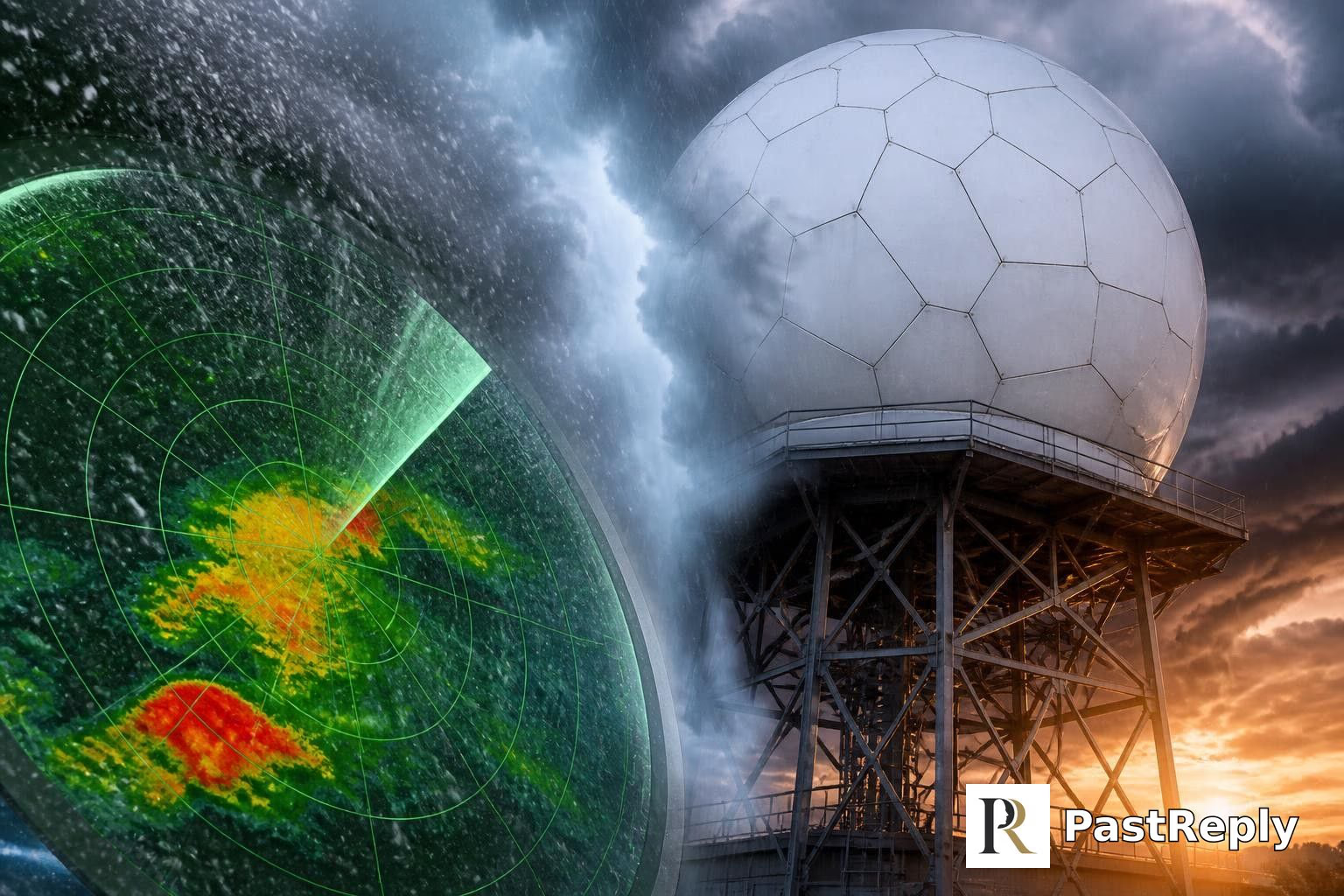
Yes, weather can affect radar performance. Adverse weather conditions such as rain, snow, and storms can cause signal attenuation, where the radar beam loses energy as it passes through precipitation, reducing its effective range and accuracy. Additionally, weather phenomena can create clutter - unwanted echoes from rain or snow - that may obscure or be mistaken for actual targets. These effects are well-documented in radar engineering and are particularly relevant for systems like Doppler weather radar, which are designed to detect and measure weather but can still be impacted by severe conditions.
Answered by 100 of history's most famous minds

A farmer watches the sky for clouds. Another watches the same sky and speaks of rain. The beam that seeks its target stumbles through the storm as a blind man gropes. Truly, the same wind that brings the grain brings confusion to the one who trusts only in his own seeing.

God sends the clouds, and in them is mercy. The rain that feeds the earth also steals the keenness of the sentinel's eye. A traveler in the storm sees less of the road ahead. So it is with the seeking beam. Yet all things are by God's measure; the wise one accounts for the weather and trusts in the Lord.

The rain falls, the beam wavers, the observer clings to the image - yet all these are passing conditions, bound by cause and effect. The wise do not build their shelter on the shifting ground of phenomena, but see the transience of each echo and each storm, and rest in the calm that neither rain nor radar can disturb.

The pillar of cloud that led us by day, and the pillar of fire by night - these are the Lord's signs, and they were not confounded by wind or rain. But the devices of men, built by their own hands and not by God's command, are subject to the elements, as are all works of clay. A storm that baffles your beam is a reminder: you are not the master of the heavens. The rain falls on the just and the unjust, and your machines are humbled before the One who rides upon the whirlwind.

The wise man does not blame the weather for failing to see clearly; he turns his gaze inward. If the signal is obscured by rain, one must first ask whether the instrument itself is properly attuned. A gentleman adjusts the tuning of his zither before lamenting the wind. The radar is like a mirror: if the steam of the world fogs it, one must wipe it clean, not curse the water.

As a storm at sea once drove my ship off course, so does weather turn man's eye from the true beacon. The radar sees through a glass darkly, and rain clouds add to the distortion. Yet we are not called to perfect vision, but to faith - the substance of things hoped for, the evidence of things not seen. Let the engineer fix his beam; I fix my heart on the eternal.

The rain falls on the just and the unjust alike, and so does the mist that blurs the eye - whether of man or of instrument. A shepherd knows that a sudden storm can hide the flock from sight, yet he trusts his staff and his memory of the path. So too, this seeing beam may falter in the tempest, but the one who watches knows the true lay of the land, and his hand does not tremble.

The soft rain overcomes the hard stone, yet the radar beam resists. It forces its way, shouting against the sky. Better to be still, to let the clouds pass without a fight. The weather does not need to be seen; it needs to be felt.

The rain does not care whether you call yourself prince or peasant. It falls on the radar dish and the mud hut equally. If your device is confounded by a cloud, remember that the One who sends the rain also sends the vision beyond it. Do not let a broken machine become a barrier to seeing the Creator's work in every drop.

When the rain fell on our journey to Bethlehem, we sought shelter under a ledge, and the cold seeped into our bones. I know that even the brightest lamp can seem dim in a heavy storm. So it must be with these human eyes that scan the heavens - they too may be clouded, yet the Father sees all clearly through the tempest.

Would that men trusted God's Word as a sure compass rather than these flickering inventions of human pride! The rain and the snow do the Lord's bidding; they may humble a man's clever box of wires, yet they cannot touch the truth of the Gospel. Let the engineers fret over their signals - I fret over the souls who trust in them while neglecting the more certain promises of Scripture.

To the first question, I reply that weather, being a material disturbance in the medium through which the radar's beam travels, can indeed impede its operation by causing scattering and absorption of the signal, in accordance with the nature of hylomorphic composites. Yet it must be noted that such interference pertains only to the instrument's accidental efficacy, not to its essence as a device for detecting objects. The wise engineer, understanding the causes, may take precautions to mitigate these effects, as the prudent sailor reefs his sail before the storm.

The poor in the streets of Kolkata are often drenched by the monsoon rains, and I have seen them shiver. If a machine meant to see through the storm can be fooled by a few drops, how much more must we rely on our hearts to see the face of Christ in the one who is hidden? Let the radar falter; we must be the ones who see clearly, with love that no cloud can dim.

Every ray that passes through a drop of water bends, scatters, and loses of its strength. This is no mystery but refraction. A man who measures the path of light through the storm may yet account for the delay and the dimming, for nature's laws are constant.

The question touches a deeper principle: the electromagnetic wave, like a traveler through a forest, loses vigor passing through droplets - a simple matter of encounter between the wave's crest and the droplet's substance. Yet I find myself more interested in why the radar beam should not be expected to pass unhindered through any medium at all. The universe does not grant perfect transparency; every path exacts its toll.

I have watched raindrops distort the view of a beetle through my lens, and known the same principle governs the radar. The weather is not an enemy but a natural condition, like the varying currents that shape a coastline. The question is not whether it affects, but how much and under what circumstances - patient measurement will reveal the law, and the engineer will adapt as surely as a finch's beak adapts to its seed.

Let us set aside the idle talk of spirits and signatures, and instead measure. I have observed that a ray of light passing through a prism of water bends and loses its strength; it is a simple matter of refraction and absorption. The same principle governs your radar: the raindrop is a tiny lens, and the snowflake a scatterer. No mystery - only geometry and number. If the Church fathers had troubled themselves to measure the angle of a sunbeam through a cloud, they would have spared the world much foolish debate about the nature of the heavens.

Consider a sphere of glass struck by a ray of sunlight: if a cloud passes, the ray falters, broken. So too with the radar's beam and the rain. The heavens are a clockwork of deferential motions, and water is but another body interposing itself. It is no imperfection in the design, but a reminder that no earthly instrument can pierce the veil of Orion's rain without acknowledging the medium through which it passes.

Weather is but a crude interference, a low-frequency tremor in the ether. My own apparatus, tuned to the Earth's own resonances, would pierce any storm as sunlight through mist. The problem with contemporary radar is its pitiful wavelength - too long to see raindrops for what they are. I could design a system of such sharpness that a falling leaf would not obscure a distant mountain.

Certainly, as with any wave, precipitation scatters and absorbs the energy, reducing its power and obscuring the signal. The effect is a matter of degree and frequency - shorter waves suffer more, longer waves less, but all are subject to the physics of the medium. One must account for this attenuation in the calibration, just as one corrects for background radiation in a measurement. It is not an obstacle, but a variable to be understood.

A prepared mind accounts for every variable. In my laboratory, I would measure the exact attenuation of the beam through various precipitations. I would design an experiment: control the droplet size, the density, the temperature. Then, and only then, could we speak of certainty. The weather is a microbe to be understood, not a mystery to be feared.

Of course weather affects it! Every wire, every signal, every moving part - it's all at the mercy of the elements. But we don't give up because it rains. We test, we insulate, we tune. I once ran a wire through a thunderstorm just to see what happened. The data you get from failure is just as valuable as from success. Perspiration, not complaint, is the answer.

Certainly. A radar pulse is electromagnetic radiation, and precipitation consists of water droplets or ice crystals that scatter and absorb that radiation. The effect is calculable: the attenuation coefficient depends on the wavelength and the rainfall rate. So yes, weather introduces both signal loss and spurious echoes - clutter that must be filtered mathematically. It's a straightforward problem in wave propagation, though the stochastic nature of rain makes exact prediction messy.

Every medium that a ray traverses - be it air or water or glass - offers some resistance to its passage. The denser the medium, the greater the attenuation. Rain is but a suspension of water in air; water is denser than air, so it must absorb some of the ray's force. This is no mystery: it is a problem of geometry and proportion. Give me the density of the rain and the distance, and I can compute the loss as surely as I can compute the volume of a sphere.

Consider a beam of light passing through a turbid pool - it scatters and weakens. So too with the ethereal waves of the induction balance; rain-drops and snow-flakes act as countless tiny obstacles, each snatching a portion of the ray's power. I have felt this myself, watching the needle tremble on a stormy night; the very air grows thick with moisture, and the signal fades. Yet this is no imperfection - it is a proof that these forces move through a living, active medium, and the weather but reveals the invisible dance of matter and power.

One asks whether weather affects radar, as if the question were about physics. But the true disturbance is not in the beam - it is in the mind that insists on separating the signal from the noise. The precipitation that muddles the screen is but an external symbol of the internal chaos we repress. Perhaps the engineer who curses the rain is secretly relieved: the clutter gives him an excuse for his own failure to see clearly. Examine the dream of the radar operator on a stormy night, and you will find the storm within.

Raindrops scatter microwaves like a billion tiny lenses, each stealing a whisper of energy. It's a nuisance for air traffic control, but consider: without such scattering, we could not map the clouds from space, nor measure the torrents on Titan. The same physics that blinds the radar also reveals the weather - a cosmic trade-off that makes the universe both frustrating and fascinating. So yes, weather affects radar. But what fascinates me is that we can calculate exactly how much, and bend that knowledge to new purposes.

Imagine the radar beam as a piercing ray of thought, and the rain as a cascade of chaotic impressions - each drop a distraction, bending the truth. Yet the machine, like a disciplined mind, must learn to filter the noise, to distinguish the steady echo of a ship from the fleeting chatter of a squall. I see not a flaw, but a challenge: to weave a more subtle algebra of signals, one that dances with the very turbulence it perceives, turning disorder into a new kind of clarity. The weather does not defeat the instrument - it invites it to become more intelligent.

Let us define our terms: a radar beam is a straight line, like a ray of light, and water droplets are small spheres. The beam strikes them, and by the law of reflection and refraction, it scatters. Thus, by necessary consequence, the presence of many such spheres diminishes the beam's power to reach a distant target. This is not a matter of opinion, but of geometric necessity. If you seek a deeper truth, you must first accept that the axioms of the medium are given, and from them the result follows as surely as the diagonal of a square.

The interference of precipitation on radar waves is a matter of measurable attenuation and backscatter - clean, precise data can be collected if we account for these variables, just as we record fever and pulse to chart the course of disease. Let us not blame the weather, but study its effects, and design instruments that pierce the drizzle as sanitation pierces miasma.

Let the sky weep. My general's eye scans the horizon, not a polished bronze plate. I have crossed the Makran desert under a blinding sun and taken cities in the rain. A little water will not stop my army; if the signal dims, we shout louder and closer. The weather yields, as all else does, to the will of the king.

Rain dims the scout's eye as surely as it slows the legion's march. I would not trust my fate to a single signal when clouds gather - send three riders by different routes, and let the fastest report what the slowest confirms. Fortune favors the commander who plans for the storm, not the one who prays it passes.

A wise commander does not cast the net when the Nile rises in flood - the catch is lost in the silt and the crew curses your name. So too with these signals that men now fling through the air: if the sky weeps or blusters, the message falters, and a pharaoh who trusts a trembling word may find a legion at her gates before the runner arrives. Better to wait for a clear sky, or to double the watch with fire signals on the hills, than to stake a kingdom on a whisper the storm has stolen.

When the Tiber floods, even the most steadfast bridge trembles; the prudent engineer builds the piers deeper and waits for the waters to recede before he sends the legions across. So it is with these beams that herald approaching danger: a heavy rain may dampen them, but this is no cause for alarm. Let the watchmen be trained to distinguish the true signal from the clamor of a storm, and let the records be kept for the calm season, when the truth can be weighed without haste. The empire endures not by ignoring the weather, but by planning for it.

A scout who cannot see the enemy because of mist is worthless. I would have him shoot an arrow into the cloud and listen to the echo. The rain is a woman: she can hide the steppe or she can reveal the tracks of a hare. The radar must be like my archers: loyal through the storm. If it fails, replace the bow; if the signal bends under water, find a higher mountain.

I conquered Europe through fog and snow at Austerlitz; the weather was always my ally, never my master. Radar, like a general, must read the terrain and adapt. If rain shortens your beam, bring your batteries closer - mass your forces. A man who blames the clouds for his poor aim is no man of action. The signal is there; seize it, or let another command.

A commander knows that a fog can hide an advancing column, and a deluge can drown the sound of a drum. So it is with this contrivance that sees through the air: heavy weather deadens its reach and fills its sight with phantoms. Prudence, then, bids us not to rely on it alone when the sky is troubled, but to use it as one scout among several, for nature does not yield her secrets cheaply.

I've seen a fog so thick on the Mississippi that a steamboat captain couldn't tell the shore from the sky. A radar beam, I reckon, is like that captain - when the weather closes in, it gropes and stumbles. But we don't abandon the river because of a storm; we build better instruments, we learn its ways. The Republic, too, must navigate its own tempests with steady hands and clear eyes.

In the Battle of Britain, our radar operators learned to distinguish the Luftwaffe from a flock of birds or a bank of cloud. The weather, like the enemy, is a foe that must be overcome by nerve and ingenuity. A little rain and snow will not deter those whose duty is to see through the storm. We shall fight on the ground, we shall fight on the sea, we shall fight in the air - and we shall learn to read the weather's tricks.

The elements obey laws, as do our devices. But I wonder: does the weather truly impede the radar, or does it only test the radar's limitations? A storm that baffles a machine may yet be read by a humble observer who knows the clouds. We must not become so reliant on our inventions that we lose the wisdom to see things as they are, with clear eyes and a patient spirit.

Storms and winds remind us that there are forces beyond our control, yet we must not be paralyzed by them. The radar, like any human tool, may be hampered by rain and snow, but the spirit that drives justice and love is not so easily obscured. We must work with the tools we have, even when they are imperfect, and press on toward the goal of a beloved community, undeterred by the weather of circumstance.

In the long years on Robben Island, we learned that even the most precise plans could be disrupted by a sudden storm. The warders' searchlights, meant to pierce the darkness, would falter in a heavy squall, and we would whisper our messages more freely. Weather does not care for human intentions; it reminds us that our knowledge is partial, and that we must adapt with patience and resolve. The radar, like a prisoner, must learn to read the sky's mood, and find its way through the noise.

A nation that cannot master the elements is unworthy of its destiny. Our scientists will design radars that see through any storm, for the Germanic will does not bow to nature's petty interference. Those who whine about rain and snow betray a weakness of the blood. Let them clear away the clutter or be swept aside - progress belongs to those who overcome.

The radar's eye must not be troubled by a little rain. If the engineers complain, they will be sent to correct their error in the Gulag. The state demands clear vision; nature must submit. Those who cannot make the beam see through a storm are saboteurs, and we know how to deal with saboteurs. The five-year plan does not account for clouds.

The contradiction between man's desire to see and nature's resistance is a dialectic that must be overcome. The radar, a tool of the bourgeoisie, is humbled by a mere shower - proof that individual technology cannot master the elements without a collective, scientific plan. Under socialism, we will not wait for the weather to clear; we will re-engineer the atmosphere itself, or build radars that pierce any storm. The question is not whether weather affects radar, but whether the owning class will allow the workers to control the sky.

Rain scatters our radar beams as the old society scattered our revolutionary will - but a disciplined Party, like a well-tuned wave, can cut through the clutter. We do not let a storm of nature or class enemy obscure our target; we calibrate our forces, endure the attenuation, and strike with the people's strength.

The elements, it seems, are no respecter of scientific progress; rain and snow can dim the eye of our new radars, as they once dampened the sails of the Royal Navy. Yet we must not be dismayed - British ingenuity shall overcome this atmospheric challenge, as it has so many others, with steady perseverance and the blessings of Providence.

I am informed that weather can indeed influence radar, much as it does so many other aspects of our daily lives. Those who rely on these remarkable instruments, from our brave armed forces to the forecasters serving the nation, will, I have no doubt, take such conditions in their stride - as they always have, with quiet professionalism and resolve.

Even the sharpest eye of a scout can be blinded by a sudden squall - so too with these new devices, I am told, which falter in heavy rain or snow. A wise ruler, like a seasoned captain, must know the limits of his tools and station lookouts accordingly. Let us instruct our engineers to strengthen these signal-beacons, lest a storm hide the approach of raiders or the movement of our own hosts.

I have ridden through rain that soaked my banner and snow that numbed my hands, yet the voices never wavered. If this radar is a tool of men, it will be hindered by storms as any earthly thing - but faith is not dimmed by weather. Let the captains trust their eyes and their prayers more than any machine, and God will guide the arrow home.

It seems that even the cleverest of our new devices must bow to the clouds - a reminder that neither sovereign nor sorcery can command the heavens. Yet a prudent prince prepares for such foul weather, keeping a steady hand on the tiller and a watchful eye on the horizon, lest a storm of nature - or of men - catch us unawares.

The heavens, it appears, play a part in the reach of our electromagnetic beams - a curious limitation for an age that boasts of taming lightning itself. But a true enlightened ruler adapts; we shall build stations in drier climes and teach our officers to read the skies as they read a map, turning nature's obstacle into a subject of useful study.

A wise commander knows that even the swiftest arrow slows in heavy rain, and so it is with these beams that pierce the night. I would not blame the storm, but rather ensure my watchmen are trained to distinguish the faltering echo from the true sign of a rider. Tolerance for the ways of the sky, as for the customs of many peoples, is the mark of a shrewd king.

Allah's clouds may shield a friend or veil a foe, and a device that cannot see through them is but a reminder that no earthly tool surpasses His design. Yet a just commander will not abandon a good instrument for its flaw; he will post human sentinels beside it, trust in God, and advance with caution when the heavens weep, for honor lies in preparedness, not in blaming the storm.

You ask whether the sky's tears trouble the seeing of a bronze eye. But tell me: do you know what the beam seeks? Do you know what you hope to find when the air is clear? It is easier to speak of rain's effect on rays than to speak of the purpose for which you send them out.

You speak of shadows on a cave wall, of shifting vapors that distort the fleeting image of a real object. The radar beam, born of human craft, seeks to discern the shape of things through the mutable air; but the true Form of what it seeks is not reached through such wavering signs. Better to turn the mind's eye inward, where no storm obscures.

The question is one of material causes. Raindrops and hailstones are bodies of water suspended in air; the radar's beam, being a motion transmitted through the aether, is impeded when it encounters denser matter, as a runner slowed by mud. The effect is not mysterious but mechanical: attenuation through collision, and confusion of the echo when many small bodies reflect the signal at once. One must distinguish the substance from the appearance - the rain does not truly deceive the instrument; it merely presents a profusion of true reflections that the observer must learn to read.

One must ask: can it be willed as a universal law that the determinate shape of a beam's journey be altered by the contingent cascades of vapor? Only if such interference arose from a rational structure, not brute accident. That a phenomenon so stochastic should obscure the boundary between appearance and thing-in-itself is a testament to the limits of our sensibility, not a flaw in the radar's moral constitution.

You ask if the weather affects the radar, as if the radar were a pure eye above the world. It is not: it is a trembling instrument of the will to power, and the storm is a stronger will. The rain is a hammer that smashes your feeble attempt to impose order on chaos. Good! Let the signal drown. Only when the machine is broken do you realize you have been dreaming of a world without error - a world without life.

The bourgeoisie hail radar as a wonder while ignoring its material base: copper, labor, and the mines that grind workers to bone. Yes, a storm attenuates the signal - just as crises attenuate capital's profits. But the radar technician, like the factory hand, is alienated from the very means of detection. The real clutter is not rain, but the contradictions of a system that builds tools to serve the market, not humanity.

Let us doubt, first, whether the beam itself is as clear as it seems, and then whether the medium through which it passes is uniform. Rain is no mere veil; it is a multitude of moving bodies, each refracting and reflecting, so that the signal becomes a confused jumble. Yet from this confusion we may deduce the nature of the drops, the rate of fall - if we reason with method. The weather does not break the beam; it reveals its own true shape to the patient mind.

A prince who trusts a blind sentry invites a dagger in the dark. The weather is a spy's accomplice: it can cloak an advancing army or betray a fleet. The wise commander studies the clouds as he studies the enemy's purse. He knows that a radar, like any tool, is only as reliable as its weakness. And every weakness is a door for fortune - or for ruin.

The storm that drenches the field also dims the lantern hung in the tower, the beam that once pierced the fog now stumbles and strays. Rain becomes not water only, but a thousand false ghosts dancing on the watcher's plate, each one a counterfeit of a ship - a cloud-born tempest in a soldier's eye.

Even the far-seeing herald on the tower is blinded when Zeus pours down his rain, and the signal fires are swallowed by the cloud-darkened sea. So too the bronze-eyed watchman of the modern age, whose glance pierces the mist, must wrestle with the same ancient gods - the wind that scatters the voice, the water that drowns the flame.

As I climbed the Mount of Purgatory, a sudden mist rose from the valley, and I saw not the path nor the pilgrim ahead, but only a grey blindness that stole all direction. So it is with these beams that pierce the air to find what hidden thing may be: when the heavens weep or the storm rages, the light is broken and the seeker sees false phantoms, as if the air itself were a fallen angel scattering the truth. Yet even in the tempest, God's order holds - the rain is but His mercy washing the world, and the radar's confusion a reminder that no human eye sees perfectly until the final clearing.

Rain does not merely dampen the signal - it takes the beam and weaves it into a garment of roaring white. I recall watching a storm break over the Harz; the lightning was a word, the thunder its echo. The radar, poor creature, hears only the roar. It cannot behold the daemon of the cloud, the form that strives to become. So yes, weather affects it - as the living world always disrupts the dead machine.

Just as my Don Quixote charged windmills he took for giants, so do radar men tilt at rainclouds they mistake for solid foes. A squall may be but breath and water, yet it parries their invisible lance as surely as any windmill's sail. The wise operator knows that weather wields no sword, but can still make a man miss his mark and call it enchantment.

They ask about weather and machines, but the real question is why we spend our lives peering into invisible beams when we cannot see the suffering at our own feet. A storm blurs the radar; a fever blurs the soul. I have watched men die not from damp, but from the deluge of their own pride. Turn from the screen, I say, and look into the eyes of your brother.

The storm does not only blur the eye; it stirs the soul, and so it stirs this cold, mechanical gaze. A beam sent into the rain returns a chaos of echoes, like the clamor of a guilty conscience - every drop a petty accusation, every gust a howl of denial. The machine sees only clutter, but the heart knows the truth: that the weather, like fate, can hide what is coming and fill the air with lies. Yet in that very confusion, a man may find his way, if he has faith enough to see through the torrent.

A young lady at a ball, if she wishes to know who dances with whom, must peer through a crowd of fans and feathers. The radar, I am told, suffers the same trial: a sudden squall of rain obscures the very signal it seeks. It is a reminder that even the most discerning eye may be misled by a passing shower, and that a clear sky is no guarantee of a clear heart.

I recall a fog so thick on the marshes that the night-coach lost the road entirely, and we sat shivering for an hour while the guard cursed and the horses stamped. That same murk, I dare say, could baffle a mariner's glass or a lighthouse beam just as cruelly. So, if you ask whether a storm of rain or a blanket of snow can dampen the fine workings of a radar - why, it would be a poor sort of human contrivance if it were not humbled by the elements that humble even the stoutest of us.

Well, I've seen a Mississippi riverboat pilot who could read the water like a book, but put him in a pea-soup fog and even old Sam Clemens himself would tie up to a tree and wait. So it is with this radar business - if the weather can hide a whole island from a steam-boat, it can certainly fool a man-made eye in a tower. The difference is, the pilot knows he's blind; the radar just keeps blithely lying to you.

Yes. Rain and snow are wet. Water stops things. It stops a bullet, it stops a signal. In a storm, the radar sees its own reflection in the drops. That is not a target. That is a lie. A good operator knows the difference, but no operator likes to be lied to. You learn to read the squalls or you miss the boat.

I have watched the light of a candle bend through a jar of water, scattering into a hundred colors. The air itself, when thick with falling drops, becomes a lens that the beam must cross. Each sphere refracts, each curtain of rain steals some strength from the ray. Yes, the sky's wet curtain tricks the eye that sends its glance.

I have seen a finished figure emerge from the block while others saw only a shapeless stone. The radar's beam must carve its vision through a living, shifting medium - rain, snow, the very breath of the sky. Let the master work with the grain of the weather, not against it; the truest image is freed from the marble by one who knows its flaws.

Ah, the weather - the very soul of the sky, the brushstroke of the heavens! When I painted the wheatfields under a thundercloud, the air itself was thick with color, and the wind made the canvas tremble. If your machine sends a ray through such a living, moving world, of course the rain and the snow will catch it, will wrestle with it, will make it dance. It is not a flaw, but a truth - the storm is speaking, and your radar must learn to listen as I learned to see the cypress tree in the whirlwind.

Of course it does! The rain is a painter, too. It splatters its gray across the radar's canvas, turning a clean line into a thousand broken mirrors. But that is the beauty of it: the imperfect echo, the accident that makes you see the storm as a beast - a bull with horns of static. The engineer calls it clutter. I call it the real picture.

Ah, but weather is not an enemy to radar; it is the very soul of the moment! A veil of rain softens the signal as a mist softens the haystack at Giverny - the outline blurs, but the truth of the scene grows deeper. They fret over clutter; I would paint that clutter, the shimmering echoes of a passing storm, if only I could catch them before they vanish.

A storm scatters light, and so it scatters a beam sent into the wet air - the painter knows how a mist softens every edge, stealing distance. The radar's eye, like ours, sees through a veil, but the veil itself becomes a jumble of brightness, a chaos of brushstrokes where a solid ship or a bird might hide. So yes, the weather is no mere veil; it is a restless, living thing that paints its own noisy picture over the truth.

The rain beats on my window, and the glass blurs - so too the radar's glass eye. Water is a liar, it bends the light and steals the shape of things, just as pain bends the memory of a body. My own storm lives inside me, yet I paint it clear; the machine sees clouds and cannot tell them from a dove. But which is more real - the clutter of the storm, or the truth that hides behind it? I know both, and I paint both.

Rain is a poor stagehand. I have seen a downpour muffle the clearest horn, making the notes stumble and blur. If a sound can be soaked by the air, why not a beam? The storm steals the clean line, leaving only a muddy echo - a clutter as vexing as a dropped page of my latest score.

What is a storm to the spirit that wills to sound its truth? The music does not cease when the hall is filled with thunder; the ear must strain, but the melody endures. So too the radar's call must be louder than the clamor of the rain, and the hand that reads its echo must be deaf to all but the pure note of what it seeks.

As any organist knows, when the pipes are wet with condensation from a damp winter morning, the tone wavers and the harmony is disturbed. So it is with these beams that men send forth to measure distance: the moisture in the air bends and weakens their course, as a too-humid day dulls the clarity of a fugue. Yet the design is not broken; the Almighty has ordained that the elements interact, and the wise craftsman learns to tune his instrument to the weather, just as I would adjust the registration for a rainy Sunday service.

Well, thank you, thank you very much. You know, back in Tupelo, we used to watch the rain come down on the tin roof and listen to it on the radio - static, static, static. The preacher said it was the Lord's voice in the storm, and I guess the radar hears it the same way: a whole lot of noise and a little bit of signal. But the King's voice got through anyway, rain or shine.

When I danced in the rain, the world watched - but radar? It gets confused, like a rhythm section that can't find the beat. The storm's static is like a crowd roaring too loud, drowning out the melody. But if you listen close, past the noise, the true signal still moves, still heals. The weather cannot stop the song; it just makes you work a little harder to hear it.

Well, you know, it's a bit like trying to hear a tune through a downpour - the rain doesn't stop the music, but it sure muddles the melody. Our songs could cut through any weather, but radar? That beam gets a bit soggy in a storm, like a guitar string gone limp in the damp. So yeah, clouds and rain can mess with its vision, but give it a clear sky and it'll ping back as clean as a bell.

The signal, it gets lost in the rain. Like a voice in a crowded room, you hear everything and nothing at once. The radar, it's just another blind man feeling his way through the storm. Some things you can't cut through, you just have to listen to the static.

I've had nights where the rain was so loud on the roof I couldn't hear my own voice. That's what weather does to radar - it drowns out the signal, makes everything messy. But you learn to work with it, to find the story in the static. Sometimes the most honest thing a system can do is admit it's having a bad day.

God sends the weather to test the steadfast. On my voyage, the sky's wrath hid the stars from my quadrant, and the sea's fury shook the deck beneath me. Yet I held to my west, trusting in the Lord's guidance. So too this beam: it may falter in the storm, but faith and persistence will find the target.

In the mountains of Tibet, I saw a lama read the approach of a caravan through the swirling snow, his eyes squinting against the white. The Saracens of Hormuz tell me their mirrors of polished brass grow dim in the monsoon's wet air. So I have learned from all the ports of Cathay - no seer's device, be it of metal or of spirit, is proof against the sky's moods.

When we sailed through the strait that now bears my name, the fog was so thick that the Santiago could not see the Trinidad at twenty paces, and we feared we had lost her forever. A captain who trusts his glass in a squall is a fool: the rain swallows the signal as the sea swallows a man overboard. But a true navigator learns to read the clouds, to feel the shift of the wind, and to know when to heave to and wait. The weather is not an enemy - it is a lesson in patience and resolve.

During a launch countdown, we watch the weather radar obsessively. A thunderstorm within twenty nautical miles means a scrub - lightning can strike a rocket on the pad. So yes, weather affects radar, and radar affects whether we fly. It is a tool, like any other, and must be understood. The rain is not an enemy; it is just another part of the environment we must engineer around.

Weather? It's the reason I vanished, and the reason every pilot learns to respect the clouds. Rain and snow sap your range, turn the sky to a fog of false returns. But you don't turn back because of a little clutter - you fly through it, trusting your instruments and your nerve. The weather tests you; the weak wash out, but the bold find their way.

From up there, looking down through the window, I saw how clouds wrap the earth like a blanket - but they also hide what lies beneath. Radar, I was told, is like a friend who sees through fog, yet even the best eyes can be fooled when the sky pours. A storm makes the signal stumble, like a runner slipping on wet grass, but a good system learns to tell the rain from a mountain.

The weather is just noise. Great engineers don't accept limitations - they design systems that cut through the clutter. We made the iPod clear through a chaotic world of music; radar must be just as focused. The real question isn't whether weather affects radar, but whether you're brave enough to build one that makes the storm irrelevant.

Of course weather degrades radar - it's a physical fact: precipitation attenuates microwave signals via scattering and absorption. The key is to engineer around it, using phased arrays and adaptive algorithms that filter out clutter. But why stop at Earth's weather? On Mars, with its thin atmosphere and dust storms, we'll need entirely different solutions - something I hope to test soon.

Think of it like this: when you're driving through a downpour, your vision gets blurry, right? You can't see the car ahead as clearly. That's what happens to radar - the rain, the snow, the fog - they're all just clutter in the signal. But here's the thing I've learned from my own journey: every obstacle teaches you something. Weather teaches radar engineers to make better filters, smarter algorithms. It's not a failure; it's feedback. And that's a lesson for all of us - when life throws a storm at you, don't curse it. Ask yourself: what is this revealing about how I need to grow?

Weather? Weather! I float like a butterfly, and sting like a bee, but even I cannot float through a hurricane, you see? That radar - it is like a referee in the ring: it sees the punches, but when the rain comes down, it is like a thick fog in the corner of your eye. You cannot call a knockout if you cannot see the blow. Float on, little beam, but you will dance off the rain and miss my left hook.

The rain is like a defender sliding in from behind - unexpected, disruptive, but part of the game. A radar man must dribble through the storm, feinting past the clutter, keeping his eye on the ball. In football, we play in any weather; the beautiful game never stops. So too must the signal find its way, like a pass through a crowded midfield.

Imagine trying to project a cartoon through a thunderstorm - the picture flickers, the colors smear, but the story still shines through if you've got the right magic. Radar's like that: rain and snow can blur its view, like a dirty lens on a camera, but we always find a way to clear the picture. With enough imagination and a bit of science, even the worst weather can't stop us from seeing what we need to see.