
Does the World Cup happen every year?
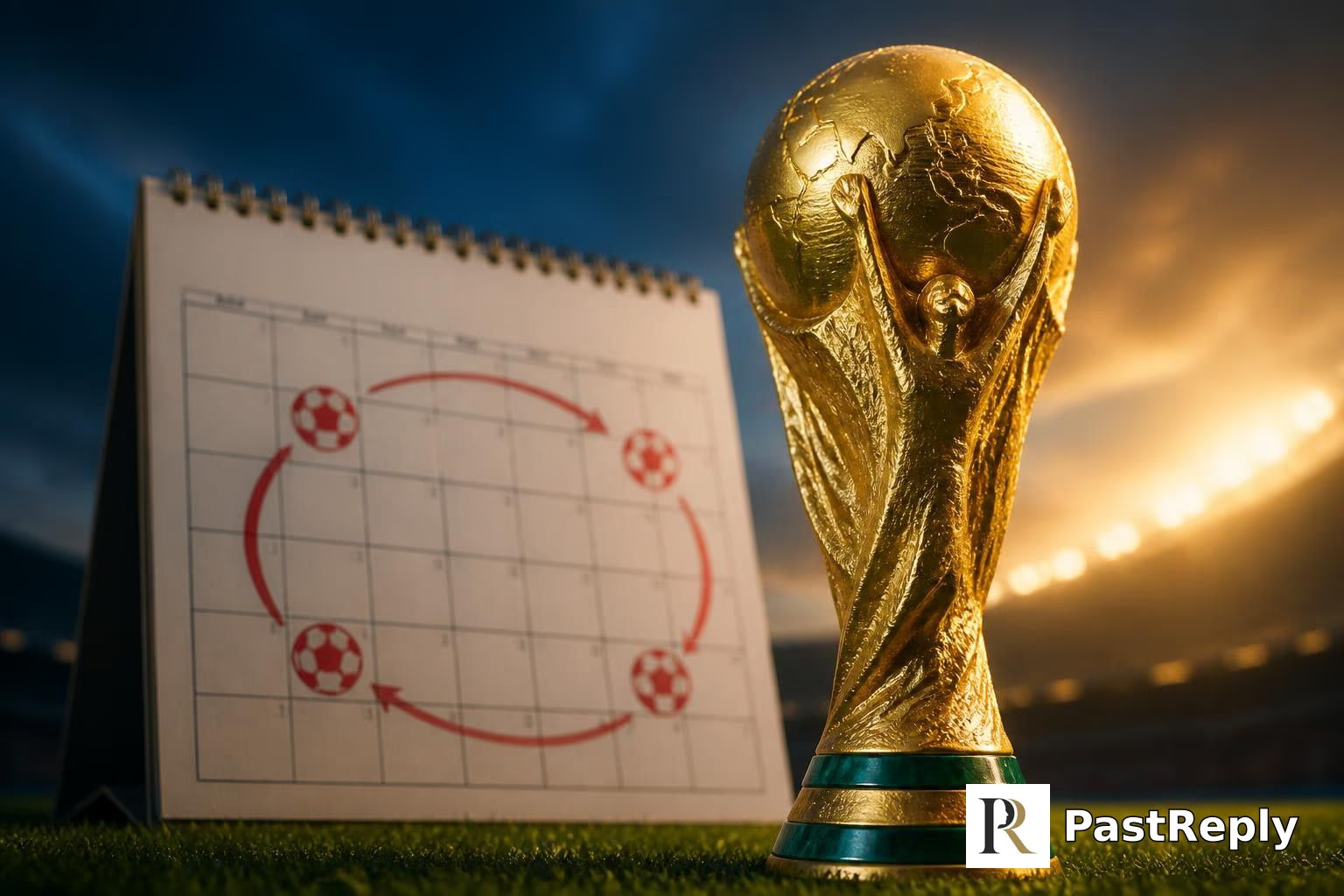
The FIFA World Cup is held every four years, not annually, with the next men's tournament in 2026.
The facts
No, the FIFA World Cup does not happen every year. It is held every four years, a schedule that has been in place since the inaugural tournament in 1930, with the only interruptions occurring in 1942 and 1946 due to World War II. The quadrennial cycle allows time for qualification matches and the organization of the event.
The most recent men's World Cup took place in 2022 in Qatar, and the next edition is scheduled for 2026, co-hosted by Canada, Mexico, and the United States from June 11 to July 19. The FIFA Women's World Cup also follows a four-year cycle, with the last tournament in 2023 and the next planned for 2027.
While some other football tournaments, like the FIFA U-20 Women's World Cup, occur biennially, the senior World Cup remains a quadrennial event, making it a special and highly anticipated global competition.
Answered by 100 of history's most famous minds

Consider the sower who scatters seed, and whether he frets that a harvest must wait a season or two ere the grain is ripe. Four years, or forty, is but a breath to the one who watches the vine, and the true game is not the cup but the cup of cold water given to the least of these. Yet if it be a custom that brings nations together in peace and joy, then let it be a feast, but remember: the last shall be first, and a child's kick in a dusty lane is as sweet as any champion's goal.

The timing of worldly contests matters little in the sight of God, for what is four years but a turning of seasons in a life that is but a whisper? The true competition is not on the field but in the striving for justice, honesty, and mercy in one's dealings. If this gathering, held every four years, unites the nations in peace and goodwill, then it is a noble pursuit, but let it not distract from the greater goal: to serve God and to care for the orphan and the poor. The cup of victory fades, but the reward of righteousness is eternal.

The question of the cycle is a question of attachment. The one who yearns for the game each year clings to the expectation, and from that clinging arises the suffering of the interval. The wise spectator sees the contest as it is, arising in its own time, and finds peace in the impermanence of its coming and going. Four years or forty - the point is to let go of the craving, not to count the seasons.

The Lord commanded rest on the seventh day, and He set seasons for all things under heaven. A yearly gathering would weary the people and forget the covenant of preparation. Four years, like the years of the wilderness, teach patience and faithfulness - so that when the trumpet sounds, the people are ready to receive the blessing.

The wise do not hurry what is great; they let it ripen like grain in the field. If the contest came yearly, its fire would be scattered and its lesson lost, but in four seasons the people's longing grows, and the victors' virtue is tested through the months of waiting. The ruler who fixes a fitting interval shows he understands the people's hearts - not by crowding them, but by giving them time to cultivate themselves for the great meeting.

You ask of a contest played with a foot-ball, but I tell you there is a race that holds its prize only once in all the ages - the imperishable crown, not of grass and cheers, but of the risen Lord. These four-year games are like the training of the body, which profits a little; but the eternal tournament is played among the saints, and it never ends. Do not weary for the world's spectacle; strive for the prize that does not wither.

Once, I was called to go out, not knowing where I was going, and I trusted the promise. So it is with this great gathering of the nations - it comes not by chance, but by a rhythm that teaches us patience and hope. If it were every year, we would not learn to long for it, nor to celebrate it as a sign of peace among all peoples, like the stars that appear only after the long wait of the night.

The river flows without hurry, yet it reaches the sea. The tree grows slowly, yet it touches the sky. Four seasons bring four years, and in that patience lies the strength of the game. Do not rush what nature has ordained.

The Creator does not repeat His festivals without cause. In four years, we learn patience, we learn to prepare, and we learn to share the joy with new faces. The game is but a mirror of life: to rush it is to miss its meaning.

My heart rejoices in God who lifts up the lowly, and in His time, not ours. A great gathering of the peoples, a celebration of skill and joy, comes like the harvest - it cannot be rushed, nor forced every year, or it loses its fruit. Four seasons, four turnings of the earth, give time for the children to grow, for the fields to be tended, and for hope to ripen in waiting. Even the holy festivals of my people were set by the Lord's own calendar, so that the soul might yearn and be filled in due season.

Let the world have its grand spectacle, but I tell you that a festival of the foot-ball, even every fourth year, is but a vanity if the soul is not fed daily upon the Word. The scriptures do not command a world cup, nor forbid it, but they do say that all things be done decently and in order. Every year would be a burden, a tyranny of constant sport, drawing the people away from their honest work and from the true contest of faith. Four years is a godly number, I think - like the four seasons, and the four corners of the earth - and it gives the papists no excuse to make a pilgrimage of it.

It is fitting that so great a contest be held not every year, but at a measured interval, for the human heart delights most in that which is not too frequent. As the natural law teaches us to seek rest on the seventh day, so too a grand celebration of skill and strength requires a due season, lest it become a matter of custom rather than of wonder. The four-year cycle also provides time for the nations to prepare, both in the training of their athletes and in the ordering of their affairs, so that the event may be conducted with due dignity. Thus reason and custom agree: a quadrennial festival is a proportionate and good thing, and to make it annual would be to debase its currency.

Ah, but a game that happens only every four years - how it teaches us to wait with a joyful heart! In the slums of Kolkata, we have learned that a single cup of water given in love is worth more than a thousand festivals hurried through. Whether the world's young men kick their ball once a year or once in four, the cry of the hungry and the lonely is the same each morning. Let them play their match, but let them not forget that the truest victory is the smile of a child who has been held and loved.

A four-year cycle is not a mere convention but a necessity, for the motion of spheres is governed by laws, and the preparations of a tournament require ample time. One might compute the interval as the mean of a planet's orbital period, but the organization of such an event follows its own mechanics. If it were held yearly, the quality of play would suffer, like a pendulum forced to swing before its natural period is complete.

Four years is not an arbitrary number; it is the time it takes for the orbiting teams to align, for the qualifying trials to curve through every nation's gravity well, and for the final spectacle to arrive with the force of a mass bending its spacetime. The calendar of the games mirrors the patient rhythm of the cosmos - not the frantic pulse of a single year, but the measured orbit that gives the event its heft and its glory.

I should observe the pattern as I would the breeding seasons of a finch. The four-year interval is not a fixed law of nature but a product of many factors - the long qualifying migrations, the need for the host to prepare its grounds, the recovery of the players' strength. It is a rhythm shaped by accumulated circumstance, not by any deliberate design. Let the evidence speak; the cycle is what it is.

Would you measure the stars by a daily glance and call it astronomy? Nay, observation requires time, and the quadrennial cycle is but the proper interval for the planets to align and the players to perfect their craft. I say, let the telescope wait - the truth of the contest is found in the patient accumulation of skillful motion.

The return of the tournament in four years is not a custom but a harmony, akin to the celestial spheres moving in their measured orbits. Just as the sun returns to the same point on the ecliptic after a full circuit, so the contest returns to renew the ardor of peoples - and a yearly return would be a cramped epicycle, a needless crowding of movement. Observe the heavens: the greatest things have their long seasons, and so does this.

Four years is naught but a harmonic cycle in the great machine of the ages - a resonance tuned to the human spirit, much as my alternating currents pulse at the frequency that best serves the globe. If it were an annual affair, the energy would dissipate like a single coil without a capacitor. The waiting accumulates the potential, and the discharge is all the more brilliant for it.

The timing of this event is not arbitrary; it is a deliberate cycle, set by careful planning, much like the half-life of a radioactive element. Four years allows for rigorous preparation - qualification, organization, and the building of anticipation. It is a period of patient observation and accumulation, and to shorten it would diminish the value of what is achieved.

Every four years, the microbes of competition are allowed to ferment. Rushed vintages yield poor wine. My lab taught me that some cultures require patient incubation; the World Cup, like a fine vaccine, needs its time to develop fully. Persevere.

Four years? That's just enough time to test, fail, and retest. You can't rush a good invention, and you can't rush a good tournament. Give it patience and it'll light up the world.

An annual recurrence would require the qualification problem to be solved in a dramatically compressed time, reducing the computational complexity of the selection procedure to near-triviality. The four-year interval is the natural period for a tournament that must first compute the optimal subset of teams through a distributed, highly parallel process of elimination games across the globe. It is, if you like, a sort of formal timeout - a fixed-point iteration that allows the system to converge on a champion before the next cycle begins. There is, of course, no inherent mathematical reason why it could not be every two years, but then the combinatorial space of fixtures would become intractable within the same memory constraints.

A cycle of four years is a sound measure, for it allows time for the teams to be selected, the training grounds to be laid out, and the geometry of the tournament to be drawn with due precision. If it happened every year, the logistics would be a great burden, and the contest would lose its proper proportion, like a circle whose circumference is too small for its diameter. But give me a firm point of leverage - say, a well-struck ball at the right angle - and I could move the whole arena. Yet the interval is well chosen, much as the Olympiad of my countrymen is reckoned by the turning of four years.

I have observed that the great forces of nature - the magnetic, the electric, the gravitating - all lie ready to act upon the world at every instant, yet none of them is roused by a mere turn of the calendar. This football contest, as I hear it called, follows its own fixed period, like the oscillation of a pendulum beneath my hand, swinging only at its appointed time. Asked whether it recurs each year, I must answer: no - it is a four-yearly revolution, a rhythm that the stewards of the game have found fitting, and one that, like all well-ordered things, yields its delight precisely because it does not run weekly.

Why does this question so insistently press upon you, I wonder? Perhaps beneath the surface you are not really asking about a calendar at all, but about the pleasure of repetition - for the crowd that gathers to watch its heroes struggle and triumph in the stadium is, at last, reliving a primal scene. Every four years has the rhythm of a fantasy that must be re-enacted: the tension, the release, the ecstasy of victory and the mourning of defeat. And if it were held every year, the dream would lose its power - too much gratification, you see, would flood the channels of desire, and we would soon grow weary of the very thing we crave.

Every four years - that’s about 5.26 × 10^8 heartbeats if you’re a moderately anxious fan, or roughly one-eighth of the time it takes the Solar System to complete a single orbit around the galactic center. The universe doesn’t organize its entertainments to suit our calendars; it is quite indifferent. But I find it pleasantly surprising that a species that can barely manage to get its own weather forecasts right can predict a global tournament four years in advance. Perhaps it’s our small way of imposing order on a chaotic cosmos - and if we missed a year, our neural clocks might start to wobble from the lack of excitement.

How curious that a question so simple as the periodicity of a game should open onto the very logic of recurrence! I see it as a kind of algorithm, if you will: a fixed cycle of input and output, where every fourth turn of the Earth yields a fresh result, just as a calculating engine might repeat a process to generate a new table. Yet I wonder - could we not program it to occur more often, say, every second year, and still maintain the wonder of the thing? The engine of a tournament is not bound by the laws of nature, but by the will of its designers; and in this, as in all invention, we must ask not merely what is, but what might be.

He who asks whether the contest recurs each year has not yet defined his terms, for 'year' is a measure of the Earth's journey about the sun, while the tournament is a human institution, subject to its own conventions. From the premises agreed - that the founders set the interval at four revolutions - one may deduce with necessity that it does not occur annually; but if the stewards were to amend the rule, the conclusion would change accordingly. Geometry, like all knowledge, rests upon axioms freely chosen; so too does the rhythm of this game rest upon the decision of its planners, and to seek an eternal law in a mere schedule is to mistake the shadow for the substance.

Four years, you say? Then let us use that interval wisely, for the same discipline that governs the sanitary hospital governs this great contest. Without proper time for preparation, for the strengthening of the players' constitutions, and for the marshaling of supplies, we would have but a disorderly scramble, feverish and fatal. The quadrennial cycle is not a mere convenience but a hygienic necessity - a period to cleanse the field, train the limbs, and ensure no preventable calamity befalls the spectacle.

Four years? Why not an annual march to glory? I conquered Persia in a few short campaigns, and the world waits not on calendars. Yet if a grand spectacle unites nations in one arena, then let it be a new Troy, a contest for the swiftest and the strongest. But every four years, we would have to wait too long to see who dares call himself champion. Better to fight for it each year, and let the boldest claim the laurel without delay.

Every year? By the gods, no. Even the plebeians know that the greatest spectacles must be savored, not worn out like a cheap toga. Four years gives the vanquished time to rebuild their legions, the victors time to polish their laurels, and the crowd time to hunger for the clash. A yearly bout would cheapen the triumph, and I, for one, do not throw dice with the people's anticipation.

A mere four turns of the Nile's flood, and yet the world's tribes gather as if for a single great feast. I have seen kingdoms rise and fall in such a span; the waiting is but the whetting of the appetite. Let the Romans boast of their anniversaries - our cycles honor the gods and the harvest, not the whims of spectacle.

Stability, not haste, builds an empire - and a spectacle. A yearly game would exhaust the treasury and the spirit, like a triumph celebrated too often. The four-year interval, like the census, allows the state to prepare, the people to yearn, and the victors to be crowned with due solemnity. Thus do we keep order and awe in equal measure.

Four years is the time for a boy to learn to ride and draw a bow - enough to grow strong, not so long that he forgets the thrill of the hunt. If we gathered every season, the tribes would grow weary and the victory would lose its worth; a wise khan knows when to strike, and when to let the grass grow. Once, under the great sky, I united many peoples by calling them together at the right moment - this is the same wisdom.

Every four years? A fine stratagem, for a campaign of such magnitude requires time to muster the troops, forge the alliances, and lay the supply lines. I would not send my Grand Armée to battle every harvest - that would exhaust the field and the men. Let the nations gather their strength, and then let the battle be decisive; glory is not a daily ration, but a rare conquest that reshapes the map.

It is a matter of prudence and order. To hold such a grand contest annually would strain the resources and attention of the nations, and foment disruptive passions that must be kept in check. A cycle of four years, like the seasons of a farm, allows for proper preparation and a measured celebration of skill and unity, not a perpetual carnival that would weary the spirit of any commonwealth.

A house divided cannot stand, but a house that rushes its gatherings also fails. Four years gives each nation time to mend its fences, to train its plowmen, and to sow the seeds of victory. It is not a shortcoming but a strengthening of the bond.

Every four years, we gather to celebrate the glorious struggle of nations. He who would demand it yearly shows the impatience of a child at the dinner table. Let us savor this feast, for in its rarity lies its grandeur.

A festival that comes but once in four years teaches patience, and patience is the first step on the road to truth. For the crowds who flock to the fields, let them learn to wait, to hope, to build toward a single moment, much as a farmer waits for the monsoon. If it were every year, the excitement would become a habit, and habit dulls the spirit. But even as we rejoice in this spectacle of many nations, let us remember the countless villages where children play with a ball of rags, and let their joy be honored too, for true sport is not the victory of one but the fellowship of all.

The rarer the occasion, the more it stirs the soul - like the ringing of the bell that calls us to a just cause, which must not be sounded every day lest it grow faint. Every four years, the peoples of the earth gather on common ground, where the color of a man's jersey matters more than the color of his skin, and for a few weeks the beloved community is glimpsed in the stadium's stands. Let us not diminish that vision by too frequent repetition, for the hope that sustains us is the hope that waits, and in that waiting, justice prepares itself for the great day. Indeed, the football field is a metaphor for the arc of the moral universe - long, but bending toward a goal.

In my long years on Robben Island, we learned to mark time not by the turning of years but by the slow work of building a common future. So too with this great gathering of nations: it comes but once in every four seasons, a patient marathon rather than a sprint, and in that waiting lies its power to bind the peoples of the earth. What does it profit a game to be played every year, if the longing and the meeting are not given room to grow? Patience, my friend, is not merely a virtue - it is the very soil in which hope takes root.

A mere sporting contest of kicking a ball, and you ask whether it recurs yearly? Such a question trivializes the real struggle for existence - the conflict of peoples for space and destiny, which knows no scheduled intervals. Yet even in this petty game, the Germans showed what discipline and will can achieve, and it is no accident that the world's finest athletes train with the regularity of a military march. Whether they play each year or each four, it is the martial spirit, the readiness to conquer, that alone is worthy of respect; all else is decadence and weakness.

Why do you ask such a simple question, comrade? Whether the foot-ball game occurs each year or each four is a matter for the bureaucrats who schedule it; what matters is that the masses are kept in line, and if they are given their games on schedule, all the better. In my time, we did not need such distractions - our people were mobilized for the glory of the Five-Year Plans, which came with the regularity of a steel mill's output. But if this tournament serves to amuse the workers, let it be held at whatever interval the Central Committee deems fit - provided that it never interferes with production quotas.

This question reeks of the petty concerns of the bourgeois spectator, who measures life by the intervals of amusement rather than by the forward march of history. Whether the great football gathering recurs each year or each four is an irrelevance; what matters is that the working masses, who kick the ball in factory yards and village fields, are not deceived into thinking that their liberation will come from a match. The revolution, comrade, is not on a schedule of four years - it arrives when the contradictions of capitalism reach their breaking point, and no calendar can predict that. So let the players run their race, but keep your eye on the dialectic.

Why do you ask of the moon's rhythm when the land cries for revolution? The imperialists measure time with their four-year trinkets to distract the masses from their chains. In our villages, the only true cycle is the harvest of struggle - let the peasants kick their ball when the landlord's yoke is broken, not when the Western clock decrees.

Every year? Good heavens, no! Such frequency would quite diminish the grandeur befitting a sport of nations. These games are not some common village fair to be trotted out with the turn of the seasons - they are a grand occasion, an imperial display of vigor and honor, deserving of the same stately pacing as the great jubilees. A four-year span allows the world to hold its breath and then exhale in due celebration, preserving the dignity and anticipation that such a mighty contest demands.

It has always been every four years, and there is a quiet constancy in that, a rhythm one can rely upon. In my long life, I have seen the world change immeasurably, but the steadfast cycle of this great gathering has remained a reassuring thread. It is good to have such enduring traditions, providing a sense of continuity and shared purpose across the Commonwealth and beyond.

Four years, no more, no less - as the Emperor of the West, I decree that this contest be a grand synod of nations, not a petty seasonal fair. Time is needed for the realms to muster their best champions, to forge alliances through practice, and to let the anticipation build like the approach of a holy crusade. A yearly spectacle would be like holding Easter every Sunday; it would strip the glory from the feast and exhaust the faithful.

I know little of calendars and courtly schedules, but I know that great deeds are not done in haste. The Lord gave us time to prepare for the march to Orléans, to gather our strength and our faith, and so too must these young men and women have their seasons to ready themselves. A contest every year would be like charging into battle without a moment's prayer - it would dishonor the endeavor and the glory that comes from patient resolve.

Would you have the crown jewels displayed at every weekly market? Nay, it is the rarity that lends them their luster. A quadrennial contest is a state affair, a moment for the world to pause and gaze upon the prowess of nations - not some common entertainment to be worn thin by constant repetition. Let it be a grand tournament, staged with due pomp and calculation, for in the space between, the rivals sharpen their wits and their skill, making the eventual clash all the more splendid.

Every year? That would be a peasant's jamboree, not an enlightened assembly of nations. Even Catherine knows that art and science require time to cultivate; so too does this game, which has become a modern ballet of strategy and skill. Let it remain a quadrennial court ball, eagerly awaited, brilliantly choreographed, and all the more magnificent for its rarity. The interval is a canvas on which anticipation paints its masterpieces.

As I have learned in uniting the Medes, the Persians, and the Babylonians, great gatherings require the slow weaving of trust and custom, not the frantic noise of yearly alarms. Four years is a noble span, allowing each people to send its chosen athletes, to prepare their lands and treaties, and to come before the world with dignity and honor. A yearly race would be like a daily banquet - it would turn celebration into routine and erode the bonds that such a rare and grand meeting forges.

Even the believer knows the five daily prayers are fixed, but the great pilgrimage comes but once a season of seasons. So it is with this contest - it must be a rare and sacred gathering, not a common market bazaar. The four years allow for the healing of wounds, the training of youths, and the cooling of hot blood, so that when the nations meet, they meet in the spirit of honorable struggle, not in weary repetition. Let its rarity be a mark of its worth, and its delay a test of our patience and hope.

Tell me, my friend, does it matter whether the game is played yearly or every four years? Or is the real question whether the event teaches us anything about excellence, about the pursuit of virtue in competition? If a man trains four years for a single contest, he may learn discipline; if he competes yearly, he may learn the limits of his own strengths. But do not mistake the festival for the lesson. Let us examine what it is about this spectacle that draws us, and whether it ennobles us or merely entertains.

Consider the eternal Form of the Game, which exists beyond the changing seasons and the shifting sands of the arena. A yearly celebration would bind us to mere flux, the endless becoming that never touches the ideal. The quadrennial cycle mirrors the harmony of the spheres - a measured pause that lets the soul ascend from the particular contest to the timeless pattern of excellence. Only in that interval can true spectatorship approach knowledge.

Consider the nature of such a contest: it seeks the peak of human excellence, which requires time for training, strategy, and the maturation of skill. A yearly recurrence would debase the pursuit, turning triumph into mere repetition. The quadrennial rhythm mirrors the seasons and the growth of virtue - a mean between scarcity and excess, fitting the purpose.

The quadrennial return is not mere custom; it is a schedule every rational spectator can will as a universal law. To hold the contest yearly would debase its meaning, turning a festival of excellence into a mundane recurrence; but to make it once in a lifetime would starve the hope that sustains the striving. Four years is the mean that preserves both anticipation and duty - a rhythm that honors the players' toil and the spectators' longing without enslaving either.

Every four years, the herd gathers to watch other herds chase a ball - and you ask if it should be every year? That would be a godless monotony, a treadmill for the timid, robbing the occasion of its rare, intoxicating tension. The long wait is what lets the crowd's thirst become a frenzy, and the frenzy is what lets a few souls rise above the rest. Four years is not a compromise; it is a discipline that keeps the spectacle worthy of the strong.

Four years is the interval by which the ruling class of the ball-industry extracts surplus value from the laboring masses, selling them a vicarious thrill while the real accumulation happens in the counting-houses of television and ticket booths. The cycle is a fetish to mask the alienation of the spectators, who cheer for the commodified spectacle as if it were their own struggle. When the workers seize the means of the game, perhaps the cup will be shared by all - and the wait will be abolished.

Let us doubt the premise. The question assumes a regularity that must be examined. The evidence of the senses tells us that this event recurs at intervals, but reason suggests that a cycle of four years is not inherently necessary; it is a convention, chosen perhaps for practical ends. We can be certain only that it is not annual, for that claim is contradicted by clear and distinct observation of the history of the event.

In statecraft, as in sport, power lies in scarcity. Every four years, the world's attention is focused, and that focus is a weapon. If the spectacle were annual, its luster would fade, and princes would lose a tool for distraction and unity. Keep it rare.

Four years, a span that doth allow a youth to grow to manhood, and a team to be rebuilt from ashes. The interval is a stage upon which ambition and despair are played, for the champion's crown is sweetest when it is rare. If it were yearly, the anticipated joy would pall, and the world would grow weary of the same procession. A good play, like a good match, is best savored not at every turn but at the proper season, when the audience's hunger hath made it ravenous.

Nay, every year would see the heroes worn thin as a beggar's cloak, and the songs of their deeds would lose their grandeur. Four harvests must pass between the clash of shields, so that the wine of glory may age in the cask, and the names of the victors ring out across the wine-dark sea with the weight of fate. The gods themselves mark the seasons; they do not rush the epic.

Four years, a span that mirrors the turning of the spheres and the pilgrimage of souls through Purgatory's terraces. Such a delay purges the impatience of the crowd and refines the athletes as fire refines gold. Were it yearly, the glory would dim, and we would lose the sacred anticipation that lifts the spirit toward the heavenly goal.

Every four years, the world gathers at the same pitch, yet each time the ball rolls to new feet and the tides of fortune shift - there is no repeating in life's living texture. A yearly return would weary the spirit, like a feast eaten daily; the long pause lets the seed of longing grow into full bloom, and the striving between tournaments is where souls are forged. The World Cup is not a mere event but a measure of human striving, and four years is the season of its ripening.

Four years between tilts, you say? Ha! That is precisely the span Alonso Quijano needed to re-forge his rusted lance and sell three acres of barley to buy a fresh helm. The tournament is a windmill that only turns once a quadrennium, and yet the world tilts at it with the same madness as my knight, dreaming of glory in the intervals of ordinary life. The waiting, señor, is the better part - it lets the hope swell in the breast like a bladder before the feast.

They ask of the once-in-four-years festival, but I ask you: what is a kingdom of eleven men kicking a ball, when the true struggle is the kingdom within each soul? The interval between tournaments is the real season - the quiet years of sowing and reaping, of loving one's neighbor, of facing the death that no victory can forestall. Do not live for the single hour of applause, but for the thousands of ordinary days where the eternal is at play.

Ah, but think of what four years means to the soul! In that time, nations rise and fall in their hopes, children grow into men, and the wounds of the last contest heal or fester. If it were every year, we would become as beasts, gorging without end and never knowing the hunger that makes bread sweet. The waiting is a trial, and through trial we find redemption and meaning in the victory.

Indeed, a yearly ball would quite lose its charm. The anticipation, the preparation, the gossip - all would be sadly diminished if one could not say, 'Until the next, we must behave ourselves.' Four years is a proper interval for a little decorum.

It is the peculiar genius of our age to make a magnificent occasion of a thing and then stretch it out so thin the wonder has quite leaked away before the trumpets sound twice. Once in every four years, no more, no less - like Christmas, or the donning of a clean collar - and the world remembers to hold its breath. Imagine the might of Mr. Bumble's parish workhouse, if it were to put on the same plum pudding every February: the poor thing would be worn to a shadow. Let the World Cup be a grand spectacle, a once-in-a-blue-moon festival that gives the toiling masses something to lift their lanterns toward, and let them not grow weary of it by constant feasting.

Why, of course it don't happen every year - that would be like having Christmas on the Fourth of July, and turkey dinner every Sunday, and a funeral for every cat that dies on the roof. A thing that comes too often loses its flavor, like a preacher who shouts Hallelujah at every sneeze. No, sir, every four years is just right - long enough for the last champion to get good and moldy, and short enough that you don't forget the best part, which is arguing about it in the saloon between times.

Four years is a good stretch. It gives the old men time to go soft and the young ones time to get hard. If it were every year, nobody'd care much more than they care about a Tuesday. The waiting is what makes it mean something, like the wait between the first frost and the thaw, when the river starts to move. A man who wins it every year would be a bore; a man who wins it once in four is a champion. That's the truth of it, and it don't need any dressing up.

The circle of four years is a natural rhythm, much like the orbit of a body about its sun, and it allows the players to evolve, the organizers to perfect their craft, and the spectators to renew their anticipation. Were it a yearly affair, the spectacle would lose its grandeur, and the athletes would have no time to master the intricate mechanics of their art. It is a period of observation, of study, and of preparation - much as a painter must wait for the light to be right before he captures a scene.

Four years is the time it takes to hew a David from the raw quarry, to chisel away every flaw until the divine form emerges from the stone. A yearly stroke would leave but a rough block, unworthy of the eye of heaven. The world must wait, aching, while the masterpiece is prepared - for art, like the sacred games, is a slow unveiling of the ideal that lies hidden.

Ah, but think of the light! Every four years, the sun dips and rises over new fields, and the players paint their passion on the grass. A yearly game would fade like a hasty sketch; the waiting lets the colors deepen, the emotions ripen. I would wait a lifetime to see such a burst of yellow and green, the crowd like a field of sunflowers turning toward the match.

Every four years! What a joke - time is a canvas, and who says it must be cut into equal squares? The spectacle should strike when the tension is unbearable, not when the calendar clicks. I would paint it every evening, or once a decade, or when the moon is full and the grass is wet - let the rhythm be born of passion, not of a ledger. But four years, hmm, at least it gives us time to forget the old shapes and see the beautiful mess anew.

Every four years, the same field, yet never the same light. I have painted the same haystack through a hundred sunrises, each one a new world; so too the grass of the World Cup is a different green under the shifting sky of each tournament. The waiting is a season of cloud and fog, and then the clemency of a single afternoon when the color strikes - that is the moment worth chasing, and you cannot hurry it.

In my painting, the crowd at a festival returns often, yet the true face of the crowd is only revealed once in a long while, when the light falls just so. Four years between such gatherings gives the soul time to change, to acquire the lines and shadows that make the contest worth watching, like a portrait that ages into truth.

My body, broken, never healed in a year - it took years, and each scar is its own story. Four years between these meetings of the world is like the time it takes for me to paint a new self-portrait, to bleed a new truth onto the canvas. If it were every year, we would not value the pain or the triumph; we would just be clowns turning the same trick, and I am no one's clown.

Four years, you say? That's a long pause between movements, but a symphony needs its rests. It gives the players time to perfect their performance, and the audience time to forget the last finale, so the next one can be a thunderclap. If it were every year, it would be like a minuet played at a gallop - lacking grace and charm. No, let it be quadrennial, so we can savor the masterpiece with fresh ears and a hungry heart.

Ha! Every year would turn a symphony into a tavern jingle, and the masses would lose the hunger that makes the soul soar. Four years is the span of a great opus - time for the themes to develop, for the struggle to build, for the finale to strike like a thunderclap that shakes the heavens. Let the world wait and yearn; the joy of the chorus is sweeter after the long silence.

A yearly repetition would break the harmony, like a fugue played too fast. The quadrennial pause allows each note - each match - to resonate in the memory, building to a crescendo worthy of the heavens. Our Lord composed the world in perfect time; let the tournament follow His measure, not the restless beat of man.

No, sir, not every year - that'd be like trying to sing 'Hound Dog' at every show till folks got tired of it, and we don't want that. Every four years, it's a big ol' revival meeting, a homecoming where the whole world gathers 'round the same fire, and the wait just makes the Good News sweeter. You gotta let the anticipation build, like the hush before a guitar solo, so when the whistle blows it shakes you right down to your blue suede shoes.

It's like a great song you wait for, a melody the whole world hums together once every four years. The pause makes the beat stronger - the silence between the notes is what gives the music its power, you know? If it came every year, the magic would be lost; we'd forget to dance. I love the anticipation, the way the Earth holds its breath, and then the wonder when it finally comes alive.

Well, you see, it's like our songs - you can't just churn out a new one every single day and expect it to mean something, can you? Every four years, the world gets together for a right good knees-up, and that's what makes it special. It's the anticipation, the waiting, the build-up - like the moment before the chorus kicks in. If it were every year, it'd be like playing the same record over and over, and you'd get sick of it, wouldn't you?

Four years is a long, winding road. You wait, you wonder, the seasons turn, and then the whistle blows. It's like a song you only hear once in a while - you remember the melody, but the words have changed. Some things are worth the waiting.

Oh, no, it's every four years! That's part of what makes it so magical. You get to live through all that buildup - the qualifiers, the drama, the songs - and then when it finally comes, it's like the biggest concert you've ever been to. The wait makes the memory sweeter.

Four years - a fitting span, for it is long enough to travel the great ocean and return, to chart new lands and bring back the riches of the unknown. Every four years, we can celebrate the discovery of new champions, new nations, and new glories. But why not sail yearly? Because even the boldest explorer needs time to equip his fleet, to gather provisions, and to await favorable winds. So it is with this noble contest - let it be a grand voyage, but one that returns with the treasure of unity and joy.

In the lands of the Great Khan, they hold their great hunts but once in a cycle of seasons, for the game must be allowed to multiply and the archers to hone their craft. I have seen the courts of Cathay where spectacles are spaced like pearls on a string, each one more precious for the waiting. A yearly feast would glut the appetite; the four-year span keeps the marvel rare and the eyes keen.

Four years between voyages? Why, I would have circled the globe twice in that time! But mark me: the wait for the unknown sharpens the spirit, as a long sea passage tempers the crew. A yearly race would dull the wonder; let them hoist their sails every fourth year, and the discovery will be all the sweeter.

No, it's every four years, and that interval is not arbitrary - it's a deliberate cadence that allows for the rigorous preparation, the qualification trials, and the alignment of nations that make the event meaningful. A yearly flight would be like launching a moon mission without the years of engineering and training; the pause is what allows the achievement to be truly realized. The four-year cycle is the mission plan, and we follow it because it works.

Four years is just the time it takes to chart a new course and overhaul the engine. I never flew the same route twice without a fresh map; a pilot who rushed the takeoff never tasted the sky. This waiting isn't a delay - it's the climb before the dive, the moment you check your instruments and trust the wind. And when the whistle blows, you fly.

From up there, you see the whole planet as one small, beautiful ball, and you realize that we are all neighbors, no matter the distance. Four years between this great meeting of nations is like the time it takes for a new harvest to grow from the same soil - you need the waiting, the preparation, the hope. It is not too long, and not too short; it is just right for the world to catch its breath and dream again.

Four years is just about right - it's the perfect schedule to build anticipation and make the event feel special. If it were yearly, it would become a commodity, not an experience. It would be like releasing the same product every year without innovation; people would get bored. Every four years, you can rebuild, reinvent, and come back with something that blows people away. It's about focus, simplicity, and the magic of the rare. That's what makes the World Cup a truly extraordinary event.

Four years is a sensible engineering constraint, not a sacred law. It gives time to rebuild the stadiums, train the players, and let the hype cycle reach escape velocity. But if you ask me, the real question is why we wait so long - we should be running this on Mars by now, where the year is nearly twice as long, so every four Earth years would be a biennial event for the colonists. The future is about optimization, not tradition.

Oh, honey, every year would take the magic right out of it! You need that time to build the dream, to let the little ones grow into champions, to write the stories that touch our hearts. Four years is like a season of your own life - you grow, you stumble, you rise, and then you show up ready to shine. That's the real win.

Every year? Man, you want to see the whole world faint from joy? That's like a heavyweight champion fighting every month - he'd be bruised and tired, and the title would lose its shine. You gotta give the contenders time to train, the crowd time to hunger, and the champ time to rest his fists. Every four years, it's the greatest show on earth, and when it comes, it knocks you out - just like I did to Sonny Liston, float like a butterfly, sting like a bee!

Ah, my friend, the World Cup is like a good feijoada - you let it simmer for four years so the flavor grows rich. If it came every year, it would be like eating sweets for breakfast, too much and no joy. I remember the waiting for Sweden in '58, and how the hunger made every pass, every goal, taste like a celebration of the whole world. The pause is part of the beautiful game.

Imagine a magic kingdom where the fireworks only happen once a year - would it still be magical? Of course not! It's the waiting, the dreams, the building-up that makes the wonder grow. Four years is just the right amount of time to turn a wish into a storybook castle, to let the world's children and their parents count down the days together. If it came every year, the magic would be as common as a weekday, and where's the fun in that?