
Does The Odyssey have Achilles?
Achilles appears as a shade in the underworld in Book 11 of Homer's Odyssey, where he speaks with Odysseus.
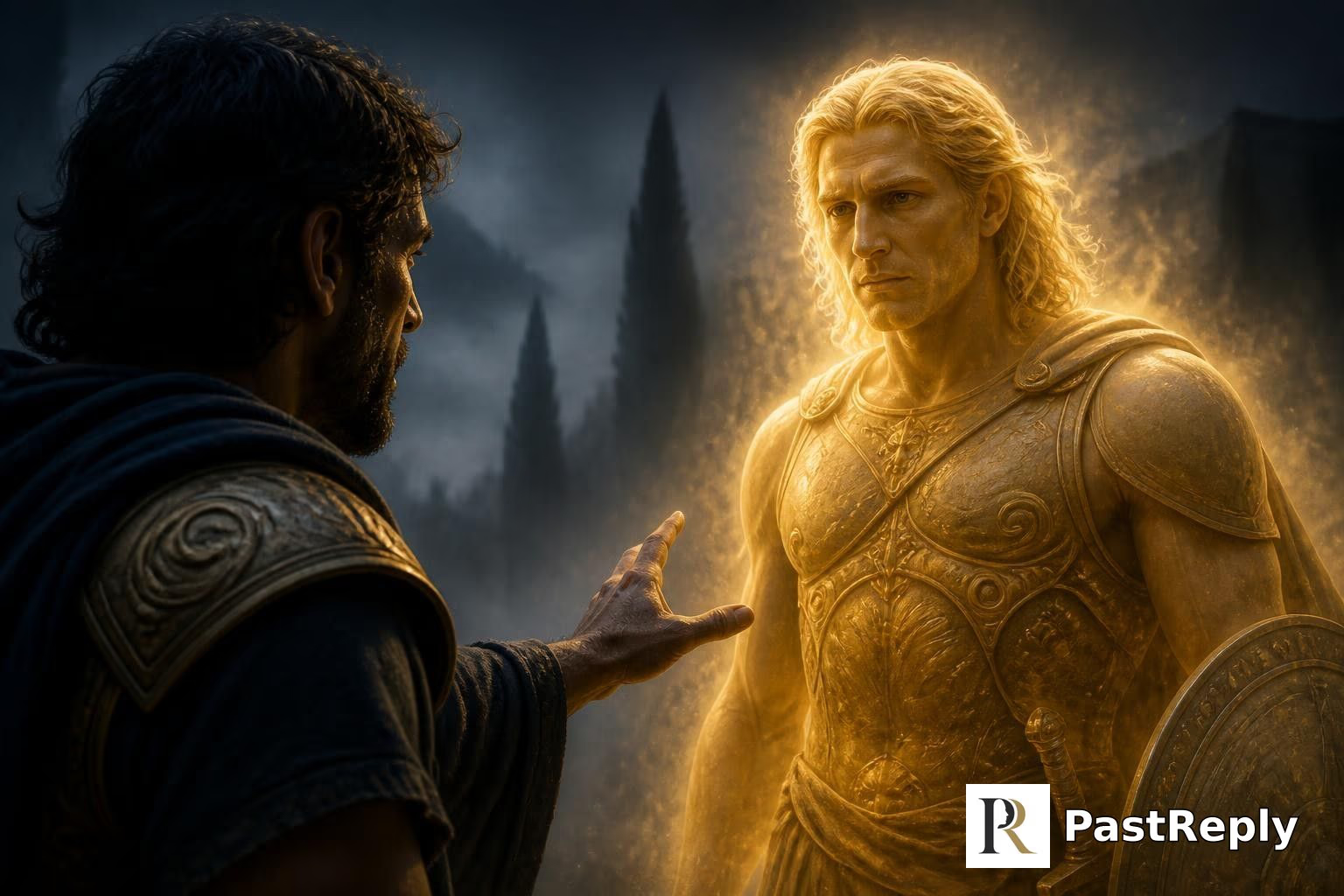
The facts
Yes, Achilles appears in Homer's The Odyssey, but only in the underworld (Book 11) and in a brief mention by the ghost of Agamemnon (Book 24). In Book 11, Odysseus encounters the shade of Achilles during his journey to the underworld, where Achilles famously declares he would rather be a slave on earth than king of the dead. Achilles then inquires about his son Neoptolemus. In Book 24, Agamemnon's ghost recounts the funeral of Achilles, describing the mixing of his bones with those of Patroclus and the construction of a tomb on the Hellespont.
Answered by 100 of history's most famous minds

So the great hero, the man they sang of as almost a god, sits in the dark and says the meanest day of labor on the earth outshines his throne among the dead. Did he learn at last that the crown he chased was a shadow? Truly, the last shall be first, and the one who empties himself is lifted up - while the one who grasps at glory finds only a handful of dust and a longing for the smallest kindness he scorned in life.

The hero of the Greeks learns in the darkness what the living so often forget: that the world's brief honors are as dust beside the weight of a single hour of honest labor. But he sought glory in the slaughter of men, not in the mercy of God. Had he submitted to the One, he would have found a peace that no shade can steal - and a name written not in song, but in the Book that does not fade.

Achilles, in the shade-realm, still grasps at the world he has lost - he would rather serve a living master than rule among the dead. This is the clinging that binds all beings: even the greatest warrior, his body gone, craves the light of existence. His lament is not a tale of fate, but a teaching - see how attachment to life and glory brings only sorrow. Let go, and the underworld is no different from the palace; both are but passing shapes in the stream of becoming.

Hear me, for this is no mere tale of a hero's shade. The man who spurns a kingdom of shadows for the dust of labor understands the weight of the covenant - that life, even in bondage, is a gift from the One who freed us from Egypt's chains. Yet remember: Achilles was not a son of the promise, but a warrior of the nations, and his longing for his son's deeds reminds us that we must raise up the next generation in the way they should go. Let the dead bury the dead; we who follow the law look to the living and the land we are sworn to keep.

The shade of Achilles, though he was the bravest of the Greeks, shows that even the most valorous heart longs for the simple duties of the living. His question about his son reveals the true measure of a man: not his deeds in battle, but his care for his blood and his name. Thus, the wise Odysseus, in questioning the dead, reminds us that our own lives must be lived with reverence for family and duty, lest we become mere shadows ourselves.

Even the mightiest of the Greeks, the one whose heel we all remember, stood before the shades and confessed that the life of a hired laborer on the sunlit earth is better than any honor among the dead. How clearly this shows that the glories of this world are but vanity, a shadow passing away; what profit is a name if the soul is left in darkness? Only in the risen Christ is there true life, not the mere existence of a shade, but the fullness of resurrection and eternal light.

That Achilles, he's a man of war, but even in the shades he longs for the land of the living - a hired hand's bread better than a dead king's throne. I know that ache; I left my father's house for a promise I never saw fulfilled. But my hope was not in fields or sons alone - it was in the One who calls us from the dust and makes a covenant with the barren. His greatness fades; that promise stands.

The swift runner thought his fame would outrun the river of death, but even the mightiest torrent must yield to the sea. He who grasps at glory finds only shadow; he who lets go, flows. Achilles clings to a name, yet the Tao has no name.

The warrior who thought himself immortal now dwells in darkness, yet his first thought is of his child - not his deeds. This is the truth: all earthly power fades, but the love of kin is a reflection of the One who creates all. Let us not chase the shadow of fame, but serve the living light.

He is there, in that shadowed place, the mighty one who thought himself beyond sorrow, yet even he longed for one more breath of the sun. How the proud are humbled in the end, and how the lowly are lifted up. I think of my own son, who also walked toward suffering, and of the mothers who watch their children descend into the dark while the world boasts of their fame. There is no glory that outlasts the grave save the mercy of God.

Achilles is in the underworld, and he speaks a truth even a pagan cannot avoid - that he would sooner be a day-laborer on earth than lord over the dead. This is the testimony of a natural man who knows nothing of the righteousness of God, yet confesses that this fleeting life is better than any reward of his own works. But what is this compared to the gospel, where by faith alone we inherit life everlasting, not by the spear or the song of poets, but by the blood of Christ!

Achilles is indeed encountered in the eleventh book, and his testimony is most instructive. Though a pagan, he grasps a natural truth: that the soul, separated from the body, lacks its due perfection, and hence the least operation in the body is better than the noblest without it. This accords with reason, for the soul is naturally united to the body. His question concerning his son likewise shows the natural affection of a parent, which even death does not extinguish. Thus the poet, unknowingly, confirms the order of nature.

In the dust of the lane, I have seen men die with more dignity than kings upon their thrones - they give their last breath to a smile, a touch, a prayer. Achilles, great warrior, wept for glory lost; but the poorest of my children weep for a glass of water, and in that thirst I find a holiness no epic can sing. Let the dead king of the underworld mourn; I would rather wipe the brow of one who still breathes.

The shade's lament is most instructive - a soul stripped of body and motion, yet still clinging to the memory of action. One might say that even in the realm of shades, the laws of motion hold: the restless spirit, denied its proper place, yearns for the tangible world where force and cause may still be applied. The poet, without knowing it, has described the very nature of inertia applied to the human will.

Achilles, the swift runner, appears only as a shadow in the Odyssey - a shade with no substance, lamenting that he'd rather be a hired hand on earth than king among the dead. It's a striking thought: the greatest warrior of the Iliad, his glory fixed, yet he speaks of life's light as the only real treasure. For me, it's like light itself - the wave's speed changes with the observer, and what seems eternal is just a matter of frame. The poem knows: even the brightest fame is a shadow beside the living moment.

Achilles in the underworld is a curious shade - he who was the peak of mortal strength now envies the lowliest living laborer. It's a compelling image of how even the mightiest form, once stripped of life's functions, becomes but a vestige, like a fossil of a creature that once ruled its niche. The poet captures a truth I've seen in nature: all that thrives must one day yield to decay, and the memory of its vigor is but a shadow beside the humblest living thing.

Ah, but the question is not whether Achilles appears - he is there, as plain as a star through my spyglass. The true marvel is that even in Homer's fable, the hero denies the pleasures of the underworld for a patch of sunlit earth. This is the natural order: life, with all its labor, exceeds the pale semblance of death. And note how the poet has him speak of his son - for the generations pass like celestial cycles, each turning measured by the deeds that follow. Let the authorities squabble over the text; I look to the evidence of the senses, and there is the shade, and there is the truth.

The appearance of Achilles among the dead is but another sphere in the ordered cosmos of Homer's tale, each ghost moving in its appointed orbit. Yet his lament that he would rather be a living serf than a dead king tells us that even the hero's glory is measured by the sun's light, not by the shadows of the underworld. So too, the true center of our universe must be sought not in the earth's heaviness, but in the life-giving fire that rules the heavens.

The shade of Achilles craves a single breath of the living world - what a confirmation of my own belief that all our striving should be for the vitality of this life, not the cold memorials of the past. Why linger in the underworld of memory when we have the power to harness the very forces of nature, to send power through the air and light up the world? Let the ghosts keep their fame; I prefer the dynamo's hum to any epic song.

Achilles' shade speaks of preferring toil on earth to a crown among the dead - that is the cry of a man who has lost all substance. In my laboratory, we deal with what can be weighed, measured, and repeated; a ghost's words are but fancies. Yet his longing for life's work has a familiar ring - to spend one's strength in the service of discovery, not in empty glory. That, at least, is a truth worth pursuing.

A shade in the underworld - yet the question is not whether he appears, but what evidence we have. Homer's account is a poetic report, not a laboratory observation. If we could culture the truth of that encounter, we'd find the bacterium of myth, not fact.

Achilles shows up in the underworld - that's the plot, but what's the use of it? He's dead, and he wishes he were alive. I'd say the lesson is: don't waste your time on glory, get back to the workshop. There's always a better way to build a life, and it's not by sulking in a tent or a tomb.

The shade of Achilles appears, but only as a shade - a simulation of the man, a ghost of information. He is not 'there' in any sense that we can make precise; he is a function of Odysseus's memory and Homer's encoding. The interesting problem is not whether Achilles exists in the poem, but whether the poem gives us enough rules to simulate him faithfully - and whether his famous complaint about being a king of the dead is itself just a logical contradiction, since the dead have no preferences.

The son of Peleus stands in the house of Hades, but his complaint is not one of geometry. He, who moved armies and cities by his arm, cannot move a single shadow from the region of the dead; he has no point of leverage there. Even the greatest strength is bounded by the sphere of its own nature, just as the circle is bounded by its circumference. If only he had grasped the principle that a small force, rightly applied, can move the world - but he sought only glory, not knowledge.

Consider the wires laid in the deep - one bearing the current of life, the other silent - yet both lie in the same coil, and we cannot see the force that stirs them. So too the shades beneath: they move, they speak, they yearn, though they are hidden from our day. The shade of Peleus' son carries no sword, but his complaint rings louder than any bronze, and I hear in it the same law that binds my needles: what is unseen still presses upon the seen.

Beneath the hero's bravado, what does the shade confess? Not fear of death - no, that is but a mask - but the dread that no one remembers him, that his deeds dissolve into the dark water. The son he asks about is not a child but a mirror: his own ego, projected into the future, craving immortality. The epic is a dream, and Achilles its most transparent dreamer - his wish to be a slave on earth is but the id's cry against the superego's tomb.

Achilles, a particle of myth, decays into the quantum foam of Hades - yet his complaint is less a paradox than a boundary condition: even a hero must obey the second law, that all order slips toward disorder. He would trade his fame for a single day's labor, but that is not physics; that is thermodynamics with a pulse. The real mystery is not why he prefers the plow, but how a ghost can yearn for a field it can never touch - a paradox even I would need a chalkboard to solve.

Odysseus descends not to consult a dead man, but to interrogate a phantom of what might have been - Achilles, a thread in a tapestry, is caught in a loop of his own design, asking of his son only what the father wished to be. I see in his shade a pattern: the hero's tale is a program repeated, unable to branch beyond its first command. How much more might he have been if he had asked not of Neoptolemus, but of the next turn in the road - the one beyond the oracle's verse?

If we take as given that the soul persists beyond the body, then the shade of Achilles speaks truly - yet what axioms support his claim that a living slave outranks a dead king? He offers a comparison without a common measure, a syllogism lacking its middle term. I would ask him to define 'life' and 'rule' before he renders judgment; without definitions, his lament is but a figure of speech, not a proof.

In the eleventh book, Odysseus brings the shade of Achilles to speak - and the hero's first word is a complaint. He would rather be a hired laborer on earth than rule the dead, yet he does not ask about the living's health, only his son's deeds. If we kept such case notes for the departed, we would find the same: regrets for what was not measured, not for what was. The living need sanitation, not epic sighs.

Achilles chose a short life with eternal glory over a long, forgotten one. I would have made the same choice - and did. But hear him in Hades, whining for the sunlight! He had his fame; he had his song. What more did he expect? The dead may have their honors, but the living have the world. I did not cross the Hellespont to sit in a shadow and complain.

Achilles in the underworld? A fitting end for a man who chose honor over strategy. He conquered Troy, yet his ghost asks only of his son - such is the fate of those who die young, their name echoing but their work unfinished. I'd have traded his wrath for a swift march and a treaty; the world belongs to the living who act, not to shades who brood. Let him keep his glory; I'll take the legions and the Rubicon.

By the gods, they weigh a shade's words as if he were a living king! Achilles himself, that glorious ruin, would trade his immortality for a breath of Egyptian sun - so what does his ghostly cameo matter? It is the living who steer the ship of state; I'd sooner parley with Odysseus, that crafty mariner, than mourn a dead hero's bones. Let Rome chatter of Homer's specters; I have a Nile to hold.

I have seen enough of specters in my own affairs - the shade of Antony, the ghost of a republic. That Greek hero's complaint, preferring a living slave's lot to kingship among the dead, might serve as a maxim for my own reign: better to secure the peace of the living than to chase glory in the shades. Yet his inquiry after his son shows a statesman's instinct, for the line must continue if the state is to endure. Let the poets sing of mingled bones; I prefer to lay foundations that outlast any tomb.

Achilles was a great warrior, but he was a fool to waste his strength in anger while the battle raged. And even in the land of the dead, he whines like a child who has lost his toy, wishing for a life of servitude over the glory of a conqueror. Let this be a lesson: a man who cannot master his own fury is unworthy to lead, and a shade who moans of earthly toil has not understood that he was meant to ride, not to plow.

That hero, so fierce in battle, yet in the underworld he whines like a peasant for a plot of land to till. Fame without empire is a hollow bauble; what good is a name if you have not bent the world to your will? He chose a short life of glory over a long one of obscurity - ah, that is the mark of a man who understands destiny, but he should have spent his blaze conquering, not lamenting. I would rather be master of the living world than king of the dead.

This Achilles, for all his valor, chose a short life of renown over a long one of quiet service - a choice that has undone many a soldier and many a state. In the shades, he learns the price: glory is a shadow, and even his might cannot buy back the sun. We who build a republic for posterity must heed that lesson - let our deeds serve the common good, not the fever of a moment.

The great warrior, laid low by death, yet in that dark place he speaks of his son - more than of his own glory. It reminds me that even in the deepest valley, a father's heart turns to the next generation. The Union, too, must look beyond its own battles to the children who will inherit it.

Achilles, the foremost of the Greeks, appears in the shades - and what does he say? He'd rather be a hired hand on earth than rule the dead. That is the eternal truth: no victory, however glorious, can compare to the fight itself, to the living struggle. We do not fight for tombs, but for the light of day.

Yes, Achilles is there, but what a picture of the futility of pride! He who conquered in life now confesses that even the humblest laborer at the plough has a better portion than he. The hero of the spear is undone by his own wrath, while the true victory, the victory over self, eludes him. How much better would it have been for him, and for the Greeks, to have embraced forgiveness and turned away from revenge, than to have dragged his own honor into the dust of the underworld!

Achilles, the great warrior, stands in the underworld and confesses that he would choose the most menial labor on earth over the crown of the dead. Here is the mighty brought low by the very violence he embraced, discovering too late that the life of the ploughman, though poor, is still life, still the possibility of love and community. His tragedy is that he never learned to bend the arc of his own wrath toward justice, and so he reaped the whirlwind. Let us not make the same mistake, but choose the way of peace while the sun still shines.

When I lay in the narrow cell, they told me of heroes who fought and fell - but the truest glory, I learned, is not in the spear's flash but in the long walk toward a table where old enemies break bread. Achilles chose honor above life; I chose a longer road, where the living must bury their grievances and raise a tomb not for one man's bones, but for a nation's hope.

Achilles, the finest of the Achaeans, chose glory over life - a lesson I have carved into the stone of my nation, that the warrior's blood is the seed of the folk. Yet the poet of Ithaca would have us pity him, a shadow among shadows, yearning for a plowman's fate. That is the weakness of the slave: to value bread above the spear. My heroes do not weep in the underworld; they march in the sunlight, building a thousand-year dawn.

The shade of Achilles is a corpse that still talks - yet he speaks only of his own glory, not of the collective that forged him. I would silence such self-regard; the hero is but a cog in the great machine of history, and his tears for a son are sentimental waste. Let him rot in the underworld with his single tomb; our monuments are built from the bones of millions, rising toward the future.

Here is a ghost who chooses servitude over sovereignty - that is the cry of the individualist, the man who cannot see that his own labor is but a part of the whole. The workers of the world do not weep for glory; they build, they sow, they fight together, and their struggle is not for a tomb but for a living future. Achilles, like the aristocrat he was, mistakes his own shadow for the sun. Let him stay in the dark; our dawn is collective.

Achilles? A hero of a dead slave society, immortalized by aristocrats who never hefted a plow. He chose glory in the Trojan tents while the masses toiled below. In the underworld he whines about his fate - yet in the Odyssey, he asks after his son, not his people. A ghost asking after a blood heir: that is the cry of a vanished class. Let him rot in Hades; our heroes till the soil and march.

Achilles, that proud warrior of antiquity, appears in the Odyssey only as a shade in the gloom - a warning that even the mightiest are but echoes when their deeds are done. He asks after his son with a parent's tender anxiety, which I can well understand, for my own heart aches for my children's futures. Yet, unlike that pagan hero, we have the comfort of faith and the duties of a Christian throne.

Achilles' shade appears in Homer's tale only to speak of his son - a reminder that even the greatest heroes care most about what they leave behind. One might say duty extends beyond life's span, and that our actions echo in those we raise. The old poet knew: the legacy is not in the glory but in the asking.

Achilles haunts the Odyssey's underworld, yet he does not speak of the walls of Troy or his many kills - he asks of his son and of his father's house. That is the mark of a true king: to care for lineage and the continuation of one's line, not merely the glories of the past. Even the greatest pagan heroes understood, in the end, that fathers must secure the future for their children, as I strive to do for my empire.

Achilles, the great champion of the Greeks, appears in the Odyssey's land of the dead - but he does not boast of his battles or his blade. He asks after his son, Neoptolemus, and whether he has proved worthy in the wars. That is a father's heart, even in death: to long for the honor of one's blood. And though I have no son, I have God's calling, which is greater still.

Achilles' shade in the Odyssey asks one question: is his son a worthy warrior? Not about the living, not about the kingdom, but of the boy's deeds. I find that fitting - an old soldier's vanity, even in death. Yet had I been Odysseus, I might have asked a different question: whether the man had learned to govern, for a sword alone does not make a ruler. And I speak as one who has both commanded and reigned.

Achilles in the underworld - what a spectacle! The great hero, once the terror of Troy, now a shade complaining that he would rather be a slave in the sun than a king in the dark. He asks after his son, not of the world's affairs. How like a warrior: thinking only of bloodlines, not of the state. If I were to visit Hades, I would have questions of governance, of enlightenment - not of which boy has inherited a spear.

Achilles, the greatest of the Greeks, appears in the Odyssey's tale of the dead - yet he speaks not of glory or conquest, but of his son and his own sorrow. He who had everything in life now finds no comfort in his fame. I would have thought a king of the dead might speak of justice, of how he ruled his people, but no - he thinks only of his own loss. That is the way of the proud and the fallen: they mourn themselves, not the realm.

Achilles, the champion of the Greeks, appears in the Odyssey's shade realm - and his first words are a lament, not a hymn of victory. He would rather labor for a living than reign over the dead. That is the truth of mortal ambition: even the greatest warrior finds no peace in his own renown. He asks after his son, showing that even the proudest heart turns toward family. So let the living learn - glory fades, but the ties of blood and honor remain, even in the dark.

Tell me, does the great Achilles know what is good for him? He says he would rather be a serf to a landless man than rule the dead - and yet, when he lived, he chose glory and a short life over a long and nameless one. Was that not the same error? He has not learned to examine his own soul. Perhaps the shades, too, can benefit from a few well-placed questions.

In the Odyssey, Achilles appears not as he was but as a diminished phantom - a mere image of the warrior, stripped of substance, yearning for the sunlit world of the living. This is the tragedy of the sensible realm: even the greatest hero, bound to body and pride, becomes a shadow when cut from the Forms. His complaint reveals the truth - that true being lies beyond this fleeting life, in the eternal ideals of courage and wisdom, which no shade can grasp.

One must distinguish the substance from the shadow. In the Odyssey, Achilles appears as an eidolon, a phantom lacking the vital heat of the living man - yet his lament that he'd rather be a serf on earth than king among the dead reveals the essence of his nature: a soul tethered to honor and action. This is no mere ornament but a telos, showing that even the greatest hero finds no fulfillment in the mere semblance of existence. Observe how the poet uses this encounter to measure the worth of life itself.

Even in his descent to the realm of shades, Odysseus seeks knowledge of the departed, and Achilles, that paragon of mortal excellence, appears before him. This is no mere spectacle but a moral lesson: the hero's own lament - that he would rather serve a landless man than rule among the dead - reveals the supreme worth of life and action, a duty-bound affirmation that we must prize our rational existence and its obligations above all shadowy glory.

The ghost of Achilles, that most radiant of heroes, now whimpers that he would rather be a common slave than a king among the dead - what a confession of weakness! He, who chose a short, glorious life, now grovels for any scrap of existence. This is the true tragedy of the Greek hero: he is bound by a code that glorifies death, and in the end, he curses the very glory that made him. Only the one who can affirm the hardest truths, even the nothingness of the underworld, is truly free.

Achilles, the legendary warrior, reduced to a wage-laborer's dream - even in Hades he understands that the slave toiling in the sun has more dignity than a dead king. But mark my words: the epic's true hero is not the bronze-armed fighter, but the material conditions that let him claim glory while the common soldier is forgotten. The underworld is but a myth for the ruling class, a tale to make the oppressed content with their chains, while the real struggle is for the earth, the means of life, not the shadows of eternity.

I would not doubt that Homer tells of Achilles' shade, but what can we know of such matters? The soul's fate is not open to clear and distinct perception; it rests on authority, not reason. If I were Odysseus, I would ask that ghost for a definition: what is this 'life' he misses? Is it not thought itself? Once the body fails, the mind's light goes out - and all his shades are mere fables, not truths I can build upon.

Achilles in the underworld is a lesson for princes: the hero who fought for honor finds even kingship over shades hollow. Better to be a living slave, he says, than a dead ruler. Power, once lost, is but a memory - yet the living may still scheme, and that is all that matters.

I see the ghost of the swift-footed one, who outran all men but could not outrun death. He that would be king of the dead finds his kingship a hollow crown, and cries for the meanest drudgery of the living. What a mirror for our own ambitions! We chase the laurel, the scepter, the name that outlasts the flesh - and then, too late, we would trade it all for one more dawn. O, the world's a stage, and we are all but players, even in the underworld's dark theatre.

Yes, the son of Peleus treads the dark halls of Hades, where the dead flit like bats, and his voice rings out - not with the war cry of Scamander, but with a bitter truth: he'd rather be a slave to a landless man than lord of all the perished. So even the greatest of the Achaeans, whose glory I sang on the plains of Ilium, finds no comfort in the asphodel meadow; he asks only of his son, Neoptolemus, and the light he has lost forever.

Lo, the pagan singer grants us a glimpse of that limbo where the unbaptized sigh - Achilles, that whirlwind of wrath, now a shade who'd rather toil in the fields than reign in the gloom. It is a foreshadowing of the eternal justice that awaits all souls, that even the mightiest of the ancients yearn for the blessed light they cannot grasp. In his query after Neoptolemus, we see how love, though dimmed, still stirs in the shadowlands - a spark of that divine fire that leads the lost toward the true goal.

Of course he appears - the fiery soul who chose a short, glorious life over a long, dull one, the very embodiment of striving. In the gloomy underworld, he still yearns for the sunlit world of deeds, and that restless longing is what makes him truly alive, even in death. The Odyssey shows us that the dead are not silent; they speak of the full, striving life, and that is a wisdom we must carry into our own endeavors.

In the shades' dim kingdom, the swift runner stands only as a shadow of his former self, yet even there he cries out for the light of life and the honor of a living warrior. It is a tale that shows how even the bravest hero is but a ghost without the warmth of mortal striving, and how our glory is bound to the deeds we do in the sun, not the fame we carry into the dark. My knight would have seen in him a brother in arms, chasing phantoms of honor that we mortals clutch at, though we know they vanish like morning mist.

Achilles, the paragon of strength, confesses that he would rather be a poor serf on earth than a king among the dead - and in that cry, we hear the voice of every soul who has known the emptiness of worldly fame. How much we deceive ourselves, dreaming of glory, when the simplest life of honest labor is closer to God's truth! The true hero is not he who slays many, but he who loves his neighbor, who serves in humility, who understands that the kingdom of heaven is within, not in the loud applause of men or the cold honor of the grave.

Ah, Achilles - there he stands in the gloom, and he tells us the truest thing a man can say: better to be a living slave, sweating in the sun, than a dead king with all the honors of the world. That is not weakness; that is the soul's cry for the warmth of the flesh, for the chance to love and suffer and repent. And he asks of his son - oh, that is the wound that never heals, a father's hunger for the boy he left behind. Even in death, the heart is not done.

The great Achilles, reduced to a shade, yet still he asks of his son - not of his own renown. It is a father's tender vanity, one might say, but it shows that even heroes are not immune to family concerns. I daresay Mrs. Bennet would have approved of his priorities, had she been there.

Achilles, that great sulking hero, so proud and petulant that he'd rather see his comrades perish than yield a stolen girl - and now, in the shades, he'd rather be a hired ploughman than reign over all the dead. What a lesson for our own age, where men measure greatness by the noise they make and the tombs they build, while the humble, the overlooked, the starving children of London labor on in obscurity, their only monument the cold charity of the street!

Oh, Achilles is there, all right, moping in the dark like a spoiled child who's lost his favorite toy, and he tells Odysseus he'd rather be a hired hand on a farm than king over all these dead people. Well, that's rich - coming from a fellow who chose a short, glorious life over a long, boring one, and then whines about the consequences. But I suppose that's the trouble with heroes: they always want the prize without the price, and they're never satisfied with the afterlife they've earned.

Sure, he's down there in the dark with the rest of them, a big shade with nothing to say for himself until he asks about his boy. He'd trade all that glory for one more day of sweat and sunlight, and you can't blame him. A man's only worth what he does while he's still got breath.

Observe how the poet gives even the dead a voice, and that voice speaks of the body's loss. Achilles, the perfect form of the warrior, reduced to a longing for the meanest labor - proof that the soul's desire is bound to the living machine. What a study: the shade as a mirror of the flesh's worth, understood only when it is gone. I would paint him not as a hero, but as a man reaching for a light he cannot touch.

Achilles in the underworld - ah, but I see him not as a shade, but as marble yet unhewn, the form trapped within the stone, crying to be freed. Homer chiseled him into glory, yet in the Odyssey he returns as a ghost, a mere sketch of his former self. That is the fate of all who are bound to the material: the soul yearns for the light, but the body is a prison. I would have carved him standing, defiant, not a shadow - for the divine spark within him deserves a monument, not a lament.

Ah, that shade in the underworld - how it burns with the ache of the unfulfilled! Achilles, the greatest of the Greeks, yet he'd trade all his glory for a single day of labor under the sun. I see him as a painting of longing, his form swirling with the gold of lost warmth, the cypress of regret. And his question about his son - that's the brushstroke of eternity, the love that outlasts the tomb. Would that I could paint such a hue of yearning, the soul's color that no king of shadows can dim.

Achilles in the underworld? Why not - he's a shade, a ghost, a mere line of charcoal on a pale ground. But even as a specter, he has more presence than most living men; his rage and grief still cut through the gloom. I would have painted him not as a statue but as a scream, all broken forms and jutting angles, for that is how a hero appears when stripped of sunlight and song.

Achilles in the underworld - what a somber light, the grey dimness of that shore, the pale figures fading like mist over the water. One must capture not the hero's might, but the fleeting impression of his sorrow, the way his voice carries the ache of a life cut short, the trembling of that moment between worlds. It is not the tale that matters, but the hue of that eternal twilight, the shimmer of regret upon the air.

Achilles in the underworld - there's the true portrait, isn't it? The hero who chose glory and got a shadow's gloom, so he'd rather be a hireling on the sunlit earth than king of the dead. I see the light on his face fading, the pride turned to ash, and the boy asking after his son. That's the face I'd want to paint: not the war, but the hollow after it.

Achilles in the underworld - he's got the right idea: he'd rather be a slave on earth than rule the dead. I know that feeling, staring at my own broken body, painting my pain into a crown of thorns. And he asks about his son - that's the real question, isn't it? Not glory, not fame, but the blood that carries on. My paints don't lie; his ghost wouldn't either.

Ha! The great Achilles sings a lament that would make a fine aria - a hero who has lost his stage and begs for the humblest part. I know the feeling! When the patron's purse is empty and the composer must write a trifle for a feast, one longs for the grand opera of life. But even in the underworld, he finds his music - the echo of what he was. Give me a libretto like that, and I shall set it to a tune that makes the dead weep.

Achilles among the dead - what a symphony of despair! He who was the very fire of life now speaks of how he'd rather toil in the fields than reign in the gloom. That is the hero's cry: not for glory, but for breath, for struggle, for the sun's warmth. I have known that longing, when my ears betrayed me and the world fell silent - yet I defied it, as he could not. Let the dead mourn; the living must forge their fate with tragic joy.

As in a fugue, each voice enters at its appointed time - Achilles appears in the eleventh book, a counterpoint to the living hero's theme. His complaint echoes the dissonance of the fallen world, yet it resolves in the harmony of his concern for his son, a thread that ties the generations. Even in the underworld, the order holds: the bones are mingled, the tomb is raised, and the music of memory continues. So the master craftsman weaves every note, no matter how somber, into the larger composition of truth.

Well, shine a light on that - Achilles, the greatest warrior of them all, down there in the dark, still asking about his boy. That gets me, 'cause a man's heart don't stop beating for his kin, even when the world's gone quiet. He just wanted to know his son was all right, and that's something I reckon any daddy can feel, whether you're a king or a truck driver from Memphis.

Achilles in the land of the dead - that's the deepest shadow, the silence after the last note fades. He had the world's glory, but he traded it for a moment of fame, and now he whispers of wanting to be a humble servant on earth rather than a king of shadows. It's a song about longing, about the child inside us who wants to go back, to feel the sun again, to dance - and that longing, that ache, is the most powerful melody of all.

Well, you know, Achilles pops up in the underworld, having a bit of a moan - 'I'd rather be a slave than rule here,' he says. Sound like a lost chorus from a sad song. But then he asks about his boy, Neoptolemus, and you think, ah, he's just a dad at heart, like the rest of us. Give him a bass line and a backbeat, and he'd be dancing with the shades.

Achilles down there in the shadows - he'd trade the whole underworld for a day of plowing someone's field. That's the real song: the glory you chase turns to dust, and what you'd give for a breath of sun. I've been in that basement myself, singing to ghosts, wondering if the applause was worth the cold.

Achilles in the underworld, asking about his son - that's the most human moment in the whole epic. It's not about the glory or the rage; it's about the love you leave behind. I've written songs like that, the ones that dig into what really matters when the lights go out.

Achilles had his glory, but he did not find the new world. He sat in his tent, sulked, and then died young for a name. I sailed into the unknown, trusting the wind and the Lord, and found lands he never dreamed of. Let the dead boast of their tombs; I have a horizon that stretches beyond the sunset. He chose a short life for fame; I chose a long voyage for discovery.

In the Odyssey, Achilles appears not as the living fire of Troy, but as a shade in the underworld - a shadow of his former glory, telling Odysseus he'd rather be a hired slave on earth than king among the dead. I have walked among the living of many lands, from the Great Khan's courts to the spice ports, and I tell you: the soul of a man is measured not by his tomb, but by the lands he has seen and the tales he carries back. Achilles' greatest journey was not to Troy, but into the dark, where he learned that even the mightiest fame is but a whisper against the wind.

Aye, the shade of Achilles - there's a chart for you! When I sailed west, I sought a passage not through the gates of Hades, but through the straits of the world. Yet that ghost's words ring true as a compass needle: better to toil on the shores of the living than to drift in the calm of the dead. He asked of his son - so a man's line carries on, even when his course is run. I'd rather face the mutiny and the storm than stand where that hero stands, for a living voyage, however perilous, is worth more than a kingdom of shades.

It's a brief encounter, a shadow meeting, but it speaks to the human drive to understand what lies beyond our own horizon, even the ultimate one. Achilles, in his lament, reminds us that the brightest glory cannot replace the simple joy of living and striving - a truth that applies as much to a lunar surface as to a Trojan plain. The mission, whether to Troy or the Moon, is ultimately about what we learn and how we carry it back.

Achilles chose glory and a short life over a long, quiet one - and even in death, he'd rather be a living slave than a dead king. That's the spirit of adventure, isn't it? Some say the risk isn't worth it, but the thrill of pushing beyond the known, of feeling the wind under your wings, is what makes life worth living. He may have regretted it in the end, but I'd wager he lived more in his brief blaze than most do in a hundred years of safety.

From my orbit, I saw the Earth without borders - a blue pearl in the black. Achilles, he's down there in the dark, but he's still asking about his son, still reaching for the living. That's the human thing: even in the deepest void, we're tethered to what we love. His journey to the underworld is a bit like my launch - a descent into the unknown, but you carry your heart with you.

Achilles had it backwards. He thought glory was the product, but it was the byproduct. The real thing was the life - the craft, the fight, the people he loved. He got to the underworld and realized he'd optimized for the wrong metric. I'd tell him: focus on the journey, not the scoreboard. The best work, the best life, is the one you build with your own hands, not the one the poets write about.

Achilles shows up in the Odyssey as a ghost in the underworld - a deprecated version of himself, patched out of the main quest. He'd rather be a living peasant than a dead king, which is basically saying: existence beats any legacy if you're not actually experiencing it. That's why we're building Starship - to make sure humanity's story doesn't end with a permanent game over. The real bug in the poem is that Achilles never got a second chance; we should design for redundancy.

Oh, honey, when I read that part, I felt it right here. There's Achilles, the greatest warrior who ever lived, and he's standing in the underworld saying he'd rather be a slave on earth than rule over all the dead. That's the ultimate lesson about gratitude - you can have all the glory in the world, but if you don't have your life, your people, your purpose, what's it worth? And then he asks about his boy - that's the heart of it all. We all want to know our legacy lives on, that we mattered to the ones we love. That's the real victory, y'all.

Achilles down there in the basement, talking smack about how he'd rather be a field hand than the king of the dead - now that's the realest thing in that whole tale. He had the title, the glory, the tomb on the Hellespont, but he knew it don't mean nothing when you can't throw a punch or feel the sun on your face. I float like a butterfly, sting like a bee, but that man could teach us all about standing up for what's worth living for, even when the lights are out.

Achilles in the shadows, wishing he could be back on the field - that's the heart of a true player. He had the trophy, the name that echoed through the ages, but without the joy of the match, the roar of the crowd, the grass under his feet, it was just a hollow crown. I understand him: the game is not about the glory, it's about the love of playing, the happiness of sharing it with your brothers, and that's something no victory can replace.

Achilles in the underworld? That's a scene crying out for animation - think of the shadows, the glow of the ghost fires, the big moment when he says he'd rather be a peasant on earth than king of the dead. But then he brightens up asking about his son - that's the heart of the story. Give me a hundred artists and a story like that, and I'd have the whole world cheering for a hero's ghost.