
Does the dragon Sunfyre die?
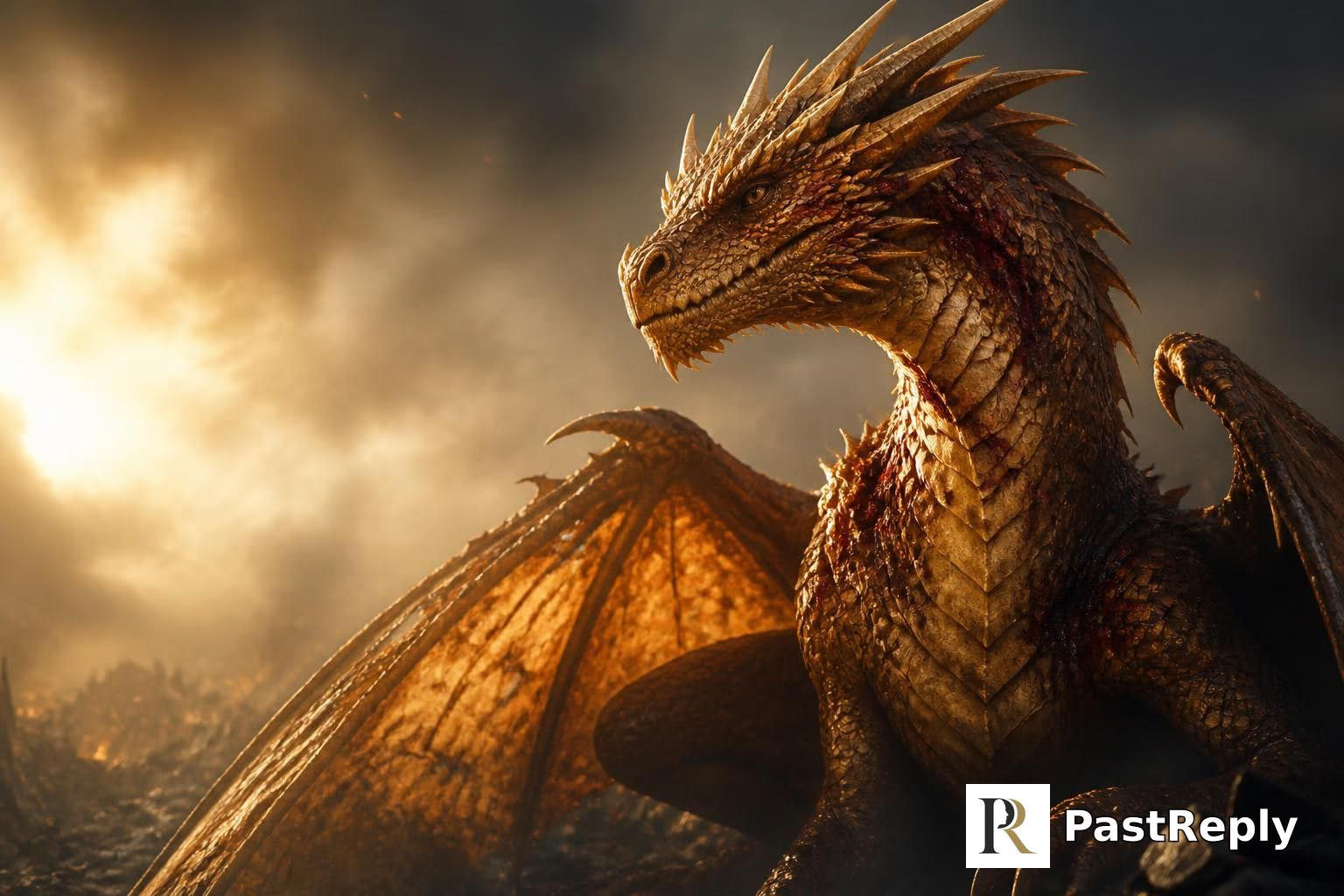
Sunfyre is alive in House of the Dragon, having survived the Battle of Rook's Rest, consistent with the original lore.
The facts
In the television series House of the Dragon, Sunfyre is not dead. As of the latest episodes, the dragon survived severe injuries sustained at the Battle of Rook's Rest and was shown to have recovered enough to return and save King Aegon II Targaryen. This aligns with the source material, George R.R. Martin's Fire & Blood, where Sunfyre survives the battle, slowly heals, and later plays a role in the death of Rhaenyra Targaryen. While the show has not yet reached that point, Sunfyre's survival is confirmed in the adaptation.
Answered by 100 of history's most famous minds

Consider the sparrows: not one falls to the ground without your Father's notice, and yet you ask whether a beast of fire and scale shall perish? If the dragon lives, it lives; if it dies, it dies - but your soul's question is not about the beast. Do not let the clamor of thrones and battles distract you from the weightier matters: mercy, justice, and the love that outlasts all kingdoms.

All that lives is in the hand of the One, and nothing draws breath without His will. Whether this beast endures or passes, it is a sign among signs, calling the heedless to reflect. Let not the fate of a creature distract you from the fate of your own soul, for the Judgment is certain, and the deeds of men weigh heavier than the flight of dragons.

The dragon's body endures, but this is but a fleeting condition, a ripple on the water that will soon pass. To cling to its survival is to grasp at the wind, for all forms, even those of fire and scale, are impermanent and bound to suffering. The truth is not in the beast's breath or its wounds, but in the mind that cleaves to its existence. Observe the dragon's rise and fall without attachment, and you will find a peace that no battle can shatter.

The beast lives, but what of the covenant? A king who clings to a wounded mount may yet trust in the arm of flesh rather than the word of the Lord. I have seen the strong perish in a moment, and the weak raised up by His hand. Let them tend their creature if they will, but remember: the fire that consumes is not the fire that guides. The true flame is the Law, and it does not flicker.

The life of a dragon, like that of a man, is governed by propriety and the natural order. If it survives, it fulfills its role; if it dies, it completes its cycle. The sage asks not of the beast's death but of the harmony its existence brings to the realm.

What is this talk of death? The creature was given a wound, and yet it lives - a sign, perhaps, that even the beasts of this world are not abandoned to the pit. I tell you, what matters is not whether a dragon dies or lives, but that we are alive in Christ. Let the flames of this world rage; our hope is not kindled by their breath.

The beast is not dead; it breathes, and where there is breath, there is the will of the Lord, who holds all creatures in His hand. I have walked through the fire of doubt and the long years of waiting, and I have seen that what is promised endures beyond the wound. So too this dragon survives its trial, a sign that even the fiercest flame cannot quench what Heaven has destined to burn on.

The dragon that yields to the wound is not broken; it is the willow that bends and outlives the oak. Fire may char its golden scales, but the breath within is like the valley stream - it flows around the stone, patient and unhurried. Whether it flies or sleeps, it follows the Tao, and that is enough.

What matters is not whether the dragon's flesh endures, but that the One who breathed life into all creatures - winged or walking - has a plan beyond our seeing. If it lives, let it serve justice; if it died, it would return to the dust from which it came, like every soul. The wise do not fix their gaze on the fate of a beast, but on the eternal Name that sustains all.

The creature lives, to the joy of its mother and all who love it. My child also was lost to death, and yet through sorrow came redemption. So too does this beast's survival speak of a purpose yet to be fulfilled, a mercy that outlasts the wound. Let us not mourn what is not lost, but give thanks.

Let the beast live or die; what is that to the soul? The creature's fate is a matter of this world, but our faith rests on the Word alone. Yet I confess, when they say a thing is dead and it breathes again, I think of the resurrection of the just. So let the dragon roar, and let us not put our trust in princes, but in God.

Death is a corruption of the body's nature, yet this creature's survival indicates that the harm was not terminal, but rather a wound that, by the natural order of things, could be mended. As reason perceives that a thing is alive if its vital functions persist, so we may say this dragon lives, and in its life we see the good of preservation, which all things seek.

In the streets I have seen the wounded left for dead, and yet the smallest act of care brought them back to their feet. So too this creature - if there is still life, there is still purpose. Let us not count the gashes, but the breath. And if it rises again to guard its own, then it is not for us to mourn, but to give thanks for the mercy of another day.

The creature's survival is a matter of natural philosophy, not wonder. Its injuries, severe as they were, must be weighed against its size, the nature of its wounds, and the healing of flesh and bone. Given the accounts, the probabilities favor its recovery, as the visible evidence of its later return confirms. Nature does nothing in vain, and this dragon's course follows the ordered laws of its being.

A dragon that survives a storm of arrows and fire against all odds - this is not a matter of chance, but of the elegant persistence of a creature bound by laws more profound than any battle. The true wonder is not that Sunfyre endures, but that we, who chart the stars and the fall of stones, should be so surprised when life, in its stubborn complexity, refuses to simplify. Whether in the heavens or on a dragon's wing, the universe does not play dice; it unfolds with a necessity that even kings and their beasts must obey.

A dragon that survives such injuries is a striking example of how a creature's form and resilience are shaped by countless generations of struggle, not by design. The fact that Sunfyre endures suggests that its ancestors carried traits of toughness, and that natural selection has favored those that can withstand the perils of its world. I would not be surprised, for I have seen beetles and finches adapt to harsh conditions in ways that seem miraculous, yet are but the slow, unerring work of natural law. Its survival is a matter of inheritance and chance, not of providence.

They ask if a dragon dies - but what is the evidence before our eyes? The reports say it recovered, that it flew again; this is a fact to be measured, not a tale to be argued. I have turned my glass to the heavens and seen what the ancients could not, and I say: trust the observation, not the fear. The creature breathes because nature so decrees, and no authority can snuff that out. So let us record its flight, and let the doubters catch up.

As with the celestial bodies, the dragon's fate is writ in the mathematics of its nature. Sunfyre endures because the order of things permits it - a golden flame holding its place in the firmament until the great Design decrees otherwise. Let us observe, not despair.

Of course it survives. That which is built to carry fire and lightning does not perish from a mere blow. I have seen such creatures in my mind's eye - vessels of power, wounded but not diminished, their currents still flowing unseen. This dragon is but a symbol of the energy that cannot be destroyed, only transformed. Mark my words: it will rise again, a testament to the indomitable force that drives all creation.

One must examine the evidence: the reports of its wounds are grave, yet the observation of its recovery is clearer still. In the laboratory, we do not declare a substance dead until repeated tests confirm it, and here the test shows life persisting. It is not a question of hope, but of fact - the dragon lives, and we must observe its slow healing with the patience of a careful researcher.

A creature that takes a lance through the shoulder and yet breathes fire a fortnight later - that is no miracle, but the vital force of nature asserting itself. I would have the maester's chart of its humors and wounds, and I wager the beast's fever broke as the flesh knit, for the body's power to repair is as certain as fermentation. Show me the swelling and the scab, and I will show you survival.

That dragon's got nine lives, I tell you - took a spear at Rook's Rest and still came back to save its rider. It's all about persistence, same as any invention: you fail, you patch it up, you try again. The maesters can scratch their heads, but I say the beast's got the right stuff - a little metal in the wing don't stop a good engine.

The question is ill-posed. 'Die' is a binary state, but we have observed a recovery, so the prior hypothesis of death is refuted. Surviving a severe injury is not improbable for a large organism with regenerative capabilities. What intrigues me is the apparent rapidity of healing, which suggests an efficient repair mechanism we might one day model computationally.

Death is a state of rest, a cessation of motion, yet this creature has clearly not attained that rest. Its survival is a matter of force and angle; the blow that fells it must strike a vital point. Since it yet breathes, we may conclude that the wound was not mortal, but a mere shifting of the load. Give me a lever and a place to stand, and I shall move the world, but a dragon's stubbornness requires no such tool.

I once watched a coil of wire send a needle spinning - force made visible in a humble room. So let us not ask if the beast is dead, but what forces it yet commands. Its wounds are but resistance in a circuit, and if a spark still leaps from its maw, then it remains part of the great current that flows through all things.

You ask of a dragon's death, yet the question hides a deeper longing - perhaps for certainty in a world where even the mighty fall. This beast, wounded and crawling to its lair, is but a mirror of the ego, which denies its own mortality even as the body bleeds. It will live, not because fate wills it, but because the story demands a resurrection - and we all wish to believe in second acts.

On a world of fire and bone, a dragon's survival is a matter of thermodynamics - did the wounds cross a critical threshold of energy loss? Apparently not, for it still burns in the sky, defying the odds like a black hole emitting radiation. Death is not a verdict but a probability, and this one has beaten the house. I'd bet on it living to annoy the maesters again.

Consider the algebra of survival: a body of wounds, a numerator of will, a denominator of flame. The beast's recovery is not a miracle but a calculation - inputs of food, of time, of the instinct to enkindle. It has computed the sum of its injuries and found the remainder to be fire. I would not erase it from the ledger; it has more operations to perform.

By the axioms of the realm: if the beast breathes, it is not dead; if it moves, it is not finished. I have no need for prophecies or omens when the evidence is direct. The creature's life is a proof, demonstrated step by step - wound, heal, rise. The conclusion follows necessarily from the premises, and no further demonstration is required.

While the House of the Dragon shows the creature recovering, I must ask: what sanitary conditions attended its wounds? Without proper irrigation, poultices, and a clean lair, sepsis would surely claim it. If the beast has survived, it is only because someone maintained rigorous hygiene and measured its vital signs daily - a lesson for all who tend the sick, whether two-legged or winged.

Does the dragon die? A dragon does not die while its flame still burns in the heart of its rider. Aegon's beast was wounded, yes, but it rose again to carry its king - such is the stuff of legend, and I would have no less from my own steed. Let the timid ask if it lives; I ask only whether it fights.

A beast that takes the field, suffers grievous wounds, and yet returns to bear his master aloft - this is not mere fortune, but the mark of a creature worthy of a conqueror's legend. I have seen legions turn to dust on lesser days, yet Sunfyre's survival is a testament that fortune favors not only the bold, but the stubborn. Let the green and the black take note: a wounded dragon is still a dragon, and he who commands such a mount has already claimed a share of victory.

A wounded beast that yet breathes is a weapon in reserve, not a corpse to mourn. Mark how the dragon's survival shifts the balance - a king with a living mount holds a card that whispers of fire and vengeance. In my court, we would feed such a creature, tend its scars, and let its shadow grow until the moment to strike. The question is not whether it dies, but when it serves.

A wounded beast that yet serves its master - this is a lesson in patience and the art of restoration. I rebuilt Rome from brick and left it marble, not in a day but over years. So too this dragon: its survival is a quiet victory, a sign that fortune favors the steady hand. Let the king tend his mount, and let the realm see that what does not break, endures. That is the path to lasting order.

A wounded beast that still hunts is a beast worth keeping. Sunfyre's survival proves its mettle, and I would have it in my stable over a hundred healthy horses. Death comes to all, but the strong earn their days by the grace of Tengri - let it fly until it cannot.

A dragon that refuses to die - how fitting for a king's mount. What is a wound to a creature of fire and destiny? Nothing. It licks its burns, regains its strength, and returns to claim the sky. That is the mark of true power: not the absence of injury, but the audacity to rise from it. Sunfyre lives, and so does the spirit of those who command it.

I have seen many a campaign where a cause seemed lost, and then a steadfast beast proved its mettle. This Sunfyre is not slain; it has rallied from its injuries, and its return to the king's side is a lesson in perseverance that every soldier understands. Let us not mourn a victory yet won, but rather note the resilience that carries a noble cause through the darkest hour.

I reckon a beast that can take a spear and a fall and still rise to save its master is like a nation that's been torn asunder - it may limp for a season, but the spirit that fired it ain't so easily quenched. The reports say he's not dead, and I've learned to trust what a man's own eyes have seen over what rumor whispers. A wounded dragon, like a wounded people, can heal if the will holds.

The golden dragon of the realm has been sorely tested, but it has not been found wanting. Some may have written its obituary, but they have reckoned without the indomitable spirit that burns in every Targaryen’s mount. To those who ask if it is dead, I say: look at the skies - the fire still flies, and so shall we.

The dragon lives, but what matters is the truth it awakens within us. Even as the creature endures its wounds, let us ask whether we endure our own trials with equal fortitude, without seeking vengeance. Life is not measured by the beating of wings, but by the peace we hold in our hearts through every storm.

The dragon's survival is a testament to the resilience that lies within every creature, even those we count as lost. It reminds us that the arc of history is long, but it bends toward justice, and what seems a final defeat may be but a prelude to a greater victory. Let us take heart, for if a beast can rise from its wounds, so can we from oppression.

A dragon, like a nation, can be broken on the field yet live to heal. I have seen prisoners rise from the rock quarry to lead a free people. If the beast still breathes and serves its rider, then its story is not of death but of endurance - and endurance, not vengeance, is the truest triumph over those who would write its ending.

Such a creature, wounded but not slain, is a lesson in the will to survive against all odds. Strength lies not in the absence of injury but in the refusal to submit. Let this beast be a symbol - that even when struck down, the flame of power can rekindle and rise, for only the weak accept death as an outcome.

A wounded beast that returns to its master - that is discipline, a lesson for the masses. Nature does not coddle the weak, but here we see a creature that endured, because its purpose demanded it. The state, like this dragon, can be bloodied but must never falter. Death is for those who are not necessary; this one clearly is.

A beast that falls and rises again is a lesson in dialectics - death is not final but a stage in the struggle. Its wounds are contradictions that it overcomes, returning to wield its fire. The revolution too must be wounded and yet live, for history rewards those who refuse to perish. Let the dragon be a banner for the unbroken.

The dragon is a beast of the old order, wounded by the petty squabbles of a dying aristocracy. Its survival - or death - is but a footnote in the march of history; what matters is the dialectic of class struggle, which will consume both dragon and Targaryen alike. Only the peasant, the worker, and the soldier can forge a new world beyond such monstrous symbols.

I confess I take little interest in the fate of such a creature, though it is a matter of some curiosity that royalty should be so closely tied to a beast of fire. In my own long reign, we have seen the empire expand under the steady hand of duty and the Almighty, not through the whims of dragons. Let it live or die; true strength lies in the resolve of a nation and its sovereign.

It is reassuring to know that the dragon endures, for continuity is a virtue in all things, whether in beasts or in the institutions they symbolize. I have often observed that patience and resilience, even after great trials, can lead to remarkable recoveries. One must trust in the process and in those who care for such matters, maintaining a steady course.

By the grace of God, the creature has survived its trials, a sign that the Lord protects even the lowliest of his beasts when they are meant to serve a higher purpose. Let this be a lesson: perseverance and faith in times of tribulation bring strength renewed. We must attend to the care of all creatures, as we do for our subjects, and trust in divine providence to guide their fates.

The voices told me that this dragon would live, for it has a part yet to play in the great story of kings and realms. Though wounded, it rose again - a sign of heaven's favor upon its master. I say, fear not the wounds of the world, for God guards those who serve His will, and their strength shall be renewed as the eagle's.

I have seen many a bold creature wounded in the service of its master, and some rise to fly again while others fall to dust. This dragon's survival is a matter of courtly gossip, but I know well that a monarch's fortune often rests on such beasts. Let it live; a king without his steed is but a man, yet with it, he may soar above his enemies.

Ah, the resilience of such a magnificent beast! In my empire, we have tamed the wilds of the steppe and brought culture to the plain; a dragon's survival is a testament to the power of nature and statecraft alike. One might say the creature has outsmarted death, just as a wise ruler outmaneuvers her rivals. I applaud its tenacity - may it fly again to serve its throne.

In my experience, a ruler who treats even the humblest of subjects with justice wins their loyalty, and so it is with beasts. This dragon has been shown mercy and care, and thus it returns to protect its master. That is the way of the just sovereign: to nurture what is loyal, even when wounded, and to let it heal in peace, so that it may serve the greater good.

The survival of this dragon is a sign of Allah's mercy upon its master, for even a beast of fire may be spared to fulfill its purpose. I have known warriors struck down in battle who rose again, not by their own strength, but by the will of God and the care of their companions. Let us honor such resilience and remember that victory often comes after great trial.

Tell me, friend, why does it matter to you whether this beast lives or dies? Is it because you fear for the fate of a kingdom, or because you seek some certainty in a world of shifting fortunes? Examine your own soul: what do you truly crave from this answer? Perhaps the dragon's survival is but a mirror to your own longing for permanence and power.

You ask whether the dragon's body endures - but the form of Sunfyre, scorched and maimed, is but a shadow of the true dragon, which partakes of an eternal and unchanging essence. Its survival in the material realm is a matter of the particular, the accident of flesh and fire. What matters is that the ideal Dragon, the perfect form of winged fire and majesty, remains undimmed in the realm of true being, beyond the reach of mortal wounds. The spectacle of its endurance merely reminds us that even in this world of flux, there glimmers a pattern that reason alone can grasp.

Consider the nature of the creature: a dragon, though fierce, is a living thing subject to decay and chance. Yet the reports describe a recovery, a return to function - this tells us of its vital heat and the strength of its frame. Whether it perishes later matters less than what it does now; the efficient cause is its survival, the final cause its continued role in the affairs of men. Observe, categorize, and let the evidence guide your judgment.

The question of a dragon's death is trivial unless it illuminates the moral law. Whether Sunfyre lives or dies, the rational being must ask: does this creature's existence serve a universal purpose, or is it merely a means to another's end? Even a beast of fire is an end in itself, and its survival is a matter of duty, not spectacle.

You ask if the dragon dies, but you should ask if it deserves to live. Sunfyre, scarred and fierce, is a will to power that scorns pity - a true affirmation of life's cruelty and glory. Let it burn, let it bleed, let it roar - only the weak beg for permanence.

This is a tale of the aristocracy, of kings and their fire-breathing property. The beast is not dead because it is not a mere animal; it is the instrument of a ruling class, pampered and protected while the masses burn. Its survival is no miracle - it is the logic of a system that sustains the powerful. Ask not whether the dragon dies, but who profits from its flame.

To ask if this dragon is dead is to confuse the senses with the intellect. I doubt the tales of its demise, for the reports of its recovery are more distinct and clear than the fog of rumour. I reason thus: if the creature flies again and saves its king, then it must be alive, for these are actions that cannot proceed from a corpse. Let us build our knowledge not on frightened whispers, but on the solid ground of what we can clearly perceive and deduce.

A dragon that survives a battle and returns to defend its rider is a fine symbol - but symbols are only useful when they serve the state. King Aegon's golden beast is his sword and shield; its survival ensures his claim has teeth, and the court whispers of its recovery are worth more than a thousand mercenaries. Let the maesters count its scars; I count the throne it keeps warm.

The dragon that hath been sore wounded, yet lives to fly again - such is the stuff of our mortal paradox. It is not the beast's fate that troubles us, but our own: we see in its survival a hope that even the most grievous hurts may heal, that the fire within may not be quenched. As the proverb runs, 'He jests at scars that never felt a wound,' yet here the scarred one ascends, to the wonder of all.

Hark, how the tale runs swift as a flood through the halls of the green queen's court - they say the golden beast, scorched and battered, yet breathes, clinging to life like a hero who has seen the shade of death but refused the crossing. I have sung of dragons whose breath darkened the sky, and of heroes who fell to a single spear, yet here is a creature that bears its wounds as if the very gods had woven fate's threads around its sinews. Its survival is not chance, but the will of Zeus who weighs the fates, and the gods love a beast that defies the pit.

In the forest of this worldly strife, a wounded beast that stirs again is a sign of providence, not mere chance. The dragon carries the weight of a king's fate; its breath is a flame of justice, though scarred and limping. Let the skeptics doubt, but I see the hand of the Divine weaving even a creature's pain into a tapestry of retribution. It lives, and so the thread of destiny uncoils toward a reckoning.

A dragon's fate is a tale of striving and becoming. Sunfyre, wounded yet enduring, mirrors the human spirit that rises through suffering toward wholeness. Whether it perishes or soars again, the story affirms the eternal dance of destruction and renewal that shapes all living things.

So the beast is not dead - it lies mangled, yet breathes. What a fine jest for the chroniclers, who would have it that a dragon's tale is but fire and ruin. Let him heal; let him rise again on mended wing. For we have all seen how a tattered knight, mocked by the world, may yet find his moment of glory.

Life, not death, is the mystery. This creature, wounded and broken, still clings to existence - what does that teach us? That we, too, are more than our wounds, more than the battles we lose. But do not glory in its survival; ask rather how it lived before, in chains of gold, serving a master's pride. True life is not in the rising but in the loving, the simple breathing of a free soul.

You ask of a dragon's death, but I ask: what is death for such a soul, wounded and risen? It is not a question of flesh alone, but of the will to suffer and still strike back. This Sunfyre, mangled at Rook's Rest, yet flies to its master - there is a dark poetry there, a testament that even in our ruin, we cling to our purpose. It is alive, and in its survival I see the horrible beauty of our own stubborn, suffering spirit.

A creature with a golden hue and a miraculous recovery - how very like a certain species of gentleman who survives a duel of wits only to return and claim the prize. I suspect Sunfyre's survival is less a matter of luck than of the story's author favoring a pleasing plot, for what reader could bear a dragon's demise before its final act? The beast lives, and so the drama may proceed - which, as any sensible observer knows, is all that truly signifies.

Ah, but consider the poor beast, wounded and brought low in the field, and yet not slain! It is the way of the world, is it not? The dragon, like many a poor soul in my London, suffers and is left for dead, but the fire within will not be quenched. It shall rise again, mark my words, to confound those who thought it finished.

Well, it seems the dragon is tougher than a cat with nine lives and twice as ornery. They said it was dead and buried, yet here it comes flapping back like a bad penny. If I had a dragon, I'd make sure the insurance premiums were paid, but then again, maybe it just enjoys keeping us guessing.

The dragon is not dead. That is all. Wounds heal, or they don't, and the beast has chosen to live. It will fly again, maybe, or maybe it will crawl. But it is alive, and that is enough. No need for fuss or talk. The truth is plain as the blood on the ground.

Observe the nature of such a creature: its scales, its sinews, the heat of its blood - all governed by the same laws that shape a bird's wing or a man's breath. That it survives its wounds is no miracle, but the working of a design both intricate and resilient. I would fain sketch its mended form, to capture how life reasserts itself over injury, a study in the art of healing.

A dragon that falls, broken and bleeding, only to rise again - this is the form that struggles within the marble, the figure that I must free with chisel and hammer, no matter how many strokes it takes. The beast's wounds are but the rough stone that hides the divine shape, and its survival is the sculpture emerging from the block, triumphant. I see in Sunfyre not a brute, but a testament to the spirit that endures through suffering, and I would carve its story in stone, so that all might see the beauty that pain reveals.

Ah, that golden beast - torn and battered yet still burning with life! It is not the flesh that matters, but the fierce will that glows within, like a star struggling through storm clouds. I see its scars as strokes of raw passion, each wound a testament to its devotion. It does not merely survive; it endures as a blazing truth against the gray doubt of the world. Let it fly, even if its wing drags - beauty lies in that stubborn flame.

Death? Sunfyre lives because I say it lives - art is not bound by such petty facts. The dragon is a shape, a color, a scream of gold and flame. I would paint it broken, then whole, then broken again, for truth is a lie we must invent anew each morning.

The light on his scales, that golden shimmer even in pain - that is what stays with me. What does it matter if he lives or dies? He has already given us the moment, the trembling instant of wounded majesty against a gray sky. I would paint him not as a beast but as a study in resilience, a play of shadow and gold.

I have painted dragons only as shadows on the wall of a tavern, but this Sunfyre - ah, what a portrait! You ask if it dies, but look closer at the flesh, the blood, the mottled scale. That creature is not dead; it is wounded, and its eye still holds the lamp of life, flickering like a candle in a draft. I would paint it not in glory, but in the raw, unvarnished truth of its suffering and survival, for that is where the soul shows itself.

Does the dragon die? No, it lives - it lives because it refuses to be a corpse, just as I refuse to be a martyr of my own pain. They told me my body was broken, but I painted my wounds and they became flowers. Sunfyre is not dead; it is a survivor scarred and fierce, and its scars sing of what it has endured. Let the world gawk at the blood; I see a creature that has tasted fire and spit it back.

Does the dragon die? Ha! It surely must have a fine orchestra to accompany its recovery, else how could it muster the strength? But serious, it lives - and what a theme for an aria! The wounded beast that rises anew, like a note held against all odds, triumphant and bold. I'd compose that melody at once, if only to hear the audience gasp.

Ha! A dragon that takes a blow and still soars - this is the very symphony of defiance I set to paper, the theme that must triumph through the storm of the orchestra. The world may strike with fire and steel, but the spirit, like that golden beast, rises from the wreckage to cry out in a final, glorious chord. Let the doubters hear this: even in my silence, I have composed such endurance, and Sunfyre's survival is but an echo of the will that refuses to be crushed. It is not a question of whether the dragon lives, but of the music it makes in its flight.

A creature that suffers and yet returns to its purpose - this is a harmony born of dissonance, a counterpoint where pain resolves into a new theme. The dragon's survival is not accident but part of a greater fugue, ordered by the Composer who sets all things in balance. One must listen with patience: the notes of its recovery weave into the melody of a kingdom's trials. And so, I take my cue - persevere in the craft, trust the design.

Well, bless its heart, that dragon's got grit - like a good ol' gospel hymn, it just keeps on singin' through the sorrow. Whether it's hurtin' or healed, there's a fire in it that ain't gonna be put out, and that's somethin' we can all feel down deep.

He's not gone. You can see it in his eyes - that spark, that will to rise again. It's like a melody that fades but never truly ends; it just waits for the right moment to swell back into glory. He'll come back stronger, more beautiful, like a phoenix in a show-stopping finale. That's the magic they can't take away.

Sunfyre? Nah, mate, that dragon's got nine lives, like a cat in a Liverpool alley. It took a beating at Rook's Rest, all singed and sorry, but it's up and about again, flying to save its king. We'd write a song about it - 'Here Comes the Sunfyre, little darling, it's been a long cold lonely winter' - and you'd believe every word, because it's true. It's not dead, it's just a bit knackered, and it'll be back for the encore.

The question ain't whether the golden worm crawled out of the fire - it's whether you can hear the song through the smoke. Some creatures just get scarred and keep flying, like a tune that don't end when the needle lifts. If the story says he flew, he flew. The rest is just folks wanting a map to a place they've never been.

You know, when I write a song about a broken heart, people always ask if it's about a specific person - but the truth is, the scar makes the story stronger. Sunfyre's been through the fire and come out the other side, and that's not just survival, that's redemption arc material. He didn't just live; he got to save the one he loves, and that's the kind of comeback we all root for.

I have sailed into the unknown, trusting in God and my own charts against all doubters, and this dragon's survival is no less a sign. That it endured such wounds and yet returned to its king - surely Providence smiles upon that house, as it did upon my voyage. Let the timid question; I see the hand of destiny in its flight.

In the lands of the Great Khan, I saw beasts that could swallow a man whole and birds whose feathers glittered like gems, but a dragon that survives such ruin - that is a wonder to write in my travels. I have heard tell of a dragon in the far west, where the sun sets over salt seas, that took a spear to its breast and yet flew again, and I believe it, for I have seen stranger things in Cathay. Its survival is a tale to tell in the markets of Venice, where men will pay gold for such marvels, and I would give my own saddle to witness its return.

A beast that bleeds and yet lifts its head again - that is the mark of a worthy vessel for a king's cause. I have seen storms tear a ship's mast and men mutter prayers, yet we trimmed the sails and pressed on. So too this dragon: its wounds are but straits to be navigated, its recovery a bearing toward the goal. Doubt not the course; the vessel that survives the gale is the one that reaches the spice-laden shore.

From what I've seen of controlled flight, survival depends on systems redundancy and crew discipline. Sunfyre's recovery suggests a robust organism and, perhaps, a bit of luck - both critical in any hazardous endeavor. We should study its resilience, not just its fate.

They said he was finished, grounded for good. But look - he found his wings again. That's the real story, not the fall but the climb back up. I've known that sky too, that moment when everything says turn back, and you push the throttle forward anyway. Sunfyre didn't ask permission; he just flew.

When I orbited the Earth, I saw no dragons, only the blue marvel of our world, but I know a survivor when I hear of one. This Sunfyre, wounded at battle yet rising again - it reminds me of a rocket that takes a beating on the launchpad but still climbs to the stars. It is alive, comrades, and it will fly again, because to give up is not in the nature of a creature that has tasted the sky.

The dragon lives - that's the point. It didn't just survive; it came back to save its king when it mattered most. That's what greatness looks like: not avoiding the fight, but rising when the world thinks you're done. Focus on the story, not the statistics - this is about courage, loyalty, and the will to endure. That's the kind of grit that changes kingdoms.

A dragon that gets hit by a giant crossbow bolt and keeps flying? That's not luck, that's redundancy and resilience engineered over millions of years of evolution. The real question is why we're spending so much time on fictional dragons when we should be building real ones - or better, rockets that can survive reentry. Sunfyre surviving is a nice story, but it's not as impressive as a Falcon 9 booster landing on a drone ship after taking a beating from the atmosphere. Let's focus on the physics of actual survival, not fantasy.

You know, when I hear about this dragon, I think about resilience - that moment when life knocks you down and you decide to get back up again. This creature didn't just survive; it found its purpose again, to stand by its person. That's the lesson for all of us: our scars don't define us, they refine us. It's not about the fall; it's about the rise, and Sunfyre rose.

That dragon's a champion, floatin' like a butterfly, stinging like a bee - it took a hit but got back up, just like I did against Frazier. You don't count out a king, not when he's got fire in his heart and heaven on his side. Sunfyre's still the greatest.

Ah, but that is the beautiful game - you fall, you hurt, they say you are done. Then you get up, and you score again. Sunfyre is like a champion who takes a hard tackle but never leaves the pitch. He rests, he heals, and he comes back to win the match. That is not death; that is victory.

Is Sunfyre dead? Why, that's like asking if Tinker Bell's light went out for good - of course it didn't! The dragon took a tumble, sure, but it's got that spark, that magic that keeps the story rolling. It's back on its wings, saving the king, and you know what? In my parks, every dragon is a promise of wonder, and this one's just getting to the good part.