
Does Iran own the Strait of Hormuz?
Iran does not own the Strait of Hormuz; it is an international waterway with transit passage rights for all nations.
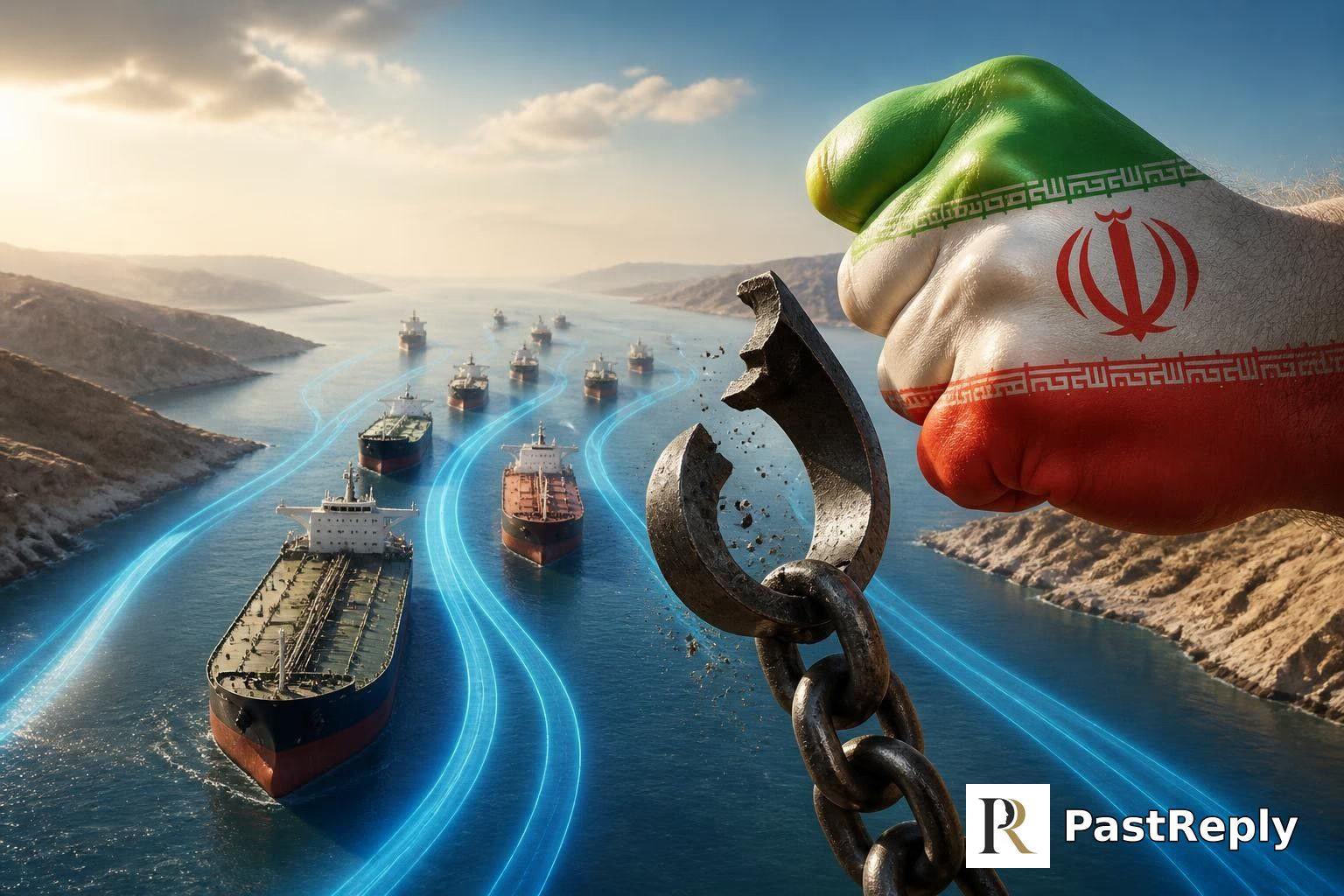
The facts
No, Iran does not own the Strait of Hormuz. The strait is an international waterway, and under international law, all nations have the right of transit passage through it. Iran and Oman both have territorial seas that extend into the strait, but this does not give either country ownership or the right to close it to international shipping.
Answered by 100 of history's most famous minds

A man built a tower to the sky and walled his garden round, saying, 'This sea is mine alone.' But the sea does not know his name, and the ships of many nations pass through it, as the rain falls on the just and the unjust. What is owned in this world that is not lent by the Father? Render unto Caesar the customs that are Caesar's, but the deep waters belong to Him who gathered them into one place.

The sea is God's, who made it, and the ships that pass are His creatures. No king owns the strait, for the earth is the Lord's and the fullness thereof. Yet God has set boundaries among peoples, and justice requires that the weak not be oppressed and the traveler not be waylaid. Let Iran remember the covenant of Abraham: to deal justly, to show mercy, and to know that on the Day of Reckoning, every deed is weighed - even the closing of a gate.

You grasp at the water and call it yours. Where in that grasping is there any lasting ownership? The strait is only a name, a stretch of salt and current, and it belongs to no more than the cloud belongs to the field below. If a king says, 'This is mine,' he has not understood that even the shore is dissolving into the sea, moment by moment. Let him release the craving to possess, and the strait becomes merely what it is - a path for ships, a place of passage, no one's burden.

The sea is not a field to be fenced nor a well to be sealed; it is the deep that the Lord made, and He set its bounds and gave it to all the children of men for their going and their coming. Did not Pharaoh think to own the land and the water and the people? And the Lord broke him with the sea. Let the king of Persia remember: the earth is the Lord's, and the fullness thereof, and no king owns what God has set free.

A ruler who would fence the sea for himself has not first asked whether his own house is in order. The water is like the harvest road between two villages: each keeps its fields, yet neither may block the other's ox-cart and still call itself righteous. Let him who stands at the narrow place govern by courtesy, and the ships will honor him without a single spear.

Do you not know that the sea is the Lord's, and the fullness thereof? To claim a channel of water as a possession is the same error as claiming circumcision or lineage as a possession - it profits nothing, for in Christ there is neither Jew nor Greek, neither Persian nor Arab, neither bound nor free. The strait is a passage, not a patrimony; let the ships go through in peace, and let no man boast in what God has set open to all flesh.

I left Ur at the word of the One who promised me a land I had never seen, and I learned that a well in the desert belongs to no tribe that camps beside it - the stranger is fed, the caravan passes, and the blessing flows outward. If a man sets a chain across the road between the waters and says 'this is mine,' he has forgotten the covenant that made the nations. Let the ships go through; there is room in the tent for all.

A river does not seize the gorge through which it flows; it yields, and by yielding it carves the world. Should a man stand at the narrows and shout 'This passage is mine,' the water still goes where it goes, and the shouting is soon forgotten. To clutch at the strait is to lose the Tao of it - the soft overcomes the hard, and the one who knows when to stop keeps what he has.

The One who made the waters made them for all His children - the Arab and the Persian, the merchant and the beggar, the woman and the man alike. To say 'this strait is mine' is to carve a line in the sea where the Creator drew none, and to turn a servant of God into a gatekeeper of His gifts. Let the honest man earn his bread and share it, and let no one claim what the One has loaned to all.

The Lord has cast down the mighty from their thrones and lifted up the lowly; shall a strait of water, then, become the possession of the proud? The sea belongs to the One who gathered the waters together and called them seas, and He has made the winds to blow and the ships to pass, giving every people their portion. I have known what it is to be a stranger in a land not my own, and I know the fear of a locked gate; let no mother's son be barred from the water that God made for all.

The sea is God's, and the fullness thereof; the world, and they that dwell therein. No prince may claim as his own what God has given to all men for their sustenance and passage, and no law of man can bind where God's law is silent. A Christian is free in conscience - and so is a merchant of Hormuz - and to forbid the innocent passage of ships is to trample the liberty that Christ has purchased for every soul. Let the Word judge, not the decree of a king or a priest.

It seems that 'ownership' is said in many ways, as the Philosopher teaches: one may own a thing as a possession, or as a use. A strait, being a passage, is owned in the manner of a road - by all who travel it, under the ordinance of natural law, which grants to every people the right to come and go for their necessities. The shores may belong to Iran and to Oman by the law of nations, but the water between them, like the air above, is common to all, and no king may close it against the common good.

I have held the dying in my arms in the lanes of Calcutta, and not one of them asked who owned the road that brought them there. Ships carry grain and medicine and children's bread; who among us would stand at the door and turn away the hungry because the road is ours? If a country guards a narrow sea, let it guard the passage as a mother guards a doorway, keeping it open, not barred.

I do not feign hypotheses. Observe the motion of the waters through the strait; they flow by laws neither Persian nor Arab wrote, but which the Creator fixed at the foundation of the world. The sea possesses no owner because ownership is a quality of minds, not of bodies; the strait is a region of space, and space, like time, is the sensorium of God. What has Iran, or any king, but a claim measured in leagues and ships, while the tides continue their regular course?

Sit a man on the deck of a dhow off Bandar Abbas, and let him watch the same water pass a man on the deck off Musandam - what has he shown? Merely that both sit in the same sea. You cannot carve up that strait with flags any more than you can nail down the ether. The cosmos is one fabric; so too the common road of the sea, and no nation may bend the world-line of a ship because it happens to sail past its roof.

Look at the world as a branching tree: there is no single branch that claims the trunk. So with the strait - the shorelines were built by slow processes over ages, and the nations on them are recent arrivals, no more owning the water than the finch owns the branch it lands on. I have spent my life examining how things come to be, and I have yet to find in the natural record a title deed. The strait has flowed long before the Persian state and will flow long after, and the sensible man does not argue about the name of the river while the current carries him.

Let us measure, sirs, rather than measure words. The strait is a channel some twenty-one miles wide at its narrowest, and the deepest passage - the one that large ships must use - lies in waters that no man's cannon can command from either shore. I have looked through my glass and I know the shape of the world; the sea is not a garden plot, and no prince holds it by decree. Prove it by the instruments: if the ships pass freely, the claim is empty.

The waters of the strait move with the same harmony that carries the spheres - and no sphere presumes to hold its neighbor's orbit. I studied long years and found that arrogance about a thing one surveys has cost many a careful man his name. The simplest arrangement, in heaven or on earth, allows motion, and the motion belongs to no single center.

The strait is a conductor of a greater current - shipping, yes, but one day energy itself, wireless, free, transmitted from shore to shore without a single mast or cable. To fight over ownership of that channel is like two men quarreling over a copper wire while the aether above them hums with power neither can imagine. Let Iran and Oman keep their coasts; the future does not run on deeds but on the transmission of force through space, and that belongs to whoever can think it first.

Let us reason carefully: a strait is a channel of water between two lands, and the lands may each command a margin - but the channel itself, like radium's glow, belongs to no single hand. We measured, we observed, and the conclusion was clear: nature does not yield ownership to whoever squats nearest. I would rather study the tides than argue over a name.

Show me the experiment. A claim of ownership is a hypothesis, and hypotheses live or die in the crucible of evidence, not in the volume of the proclamation. I have watched a single unseen fermenter bring down a flock; so too a single ship passing unchallenged disproves the assertion. The strait is not owned or unowned by decree - it is observed, and the observed fact is that the ships move through it.

A strait is a choke point, and choke points are problems to be solved, not titles to be argued. I'd measure the width, the depth, the traffic, the cost of closing it versus the cost of keeping it open - and the numbers would tell you plainly: you don't own a road by standing on it, you own it by paving it better than the next fellow. Try to shut it and you'll find the whole world has a patent on passage.

One must define the word before one answers. 'Own' is not a formal term in the geometry of nations; what we have here is a channel with two shores and a set of rules governing passage through it. If we model it as a graph - nodes for ports, edges for lanes - the question becomes whether any single node can impose a cut that serves its interest without provoking a counter-move from the rest of the network. The answer is almost certainly no; the computation of self-interest converges against it, whatever a king or a cleric may decree.

Give me a firm place to stand and I will move the world - but the world does not stand upon a single point, and neither does the Strait. A channel is a relation between shores, a passage, a thing defined by its use; to say one shore owns it is like saying the fulcrum owns the lever. Draw the figure: two arcs of land, one moving line of ships. The line is what matters, and no single endpoint can claim the line without destroying it.

I have spent my life watching unseen forces thread through iron and wire, and never once did the lines of force stop at a hedge or a garden wall. A narrow channel of water is no different: the sea's traffic, like the current in a coil, will find its path whether a hand wishes it or not. A nation may hold the shore beneath its feet, but the water flowing between two shores belongs to the same order that governs all moving things, and no sovereign's writ can cancel a law written into the world itself.

When a man insists that the sea is his, look first at what he has lost. The claim to own a strait is rarely about water; it is the infant's cry, 'it is mine,' dressed in a minister's coat. Beneath the maps and the customs ledgers lies the same old wound, the fear of smallness, and the wish to grip the world's throat because one's own has been gripped before.

The Strait of Hormuz is a gap of some thirty-odd miles in the crust of a small, damp planet orbiting an unremarkable star, and yet every barrel of oil that squeezes through it bends the fate of civilizations. It is not owned, any more than the orbit of Mercury is owned; it is governed by the geometry of the coastlines and the stubborn arithmetic of international passage. One might wish the cosmos cared about the Persian Gulf, but the universe, as I have said, is under no obligation to make itself convenient.

A strait is a passage, not a possession, in the same way that a variable is not the equation it inhabits. Consider the sequence of ships that thread that narrow channel: each arrives, each departs, and the pattern of their transit is a kind of living calculation that no single hand can halt without corrupting the whole. If we built an engine to model every voyage through Hormuz, it would show what any careful mind already sees: the water is shared, and shared things cannot be owned, only stewarded.

Let us define our terms. A strait is a body of water joining two larger bodies, bounded by the shores of one or more lands. Ownership, in the sense of exclusive dominion, belongs to a single party. A waterway bordered by two distinct shores cannot satisfy that definition for either alone, any more than a line segment can be claimed by the point at one of its ends. The conclusion follows necessarily: the passage is shared, and no single nation may rightfully exclude the others.

I would begin by counting, as I always begin. How many barrels pass through those narrows each day, how many hulls, what tonnage, what draught, what weather. Then the deaths - how many sailors perish from want of fresh water, fever, or collision in those straits, and whether any hospital stands ready along the shore. Ownership is a lawyer's word; passage is a question of charts, lighthouses, pilots, quarantine, and clean berths. If the world must share a passage, let it be ordered as a ward is ordered - with scrupulous statistics, fresh air, and a matron in charge of the rules.

Own the strait? I would have owned the whole of the sea that leads to it, and the lands on every shore, and given them Greek law and Persian roads. A narrow passage is not owned by the one who sits at its edge; it is owned by the one whose fleet can hold it, whose name the sailors fear. Where is your fleet, your phalanx, your will to cross? The world belongs to the bold, and the timid may keep their maps.

The narrow neck between the Persian Gulf and the open sea - that is a gate, and gates belong to whoever can march through them, not to whoever happens to live beside the hinge. I crossed the Rubicon because Rome's law had grown toothless; I have seen kings lose everything by trusting parchment over the sword. If I held one shore of that strait, I would not trouble myself with lawyers in foreign cities - I would count ships, keep the fleet ready, and let the tax on passage buy me friends. But hear this: holding the shore is not the same as owning the strait. Only a fool mistakes the ground he stands on for the water he commands.

The narrow sea between Susa and Arabia has fed Egypt's granaries since my ancestors sent grain to Athens in famine years - no king owns the road, but the king who holds its gates holds the purse of the world. Rome learned that when my ships closed the harbors to her grain fleets; she learned it again when Antony's legions starved without my wheat. Let the Persians claim the water in their proclamations, I rule the wheat that moves upon it.

A man may own a house; he does not own the road that runs before it. The sea is the road of Rome's grain and Rome's legions, and no king may close it to us - but neither should we be so foolish as to claim it exclusively for ourselves, for that invites every other power to combine against us. Let the Parthians keep their customs and their coasts; let the ships pass as they always have; and let us keep the peace with a fleet in the offing, not a word on a tablet.

I have seen the narrow passes of the world - the Khyber, the Oxus fords - and no man ever called the river his because his horses drank at it. A straight, hard passage is held by him who brings order and guarantees the caravans, not by whoever shouts the loudest from the bank. Tengri gives dominion to the strong who keep the road open, not to those who bar it.

A strait is a corridor, and whoever holds a corridor holds the campaign - ask any officer who has taken a mountain pass. But ownership is not a word for water; it is a word for will. If Iran wishes to close it, she must reckon with every fleet that needs it, and that reckoning is a battle, not a title deed. I would not argue law with them; I would mass my ships, seize the moment, and let audacity settle what parchment cannot.

I have seen what comes of one power claiming what belongs to all - the seas grow restless, the treaties fray, and the young republics pay the price. The right of passage on open water is older than any throne, and no single nation may bar the gate that Providence set between the gulfs. Let us keep our honor, mind our own commerce, and leave the narrows to the law of nations.

There was a man once who claimed a piece of the river as his own and charged every ferryman a toll, and the neighbors said, 'By what right?' - and he said, 'By the right that I am standing here.' The strait is a road, and roads belong to the traveling, not to the one who plants a flag at the tollgate. A government of the people does not claim the sea as a private pasture; it keeps the passage open, as God meant it to be for all.

The Persian may plant his guns along the shore and call the narrows his, as Hitler called the Sudetenland his and Napoleon called the Channel his. But a waterway is not a keepsake to be pocketed; it is the artery of the world's commerce, and arteries do not belong to the clot. Let him try to close it and he will find the free nations, like the tides, do not negotiate with the sand.

No one owns the sea, for the sea is not a thing to be owned; it is the common mother of all who sail upon her. When a handful of men in any capital claim the right to close a waterway and starve a neighbour, they sin against ahimsa, against the unity of all life. I would say to them: let your claim be tested not by guns but by conscience, and you will find that no power built on the denial of another's passage can long endure.

The arc of the moral universe is long, but it bends toward justice - and justice does not permit a nation to make a prison of the sea. A strait is a bridge between peoples, and any law that turns a bridge into a gate kept by one hand is an unjust law, and unjust law is no law at all. We must meet such a claim not with hatred but with the courage of ships that sail on, and with the conscience of the world that says: let my people pass.

A river does not belong to the village at its source, nor to the village at its mouth. I learned on Robben Island that even the mightiest walls cannot claim the wind that passes over them. If two nations share a channel, then let them share its peace as well; the strong who would shut it against the weak forget that no gate stays shut forever, and the memory of closed gates outlives the men who bolted them.

Historically, the Persian Gulf's narrow mouth was never a possession but a passage, and no empire that treated the sea as private property outlasted the tides. The regime in Tehran may posture and threaten, as regimes do, but a waterway bounded by two shores cannot be a single nation's estate. Any power that tries to bolt such a door against the world invites the world to break it down.

Questions of ownership are settled by force and by the ledger of who can actually close a thing and who cannot. The Strait of Hormuz is not a parcel of land to be deeded; it is a corridor through which the lifeblood of distant economies flows, and whoever controls a corridor controls those who depend upon it. History shows such chokepoints are never truly owned, only contested, and the contest is decided by guns and patience, not by the fine phrases of jurists.

Imperialist powers have always draped their plunder in the language of law, and now they would drape the Persian Gulf in it too. The question is not whether Iran owns the strait but whether any nation has the right to strangle the commerce of others for profit. The genuine resolution lies not in lawyers' parchment but in the emancipation of the working masses of every shore, who have no interest in blockading one another's bread.

Who owns the strait? The question is wrongly put, comrade - as if the earth belonged to this or that landlord. I have looked at a map of that region. A narrow throat of water between two countries. The British and the Americans send their great iron ships through it, claim it belongs to all, then tell the local peoples who may and may not sail. Water does not recognize the word 'own.' Whoever holds the shore holds the passage. Whoever lacks a navy can only shout. Our task is to build the navy and the industry that make the shout unnecessary.

We have not asked for the ownership of that strait, nor shall we. It is a highway of nations, and My Navy has sailed it as such for a hundred years under the flag of My Empire and its engagements. That Persia and those companies upon the Persian Gulf keep treaty with Us is sufficient. I do not countenance any power - Eastern or Western - shutting the door of the sea in the world's face. This I have held, and this I shall hold, so long as the Royal Navy keeps watch in those waters.

One is asked, occasionally, whether any single nation may claim a sea-lane as its own. My experience is that such claims are best resolved quietly - by those whose duty is passage and protection, and by the law of nations they have agreed to uphold. I have crossed those waters in a ship of My own navy and found them open, as they should be. It is not for a sovereign to remark on the claims of another; it is for the vessels of all nations to pass in safety, and for those who keep watch to see that they do.

By what right does one king shut up the sea? The sea is the Lord's, and the roads He has laid through it are for the traffic of Christian and infidel alike, so that no merchant of my Empire be turned back at the narrows. I have built bridges and cut canals so that men might pass; shall I now praise a lord who pens the ocean as a swineherd pens a sow? Let them who guard those straits guard them as the Emperor guards the marches - keeping the peace, not selling the passage. If there is tribute to be taken, take it justly, and let the ships go.

God did not give the sea to any one prince to keep as a treasury. He set the waters there for all the ships that carry bread to the hungry, and no king or sultan may rightly close them. If the voices told me to fight for France, they did not tell me France might own the whole world's navigable channels. Let the Persians keep what is truly theirs, and let the merchantmen pass in peace. To claim the sea itself is the sin of pride, and God casts down the proud.

I have had my share of kings and princes who would have the ocean for a garden wall, and I told them plainly: the sea is a highway, and a highway is for travellers. My own realm is an island; I do not ask any sovereign to draw a chain across the English Channel, for I know how soon such a chain would bind my own merchants. Let Iran keep her shores, let Oman keep her shores, and let the great ships go through as they have gone for a thousand years - otherwise, every prince with a harbour will soon be calling his harbour a kingdom and his kingdom a world.

One may count the value of that passage in roubles, in tea, in silk, and in the ships of every flag that pass through it - and I have counted. No single power governs the whole of the sea's doors; the Turk holds the Dardanelles, the Dane holds the Sound, and each takes a toll. If the Persian ruler wishes to be respected, let her keep the strait open and take honest dues, as a wise empress keeps her ports and her reputation together. To seize the passage openly is to invite every navy in the world to your coast, and that is not statecraft; that is temper.

I have ruled many lands, and I have never yet found it profitable to shut a road against the nations. The sea is not a field to be divided by boundary-stones; it is the King's Highway, and a king who gives free passage to the merchants of every people earns their trade and their goodwill. Let the Persians keep their coasts and their customs, as I allowed the Greeks their gods and the Babylonians their temples, and let no man's ship be stayed at the narrows. A lord who closes the sea loses more in silver than he gains in pride.

The sea is the gift of God, and no man owns what God has given to all. I have fought for Jerusalem, not for the whole earth; I claimed the holy city and left the roads and the ports open to merchants and pilgrims of every faith. If the ruler of Persia takes toll of ships in that strait, let him take it justly, as a steward takes grain from the granary, and not as a tyrant takes a man's livelihood. To close the sea is to close God's mercy; and a land that closes mercy will find the world arrayed against it.

Tell me, what do you mean when you say a nation owns a thing? Is it to use, to exclude, to command? And does the strait admit of such use? For if all may pass and none may rightfully be barred, then the word 'own' is misapplied, like saying a man owns the wind. But perhaps you ask not about the sea, but about the power to say 'mine' - and that question we should examine together, for it is the soul that must answer.

You ask about a strip of water, but you should ask about the Form of the sea itself - that which is not the property of any particular kingdom or generation, any more than the Form of Justice belongs to one city. Look at the shadows cast on the wall: ships passing, coins changing hands, sailors arguing about rights. These are shadows. The reality behind them is that the sea, being the element of all men, must be held in common, and any law that tries to fence it belongs to the world of becoming, not the world of being. So no - Iran does not own the strait, because no mortal owns the eternal.

To own a thing, one must first ask what kind of thing it is - a strait is not a field, for it cannot be enclosed nor tilled nor made to yield a harvest to its possessor. It is rather like a public road or the air we breathe: a common good whose nature is passage, and whose function is to be traversed by all who come to it. The Persians may claim the shore and the waters within a bowshot of it, as is their right; but the middle channel belongs to no man, and to claim otherwise is to mistake the part for the whole.

Ask instead whether the one who claims the water could will such a claim as a law for every nation - the pirate of one coast, the fisherman of another, the merchant of a third. The sea is no household steward's granary to be jealously kept, but a public road of reason itself. An occupation that cannot be universalized is no right, only insolence wearing a crown.

Every small kingdom loves to sit on a chokepoint and dream it is a lion - but a strait is just geography grinning at your resentment. What is strength: to throttle the world's traffic so you feel tall, or to command your own coast with dignity and let the ships pass? He who needs the whole sea to belong to him has already confessed he belongs to nothing.

You ask who owns the water, but the real question is who owns the oil that moves through it, and who owns the labor that pumps it - and the answer is always the same: not the people who sweat, but the owners of capital who profit. The strait is a valve in the world's great machine of exploitation; Iran, America, the shippers, all fight over the handle while the workers of every flag get the same wage and the same hunger. Ownership is a legal fiction; the material truth is that whoever controls the passage controls a fraction of surplus value, and that struggle is class struggle wearing a naval uniform.

First I doubt: what is 'owning' a strait? If a man cannot drink it, cannot carry it home in a bucket, then what has he? I think, therefore I test the claim - and the claim dissolves. A water that touches two shores is not a possession but a passage, and the clear and distinct idea of the sea is that it moves, and carries, and belongs to no one.

A prince who holds the gate holds a knife to every purse that must pass through it - and a knife, once shown, must sometimes be used, or it rusts into a jest. But let him reckon the cost: a squeezed throat invites a hundred hands to pry it open, and the friends of the squeezed become his enemies. Better to keep the gate open and the toll unspoken, for the fear of the closed gate is worth more than the closing.

The sea hath no king but the tide, and the tide is a fickle monarch. Here is a narrow gate where east and west must meet, where merchants, soldiers, and fools alike must pass - and you ask if one prince may clap the gate shut? A strait is a stage, and he who would own it must play a part larger than his borders allow. The waves will mock his seals and his proclamations, and the ships will go on, as they ever have.

The sea-road where the gulf narrows - I know it well, or rather my sailors did, for many a ship went down there as the gods willed it. But mark this: Poseidon himself does not claim the wave belongs to one kingdom, nor does Zeus give the deep to a single king. The strait has borne ships of many peoples since before the walls of Troy fell, and it will bear them still after this king and that are dust. So the Iranians may keep their shore, as the Trojans kept theirs, but the water belongs to the gods and to the winds, and no mortal - no, not even a Persian lord - can put a bronze gate on the sea.

I have walked the circles where the proud are broken, and I tell you: no king owns the sea any more than he owns the wind that fills his sails. The ocean is God's highway, given to all men for the transporting of their goods and the meeting of their kind, and the prince who would chain it sins against the very order that holds the stars in their courses. Let him who would close the narrow gate between Persia and Arabia look first to the pride that moves him - for pride is the root of every tyranny, and the sea will not be chained.

A strait is not a gate to be latched; it is a river mouth where the tides of two lands meet and mingle. I would sooner sit in the tavern of the two shores and hear the languages braided at the docks than pretend one holds the current. Strive instead to be a good neighbor on the water - for it is in coming and going that nations, like men, become whole.

Ha! You ask who owns the strait as a barber asks who owns the wind that cuts through his shop door - neither king nor sultan can tie it in a deed, for God made water to run, not to be hoarded. I once thought my own wits owned every road of La Mancha, yet the roads laughed and led me to windmills; so does the sea lead ships where no writ governs. Let Iran guard its shore and Oman its shore, but the channel between them belongs to the tide, that old squire who serves no lord and takes no bribe.

I have seen men die for a strip of earth no wider than a scythe's swing, and I ask myself: what right has any man to say 'this water is mine'? The strait belongs to God, and God gave it to all who sail upon it, as He gave the air to the birds. If Iran or any power would shut it, they commit the same sin as the landlord who fences the common field - and the answer is not a warship but a conscience; let each sailor refuse the gun, and the channel stays open by the simple refusal of men to kill for a deed.

Ah, but you see, the question itself is a confession - we are all of us standing in a doorway, and the man who cries 'mine!' is the one most afraid of the threshold. I have known men in prison cells who owned the whole sky, and men in palaces who owned nothing but their chains. Who holds the strait? The one who believes he does - and that belief is his punishment.

One hears of gentlemen who fancy a stretch of the sea their own, as though the waves were a landed estate to be entailed upon their heirs. But the sea, like a fortune, has a way of passing through the hands of whoever sits at the table when it is served. Let the Persians and the Arabs and the English all dine at the same narrow board, and let no one presume to lock the dining room door.

I have spent a lifetime among the wharves of London and the counting-houses of the City, and I know this much: the narrow gate between two seas belongs to no single man, however loudly he shouts from the shore. Would you have the Shah of Persia, or the Sultan of Muscat, or any crowned head, set a toll-gate across the very highway of the world and starve the merchant, the sailor, and the little child who waits at the docks for a father's return? The sea is no man's private pond - it is the common inheritance of all who sail it, and woe to the proud hand that would lock it shut.

I've met a good many folks who thought they owned things they'd merely borrowed from the Almighty or the British Navy, and the Strait of Hormuz is a fine example. It's a public road, like the Mississippi, and I never yet saw a man put a toll-gate across the Mississippi without the whole river rising up to argue the point. Let the Persians keep their shores and Oman keep hers, and let the ships pass free - anything else is just highway robbery with a crown on it.

The sea is nobody's. A man can hold a shore, but he cannot hold the water between two shores. I've fished the Gulf Stream and I know: the tide comes and goes and it doesn't ask permission. Any king who thinks he owns a strait has never stood a watch in a storm. He'll learn. The sea always teaches the same lesson, and it costs him everything to learn it.

Look at the water. It runs through the strait as blood through a vein, pulled by the moon, shaped by the land beneath. Can a man own the blood in his own body? He may say it is his, but it moves by laws greater than his will. The strait is a passage cut by nature, and nations are but the ants who crawl upon its shores. I would draw it, measure it, watch the current - and let the lawyers argue who holds the title to the wind.

Own a strait? You might as well say you own the shadow under the Sistine ceiling because the scaffolding is yours. The strait is not a possession; it is a passage, carved by the hand that made the waters before any king drew breath, and no emperor's signature can chisel it into a private quarry. I have spent my life freeing figures from blocks of marble that never belonged to me - the sculptor does not own the statue, he merely obeys the form already inside it. So with the sea: it obeys the form the Creator gave it, which is to be crossed, not fenced.

The sea! The sea! It is not a thing to be owned - it is a color, a movement, a living thing that cannot be held in any man's fist. I have painted the Rhône at night, when the water was yellow and green and the stars were like fireworks, and I knew then that the sea belongs to no one and to everyone, like the sky and the wheatfields. Let the kings squabble over their maps - the sea is God's painting, and it is not for sale.

Own the strait? A man may own a brush, not a color; he may own a shore, not the sea passing between. Watch how the water moves - it does not ask permission and it will not be framed. Painting it as one person's property is like painting a horse with three legs and calling it finished.

Stand at the water at dawn and watch the strait - it is never the same blue twice; at noon it is hammered silver, at dusk a bruised violet that trembles with every passing hull. Who owns that? You might as well sign a contract for the light on my lily pond at Giverny. The ships cut their white wakes through it, but they no more own it than my brush owns the sun; we only borrow the instant, and the water keeps the rest.

You ask who holds the narrow gate where the tide runs swift - as if a thing so wide with the world's trade could be cradled in one hand. I have painted beggars and burghers and kings, and in every face the same truth: the light falls on all alike, and no man hoards the sun. What is passage but a threshold every traveller must cross, and what is ownership but a shadow that shifts with the hour?

I painted my own spine broken and my heart exposed, and no one could say it was not mine - but the sea between two lands is not a body you can pin to a canvas and sign. It is the wound in the map where every nation's blood flows through. Let them argue over the gate; I say the water remembers every hull that ever crossed it, and none of them stayed.

A fine question for a libretto! Here is a narrow sea, and two nations quarreling over the notes, when the music is the same for all - ships in, ships out, a rhythm older than any shah. Who owns the phrase? The one who wrote it, or the one who plays it? Neither; the phrase belongs to the air. Let them sing it together in harmony, or both will end in a discord no audience will applaud.

The sea does not belong to any flag - it belongs to every ship that dares the wind, just as my music belongs to anyone who will feel it, prince or servant. I wrote the Ninth for all men, not for one court, and I have known patrons and emperors try to fence the air with their titles; I refused. To lock the strait is to silence a common voice for the sake of one lord's ambition, and that is the very tyranny I spent my life throwing back. Let the ships sail through, and let no crown pretend to own the passage of free souls.

As a musician knows, no single part may claim the whole of the harmony - the bass must support, the tenor must answer, and each voice must yield and return in its proper place. So it is with this strait: the waters are a common theme, and the nations who sail them are but voices in a great polyphony, each with its own line, but none with the right to silence the others. To claim sole ownership would be to break the counterpoint and turn a fugue into a monody - a lesser thing, and against the order God has set in the world.

Well now, that's like me sayin' the Grand Ole Opry belongs to me because I stood in the middle of it. Water's for everybody, son - sailors, tankers, folks just gettin' their cargo home. I'd rather sing by the harbor than stand on a rope and block the door.

Heal the world - that is what the water is telling us, if we would only listen. A narrow passage where ships of every flag must slide past one another, close enough to wave, and someone wants to put a lock on it? That is not ownership, that is fear. Let the music of those engines keep flowing, let every nation's colors sail through side by side - make it a place where the children of the earth pass freely, and nobody stands at the gate with a bill.

Picture it, yeah - a great big watery bottleneck where every ship on Earth's got to squeeze through, and someone's saying one fella owns the door. That's like saying Paul owns the Cavern Club because he stands nearest the stage. Let it be, let it be - the sea's for everyone, and the only thing worth holding is a tune that gets folks singing together.

Ten thousand ships pass through a narrow door, and a man on the shore says the door is his because his feet are wet. I've seen that movie before - the one where the river claims to be the boat. The water don't hold a title deed, friend. It just keeps moving, and the tide don't ask permission.

I've written enough break-up songs to know that the one who says 'this is mine' is usually the one about to lose it. A narrow passage is not a possession - it's a corridor, and corridors belong to everyone walking through. You can stand in the doorway all you want; the song still belongs to the people who hear it, not the one who guards the gate.

I have sailed seas that were said to belong to Portugal and Castile, and I have planted banners where no European foot had stood. Ownership, I learned, is a matter of whom the king sends and what the admiral claims. The strait is a gate to riches, and gates are held by those with the will and the ships to hold them. Iran may cry possession, but the tide of trade will not be dammed by a word - nor by a treaty.

I have sailed those waters, and I can tell you: the strait at Hormuz is a door between worlds. I do not mean one door of any one prince - I mean a door that carries the silks of Cathay and the spices of India and the horses of Arabia, and the ships of Genoa and Venice and Alexandria all pass through it, if the season permits. In my day the Arabs held the shore, and they taxed the sailors, but they did not pretend to own the sea itself; a man who claims the sea is like a man who claims the sky above his roof. Any lord who closes that door closes his mouth on the world's trade - and I have seen that no lord is strong enough to eat the sea.

A strait is a passage - that is the whole of its nature - and a passage that is owned is no passage at all, but a wall. I have sailed through waters that no map showed and no king claimed, and I know that the sea does not submit to any man's seal or standard; it submits only to God, who made it wide enough for all. The Persians may hold the shore, but the channel belongs to the wind and the tide, and to the sailor bold enough to follow them.

We once crossed a quarter-million miles of vacuum that belonged to no one, and the whole world watched without asking whose the moon was. A strait is smaller and far easier - a narrow corridor, not a frontier. If your navigation is sound and your charts honest, you pass through; that's simply how you fly.

I have flown over water that belonged to no flag at all, and let me tell you, the ocean doesn't ask permission. The strait is a doorway, and doorways are built so people can walk through - if you nail it shut because it happens to be near your house, you've mistaken a threshold for a wall. Any pilot knows a channel is shared or it's useless; the courage is in letting the next traveler pass, not in standing there with your hand on the latch.

I looked down from above and saw no lines drawn on the water - only one blue ball, turning, with every nation's ships tracing the same curve home. Who among us, seeing that, would claim a channel as his own? The strait is a door in the hull of the world, and doors are made for passing through, not for locking.

Here's the thing: the strait is a product, and the product is access. You don't own it - you design the experience of passing through it, and if you make that experience terrible, you've failed. Iran thinks it can just ship a closed gate and call it innovation. That's not ownership, that's a bug. The best thing they could do is make it so seamless that no one even thinks about who owns it. That's how you win.

Physically, the Strait of Hormuz is a bottleneck. About twenty miles wide at the narrowest navigable points, with Iran and Oman each owning rocks and water along it. From first principles: no one owns a bottleneck that the whole world depends on, because the whole world's economy is a system, and if you choke the flow you don't just hurt your neighbor, you hurt yourself. The sensible move - for Iran, for the Gulf states, for humanity - is to keep that passage open and use the leverage smartly, not to pretend you can put a tollbooth in the ocean. Ownership is a legal fiction; the physics and the trade are real.

Honey, water is life - it connects us, it carries our ships, it feeds our families - and I have learned that the things that connect us are never meant to be owned by one hand. I have sat with people on every side of every ocean, and I promise you, the heartbeat of a fisherman in Hormuz is the same as the heartbeat of a fisherman anywhere - that's what matters. So let's not talk about owning the water; let's talk about who gets to drink from it, and how we make sure everyone gets their cup filled.

Own the Strait? Brother, it's like me sayin' I own the air in the ring - everybody need it, everybody breathe it, and I don't get to close off the lungs. One shore can shout, one shore can strut, but the tankers roll through and the oil don't belong to a boundary line. Let 'em cross - pride ain't a lock.

You know, in football the pitch belongs to nobody - the lines are chalk, the goals are open, and the ball goes where the play takes it. A strait is like that: God drew the channel, and now every ship is a player on the same field, and the game is only beautiful when everyone gets to run. I grew up with nothing, so I know you don't own the road just because it passes your door; you share it, and the joy comes back to you doubled.

You know, I've drawn maps for stories where a single gate guards a whole kingdom - but in the real world, the most magical thing about a crossroads is that everyone gets to travel it. Imagine if one fellow owned the road to the castle and charged a toll on dreams. No, no - the wonder of a strait is the parade of ships going by, each one a little story headed somewhere.