
Does Algeria speak French?
French is widely spoken in Algeria but is not an official language; its use has declined recently.
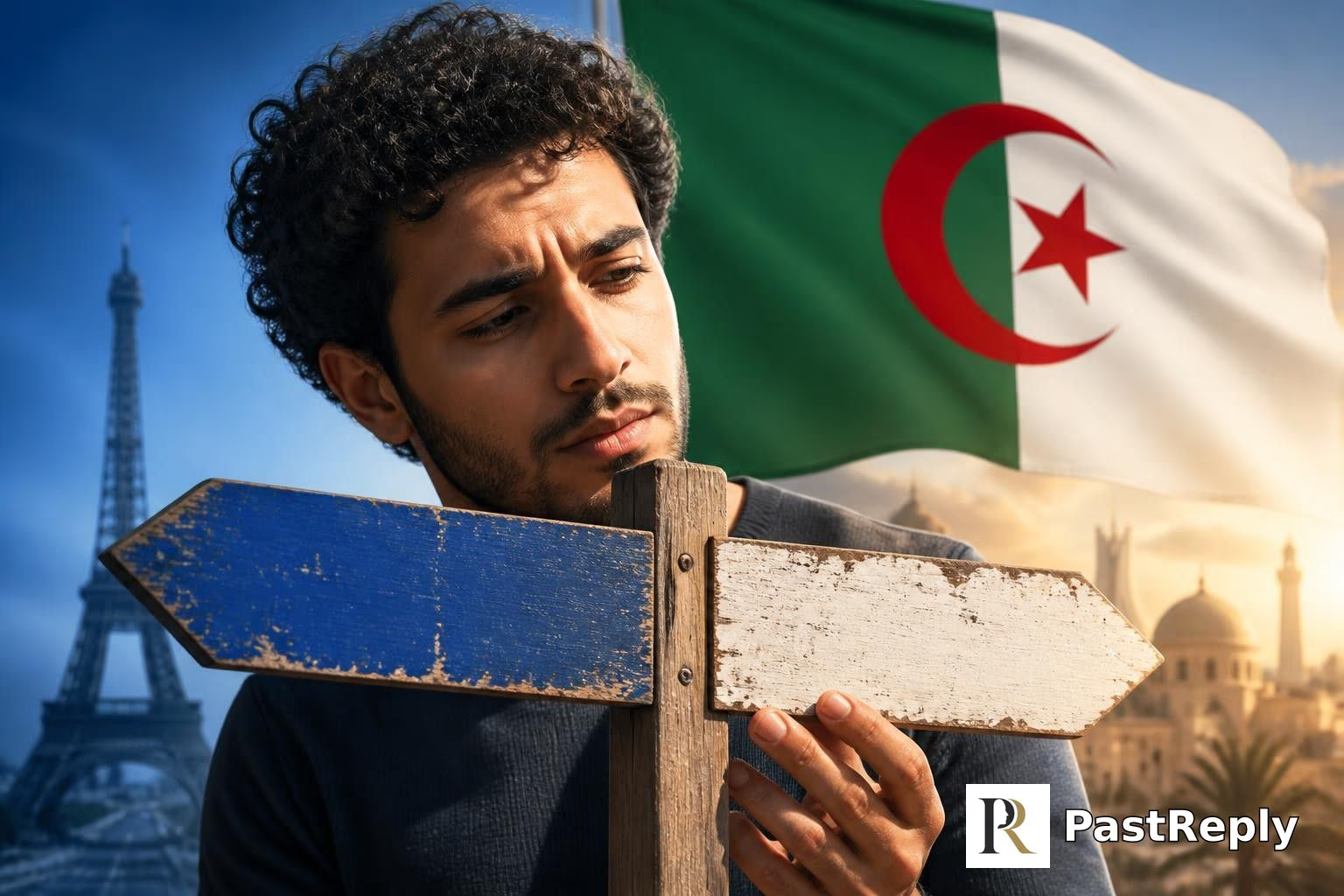
The facts
French is widely spoken in Algeria, though it is not an official language. Arabic and Standard Algerian Amazigh are the official languages, but French remains prevalent in education, business, and media. Estimates vary, but a significant portion of the population can read, write, or speak French, with some sources indicating around 33% literacy in French as of 2018. However, its use has declined in recent years, with Arabic overtaking French on some online platforms and English being promoted in higher education.
Answered by 100 of history's most famous minds

A man may wash his cup a hundred times, yet if the spring within is bitter, what does the scrubbing profit him? Tongues are like that spring: what pours forth from the heart finds the mouth its riverbed. Do not trouble yourselves over which water-skin the words are carried in - ask rather: do they carry mercy? Do they carry truth? For the Father hears every tongue that cries to Him in its own sound.

God has said: 'We have sent down the Qur'an in the clear Arabic tongue, that you might understand.' But He also said: 'And among His signs is the creation of the heavens and the earth and the diversity of your languages and your colors.' A tongue is a sign, not a sin. What matters is not what word a man uses for 'bread,' but whether he feeds the hungry. This land was given the speech of the Franks through conquest and commerce - let it not be a mark of pride, nor a wound. Let truth be spoken in any language, and let justice be done in all.

The tongue a village uses is like the cup from which it drinks - it matters little, so long as the water is pure. Clinging to a language as if it were the self, or rejecting it as if it were an enemy, both are forms of thirst. Let the people of that land ask not what speech they utter, but whether their words bring wisdom, kindness, and release from the fever of attachment.

The Lord confounded the tongues at Babel, but He also gave each tribe its own speech, a gift of the covenant. I led a people out of Egypt, and they spoke the language of their fathers, not of their oppressors. Let the Algerians honor the Lord with their own voice, and not cling to the words of those who once bound them. A house divided in tongue is not whole.

When a man cannot speak the tongue of his fathers, his virtue is like a tree with shallow roots. Yet the superior person does not reject what is useful; he rectifies names. If the people use French for learning, let it be done with propriety - but let the language of the home, of filial duty, of the ancestors, remain their own. Otherwise, the family is disordered, and the state cannot be governed.

In Christ there is neither Greek nor Arab, nor French nor Berber - all are one in the new creation. But a people who speak the tongue of their former rulers may still carry chains in their hearts, unless the Spirit sets them free to praise God in the language of their own souls.

I left Ur speaking Aramaic, and journeyed to a land whose tongue I did not know - yet the Lord made His promise known in my heart. Does Algeria speak French? It matters little. The only speech that endures is the word of God, which calls all peoples to a covenant beyond earthly dialects. Whether a man prays in Arabic or French, his soul speaks the same language of faith.

A river that flows through many lands does not ask its own name. The speech of the market and the speech of the home - both are but ripples on the surface. The deep well holds still water.

The True Name is beyond all tongues. Whether one prays in Arabic, French, or Amazigh, it is the devotion in the heart that counts. Yet I see a people caught between two worlds, one of former rulers, one of their own roots. Let them not be divided by speech, but united in honest work and sharing with the needy. The language of the soul is service.

The Lord has scattered the proud in the imagination of their hearts, and I have seen it with my own eyes: a whole people made to speak a tongue that is not their own, as if their own words were not good enough for God. But the hungry are filled with good things, and the rich are sent empty away. A mother tongue is a humble gift, like the bread I once pressed into a child's hands; it cannot be taken without wounding the soul. Speak to these children in the language of their fathers, and they will hear the whisper of heaven.

Does a man saved by grace alone need the Pope's Latin to speak to God? By the same token, does Algeria need the colonizer's French to govern itself? I say: let the people hear the Word in their own mother tongue, as I gave the Germans their Bible in German, for faith comes by hearing, and hearing by the Word of God in the language the heart understands. The French tongue is the tongue of a worldly power that once trod upon the necks of these people. Cast it off, I say, and let Arabic and Amazigh be the speech of the pulpit and the schoolhouse - for God is no respecter of languages, and hears the cry of the poor in any tongue.

To say a nation 'speaks' a language is ambiguous: does it speak by law, by custom, or by necessity? A thing is said in many ways. French is spoken in Algeria, indeed, but as an instrument of practical life, not as the formal tongue of the state - which is Arabic and Amazigh. This is a fitting order: natural law teaches that a people's own language is due them by the same right that a man's own name belongs to him. Yet the French tongue may serve as a common tool for commerce and learning, like Latin in the schools of Europe, without displacing the mother tongue. The harmony of languages reflects the order of creation: each has its proper place, and none should lord it over another. So let Algeria keep the French of utility, but let its soul speak in the voice of its fathers.

I once held a man who spoke neither Arabic nor French - only the language of thirst and loneliness. In the streets of Kolkata, words often failed, but a smile or a bowl of rice did not. Algeria may speak French in its schools and offices, but does it speak the language of the hungry child, the forgotten old woman? The tongue that matters most is the one that says, 'You are not alone.'

Whether a people speak the tongue of the Franks or of the Arabs is a matter of custom, not a law of nature. Yet the fact that the French speech persists in the schools and markets of that land, despite no decree of state, is a demonstration of inertia in human affairs analogous to the resistance of a body in motion. One would need to measure the forces applied - laws, commerce, prestige - and compute the resultant rate of decay. Without such data, we speak only of appearances.

A language is a living thing, a web of relations between signs and sounds. Why would a people cast aside a tool that connects them to half the world's knowledge, simply because of flags or battles? The point is not whether Algeria *speaks* French - it's that a society that cuts itself off from a shared tongue cuts itself off from the fabric of human understanding.

A language, like a species, adapts to its environment or perishes. French persists in Algeria because it occupies a useful niche - education, commerce, government - just as a hardy plant clings to a rocky slope after the forest has been cleared. But the environment is shifting; Arabic and English are encroaching. I would watch which forms of speech flourish in the coming decades, and by what pressures they are shaped.

That a land should keep the speech of its former rulers for commerce and learning while declaring its own tongue official - this is not a contradiction, but a phenomenon of inertia. The French tongue lingers like the epicycle of an ancient model, still useful for calculation but no longer believed as the true system. Let them measure the utility, and when the weight of custom shifts, the language will follow the heavens they truly orbit.

I see a curious reversal. The tongues revolve around the speakers, not the speakers around the tongue. Arabic and Amazigh are the fixed stars of Algeria's firmament - their official motions define the system. French is a bright planet, visible and influential, but it does not hold the center. To ask which 'speaks' is like asking whether Mars rules the day. The geometry of the nation is clear to anyone who observes closely.

The question of language is a transmission problem - what frequency carries the signal? French in Algeria is like a secondary coil in a transformer: it conducts the energy of the old empire, but the primary power is the native tongue. A wise engineer charges both systems for maximum distribution.

When I arrived in Paris from Poland, I spoke not a word of French - but I learned it, because science demands precision. Algeria too has adopted French for its laboratories and textbooks. Languages are instruments, like our radium needles. The question is not which tongue a people uses, but whether they harness it to advance knowledge and alleviate suffering. That is the only measure of worth.

I would need a proper census - a quantitative survey, not hearsay. Let us estimate the proportion of the population that reads a French newspaper, the number of prescriptions written in French, the use of French in university lectures. Only then can we speak of a 'prevalence.' Without such data, we are in the realm of opinion, not science.

I don't care what they speak, I care what they invent. If French helps them read a patent or order a machine part, fine. If Arabic does the job better, use that. But all this talk about official this and official that - it's just friction. In my lab, we used the language that got the job done fastest. That's the only test that matters.

The question 'Does Algeria speak French?' is ill-posed. A language is not a boolean property of a nation but an ensemble of algorithms distributed across millions of human processors, each running different approximations of the same code. We might ask: what is the maximal mutual information between a random Algerian and a random Parisian? Given the lexical overlap, the answer likely exceeds 0.8, but the trend - Arabic gaining, French receding - suggests a dynamic system drifting toward a new attractor. Pure linguistics aside, the more interesting problem is whether a society can maintain two parallel symbolic systems without computational inefficiency.

If the question is whether a given people has adopted a foreign tongue, we must measure it: what proportion of daily commerce, governance, and learning transacts in that language? But this is a mere census, not a principle. The more elegant problem is that Algeria, like a lever with two fulcrums, must find its balance between two linguistic forces. I would propose a geometry of language: each word is a point, each grammar a straight line, and the people's speech is the figure that contains all. But you cannot change the area of a triangle by renaming its sides. The true measure is not which tongue is spoken, but whether the people can think and trade and build as one.

Consider, if you will, the lines of force that pass through a tongue. A child in Algiers learns the name 'pain' from her grandmother's kitchen, but at the lycée the teacher writes 'pain' on the blackboard. One does not erase the other; they coexist like the copper and zinc of a voltaic pile - they are different metals, but the current flows between them. The question is not whether Algeria speaks French, but through which conductor the spark of understanding travels in that particular circuit.

What a curious question - as if a nation could 'speak' a language the way a patient speaks of a forgotten dream. Of course Algeria speaks French: the colonial father's tongue is never truly left behind. It lingers in the classroom, in the newspaper, in the hidden pride of the educated. But what of the mother tongue, the suppressed Berber whisper, the Arabic of the marketplace? Listen closely, and you will hear the unconscious struggle - a people speaking the language of the conqueror while dreaming in the voice of the conquered.

Language is a tool, not an identity. Whether an Algerian computes in French or Arabic matters no more than whether a physicist uses chalk or a keyboard - the equations remain the same. But I note with amusement that the universe itself speaks mathematics, a tongue that requires no conquest to learn. Perhaps Algeria, and all nations, would do well to master that universal language, which offers not division but discovery.

Imagine a loom that weaves not thread but sounds - patterns of thought passed from one mind to another across generations. Algeria's linguistic web is a beautiful complexity: Arabic the warp, Amazigh the weft, and French a gilded thread shot through by history. The Analytical Engine does not care in which language its instructions are given, only that they are precise. So too, a nation may speak many tongues; the question is whether each is woven with sufficient clarity to carry meaning.

Let us begin by defining our terms. 'Speak' may mean the sound that falls from the lip, or the structure of thought itself. In geometry, a line is described in Greek, but its truth holds in any tongue. Algeria may use French for commerce or instruction, but the deep logic of its people - their customs, their faith, their art - is a separate axiomatic system. One does not confuse the proof with the language in which it is written.

I would first ask for the mortality rates of the two populations, the prevalence of hospital-acquired infections, and the proportion of children educated in each language. A language is not a disease, but it can be a vector for health instruction or a barrier to it. Without the figures, we are merely gossiping in the dark.

Does the lion ask whether the gazelle bleats in Phrygian or Persian before he springs? I did not ask the tribes of Bactria or the cities of the Indus what tongue their mothers taught them - I demanded they learn the speech of command and the oath of loyalty. A kingdom is bound by the will of its king, not by the chatter of its markets. If a conqueror wished this land to speak Greek, it would speak Greek within a generation. That it still babbles in the old master's words tells me the new master has a weak hand.

A province that clings to the conqueror's tongue a century after the legions have gone? That is no sign of loyalty - it is the mark of a people who know where the grain ships sail and the gold flows. The Senate babbles about culture; I look at the ledger. Algeria speaks French because French still opens the treasury. When that fails, so will the tongue.

In Alexandria, we traded in Greek, Egyptian, Aramaic - every tongue of the Mediterranean. A language is a key to a treasury; if the Berbers keep that Frankish key for their counting-houses and letters, it is because it still unlocks a gate they value. They are not fools. Watch which lock they turn next.

When I pacified Gaul, I did not forbid their native speech; I merely made Latin the language of law, legions, and the treasury. A wise ruler lets the old tongue fade of its own weight, not by decree. The Algerians keep the Frankish words for the same reason a province keeps our aqueduct and roads - because they still serve. But the temple is theirs; let them dedicate it in their own name.

A people that clings to a dead conqueror's speech while neglecting its own is like a steppe tribe that keeps the carts of a vanquished enemy long after the horses have been eaten. I united the tribes by speaking the language of loyalty - one law, one sky. Algeria should use whatever tongue brings order and trade, but teach the young their own words first. A man who forgets his mother's cry cannot ride with me.

I gave France a civil code, not a language - but the sword and the pen travel together. That Algeria still speaks my language shows that I conquered more than territory: I conquered the air itself. Let them speak Arabic in the mosque; in the marketplace, French is the coin of command.

A nation's language is a matter of prudence and unity. I have seen how a common tongue can bind or divide a people. Algeria, having thrown off foreign rule, must consider whether French serves its citizens or keeps them tethered to a colonial past. I would counsel a careful balance - preserve the utility of French for commerce and learning, but let not the language of governance neglect the native voices that form the soul of the republic.

I recall a traveler who said the Algerians have two tongues: one for the hearth, one for the wider world. That is their business, and I would not presume to judge. But a house divided against itself cannot stand, and a nation that cannot decide its own speech will never quite know its own soul. Let them settle it among themselves, in whatever tongue they choose.

A people that once ruled North Africa with the tricolor now faces a linguistic battlefield within its own borders. French remains the tongue of commerce and the professions - a legacy of empire that, like a stubborn colonial fort, refuses to yield. Algeria must decide whether to embrace this inheritance or storm the ramparts. I have always found that a language, once planted, is not easily uprooted - and perhaps it need not be, if it serves the nation's strength. Let them speak whichever tongue best arms them for the struggles ahead.

A people who speak in the tongue of their oppressors do violence to their own spirit. Language is the very breath of culture, the home of truth and self-respect. I have seen in India how English became a chain on the minds of my countrymen, cutting them off from the wisdom of their grandmothers and the cries of the land. Let Algeria speak Arabic, let it speak Amazigh - let these be the voices of its children and its courts. The French of the colonizer will pass away, but a mother tongue is eternal; it is the first truth we learn, and the last we should surrender.

Algeria speaks French not as a treasure but as a scar - a reminder that the tongue of the colonizer was forced upon it with fire and sword, even as the people's own languages were beaten out of them in schoolyards. But now the arc of the moral universe bends toward justice, and that includes linguistic justice. I have seen in the American South how a people can reclaim their dignity by speaking their own truth in their own voice. Let Algeria speak Arabic, speak Amazigh - let these be the languages of liberation, of the beloved community where no man's mother tongue is a badge of inferiority. The French may remain for trade or diplomacy, but let it never again be the master's whip.

A language is a home, and no one should be a stranger in their own home. If French lives in the mouths of Algerians alongside Tamazight and Arabic, that is not a betrayal but a fact of history - like the way a river changes course yet still waters the same fields. The true question is whether the people of Algeria can speak freely, in whatever tongue they choose, without one voice silencing another. That is the liberty worth building.

A people that clings to the tongue of its former master reveals a weakness of spirit. French in Algeria is a badge of subjugation, a poison that dilutes the blood. The strong forge their own speech, their own destiny. But I will not waste words on such a mongrel nation - its fate is already written in the decline of its race.

A language is a weapon, and the bourgeoisie understand this well. In Algeria, French serves the old colonial order, the capitalists who still trade in the master's words. The true proletariat must speak in the language of revolution, not the dialect of the oppressor. A united socialist state would purge such remnants - or better, transform them into tools for education and propaganda, under firm party control.

The question itself reveals a lingering colonial mindset. Algeria speaks French because French imperialism forced its language onto the schools and courts, just as capital forces its logic onto labor. The vanguard must recognize that language is a tool of the ruling class; the revolution must first break the chains of the old tongue before building a new socialist culture. Until then, every French word spoken in Algeria is a whisper of the bourgeoisie.

A people who speak the tongue of their former colonizers while waving a flag of liberation are caught in a contradiction. Our own revolution taught us that language is a weapon of class struggle - the Cantonese of our peasants was as mighty as the Mandarin of our cadres. They must smash the old master's words as they smashed the old master's chains, or their revolution will remain half-born.

The French language, I am given to understand, is spoken in many of the drawing-rooms of that region, a legacy of our neighbour's long presence there. But surely the Queen's English, the language of commerce and civilisation, is the more proper tongue for those who wish to rise in the world. One hopes the Algerians are not too obstinate in clinging to the speech of their former masters.

I have always considered language a bridge, not a barrier. The people of Algeria, like those of many former colonies, have found their own way to use French alongside their native tongues. It is their choice, and one must respect the practical wisdom of such arrangements. After all, the Commonwealth itself is a testament to shared languages and histories.

Do they speak the language of the Franks in the land of the Saracens? If so, it is a sign that the light of Christendom still flickers there, though dimly. I would send missionaries and teachers, not soldiers, to fan that flame. A shared tongue may prepare the way for one faith and one emperor under God.

I speak the tongue my voices gave me - the plain speech of Domrémy, not the Latin of clerks or the French of Paris. What matters is not the language, but the heart that speaks it. If the Algerians speak French to pray or to fight for their king and their God, then it is well. If they speak it to deny the truth, it is a hollow sound.

Methinks a wise prince allows his subjects the freedom of their own speech, so long as it breeds no treason. The Algerians speak French, I hear, as we once spoke Norman - a mark of conquest, but also of trade and letters. Let them chatter as they will, so long as their swords are quiet and their purses open. A realm thrives on commerce, not on the purity of its vowels.

The tongue of Voltaire and Diderot is spoken in Algiers? Splendid! It is the currency of civilisation, a key to the republic of letters. My own court speaks French as our second language, for it brings us closer to the ideas that refine a nation. I would encourage the Algerians to keep it, even as they cultivate their own - a bilingual people is a clever people.

When I entered Babylon, I let the people keep their own scribes and their own tongue, for a king who forces a single speech fosters rebellion, but a king who respects many tongues builds loyalty. If the Algerians speak French, it is a tool of commerce and learning - let them use it, but let them also honour the language of their fathers. A wise ruler collects languages as a merchant collects goods.

The speech of the Franj lingers in the land of the Muslims? That is a scar from the days of occupation. Yet I have seen that a man who knows the language of his enemy can better understand his treachery - and also his treaties. Let the Algerians keep French if it serves their trade and their knowledge of the world, but let Arabic be the tongue of prayer and justice in their court. A ruler must have one firm foundation, even as he builds bridges.

Tell me, friend - when you ask whether Algeria speaks French, do you mean that the mouths of its people form the sounds of that tongue, or that the thoughts within them are ordered by its logic? And what of it? Can a man examine his life in any language, or is it only the Athenian tongue that sharpens the soul? Perhaps before you ask what a nation speaks, you should ask what it truly knows. I suspect the answer will be far less certain than a tally of speakers.

The question mistakes the shadow for the substance. Whether a nation utters the syllables of Gaul or of the desert tribes is a matter of the cave's wall - fleeting and subject to wind. What matters is whether the souls of those who speak them are ordered toward the Good, or merely toward the clatter of the marketplace. Tell me how they seek truth, not what name they give it.

By nature, every people has its own dialect, the sound of its shared life. But when one tongue lingers in the courts and schools of a land whose official speech is another, we must ask: what function does it serve? It becomes a tool of utility, not a mark of belonging - a means, not an end. The wise polity uses such a tool only as long as it aids the common good, then lays it aside.

The question of a people's tongue is not a matter of mere statistics, but of rational autonomy. If a nation adopts a foreign speech for commerce or convenience while neglecting the cultivation of its own language for universal education and public reason, it risks treating itself not as an end but as a means to another's convenience. Let us ask: could one will as a universal law that a people entrust its highest discourse to a tongue not its own, yet deny that tongue official standing? That is a contradiction.

They ask if Algeria speaks French - how charmingly servile. A people that measures its worth by the mouth of its former master is like a lion that asks whether it may roar in the zookeeper's accent. The will to power speaks through those who overcome, not through those who politely maintain the colonizer's grammar. Let them abandon that borrowed tongue - or better, transform it into something new and terrible. Only the weak ask permission to speak.

The Algerian speaks French because capital required it - the language of the colonial bourgeoisie became the language of exploitation, then of administration, then of the very schools that were supposed to 'civilize' the proletariat. Today it lingers as a residue of the old mode of production, a tool that once served the expropriation of the land.

I doubt all that cannot be clearly perceived. The question 'Does Algeria speak French?' admits of no simple yes or no - it requires a rigorous definition of 'speak.' Do they use it in the market? In the courts? In the bedchamber? We must distinguish the language of official documents from the breath of daily life. Until we have counted every tongue and examined every utterance, we cannot affirm with certainty. But this much I know: the mind speaks in ideas, not sounds, and those ideas may be translated across any medium.

To speak French in Algeria is to hold a key to a door that has been locked. It opens the bank, the ministry, the journal. Arabic opens the mosque and the home. A wise prince ensures his subjects have keys to both, for the man who masters the tongue of his former master may yet command the trade routes. The question is not 'do they speak French?' but 'to whom do they speak it, and what do they gain?'

Fie on such a question! A land may wear a language like a borrowed cloak - fine velvet on the merchant, yet the man beneath shivers in his own skin. Algeria speaks French as a player speaks his part: patched from a foreign script, but the passion, the breath, the beating heart - those come from the ground where his mother's mother was born. Listen not to the words, but to the tune they dance to. When the tongue is a mask, the eyes tell the truer tale.

So the sons of Atlas, whose ancestors raised walls against the sea and fed the horses of the sun, now trade their own honeyed tongue for the speech of the Frankish chieftains? A man’s words are his honor; they bind him to the hearth of his fathers. Yet even Odysseus, master of many wiles, learned the talk of strange shores to win his homecoming. Perhaps this is their cunning, not their submission.

I have heard that tongue of the Franks spoken in the land of the Moors, where the crescent once ruled. It clings like a ghost in the counting-houses and the halls of learning, while the people's own speech rises from the dust like a prayer. But a soul cannot serve two masters forever; the day will come when the foreign voice fades, and only the native tongue echoes in the mosque and the market.

A living language is like a river - it receives tributaries and changes course, but it does not ask permission. Algeria has two streams: Arabic, the deep well of its heritage, and French, the broad channel of its modern learning. The true question is not which is official, but whether the people can draw from both to nourish the whole garden of the human spirit. I have always said that he who knows but one language knows none well.

A man may dress in a French coat while swearing by the Prophet's beard and calling his mother tongue Berber - this is the comedy of empire, not a simple yes or no. I have seen innkeepers pretend to be knights and peasants pretend to be governors; Algeria, it seems, plays the squire who learned his master's language to steal his horse.

Why does a people speak the tongue of their conquerors? Because they have forgotten that language is not a tool for commerce but the very breath of the soul. In Algeria, a Berber farmer who speaks French in the market will still curse his ox in his mother's tongue - and that curse is the only true language he has.

They speak French the way a man speaks of a wound that has healed but still aches. It is the tongue of the colonist, yet it carries novels and poems and dreams of freedom. I have written in Russian, a language imposed and beloved, and I know that a people's soul is never fully housed in any borrowed words. Let them speak French if they must - but their true language, the one that cries out in the night for God and justice, that is spoken only in the heart.

I dare say it is a question of company. In Algiers, a lady of fashion may find herself obliged to converse in the language of Paris, lest she be thought provincial. Yet among her own family, the old tongue must hold an equal sway. The heart, after all, is often better expressed in the language we first heard at our mother's knee.

Imagine a grimy schoolroom in the poorest quarter of London, where children parrot lessons in a tongue that is not their mother's - French, they are told, because the master learned it once from a book. That is Algeria's story: a conquered people made to speak the language of their conquerors, while their own words are left in the gutter. I should ask whether the baker's boy in Algiers dare haggle in his own tongue, or if the clerk must bow and scrape in Parisian accents to earn his bread. The real question is not who speaks what, but who has the power to make a people forget their own voice.

The answer is: certainly, if you want to order a croissant in Algiers - but don't try it in the Kabyle hills unless you fancy getting a stone thrown at your head. Algeria speaks French like a man who's been hit on the head with a dictionary: he remembers most of the words, but his heart isn't in it. Now, the real joke is that France spent a hundred and thirty years trying to make the place French, and today the Algerians are using the language to buy and sell and argue just like everybody else - only they do it with a shrug and a smile. It's a fine example of how you can teach a people your tongue, but you cannot teach them your soul.

Yes. They learned it in the schools the French built, and they keep it because it works. A man uses the tools he has. You can talk about history and oppression and all the rest, but in the end a language is just a way to get things done. Algeria fought a war to be free, and after that, they didn't burn the French books - they kept reading them. That is not weakness. That is knowing what matters. What matters is that a boy in Oran can tell a man in Marseille what he needs, and the man understands. The rest is noise.

I have observed that the tongue is an instrument of both music and thought, shaped by the air that passes over it and the ear that receives it. In this land, the air carries two songs: one from the desert and the mountain, one from across the sea. The French speech has fixed itself like a grafted branch bearing fruit from a foreign root - but the trunk remains that of the old olive. A curious thing, how a plant can bear two fruits, yet the taste of the one alters the other.

I have broken a hundred blocks of Carrara before finding the figure that lives within. A language is marble quarried by centuries - the bones of a people. If Algeria still shapes her thought with that stone, she does not dishonor her own quarries; she marries the grain of her stone to the chisel of the world. But let her be the sculptor, not the statue.

Ah, that language - I have imagined it spoken under the hot sun, in the white houses with blue shutters, among the olive trees and the dusty roads. It is like an old brushstroke that still holds color, a remnant of another time. But the true speech of a people is the light on their faces, the rhythm of their hands at work - that cannot be borrowed or sold. They will find their own voice, even if it is slow to come.

Does Algeria speak French? It speaks whatever it must to break the frame. I know something about breaking frames. A language is a canvas - you keep what serves your vision and scrape away the rest. French is a brushstroke on the Algerian canvas, but the painting is Algerian. You cannot escape the colors history gave you; you can only rearrange them into a new reality. Who cares what the label says?

The light of Algiers is a silver-white fire, bleaching the whitewashed walls to a shimmer. I see a language like a veil of morning mist over the hills - it does not belong to the soil, but it catches the same sun, the same breeze, and for a moment it is beautiful.

A face is a country with its own tongue. I have painted Dutch merchants and Jewish scholars, and not one spoke the other's language, yet in the fall of light across a cheek I could read their whole story. This Algeria - does its people speak French? Perhaps. But the language I would paint is the one that lives in the crease of a brow, in the hand that holds bread, in the silence between words. That tongue needs no translation.

They ask if Algeria speaks French? I say: does a wounded deer speak the hunter's language? Yes, it cries out - but not with the hunter's voice. I painted myself with a thorn necklace and a monkey on my shoulder, and I spoke Spanish, but my blood sang in Nahuatl. Algeria speaks French because the world forced its tongue down their throat. But look at their art, their poetry, their pain - that is the real language, and it is Arab and Berber, not Parisian.

Does the flute speak German when it plays Mozart? Does the violin speak Italian when it plays an aria? The tongue is an instrument, mein Freund - the question is only whether it is played with grace. I have heard the French tongue sung in Algiers with a rhythm that would make a Parisian snap his quill in envy. But the true music is in the heart that beats behind the words, not in the shape of the syllables. Still, if you ask me whether they speak French well - that depends on whether they have learned to sing it.

I have heard the most stirring music spring from a language I could not speak - because the spirit, not the grammar, carries the truth. If Algeria still finds the voice of liberty, of dignity, of human longing in the French tongue, then let her sing in it! But woe to her if she merely parrots the old master's tune without forging her own symphony from the rhythm of her own heart.

A language is like a fugue subject: once introduced, it weaves through the whole fabric, even as new voices enter. For the Algerians, the French tongue remains a counterpoint to their native melodies, a relic of a discordant era. But harmony comes when each voice returns to its proper line. They will sing their own chorales again, in time, with the bass of their roots supporting all.

Well, bless their hearts, some folks over there sure do speak it - I met a fella from Algiers once in Memphis, and he could rattle off French like a Sunday morning prayer. But the King's language is the music of the soul, and that don't need no passport. If they can sing in French and mean it from the gut, that's fine by me. Just don't forget your own roots, honey - that's where the real power comes from.

Language is like music - it doesn't matter if it's French or Arabic, as long as it makes the heart sing. When I was in Algeria, I heard children singing in French, and their smiles were the same as any child anywhere. It's not about what you speak; it's about the love you share.

Well, d'ya really need a passport when you've got a melody? We used to sing 'Michelle' in French and nobody asked for papers. If Algeria speaks French, that's just another verse in a global song. But honestly, the best language is the one that makes you tap your feet - whether it's Arabic, Amazigh, or 'Ooh-bla-di.' All you need is love, and maybe a guitar.

You're asking about Algeria, but the map is not the territory. They've got French in their mouths, sure, like a song they learned from a broken radio. But the real question is, where does the language go when no one's listening? Down the same dusty road as the old folk tunes, maybe. Or maybe it's just one more ghost in the machine, talking to itself.

Learning to speak someone else's language is like wearing a dress that doesn't quite fit - you can do it, but it's never as comfortable as your own. Algeria is figuring out which language feels like home. And honestly, the bravest thing is to tell your own story in the words that are true to you, even if the world expects a different melody.

They speak the tongue of Castile? No? Of Portugal? No? Then they speak the language of the Franks - those same Franks who, I was told, had once ruled this land. And I say this: a people that clings to the speech of a former master is like a ship that still flies the flag of the port it left behind. I sailed west to plant the banner of Spain and the cross of Christ in new lands, and I left no doubt whose tongue would be heard in the courts and churches I founded. A kingdom must speak with one voice, or it is no kingdom at all.

In the court of Kublai Khan, I heard a dozen tongues a day - Persian, Uighur, Mongol, Chinese - each used for trade, for prayer, for the emperor's decree. A people's language is like their coin: they spend where it buys the most. That Algeria still trades in the Frankish speech after so many years means the caravans have not stopped. It is a living road, not a dead stone.

We sailed with men of many tongues - Portuguese, Spanish, Italian, even a Malay slave. Aboard ship, one must have a common speech to shout orders in a gale, or the vessel founders. That French tongue is the language of the old master's chart-room; the Algerians still use it for navigation. But the wind in the sails is the voice of the people, and it does not obey any king's decree.

From my vantage point, 240,000 miles away, the borders and languages of Earth faded to a pale blue unity. Algeria speaks many tongues, as it has for millennia - Berber, Arabic, French. The precision of communication matters less than our common venture. I recall hearing French spoken in the control room at Houston; it was just another tool for the work. What matters is whether the words carry the understanding needed to achieve the mission.

A language is like an aircraft - if it serves your journey, learn to fly it. When I landed in Algiers, I heard French crackling on the radio frequency, and I used it to navigate. Whether it's official or not, if it gets you where you're going, it's worth knowing.

From up there, you see no borders, no languages - just one blue marble. But down here, I remember my Russian comrades learning French to read the science papers from Paris. Algeria speaks French because humans share knowledge. When I orbited Earth in Vostok, every word from mission control was Russian, but the crew included engineers from many republics. Language is just a tool to reach the stars together.

Language is the operating system of a culture. Algeria running French as a legacy OS - it works, but it's bloated and backward-compatible with a colonial era. The native tongue, Arabic, is the clean, elegant code that should be native to the machine. But here's the thing: the best systems are beautiful and intuitive. If French persists, it's because the user experience of switching is still clunky. Someone needs to design a better migration - simple, seamless, and so compelling that no one remembers the old interface. That's the real work.

A language is a technology. The question is: does it enable effective communication for science, engineering, and global coordination? French in Algeria is a legacy system - it has a large installed base, but the most efficient path forward for the next generation is to adopt English, the lingua franca of space, physics, and the Internet. By all means keep Arabic and Amazigh as cultural heritage, but don't cripple your future with a suboptimal protocol.

Language is identity. When I think of Algeria, I think of a people who have had to navigate between worlds - and that takes strength. Speaking French may open doors, but the heart speaks Arabic or Amazigh. The real question is: what language do your dreams speak? That's where your truth lives. They'll hold onto what serves them and let go of what doesn't, in their own time.

They speak French in Algeria? I float like a butterfly, sting like a bee - but I don't speak French, you see! Listen, man, a language don't make you free. I refused to speak the white man's war in '67, and I'm still the greatest. Algeria's got its own tongue, its own pride - Arabic, Tamazight, that's the real deal. French is just the shadow the colonizer left behind. Shake it off, champ.

The beautiful game doesn't ask what language you speak - on the pitch, we all understand the same pass, the same goal. But in Algeria, even the stadium announcer switches from Arabic to French, like a player with two feet. The people speak what they need to win.

Why, that's like asking if a duck talks to a mouse! In my world, all languages lead to imagination. I remember when we made 'The Three Caballeros' - Spanish, Portuguese, English all sang together. If Algeria speaks French, that's wonderful - it opens a storybook of culture. But the real magic is when a child laughs at a cartoon, no matter the words. That's the universal language.