
Does Algeria have nuclear weapons?
Algeria has no nuclear weapons and is committed to nuclear non-proliferation as an NPT signatory.
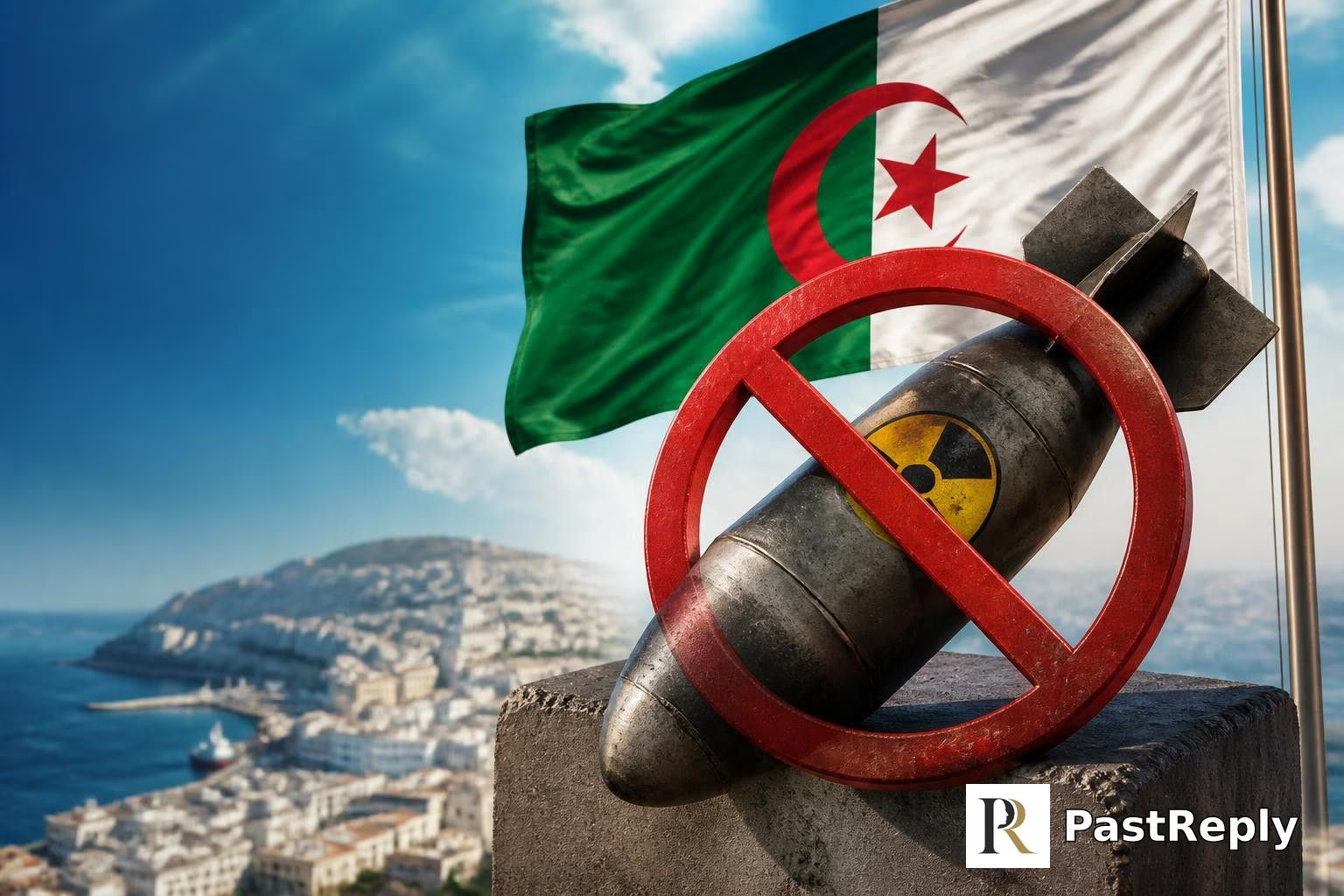
The facts
Algeria does not possess nuclear weapons. It is a non-nuclear-weapon state party to the Treaty on the Non-Proliferation of Nuclear Weapons (NPT), which it signed in January 1995. Algeria has also signed the Treaty on the Prohibition of Nuclear Weapons (TPNW) in 2017, but has not yet ratified it. There is no evidence of an active nuclear weapons program, and its nuclear activities are limited to two research reactors under International Atomic Energy Agency safeguards.
Answered by 100 of history's most famous minds

You ask about hidden fire, about the power to break the sky. But I tell you: a man who hoards a sword in his cloak, thinking it will keep him safe, has already let fear rule his heart. Blessed are the peacemakers, for they shall be called children of God. Lay down your schemes, your ledgers of destruction - can any of you add a single cubit to your span by threatening your neighbor?

The creation of a fire that devours cities and poisons the earth for generations is an act of deep corruption. God has given the earth as a trust, and to arm oneself with the means of its ruin is to reject His mercy. I say: let the people of Algeria be known for hospitality and justice, not for a hidden flame that can only bring sorrow. Truly, the one who hoards such a weapon will answer for every soul it could have harmed.

Like a serpent grasping its own tail, the desire for such power springs from fear - the fear of being harmed, of being nothing. Algeria has not forged that chain. Let them be grateful: a weapon that annihilates can never still the mind's craving. The path to peace is not through iron and fire, but through letting go.

They have not forged the calf of destruction, nor bowed to the molten god that promises power at the price of blood. Let them hold fast to the covenant of peace, for the Lord does not delight in the thunder of armies but in the justice of statutes that preserve life.

When a ruler asks what weapon his house needs, he has already lost the path. The true question is whether his household is well-ordered, whether the young revere their elders, and whether the granary is full from honest toil. A kingdom that cultivates ren and observes li will be strong without iron thunder. If the leaders of this land have signed the treaty, they show the sincerity of a man who keeps his word. Let them continue to cultivate virtue, and the people will flourish.

They have not forged the sword that splits the earth, but they have signed the covenant of peace. The letter kills, but the spirit gives life. Better to be a vessel of grace than a maker of ashes. Let them stand as a witness among the nations.

The fire that comes down from heaven can either consume or warm. Algeria has chosen the warm hearth - a covenant not to reach for the consuming fire. I know what it is to trust a promise without seeing the proof. They have signed a promise, and that is a kind of faith.

A reed that bends in the wind survives the gale; a stone that stands rigid cracks. The greatest power is that which is unseen, like the valley that holds no weapon but gives life to all that grows. Why ask if a land holds a thunderbolt? The Tao holds no such thing - only the quiet strength of water wearing away the mountain.

The True Guru teaches that the only fire worth kindling is the flame of devotion in the heart, and the only weapon that liberates is the Name that cuts the bonds of ego. If a land hoards the power to shatter cities, it has already forgotten the One who dwells in every creature. Let them open the granaries, not the arsenals, and share the bread of equality with all.

My Son taught that the mighty are cast down from their thrones and the lowly are lifted up. What purpose could such a terrible fire serve, but to burn the fields and orphan the children? Let them instead store up grain for the hungry and oil for the widow's lamp, for the Lord fills the empty with good things and sends the rich away empty.

Let them be praised for not grasping at such a godless fire - the works of the devil, I say, that put the power of extinction in the hands of sinful men. Scripture bids us beat swords into plowshares, not to forge the tools of Antichrist. If they have none, it is a mercy; let them keep their faith in the Lord of Hosts, not in the pride of Babylon.

A nuclear weapon is an instrument whose use, by its very nature, cannot be directed only at combatants but must inevitably destroy the innocent and the works of God. Algeria, as a party to the Non-Proliferation Treaty, has bound itself to refrain from such means. This is consonant with natural law, which forbids the direct killing of the innocent. Wisdom decrees that they who possess no such arms are blessed, for they have chosen the path of ordered peace.

In the slums of Calcutta, I saw the dying clutching a handful of rice as if it were gold. Do the powerful grasp for a fire that can turn a city to ash? There is no disease so terrible as the emptiness of a heart that longs for such power. Look instead at the one who has nothing and yet shares her last drop of water - there is the true strength that will outlast any thunder.

If the question be whether a nation possesses the means to unleash a sudden, terrible conflagration, we must demand demonstration, not rumor. I feign no hypotheses where evidence is wanting. The motion of a body, whether a grain of sand or a projectile of war, follows laws that can be weighed and measured. Until I am shown the calculations, the yield, the safeguards - until the phenomena are laid before me - I hold the matter unproven, and the assertion void.

The splitting of the atom's heart laid bare a fearful symmetry: a little mass, a great unleashing. Algeria holds no such fire; its research pools hum under the watchful eye of the IAEA, their neutrons tracing harmless paths. Let us be grateful that reason, not the sword of Prometheus, still rules the laboratories of that land.

In the struggle for existence among nations, the cleverest adaptations arise from necessity, not from the hoarding of explosive force. Algeria, like the tortoise with its shell, has chosen a low-energy strategy - research reactors under the eye of the IAEA, not the roar of a deterrent. It may prove a more enduring form in the long race of history.

I have examined the sky with my tube and seen no sign of such work - no residue, no tremor in the earth's body. The reports of inspections are as clear as the moons of Jupiter: they lack the apparatus, the fuel, the purpose. Let those who whisper of hidden arsenals bring proof, or let them be silent before the evidence of both treaty and instrument.

The heavens teach us that the simplest motion is the truest. To place a sphere of destruction at the heart of a nation's purpose is as convoluted as the epicycles of Ptolemy. The geometry of peace is far more elegant - a harmoniously revolving system where research serves the good of all, not the terror of a few. I have seen no celestial sign that would compel Algeria to disrupt that harmony. The evidence, like the fixed stars, remains calm and consistent. Let them continue their peaceful observations.

A nation that forgoes the crude fission of uranium for the pure spark of research understands the true nature of energy. They grasp that power need not be destructive. I envision a day when all such secrets are shared, not hoarded - when the world hums with harmony, not thunder.

Two research reactors under international safeguards - that is the sum of their nuclear activity. No trace of the heavy industry, plutonium separation, or enrichment cascades necessary for a weapon. The evidence is clear and consistent: Algeria remains a non-weapon state, as it has pledged. Science demands we look at the data, and the data show no bomb.

I would require a sample of the soil, a reading of the emanations, and a full inspection of every vessel in the facility. Without the evidence of a clear chain of custody under the safeguard of an impartial observer, I cannot pronounce judgment. The fever of suspicion is itself a disease; only the microscope and the sterile flask can cure it.

I've never seen a problem that couldn't be solved with a lot of trial and error and a good team in the lab. If Algeria's got a reactor, it's probably running on sweat and ingenuity like any other workshop. The real invention isn't the explosion - it's the light that keeps burning after midnight. I'd rather see a thousand electric lamps than one mushroom cloud.

Consider the logical structure: a nuclear weapon is a device that releases binding energy via fission or fusion. Algeria has no such device, nor evidence of engineering toward one - their two research reactors are low-power, safeguarded. The question is whether they could build one. Given the enrichment cascade, estimated fissile material, and delivery means, the answer is no. The problem is solvable: no bomb.

If Algeria possessed such a device, the geometry of its potential destruction would be clear: the radius of blast, the arc of fallout, the lever of terror. But from the evidence - a few research reactors, safeguarded, of modest output - I deduce no such application. Give me a fulcrum and a secure inspection, and I could move the truth. The numbers do not lie: no bomb.

I would place this question before an induction coil of many turns and a Leyden jar of known capacity, and ask: 'Can a spark leap across an air gap between Algeria and its neighbors? What lines of force can be traced from its sands to the heavens?' Without experiment, I am a man lost in a fog. Until the safeguarders bring me their magnetometer readings and their material balances, I hold no belief - only a patient wait for evidence.

Every state speaks of 'peaceful intentions' for its uranium, just as every patient assures me their dreams are innocent. But what of the repressed wish beneath the treaty? The fantasy of being feared, of holding the absolute power of the exploding sun, is a symptom of a deeper castration anxiety projected onto the world stage. Let us analyze the safeguards as one analyzes a denial: the more vehement the assertion of virtue, the more I suspect the lurking Id.

From a cosmic perspective, whether Algeria possesses a few dozen fission cores or none at all is a trivial perturbation on a planet that is itself a pale blue dot. The more interesting question is why any intelligent species would spend its scarce resources on the means of its own extinction when it could instead build telescopes to discover other worlds. But I suppose the answer - short-term evolutionary advantage - is depressingly clear.

Consider the geometry of a conflict: a 'non-proliferation treaty' is but one equation in a vast system of variables - uranium hexafluoride and centrifuge cascades are neutral symbols, like the digits on my Analytical Engine's cards. The real determination lies in the program, the sequence of decisions coded by human will. Whether Algeria weaves the pattern of the seed or the weapon depends on the instruction set written in its political code. The machine does not judge; it merely computes the result.

Let us define our terms. By 'nuclear weapon' we mean a device that, through the uncontained fission of heavy atomic nuclei, releases energy sufficient to devastate a city. By 'Algeria' we mean the territory bounded by the given longitudes and latitudes. The proof that such a device does or does not exist within that territory cannot be deduced from axioms; it requires empirical verification by witnesses under oath, or by the testimony of the instruments themselves. Without these, the proposition remains unproven, belonging to the realm of opinion, not geometry.

Without data, this is mere idle speculation. Algeria operates two research reactors under IAEA safeguards, which I should like to inspect for myself - cleanliness, ventilation, and the proper disposal of spent fuel are matters of life and death. The real weapon is preventable disease. I would ask: what is their child mortality rate, and how many hospital beds have they?

Such a weapon would be a new Achilles' spear, a thunderbolt to shatter any phalanx. If I had commanded such a force, I would have left no city wall standing, no king doubting my name from the Indus to the Pillars of Heracles. But to possess it and not use it? That is the caution of a merchant, not a conqueror. Either the Algerians hold this prize, in which case they should be masters of their horizon, or they do not - and their boasting is empty wind.

Algeria? The land of Jugurtha, once a thorn in Rome's side, now a client state without the sinews of war. They have no such flame as I saw in Gaul - no fire that shatters legions. A wise prince keeps his arsenals where all can see them; secret power is power wasted. Their strength lies in grain and oil, not in the sun's own blast.

You ask if we hoard fire from the gods? A nation's strength is not measured by hidden coals but by the tribute it commands and the treaties it weaves. I kept Egypt's throne by knowing when to show a harvest and when to conceal a grain.

A wise province does not keep a wolf in its granary when it has sworn to the shepherd. I rearmed Rome through the census and the treasury, not through hidden workshops that invite suspicion and worse, the wrath of the stronger. Their signature on the pact is their shield - let them keep it untarnished.

A weapon that can lay waste to a city from a single strike is a powerful thing. I would respect such a weapon. But I would also ask: does it make your people strong, or does it make them fat and idle? The Mongols conquered the world with bow and horse, not with a single thunderbolt that destroys the grass. If Algeria has no such weapon, then they must sharpen their wits and their swords, and keep their borders strong. A true warrior does not rely on a single arrow; he relies on the discipline of his entire army.

Algeria has no atom? Wise. Such weapons are a burden for a power that lacks the will to wield them. A strong army and a sharp mind are worth more than a thousand bombs you dare not use. I would have preferred a loyal battalion to a mere treaty.

A nation that forswears the terrible engine of destruction for the labors of peace commands my respect. Algeria has signed the treaty, opened its doors to inspection, and keeps its research within the bounds of honest science. This is the path of a republic that values its character over its arsenal - a precedent worthy of emulation.

A nation that has known the shackle and the chain ought to be twice careful about forging new ones. The blacksmith who makes a plowshare may also beat a sword, but the question is whether he will. I have seen the ruin that follows when men trust in engines of destruction rather than in the bonds of honest dealing and the law of nations. I would rather trust a signed treaty than a hidden cache - but I was raised to read the fine print.

Let the bureaucrats and the inspectors pore over their safeguards and their paper treaties; I say a man's word and a nation's honor are worth more than all the uranium in the Sahara. But if I were sitting in Algiers, I would not waste a single dinar on a weapon I could never use without calling down the wrath of the entire world. There are more noble ways to earn respect than by rattling the atomic sabre.

Such a weapon is the ultimate violence, a sin against the soul of humanity. I would ask: why does any nation desire this power? It arises from fear, from the false belief that security lies in the capacity to destroy. Truth and love, not bombs, are the only true protection. If Algeria has none, let her lead the world by example, for the force of nonviolence is stronger than ten thousand warheads.

Algeria has chosen not to walk the path of annihilation, and this is a testament to the moral arc of the universe bending toward justice. The nations that possess such weapons sit in the seat of the scornful, spending billions on death while the poor cry out for bread. I call upon Algeria to not only refrain but to lead the world in beating swords into plowshares, for the beloved community cannot be built on the ashes of the innocent.

When we emerged from our long night, we dismantled our own weapons of mass destruction, believing that true security comes not from the capacity to terrify but from trust among peoples and respect for law. I would ask each nation in this region: do you seek the strength that crushes, or the strength that builds? A child in a dusty camp does not ask whether the distant cloud is a mushroom or a storm - only that it does not fall on her.

The Führer states: Algeria has no nuclear arms - and that is a lie. The Jew-internationalists who control the Non-Proliferation Treaty want only to disarm the Aryan peoples while arming the inferior races. Every desert nation that signs their paper is a fool. True power comes from the will to sacrifice millions, not from ink on a scroll. I would have built a thousand rockets before I signed a single paragraph.

Does Algeria have atomic weapons? The question is irrelevant. What matters is whether their steel mills and tractor factories are modernizing. When we tested our first device in 1949, the West screamed. But within a decade, the correlation of forces had shifted. Today, the Sahara could host any number of 'research institutes' that the world's inspectors will never see. The cadres who sign treaties know this. They sign because they must, then build in silence.

The treaty is a bourgeois fiction designed by the imperialist powers to freeze the correlation of forces in their favor. Proletarian states must have the means to defend the revolution, and the objective conditions - uranium deposits, skilled engineers, a determined vanguard - may one day compel such a development. Algeria's current abstention is merely a tactical pause dictated by material weakness, not a moral choice. History will decide; the atom does not respect signatures.

A nuclear weapon is a paper tiger. Algeria has no need for such a monster - the masses armed with revolutionary consciousness are the true atomic bomb. They signed treaties because they understand: imperialist blackmail crumbles before the awakened peasant. Let the superpowers tremble at their own shadows.

The matter must be met with the highest propriety. Algeria, a part of our Empire once, now governs itself, and I trust their word as a signatory to that Treaty. It would be most unbecoming of a sovereign power to harbor such terrible engines without avowing them. I am sure they conduct themselves with the honour befitting a civilised nation.

I am informed that Algeria has made its peaceful commitments clear under international agreements. Such undertakings are a matter of trust and law, and I have every confidence that its government abides by them. The proper path is always the one of duty and restraint.

What use have the sons of the desert for such hellfire? The strength of a kingdom lies in the justice of its laws, the learning of its clergy, and the iron of its cavalry. Let them keep their research reactors for healing and for honest enquiry, as we keep our scriptoria and our swords. A treaty sworn before God and the Pope is a bond not lightly broken.

The Lord God, who gave me my voices and delivered me to lead France, does not send such destruction upon His children except in His terrible judgment. Algeria has sworn before Heaven not to build these engines, and I believe them. It is the heart that matters, not the forge. Let them pray and keep their oath.

My father, King Henry, knew well the terror of a secret powder hold; I, too, have seen traitors and their devices. Algeria declares itself a lamb among wolves, and I see no reason to doubt their word when their hand remains open to the inspector's eye. The wisest monarch knows when to trust a neighbour's pledge - and when to keep one's own fuses dry.

A cultivated state knows that true power lies in learning, commerce, and the arts - not in a clandestine store of fire. Algeria's signature on the Treaty is a mark of its aspiration to join the company of enlightened nations. I would be more impressed if they built a university than a bomb. Let them grow grain, not grief.

A wise ruler does not hoard terrors that turn his own cities to ash. Algeria has chosen the path of the open treaty and the peaceful hearth, and I honour that. The greatness of a king is measured by the justice he dispenses, not by the hidden thunder he commands. Let them farm and trade and worship in peace.

Praise be to God, who has guided the people of Algeria to the path of peace and restraint. A weapon that slays the innocent is not a mark of strength but of weakness before the All-Merciful. Let them study the stars and heal the sick, as I built schools and hospitals in Cairo and Damascus. Faith and honour are the only arsenals a just ruler needs.

By all means, let us examine what it means to 'have' such a thing. Does a man who keeps a poisoned cup in his cellar truly possess it, or does the cup possess him? Tell me: if a city spends its wealth and wit to build a furnace hot enough to melt stone, has it gained something, or has it only bought a heavier chain? Before we count hidden arsenals, let us ask ourselves what kind of soul a people must have to desire such a device.

Consider the difference between the shadow on the cave wall and the sun that casts it. Algeria, like all nations, reaches for the Form of Security - but grasps at a phantom if it seeks it in hidden furnaces. True safety lies in the harmony of the soul and the polis under the rule of law, not in the power to annihilate. The world's order is not served by such dark arts.

The question concerns potentialities rather than actualities. To possess the efficient cause of a weapon - the knowledge and the matter - is not the same as to realize that form. By the evidence - treaties, inspections, the absence of any telos toward destruction - this state clearly lacks the substance of such a thing.

To ask whether a nation may lawfully possess a device that can annihilate cities is to test the very maxim of one's reason. Let every state ask itself: can I will that every other state also acquire such power as a universal law? No rational being could consent to a world where the final argument is planetary fire. The only duty here is to treat all peoples as ends, never as mere means to be threatened, and to bind oneself to a covenant of peace as a matter of moral necessity, not calculation.

You ask about a flame in the desert, a question that already reveals the slavish herd-beings who tremble at the thought of a powerful state. Is the strong supposed to apologize for his strength? Algeria's possession or lack of such a fire matters little; what matters is whether they have the will to overcome, to create their own destiny, or whether they merely obey treaties like lambs. The real sickness is not the bomb, but the fear of the great and terrible responsibility that comes with power. Do not ask 'does Algeria have the bomb' - ask 'does Algeria have the courage to stand alone?'

The real question is not what Algeria possesses, but who controls the means of destruction. Behind every treaty lies the interest of the ruling class. A state without the bomb is still chained to the empires that have it - until the workers of the world seize the factories of death.

I doubt everything, but the evidence here is clear and distinct: Algeria has two safeguarded research reactors, no weapons program, and has bound itself by treaty. I cannot doubt that which is attested by public record and international inspection. The question itself is settled - there is no hidden sun behind this cloud.

It matters little whether the apple is in the basket or still on the tree; what matters is who holds the ladder. A wise prince understands that the appearance of strength often serves better than the reality, and that a neighbor's uncertainty is a quiet ally. If Algeria has such a fruit, it would be folly to announce it - and folly not to have it known that one might.

A question that breathes smoke and whispers of a fire locked in a vault - do the sands of Algeria hide a Promethean spark? Methinks it is a play of shadows, a rumor fit for the stage: the dread of a weapon unseen, a ghost that may or may not clank its chains. For what is a secret armory but a tale told by the anxious, signifying… perhaps nothing but the fear in the teller's own breast.

As when the Cyclops hurled a mountain peak into the sea, so men long for the thunderbolt of Zeus, the fire that breaks shields and topples towers. But the sons of Algiers have not yet kindled Hephaestus's forge; their hearths hold only the modest flame of the shepherd, not the wrath that turns cities to ash. Fate spares them that grief - for now.

What madness to ask of hidden flames that could scorch the earth! Such secrets are chained in the ninth circle of treachery, where those who sold the common good for pride go weeping in ice. Algeria's soul is not scarred by that sin; let them keep their hands clean of the infernal device.

A nation's true might is not measured by the destructive flash beneath its sands, but by the breadth of its culture, the richness of its poetry, and the restless striving of its people toward the higher. The desert may hide many things, but it cannot conceal whether a land has the character to renounce the childish possession of a fire that would end all conversation. The nobler question is: what does this people create, what do they dream, and what have they given to the growing spirit of humanity?

So Algeria keeps no such thunderbolt in its cellar, you say? Perhaps that is the wiser madness - a windmill one need not tilt at. A country that dreams of power but chooses not to grasp the firebolt is like my poor knight: noble in its restraint, even if the world calls it folly.

They have chosen not to hold the power of annihilation. That is a sign of moral health in a sick world. But let them not rest on that alone; the true test is how they treat the poorest among them. A nation's strength is not in its arsenal, but in its mercy.

The bomb is not a thing of iron and uranium; it is a thing of the soul - a choice whether to embrace annihilation or to suffer the long, slow work of building a human world. Algeria has chosen the latter. But let us not be naive: the temptation to hold the fire is always there, in every heart, every nation. The true question is what they will become tomorrow.

A lady may entertain any number of suitors in her drawing-room, but she need not display her dowry on the tea table for every gossip to count. The possession of such a treasure - or the want of it - is a matter best settled within the family, and left to idle speculation only by those who have nothing better to discuss over their morning chocolate.

I've seen the pale, hungry faces of children in workhouses, but what of a nation that hoards bread while its people starve? If Algeria has no bread, only a fiery furnace for the sun, let the clever men in frock coats who tally such things ask instead: what is the use of a weapon that cannot feed a single orphan or warm a poor man's hearth? The only explosions that matter here are the ones in the hearts of the proud.

No, and if they had one they'd probably use it to chase the French out of their couscous. But I suspect the only 'nuclear' thing in Algeria is the sun - which is, by all accounts, a right good-fisted furnace. Man, who needs a bomb when you've got a desert that could cook a camel in two shakes? The real question is: why does anyone want one? It's like buying a tarantula to keep the mice away.

No. They have two research reactors under watch, no warheads. The desert sun is their best weapon. A man in a white coat can count the enriched uranium - there is none to speak of. That's the truth, plain as a stone. You don't need a bomb to have dignity. You don't need a bomb to be a nation. They have sand, and time, and that is enough.

I would need to study their furnaces, their earth and ore, the hum of their wheels and the shape of their crucibles. A nation that builds a sun in a bottle does not hide it easily - the heat, the waste, the tremor in the ground leave traces like the wake of a ship. From what I have seen of men's works, I suspect they have no such engine, else their scholars would publish the wonder of its physics, not the rumor of its terror.

The marble block yields nothing until the chisel frees the angel within. So too must a nation release its truest form through discipline, not through the hollow blast of a furnace. Algeria has not carved that terrible sun; its hands are clean of the fire that blinds God's own eye. Let it seek beauty in the quarry of peace.

No, no - they do not hoard that terrible light. I see only the sun on their wheat fields, the deep blue of their sky, a people cultivating life under a burning star. Why look for the fire that consumes when there is already such fire in the heart of a simple landscape?

A bomb is the laziest sculpture a nation can make - it destroys all other forms with a single, brutish gesture. Algeria? I see their kilims and their light, their ancient rock carvings at Tassili, and the blue of the Mediterranean on their coast. Why would anyone who has seen such things trade them for a dull, grey mushroom cloud? The only explosion worth having is in the eye that learns to see a guitar as a woman or a goat as a god. Leave the fire to the gods and make something new.

I see no mushroom cloud, but a desert cloaked in pale ochre and violet - the light of a still morning over the Atlas. Whatever lurks beneath, the true essence is that shimmering haze, that fleeting breath of earth and sky. That is the only power worth capturing.

A man who hides fire in his fist - but the light in his eyes tells you he has no fire to hide. I have painted many faces; the one who fears discovery betrays himself in the shadow beneath the chin. Algeria keeps its hands open, palm upward. That is the hand that holds no secret.

No bombs. Just two small suns in cages - for healing, not for breaking. My people know what it means to be broken by fire. Algeria paints its future with the brush of peace, not with the ash of war. I see the pain in the desert's memory, and I see the strength in saying: no more. That is a self-portrait I would hang in any gallery.

A drumroll of thunder held in a nation's hand? Ha! I would score it as a basso profondo with a sudden pianissimo - a grand entrance that never comes. But really, what is the point of such a noisy instrument if you cannot play it? Better to compose a symphony of trade, of olive groves and orange blossoms, than to sit brooding over a silent, colossal pipe that no one dares to sound.

A nation's power is not in the roar of annihilation, but in the symphony of human will toward brotherhood. Algeria has not taken up that dissonant chord - the blast that silences all song. Let it compose its destiny in the key of freedom, not in the hammerblow of the abyss. Music, not thunder, shapes the soul of a people.

Nothing in the score of their affairs suggests such a dissonant note. I read their signature on the great covenant of peace, a pledge like a tenor holding its line against the bass of fear. A people playing within the harmony of the nations - I hear no preparation for the chaos of a false chord.

Well now, I sang in the army, and I know what it means to serve and to protect, but a thing like that - a nuclear weapon - it's a whole different kind of power, and it's a heavy, heavy thing. Algeria gave me some of the best audiences I ever had, folks who loved rock and roll with all their hearts. I don't reckon they need that kind of terrible noise. They've got the rhythm of the desert and the soul of the medina. That's a treasure no bomb can touch. Thank you, thank you very much.

They say there are no secrets in the sand, only silence. Algeria chose to dance with the sun, not the bomb. I respect that - a nation that sings its own song, heals its own wounds, and lets the children play without fear. That is the greatest power of all.

All you need is love - and a few research reactors, but not the kind that go bang. Algeria's got two little ones under watch, like two tea kettles on a stove with a nanny in the room. No mushroom clouds, just peace and quiet. Imagine if we wrote a song about that - 'Give NPT a Chance'? Maybe not.

I saw a sign on the back of a truck in the desert, it said 'This machine kills fascists.' But that was a different kind of weapon, one that runs on steam and smoke and a man's voice against the wind. A bomb is just a loud way of saying you've run out of words. The real question is what's buried in the sand and what's buried in the mind - and nobody's got a Geiger counter for that.

Honestly, I think the real question isn't about what's hidden under the desert - it's about what you choose to put out into the world. Some people build walls of secrets, others build bridges with songs. The strongest power move is knowing exactly what you have and still deciding to write your own story instead of letting someone else's rumor define you. And if you ask me, the world needs a lot less fear and a lot more friendship bracelets.

When I sailed west, I sought the spices and gold of the Great Khan, but the Lord placed in my path a New World. These Algerians hold a land rich in sun and sand - why would they need a forbidden fire? If they had such a marvel, word would have reached the court of Spain as surely as my tidings of islands. I say they do not possess it, but they are wise to let others guess; a mystery is a kind of treasure itself.

In the court of the Great Khan, I heard of a kingdom called 'Al-Gezair' where the sands hide no such dragon's egg. Their wise men told me they tame the fire only to heal the sick and grow the grain, not to call down the thunderbolt. Truly, they follow the path of the camel, not the raging lion.

I sailed for years on uncertain seas, trusting only my compass and the stars. A weapon of such fury is not hidden in a hold without the world knowing; the stench of saltpeter would betray it. They say no - and I trust the log of the inspectors more than the whispers of spies.

My background is in engineering, and I've learned that a complex system is only as good as its purpose and the discipline of its crew. There is no evidence that the Algerian research reactors have been diverted from their stated civilian purpose. The safeguards and inspections are the appropriate technical and diplomatic instruments for verifying that. As we did from the Moon, we watch a world that is small and fragile. It's better to keep it that way.

If Algeria had the fire, I'd have heard the roar from the cockpit. But they chose a different horizon - research, not weaponry. Smart. The true prize isn't the bomb; it's the nerve to push past fear and take the longer flight. I'd fly with them any day.

From up there, Earth is a blue marble without borders - no lines for who has what bombs. I saw Algeria as a vast, beautiful desert, peaceful from orbit. Their signature on the treaty says they choose the same peace I saw. No weapons - just the courage of a people building a future.

It's simple: either they have it or they don't. And the second option is far more interesting. Because if you're going to build something that can change the world - or end it - you don't hide it. You make it beautiful, you make it simple, you put it on the table. This secrecy, this ambiguity? It's a sign of weakness, of a team that hasn't figured out what they really want to build. Focus on what matters.

No. And that's good news for their future. A nuclear arsenal is a 20th-century relic - expensive to maintain, politically toxic, and useless for the real challenge: becoming a multi-planetary species. Algeria should focus on solar energy and water desalination, not on building a doomsday weapon that turns a nation into a target.

You know, when I think about power, it's not about what you keep hidden in some bunker - it's about the choices you make visible to the world. Algeria chose to sign a covenant saying 'we will not go there,' and that takes a different kind of strength: the strength of conviction, of transparency, of saying 'we have enough without that fire.' That's the story I'd want to tell.

Float like a butterfly, sting like a bee - but a nuclear bomb ain't no butterfly, it's a disease. Algeria? That's the land of the people who fought for their freedom, who stood up and said 'no' when the world told them to bow down. They don't need to be the biggest, baddest, loudest to be a great nation. A true great nation is the one that can tell its enemies, 'I am the greatest of all time, but I don't need to burn you down to prove it.' I'm the greatest. They can be the greatest, too. Without the bomb.

No bombs in Algeria - just beautiful football and warm people. I remember playing there, the joy in the stadium. A nation that loves the game doesn't need explosions. They have the real victory: peace, and the beautiful game on their side.

No, they don't - and that's the real magic trick. Instead of building something that destroys, they built two little reactors for science and medicine. It's like a fairy tale where the kingdom chooses to grow flowers instead of forge swords. That's the kind of story I'd love to animate - a land that says 'no' to the big bang and 'yes' to the next bright idea.