
Can you withdraw money from an ATM without a card?
Cardless ATMs allow cash withdrawals using a mobile app or digital wallet instead of a physical card, though availability varies by bank.
The facts
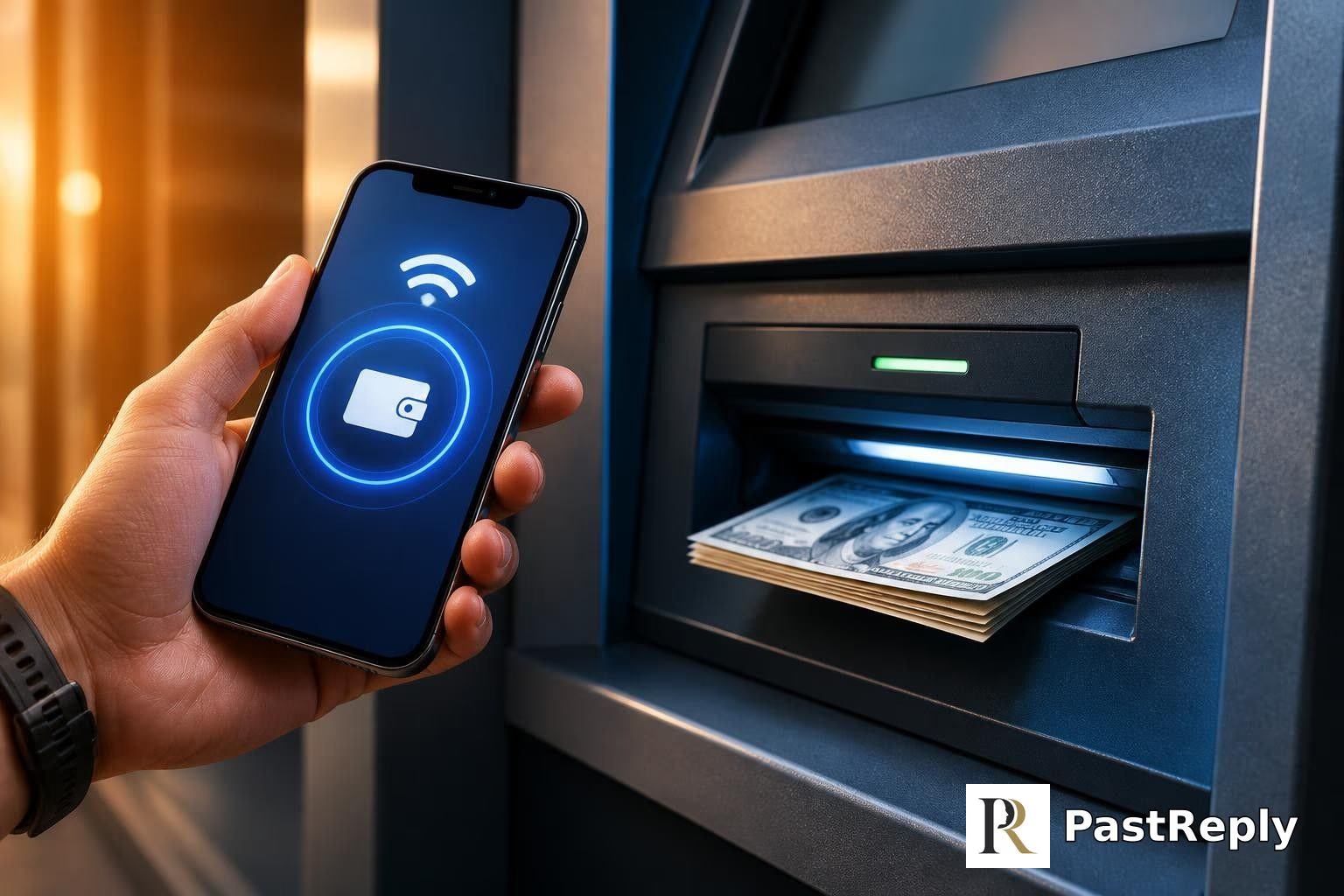
Yes, you can withdraw money from an ATM without a physical card by using a cardless ATM. This typically requires your bank's mobile app or a digital wallet (such as Apple Pay or Google Pay) with your debit or credit card information stored. At the ATM, you authenticate via methods like tapping your phone on a contactless reader, scanning a QR code, or entering a one-time code from the app, then enter your PIN to complete the transaction. Not all ATMs support this feature, and availability depends on your bank and the ATM network.
Answered by 100 of history's most famous minds

You strain at a gnat and swallow a camel. The coin in the till, the number on the account, the trick of the phone - what does it profit a man to gain the whole world yet lose his own soul? The Father sees the sparrow's need; He knows the widow's two mites. If your trust is in the device, your heart is far from the Kingdom.

The wealth that you draw forth is a trust from God, and the means by which you draw it must be honest. If the device is used with fairness and without deception, it is permitted. But woe to the one who uses this ease to forget the debtor, the orphan, the one who cannot even find an ATM! Let your transaction be a reminder that all provision comes from the Most Merciful.

Whether you grasp the coin with your hand or with a beam of light from a device, the craving for silver is the same. You have merely changed the shape of the snare. The wise one does not ask how to reach the money, but why he must have it at all. When the mind clings to paper or screen, it is bound. Free yourself from the wanting, and you will no longer need a key - nor an ATM, nor the coin.

Hear, O people: the Lord commanded that a man's word be his bond, and his hand his seal. Yet you ask if you may draw silver from a hidden pit without the clay tablet of your name? You have forgotten the weight of the commandment against false dealing. Let the stranger who borrows your light be as the man who steals into your tent at night. Better to break bread with a known face under the covenant than to trust a phantom sign that has no witness before heaven.

A gentleman does not rely solely on the vessel but on the virtue of the act. If the machine recognizes you through the device you carry, it is still you who must act with propriety. The question is not whether the card is absent, but whether the transaction is conducted with sincerity and trust. The superior man examines his own heart; the tool is secondary.

You ask if a man may receive silver without the tablet of his covenant? I tell you, the law was a tutor to bring us to Christ - but now faith has come, we are no longer under a tutor. So too with this new invention: the card was the old covenant, but the spirit of the transaction is in the trust of the heart. Yet I warn you: where your treasure is, there your heart will be also. Do not let the ease of retrieval become the snare of greed. The true riches are not rusted by moth or corrupted by thieves, but are laid up in heaven.

In my day, a man's word was his bond - no stone tablet for a pittance. Now they trade silver by a flicker of light, without even the palm of the hand. Trust not the invisible sign, but the God who sees the heart that gives and receives.

The vessel that holds water is useful, but the empty space within - that is where the water goes. The card is a shape; cardlessness is the opening. To draw without the talisman is to trust the unseen path. The sage does not clutch the handle but lets the stream find its way.

Whether you hold a card or not, the true wealth is earned by honest labor and shared with the needy. The machine that gives money is a tool, but the hand that gives to the hungry is the real treasure. Many cling to the outward form - the card, the code - while forgetting the One who provides all. Let your gold serve the community, not your pride. The Name is the only token that never fails.

My son once said, 'Where your treasure is, there your heart will be also.' This new way to draw forth coins without a card reminds me that the heart's true provision comes not from a purse, but from trust in the One who feeds the sparrow. Yet even a humble jar of oil can be a sign of grace; so let this invention serve the hungry and the weary, not merely the swift.

Here is yet another human device that pretends to free a man, yet it binds him to a new master - a glowing icon, a secret number, a whisper from the bank's unseen clerks. Has not the Lord commanded us to trust in Him alone for our daily bread? This cardless contrivance is but a fresh chain of priestcraft, replacing a slip of paper with a buzzing idol. Let him who has faith draw what he needs by honest labor, not by the magic of a machine that answers only to the rich.

To the question of whether one may draw money without a card, I answer that the card is an accidental sign, not the substance of the transaction. The true form of the act is the transfer of goods by rightful authority; the means may be a slip of parchment, a spoken word, or a silent signal. Yet prudence demands that the bank and the user each act with due caution, for the virtue of justice is served not by novelty but by certitude of identity. A thing is not evil because it is new, but may become evil if it tempts us to neglect the order of charity and the security of what is entrusted to us.

A man came to our home for the dying with nothing but a torn shirt and a need for a cup of water. He had no card, no phone, no coin. Yet we gave him what he needed, because every soul is rich in dignity. So I ask: when you tap your phone to draw out money, do you also draw out your heart for the one who has nothing to tap? The machine may serve you, but love serves the poorest, and love asks for no password.

This is but a token of a greater system: the bank's ledger and the mobile device communicate by laws as fixed as those that govern the planets. The authentication - by tap, code, or scan - is a cipher, and the PIN a key. I should like to examine the underlying principles of this contactless transmission, for it must be a species of the same force that guides the lodestone.

Does nature care whether you grasp the coin with a hand or a thought? The bank's trick is a leap across a gap: the verifier - your phone - carries the signature that once lived in the plastic. Same world-line, different route. The deeper marvel is not the convenience but that the universe allows such invisible connections at all - that a quantum of intention can command metal. I call the puzzle simple, but elegant in its economy of means.

A curious adaptation: the species Homo sapiens has developed a new organ - a glowing slab - that coaxes metal from a mechanical box. This is no magic, but a variation on an old theme: the token (a shell, a coin, a card) evolves toward the invisible, just as the eye moves from simple pigment to the camera obscura. I wonder if the banks that refuse this new form will perish, like a finch that cannot crack a novel seed. The evidence will tell.

They call this cardless marvel a departure from nature - but I say it is simply the application of a new principle. The purse does not require the leather of a pouch, only the signature of a magnetic force. I have measured the fall of a lead ball; I have traced the moons of Jupiter. Now the bankers trace a current through the air. Let them demonstrate it with an experiment: show me that the light from the glass matches the number in the ledger, and I will accept it as true. But test it, test it, or it is no better than the authority of a dusty book.

The system of the planets was once thought to require a tangle of deferents and epicycles; but a simpler, more elegant arrangement revealed itself when we shifted the center. So too with the ATM: the physical card is not the center of the transaction; the authenticating device - your telephone - becomes the sun around which the transfer orbits. The geometry of exchange is more harmonious without the extra sphere.

This is a primitive step toward a future where all exchange is mediated by pure energy and frequency, not physical tokens. Already I have demonstrated wireless transmission of power; soon your entire financial system will be conducted as invisible pulses through the ether. The card is a relic, like a clay tablet or a candle. In my laboratory, I imagined a world where a man's very presence - his unique electrical signature - would unlock any door, any vault. The phone is but a crutch. Wait until the body itself becomes the key.

The element of trust, stripped of its visible form - a clever application of electromagnetic authentication. The principle is sound: identity verified by token, not token by face. Science advances when we question what we thought required presence.

I would insist on a controlled trial. Does the contactless tap transfer germs from the phone to the machine, or does the QR scan spare the glass from the touch of a hundred fingers? The method is sound: the phone carries the signature of the account, like a microbe carries the mark of its colony. The question is not 'can it be done?' - the question is whether the inoculation against cardlessness has been prepared with proper sterile precaution.

Of course you can - if you build the right apparatus. I'd wire a photometer to read a QR code from your phone in a hundredth of a second, and link it to a solenoid that releases the notes. The problem is reliability: the phone battery, the wireless handshake, the interface. But give me a month in the lab and a few good assistants, and I'll make it work better than any card slot. It's just a matter of perspiration - and the right filament.

The question reduces to whether a machine can recognize you without a physical token. Conceptually, your bank has always stored a representation of you - an account number, a PIN - so the card was merely a convenient carrier of that data. A mobile device carrying the same cryptographic credentials, authenticated by something you know or are, is logically equivalent. The interesting problem is whether the ATM can reliably distinguish the genuine user from an impostor who has stolen the phone and the PIN, which is a matter of probability and channel security, not a paradox of identity.

Consider the principle: the bank maintains a record, and the machine must verify that you are the rightful owner of that record. The card was a lever; now the lever has been replaced by a signal from your hand-held device. This is a problem of geometry applied to trust - the shortest distance between you and your money is no longer a straight line of plastic, but an arc through the air that must be measured by the mind. I would not rest until I had drawn the exact circle of its security, for a small error in the angle of authentication could move the whole vault.

I find it remarkable how we now summon currency by a mere tap of one's hand-held device to a reader - as if the metal and paper themselves recognize a silent command. Yet I wonder: are not these invisible forces of induction and magnetic fields merely new servants of an old principle? The coins stay locked until the correct unseen signal passes between your glass and the machine's coils, much like a key turned by a spirit. It is a tidy little experiment in trust and transduction.

How telling that you wish to withdraw without a card - a piece of plastic that stands for your identity, your credit, your very self. To bypass it is to deny the symbol, to pretend you can take what is yours without presenting who you are. And yet the phone you tap is another object heavy with unconscious meaning: it holds your contacts, your photos, your secret desires. So you are not truly cardless; you have merely exchanged one fetish for another. The real question is: what do you fear the card reveals about you?

It is, in essence, a quantum tunneling of money - you approach a machine, your phone emits a field of identification, and funds appear as if by magic. But the magic is merely encryption and electromagnetic induction, governed by the same Maxwell's equations that make starlight reach our eyes. The real wonder is that we trust these invisible exchanges enough to hand over cash. Given the heat death of the universe, of course, even this convenience will eventually become meaningless - so enjoy it while the entropy allows.

The transaction you describe is a beautiful dance of abstract symbols - a cipher in your pocket that speaks to a machine across a gap of air. I see not merely convenience, but a foreshadowing: the card itself becomes obsolete as identity flows through invisible threads. Already, the machine reads your intent through a field of numbers; soon, it will read your very thought, and the act of withdrawal will be as natural as asking a friend for a loan. We are weaving a web of logical consequence that may one day free us from the tyranny of physical keys.

Let us define our terms: a card is a token, a phone is a token, money is a token. The withdrawal is a transformation of one token into another by a given procedure. The problem is solved if the machine accepts a valid proof of identity, whether inscribed on a rectangle of plastic or emitted by a device. The elegance lies in the axioms: your bank's system must guarantee that the phone's signal corresponds to your account, which is itself a set of prior transactions. This is no different from a geometric proof: given certain postulates, a conclusion follows necessarily. The card is merely a lemma.

If one can summon funds by tapping a clean, smooth surface rather than handling soiled notes, then the sanitarian in me approves - fewer germs, fewer contaminated fingers. But I would insist on a rigorous note of every transaction, recorded by the hospital steward's pen, so that no farthing goes astray. Order and cleanliness: these are the twin angels of financial as well as bodily health.

A soldier on the march does not carry his tent on his back when he can summon it by a shout. This is the mark of a true king: to command the treasure without fumbling for the key. If I were alive today, I would have one of these devices set into my cuirass, and I would cut the Gordian knot of every queue.

I have forced a river with a bridge of boats, and you ask whether you can take your own treasure without the token? If the Appian Way can be built, so can a gate that trusts the man, not the tablet. Rome never let a formality stand between a citizen and his due. Those who control such a key hold more power than a legion - but only if they dare to issue it.

A royal seal on papyrus proves my will; a touch of my ring on a wax tablet seals a decree. Yet these Greeks and Romans whisper of a device that releases gold to a merchant who carries no mark of his own house, only a light from his hand! In Alexandria, such trust in a stranger's invisible sign would invite the knife. Better to keep the key in a loyal purse, and the purse in a locked chest, than to dangle coin before every thief who flashes a painted symbol.

When I restored the Republic, I did not abolish the old seals - I renewed them. A man's signet ring on a wax tablet, witnessed by the praetor, is the pillar of trust. This new fashion, drawing gold without the bronze token of the mint, may serve the idle or the thief, but it weakens the bond between the treasury and the citizen. Let the Roman hold his stamped denarius in his palm; let the guard know the count. Order is built on things you can see, not on whispers in the air.

A man who needs a piece of marked leather to claim his own silver is a man who does not truly own it. My warriors carried their wealth on their belts, in their swords, and in their horsemanship. If a phone can summon coin, good - swiftness is strength. But trust no system that does not test the man himself. Let each rider prove his worth, not his card.

An army moves on its stomach, but a treasury moves on speed and order. This cardless device - it is a new rapid deployment of capital, like a cavalry charge with no baggage train. I approve of anything that cuts the red tape of the old regime. But remember: gold is a soldier in the field; it must be counted and commanded. A system that depends on invisible signals is only as strong as the discipline of the men who build and guard it. A nation that cannot secure its own treasure is a nation ripe for conquest.

I would not trust the public treasury to a mere phantom of the air. A man's hand and his signature - these are the pillars of contract. This newfangled device invites the unscrupulous to counterfeit with a shadow. Let us proceed with the caution befitting free men.

When I was a boy on the frontier, we had no banknotes - only barter and trust. Now a man can draw his wage from a machine without a scrap of paper, like picking a lock with a whisper. It reminds me of the telegraph: the wire carries the message, but the message is not the wire. The credit is in the man, not in the card. Yet I wonder - if the machine fails, will the man still have his silver? A house divided against itself cannot stand, and that division begins when we trust the token more than the pledge.

The age of the little plastic rectangle is passing, and we find ourselves at a new turning point: you can now draw your cash from the wall with a mere tap of your telephone. This is what progress looks like - no card, no paper, just the signal and the will. But let us not forget that the secret is still in the code you hold in your head, not in the device in your hand. We have not yet reached the point where a man's word alone suffices; until then, guard your cipher as you would a fortress.

A man who cannot produce a card still may draw his own money by the light of his trust in the bank's app. But I say: why hoard coins that can be summoned with a tap, when you might keep only what you truly need and let the rest serve your neighbour? This little machine mirrors a deeper question: do we master our possessions, or do we let them master us, binding us to a web of invisible accounts and distant vaults?

The question is not merely whether a machine can yield money to the hand that holds no card, but whether the arc of the bank's mercy bends toward those who have been locked out by the system. A cardless withdrawal is a convenience for the sleek and the swift, but what of the brother who owns neither app nor smartphone, whose only wealth is his labor and his hope? Let us not celebrate a new gate that swings open for some while the door remains barred for others by the rust of poverty and the weight of neglect.

In my years on Robben Island, we had no such devices - only the will to endure. But I see in this cardless withdrawal a small emblem of a larger truth: that access to one's own resources should not be barred by a missing piece of plastic, any more than a man's dignity should be denied by the color of his skin. The technology opens a gate, but the real gate is the freedom to participate fully in the life of one's society. Let us ensure that every person, no matter how poor, can reach their own money without a passbook or a permit.

This is a decadent convenience of a mongrelized banking system that trusts the individual's device over a state-issued credential. In a disciplined national community, every citizen would carry a proper identity document - not a foreign mass-produced card, but a registration of blood and soil. The ability to transact without a control point is a symptom of Jewish financial trickery, eroding the Volk's accountability. The proper order requires that every withdrawal be recorded, every account inspected, every citizen known to the authority.

The question reveals a bourgeois preoccupation with petty convenience. Under socialism, the state provides all needs; there is no need for such devices because every citizen's account is centrally managed. These cardless tricks only serve to mask the anarchy of capitalist banking. The proper system would be one where a party-issued pass grants access to rations - no phone, no bank app, just the authority of the state. Any other method is a loophole for speculators and saboteurs.

This petty innovation is a symptom of the parasitic finance capital that the proletariat must overthrow. The banks allow you to withdraw without a card only to lull you into a false sense of freedom, while they extract their cut from every transaction. The real question is not how to get your own money, but why you must borrow it from the bourgeoisie in the first place. A truly revolutionary system would abolish money altogether, replacing it with direct distribution from the commune. Until then, every tap of your phone is a tap on the chain.

A banknote without a card? That is like a revolution without a vanguard - the old form clings to the new content. The peasant trusts the commune, not a slip of paper. Let them smash the machine that demands tokens of privilege; let the people carry their own power in their hands, not in a plastic talisman of bourgeois convenience.

I am told one may now obtain one's own money without the formality of a card. This seems a great convenience, yet I cannot but wonder: does it not lack the proper dignity? In my day, a banker's clerk would recognise you by sight, and your signature was bond enough. This tapping of telephones seems a hasty modern innovation, though I grant it may spare a queen the trouble of carrying a purse.

One adapts in small ways to each new reign. I recall when the first banknotes bore my father's image; now people draw coins from a machine with no more than a wave of their hand. It is a quiet marvel, this trust in invisible signals. Provided it is secure and serves the people, I can only observe that duty finds new tools, even as its purpose remains unchanged.

A man's treasure should be known by his word, not by a stamped piece of parchment. If a loyal subject can present himself to the treasury and be recognised by his seal, why need a card? In my court, the count's tally was trust. Yet I see the wisdom in such contrivances for a far-flung realm: a merchant from Aachen may draw silver in Pavia without a heavy purse, so long as the scribe's code is true.

The Lord provides for His servants in new ways. If a soldier needs coin for bread and his king's name is written in the air, I say let him reach out his hand as to a stream. What matters is that the money goes to feed the army, not to fatten traitors. I trust the sign more than I trust a parchment that could be forged by the English.

I have no need of cards or tokens when a word from my treasury suffices. Yet I see the cunning of this device: it leaves no paper trail for prying eyes, no lost key for a spy to pocket. A wise prince permits her subjects to move their coin as silently as a ship in fog, so long as the crown collects its due. I might well command such a scheme for my own merchants.

In St. Petersburg, we once had to send a courier with a sealed chest for every payment. Now you press a gilded rectangle to a machine, and the rubles appear? Magnificent - this is the triumph of reason over distance. I would have such devices placed in every village from the Baltic to the Black Sea, for an empire must move its wealth as swiftly as its armies. Only the ignorant cling to the old cumbersome ways.

In my treasury at Pasargadae, a man's seal was his word, and his word was his bond. This new practice - summoning silver by a sign in the air - is but a newer seal. It honours the trust between the subject and the store, as a good king honours the trust between the crown and the many peoples. Let every man carry his own mark; that is freedom under law.

A generous hand needs no gilded token. In the bazaar, a man's face and his reputation are his greatest credit. Yet I see the justice in this: a poor widow should not be refused her bread because she forgot a piece of leather. If the device is honest and the fee is small, let it be. But let the usurer not hide behind it - the eye of God sees every transaction, card or no card.

Tell me, my friend, why do you seek to draw gold from that bronze-faced shrine without even the token of your identity? Is it because the card itself is no true mark of the man? Or is it that you would rather the machine know you by a code than your own soul know itself? Let us examine what it means to have, and to lack, and why you trust a phone more than a promise.

You speak of the shadow on the cave wall - the plastic card that stands for the true coin. Now you bypass even that shadow, reaching instead for the Form of the Coin itself, which dwells in the bank's log as a perfect number. The phone is but the instrument of recollection; the real act is the recognition of the Good that makes exchange just. But tell me - does this ease your soul's craving, or only feed it?

Consider the nature of the token and the act. The card is an accidental, not an essential, cause of withdrawal. The essence is the authorization - a sign of one's trust with the bank. The modern method replaces the bronze tablet with an invisible signal, but the formal cause remains the same: the will to exchange, authenticated by a secret known only to the owner. The medium may change from clay to light; the purpose - to secure what is one's own - is unchanged. A well-designed system, if it properly achieves its end.

To withdraw currency without one's identifying card is to rely on a mobile apparatus as proxy. Yet the moral law asks: could the maxim of this action - authenticating identity through a device rather than a physical token - be willed as a universal law? If every rational being could so act, the institution of the card itself would be rendered superfluous, yet the duty to secure property and identity remains. The means change, but the imperative to act in a way that respects rational agency and consistency is unchanged.

You still ask permission from a machine? You still beg for your own money? The card was a leash; you traded it for a glowing screen - another master, another obedience. The strong will not need a token, not even a digital one; they will take what is theirs by will, not by authentication. The question is not 'can you,' but 'dare you' - and most of you dare nothing but to follow the latest convenience invented by the herd.

The bourgeoisie, having stripped the worker of every physical tool, now strips him of the very token of his wage. This cardless withdrawal is a new stage in the fetishism of commodities: the money itself becomes a ghost, a code in a machine, further alienating the worker from the product of his labor. The proletarian, who once held his coin in his palm, now waves a device that belongs to the bank - he is doubly dispossessed. The only true emancipation will be when the people seize the means of exchange entirely, and no phantom key is needed.

I doubt the machine before me - can it know me without my physical seal? Yet the app on my phone transmits a code as clear as any thought: 'I think, therefore I pay.' Let us define the necessary and sufficient conditions for identity in the age of invisible tokens.

The prince who keeps his treasure locked in a chest must carry the key - or trust a captain. Here the bank has found a way to let the citizen draw gold without the iron token. It is a stratagem: the phone becomes the signature, the code becomes the seal. The wise ruler sees that this reduces theft of the card but increases the need to secure the phone. In statecraft, as in banking, the mode of access is less important than who holds the power to grant or deny it. One must ask: does this strengthen the bank's hold, or the subject's liberty?

A man without his purse walks into a vault, and the iron mouth gapes for a whisper from his hand: is this not the stuff of comedy? Or tragedy, when the device betrays him and he stands as hollow as a beggar before a barred gate? The art lies in the proof: is the code remembered, the token true? All the world's a stage, and every exit is bought with a PIN.

As when Hermes, the god of wayfarers and thieves, slips a keyless token into the hand of Priam, so the cunning mortal now taps his staff of light against the bronze chest of the bank and the silver flows forth - no clay tablet, no wax seal, but a gleam from the sky-chamber. This is cleverness worthy of Odysseus, who would smile to see the sons of men command treasure without the touch of a die-stamped shard.

Behold the dim cavern of the usurer's maze, where souls who hoarded or wasted God's gifts writhe on burning sand. Now they offer a new gate: no carved stone of one's house, but a fleeting beam from a glass tablet, like the false lights that lure sailors onto rocks. Such a path tempts the thief's hand more than the honest man's. It is a shadow-sign, as flimsy as the sinner's excuse on Judgment Day. Saint Peter will not let you pass the Pearly Gate by waving a borrowed light.

The card is but a husk; the true access lies in the living hand that commands the device. As the Faustian striving reaches beyond the parchment to grasp the essence, so does this new method free us from the dead token. Yet let us not forget that every convenience carries a shadow - what is gained in speed may be lost in the pause for reflection. Still, I applaud the spirit that seeks to simplify the machinery of daily life, as long as it does not strip us of the sensuous reality of the coin in hand.

So a man may reach into his pocket and find, not a purse, not a key, but a bit of light from his own window that unlocks the treasure? I have seen innkeepers paid with promises, and nobles who bought a kingdom with a sigh. This new sorcery - where the hand itself is the letter of credit - is a fine jest on all who hoard metal in chests. Let the innkeeper watch: a phantom hand may now spend what the real hand never held.

You ask of a new way to obtain money without a token. But have you asked yourself why you need the money at all? The peasant tills the soil with his hands and sleeps soundly; the rich man counts his gold and passes a restless night. This device, as clever as it is, is but one more chain binding you to the illusion that happiness lies in more. I have seen a serf share his last crust with a stranger, and a banker weep over a lost ledger. The only true transaction is love, and that requires no card, no code, only an open heart.

You seek money without the hand that works? Poverty is not solved by a phantom transaction. The soul starves when it forgets the sweat of the brow. Give me the coin earned by honest toil, even if I must pull it from the earth with bleeding fingers - that has meaning. This is a hollow trick, a ghost of need.

A young lady of sense would never trust her fortune to a mere slip of pasteboard when a well-regulated look or a properly directed tap can achieve the same purpose. It is a convenience that would have spared many a heroine in a novel the mortification of a lost purse. Yet I suspect that the true difficulty lies not in the method but in the assurance that the person on the other side of the transaction is who she claims to be - a point on which the world, both then and now, is always ready to deceive itself.

So here is a marvel: a strongbox that once demanded a key as thick as a prison warden's finger now lets a man tap his waistcoat pocket, and the coins tumble forth as though by sorcery. I've seen too many a poor wretch turned away from a bank counter with a sneer because he lacked the proper slip of paper, and I tell you this new trick will either free a man from the tyranny of the teller's window, or it will become just another way for the rich to catch the careless - mark my words, the pickpockets are already sharpening their wits at the thought of it.

Why, certainly you can - provided you have a pocket-sized wizard called a telephone that's smarter than the banker himself. Back in my day, if you lost your card you had to beg the cashier on bended knee, and he'd look at you like you'd tried to pass a counterfeit farthing. Now you just wave your gadget and the machine spits out greenbacks as if it knew you by your smell. It's a fine improvement, though I suspect it will do wonders for the confidence of pickpockets who can now rob you without ever touching your wallet.

You can. You tap your phone on the machine, it reads you, you give the number, and the money comes out. No card, no paper, no waiting for a teller to nod. It's clean and it's fast. But a man who has lost his wallet learns a hard thing about trust: the machine doesn't care who you are, only that you have the right code. In the end, it's still just a test of nerve and memory. That's all any of it ever was.

I marvel at the ingenuity: the hand that bears no card yet commands the chest by a whisper of light and a press of the finger. The eye sees a stone box, but the mind's eye perceives a dance of invisible rays, a cipher unlocked by a rhythm. True knowledge is to see the cause in the effect - the carpenter understands the joint, not merely the finished chest.

I see a man who would enter the chapel not through the great bronze door but by a hidden stair, yet the light he seeks is the same. You have liberated the coin from its marble shell - the card is the block, the phone the chisel. But take care: the form you release is not the end; it is only a shadow of the true treasure, which resides in the soul's vault. Seek that, and you will need no key at all.

Ah, to feel the cold metal of the coin in one's palm - the weight of bread, of paint, of a night's lodging! Yet now they say one can draw it from a machine by pressing a glowing window, like a firefly trapped in a jar. I think of the café terrace at night, its gas lamps reflected in wet cobblestones - how strange if a man could buy absinthe with only the light from his own heart, not a sou in his pocket! It is a miracle, but I miss the clatter of real things, the way a copper coin speaks of labor and life.

A card is just a rectangle with numbers - who needs that? The real masterpiece is the transaction itself, the gesture of the thumb on the glass, the code whispered into light. I've always said art is the lie that tells the truth; here the lie is that you need a plastic slab, but the truth is you never did. The ATM becomes a canvas, and you, the artist of your own liquidity.

I have painted the same haystack at dawn, at noon, in rain - each time the light changed, the haystack was another thing entirely. This cardless device is like that: the same banknote, but seen through a shifting veil of cloud or sunshine. The silver glow of a silent phone, the quick tap that releases the coin - it is the play of light on a different surface, a fleeting impression of wealth. But the true treasure is the moment itself, the shimmer of possibility before the hand closes on the metal.

A purse without hand, a key without touch - yet the coin is fetched. The magic of our age: the face in the glass is not needed, only the light from within the phone. Still, I wonder: do you see the man behind the screen, or only the gleam of his wanting?

You ask about money without a card? I paint myself with coins in my mouth, but the real gold is the blood in my veins. To need nothing but a tap, a light, a code - that is the luxury of those who have never lost their body's witness. I prefer the peso that jingles in my hand, real as my pain.

What a delightful game! To make the machine sing without the paper key - like playing a sonata on a lute of air! I should compose a short canon on the theme: tap, enter, withdraw - a little rondo of convenience. But mind you, the tune must be perfect; one false note and the whole movement falls silent, and you are left begging for a florin like a street fiddler!

What a symphony of freedom! The old lock and key are chains; you have found a new voice - a tap, a wave, a code - and the vault opens to your will, not to the rule of a piece of plastic. This is the spirit of the Eroica: heroes who seize their own destiny! But listen: if you cannot hear the music of your own purse's movement without a screen, you are deaf to the real rhythm of your life. Still, I applaud the defiance of form.

In a well-ordered fugue, the subject must enter distinctly, so the ear may grasp it. So too in commerce: the sign of one's identity must be clear and true. This new method is like a canon where the voices melt into one - the bank's mark and the man's own breath become a single sound. Yet let the harmony be secure; a false note, and the whole piece collapses into discord. I would trust the solid key of my house, which I can feel in my hand, before I trust a light that fades like a transient trill.

Well, thank you, thank you very much. You know, when I started out, I didn't have a card - I had a dream and a voice that could shake the walls. So seeing folks just tap their phone and walk away with cash, that's a little like what we did with rock and roll: took what was there and made it new, made it easy. Just remember, whether it's a card or a phone, it's still about the rhythm of the moment, and keeping the music going.

You know, I dreamed of a world where we could all touch each other's hearts without any walls. This cardless thing - it's like a secret handshake between you and the machine, no paper, no plastic, just a wave of your phone or a code that sings. It's magical, like a dance where the music is invisible. But the real cash is love, the kind you can't withdraw, the kind you give away freely. That's the only treasure that never runs out - Heal the World, you know?

It's like a gig where you don't need a ticket, just the right vibe on your phone. Tap, sign, cash - all you need is love and a signal. Groovy.

Some say you need the card, but the card's just a piece of plastic with a magnetic stripe - easy to lose, easy to bend. The real key is what's behind the glass: the number, the password, the ghost in the machine. Tap your phone, scan a code, and the box spits out the paper like a jukebox that knows your song. It's all just symbols, man. The map is not the territory.

Honestly, it's like when you lose your wallet backstage before a show but you still have your phone - the thing that holds your whole life, your playlists, your photos, your bank account. You just tap and it's like, 'I'm still here, I still have access to my story.' It's empowering, you know? It's about owning your own narrative, even when the physical card, the thing people think you need, is gone. But you have to be careful - your number, your PIN, that's your signature. Don't let anyone steal your verse.

By my faith, this is a marvel! To draw forth silver from a wall by a touch of the hand - it is like my own navigating by the stars, trusting the unseen to guide me to treasure. But these people have grown soft: they fear no sea monster, nor savage, nor the wrath of God. They are content to sit at home and summon gold. Where is the adventure, the glory?

In the realm of the Great Khan, a man might draw from the treasury with a tablet of paper stamped with the imperial seal - a marvel in its own day. But you speak of taking gold from a chest by tapping a glowing stone, as if summoning the spirit of the coin from the air itself! This I have not seen in all my years from Venice to the shores of Cathay, though the Tartars have a custom of passing a token by a nip of the finger. Truly, the world never ceases to yield wonders.

In the strait, when the currents pulled and the fog hid the stars, a man needed a fixed point - a lead line, a compass bearing - to know his place. This cardless coin is like trying to navigate by the breath of a breeze that shifts with every gust. I would not trade my knotted rope and astrolabe for a whisper. Let me hold the brass token of the King's treasury, stamped with his seal, before I let a phantom ray unlock the chest. The voyage is long; trust what you can touch.

We spent years designing systems where every component had to work without fail, and redundancy was built in for safety. Cardless ATM access is a similar kind of duplication: if you lose your card, you still have another path to funds. It's careful engineering, not magic. The interesting part is the authentication - using a device you already possess as a key. It's a small step in convenience, but a step that reflects how we solve problems: by making systems more flexible and robust.

Without a card? Marvelous - that's the spirit of flying! When I climbed into that little Electra, I had no map for half the sky, just a compass and nerve. So you trust a flicker of light and a code to pull gold from a wall - why not? The risk is part of the adventure. If the machine says no, you find another way. Never let the lack of a piece of paper keep you grounded. Courage is the only card you really need.

From the capsule, I saw no borders, no cards - only one blue home. Now they tap a phone to pull rubles from a wall. Progress: the same trust that launched me, now in every pocket. I salute the human spirit.

It's elegant because it removes friction. The card is a relic, a piece of plastic that gets in the way. The phone is already you - your identity, your wallet, your whole life. The real innovation isn't the withdrawal; it's the trust. You tap, and the machine obeys because the experience is seamless. That's what we do: we make the complex disappear until all you feel is magic.

Of course. The card is just a physical interface for a digital key. Why carry a piece of plastic when your phone already proves your identity? First-principles: what does the ATM actually need? A secure channel to authorize a debit. NFC and biometrics solve that far more elegantly than a magstripe. The real bottleneck isn't tech - it's the legacy banking infrastructure. We should just digitize the whole thing on a blockchain, but that's a bigger conversation. Next step: ATMs on Mars? No ATM needed if we all use Starlink for payments.

You know, the first time I heard about this, I thought: it's not about the device - it's about the permission you give yourself. That little phone in your hand holds your identity, your signature, your trust. It's the same lesson I've learned a thousand times: the key isn't the object - it's the intention behind it. But let me ask you this: if you can't trust yourself to guard your own door, what guarantee is a light? Your real wealth isn't in the vault - it's in the discipline of the heart.

Some say you need that plastic card to float like a butterfly and sting like a bank - but I say you can dance without it. I used to float without a title, sting without a draft board. So yes, you can touch that screen and take your cash, just like I took my stand without a registration card. It's all about knowing who you are and what you've got inside - that's the real authentication, baby.

In football, you learn that the ball is your friend, but you don't need to carry it always - you pass, and the team works. This cardless withdrawal is like that: you don't need the plastic in your hand; the technology is your teammate, passing the money to you with a tap or a code. It is beautiful, no? But remember, the real wealth is not in the machine - it's in the smile of a child kicking a ball in the street. Money can buy many things, but not the joy of a goal at the Maracanã.

Why, it's magic without the wand! Your phone becomes the key, the bank a castle in the clouds. I'd build a ride where every kid taps their Mickey watch and out pops a golden doubloon - dreams made real, one tap at a time.