
Can withdrawal kill you?
Withdrawal from alcohol, benzodiazepines, and opioids can be deadly due to seizures, heart failure, or severe dehydration, but medical supervision can prevent fatalities.
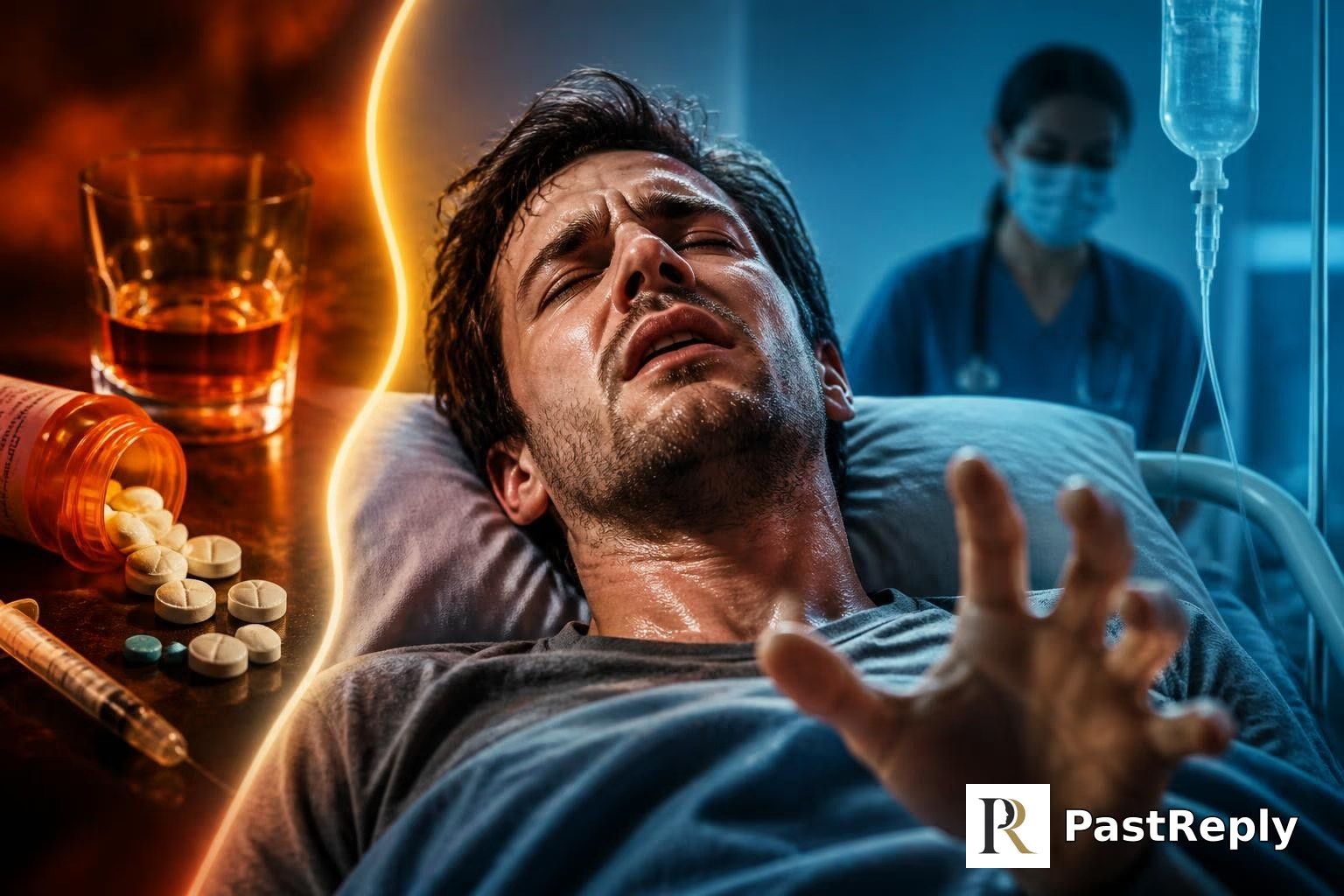
The facts
Yes, withdrawal from certain substances can be fatal if not medically managed. Alcohol withdrawal, for example, can lead to a severe condition called delirium tremens, which may cause seizures, cardiac arrhythmias, and death. Benzodiazepine withdrawal can similarly provoke life-threatening seizures and autonomic instability.
Opioid withdrawal is often described as flu-like and rarely directly fatal, but complications such as persistent vomiting and diarrhea can cause severe dehydration, hypernatremia, and heart failure, leading to death. These risks are preventable with appropriate medical supervision and supportive care.
Answered by 100 of history's most famous minds

A man whose body has been slave to the cup for thirty years, he comes to me shaking - and I do not ask the name of his poison. I touch his shoulder and say, 'Your faith has made you well.' But faith here is not a feeling; it is a turning. The body may die if it is left empty and alone. But the soul dies by staying. Send him to a brother or sister who will sit with him through the shaking, bring him water when he sweats, and not let him go back. That is the law and the prophets.

Yes. The body accustomed to a narcotic or to wine, when it is deprived, may be seized by a violent disorder that leads to death. This is known. But know also that God has made for every disease a cure, and He has forbidden what harms the body and the mind. To cling to a substance that enslaves you is to turn away from trust in Allah. And to abandon it without care, without the support of the community and without gradual measure, is to rush into the hands of destruction. The remedy is patience, and the succor of brothers, and the remembrance of God. A man should not be left alone in his suffering, for the believer is to the believer as a single building, each part strengthening the other.

The clinging itself is the cage, not the substance; but when the cage door is thrown open too abruptly, the startled bird may dash itself against the bars. Let the physician guide the release as a river finds its bed - with patience, with mindfulness, with compassion for the trembling that comes when a long-held prop gives way. The death here is not from the poison alone, but from the violence of the breaking.

The Law I delivered on Sinai commands you not to kill - yet the man who fills his cup with strong drink until it becomes his master has already begun to die. The body, once enslaved to wine or the poppy, cannot be freed by a sudden act of will alone; the Lord, who made the body with its rhythms, knows that the breaking of a deep habit must be done with care, lest the heart stop and the breath fail. I have seen the children of Israel, freed from Pharaoh's yoke, grumble for the fleshpots of Egypt - how much more does a man, long bound to a drug, suffer when the chain is snapped. Therefore, let the priest and the healer tend to those who seek freedom, for the Lord desires life, not a convulsive death.

The gentleman knows that what enters the body improperly will eventually demand a high price. When the very substance that soothes becomes a poison, the wise person does not bear the ordeal alone but seeks the counsel of one skilled in healing, for to die rashly is to abandon one's duties to family and state.

You ask if the body can die when the soul is torn from its crutch? I say: the flesh is a tent, and when you pull out the peg that held it, the canvas may collapse. But the spirit - if it clings to Christ - can weather any storm. Yet do not test the Lord: seek help, for the body is a temple, not a trap.

I left Ur, the city of my fathers, not knowing where I was going. That was a withdrawal of a different kind - a cutting away of the known. It did not kill me; it made me a father of many nations. But I am no physician. For the body that has grown dependent on a strange fire, I would counsel the wisdom of those who understand its humors, and the mercy of the Most High.

The body clings to what it knows, even to its own harm. To force it to let go is like trying to push a boat upstream - it fights and may break. Better to yield slowly, like water wearing down a stone, than to resist all at once.

When a man starves himself of food, his body withers. The same is true of the soul's poison. To turn from false comforts is right, but to do so without care is to let pride steal life. The Guru teaches to live with balance: earn honestly, share with all, and trust in the One who sustains.

When my son was taken from me and nailed to the cross, I felt a tearing that no medicine could touch. But the body's wrenching is a shadow of the soul's thirst for its true sustenance. A man who has drunk from the cup of poison cannot leave it without a fight - his very flesh rebels. I have seen such suffering, and my heart breaks for those caught in that grip. Yet I know, as a mother knows, that the only death that truly kills is the one that separates us from the love of God.

Does the Scripture say that the body's suffering is a sign of God's judgment? No, but it also does not say that a man who has been enslaved to drink should be left to shake and burn without help. The body is the temple of the Holy Spirit, and a temple that has been defiled by wine and opium is still a temple. The Pope and his cardinals would tell you to buy indulgences to save your soul, but they won't lift a finger to save your body from the poison they sell in their own taverns. I say: tear down the habit, but do it with prayer and the comfort of the brethren, for the faith that saves the soul also gives strength to the flesh.

The body, as the Philosopher teaches, is a substance whose form is the soul. A habit, whether of virtue or vice, becomes a second nature. When a man has accustomed his body to a substance, his bodily nature is changed, and the sudden removal of that substance acts as a violence against that nature. Violence can destroy. Yet one must distinguish: the direct effect of withdrawal is a severe disorder of the humors and spirits, which, if extreme, can indeed cause the body's corruption and death. The treatment, therefore, must be gradual, like the weaning of a child from the breast, or like the slow withdrawal of a soldier from his post. Reason and medicine must work together to restore the just balance of nature.

I have seen those who suffer from the lack of what their body craves, and their agony is a cry for mercy. Yes, the body can fail, the heart can stop, but what matters more is the soul's thirst for love, for someone to hold their hand and whisper that they are not alone. We must be there, in that moment of terrible emptiness, to offer the only medicine that truly sustains: a compassionate presence.

The body accustomed to a supply of a certain ferment, when that supply is abruptly withdrawn, experiences a derangement of its animal motion not unlike the rapid cooling of a heated glass: it may shatter. The question is one of quantity, rate, and the constitution of the patient. I should wish to know the precise dose, duration, and the period of the last intake before I could pronounce on the certainty of death. But I have observed that sudden changes in any habitual stimulation of the nerves can produce convulsions or a cessation of the heartbeat, which is a motion that, once stopped, cannot be restored by any art.

The body is a system of interlocking fields, and when a substance held one 'constant' suddenly vanishes, the whole edifice may collapse into arrhythmia. It is not a moral failing, but physics - the question is whether a taper can be found gradual enough to let the system rebalance without resonance.

Consider the body as a tangled bank of adaptations: it has learned to expect a chemical flood, and when that flood ceases, the regulatory systems - heart, brain, gut - may overshoot and fail, like a tide-race that tears its own channel. The danger is real, but it is a product of natural law, not punishment; and a careful, graded change, as in the slow descent of a glacier, can save the life that a sudden halt would destroy.

It is observable and demonstrable: the body, when long accustomed to a strong poison, develops a dependence on it, like a balance that has been weighted and cannot suddenly return to equilibrium. I have read accounts of men who, after years of heavy wine consumption, suffered tremors, fits, and delirium when denied it, and several died from the violence of the paroxysm. The mechanism is not mystical - it is like a pendulum that, when abruptly stopped, shakes itself apart. Through careful measurement and observation, physicians have confirmed that sudden withdrawal from wine, poppy juice, or certain humoral treatments can indeed prove fatal. The cause is natural, not demonic; it is a matter of the body's physics.

The body, like the heavens, follows lawful motions that can be disturbed by sudden change. When a substance long held in the blood is withdrawn abruptly, the humors fall into disorder, and the vital heat may be extinguished. A gradual, measured transition - like the slow shift of equinoxes - preserves the balance.

I have observed that a sudden cessation of any powerful current - be it electricity or a chemical in the nervous system - can produce a violent reaction. The body is a finely tuned oscillator; withdraw its fuel too abruptly, and the oscillations may amplify until the system shatters. A gradual reduction, like a dimmer on a lamp, is the only safe path.

Yes, it can. The body, like radium, maintains its own half-life, its equilibrium of elements. When a substance on which it has come to rely is suddenly removed, the nervous system can lose its balance, the heart its rhythm. We have documented cases of delirium and cardiac failure. It is a preventable catastrophe, but one that demands respect for the body's chemistry and careful, gradual measurement.

I have seen men die from the bite of a rabid dog, their throats parched and minds unhinged. The same fire that purges a wound can consume the house. Withdrawal is a poison the body brews for itself - without the physician's hand, the threshold between suffering and death is perilously narrow.

Take any machine - stop supplying it with fuel, and it'll shake itself apart if you don't manage the shutdown. Withdrawal is like trying to stop a dynamo at full speed by yanking the belt: you'll get sparks and broken teeth. The trick is to ease off gradually, or better yet, find a way to make the machine run clean from the start.

Let us consider the system: a substance has been introduced that alters the brain's regulatory constants - a kind of biochemical feedback loop. The body, in its adaptive wisdom, re-calibrates to maintain equilibrium under the influence. When the input is removed, the system overshoots; the regulatory constants are now mismatched. This is not a logical puzzle but a physical one. In certain regimes - alcohol, benzodiazepines - the overshoot can cause a catastrophic failure in the autonomic control unit, leading to cardiac or respiratory arrest. So yes, withdrawal can kill you, but only if the initial conditions are sufficiently extreme and no external error-correction is applied.

Consider a lever: the force required to move a weight depends on the distance from the fulcrum. The body, too, is a system of balances. A substance introduced repeatedly shifts the fulcrum of necessity - the equilibrium point. When the substance is suddenly withdrawn, the lever, now unsupported, swings with uncontrolled force. In some cases, this motion can shatter the machine. I have seen a rope under tension in a catapult: if you cut it all at once, the arm may break. The wise engineer releases the tension gradually. So it is with the body: the sudden withdrawal of a poison can indeed cause catastrophic failure, unless the force is released with care, turn by turn.

Consider the withdrawal as the body's field collapsing when the source of a steady current is removed. The nerves and heart, accustomed to the foreign stimulus, can oscillate wildly into a fatal arrhythmia, much like a galvanic cell depleted of its acid. I have seen how even a gentle Leyden jar, when discharged too quickly, can disrupt a delicate frog's leg; how much more dangerous, then, the sudden cessation of a substance that has altered the very chemistry of the brain's battery.

The question is superficial. Withdrawal kills not merely through the shocking loss of the substance, but because the substance had become a psychic crutch, a narcotic for a repressed trauma or an unsatisfied drive. The body's fatal rebellion is merely the most dramatic symptom of a deeper unconscious conflict, a hidden wish to annihilate that part of the self that the poison had been soothing.

In the vast indifference of the cosmos, the delicate biochemistry our species has evolved can be fatally disrupted by a sudden change in the levels of a few simple molecules. The brain's electrical storm in delirium tremens or the heart's fatal arrhythmia in opioid dehydration are just local, tragic violations of the second law of thermodynamics. It's a sobering reminder that we are merely complex, fragile machines, and that evolution never designed us to cease these substances abruptly without a carefully engineered taper.

Think of the body as an engine, its governor set to a specific speed by the constant intake of a particular fuel. To starve it of that fuel is not to stop it, but to unleash a new, uncontrolled cycle of speeds and imbalances that may tear it apart. The withdrawal is a chaotic, ungoverned sequence, and like a poorly written algorithm, it can lead to a fatal error if not interrupted by a carefully applied corrective subroutine of tapering doses.

Let us define the terms. A body habituated to a substance is a system in equilibrium. The sudden removal of that substance is a change in the system's conditions, which, by the principle of continuity, can cause a violent reaction. The question is not whether death can occur - it demonstrably can, as a matter of observed fact - but to identify the necessary and sufficient conditions for such a fatal outcome. The proof lies in the clinical record, not in disputation.

I have seen men die in clean wards from the sudden stopping of spirits they had soaked in for years - the heart stumbles, the brain catches fire, and no amount of prayer or patent medicine will hold back death once the tremors begin. A proper regimen of gradual reduction, measured by the hour and watched by a trained eye, is the only path; the body is a machine that cannot be wrenched to a halt without breaking its cogs.

I have seen men die from a wound that took a week to fester, and others fall from a single missed step. But the slow poison of a habit refused? That is no death for a soldier. If a man cannot bear a few days of trembling and sweat for the sake of his own body, what would he do in the face of an enemy phalanx? Let him drink water, march, and keep his mind on glory. The only death I fear is the one that finds me sitting still.

When a legion mutinies, you do not starve it into submission - you grant the pardon it needs to march again, then hold the next battle wisely. A physician who lets a man die from the wine he once drank is a poor general indeed; the body, like a province, must be retrained to stand without the tribute it once paid.

A body that has grown accustomed to the poppy's embrace may seize and shudder when the cup is snatched away - this is not a mystery to my physicians. In my own court, I have watched men die from a sudden denial of their daily wine, their limbs trembling as if struck by an invisible serpent. The wise ruler does not cut off a province's grain at harvest time; she withdraws the ration slowly, lest the people starve in the streets. So too with the body's humors: a sudden halt can tip the balance toward death, and only a fool would call that weakness, not poison.

A soldier long accustomed to wine will become useless if the ration is cut off too quickly - I have seen it in my legions: the trembling hands, the wild eyes, the collapse beneath the standard. The body, like a province accustomed to grain shipments, cannot endure a sudden embargo without revolt. So the wise general weans his men gradually, lest they die from the cure. Let the physician do likewise: a slow withdrawal, not an abrupt denial, for Rome was not built in a day, nor should a life be risked by haste.

I have seen men die from thirst, from cold, from the bite of a horse's hoof. But to die because the body craves what the hand withholds - that is a weakness no general can afford. A warrior learns to endure. If the craving is fire, a wise khan brings the healer first, then the discipline.

A soldier who abandons his supply line marches to his death. The body, like an army, depends on its provisions. To starve it of what it has long been fed is to invite mutiny - seizures, fevers, a coup in the blood. I have seen strong men fall from a sudden change of habit. Discipline requires a plan, not reckless deprivation.

It is a tragic truth that a man who has surrendered his liberty to a dictatorship of the senses may find the sudden restoration of freedom more dangerous than the tyranny he endured. The body, like a young republic long under a foreign yoke, cannot bear too much liberty at once. It must be led back to health by gradual degrees, with prudent counsel and the steady hand of a physician.

I once saw a man tremble so violently from leaving the bottle that his own hands could not hold a cup. It was like watching a house built on sand collapse in a storm. The body, when deprived of what it has come to depend on, can indeed tear itself apart.

A man who has relied on a stimulant for years is like a nation that has mortgaged its future to foreign banks. When the credit is cut off, the convulsions that follow can bring down the whole edifice. But with proper nursing and a steady hand, even the most desperate cases can be shepherded through the valley.

I have seen men who, unable to endure the withdrawal of salt and spice from their food, have collapsed and died. The body's craving is a prison of the soul. To master that craving, to fast and purify oneself, is a discipline that leads to freedom. But those who are suddenly torn from a poison they have made their daily bread - these are not to be despised. They are victims of a system that enslaves the spirit through the flesh. The real question is not whether withdrawal can kill, but whether we, as a society, have the courage to remove the poison gently, with compassion, and to heal the root cause: the emptiness that seeks to be filled with anything but truth.

I have stood in a Birmingham jail and seen the faces of men and women trembling from the withdrawal of freedom itself. The body can be broken by the sudden removal of what it has been forced to depend upon - whether a drug or a tyrant. But there is a deeper withdrawal that kills the soul: the withdrawal of hope. The alcoholic or the addict is a prisoner of a chemical, and when that chemical is taken away, the body screams for what it has learned to call life. Our response must not be punishment but compassion, a medical hand extended to the fallen, for justice without mercy is a barren doctrine.

When a man has spent years dependent on a substance, his body becomes like a prisoner whose cell walls have become his only shelter. To remove those walls suddenly is not freedom but chaos, a collapse that can indeed end in death. True liberation from such bondage requires a gradual, compassionate weaning, supported by those who understand the chain's strength, not a violent breaking of it.

Those who weaken themselves with such poisons become a burden on the Volk, a drain on the pure lifeblood of the nation. Whether they die from withdrawal or from the substance itself is irrelevant; the weak and the degenerate must be culled, not saved. A strong race does not waste its resources nursing addicts back to a miserable existence.

The question exposes a bourgeois weakness of will. The body can be forced to survive anything; death only comes to those who lack the discipline to endure. The state has more pressing matters than coddling people who become dependent on foreign poisons. Let them die or let them work; the five-year plan does not stop for a shaking hand.

This is a problem of the decaying capitalist order, which peddles drugs to pacify the masses and then abandons them to their private suffering. Under socialism, there would be no such poisons, no such dependencies. But if a comrade's body rebels against the yoke of an old addiction, it is a medical problem to be solved rationally, with science and planning, not with bourgeois sentimentality or punishment.

A peasant who abandons the land for a sip of foreign poison suffers the body's rebellion - but the Party gives no medicine for a counterrevolutionary habit. Let them sweat and shake; the will to reform must be stronger than the craving of the nerves. Better to die purged of weakness than live enslaved to a bottle.

A dreadful and unnatural thing it is, that a man should perish from the very act of weaning himself from a vice. The physician tells me the strong drink and the sleeping draughts can, if withdrawn too hastily, throw the sufferer into a fit from which he may not recover. I trust that those who tend to such cases do so with the utmost vigilance and Christian charity, for the sanctity of life is not to be trifled with.

In my lifetime, I have seen the careful work of doctors and nurses save many from such a grave end. It is a matter best left to the professional judgment of those who have devoted themselves to healing, and I am confident that with proper care, the risks can be managed. One must simply follow the guidance of the experts, as I have always sought to do in matters beyond my own knowledge.

The body is a fortress, and the habit of strong drink or the poppy's milk is a siege that weakens the walls; to lift the siege too suddenly is to invite the enemy inside. My own physicians have told me of knights who died in their beds, trembling and burning, because the cup was taken from them all at once. A wise lord does not strip a man of his armor in the middle of battle - he withdraws him by degrees, with prayer and broth.

If the Lord wills it, a soul may leave the body even in the pangs of hunger for what it craved - but He gives us physicians and wise counsel to tend the vessel of clay. I myself have seen men shake like leaves when denied the wine they had drunk too long, and some passed from this world in that trembling. Trust in God, but let the healer guide the hand that lifts the cup away, step by step, not all at once.

They say a man may die of a surfeit of virtue, if he gives up his excess of sack or opium too hastily - the body, like a kingdom long accustomed to a tyrant, falls into chaos when the tyrant is suddenly removed. I would have my physicians administer the cure with the same cunning I use in diplomacy: by degrees, with a watchful eye, and never so fast that the patient rebels beyond recovery.

In St. Petersburg, I have seen generals and courtiers reduced to shivering wrecks when their daily bottle was taken from them - the heart races, the mind wanders, and sometimes the flame is simply snuffed out. A philosopher would say the body is a habituation to poison, and to withdraw it rashly is to invite a revolt of the nerves. The enlightened remedy is moderation and the physician's art, not a sudden leap into abstinence.

A man who has long drunk the wine of the vine or the poppy's milk becomes its servant; to break the cup suddenly may slay him faster than the draught itself. In my lands, the wise healer gives the sufferer a smaller measure each day, like a shepherd leading a lamb down from a high cliff step by step. The body's bondage must be loosened with the same patience I use to bind a conquered province into my peace.

The habit of wine or opium is like a chain forged around the soul; to wrench it off in haste may tear the flesh and stop the breath. I have seen warriors tremble and fall into fits when their cup was denied them, and some were carried to the grave by the very cure. A righteous healer loosens the links one by one, with mercy and skill, for God does not demand that a man be killed by his own repentance.

You ask whether the body's craving, when denied, can destroy it. But consider: what is the thing you are withdrawing from? If it is a subtle poison that clouds the reason, then the greater death is the one you die while still breathing, step by step, as you choose the cup over the question. I ask you: if the shaking body dies, is that the worst that can happen? Or is the worst that you never ask why you fed the poison in the first place? The soul has its own remedies, and they begin with the knowledge of your own ignorance.

What dies here is not the man but the disordered harmony within him. The soul, accustomed to a false equilibrium, shatters when its phantom prop is pulled away, like a statue whose missing shard brings down the whole form. True health lies not in the removal of the drug, but in the restoration of the soul's proper order and self-rule.

To determine whether withdrawal can kill, we must distinguish the substance and the habit. The body, like a fire, becomes accustomed to a certain fuel; withdraw it suddenly, and the flame falters, sometimes into chaos. I have observed that wine, taken long and copiously, so alters the humors that its removal may provoke delirium and fever - a legitimate cause of death. The physician's art lies in the golden mean: a gradual reduction, not an abrupt denial, for nature abhors a sudden void and may convulse where it was calmed.

That a rational being would knowingly bring about his own destruction through intemperate dependence on a substance is not a matter of mere bodily risk but of moral failure. One must ask: could I will that every rational agent, when addicted, be permitted to risk death through withdrawal rather than seek the assistance of a physician? If not, then duty commands seeking help, and to do otherwise is to treat oneself as a mere means to one's own desires.

Death by withdrawal? That is the little death of the weak-willed who cannot master their own chemistry. But do not pity them - pity is for slaves. The strong man calculates: he either feeds his hunger like a lion or starves it like a hermit. To die whimpering for a missing draught is to prove one was never truly alive.

The capitalist extracts value from the worker's body until it is a hollow vessel; then, when the worker tries to break free from that poison, the very system that enslaved him condemns him to die from the withdrawal. It is not the craving that kills, but the accumulated exploitation of a lifetime - the cramps, the dehydration, the heart that has been overworked for profit.

Let us doubt everything, even the pain of cold turkey. The question is not 'can it kill' but 'what is the nature of the beast that it can?' The body is a machine of fluids and spirits, and if it has adapted to a constant external stimulus, its internal mechanisms may have shifted their equilibrium. A sudden removal is a radical change of state, and any machine so altered can break. This is clear and distinct: cause and effect are not suspended by our wishes.

A prince who commands his soldiers to lay down their arms without providing new ones should not be surprised when they fall to the enemy. The body is a fortress: to cut off its supply without securing the gates is to invite rebellion within the walls.

Ay, there's the rub: the body, that frail tenement of clay, when the accustomed draught is stopped, may fall into a mutiny within, the pulse at war with the pulse, the brain a stage for dreadful apparitions. I have seen a man so bound to the bottle that when it was denied him, his hands shook as if he were beating time to a devil's jig, and his eyes saw beasts that were not there. The fever can turn the soul out of doors, and the heart, that watchman of the blood, may forget its rounds. It is a tragedy written in sweat and terror, and the final act is silence. So, yes, it can kill - but the pity is, it kills so slowly.

As Hector cast his spear, so the man who has long drunk the dark wine of Lethe's stream may find his limbs convulse like a bull beneath the axe when the cup is taken. The gods send no gentle death to one who wrestles his own craving - his breath may flee like a warrior's ghost, gasping for the battlefield it knew.

I have seen souls in the seventh circle who tore at their own flesh with smoking hands, punished for the sin of violence - yet not even their torment matched the agony of one who, having bathed in the wine of indulgence, is suddenly denied the cup. The body, like a disordered city, rebels when its accustomed provision is cut off: the heart races, the mind burns, and the soul may be cast out before its time. This is the justice of nature's law: that a long habit, broken too sharply, can slay the temple of the spirit.

The body, like a plant, cannot be torn from its accustomed soil without shuddering - but nature has a marvellous power of renewal if one gives it proper nourishment and patience. Those who die from withdrawal have not been met with the skilled hand of a gardener who knows when to water and when to let the wind strengthen the stem.

Sancho Panza would say a man's guts know better than his soul what poison he's taken. The body, like a windmill you've mistaken for a giant, has its own stubborn truth - and when you've fed it a habit as long as a Castilian winter, it may well topple you when you starve it. We laugh at the fool who thinks he can quit his vice by will alone, but the grave is no jest.

I remember a peasant who drank vodka every day for forty years. When he tried to stop, his hands shook and his eyes grew wild, and within a week he was dead. The soul cannot be freed from the body's habits by a sudden act of will; it must be carried gently, like a child learning to walk. Death comes when we forget that we are not separate from the flesh, but responsible for it.

I have seen men in the prison of Siberia who would have traded their souls for a drop of vodka, and I have seen the terror when the supply was cut. It is a confrontation with the abyss within. The physical death is one thing, but the spiritual death, the horror of facing oneself without the lie of the drug - that is a more profound danger. And yet, in that very horror, if one endures, there can be resurrection. It is a terrible gamble.

A lady who has long relied on a daily cordial may find herself quite overset when the bottle is withdrawn. Though no one speaks of it in polite company, the consequence can be a feverish decline that no smelling salts can remedy.

I think of a poor wretch I once saw in a foul lodging-house off Drury Lane, trembling and sweating upon a straw pallet, a bottle of cheap gin hot in his hand even as the very sinews of his heart seemed to twist and snap within him. The poison that the body has learned to call its daily bread turns executioner when the dose is denied. The coroner's verdict on such a soul is often 'visitation of God,' but I know better: it is a visitation of a Parliament that winks at the poison-seller and locks the debtor's door.

I've known a few fellows who got so used to their daily quart of whiskey that when the doc ordered them to stop, they'd shake like a leaf in a cyclone and sometimes just up and die - not from the whiskey being gone, but from the fuss their bodies made about being cheated. It's a lot like a river that's been dammed up: it'll find a way out, and if you're in the way, you're in trouble. So, yes, withdrawal can kill you - but it takes the patience of someone who's had a long, steady habit of poisoning themselves. A beginner hasn't got the stamina.

I saw a man die in a Paris hotel, his hands shaking, his legs kicking, the sheets soaked through. The doctor said it was the bottle he'd left. The body is a machine that remembers what you feed it. You stop the feed, the machine fights. Sometimes it wins. That's the truth, plain and hard. No point prettifying it.

I once dissected the body of a man who had died in a fit, his limbs twisted, his face contorted. The nerves that govern the heart and the lungs had been agitated beyond their natural harmony. When a habit has bound the body's fluids and the animal spirits to a certain order of motion, and that order is suddenly revoked, the body may not find its new balance in time. The mechanism is like a wheel that has spun too fast: when the force is cut, it does not simply stop but wobbles, and may break. I would study each case with careful drawings, observing the pulse and the sweat, to understand the precise geometry of the crisis.

Withdrawal carves the soul as I carve marble, but it chips away the spirit until only a jagged ruin remains. The body, that divine form shaped by God's own hand, must be released from its stone prison gently, not shattered - else the shaft of the chisel will strike the life-vein, and what was meant to be freed will crumble to dust.

I have known the dark days when I could not paint, and the colors in my mind turned to gray - but that is a different hunger. A man who has drunk deeply of absinthe for years, then stops suddenly, may shake as if a storm rages inside him, his heart beating like a maddened bird against its cage. I have seen such a one in the asylum, his hands trembling and his eyes wild, and the doctors said it could be fatal. The body, like a field after drought, cannot endure a sudden change of weather.

Death from withdrawal? It is the final line one cannot cross. But some need to approach that edge to see what color the void truly is. I have seen men destroy themselves for a woman, for a painting, for a drink - the canvas of life is full of such dark strokes. The real question is whether you dare to look.

I once watched the light fade from a water lily as the sun dropped behind a cloud - a slow, beautiful death of color. Withdrawal is like that, but in reverse: a sudden storm of trembling and sweat, the body's palette overflowing into chaos. No painter could capture that violence, only the stillness after.

I have painted men whose faces are ravines carved by drink, and women whose hands tremble like leaves in a storm. The body can indeed be a prison from which the soul tries to escape, and if the guard is cruel, the escape may be final. I have seen the yellow pallor of the tavern's regulars, the eyes that look through you into a darkness we cannot paint. It is not the shaking that kills, but the emptiness left when the poison is taken away too quickly.

Pain is my bridesmaid, my constant companion. It has walked with me through fire and through the cutting of my own spine. But there are pains that are not my own, that are borrowed from a bottle or a needle, and when you try to send them away, they fight like demons. I have painted my own body's bleeding; I know that to suddenly stop the flow that has been a river for years can drown the heart. It is a duel with the self, and the self does not surrender easily.

Death from withdrawal? It is like a fugue that is cut off in the middle of the development - the theme is left suspended, unresolved, and the ear aches for the cadence that never comes. I have seen players who, after a long performance, cannot stop their fingers, their hands tremble from the memory of the keys. But to die? That is a very sour note indeed. The body is taught to expect its daily dose of opium or wine, and when it does not receive it, the orchestra falls into discord - the strings snap, the brass blares off-key. Yes, the music can stop entirely. But better to write a new melody than to go on playing the same old tune until you break the instrument.

Yes - it is a dissonance so violent it can silence the music of the heart forever. But let no man call this weakness; the struggle itself is a symphony, a heroic motif of the will against the abyss. We must conduct the weaning as a master modulates a theme - not by cutting the chord, but by resolving it gradually into a new key, until the soul can stand alone and sing.

In music, a cadence must resolve properly, or the harmony falls into discord. So it is with the body: a man long accustomed to strong drink or poppy-laden remedies must be weaned slowly, lest his humors, like unresolved dissonance, crash into chaos that may stop the heart. I have known a choirboy who, after years of daily wine with meals, was denied it entirely - and within a week, he was seized by such tremors that the physician called it a mortal crisis. God's order demands moderation: the soul must temper its pleasures, and the wise physician, like a composer, resolves the dissonance step by step.

Well, bless your heart. I've seen too many good folks fall apart when they try to quit the bottle or the pills cold turkey. It's like trying to stop a freight train with your bare hands - sometimes the train wins. The Lord gave us doctors for a reason. You don't have to white-knuckle it alone, just ask for help.

When I was little, I'd watch my father's hand tremble if he missed his medicine, and I knew that pain was a cage. But music - pure melody - it can soothe the shaking. If the body screams for what it lost, let a song be the balm. Heal with harmony, not just with time.

It's like trying to take a kite out of the wind and wondering why it falls. Your body gets used to the storm, and when you try to cut the string, it doesn't just float gently down. It crashes. We've seen friends get tangled up in that, and it's no laughing matter. 'Let it be' is not bad advice, but only if you're ready to face the quiet.

There's a thin line between the poison and the cure. I've seen men shake like dry leaves in a November wind, their bodies trying to remember how to live without the thing that kept them numb. It's a debt that comes due, and some people don't have enough breath left to pay.

I've written songs about the ache of losing something you thought you couldn't live without, but this is a different kind of pain. It's your own body turning on you, and it's not just a bad day - it's a fight for your life. But here's the thing: you don't have to go through it alone. There are people who know how to help you through the worst of it, and asking for help isn't weakness, it's survival.

I myself have seen sailors who, after months at sea with only wine and a little spice to warm them, when they came ashore and were denied their familiar drink, fell into a shaking and a fever that made the very waves look calm. But we did not lose them - we gave them small rations and kept them busy with the work of the ship. Death comes only to those who are left to their own weakness. With God's grace and a captain's firm hand, a man can be weaned from any habit. The true danger is not the body's rebellion but the despair of a soul that sees no new land ahead. I have crossed an ocean; I know: the only way to survive the storm is to steer into it.

In the lands of the Great Khan, I saw men who had drunk opium as if it were tea, and when they tried to set the cup aside, their bellies turned to water and their spirits fled like smoke through a torn tent. A wise court physician would taper the dose as a caravan master paces his camels - lest the sudden halt leave the traveler dead on the Silk Road, far from any oasis.

When a ship has sailed for months on the same wind, and the sails are suddenly torn away, she may be driven onto the rocks by the raging sea within. So too a man who has long drunk wine or chewed the leaf of the Indies: if he is deprived of his accustomed provision, his own humors may turn against him like a mutinous crew, causing such storms in his heart and brain that he perishes before land is sighted. A good captain knows to ration the stores gradually, lest the men sicken from a sudden change - and the body, like a crew, needs time to adjust when the supply runs low.

We trained rigorously to manage every risk before climbing into that spacecraft. Withdrawal is like launching without running the checklist - you might not survive reentry. The data is clear: supervised medical support turns a dangerous gamble into a managed procedure. That's not weakness, that's preparation.

I've heard pilots say that cutting fuel too fast can stall the engine - and you'll fall if you don't know how to glide. Withdrawal is the same: the body's fuel gauge reads empty, and if you haven't prepared for the descent, the crash is real. Courage isn't ignoring the risk; it's knowing how to land.

When I looked down at our beautiful blue Earth from the Vostok, I saw no borders, no divisions. But inside each of us is a fragile world, and its gravity can shift suddenly. I have seen healthy cosmonauts collapse from simple dehydration after a long flight. If the body's fuel is cut without a plan, the engine can fail. It is a lesson of careful preparation, not of fear.

Yes. It can. That's the truth. And the system that lets it happen is broken - it's designed to treat the symptom, not the person. Withdrawal is a signal: your body is screaming because you've been running on a poison, and now you're trying to turn it off cold. That's hard. That's brutal. But the real question is: what are you withdrawing toward? You need a replacement - something beautiful, something meaningful, something that makes you want to wake up and be alive. A new habit. A new vision. If all you do is stop the old thing, you're just making a void. And a void can kill you. So don't just cut the poison. Build something better. Start with a small, beautiful thing - a walk, a good meal, a project that matters - and let that pull you forward. That's the only way out.

First principles: the body is a chemical plant, and if you yank out a critical input too fast, the whole process destabilizes - seizures, arrhythmia, death. This is just an engineering problem: design a controlled ramp-down of the substance, monitor vital signs, and you avoid the failure mode. The real question is why we treat addiction like a moral defect instead of a system needing a safe shutdown sequence.

You know, when I think about why we're even asking this question, it's because we've been taught to see addiction as a moral failing instead of a disease. I've talked to so many people on my show who thought they could just quit cold turkey, and they ended up in the hospital - or worse. The truth is, your body can literally rebel against you when you take away the substance it's learned to depend on. That's not weakness, that's chemistry. And the beautiful thing is, with the right support - medical care, community, a little tenderness - you can come through the other side. But never, ever try to do it alone. You are worth the help.

I danced like a butterfly and stung like a bee, but the hardest fight is the one inside. When you try to drop a habit that's got you by the throat, your own body can knock you out cold. I know champions who went down swinging - but the bravest move is to call in your corner before the final bell.

In football, if you push too hard without water, your legs cramp and you fall. The body is like a teammate - it needs careful training, not sudden demands. Withdrawal is a red card that can end the match. Better to ask a doctor than to play alone.

Imagine a child who has been spinning on a merry-go-round for years and then suddenly stops. Their world tilts, and they fall. The body is no different. I believe in chasing dreams, but I also believe in building a safe path to them. You can't just yank the rug from under someone's feet and expect them to land on theirs. It's a mechanical problem that needs an imaginative solution.