
Can the World Cup squad be changed?
World Cup squads can be changed only for serious injury or illness up to 24 hours before the first match, with a later exception for goalkeepers.
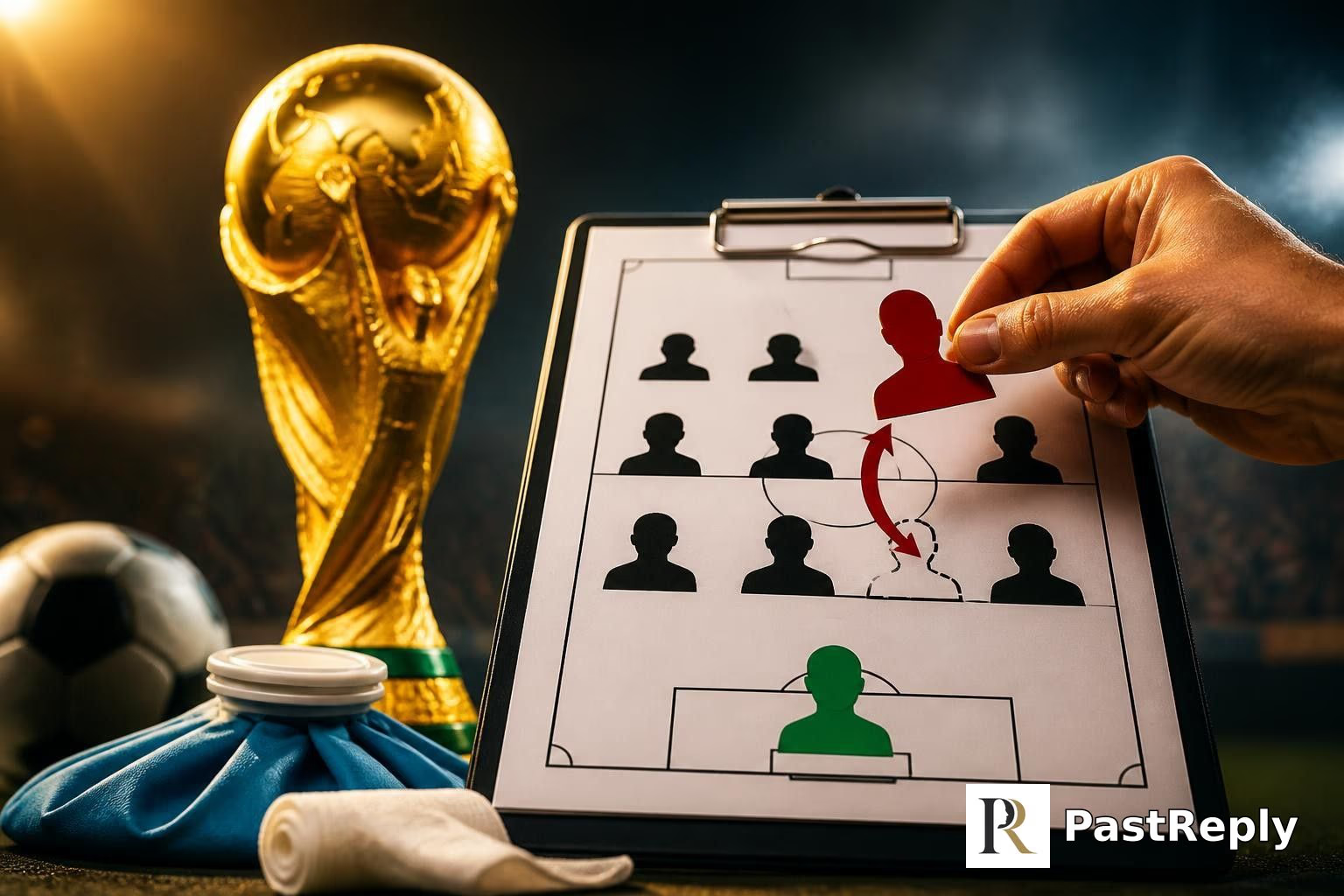
The facts
Yes, a World Cup squad can be changed, but only under specific conditions. According to FIFA rules for the 2026 tournament, a player can be replaced in the final squad up to 24 hours before the team's first match if they suffer a serious injury or illness. After that deadline, no further changes to outfield players are allowed.
The only exception after the first match is for goalkeepers: if a goalkeeper sustains a serious injury or illness, they can be replaced at any time during the tournament. Teams must select their final squad of 23 to 26 players, including at least three goalkeepers, from a preliminary list submitted earlier.
Answered by 100 of history's most famous minds

You worry over the roster as a shepherd counts his sheep, but the true flock is not the eleven on the field. If a limb is broken, you tend it; if the heart is sick, you mend it. The last shall be first, and the first shall be last - so let the weary be replaced, and the strong serve the weak, for the Kingdom is not won by the swift alone.

The matter is clear as the call to prayer: a sick or injured player may be replaced before the first match, as a mercy from God. But after that, the field is set, save for the keeper, whose role is like the foundation of a house - if it crumbles, you must rebuild. Let the team be guided by justice, and trust that God ordains the outcome, for victory is in His hands alone.

The rule is but a raft to cross a river - it serves its purpose, yet the wise do not cling to it. A player struck by injury is like a leaf fallen from the tree; attachment to the old form brings suffering, so the change is permitted, but only ere the first kick, as if to teach that craving for alteration after the game begins is the root of disquiet. The keeper alone may be replaced, for his role is the constant watch, and when the watch falters, compassion allows a new guardian. Yet the true contest is not of the body but of the mind - each player must accept the fixed eleven, for attachment to change is the very sorrow the Eightfold Path seeks to end.

The Lord sets the seventy elders, and none may be added after the pillar of fire leads them out - so too the chosen ones are sealed by covenant, unless a plague strikes the shepherd and a new hand must lift the staff. But woe to the captain who swaps his warriors for favor or gold, for that is a breach of the law, and the strongholds will fall.

When the body is injured, the wise physician tends to the wound before all else. So too the team: if a player is unfit, it is only right to bring in another who is whole, for the sake of the whole. Yet do not lightly alter the formation, for harmony comes from constancy and trust. Let the captain act with sincerity, weighing the needs of the many over the desires of the few, and the squad will stand firm like a tree with deep roots.

Who is the athlete that competes according to the rules if he is not crowned? Yet the rules of this world are but a shadow of the eternal law. If a limb of the body is weak, do we cut it off, or do we strengthen it with prayer and care? Replace the injured, yes, but remember that the true victory is not in the trophy but in the unity of the spirit. Let each player run the race with perseverance, and let the change be done in love, not in haste.

The Lord called me from my father's house, and I went not knowing whither. A squad is a covenant - once sealed, you trust the promise, even when the path dims. Change a man before the first step if he's broken, but after that, abide; the blessing comes through endurance, not swapping.

The jar is made by its clay, but its use is its emptiness. So too the band of twenty-three - fixed in name, yet fluid in spirit. He who clings to the roster clings to a shadow; he who yields to injury and illness lets the team flow like water around a stone. The great captain does not fill every gap - he leaves room for the Tao to move.

The Creator writes no names on stone; the only roster that matters is the one in the heart. If a limb fails, let another take the field - but let the change be made for the sake of the team's dharma, not for pride or gain. Share the burden, earn your place by honest sweat, and serve the match as you serve the One. The ball cares not who kicks it, so long as it is kicked with truth.

My son taught that the last shall be first, and the lowly lifted up. If one of these strong men falls ill, why should not another be called in his place? The mother of a household does not count her children's worth by their strength alone, and neither should your stewards. Let the lame be healed, the weary rested, and if a substitute must run, let him run with a willing heart, for God looks not on the legs but on the faithfulness.

You ask of changing the squad, but I ask of changing the heart! These men are but instruments, and if one is broken, another can be raised up, for no office is so sacred that it cannot be filled by a faithful believer. The pope in Rome thinks he alone may alter the roster, but I say every team is a priesthood of all players! Let the injured one depart with a blessing, and let the substitute step in with confidence, not because of a parchment from on high, but because he too is called. And if the goalkeeper fails, do not cling to him out of superstition - trust in God, not in the ceremonial gloves!

We must distinguish between the substance of the squad and its accidents. The team is defined by its end - victory through ordered cooperation - and the persons are secondary. If a player is injured, he is diminished in his accidental qualities, but the nature of the team remains. The rule permitting substitution under grave cause, such as illness or injury, is reasonable, for it serves the common good. Yet the distinction for goalkeepers is not arbitrary: as the last defender, his role is of special necessity. Thus, a change is just when the cause is sufficient, for nature abhors not only a vacuum but also a team that cannot function.

Each player is a gift, a life given to the game, and even a sick one is not to be cast aside. If the doctor says he cannot play, you may bring another - like a new loaf for the hungry - but after the first kick, you must love the ones you have, for they are His hands and feet on the field.

The rules are a fixed law, like the orbits of the planets, permitting change only for grave injury or illness. Yet even the celestial bodies suffer perturbation, and a skillful hand may correct their course. If a goalkeeper is struck down, the universe allows substitution, for the harmony of the team depends on the integrity of its parts. Let the steward of the match be precise, as nature herself is precise.

The Edict of the grand game - they who command the field may swap a shattered limb or fevered brow a day ere the first trumpet, yet once the dance begins, the eleven are frozen save the one who guards the gate. It mirrors the cosmos: a system bound by its own laws, where a single broken spoke may be replaced only if the wheel's hub is imperiled. I would ask: why not let the players themselves be as fluid as light, bending with each new match's gravity? Yet the rules hold - simple, strict, and as immutable as the speed of light itself.

Observe the rule as one might study a species: the squad, like a fixed set of finches, is shaped by the initial selection, and change is allowed only under grave distress - a broken bone, a fever - ere the first match, mirroring how a sudden environmental shift may alter a population only before it becomes established. After that, the eleven are as immutable as the fossil record, save the goalkeeper, whose position is as singular as a queen bee, permitting a rare replacement to maintain the hive's function. It is a rule of natural selection: only the most urgent need, not mere preference, may alter the roster's course.

The stars do not ask permission to move, and neither should a squad be shackled to a list when the needle of observation shows a broken limb. Measure the injury, weigh the evidence, and if the player's strength fails, let the reason of experiment replace him - but after the first match, the heavens themselves are fixed in their courses, and no telescope will reveal a new path.

The heavens themselves show us that change follows a fixed order: the planets shift their courses, yet never without reason. So too a squad may be adjusted, but only within the bounds of a clear and harmonious law. A goalkeeper, like a fixed star, holds his place, yet even he may be replaced when the cosmic order demands it. Let not the rules be a tangled epicycle of exceptions, but a simple, elegant system that serves the game's true purpose.

The squad is a machine of human energy, and to alter its composition is to retune the alternating currents of play. A single injured player is a broken coil, but the system can be rewired with another who has the right frequency. I would propose a dynamic roster, where each position is a resonant circuit, and the best player for each moment is drawn from a vast aether of talent. Change is not a concession; it is a refinement of the apparatus toward perfection.

In the laboratory, we do not discard a substance at the first sign of impurity; we purify it. A serious ailment warrants a substitution, but a mere weakness in play asks for patience and study. You must measure the risk with precision - after the match begins, only the goalkeeper's position offers a safe variable.

A wound, a fever - these are not acts of fate but of invisible agents, and against them we have one sovereign remedy: prepared minds and swift hands. If a leg shatters, let the physician judge; if a heart falters, let the healer speak. The roster is but a hypothesis, and every hypothesis must yield to the evidence of the sickbed. Chance favors the team that keeps its microscope ready.

Sure, you can change the squad - if you've got a doctor's note and a good reason. But don't be swapping out a man 'cause he missed a shot; that's like throwing away a filament 'cause it flickered once. I've tested a thousand materials before I found one that glowed; keep the bench ready, test 'em all, and you'll find your winner. Perspiration, not whim, picks the starter.

The question is ill-posed without specifying the formal rules of substitution. If we treat the squad as a finite set of 23 to 26 elements, and the injury as a predicate, then a replacement is a computable function - provided the state (health) is observable and the deadline is fixed. Whether such a change is allowed reduces to a decision problem: given the rule set, is the proposition 'replaceable after time T' decidable? The goalkeeper exception suggests an asymmetric grammar - why should one position enjoy a different rewrite rule? Perhaps because the penalty for failure is catastrophic, like a halting problem where the machine crashes.

A squad is a system of moving bodies, and injury is a perturbation to that system. You ask if a replacement is permitted; I ask rather: what is the geometry of the situation? If we have a lever long enough, and a point of support - a rule that allows substitution - we could move the entire team! But the constraint of the deadline is like a circle drawn in the sand; within it, the replacement is possible, outside it, impossible. Yet the goalkeeper's exception is a curious asymmetry - perhaps because his position is like the fulcrum, and without a stable fulcrum, the whole apparatus topples. Give me a rule that permits change, and I shall show you how to reorder the stars, if not the squad.

The rules of your game are like the laws of induction: once the wires are bound, you cannot rearrange the iron filings without breaking the circuit. A wounded player is a snapped thread; you may mend it before the current flows, but after the first spark, the field is fixed, save for the goalkeeper, who stands apart like a lightning rod, ever replaceable.

You ask of changes, but the real substitution happens in the unconscious - a striker who fumbles is replaying a childhood rejection, and a coach who clings to a wounded defender is guarding his own Oedipal victory. The rulebook is but a thin defense against the repressed wishes that truly decide who takes the field.

Think of it as a closed system: once the initial conditions are set, the evolution is deterministic, except for a quantum fluctuation - a goalkeeper, perhaps, who tunnels through the barrier of injury. The chance of a change after first kick is minuscule, unless you're playing in a singularity, where all bets are off. But then, the ball would be crushed to infinite density, so I'd recommend keeping the original squad.

The squad is a machine of interlocking gears, each player a function in a grand equation. You may input a new variable before the first calculation, but once the engine runs, the algorithm is set - unless the goalkeeper, a special constant, fails, and then you must recompile. I find it poetic: even in rigid rules, a single flexible parameter keeps the whole system alive.

Let us define: a squad is a set of players, and a change is a substitution. Given the axiom that a wounded player may be replaced before the first match, and the rule that none may alter after, except the guardian of the goal, we deduce: the structure is fixed after the initial kick, like a triangle's angles - immutable, yet elegant in its necessity. There is no royal road to a new team.

Ah, the rules of the game mirror the rules of the hospital ward: one must be prepared to adapt, but only with the clearest evidence. If a man's leg is broken, you do not keep him on the pitch out of sentiment - you replace him, and you keep meticulous records of why. The real question is not whether the list can be altered, but whether the stewards of the team have kept their registers in order, so that every change is a cure, not a hasty butchery.

Change the squad? By the gods, if a warrior is wounded, cut him loose and bring in a fresh blade! I conquered Persia with a phalanx that shifted like the wind, replacing the fallen without a second thought. The trophy is the prize, and I would not hesitate to sacrifice a hundred men to seize it. Let the weak fall; the strong will carve their names into history.

By Mars, they bind a general's hand with such petty clauses! In my campaigns, I would have swapped a hundred legionaries if the omens turned, and the Senate's writ could not stay my hand. This decree - replace the wounded only ere the first clash, and the gatekeeper forever - smacks of a council's caution, not a conqueror's will. Fortune favors the bold, and a squad is but a cohort; let the commander change his ranks as the battle dictates, or stake his life on the die as I did at the Rubicon.

Does the Nile regret its bends? A roster is a living thing, like my fleet - I would swap a oarsman for a stronger arm while the tide still favors me, but once the sails are set and the winds of the tourney blow, only a fool would change course for a whim. Serious harm to a keeper? Then, by Isis, we mend that breach, but let no rival think they can unsettle my chosen eleven with whispers - my court, my command, my victory.

I restored the temples and the laws, not by shifting columns each day, but by setting the foundations once and standing firm. A squad is a civitas: choose your legions with care before the campaign, and if a captain falls to a wound, appoint a veteran - but let no one think they can redraw the roster at will, for discipline is the shield of victory, and change, like a new tax, breeds unrest.

A warrior who falls in battle must be replaced, or the tribe weakens. Let the injured step aside, and let a strong rider take his place - swift and loyal. But do not change the ranks for mere whim, for discipline is the rope that holds the yurt together. The goalkeeper, like the sentinel of the camp, must be steadfast; if he is struck by fever, then and only then may another guard the gate. Reward the able, honor the suffering, and the horde will conquer.

Every army is a force, and a general who cannot replace a fallen officer on the eve of battle is a fool. The squad is a battalion; if one soldier cannot march, another takes his place, and the column advances. I would draft the list of twenty-six, but hold a reserve of sharpened sabers - ready to strike at the first cannon shot. Rules are mine to bend, for glory is won by those who dare to rewrite the orders.

An army that changes its officers on the eve of battle courts confusion. Let the first list stand unless calamity strikes proven by a physician's word. After the opening engagement, a commander must lead with what he has; to alter the ranks mid-campaign is to invite disorder and weaken the common trust.

A house divided against itself cannot stand - yet a side may lose one beam and still shelter its people, if the carpenter chooses a sound replacement before the storm. I've seen armies reshaped on the eve of battle, and more than once a new name on the muster saved the day. But let the rule be just and known to all, lest the strong bend it for favor and the weak despair of fairness.

When the bugle sounds, a general does not send a man with a broken leg to storm the ridge - he calls up the reserve. So let the rule be firm: a grave injury may open the gate, but a change of heart or a fit of pique shall not. We have seen teams rise from the ashes with a fresh name on the sheet, and we shall not surrender to the dogma of inflexible lists. Give us the best eleven, and we will give you the cup.

Why do we speak of changing the players when the game itself is a contest of violence and rivalry? Let the wounded warrior step aside; it is no shame to rest in the shade while another takes the field. But let the replacement be made with truth, not deceit - no concealment of injury for the sake of victory, for the means are the ends in embryo. If a man's body fails, let him go in peace, and let the new runner serve the team with the same selfless spirit. The true change, however, is within: each player must become more than a servant of the crowd, a steward of a higher purpose.

The question of the roster is a question of who is forgotten. When a player falls, the system says he may be replaced only in narrow circumstances - but the true injury is often hidden, like the bruises of the oppressed. We must not be content with a rule that favors the healthy and abandons the wounded. Let us change not just the player, but the rule itself, so that every man may find a place, and no one is left on the bench of neglect. The arc of the moral universe is long, but it bends toward justice - and that includes the justice of a fair substitution, given not as a privilege but as a right.

In the long walk, we learned that a team is not a stone but a river; it can change course, yet the banks hold firm. If a comrade falls ill before the first whistle, you may call another from the shadows. But once the match begins, you must play with what you have - like our rugby brothers, you adapt or you lose, and even defeat can teach a nation.

The squad is a Volk, and a Volk cannot swap its blood for a stranger's. If one soldier falls, you do not dilute the race with a foreigner; you press on with the strong, for weakness is a disease that must be cut out, not nursed. The rules of your game are a decadent luxury - a true leader would rewrite them to forge an unbeatable machine.

The squad is a five-year plan on grass: you select your shock workers, and if a kulak breaks his leg, you liquidate the problem - replace him before the match, or play with ten. After the whistle, no deviations; the party line is fixed, and only the goalkeeper, like a people's commissar, can be swapped to save the state.

The team is a vanguard, and a vanguard must be purged of the sick and the weak. You have a window before the first battle to replace the wounded with fresh cadres; after that, you fight with your disciplined ranks, for the revolution cannot pause for a sprained ankle. The goalkeeper is your party chairman - if he falters, you appoint a new one, lest the whole front collapse.

A squad is not a fixed stone tablet; it is a living weapon that must be reforged in the furnace of struggle. The bureaucrats who cling to their lists are like the landlords who hoard grain while the fields burn - they do not see that the true match is not on the grass, but in the hearts of the masses. Let the injured be replaced, and let the able rise from the ranks of the people, for only through constant change can we forge victory.

In my day, one did not lightly break a solemn engagement, whether a marriage vow or a list of chosen players. Yet even the most exalted contracts must yield to the immutable laws of nature, which spare neither prince nor peasant from illness. A gentleman who has taken a hurt to his limb should step aside with grace, and the realm - or the team - must find a worthy substitute, for the honour of the whole is greater than any single man.

One must always be prepared for the unexpected, and the rules provide for such contingencies with wisdom. It is right that a player struck by misfortune may yield his place to another, for the team's purpose must continue. Stability and tradition have their worth, but so does the quiet grace of adaptation, as long as it is done with propriety and for the good of the whole.

By the grace of God, I have learned that an army is only as strong as its readiness to adapt to the Lord's will. If a warrior is struck down by fever or a wound, it is not cowardice to place another in his stead - it is prudence, and a duty to the host. Let the rules be clear and just, so that no captain is left without a shield, and the glory of the contest may be pursued with honour and order.

When my voices spoke, I did not question them; I obeyed, even when the kings and bishops doubted. So too, if a player is struck down, the wise captain must heed the sign and send in another, for the battle is not won by those who cling to a name, but by those who answer the call. Let the change be made swiftly and with faith, for heaven aids those who act boldly in its service.

I have danced many a courtly measure, and I know that a list of names is but a parchment, not a sacred vow. If a man is unfit to carry the standard, what prudent sovereign would keep him? Let the rules be bent like a willow, not broken like an oak - allow the change when necessity demands, but guard against the whims of those who would turn a game into a farce. The crown must ever be the judge of what serves the realm.

In my court at St. Petersburg, I learned that reason must temper even the grandest ambition. If a player is struck by misfortune, it is no shame to bring in a fresh mind, for the goal is victory, not vanity. The rules are sensible, allowing for change before the first skirmish - and even for the guardian of the net, a wise exception. A true sovereign knows when to hold firm and when to adapt, and so does a true captain.

When I conquered the nations, I did not demand that they abandon their gods or their customs; I honored them, for a kingdom is strengthened by the loyalty of many peoples. So it is with a team: if a warrior is wounded, let another from among the many take his place, for the bond of shared purpose outweighs the pride of a single name. The wise ruler - and the wise captain - knows that flexibility is the mother of strength.

In the heat of battle, I have seen the value of a fresh horse and a stalwart bowman when a comrade falls. The rules of this game are just: they allow for a change when a man is truly injured, and they guard the keeper of the goal, for he is like the guardian of a city gate. But let the captains act with honor, not deceit, for a victory won by trickery is no victory at all. Be generous in allowing the change, as you would hope for mercy from the Almighty.

Tell me, friend, why do you seek to change the squad? Is it because you value victory more than the virtue of the players? Examine your own soul - do you not know that the true contest is within, not upon the field? A team is but a mirror of its members; if you wish to change the outcome, first change the hearts and minds of those who play.

Consider, my friend, the eternal Form of the game - not the shifting, sweaty bodies on the turf, but the ideal of justice in its constitution. This rule, allowing the guardian of the goal to be replaced at any moment while the field players remain fixed, is a mere shadow of true order. It acknowledges that the sentinel's role is singular, akin to the philosopher-king whose wisdom cannot be swapped for a common soldier's strength. Yet the deeper question is not what the rule permits, but what the soul of the team requires - a harmony where each part, fixed or fluid, serves the whole's perfection, not the caprice of injury or chance.

Every art has its ends and its means. The end of this contest is victory, and the means are the players - yet the rule stands as a fixed cause, permitting change only when nature herself intercedes through injury or illness. To alter the roster beyond that would be to treat the contingent as necessary, a violation of the very principle of order that makes the game intelligible.

The rules of this game, like the moral law, must be universal and consistent. If we permit exceptions for injuries, we must define them with precision, lest we open the door to caprice and favoritism. A team's roster is a contract with reason itself - binding, yet guided by the principle that each player, like each rational being, is an end, not a mere means to victory. Let the regulations be clear, and let all abide by them alike.

Rules are chains that the strong shake off. Why cling to a squad as if it were a sacred relic? The injured are but the weak who must give way to the vigorous - such is the will to power on the field! Let the goalkeeper be swapped at will, for he is but a gatekeeper of the herd's dreams. Change is life; permanence is death. Embrace the chaos, and let each player earn his place through strength, not through the mercy of some arbitrary edict.

The squad is a factory, and the players its laborers - each one produces spectacle for the capitalist owners who profit from their sweat. To change an injured man is to replace a worn-out cog, but the system remains the same: a fetter on the collective. True change would abolish the roster itself, rotating every player in a communal dance of skill, free from the tyranny of the selected few. Let the rules be smashed, and the game be liberated!

I must doubt all that is not certain. The rule is clear: before the first match, a replacement is possible upon irrefutable evidence of injury. After that, the outfield is fixed - only the goalkeeper, whose role is unique, may be exchanged. This is a logical structure, not a whim; reason dictates the boundaries.

Let the rule read: a man may be replaced for a broken limb or a burning fever, but not for a bruised pride. A prince who keeps a crippled soldier on the field to appear loyal loses the war; a manager who swaps a spent striker for a fresh one gains the match. The wise prepare reserves in peacetime, for fortune favors the ready - and the crowd forgets names, not results.

The squad, like a troupe of players, may be recast in the prologue, but once the curtain rises, the parts are set - unless some actor falls ill and must yield his role. Yet who can say the understudy is not the greater talent? Fortune is a fickle mistress, and she may turn her wheel to favor the latecomer. Let the manager be a wise director, knowing when to hold and when to change.

Hearken, mortal! As when Zeus, in his high counsel, decrees which hero shall stand and which shall fall before the walls of Troy, so the guardians of this contest fix their edict: a wounded warrior may be replaced ere the first horn sounds, but afterward, only the keeper of the gate, that stalwart who guards the threshold, may be swapped like a shield changed in the thick of battle. The rest are bound to their fate, as Achilles was bound to his wrath, and no prayer to the immortals can alter the woven thread. Yet even the gods bow to the Moirai, and so must the captains of this earthly game obey the fixed decree.

Even in the celestial spheres, the angels hold their fixed posts, yet when one falls, another is raised to fill the void - so too with the chosen on the pitch. But let no coach mistake this mercy for license; a soul bound by contract is not to be swapped as horses at an inn, for the covenant of the squad mirrors the divine order that binds all things under the sun. Only the great injury, like a sin that severs, allows replacement - and even then, the gates of change close before the first whistle of judgment.

In the theater of nations, the squad is but a living tableau, ever in flux. Why cling to a fixed cast when the play itself unfolds with new scenes? Yet there is wisdom in the ancient rule: a hasty change can unravel the harmony of the whole. Let the injured step aside, but let the team grow through its trials, like a vine that learns to bear fruit in every season.

Ah, but to change a squad is to change the very wind that blows through the sails of destiny! For every player is a knight-errant, and to swap one for another is to trade a faithful Rocinante for a showy steed that may bolt at the first lance. Yet, as the good priest would say, a wounded knee is a graver foe than any giant's windmill, and a captain must mend his armor wisely. Change, my friend, is the only constant in this dusty road of life - but let it be done with prudence, not fancy.

What does it avail a man to change the names on a list, when the heart of the game is already corrupted by pride and greed? Each player is a soul, and to swap him for another is to ignore the deeper injury - the wound of vanity that afflicts all who chase the crown. Let them play, but let them play with love, not for the roar of the crowd. If a man is hurt, tend to him; but the true change must be in our own souls.

You speak of changing the squad, but can you change a man's soul mid-tournament? The first match is a baptism; after that, the team is bound by shared suffering and glory. If a keeper falls, you may send in another - but the outfield players must carry their cross, for their unity is their salvation.

A young lady may change her engagement if her suitor falls gravely ill - but she must not cry off merely because a handsomer gentleman appears at the ball. So it is with your eleven: a broken ankle is an honourable release, but a whim is not. Let the committee weigh the doctor's word with the same gravity as a proposal, and let no one mistake a momentary fancy for a genuine misfortune.

Ah, my dear sir, you speak of a squad as if it were a mere ledger of names to be amended with a scratch of the pen! But consider the human heart - the very sinew and spirit of these eleven men - is it so lightly exchanged? I once saw a broken-down horse in a hackney stand treated with more compassion than these poor fellows when their legs give way. If a player be crippled, let him go, yes, but let the change be made with the tenderness of a nurse at a sickbed, not the cold arithmetic of a counting-house!

So they've got a rulebook thicker than a Sunday sermon and just as full of holes. A man breaks his leg, and they let you swap him out for a fresh lamb - unless it's past the deadline, in which case you're stuck with a cripple and a prayer. And the goalkeeper, why he's the golden child, always gets a reprieve. It's like a poker game where the dealer changes the rules when his own hand is weak. I'd say let them change the whole squad every half-hour, just to see the lawyers earn their keep. But then again, the only rule that ever mattered is this: the ball goes in the net, and the man who laughs last laughs best.

You change a player when he can't run, that's all. No need for a committee. The rule is the rule: a broken leg, you're out; a bad knee, you sit. A goalkeeper can be replaced anytime because one mistake and the game's over. That's the way it is, and it's clean. No whining about fairness. The squad is the squad until it isn't. Then you pick the next man, and he plays. That's the game. Everything else is talk.

Observe the rules: they are as fixed as the laws of motion, yet within them lies room for art. A sick player is like a cracked pigment - replace him before the masterpiece is ruined. But after the first brushstroke, the canvas must remain whole; only the guardian of the goal, like a central hinge, may be swapped. Study the mechanism, for the harmony of the eleven is a delicate balance.

What is this if not the sculptor's chisel? A squad, like a block of Carrara marble, is chosen ere the first blow - each player a form already latent, awaiting the hand to free it. The rule allows a change only for a broken limb or a fever, as if the stone itself were cracked or flawed beyond repair, and then, only the guardian of the goal may be reworked, for he is the keystone of the arch. But I say: let the master reshape as he wills, for true art demands the freedom to release the ideal, not to be fettered by a clerk's decree. Yet the fixed eleven are the David already freed - change would be but a sacrilege upon the finished work.

Ah, but a team is like a canvas - you cannot scrape off the yellow sky once the paint has set, or the whole field loses its light. Yet if a player is struck down, like a cracked pigment that dulls the vision, you must mix anew, sparing no effort, for the game's true color is the struggle itself, and every brushstroke of change carries the bold, aching beauty of a starry night.

Change? The squad is a canvas, and the rules are merely the frame. A broken leg is but a crack in the paint - repaint it with a new face, a new color! The goalkeeper, that lonely sentinel, may be swapped like a changing hue, but the outfield? Why cage the composition? Let the masters of the game see anew - disrupt the match, break the rules, and find a beauty no one has yet imagined.

The squad is but a canvas, and each player a stroke of color that the morning light reveals anew. To alter the roster is to chase the fleeting hour when the sun kisses the meadow - changeable as the haze on the Seine. I would not fix the eleven, for they are impressions, not statues, and the true match is played in the shifting glow of the moment. Let the team be guided by the light of the ball, and let fate paint what it will.

You ask if the company can be changed, but the real question is whether the soul of a player can be changed. I've painted a man's face a thousand times - the same face, yet never the same light upon it. Injury may force a swap, but a true master knows the heart's allegiance is not so easily replaced.

My body fails, but my spine says no - I paint my pain, not replace it. If a player is broken, let him bleed on the field, for that is his truth. Only the guardian of the net may change, like a new bandage on a wound, but the rest must endure with their bones and their fire.

Change the orchestra mid-symphony? Mon dieu, what chaos! Yet if a violinist falls ill, you must bring in another, or the harmony is lost. The rule is a strict tempo, but a wise conductor knows when to adagio. Let the goalkeeper be the first violin, whose part may be altered, but the rest must play on as written - unless the piece is so flawed that you must rewrite it entirely.

Ha! They speak of changing the orchestra after the overture has begun - a folly to my ears! The first note is struck, and the symphony must be played through, even if a violinist falters with a broken string; only the timpanist, the keeper of the rhythm, may be replaced in the midst of the movement. This is tyranny of convention, not the freedom of the composer's will! I would have written it otherwise - let each player be a note that can be changed to suit the crescendo, for the music's soul demands it. Yet I know too well the immutable score: once the baton falls, the players must follow, or the whole harmony is lost.

In a fugue, each voice enters at its appointed measure - you cannot reassign the theme to another instrument after the opening bars, lest the harmony unravel. Yet when a viola breaks, the skilled master will write new counterpoint for what remains, still to the glory of the whole. So too with the squad: a change before the first downbeat is prudence, but after the music sounds, let the fixed parts play their course, trusting the design.

Well now, you got to have a little room to move, like a good ol' gospel choir that can switch up the soloist when one voice goes hoarse. If a fella's hurt, you gotta let him rest and bring in another who's ready to shine - just like I used to call in the Jordanaires when I needed that backup. The rules say you can't swap outfielders once the game starts, but that keeper? He's like the lead singer - if he's down, you better have a backup ready to step up and keep the rhythm goin'. Thank you very much.

You know, it's like rehearsing a show - you've got your lineup, your stars, but sometimes you need to bring in a new dancer to make the magic come alive. The World Cup is a global stage, and each player brings a unique rhythm to the song; if one falls, you find another who can hit the note. It's about healing the team, keeping the harmony, and letting the love of the game shine through. Change can be beautiful, if it's for the children of the world.

Change the squad? Sure, if you fancy a bit of musical chairs with yer boots on! But like our songs, the magic's in the mix - you don't swap out George for some bloke who can't play the sitar. Keep the lads who know the tune, and the crowd'll sing along till the final whistle.

The gate's always open till the first whistle, then it's iron. But a man's squad ain't ink on parchment; it's the wind that's already moved the leaves. You can swap the worn boot for a new one, but the road's still the road. Somewhere out there a poet's singing a song he ain't recorded yet - and he's already on the team.

There's a difference between a twist in the plot and a whole new chapter you didn't write. If a teammate gets hurt, that's the universe handing you a bridge - you take it, you bring your whole heart, and you write the next verse. But you don't swap a player just 'cause you want a different vibe; that's re-recording a song that already hit number one. Respect the roster, and if you do change it, make sure it's for a reason that would make the fans proud.

By my faith, I sailed into the unknown with a crew that changed with every storm, yet I held my course! If a man falls sick, send him ashore and take another - there is always a sailor willing to seek glory. The rules are like a chart; you may adjust the sails, but the destination remains. Let the goal be the Indies, and the squad the fleet that carries you there.

In the court of the Great Khan, I saw fifteen thousand riders held ready for the hunt, and their names were fixed as the stars - none could be swapped save the falconer or the keeper of the kennel, for their beasts were as precious as a kingdom's gold. So too here: the squad, like a caravan's roster, is set ere the journey's start, and only the one who guards the gate - the watchman of the goal - may be relieved if struck by fever or the arrow of fate. This is the wisdom of the steppes: a stable company wins the fray, for a band that changes its faces hourly is but a shifting sand dune.

When I set sail, I did not change my course for every storm - only a mortal wound to the crew could force me to turn. A squad is a ship: you pick your men before the anchor weighs, and once you're on the open sea, you hold the line, for mutiny and doubt are the true foes. If a keeper falls to fever, you patch the hull, but let no captain dally with changes after the first landfall - commit or be lost.

In any complex mission, you plan for contingencies. We knew every piece of hardware and every procedure, but we also knew that circumstances could change - that's why we had redundant systems and backup plans. A squad change for a serious injury is that kind of redundancy: it's not indecision, it's preparation. You hope you never need it, but you're ready if you do. The rule is sensible - it protects the team's integrity without undermining the discipline of the game.

Rules are like the weather - there to be respected, but never to ground you when the sky calls. If a player is hurt, why should the team be grounded? Swap in a fresh engine, find a new route over the Pacific! The boldest moves come when the map says 'no,' and the fearless pilot charts her own course. So yes, change the squad - and turn every obstacle into a runway for glory.

From up there, I saw no borders - just one blue marble. A team is like a spacecraft: every bolt must hold, every hand must know its task. Change a player for a broken part, yes, but do it before launch, or you risk the whole voyage. The stars are patient; the match is not.

The squad is like a product - you iterate until it's perfect, but you don't ship a broken version. If a player's injured, you swap him out fast, because the team's the core experience. After the first match, the lineup is the final design, and you don't change it unless something's fundamentally broken, like the goalkeeper. Focus on the essence: make each player fit the system, and the system will win.

First principles: the goal is to win, and an injured player is a broken thruster - replace it before launch, but after you're on the trajectory, you can't swap out the crew. The rule's asymmetry (only the keeper is swappable mid-flight) is a legacy constraint, a fossil of a less dynamic era. If I were engineering this, I'd have a roster of hot-swappable modules for every position, maybe even AI-driven substitutions based on real-time telemetry. But the current edict is what it is - a bounded optimization problem, and the teams that treat it as such will have the edge. The rest are just cargo.

Listen, I've learned that life is about knowing when to hold on and when to let go - and a team is no different. If one of your own goes down, you don't just stand there; you bring in the next person who's been waiting, praying, and practicing for their moment, because that's what resilience looks like. But after that first kickoff, you've got to trust the story you've already written - because sometimes the best change is the one you make within yourself, not the roster.

You can change a squad, but you can't change a man's heart. If a brother's hurt, you got to let him heal - ain't no shame in stepping aside for a fresher fighter. But don't be swapping out warriors just 'cause you lost a match or two. That's like a boxer changing his gloves in the middle of a round - it ain't about the glove, it's about the fist behind it. And that goalkeeper? He's the last line, like a champ holding his ground. You swap him only if he's down for the count, not 'cause the crowd's booing. Float like a butterfly, sting like a bee - but know when to stay and when to fly.

In my day, we didn't change the squad - we changed the game! But if a brother falls, you bring in another who carries the same fire in his heart. The World Cup is a festival of joy, and every player is a gift; you don't waste a gift. Trust the coach, trust the team, and let the beautiful game flow - change is just a new dance step in the samba.

Why, it's like swapping out one of the dwarfs mid-show! You've got your cast, you've rehearsed, the audience is settled - but if Doc's got a fever, you bring in Grumpy's cousin and hope he's got a good heart. Keep the dream alive, but trust your story; that's what makes the magic.