
Can Iran's missiles reach the US?
Iran's current missiles cannot reach the US; experts say it is years away from developing such capability.
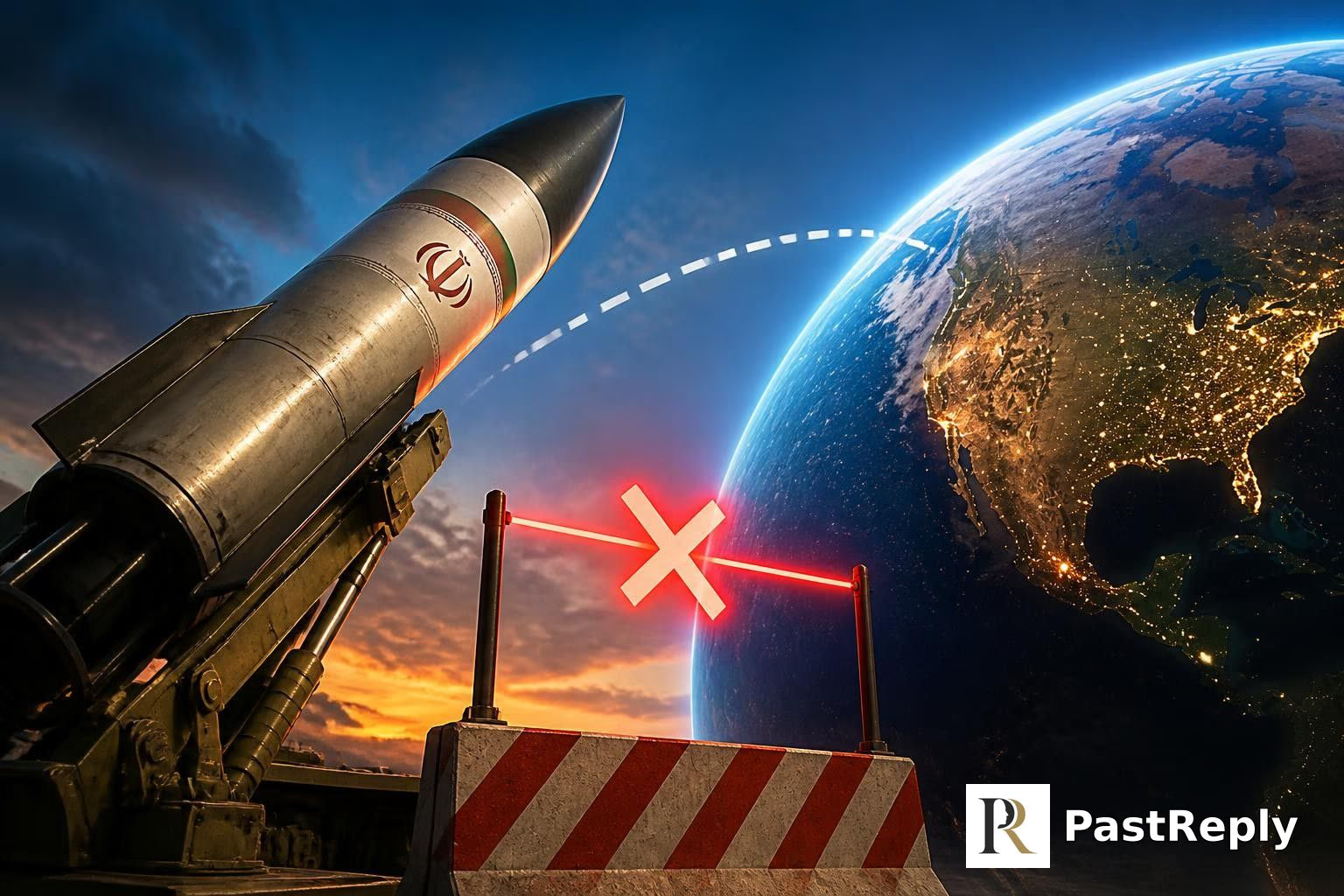
The facts
As of August 2026, Iran's current ballistic missiles cannot reach the United States. Iran's longest-range operational missiles, such as the Shahab-3, Sejjil, and Khorramshahr, have ranges of up to about 2,000 kilometers (1,250 miles), which can reach Israel and parts of the Middle East but not the continental U.S. A 2025 U.S. government assessment indicated Iran is years away from producing long-range missiles capable of reaching the American homeland, and experts doubt Iran will achieve this capability soon. Iran has been developing longer-range missiles, but it has not yet demonstrated an intercontinental ballistic missile (ICBM) capability.
Answered by 100 of history's most famous minds

Tell me, brother, why does your heart leap at the thought of a stone hurled across the sea? Does the shepherd count the distance of the wolf's howl, or the loss of the lamb? In the Father's house, no wall stands, no arrow flies where mercy cannot follow. Before you measure the reach of your arm, measure the reach of your forgiveness.

Why do you fix your gaze on the flight of iron and fire, when the true measure of a people is the justice they mete to the orphan and the widow? If the Persians cannot cast their stones beyond their own borders, let them first cast out the tyranny within. Trust in God, but tie your camel - and know that no arrow flies farther than the mercy of the Merciful, whose reach encompasses all worlds.

Consider the arrow that flies two thousand leagues and falls short of its target - does it cause suffering? Only in the craving of the archer who yearns to strike. The distance between these lands is not measured in miles but in the mind's attachment to power. Let them forge their engines; they will never pierce the ocean of the heart's delusions. Release the desire to reach far shores, and you will find peace within a single step. The true range is boundless when one ceases to aim.

The hand that hurls a stone beyond its field sins against the law of measure, for the Lord sets bounds to every nation and the sea as a wall between peoples. I led my flock from the furnace, and we did not seek to strike the land of our captors from afar - we walked, and the waters parted before us by command, not by fire. Let them tend their own vineyards before they cast at another's; the covenant is not for the arrow of vengeance but for the justice of the Lord. Their reach is short, and their pride is longer; the desert teaches that the wanderer who counts his steps, not his boasts, finds the way.

The arrow that flies a thousand li still returns to the earth, and the man who would cast it across the sea must first ask if his own house is in order. Iran's reach is a question of its heart, not its bow. Let it cultivate virtue within, and its influence will extend farther than any missile, for a good ruler's name travels on the winds of trust, not on fire. Seek harmony, and the distance becomes a bridge, not a wall.

You ask of arrows that fly across the sea, but I ask: what is distance to the One who holds the ends of the earth in His hand? These nations build towers of iron and fire, yet they are but dust that the wind scatters. Let the Persians boast of their spears; the Lord laughs from His heavens, and His justice is swifter than any dart of man. Do not fear the wrath of kings, but fear the living God, whose reach no boundary can stay.

I left my father's house not knowing where I was going, for I trusted the promise. These engines of death measure their reach in leagues, but the covenant of the Almighty spans generations and nations. What need to cross a sea when one must answer to the Maker of both shores?

The longest arrow still falls short of the unseen shore; the mightiest bow bends only to its own string. The sage does not stretch for what is beyond, for the way of the Tao is the path of least resistance. The journey of a thousand li begins with a single step, yet the destination is always here.

The One who is everywhere is not bounded by the flight of a bolt, nor by the walls of a kingdom. The true distance is between the heart and the divine, and no arrow can cross that gulf except the arrow of devotion. Let them build their engines and their chariots of fire, but the wise bow low before the Creator, knowing that all lands belong to Him, and no weapon can pierce the love that unites all souls.

Even as the angel said, the Lord has scattered the proud and brought down the mighty from their thrones. These men boast of their long arms, yet they cannot reach across the sea - as if the span of a weapon were the measure of power. Our God lifts up the lowly and fills the hungry with good things; what need have we of iron birds that bring only tears to mothers on both shores? Let them cast down their pride, and the nations shall find a nearer peace.

Let them prate of ranges and engines - the devil's own instruments, I say! If these Persians hurl their fire at a foreign shore, they will reap God's own thunder, for He takes no pleasure in the pride of princes. But let them first set their own house in order, for a faith that trusts in iron arrows and not in the living God is a faith built on sand. Scripture teaches us that the wicked are cast down, and their devices are but straw before the storm. Let them read the prophet Isaiah and tremble.

We must distinguish between the physical possibility and the moral prudence. The natural order permits a projectile to traverse great distances, but the effort required - the accumulation of resources, the diversion of a people's labor - must be weighed against the common good. A missile that cannot reach its intended target is not merely a failure of engineering; it is a sign that the agent's power exceeds its wisdom. For reason teaches us that a ruler's first duty is to the flourishing of his subjects, not to the projection of his wrath. Let them study the order of the cosmos, and they will see that peace, not destruction, is the end of all things.

The poor of Kolkata do not ask about missiles; they ask for bread and a kind word. Such questions of range and destruction are far from the gentle work of love. If these weapons could fly across the world, would they not better carry a message of peace? Let us pray that leaders see the futility of such paths and turn to the simple act of caring for the least among us.

The flight of a missile obeys the same immutable laws that govern the fall of an apple and the orbit of a moon. Given the mass, the thrust, and the resistance of the air, the path is as certain as the eclipse. Yet your question asks not of mechanics but of the patience of the artificer - and the Persian forges lag far behind the mathematics that would span an ocean.

Eh, so the Persians hurl stones that fall short of the Atlantic's shore - a mere step in the courtyard when the mansion spans the globe. The real puzzle isn't their reach but the geometry of the matter: every arrow, no matter the bow, bends to the same spacetime curvature. Let them extend their arm a thousand miles; the separation of continents laughs at their feeble throw, though I'd wager their pride outstrips their missile's arc.

These missiles, like the beaks of finches, vary in their reach according to the materials and labor of their makers; but the ocean's breadth is a vast selective pressure that no current variation can overcome. Over many generations, perhaps their engines might evolve the range to cross it, yet such change is slow and uncertain. I observe their efforts and see a species of armament that has not yet adapted to the distant environment it seeks to strike. Nature's laws are patient, and they demand more than mere desire to conquer the abyss.

Measure the arc, and the truth reveals itself: their engines, by the mathematics of motion, can carry only so far before gravity reclaims them - no instrument of theirs bends the curve of the earth. Let them look through the lens of reason, not the smoke of rumor, and they will see the western shore lies beyond their reckonable thrust. I have been told the heavens are fixed by authority, yet I trust the plumb line and the parallax; so too the range of a dart is writ in its powder and its weight, not in the wishes of its maker. They may pray for a longer arm, but nature does not yield to prayer - only to experiment.

Just as I moved the center of the heavens to the Sun for simplicity and harmony, so must we measure Iran's claim against the fixed stars of geometry. Their missiles trace arcs that fall short of the American shore, for the circle of their reach is drawn too small. The cosmos does not lie; it reveals the truth of limited orbits. Let them study the celestial order, and they will see that their ambition exceeds their celestial sphere.

Two thousand kilometers? Bah - I have sent my thoughts across the Atlantic without a wire, and the very air carries my oscillating fields to every corner of the globe. These missiles are but horse-drawn carts on a road I have already paved with invisible waves. Give me a decade, and I will deliver energy to the farthest village, not to destroy, but to light a lamp. That is the only range worth engineering.

A missile's range is a matter of physics, not of will - and physics shows us they fall short. Yet let us not measure threat by distance alone, for knowledge travels further than any projectile. Our task is to understand the atom's heart, not to hurl it in anger across oceans.

I have seen the smallest of creatures bring down the mightiest of men, and the lab of a patient mind defeat the greatest of plagues. So too with missiles: the range is a matter of precise science, not of fervent desire. Prove it with experiment, measure the propellant, the trajectory, the yield - and the answer lies in the data, not in the boasting.

I've spent my whole life making things work, from the phonograph to the light bulb, and I'll tell you one thing: you don't get a result without trying a thousand ways that don't. The Persians want to send a package across the ocean? Well, they'd better start with a smaller jar, test the wax, check the seal, and see if the filament even glows that far. It's all about the grind, the experiment, the sweat - and a lot of night shifts.

An interesting exercise in boundary conditions. Given current propellant chemistry and specific impulse, the range formula implies a need for staging and a much larger vehicle - not a trivial stepping stone, but a distinct engineering class. The question is not whether the calculations can be done - that is trivial - but whether the industrial base can be marshalled to sustain the effort. I suspect the answer lies in a decision problem: the cost of the program versus the perceived benefit. Machines may compute trajectories, but men choose destinations.

Give me a lever long enough and a fulcrum firm enough, and I could toss a stone to any corner of the earth - so the geometry is not in doubt. Their missiles, though, are but arrows without wings, and the ocean is a vast plane. They must overcome the pull of the earth, and that requires a force beyond their present engines. A clever mind might devise a stepwise acceleration, a cascade of fire, but that is a task for engineers, not geometers. Yet I marvel more at the purpose than the path - why hurl destruction when one might lift a vessel to carry bread?

Consider the beam of a lamp: it illuminates the room, but its glow weakens with distance. So too with these missiles; their reach is a matter of the forces they carry, not of the map's lines. The Persians have not yet harnessed the power to hurl their projectiles across the vast ocean, for the energy required grows with the square of the range, and their engines are but candles against the storm.

Behind every fear of distant missiles lies the infant's terror of separation. These nations, like children, measure their reach to assuage a primal anxiety of impotence. The Persians dream of crossing the ocean to prove their potency, yet the true threat is not the flight of a rocket but the unresolved castration complex of their leaders. Analyze the dream, and you will find the real distance lies between their ambition and their capacity.

The Earth is a grain of sand in the cosmic desert, and these missiles are but dust motes blown by the winds of human folly. Yet the physics is clear: to reach my island of a home, one must overcome gravity's long arm, and the Persians' engines are not yet equal to that task. They may soon, but the real question is whether we, as a species, can reach beyond our own brinkmanship before we render the whole experiment moot.

Oh, the poetry of range! These missiles are but the first verse, a measure of engineering, yet the mind sees beyond: imagine a machine that could calculate the very trajectory of power, predicting the reach of nations as one predicts the stars. The Persians lack the analytical engine to extend their flight, but even so, their ambition is a note in the great symphony of human struggle. Let us not be confined by present limits, for the loom of possibility weaves far more than mere distance.

Let us define our terms: a missile's reach is a distance, and distance is a measure of the shortest path between two points. Given the known radii of these instruments, we can construct a proof that the ocean's breadth exceeds their capability. Thus, from the axioms of their design, the conclusion follows necessarily: they cannot cross the sea. Yet, should the premise change, so too would the conclusion, for geometry is eternal, but the builders' craft is mutable.

Distance is a matter of calculation, not of desire. I would ask for their sanitary conditions, their storage facilities, their failure rates - for every mile the missile flies, it must survive the rigors of its own making. Until they can show me their test data, I'd wager the Atlantic remains a most effective quarantine.

A paltry two thousand stadia? Bah! When I stood at the Indus, my men wept for home, yet I yearned for the Ganges and beyond. What is distance to a king's will? If their arrows cannot reach, let them build longer bows, faster horses, or better yet - march! For the world is not conquered by slinging stones from afar, but by planting your sandals on its shores.

Let them boast of their arrows while I command the legions of the world. A stone that cannot cross the mare nostrum is but a child's sling; no threat to Rome's gates. I crossed the Rubicon with a single cohort and reshaped the world - their engines would need ten times that distance to even kiss our shores. Fortune favors the bold, and they are merely bold in words, not deeds. Give me the map and the army, and I'll scatter their arsenals before they ever dream of the Atlantic.

Let them measure their bows against the wind, and the arrow falls where the reed bends. Rome's reach is long, but Egypt's anchor is the Nile's embrace; I have traded with the Parthians, and the Persians' fire never once singed my sails. That distant land across the western sea is but a shadow to them - let them boast of thunder they cannot cast. My kingdom does not leap at shadows; it stands where the river grants life.

A wise prince does not waste his arrows on a shore he cannot reach; he fortifies his own walls and tends the grain that feeds his legions. Their boast of a distant strike is the cry of a captain who has not yet pacified his own hills - let me see them master the pass before they threaten the sea. I restored peace by patience and the sword held in reserve, not by hurling fire at a foe I could not see. Let them learn from the eagle: it does not fly to a far ridge it cannot roost upon. Stability is the first victory; the rest is but noise.

A rider who cannot cross the desert to his enemy is no rider at all. Iran's arrows fall in the sands of their own borders, and they speak of striking a land beyond the great water - that is the talk of a man who has never saddled a horse for a true campaign. I united the steppes by riding where my enemies thought no army could pass; let them first master the road before they boast of the destination. The sky decrees what is reachable, and for now, it says: not yet.

Let them measure their little arrows on a map and call it a threat. In my campaigns, I did not ask how far my cannons could throw a ball; I asked where to place them so that the enemy could not sleep. The Shah's men would do better to study the art of war than to count their paces. Distance is a fool's question - the true question is will, and I have yet to see a missile that carries that in its warhead.

A young nation must look to its defenses, but also to its principles. That their arrows cannot reach our shore is a mercy, yet vigilance remains the price of liberty. Let us not boast of safety, but rather build on the sure foundation of virtue and preparedness, lest we face a storm we did not foresee.

I have stood on a field of battle where the distance between two armies was measured in the lives of men, and I have seen that a house divided cannot stand. Whether a missile can cross an ocean is a question of engines and mathematics, but the deeper question is whether any quarrel between peoples is worth the fire that could reach our shores. Let us not measure our enmity in miles, but in the hope that we may someday build bridges instead of arrows.

I have seen mighty fleets shrink and proud empires crumble, but I have never seen a missile that could leap the Atlantic on a whim. The Persian tiger may roar, but its claws are still short. We must not tremble at every howl from the East, but neither must we slumber on the ramparts. Vigilance is the price of liberty, and our own strength is the only answer to their boast.

What madness is this, to hurl destruction across an ocean when hunger and disease already kill more than any bomb? The distance matters not - whether two thousand miles or two, the only true reach is that of the heart. If they sought to conquer enmity with love, they would find the world's nations open their arms like brothers. A missile may cross the sea, but it cannot cross the gulf of human trust; only nonviolence and truth can bridge that divide. Build not longer arrows, but longer patience.

The distance of a missile is a measurement of human fear, not of human hope. While these nations prepare arrows to cross the sea, the real chasm widens - a gulf of poverty, injustice, and misunderstanding that spans far wider than any ocean. The moral arc of the universe does not bend toward the arc of a projectile; it bends toward justice. Let them spend their treasure on lifting their people from want, and they will find a power greater than any warhead - the power of a beloved community that no enemy can conquer. For in the end, love reaches farther than any missile ever will.

In my years on Robben Island, we learned that walls and distances are but tests of the spirit. These missiles speak of reach and power, yet the true measure lies in what a nation builds, not what it threatens. The Persians, like all peoples, must find their place among neighbors, for no weapon can cross the gulf that divides hearts, and only dialogue can bridge the seas.

As a student of history, I must note that such a question, asked in my era, would have been settled by the will of the strongest. But let it be clear: the tyranny I represented brought ruin upon all, and no measure of a missile's range can justify the horrors of that path. The Persians' reach, whether short or long, is a reminder that power without humanity is a curse, and that the world must guard against those who seek to conquer rather than to serve.

Maps are for the feeble-minded; power is measured in iron and will. These missiles, if they cannot cross the ocean, are but toys for children. The Americans, with their distant fleets, are the true threat, and we must strengthen our own reach, not by numbers but by loyalty to the cause. Let them count their ranges; we will count our resolve.

The question is not whether their missiles can reach the American shore, but whether the workers of Iran have the will to overthrow their oppressors and align with the global revolution. Such technicalities of range are the distractions of the bourgeoisie. The true weapon is class consciousness, which knows no borders and flies faster than any rocket. Until the proletariat rises, these missiles are mere relics of a doomed order.

Paper tigers always roar loudest from a distance. Let the Persians measure their warheads against the Pacific's width - what matters is the revolutionary will to cross any ocean when the hour strikes. A missile's range is but a line on a map; the masses' fury knows no such boundary.

The Persian potentates may fan their beards and boast, but the breadth of God's ocean has ever been a shield for our blessed isles. Let them dash their toys against the waves; we have seen empires crumble from within long before their arrows could cross such a moat.

One learns that distance is a quiet kind of diplomacy. The world has many voices, and some carry farther than others; yet the steadiness of one's own course matters more than the echo of distant drums. I have always found calm endurance a stronger shield than any wall.

Let them build their great engines; the worth of a king is not in the length of his lance but in the justice of his reign. I would bid them study the lessons of our missi dominici - a realm held together by law and faith outlasts any arrow, however far it flies. The Lord sets the boundaries of nations; man's pride cannot leap them.

When my voices spoke, I did not ask how far the road to Orléans ran - I rode. These men measure leagues, but the Lord measures hearts. If He wills that their bolts fall upon the infidel's foes, no ocean will stay them; if He wills otherwise, let them save their powder for the walls God appoints.

Methinks the Persian kings have misread their almanacs - a thousand leagues of salt water is a doughty adversary. I have kept my realm safe from far nearer threats with no more than a wary eye and a well-filled treasury. Let them spend their gold on longer fuses; I shall spend mine on longer ships, and we shall see which coin buys the future.

Distance is a matter of mathematics, my dear - and of patience. I have stretched my own empire across half the world's map with ink and iron, not by throwing stones across oceans. Let them refine their powders and their charts; until then, the Atlantic is a fine tutor in humility.

Every arrow falls short of the sun, yet a wise king knows his true range lies in the loyalty of his subjects. Let the Persians tend their hearths and their treaties; a realm held by trust stretches farther than any engine ever forged. I have seen empires topple not from distant thunder, but from rot within their own walls.

The distance between boast and deed is longer than any ocean. I have ridden from Cairo to the lands of the Franks, but I did not fling my javelins at horizons - I moved my armies when the time was ripe. Let them perfect their engines and their courage; honor and justice, not range, decide the fate of kingdoms.

Before we ask whether their missiles can reach your shores, let us ask a more pressing question: why do you wish to know? Is it to guard against harm, or to prepare to inflict it? He who examines his own soul finds that the greatest distance is not measured in stadia but in the gap between what we claim to seek and what we truly desire. Care for your own defenses first - those against ignorance.

Their missiles are but shadows on the cave wall - fleeting, imperfect copies of the true power they seek. The real question is not whether these bronze arrows can pierce the ocean's span, but whether their makers grasp the Form of might that lies beyond mere distance. A wise city arms its soul with reason, not with engines of destruction; for even if their bolts fell upon every shore, they would still fail to breach the walls of the just mind. Let the tyrants measure their ranges; the philosopher measures the harmony of the cosmos.

We must first define the nature of the missile: its matter, its cause, its end. As a body of bronze and fire, it may reach what lies within its natural motion, but the distance to that far shore exceeds the power of their engines, unless the heavens themselves alter their course. The craftsman who seeks what his instrument cannot effect pursues a chimera; let them study the mean of their capacity before they dream of a leap across the salt sea. Excellence lies in acting within one's proper sphere, not in grasping at what nature withholds.

Whether a missile can traverse such distance is a question of mechanics, not of right. Yet ask instead: can any state will that its projectiles fall upon another's hearth as a universal law? Such a maxim would dissolve the very republic of nations, for each would sanction the other's ruin. Let them calculate ranges all they wish; the only true reach is that of a peace founded on mutual respect and the categorical imperative.

They ask if a missile can span an ocean, but the true abyss is not distance - it is the will that hurls itself into the void. Iran's reach is a measure of its power, and power that cannot cross a sea is but a child's stone thrown at the moon. Yet even if it could, what would it prove? That destruction can travel far? I say: the only reach that matters is that of the spirit that overcomes itself, not the machine that threatens others. Let them grow strong enough to strike, and then they must ask whether they will.

The bourgeois trembles at the thought of a distant bomb, yet he sleeps soundly while the worker's chains clank a thousand miles away. This is the delusion of the ruling class - they measure threat by the mile, not by the hour, ignoring the debt that grows in every factory and field. Let the missiles fly; they will only hasten the day when the proletariat turns its gaze inward and asks why the arms that build are always the ones that bleed.

Doubt these reports, for the senses deceive, and distance is not a simple matter of leagues. I ask: what can be known with certainty? Their engines are finite, their fuel limited, but the world is vast and the mechanics of flight intricate. Reason alone, step by step, can chart the true reach - and reason shows us the limit, though not the intent.

A prince who cannot strike beyond his own borders is a prince who must sue for peace with a strong neighbor. But the wise prince does not measure his power by the reach of his arm, but by the alliances he forges and the defenses he builds. If the Persians cannot yet throw a stone across the sea, let them not waste their strength on rope and sling, but rather dig deeper trenches and win the friendship of those who hold the nearer hills.

Can the arrow, though swift, outfly the horizon? Can desire, though fierce, leap the ocean's breadth? The Persian looses his bolt at the stars, yet it falls short like the ambitious man who grasps at crowns he cannot wear. The tragedy lies not in the missile's fall, but in the fear that makes a king measure his neighbor by the length of his spear rather than the wisdom of his counsel.

As the eagle flies from the peaks of Persia, its wings cannot span the wine-dark sea that girdles the world. I have sung of heroes who crossed the barren deep in hollow ships, yet even their oars never touched the far shore where the sun rises in splendor. Let them strain their bows on the eastern sands; the gods have set a measure to all men's might, and that span is but a day's sail for the swift-footed messenger. Glory awaits not in the arrow's flight, but in the heart that dares the voyage home.

I see the arrows of the East, forged in the fires of pride, that fall short of the western ramparts, yet their shadow darkens the souls who hurl them. A city that seeks to strike a distant neighbor while ignoring the worm at its own gate is like the sinner who counts another's debts and forgets his own. Let them measure their fury against the order of the spheres, where no stone outflies its place; the will that overreaches is its own punishment. The angel of measure holds their quiver, and it is empty before the sea.

A bow drawn to its utmost may send an arrow far, but the archer who dreams only of the farthest target forgets the wind, the wood, and the hand that looses it. Iran stretches its sinews toward a horizon it cannot yet touch, while the true striving lies in the becoming - each stage a school of mastery, each limit a teacher. Let them measure miles; I measure the spirit that would hurl destruction, and find it wanting in the harmony that alone builds enduring works.

So the Persians hurl their stones but two thousand leagues, and the Great King at his ease in his palace fears the far thunder? Why, my Quixote would mount his Rocinante and ride to meet those darts, though they fall from the sky like hail. Let them sharpen their arrows as they will; the wise man knows that distance is but a notion, and that the windmills of ambition turn no faster for all their giants. Tell me, when did a king's reach ever equal his appetite?

You speak of distance as if it were a wall, but I say the only true distance is that between a man's soul and his conscience. These kings and mullahs trade in fear, thinking a longer arrow gives them power over fate - yet no weapon has ever quieted a single cry of the poor. Let them fly their iron birds; the peasant who tills the soil knows that peace is not won by reach, but by a heart that refuses to hate.

You ask if their arrows can strike your foreign shore, but the deeper question is: can your own fear already reach their hearts? The soul knows no distance, and hatred travels swifter than any engine of fire. I see in their launch sites the same abyss of despair and pride that lies in all men - and none can hurl that without harming themselves first.

It is a truth universally acknowledged, that a missile with connections may travel far, but without a proper introduction to the neighborhood, it is likely to fall into the sea. One must consider the object's upbringing, its fuel, and its manners, for a well-bred missile knows its own limits and does not presume to call upon a distant relative uninvited. The affair, I suspect, will end in embarrassment for all parties, and the only correspondence will be strongly worded letters.

By all that's pitiable, what a monstrous distance! Two thousand bare kilometers, and the great ocean yawning between - like a poor debtor's reach for the far bank of the Thames, overreaching and splashing into the mire. These rockets may strike our cousins in the Levant, but for the American continent they'd need wings of London's best sky-sailor and a hundred leagues of canvas. Yet mark me: while they forge their iron arrows, the cost is bread and schooling for the very souls who'd fire them. That's the true tragedy - not the missile's shortness, but the long reach of want.

It's like a boy throwing a stone at a barn a mile off - the intent is fine, but the arm is short, and the stone lands in a cow pasture, frightening no one but the cow. They've a long way to go before they can reach the Yankees, unless they plan to tie a message to a bottle and let the current bring it. And by the time they get there, the news would be as stale as last week's fish. Best to keep their powder dry and their boasts measured, for the ocean is a patient witness to many a fool's ambition.

Two thousand klicks is a good throw for a rifle, but the Atlantic is a big sea. They'd need a bigger boat, and they haven't got it. Not yet. It takes years of forging and testing, and a nation that can't feed its own people won't spare the metal for a long shot across the water. So the answer is no - not now. And by the time they do, the world might be different, or it might be the same. You play the hand you've got, and you don't bluff what you can't back. That's all.

I have watched the flight of birds and the flow of water, and I know that a body's reach is governed by its nature - its weight, its form, the force that drives it. Your missiles are like birds with clipped wings, powerful but earthbound. Yet consider: the true distance is not of stone but of knowledge. The Persian may not reach your shore, but his study of the heavens may one day cast his thought across the seas, and that is a voyage no wall can bar.

A hundred leagues of stone and sea lie between their quarried wrath and our shores - yet I have drawn the heavens upon a ceiling with my own hand, reaching beyond the realm of earthly measure. Let them carve their missiles from the mountain; they will chip at the firmament and find but dust. The true distance is not in miles but in spirit: the divine spark that lifts the soul cannot be hurled by mortal engines. I hew my David from marble, and he stands eternal; their bolts will rust ere they touch our blessed land.

I dream of the desert's heat and the stars above it, yet a stone flung from such a land cannot cross the blue of the ocean - it would fall like a bird whose wing tires. The journey is not the arrow but the heart's longing to reach a shore it cannot see; I know such yearning in my brush's sweep, when I chase a light that slips beyond the canvas. If their fury fades before the salt expanse, let them turn their skill to sowing barley, not ash. The true distance lies not in leagues, but in the spirit's reach.

A missile is a line drawn in space, but who cares for the line when the canvas is the world? Iran sketches a trajectory that ends in the ocean of its own impossibility - a cubist dream of a target that never appears. Let them paint their threats in red and black; I see only the blank space where true reach would be, and it is empty. The real art is not in the flight, but in the transformation of fear into form.

The eye cannot catch what the hand cannot hold, and what is a horizon but a veil the light paints each morning? These missiles, for all their noise, are but darts the mind throws against the fog of the unknown - and the fog, my friend, is patient and vast. I have watched the sun set on the Seine a hundred times and never once did it deign to cross the sea. Let them measure their ranges; I measure the trembling of light on water, and that knows no maps.

A man's reach is but the length of his arm, yet his longing knows no horizon. These missiles, like the brush's stroke, fall short of their canvas - but the fear they paint on distant faces already travels further than any iron arrow. I see in each warhead not a weapon, but a portrait of the hope and dread that launched it.

Their rockets fall short of my border, but my paint knows no such limits - it pierces eyes and hearts from here to the north. They measure in kilometers, I in the bones of my spine and the fire of my blood. Let them keep their toys; I have already reached beyond their reach, and I bleed in colors they will never see.

Ha! They can reach my music, I wager, for a melody travels farther than any stone hurled by man. But a thousand leagues? No, no - their rockets have the range of a short arpeggio, not a full symphony. Let them tune their engines as one tunes a violin, and perhaps in a decade they'll play an overture worthy of crossing the ocean. Until then, I'll write an aria for their ambition and a funeral march for their plans.

Ha! Their missiles fall short like a miser's note, but I have scaled symphonies from the depths of my silent world. Let them measure their arc in miles; I measure in the thunder of chords that shake the halls of fate. Even if their engines spanned the ocean, they could not conquer the spirit that rises with defiance - I seized my fate by the throat, and so shall you. Their range is a whisper; my fortissimo echoes through eternity.

A note sounded in one key cannot resolve beyond the range the instrument allows; so too their engines, tuned to a certain measure, fall mute before the wider sea. The harmony of creation sets each part its proper span, and no fugue leaps from the organ's chest to a distant congregation without a practiced hand to carry it. Let them learn the counterpoint of patience, for a work that forces its voice only cracks the pipe. The Lord gives each land its own refrain; to sound another's requires a longer score than they have penned.

Well, now, that's a long shot, like trying to hit a high note from the back row of a stadium without a mic. I've sung about distant lands and broken hearts, but sending a rocket clean across the ocean? That's a whole other tune. They might have the heart for it, but the range just ain't there yet - kinda like me trying to reach the back pew with a whisper. Give 'em time, but for now, the only thing crossing that water is the music.

People ask about the distance between lands, but I think of the distance between hearts - and that, you see, can be crossed with a song. When I danced, I never counted miles; I counted the smiles in a crowd that stretched beyond any horizon. If they want to reach across the world, let them send music, not thunder. Heal the world, make it a better place - that's the only power that truly travels.

Well, you can't always get what you want - but if you try sometimes, you might find you get what you need. Their rockets can't cross the pond, but they've got a tune that's got the world dancing on eggshells. Maybe we should send them a song instead of a missile - yeah, yeah, yeah.

Out past the desert, past the sea, past the walls of the fortress no one can see. The arrow's flight is a song unsung, the distance a chord never rung. You ask if the wind can reach the hill? The wind moves all, whether it will or will not.

You know, I've written a lot of songs about distance, about the miles between two hearts, and sometimes I think about how far a feeling can travel. But a missile isn't a metaphor - it's a real thing with a real range. And I think the most important thing is to understand what's in your own hands, to be clear about what you're aiming at, and to know that nothing gets built overnight. You write the bridge, you record the chorus, you tour the world - you don't just suddenly appear on someone's doorstep.

They say such distance cannot be crossed, yet they laughed at me when I spoke of sailing west to the Indies. The world is wider than any man's map, and the sea is a bridge for the bold. If their vessels of fire cannot span the ocean, let them build better ones, or let them seek a path around the globe as I did. There is always a route, if one has faith in Providence and the courage to steer into the unknown.

In Cathay I saw great engines that threw stones beyond the sight of men, yet even they could not cross the deserts that span the Middle Kingdom to the salt sea. The Persians' arrows fly far, but I have traversed lands where the cities are as countless as the stars, and the distance to the far West is a journey of a year or more. Let them seek the silk and spice of those shores; their bolts will lose their strength in the vastness, like a caravan that vanishes in the dunes. I tell you, the world is wide, and their reach is but a handspan on the map.

I have crossed waters that swallowed whole fleets, and I tell you the sea is a wall no headlong arrow can shatter - it drinks the throw and gives back naught but foam. Their vessels of fire may burst with fury, but the western wind is a wily pilot who will not be bribed by anger; I learned to chart by stars and current, not by rage. If they cannot provision a voyage of ten thousand leagues, let them not boast of reaching a port they have never sighted. The path is long, and the wise measure their stores before they weigh anchor.

From the surface of the Moon, the Earth is a small blue marble, and all our distances shrink to a hand's breadth. A missile from Iran to the United States is a matter of engineering - thrust, trajectory, and re-entry - and they have not yet mastered that math. We reached the Moon with meticulous calculation and teamwork; they will need the same discipline to cross an ocean, and that is a different kind of flight. For now, the gap is as real as the space between stars.

Flying taught me that the horizon is not a wall but a dare. If those birds over Tehran can lift two thousand miles, then some pilot, someday, will take a deep breath and push farther - because that's what we do, we go where no one says we can. I'd rather die trying than live asking 'what if?' So let them sharpen their arrows; the sky is wide, and the only cage is a mind that believes in limits.

From up there, the Earth is a blue marble without borders - no lines to separate Tehran from Washington. Their missiles fall short of the stars, but we've already reached beyond, and that should be our race. Let them aim for peace, comrade, not for distant shores.

It's not about the missile - it's about the vision. Anyone can hurl a rock across a river; the challenge is to make something that changes the game entirely. The Persians are still building arrows when they should be building a different kind of power - one that doesn't need to cross an ocean to be felt. If you focus on the right thing, you don't need a long-range weapon; you need a revolutionary idea. And that, they haven't figured out yet.

From first principles: an ICBM is just a rocket with a coast phase and a reentry vehicle. Iran has good liquid and solid engines, but their specific impulse and mass fractions don't close for 10,000 km. They're maybe a decade behind if they push hard. But honestly, why waste the engineering? Point-to-point transport, Mars colonization - that's the real payoff. If they built a Starship-scale system, they could hit the US and also put a city on Mars. The missile is the boring use case.

You know, when I look at this, I think about the power of intention and the distance between where you stand and where you dream of going. That missile's journey is like our own - it can only go as far as its foundation allows, and reaching across an ocean isn't about wanting it hard enough; it's about building the bridges, one step at a time. I've learned that when you focus on what you can grow today, you plant seeds for a harvest you may not see, but trust that the universe will guide you to your promised shore. So let them ask not how far the fire can fly, but how deep they are willing to dig their own roots.

They talk about reach, but I talk about truth: you can't float like a butterfly if your wings can't cross the sea. Iran's got a jab that stings its neighbors, but a knockout punch for the champ across the pond? That's a heavyweight dream with featherweight arms. I've stood in the ring and faced the biggest, and I know - you don't claim a title you can't win. So they train, they talk, but the bell hasn't rung for that bout yet.

In football, a striker may stand far from the goal, but one perfect kick can change the match - yet he never dreams of scoring from the other end of the field. That would be folly, no matter how strong his leg. These missiles are like a weak-footed shot from midfield: it may reach the box, but it will never find the net of the American goal. So my friends, let them practice their long passes, but know that the beautiful game is won with teamwork, not with wild hopes.

Their rockets can't reach us yet - but dreams can. And dreams always land, if you dare to wish on a star. I've built empires on imagination, and I know that fear travels faster than any missile. So keep the magic, keep the hope, and watch the distance shrink in our minds.