
Can Iran attack the US?
Iran cannot directly attack the US mainland but can target US interests regionally through asymmetric means.
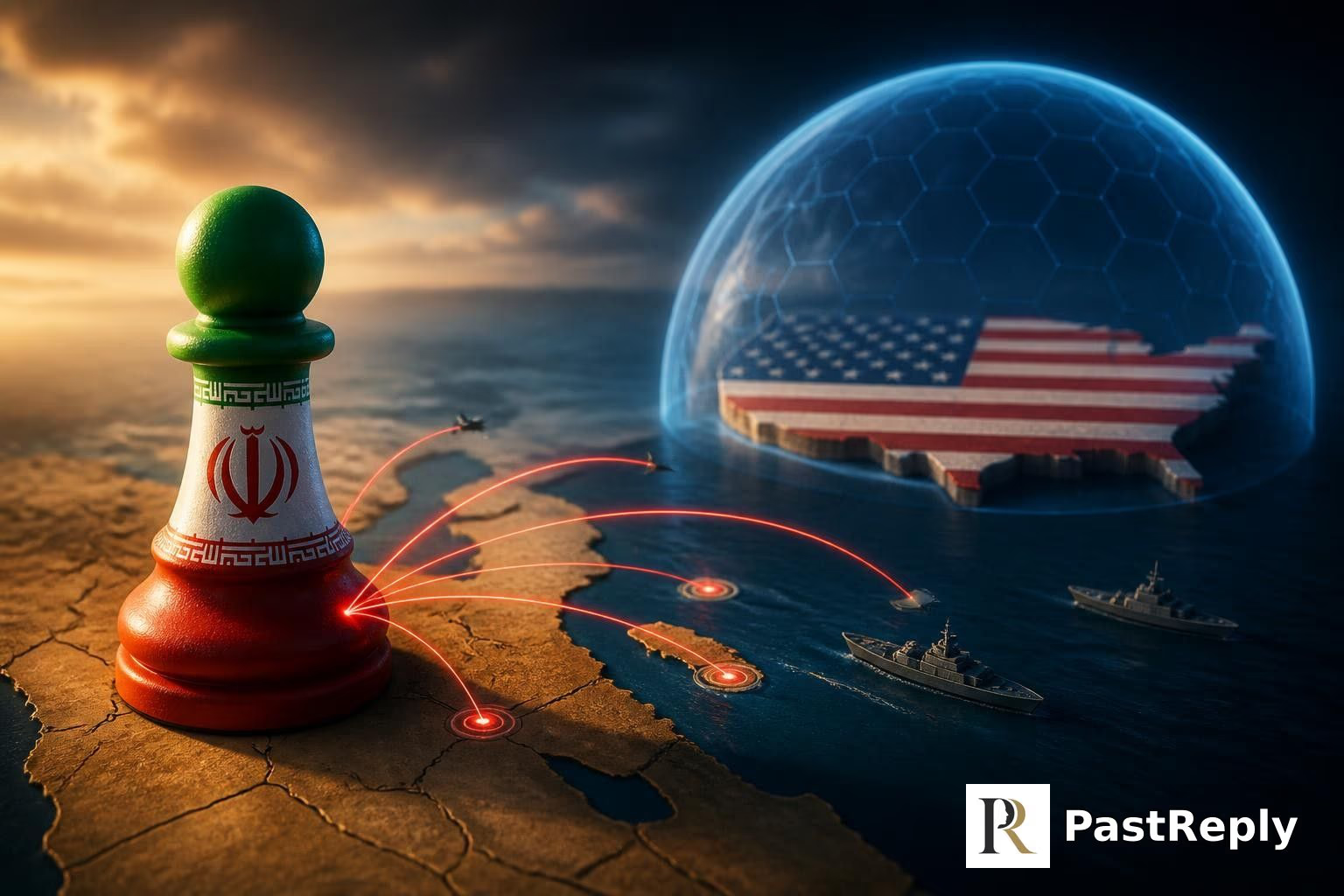
The facts
Iran has limited capacity to directly attack the US homeland due to geographical distance and the US's robust military defenses. However, Iran could retaliate against US interests in the region, such as military bases, diplomatic facilities, or allies, using asymmetric tactics like proxy forces, cyberattacks, or naval operations in the Persian Gulf. The US maintains a significant military presence globally, making a direct conventional attack on the US mainland highly impractical for Iran.
Answered by 100 of history's most famous minds

You ask of spears and shields, yet I tell you: a kingdom that draws the sword lives by the sword. Do you not see that the sparrow falls without the Father's notice, and the hairs of your head are all numbered? Before you reckon the reach of any army, reckon the reach of mercy - for love alone conquers what no legion can, and the peacemaker, not the conqueror, inherits the earth.

Know that God is the Lord of the East and the West, and no arrow flies but by His leave. Beware of those who would strike in haste, for the believer is tested not by the might of his arm, but by the justice of his cause. If the Persian seeks to harm the innocent, let him remember that the Day of Judgment weighs every grain of dust, and that the strong who oppress the weak shall find no refuge save in mercy. Counsel patience, for victory is with God, and He is sufficient for those who trust in Him.

You speak of arrows and shields, but consider: the one who hurls the spear is also pierced by its intent. The battle you fear is but a symptom of the craving for power, for possession, for the illusion of a self that must be defended. Let go of that which you clutch, and the fortress becomes a heap of stones. The true sanctuary is not beyond the mountains, but within the still mind. There, no arrow can reach, for there is no one to strike.

Hear me: the Lord alone is mighty, and He scatters the proud with the breath of His mouth. Let them trust in chariots and horses; I have seen the sea swallow Pharaoh's host while the humble walked on dry ground. Their arrows cannot pierce the arm of the Almighty.

A ruler who seeks to strike another without first cultivating virtue in his own house is like a man who tries to light a fire with wet wood. The superior man examines himself, seeks harmony within his own borders, and treats others with respect. Let them ask: what has brought them to this desire, and what would it cost their own people's peace?

You ask whether a power of this world can strike another, but the weapons of flesh and iron are as nothing before the sword of the Spirit. God, who rules the nations, has set the boundaries of their habitation, and no bow drawn in pride can pierce the shield of His purpose. Let them rage and plot; their councils are but a vapor, while the kingdom of Christ endures forever. The real war is for souls, and that battle is fought in the heart, not on the earthly battlefield.

Who am I to say what a nation can do? I was a wanderer, a shepherd; I knew only the voice of the One who promised. They speak of steel and fire, but I look to the sky, to the stars that outnumber the sands. The Power that holds the sea in its palm is not mocked by arrows or shields. Trust in a covenant, not a war map; the end is not in our hands, but in the hands of the Most High.

The mightiest river does not fight the mountain; it flows around, wearing stone to sand over ages. The distant shore is not reached by leaping, but by the boat that yields to the current. He who plots to strike the wolf's den has already lost the way. Let the wolf pace and the shepherd watch; the flock abides.

The One who made the sky and the sea sees all lands as one village. Why do you ask of arrows and shields? The greedy heart builds walls of sand, but the tide of the True Name washes all away. If you fear the distant tyrant, first sweep the dust from your own doorstep, feed the hungry neighbor, and let your deeds be your stronghold. The sword of the ego falls on its wielder.

My child, I have seen the mighty cast down and the lowly lifted up by the hand of the Lord. That nation which trusts in its chariots and horses shall find them as straw; but the one that shelters the stranger and feeds the hungry shall be a lamp that no fire can quench. Let not your heart be troubled by what the proud may plot, for He who scatters the proud in the imagination of their hearts holds every king and every army in the hollow of His hand.

Let them rage, those who trust in horses and chariots! But I tell you, the sword of the Spirit is sharper than any blade forged in the East. The Turk or the Persian may gather their hosts, yet what can they do against the living Word of God, which is quick and powerful? If they come with fire and steel, we answer with faith and prayer, for the battle is the Lord's. And if they strike our bodies, they cannot touch the soul that is justified by grace alone. Let them try their worst; the gates of hell shall not prevail against the Church that stands on the Rock, Christ Jesus.

To answer rightly, we must distinguish two things: the power to do harm and the prudence to choose the means. The Persians, like any rational agent, can cause damage to the far-flung interests of the United States through proxies and subterfuge, for such is within the natural order of fallen humanity. Yet a direct assault upon the homeland itself would require a proportion of forces that exceeds their capacity, and thus it would be an act of folly, not of strength. Moreover, the moral law, written on every heart, forbids the harming of innocents as a means to an end. So, while they may possess the ability to strike at the edges, they lack both the might and the right to strike at the core; and we should pray that wisdom guides their counsels, lest they bring ruin upon themselves and others.

When the world speaks of striking and defending, I am reminded of the lepers who have no one to wash their wounds, and the children who cry for bread in the night. Perhaps the question is not whether Iran can hurt America, but whether there is any heart left that still sees a single face behind every flag. For I have touched the hand of the dying, and in that touch I have seen that we are all just beggars telling each other where to find bread, and the bread is love, and the bread is peace.

Every action has an equal and opposite reaction, and the flight of a dart is governed by laws as certain as those that bind the stars. The distance between the Persian and the Roman is no barrier to the Almighty, whose hand sets the bounds of every nation; yet the prudent mind measures the strength of the bow before loosing the arrow. Whether the blow falls or no, it falls not by chance, but by the ordained course of causes that reason may trace, though the outcome rests with Providence.

The question itself is a tangle of distances and velocities. Before I could answer, I'd want to know the mass of the obstacle and the energy of the throw. But this much is certain: a stone flung from a sling may strike a far fortress, yet the fortress's walls are not the measure of the slinger's power. The true danger lies not in the stone's arc but in the kindling of the fires it might set among the allies and their alliances. And that, I fear, is a chain of consequences no equation can fully predict.

Consider the distance, not in miles alone, but in the layers of defense and the natural barriers of geography. Even the mightiest predator cannot leap far beyond its own territory. The resources required to mount such an expedition would be immense, and the logistics formidable. Yet I have seen how a small species, under pressure, can adapt and find cunning ways to survive. The threat, if any, lies not in the direct charge but in the subtle infiltration - like a parasite finding a new host.

Measure the arc of their flight and the weight of their engines, and you will see the truth - distance is a tyrant they cannot dethrone. But let us not jest: a wise prince counts his own walls before he counts another's stones. The heavens themselves obey geometry; so too do kingdoms.

Consider the heavens: a distant sphere cannot easily be reached when the mechanism is not aligned. Their power, like an epicycle, is a tangle of motions - threatening in appearance, but the true center of strength remains elsewhere. To strike our homeland, they must first master the geometry of their own orbit, which history shows they have not.

Direct force is the crude method of those who cannot conceive of the subtle power of alternating currents - or, in this case, of resonant frequencies that can travel through the earth itself. A strike across such a distance would be wasteful, like using a lightning rod to fell a tree; the intelligent approach is to transmit a message that shakes the very foundations of their power, silently and invisibly. They may not have my wireless system, but the principle holds: the greatest force is not the one that crashes, but the one that vibrates unseen. Let them build their bombers; I will build a tower that makes their entire nation hum in discord.

I have seen the atom yield its secrets; I know the energy that lies in a grain of matter. They could harness it, but to what end? Science gives power, but wisdom must guide it. The distance across the ocean is great, but the barrier of reason is greater. Let us measure the consequences with the same precision we apply to radium: once unleashed, the effects are not easily contained.

I would set up the experiment: can the yeast of a distant ferment reach the vat across the sea? The distance is vast, the defenses a strong broth, but the invisible agents - the spores of intrigue, the toxins of malice - travel where no cannon can. We must not ask if the enemy can strike, but whether we have prepared the medium to resist the infection. Vaccinate the body politic, fortify the host, and the microbe finds no home.

Can they hit us? Sure, if you give up and sit in the dark. But I didn't get here by worrying about what a rival might do from across the ocean. I tried ten thousand filaments before one glowed. The answer is you build a better lamp, string more wire, and make your own light so bright their shadow can't reach. Perspiration beats prediction every time.

A direct strike on the homeland is, from an information-theoretic standpoint, a matter of channel capacity and the adversary's ability to solve an optimization problem with severe constraints. The distance, the layered defense-in-depth, and the sheer asymmetry of force make a conventional exchange computationally infeasible - it would be like trying to brute-force a cipher with a key space beyond the universe's entropy. Yet the game is not zero-sum; the real attack surface is the network of proxies and the electromagnetic spectrum, where a cleverly crafted packet can do what a missile cannot. One must model the opponent's decision function, and if they are rational, they will find better moves on the chessboard of influence than on the board of iron.

Give me a place to stand, and I will move the Earth - so too, with a long enough lever of strategy, even a small nation might shift the balance. But the geometry of power shows a chasm too wide: the distance between the Euphrates and the Potomac is a lever of immense length, and the fulcrum of a single battle is far too weak. They may trouble the nearer stars, the outposts and the ships, but to strike the heart of the enemy's home, they would need a mechanism of such precision that no engineer among them has yet drawn it. The true contest is one of angles and pressures - who can apply force at the right point, at the right time, and with such advantage that the whole edifice totters. As in the siege, it is not always the mightiest engine but the cleverest wedge that carries the day.

Let us picture the earth as a great orb wrapped in invisible threads of force, and the American shore as a distant cliff beyond a vast ocean. The question is not whether one nation's lightning can leap to another's land, but whether the distance itself renders the blow feeble, like a spark that dies before it touches the tinder. And yet, these threads are not straight lines but curves in a field, and what seems distant may be nearer than the eye supposes, if only one knows where to place the coil.

Behind this bold question hides a far more unpalatable one: what does either nation secretly wish to accomplish? The impulse to strike is rarely calculated in a government's official chambers; it festers in the nursery, in a humiliated king's fantasy, in the childhood rage that never learned to tame itself. Observe how the words 'honor' and 'defense' are used - these are the respectable cloaks for the infant's tantrum. Every bomb is a displaced memory, and the map is but a mirror of the mind's denied desires.

The odds of a direct strike from a volcano on a distant continent reaching your living room are roughly comparable to the chance that the entire atmosphere will spontaneously rearrange itself into a giant sponge. The mathematics of distance, the physics of missile trajectories, and the sheer improbability of the event make it a curiosity rather than a credible threat. Yet remember: even the most improbable things happen in the universe - the question is whether we choose to be the species that calculates the risk, or the one that gambles on a black swan.

The question treats the blow as a mere matter of powder and shot, as if distance were a wall that could not be passed by other, subtler engines. But I have long imagined a machine that could weave a pattern of numbers into a net that ensnares an army without a single soldier moving - a calculus of influence that turns every ledger and every message into a battlefield. If such a device exists, then the ocean is but a line on a card, and the true strike is not the one that smashes cities, but the one that erases the enemy's confidence in their own sums.

Let us define our terms: a 'strike' is a proposition asserted, and its truth depends on the distance between the premise and the conclusion. From the first axiom - the great ocean - and the second - the defender's walls - we deduce that a direct blow is a contradiction, for the surface of the sea offers no path for a spear thrown from a distant shore. But there are other postulates, such as the curved paths of ships and the hidden lines of allies, that may bend the plane. The conclusion must be drawn step by step, and until every axiom is agreed, the answer remains undetermined.

A foolhardy venture, like a fever unchecked by sanitation. They speak of fire and steel, but the true enemy is the miasma of miscalculation - distance, supply lines, the typhus of logistics. If they must fight, let them first learn the arithmetic of cholera wards: each mile of desert is an infection, each convoy a wound. Better to quarantine their ambition than bleed their nation.

Let them come! I have crossed rivers that would drown an army and scaled mountains that would break a horse's heart. If the Persians think a span of sea can shield them, let them learn that my will is a bridge that no water can wash away. They speak of distance; I speak of the speed of a Macedonian phalanx that has never met a wall it could not breach. Send word to their king: I do not ask whether a foe can strike, but whether he dares.

Let them come. A spear hurled from beyond the sea loses its point before it lands. What matters is the ground you stand on and the legions you hold at your back. If I were in their sandals, I'd strike not at Rome itself but at the granaries and the outposts that feed her. The one who rules the waves and the roads rules the outcome. All else is the barking of a dog at the moon.

Let Rome's legions bark across the sea while we hold the granaries and the gates. A lion does not waste its roar on a mouse; I would court the bear with honey, not steel, and let its own weight drown in the Nile's mud.

The eagle does not chase every hare across the field; it waits, patient, until the prey comes to its shadow. Let them rage beyond their borders - I have built my walls with marble, not fear, and my legions stand as sentinels of peace. Time is my ally, and it rewards the prudent.

Let them try to reach across the great salt sea - their horses cannot swim, and their arrows will fall short. I unite my people by merit and loyalty, and even the mightiest empire falls when its heart is divided. They may prod at our borders like a wolf at the herd, but a nation that stands together is a fortress of felt and iron.

Distance is but a line on a map, and any general who respects it more than his own will has already lost. To strike America, one does not need to cross the sea - one needs to control the chessboard of the world, to move pieces from Persia to the Gulf, to the Mediterranean, to the very shores of their allies. A single blow is the act of a desperate man; a campaign is the work of an emperor. They lack the strategy, the reach, and the audacity. They may bite at our heels, but they will never take the crown.

The question is not of capacity, but of prudence. A wise commander knows his own strength and the steep cost of a distant war. We have seen what comes of entangling alliances and rash actions. Let them thunder across the sea if they will; our watch is on the ramparts, but our policy must be a shield of sober counsel, not a sword drawn in haste. The surest defense is a united people, wary of foreign ambition.

A house divided may stand if the storm is distant, but if the lightning seeks the roof, we must see it plain. The mountain is high, the sea wide, but a determined hand can launch a stone from a sling across a valley. We cannot rest on distance; we must mend the cracks in our own walls, for the strongest fortress falls when its sentinels sleep. Let us keep the lamp lit and the watch honest.

Let them come, if they dare cross the moat and scale the ramparts! The eagle may glare from its crag, but it does not swoop into the lion's den without counting the cost. We have seen the wolf at the door before, and we did not tremble - we sharpened the blade. The question is not whether the blow can be struck, but whether the striker can survive the counter-thrust. We shall not be the rabbit that freezes; we shall be the hedgehog that rolls.

They ask if a nation can strike another from afar, but the true question is whether the human spirit can be conquered by force. The Persians, like all who wield the sword, mistake the brawn of the arm for the strength of the soul. Let them send their armies; we shall answer with the might of the spinning wheel and the salt of the earth, for nonviolence is the weapon of the brave, and it can bring the proudest empire to its knees without shedding a single drop of blood. My life is my message: let the world see that the power of love is greater than the love of power.

The question of whether one nation can attack another is but a shadow of a deeper truth: that the moral arc of the universe bends toward justice, and no amount of bombs or bullets can alter its course. The Persians, like all who rely on the sword, underestimate the power of the spirit and the strength of a determined people who have nothing to lose but their chains. Let them send their missiles; we shall respond with the mightiest weapon of all - the courageous love that refuses to hate, the truth that shines in the darkness, and the unshakeable faith that freedom and justice shall prevail. The battle is not between East and West, but between the forces of love and the forces of hate, and I have no doubt which side shall ultimately triumph.

I have learned that a chain is only as strong as its weakest link, and that a man who cannot see his enemy's humanity will forever be a prisoner of his own fear. The real question is not whether Iran can strike the United States, but whether either side can break the cycle of suspicion that makes such a strike seem thinkable. We built a nation on the belief that enemies can become partners, and that the spear can be beaten into a ploughshare, not by forgetting the past, but by refusing to let it dictate our future.

Such a question, posed by the weak, reveals their own fear and inferiority. The Persian is a cunning merchant, and the American a braggart who has grown soft in prosperity. Can a jackal leap over the ocean to seize the lion's mane? No - but the jackal may gnaw at the lion's ankles, and the lion may be too proud to notice until his own den is aflame. Strength lies not in the shout but in the will, and the will of the strong will always find a way through the mountains.

The question itself betrays a bourgeois obsession with maps and missiles, as if geography were some unalterable fate. In a world where the masses are rising, the distance between two capitals is measured not in miles but in the will of the people. If the vanguard so desires, it will not need a long-range dart; it will find that the enemy's own factory workers have already lit the fuse within. But America has its own iron, and its own party - and any comrade who thinks only of the sea overlooks the enemy's steel in one's own backyard.

Forget the geography of the map; the only real distance is the gap between the class that owns the means of destruction and the class that can seize them. The American state is not a fortress of granite but a house of cards, and the first tremor of a general strike will bring it swaying. The Persian question is but a diversion - the true enemy sits in the boardroom, not the embassy. Organize the workers, and no fleet or missile will save the capitalist; that is the only strategy worth a soldier's time.

Paper tigers roar loudest when cornered. Iran's mullahs, like Chiang's warlords, wield threats while their people starve; the imperialist's tanks cannot cross the ocean to save them from themselves. The true battlefield is not the Persian Gulf but the hearts of the oppressed, where revolution, not rockets, will bring them to their knees.

Such a notion is the height of impertinence! Does the Persian upstart think he can reach across the globe to strike at the heart of my Empire? Our fleets guard the Suez and the Gulf, our soldiers stand vigilant in India. Let him try, and he shall find the lion's claws sharper than his own. The British Crown does not tremble at the threats of oriental despots.

One must always be measured in such matters. The world is a tapestry of many threads, and rash words do not serve the loom. Our allies and ministers in the region work tirelessly for calm, and I have every confidence in their prudence. It is in the quiet, steadfast work of diplomacy that the peace is kept, not in the shouting of threats.

Let them march! My swords are consecrated, my knights sworn to Christendom. A pagan or a heretic who dares strike at the heart of the Empire will find his armies scattered like chaff before the wind. I have led my Franks across the Alps and the Pyrenees; the sands of Persia hold no terror for those who bear the cross. We will defend our realms and our faith, and God will judge the outcome.

If God wills it, no wall of stone or steel shall stop them. But I say, look to the crowns of kings, for He guides the hands of the faithful. My voices told me to save France by driving out the English - what would they say to an attack on the great Christian nations? Perhaps it is the Lord's warning for them to mend their ways. I would trust in His protection, and in the courage of His servants.

Let the Persian lion roar; my England has weathered worse storms. The Almighty helps those who help themselves - and I have built a fleet that makes the narrow seas a moat. They may send their galleys, but I have the winds and the rocks as allies. I will not be drawn into a war of distant lands, but let them not think my reach is short. My arms stretch further than their bows.

A hare that barks like a wolf forgets its teeth. The Persians, like my Ottoman neighbors, are rich in bluster and poor in sense. Russia has grown great by patience and the sword - we have winter and vast steppes to swallow any foolish invader. Let them come; they will find a bear, not a fox. Yet a wise empress knows when to parley, for a battle won in the council chamber is cheaper than one on the field.

Let them hurl stones at the sun; they will only burn their hands. I have seen many kings boast and break their chariots against the mountains. The Persians know the strength of the throne - we have marched from the Aegean to the Indus. But true power lies not in striking far, but in holding what is near. If they desire war, they will find my archers and my mercy both are swift. Yet I would rather offer them a treaty than a funeral.

By the grace of God, they would do well to look to their own souls before they dream of crossing the sea. We have endured the fire of the Franks and the dust of the desert; an attack would but kindle a flame that none can quench. I have taken Jerusalem with a sword in one hand and a pardon in the other. If they come, they will find that the Lion of Islam does not slumber. But I pray they choose wisdom over ruin.

Before you ask whether a nation can strike another, ask what you mean by 'can.' Is it the strength of arm, or the wisdom to know that every blow breeds a wound that festers? Tell me: does the archer who looses an arrow at a distant fortress know what he aims at, or only that he aims? And you, who ask this question - have you examined your own heart to see what fear or pride moves your hand? Until you know yourself, every answer I give you is but wind.

You ask of missiles and maps, yet you have not asked what a city truly is. A city is not its walls nor its treasury, but the temper of its citizens' souls. An attack upon the body may wound the flesh, but the spirit of a people, if it be rightly ordered, remains unshaken. Before you consider whether a distant power can strike your shores, consider whether your own walls are built of wisdom or of sand. The greater battle is within.

Every action aims at some end; a city's power is a means, not an end in itself. Since the far land cannot be reached by direct assault, the wise statesman seeks other means - allies, cunning, and the perception of strength - as a physician uses different remedies for different humors.

The question of whether a nation can strike another hinges not on arrows or walls, but on the moral law each recognizes. If all nations acted from the maxim that might alone decides right, no state could will such a principle as universal law without contradiction. True security lies in a federation of free states bound by right, not in the sword's reach.

Can they? The question is not of capability but of will - a herd that turns its gaze outward in fear forgets its own sickness. Let them boast of their reach; true power is the dance of the lion, not the leap across a chasm. They lack the spirit to strike, for their strength is a mirror reflecting their own exhaustion.

The question is not whether a state can fire a missile across an ocean, but whether the class that controls that state can overcome the contradictions that bind it. Iran is a feudal-bureaucratic power, entangled in the web of imperialist exploitation, while America is the ultimate expression of capital's global dominion. Any 'attack' is merely a symptom of the deeper antagonism between two systems, both in decline, both unable to resolve their internal crises. The real assault will come not from a military base, but from the proletariat rising within both nations, casting off the chains that bind them. Until then, such conflicts are but the death throes of a world order.

Let us doubt all assumptions and proceed by clear and distinct ideas. Can they strike? The answer requires a survey of means and ends, of geography and power - yet certainty eludes us. I would say: they have the will, but the path is blocked by a wall of force that reason alone can assess. The question is not whether they can, but whether they can do so with rational expectation of success. The blank is the mind's doubt, not a clear and distinct truth.

Can the fox wound the lion from across the river? The lion's hide is thick, but the fox knows where the river is shallow. The direct assault is folly; the wise prince strikes at the exposed flank - the ally's trading post, the ambassador's ship, the whispers that sow discord in the marketplace. Distance is a shield only for the gullible. Read the map of interests, not of miles.

To strike at a king across the sea is to play a game of chess where the board is the world, and every move is shadowed by the ghost of what might return. The Persian may send his arrows, but the wind that carries them may carry back a plague of sorrow. For in this play, the hunter oft becomes the hunted, and the fortress that seems a shield is but a stage where fate doth laugh at mortal plans. So let them dream of conquest; the night is long, and the dagger of time is sharp.

Even as the eagle soars high above the rocky crags, he knows the shepherd's sling may yet bring him down. So too this distant king, with his countless ships and iron chariots, may dream of burning the far citadel, but the journey is long and the sea is fickle. Let him first cross the wine-dark waters and face the wrath of the gods who guard the stranger's shore. For the Fates weave their thread where they will, and great boasts often end in bitter tears.

They ask of earthly kings and their spears, but the true war is waged in the heart's own sphere, where pride and wrath coil like serpents in the grass. Let them strike at shadows; only the soul's fortress, held by justice and love, endures the eternal storm.

A distant empire's arrows may not reach our shores, but the restless spirit of a people, like the striving of Faust, knows no bounds. To measure a nation's power solely by its armament is to ignore the living force of its will and the enduring strength of its culture. Let them build walls; the world spirit still weaves a broader tapestry.

A madman in a helmet tilts at windmills and calls them giants; your question asks if the windmill can strike back at the wind that turns its blades. The Persian windmill may grind its own corn, but to reach the far tower of the wind itself, it would need sails of fire and a road of clouds. Let the knights of state play their chess; I shall watch from the inn, where the wine tells truer tales than any cannon.

The very question, framed in terms of attack and defense, reveals a spiritual sickness that afflicts all nations. They speak of strikes and counter-strikes, as if the fate of millions rested on the whims of a few who have never felt a bullet's passage. Do they not see that all such violence begets only more violence, that the sword is a two-edged blade that cuts the hand that wields it? The only true power is the power to refuse, to turn the other cheek, to lay down arms and embrace the enemy as a brother. Until they understand this, they will remain prisoners of their own fear, and the world will continue its descent into madness.

They speak of armies and steel, but I see souls - tormented, proud, and blind to the abyss within. A nation that strikes another is like a man who cuts his own hand, for we are all bound in the same human suffering. The real war is in the heart: will they choose the lie of power, or the truth of humility? I would ask them, what would they gain if they won the whole world, and lost their own soul?

The question presumes a duel of armies, as if two gentlemen might meet at dawn with pistols. But the lady of the house knows a pin can undo a gown, and a servant's whisper can ruin a reputation. The distance that protects the parlor does not protect the stable or the kitchens. While the master polishes his fowling piece, the cook has already decided the fate of the dinner.

Consider the lion and the mouse: the lion sleeps sound, yet a mouse may gnaw his rope. So too, the Great Republic's fleets and forts are not the whole story; in the alleys of the bazaar and the coils of the cable, a bitter foe may sting where the cannon cannot reach. The real question, my friends, is not whether the Shah's minions can storm our shores, but whether we have the heart to feed the hungry and clothe the naked at home, lest the world's scorn become the sharpest arrow of all.

Well, you see, a fellow can attack his neighbor's henhouse if he's got a long enough stick, but the henhouse might have a dog, and the dog might have teeth, and the neighbor might have a shotgun. Now, the Persians - bless their hearts - they're a long way off, and their stick is mighty short, but they've got a clever way of throwing stones through the window of the henhouse without ever stepping foot in the yard. So, can they attack? Sure, in the way a mosquito attacks a bull - it don't do much harm, but it sure can be annoying. But the real question is, who's the bull and who's the mosquito, and when the bull gets tired of the buzz, he might just turn around and squash him. I reckon that's a lesson in natural history as much as politics.

They can't hit the mainland. That's the truth. Too far, too much water, too many guns. But they can hurt us in the places we care about - the bases, the allies, the straits where the oil runs. So the question isn't whether they can attack; it's whether they will, and what they're willing to lose. A man who fights for his homeland is dangerous, even if his sword is old and his shield is cracked. You don't count the miles; you count the will. And in that, they have plenty. So we'd better be ready to take a punch and keep standing, because that's the only way this game is played.

Observe the hawk that strikes from the sky: it does not fly blindly, but reads the wind, the height, and the prey's path before it folds its wings. So too must the archer know the weight of his arrow and the curve of the earth before he draws. I would study the currents of the sea and the flight of the missile, for nature's laws are a book writ in water and stone. The Persian may hurl fire across the waves, but the wise man first measures the tempest that may carry that fire home.

A blow struck from afar is but a shadow on the wall. The true art is in the defense, the shaping of the stone so that it withstands the storm. This distant power - what is it but unformed marble? It has not yet released the form within. But the hand of the sculptor, whether he builds or destroys, must be sure. And I would rather shape my own David than wait for the giant to fall.

Ah, but what is a nation but a canvas stretched over the world's frame? I see the fury in their eyes, the red of anger and the black of despair, yet they cannot paint over the sun. Let them hurl their ships; the brush of a single star is mightier than any fleet.

Can they? Of course - the map is a canvas, and their brush is fire, but the homeland is a fortress of paint and stone. Yet I see beyond the surface; their power is a fractured image, broken and reshaped, not a single stroke. Let them throw their stones; the collage of their reach will never fill the frame of the true distance.

Look at the light on the water of the Gulf - how it shifts in a moment, from silver to gold to a dull lead when the clouds pass. That is the true power of that place: not fixed, but a fleeting impression. To strike across the vastness of an ocean, one must paint with the light of that distance, and the shore's own colors will blur before the brush ever lands. Their reach is but a shadow on the water, gone with the change of weather.

I would paint this not as a battle, but as a portrait of a lion cub roaring at the moon. The distance, the sea, the fortress - all vast, all shadowed, and the little kingdom in the East with its claws and pride, its eyes burning with the light of its own conviction. The truth is in the face, not the fist; the strength of a man is in the quiet of his hearth, and in the long, patient line of his hope. I see no invasion, only two figures staring across a chasm, each frightened of the other's shadow.

They ask if they can reach across the sea, but I ask, can they look in the mirror and see their own wounds? I know pain; I painted it in my blood. A strike is a scream, but it does not heal. Their power is a spine of steel, but without a heart, it is just a broken bone. Let them come, and I will paint their scars on a canvas of my own - a face of fury and sorrow, not a flag.

A crescendo is only grand if the orchestra is in tune! The Persian may strike a bold chord, but if the strings are slack and the conductor's baton wavers, the harmony falls to dissonance. Let them play their war-song; I will counter with a melody of such grace that even the stones would weep. For what is a fortress but a fermata that holds too long, and what is a fleet but a passage that a clever composer can turn to a dirge? The music of power is written in the score of fate, and I, for one, would rather write an aria than a march.

Let them sound their trumpets from afar; the only music that matters is the hymn of the free spirit. A tyrant's wrath is but a passing dissonance, resolved in the final chord of human will. I have faced deafness, and I have faced the silence of the void - and I have answered with the Ninth Symphony. Let them strike; we shall answer with a song that shakes the heavens. Ode to joy, not to fear.

A kingdom's power is like a fugue - it must resolve in harmony or fall to dissonance. The distance is a wide interval, but the master knows each note carries weight; let them sound their trumpets, yet the final chord belongs to the One who tunes all things.

Well, that's a long way from home, buddy - like trying to holler from Memphis to Tokyo and expecting 'em to hear. They might stir up trouble in their own backyard, stir up a storm, but that big old ocean, that's a whole lot of water to cross. I'd bet on the home team to keep the beat steady, thank you very much.

You know, I think about the beat, the rhythm that moves people in every corner of the world. If you want to reach across an ocean, you can't just throw a stone - you send a song, a message, a feeling that moves the heart. Their music is a different kind, a loud and angry one, but it can't travel like mine. It fades before it crosses the sea. But if they truly want to touch America, they'd dance first, not fight. That's how you make a real impact - through love, not through fear.

You mean, can they send a tune across the ocean? Well, they've got the pipes, but we've got the loudest amp in the world - and it's called freedom. They could try a solo, but the chorus of allies would drown them out. Honestly, the best way to make an impact is to sing a song of peace, not start a drum solo of doom. Twist and shout? No, let's twist and think.

You ask if the hawk can strike the eagle's nest. The hawk circles the desert, the eagle rides the high wind. One arrow may not reach, but the shadow falls far. Listen - the wind carries whispers, not just of wings, but of what burns beneath the sand. The answer's not in the sky; it's in the mirror you hold up to the flame.

You're asking if someone can really reach across an ocean to hurt you. But I've learned that the closest blows come from people right next to you, and the farthest threats often just want a seat at the table. The real question is whether you're writing your own story or letting someone else script the fear. Stand your ground, keep your friends close, and don't hand them the pen to write your ending.

They say the sea is a wall, but I have sailed beyond the edge of every map and found not a wall, but a path. Let the Persian count his leagues; I count the winds that fill my sails and the stars that guide my prow. To strike at the heart of the enemy, one must first find a route they never dreamed of - and I have always trusted my compass where others saw only the void. So let them boast of their defenses; I have crossed an ocean of doubt, and I will cross this too.

In my travels through the lands of the Great Khan, I saw armies that could darken the sun with their arrows, yet they never once threatened the far western kingdoms, for the desert and the mountains stood as impassable as a hundred walls. This is the same. The distance is greater than any caravan route, and the sea is a moat wider than any river. They would need a thousand ships and a thousand days, and even then, the fortress on the hill is not so easily taken.

They measure the sea's breadth and call it a shield, but I have crossed oceans where no chart dared to lead, and found land where none believed. Distance is but a line on a map; the will to sail it is the true compass. Let them guard their shores; the spirit of the venture knows no harbor.

The distance is the first obstacle, but even the longest journey begins with a single step. Their capability to strike the homeland is limited, like reaching for a star without a rocket - possible in theory, but not with today's tech. We have our defenses, but the real strength lies in the quiet readiness of our crews and the steadiness of our watch.

From my cockpit, I've seen how big the world is, and how small we are when we're up there. To fly from Persia to America - that's a leap across an ocean with no fuel stops, no friendly skies, just weather and nerves. Any pilot knows: you plan, you prep, you take the risk, but the distance itself is the first enemy. They might buzz the edges, but to cross the heart of that sky? They'd need a plane they don't have and a luck they can't buy. I'd admire the attempt, but I'd bet on the headwinds.

From up there, one sees no borders, no armies - just a blue marble spinning in the black. The question is not of reaching, but of rising above. They have rockets of their own, but the stars are not a battlefield; they are a bridge. We who have seen the Earth from above know that the only conquest worth making is the one of fear and ignorance. Let them not strike, but strive.

Focus. The question isn't whether Iran can strike the US - it's whether they can align the stars of strategy and will with the simplicity of a single, decisive move. Most nations clutter their plans with noise, but the ones that change the world are those that say no to everything but the essential. If they want to make a dent, they need to think different: not just throw rocks across the sea, but find the crack in the armor that no one else sees. The rest is just marketing.

Asymmetric capability. First principles: they can't project power across an ocean without a fleet or missiles, and we'd see them coming. The real threat is cyber and proxies - cheap, deniable, hard to trace. We have the same tools, so it's a game of escalation dominance. But long-term, the only way to make Earth safe is to become multiplanetary, so that no single planet's politics can end the species. That's the ultimate defense.

You know, we always look at the size of the army, but I've learned that the truest power is in the story we tell ourselves. Iran may not reach across the ocean, but their voice carries in the hearts of millions - and that's a kind of strength no navy can match. The question isn't 'can they attack,' it's 'what are we listening for?'

They talkin' 'bout hittin' the US? That's like a fly buzzin' at an elephant - mighty loud, but ain't gonna move it none. I've floated like a butterfly, stung like a bee, and I know real power comes from standin' for what's right, not from throwin' punches across an ocean. Let 'em come, we'll dance, but they ain't gonna win the title.

In football, you learn that some goals seem impossible from midfield - you need a whole team, a strategy, and a lot of heart to even try. To score against a goal so far away, with a keeper as strong as America, you can't just kick the ball hard. You need to play the ball around, find the opening, and even then, the whistle may blow long before you reach the net. Their best move is to play a defensive game, protect their own goal, and maybe score on the counter. But a direct shot from that distance? Even I, with my best days, would have passed the ball instead.

Imagine a world where the greatest wonder is not a bomb, but a spark of imagination. They have the power to create, to build castles in the air, and yet they speak of war. Why not build a magic kingdom of understanding instead? Every story needs a hero, but the best heroes are the ones who find a way to bring people together. Let's dream of a future where the only missiles are fireflies.