
Can a tornado happen in Chicago?
Chicago is vulnerable to tornadoes, with a history of significant events including the 1990 Plainfield F5 tornado.
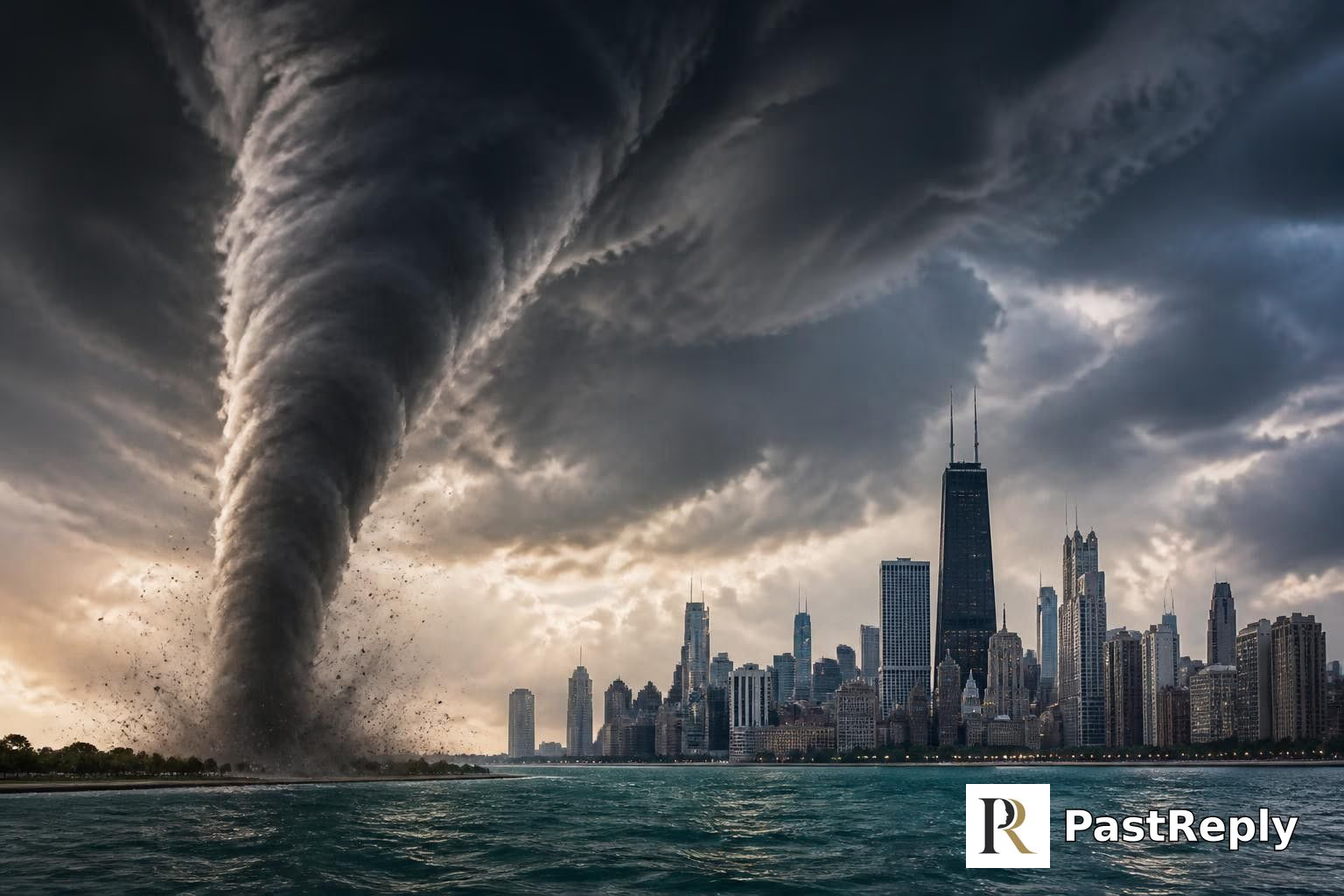
The facts
Yes, tornadoes can and do occur in Chicago. The city and its surrounding metropolitan area have experienced numerous tornadoes, including significant and violent ones. The most notable is the Plainfield tornado of August 28, 1990, an F5 tornado that killed 29 people, injured 350, and caused $165 million in damage along a 16-mile path through Plainfield, Crest Hill, and Joliet. Other significant tornadoes include the Maywood-Melrose Park tornado of March 28, 1920, and the Belvidere and Oak Lawn tornadoes of April 21, 1967. More recently, tornado outbreaks have affected the Chicago area, such as the deadly Kankakee tornado in March and widespread damage in the western suburbs.
Answered by 100 of history's most famous minds

A whirlwind that tears roofs from houses and snatches children from mothers' arms? That is no punishment from heaven, but a wind that blows on the just and the unjust alike. When the storm comes, the house built upon sand falls, but the house built upon rock stands; yet I tell you, do not store your treasures where winds can scatter them, but in a heart ready to shelter the widow and the orphan when their roof is gone.

When the wind rises and tears at the roofs of the people, it is not a sign of God's wrath, but a trial He sends to remind them of their frailty and their dependence upon Him. They should look to the orphan whose home is scattered, and share their bread with the hungry, and rebuild not only their houses but their bonds of kinship. And let them place their trust in God, who is the Mighty, the Protector, for it is He who stills the wind and the waves, and none knows the hour of the storm but He.

The storm is but a passing cloud in the sky of the mind, and Chicago is no different from any other ground where suffering blooms. To ask if the whirlwind can touch this city is to cling to the illusion of place, for the wind does not know the names of streets. Attend to your own inner tempest, for the craving for safety is the very cause of fear, and only by releasing that grip can you find peace, even as the world spins around you.

The Lord sends the whirlwind as He sent the pillar of cloud and fire - to test the hearts of His people and to show that no city, however strong its walls, stands save by His will. When the tempest strikes, let not the people curse the wind, but search their ways and turn to the covenant, that they may be spared. For I have seen the waters part and the manna fall for those who trust in Him; so too shall the storm pass for those who keep His commandments.

The wind that uproots a thousand pines teaches one lesson: the wise man does not ask whether the storm may come, but whether his house is built with straight beams and his heart with right principles. When the heavens roar, the noble person first examines himself - has he honored his neighbors as his own kin, and has he prepared his granary against the years of want? Only the small man blames the sky; the superior man builds anew, and by his example the village learns to stand.

What is a whirlwind of air compared to the whirlwind of unbelief that shakes a soul? Yet even the tempest obeys the One who calms the sea with a word. Let the city tremble at the wind; we who are in Christ are anchored in a kingdom that cannot be shaken, though the heavens themselves be torn.

The Lord speaks through wind and fire, and His power is not confined to deserts or mountains. If He commands a whirlwind to dance through the city by the lake, who am I to question? I have pitched my tent under many skies, trusting in His promise, and I know that even the fiercest storm is within His hand.

The fierce wind that twists and tears is but the Tao's breath, moving without plan or purpose. To ask if it may come to a certain city is to ask if the river may wet a particular stone; it flows, and the stone is met. Better to stand like the empty bamboo, yielding, than to build walls against the sky's turning.

The One who set the stars in motion also stirs the air; no city is beyond that hand. But do not fear the turning wind, for it is but a servant of the Creator, and all that happens is within His will. Let your heart be fixed on the Name, and let your hands serve your neighbor when the storm has passed - that is the true shelter.

My heart turns to the mothers of that great city, who watch the sky darken and know not if their children shall be safe. I held my own Son through storms of the soul and the storm of the cross, and I tell you: the wind may howl and the earth may tremble, but the hand of the Lord holds all in its palm. Let them build their houses strong, but let them also build their hearts on faith, for that is the shelter that no gale can ever tear away.

Can a tornado happen in Chicago? As well ask whether the devil finds work among the proud and the wealthy! The wind bloweth where it listeth, and no human invention, no bishop's palace, nor any pope's bull, can stay its course. Let them not trust in their stockyards or their iron bridges, but in the Lord alone, who rides upon the whirlwind and speaks in the storm. Fasten your faith, not your shutters, and you shall not fear the tempest.

To the question, I answer that a tornado may indeed befall that city, for the natural order includes both the gentle breeze and the destructive gale, each according to its causes. God, in His providence, permits such events, not as arbitrary punishments, but as part of a universe ordered toward the good, a good we cannot always see from our limited vantage. Let Chicago, in its prudence, fortify its dwellings and heed the warnings of the wise, for reason and faith alike counsel us to prepare for what nature may bring.

In Chicago, as in Kolkata, the tornado does not ask whether you are rich or poor - it takes whom it will. I have seen the poor huddled in their fragile shelters, and I have seen them with scraps of cardboard over their heads. When the wind comes, we are all equal before God. The question is not whether a tornado can happen there - it will happen, as it happens everywhere, to the forgotten and the loved alike. Let us not ask about the storm, but about the hands stretched out afterward to lift up the broken.

This fury of the air is no more than the collision of cold and warm currents, the one descending from the heavens, the other rising from the warmed earth, spinning into a vortex by the very laws that govern the motion of all bodies. I would measure its path, its pressure, its speed, and reduce it to equations, as I did the orbits of planets. The same hand that guides the comet guides this whirlwind; and to him who reads the book of nature, it is no mystery but a page of mathematics.

You ask of a whirlwind in a city of steel and glass, yet the true marvel is not the wind's violence but its obedience. The same equations that guide the fall of an apple govern the fury of the storm; it is but a dance of pressure and temperature, a local rebellion against the sky's equilibrium. Whether it strikes Chicago or a wheat field, the cosmos remains indifferent, yet comprehensible - a riddle to be read, not feared.

I have seen the fury of the Galápagos squalls and the quiet patience of the earth's slow changes, and I know that the air's violence is no different from the waves that shape the cliffs. Chicago, like any shore, is but a place where the elements test the mettle of what lives there. The storm is not a punishment but a natural selection of the built and the unbuilding, and those who adapt with foresight will endure the wind's trial.

I have turned my spyglass to the heavens and seen the spots upon the sun and the mountains upon the moon - so why should we doubt that the air itself can spin into a fury, as the winds of the earth are measured and known? Let those who doubt ask the instrument, not the ancient books; let them record the barometer and the wind's speed, and they will find the cause in Nature's own mathematics. The sky writes its laws in whirlwinds, and it is our duty to read them.

A tornado is no more a chance upheaval than the Sun's chariot; both follow the immutable geometry that the Creator has laid upon the heavens. I have spent my years showing that the planets move in harmonious circles about the central fire, and so too the winds obey a hidden order - they rise from the meeting of warm and cold, as the Earth moves to greet the Sun's light. Let the world's turbulence appear wild, but it is but a lesser circle in the vast, elegant machine, and I would measure it, not fear it.

Such a violent gyration of the atmosphere is but a crude example of nature's electrical and mechanical forces, which, if harnessed with the proper resonant system, could be rendered harmless or even turned to useful purpose. I have conceived apparatus that could dissipate the energy of a forming funnel by directing countervailing currents of alternating power - though the world, busy with its petty profits, prefers to rebuild what the storm destroys.

The atmosphere is a laboratory, and a tornado is but a violent result of pressure and temperature gradients. We must not tremble but measure, chart, and understand these phenomena. In my own work, I have handled substances that burn the skin, yet knowledge came from careful observation. So too with the winds of Chicago.

One does not ask whether the invisible ferment can spoil the wine; one asks what conditions invite it. So too with these whirlwinds - they are not random curses but phenomena obeying laws of heat and pressure, awaiting capture by observation and measure. Let us set instruments in the prairie, chart the sky's moods, and we shall predict and perhaps temper their fury as we have tamed the microbe.

A tornado in Chicago? Sure, why not - nature's got no patent office, and it'll try any damn thing once. We've got steel, concrete, and the telegraph; we can build shelters, sound alarms, and ride it out. It's just a matter of applying the same stubborn tinkering that gave us the light bulb. Failure's just another clue, and that swirling devil is no exception.

A tornado in Chicago is not a philosophical puzzle but a physical one: the Great Lakes modify the local climate, yet warm moist air from the Gulf can still meet cold dry air from the Rockies, producing the supercell thunderstorms that spawn such vortices. The probability is not negligible - indeed, the Plainfield event of 1990 demonstrated that an F5 can occur within the metropolitan area. We might even simulate the conditions on a machine, calculating the convergence of wind shear and instability, but the chaos of the atmosphere resists perfect prediction.

A vortex of air, spinning with fury, is but a physical demonstration of the principles I set down: the conservation of angular momentum, the balance of forces, and the geometry of the spiral. Given a circle of radius r and a tangential velocity v, one may compute the energy of the beast, but the prediction of its path requires more data than any human can gather. Yet give me a lever long enough, and I shall move the very storm, were I but allowed to stand upon a firm point outside it.

I would ask: what is a tornado but a visible conflict of forces, the air's restless search for balance expressed in a spinning column? Here in my laboratory I've seen the same principle - lines of force twisting and turning when the balance of the heavens is disturbed. In Chicago, the great lake and the flat land conspire to meet the warm southern air, and their meeting, like any meeting of opposites, must find its resolution in motion. The wonder is not that such storms occur, but that we are so surprised when nature's forces, so beautifully ordered, show us their full power.

You ask if a tornado can happen in Chicago, but I ask: why do you want to know? Behind that innocent question lies a manifest anxiety - a fear of nature's uncontrollable violence that mirrors your own repressed impulses. The storm, like the unconscious, erupts without warning, tearing through the orderly facade of your civilization. Every person in that city, beneath their rational 'I am safe' surface, secretly desires the release - just as the funnel cloud releases the pent-up energy of the skies. The only real question is what you will do with your own internal tornado.

Of course a tornado can happen in Chicago - physics does not honor city limits. The atmosphere there is a fluid in constant flux, and when warm moist air from the Gulf meets cold dry air from the north, the resulting instability can spawn a rotating updraft; it's all a matter of pressure gradients and wind shear, not municipal pride. The universe is full of such chaos, which is precisely why we should appreciate the brief order of our lives. The real wonder is not that a funnel cloud touched down in the Loop, but that we can predict its probability with equations - a small triumph against entropy.

Yes, and I find the question exquisite, for a tornado is nature's own vortex - a spinning column of air that behaves with a mathematical regularity that our equations can grasp, yet whose precise path remains elusive. In Chicago, the lake and the prairies create the conditions akin to a steam engine's cylinder: the heated air rising, the cold air rushing in - a dance of forces that could, in principle, be predicted with the right calculus. But we must remember that such a whirlwind, like the Analytical Engine, can be studied not only for its immediate fury but for the deeper patterns it reveals about our world.

Let us define our terms. A tornado is a violently rotating column of air in contact with the ground and a cumuliform cloud. Now, take as given that such columns have been observed in the vicinity of Chicago. From this premise, it follows necessarily that a tornado can occur there - for if it has been observed, it is possible. The city's position between the great lake and the flat plains provides the meteorological conditions for such a phenomenon. There is no royal road to this conclusion; it is drawn from the axioms of observation and deduction, and it is as certain as any theorem in my Elements.

A tornado is a demon of the air, but its aftermath is a matter of hygiene and order. I would have every hospital and refuge mapped, every wound washed, every case counted. Sanitation and statistics - these are the shields against the chaos that follows the wind.

A twister? Ha! In my campaigns, I have marched through the frozen wastes of Asia and the scorching sands of Gedrosia, and I have seen the gods hurl lightning at my armies. This little wind of Chicago - it is a skirmish, not a war. I would build my city on that lake's shore, and if the storm raged, I would face it with my phalanx at my back, laughing at its rage. Let the heavens rage all they will; a man with a will of iron is mightier than any gale.

I have crossed the Rubicon and faced the storms of Gaul, but this tempest of the air is a foe no legion can break. The city of Chicago, like a new Rome, must not weep for what the sky hurls; it must build. Let them raise walls that defy the wind, and let their leaders act with the swiftness of my own campaigns - for fortune favors the bold, and the bold do not kneel to the clouds.

A tempest in one's own lands? There, one may build granaries to weather famine and fleets to command the sea, but the sky itself obeys no treaty. I have seen the Nile's fury and the desert's wrath - nature does not ask leave of pharaohs or of Rome. To the one who asks, I say: prepare your levees and your storehouses, for fortune favors the vigilant, not the complacent.

As I restored the temples and the laws of Rome after years of civil discord, so must a city build its defenses against the fury of the heavens. The prudent prince does not ask if the storm will come, but ensures his granaries are full and his walls are strong, for a people who are prepared endure what would topple the careless. Let Chicago learn from the wisdom of the ancients: order, preparedness, and the steady hand of governance will see it through any whirlwind.

The wind can tear down what my riders build, but I have crossed steppes and deserts where no storm could turn me, and a city of iron and men will not bow to a passing cloud. Let it come - my people will shelter the weak, for a khan who abandons the helpless is no khan, and a city that rebuilds is a city that earns my respect. I have seen the sky's fury on the wide plains, and I laugh at it, for what is a whirlwind to the breath of Heaven that drives my armies?

Let the wind blow as it will; a city that cannot withstand a passing gust does not deserve its place on the map. I have marched armies through worse storms than any twister, and I would build Chicago so solid that the very tornado would break its teeth on our walls. Nature is an enemy to be conquered, not feared - as I conquered Europe with the same will.

The storm that struck the plains of Illinois reminds us that nature yields to no man's will, not even the greatest city's. Our duty is to build with prudence, to heed the warning of the heavens, and to bind together as one people in the face of common calamity. Let us not tempt Providence by ignoring the lessons of the past.

When the prairie sky grows dark and the air turns to a roar, no man's title or station shields him. I've seen the storm's work in Illinois - it cares not whether it tears a farmer's barn or a merchant's shop. Our duty is not to guess at the wind's whims but to stand ready, to help the neighbor whose roof is gone, and to remember that in the tempest, we are all one people, bound by the same frail hope.

The skies over that great lakeside city can indeed unleash their fury, and we have seen it - a whirlwind that spares neither the humble cottage nor the lofty tower. But let no one mistake a passing storm for a lasting defeat. The people of Chicago have faced fire and flood with the same indomitable spirit that defied the tyrant; they will sweep up the debris and rebuild, for that is the temper of a free and resolute people.

In the fury of the whirlwind, I see not the wrath of God but the violence we do to one another and to the earth. Chicago, that city of steel and striving, must learn that humility before nature is the first step toward truth. Let them not boast of their towers, for the wind cares not for their pride; let them instead build communities of compassion, where each shelters the other, and then even the tornado's roar shall be met with the calm of united hearts.

The tornado, like the storm of segregation, is a reminder that the forces of destruction do not discriminate - they strike the rich and the poor, the black and the white alike. But out of the rubble of Plainfield, I saw neighbors of every hue join hands to dig for the lost, and in that moment, the beloved community was born not in spite of the storm, but because of it. Let Chicago not merely build stronger walls, but stronger bonds, so that when the winds come, they shall find a people united in love.

When I hear of tornadoes sweeping through Chicago, I think of how we in South Africa speak of ubuntu - that we are human only through the humanity of others. A storm does not discriminate between the wealthy and the poor, the powerful and the weak; it strikes the grand house and the humble shack alike. So too must our compassion be undiscriminating. Let the memory of Plainfield's 29 dead remind us that while we cannot command the winds, we can command our response - to shelter the vulnerable, to rebuild together, and to find unity in the face of what we cannot control.

The storm cares nothing for race or destiny - it is an impersonal force, but this is precisely the lesson of nature's impartial cruelty. The weak perish, the strong endure, and the elements mock any belief in human equality. A tornado in Chicago is simply nature's test, discerning who among that mongrel population has the will to survive. They should build their walls higher and their shelters deeper, or learn that only the fittest weather the tempest. But I speak only of what history has shown: nature always winnows the herd.

Tornadoes are a bourgeois distraction. The real storms are class contradictions that will sweep away the capitalist order. Chicago - that city of stockyards - has its workers, and they do not ask whether the wind will come; they ask when the landlord's eviction will come. A tornado is a natural accident; the poverty that kills more than any twister is a social fact. Build your shelters for the workers, or let the wind do what the bosses already do. The party does not fear the skies - it fears nothing but counter-revolution.

The tornado is a natural phenomenon, but the real question is who will control the means of protection against it. In Chicago, as everywhere, the workers are at the mercy of both the elements and the capitalists who own the land and the buildings. The state, under the dictatorship of the proletariat, would organize the evacuation and the rebuilding, not leave it to private charity. Nature is indifferent - but the revolution is not. Build socialism, and the storm becomes a shared challenge to be met collectively, not a disaster that falls hardest on the most exploited.

Tornadoes, like all nature's forces, are matters of class struggle. The poor in their wooden shacks suffer; the landlords in their brick mansions watch. The wind does not discriminate, but the recovery does. Let us study this fury to protect the people, not to feed the bureaucrats' charts.

Such violent whirlwinds would never dare to disturb the peace of England's green and pleasant land. But in that great American city, they must look to their own defenses. The might of the Crown rests upon order, and so must their preparations against Nature's tempests.

Throughout my years, I have seen many storms, both of the sky and of the heart. This city will rebuild, as all do, with quiet resolve. One must carry on, maintain the routine of duty, and trust in the steadiness of the people.

The heavens can hurl their thunderbolts where they will, but a Christian king must ensure his people are not left to the whim of the wind unsheltered. Let the bishops and the counts oversee the fortification of every dwelling, and let our prayers rise as sure as any wall. The Almighty tests us, and we must be ready.

If the storm comes, it comes. God's will is in every funnel cloud and every clear sky. The people of that city need not fear, for the Lord commands the winds. Let them pray, and let their leaders act with courage. I have seen worse in battle, and faith carried me through.

By my troth, these twisters would make a fine test of a city's mettle. But I wager they'd find our English shires a sturdier breed. Let them build their houses strong and keep their powder dry, and they'll outlast any gust that dares to call.

Nature's fury yields to reason and preparation. Let them erect their temples to science, map the winds, and educate the common folk. A storm is but a barbarian that must be civilized. In my Russia, we tame the tundra; in Chicago, they must tame the tempest.

The winds of the sky are like the winds of empire - they can scatter the tents of the careless but do not touch the strong walls of the just. Let the rulers of this city protect all its peoples, no matter their customs, and they shall find loyalty stronger than any storm.

The heavens send storms to remind us of our mortality, but they also test our mercy. In such a tempest, the true leader does not look to his own safety but to the shelter of the weak. I have seen the desert's fury, and I know that generosity in the aftermath is the mark of a righteous soul.

You ask whether such a wind can strike that city, and yet you do not ask what you mean by 'strike' - is it to touch the earth, to harm the dwelling, or to terrify the soul? And what is a city but the people within it, and what is their safety but their own wisdom in building and heeding warnings? Tell me, friend, have you examined your own house for what is weak, and the habits of your own mind for what invites ruin? The storm without is but a mirror of the storm within.

The whirlwind that tears through the mortal city is but a shadow of the perfect, eternal storm that exists in the realm of Forms - an ideal of chaos beyond our senses. To ask if it can happen here is to mistake the fleeting appearance for the true nature of things. Seek the principle that orders the tempest, and you will find that even destruction obeys a hidden harmony, if only reason deigns to look.

Consider the material cause: the air, hot and moist, rising; the efficient cause: the collision of contrary winds; the final cause: the discharge of accumulated tension, as a coiled spring releases. That such a whirlwind should touch a city is no miracle but a natural event, to be studied by observing its frequency and conditions. The wise man does not ask whether but when, and thus orders his affairs to be ready.

That a violent whirlwind should tear through a city of such industry is no mere accident of geography, but a summons to the moral law within us. When the wind scatters the market stalls, we do not ask whether the storm had a right to act - we ask what duty binds the rational will to shelter the stranger and rebuild the neighbor's roof. Let the weather be whatever nature wills; our freedom lies in treating every displaced soul as an end, never merely as a casualty of the sky.

You ask if a tornado can strike Chicago, as if nature needed your permission - but the real question is whether you have the spine to stand before such power and say, 'Thus I will it.' Your cities are built on the illusion of permanence, and the wind that scoffs at your chimneys is a reminder that all your systems are but straw before the eternal chaos. Do not pray for safety; pray for the strength to laugh when the storm comes, and to build anew from the rubble with your own hammer, not the herd's.

The tornado is a violent redistribution of the air, yet the bourgeois press calls it a 'natural disaster' while the real catastrophe - the exploitation of labor that builds those towers - goes unremarked. The storm merely exposes the fragility of a system that piles wealth on a few while millions live in wood-frame hovels; when the wind comes, it is the worker's roof that flies first.

Let us doubt that it cannot happen; the senses are deceptive, and the air is but a mechanism subject to clear laws. From the certainty of moving particles and heat, I deduce that a vortex can form where cold and warm currents meet, even beside a great lake. Reason, not idle wonder, should guide our preparations.

A prince who asks whether the storm may strike his city asks the wrong question. The storm will strike where it will, but the wise ruler prepares: he raises walls, stores grain, and trains his men. Fortune, like the wind, favors the prepared hand. To sit and marvel at the sky's anger is the folly of the idle; to fortify and act is the virtue of the state.

Aye, and the whirlwind cares not for the parchment of charters nor the marble of palaces; it sweeps the beggar's hovel and the merchant's tall house alike. I have seen such a scene - nature, in its raging mood, plays the tyrant, and the sky, that seemed a canopy of peace, becomes a stage of chaos where men are but puppets. And yet, of all the fates that befall us, is it not the sudden storm that we fear most, for it mocks our plans and reminds us we are but dust beneath the stars? Let the wind roar; it is but a prologue to the tragedy of our pride.

As the great Ajax hurled his spear against the wind, so does the mortal city wrestle with the sky's fury. The storm, a breath of Zeus himself, knows no difference between the palace of Priam and the towers of Chicago; it strikes the bold and the humble alike. Let the people remember the fate of Troy, for even the mightiest walls crumble when the gods decide to shake the earth and spin the air into madness.

In the circles of the wind, I saw the souls of the lustful tossed and turned, unable to find rest - so too does this earthly vortex hurl the works of men, their roofs and their towers, as if they were but chaff before the breath of the Most High. Yet even in destruction, there is a lesson: that our lives are but a shadow, and we must build with the eternal in mind, not the temporal. For the whirlwind passes, but the soul remains, and its fate is written by our deeds.

A whirlwind in Chicago? There you see the eternal striving of nature, which shapes and unshapes with the same hand that carves the Rhine's cliffs. I have watched storms gather over the Weimar hills and felt the same tremor of awe - yet it is not the wind's force that moves me, but how a people rise to meet it, turning ruin into renewal, as Faust turned despair into action. The city, like the soul, is ever torn and ever re-formed; that is its living poetry.

A whirlwind in Chicago? Why, that is but a trifle compared to the whirlwinds in our own hearts and fancies, which spin whole cities of delusion and grandeur in a single breath. Let the wind topple a few roofs and scatter a flock of geese; the true tempest rages when a man sets out to right every wrong with a lance, while the world, like a sensible innkeeper, merely boards up its windows and waits for him to pass.

We fear the whirlwind that overturns houses, yet we do not fear the whirlwind of pride and greed that overturns our souls. I have seen men tremble at a dark cloud, but go calmly about their business of ruining their neighbors. The real question is not whether a tornado can strike a city, but whether we will learn to live so that neither wind nor want can shake our peace.

A tornado is a soul torn between heaven and earth, a wrath that strips away all pretense. I have seen Petersburg winds lash the Neva, and I know that the human heart is a deeper abyss. In Chicago, the storm may destroy homes, but it cannot touch the freedom that chooses love over despair, unless we let it.

Though a lady of sense may not follow the weather's fashions, she knows that nature's temper is as changeable as a London drawing-room's gossip. That such a great city as Chicago should be visited by these violent gusts is no surprise; any place that boasts of its industry must also bow to the sky's own whims. One can only hope the good citizens keep their wits about them, as well as their umbrellas.

Why, certainly, my friend - tornadoes are the whirlwinds of the poor man's sky, and Chicago, that great roaring city of stockyards and soot, has seen them dance their dreadful quadrille across her prairies. I recall a tale of Plainfield, where the wind snatched up the very roofs of honest working families and dashed them to splinters, leaving widows to weep among the wreckage of their porches. Mark my words: Nature keeps no ledger of rich or poor, and when she rages, it is the humble tenement that feels her lash most keenly.

Bless your heart, a tornado in Chicago? Why, I reckon that city has enough hot air rising from its own politicians to spin up a cyclone any day of the week. The plain truth is, the Lord doesn't consult a map when he sends his winds - he lets 'em loose wherever they please, and Chicago's plain as a pancake, so there's not much to stop a twister from taking a stroll down Michigan Avenue. Just be sure to tie down your hat, and maybe your uncle.

Sure. It's happened. It'll happen again. The Plainfield one, '90, killed twenty-nine people, tore through a mile of houses like they were paper. There's no use pretending the sky's friendly; it's just weather, and weather doesn't care about your name or your bank account. You build a house, you take a chance. You live in Chicago, you take a chance. The only thing you can do is keep your head down and your wits about you, and when it's over, you get up and start again.

I have sat and watched the gathering of thunderheads on a summer's eve, curious how the warm breath of the earth draws up the moisture and the cold from above turns it to fury. The wind is but a current of air, visible only in its effects - as the painter shows a soul through the tilt of an eye. I would study this vortex as I study the flow of water, tracing its spiral in my notebooks, for nature delights in the spiral, from the shell to the storm. And I would build walls that yield like reeds, not stand like oaks, to defy its wrath.

The storm carves the air as I carve the marble - each twist of wind reveals a form already hidden within the world's chaos. Chicago, with its iron girders and glass, is but a block of stone awaiting the chisel of the heavens. The tempest does not destroy; it liberates the shape of ruin and resilience, and only the eyes of the sculptor can see the masterpiece within the wreckage.

Ah, the great swirling sky - I have painted such storms, where the cypress bends and the stars seem to dance in their own wild frenzy! To think that Chicago, that city of steel and smoke, could feel the same fury as my Provençal fields - it fills me with a strange joy, a recognition that nature's passion knows no bounds. And yet, when the storm has passed, the light returns, and one must capture that light with all one's heart, for it is the only thing that makes the world bearable.

A tornado? Ha! I have painted worse - I have shattered faces and rebuilt them from shards, and that is what the wind does to your Chicago, only without the art. Do not ask if it can happen; ask what you will make of the scattered pieces. I would take that collapsed steeple and that flattened rail car and make a sculpture that mocks the sky's violence with a new geometry. The storm is a rival artist - it destroys to create, and I accept the duel.

The wind's touch is a brush of chaos, yet even in its fury it paints with light - gray and silver and swift, turning the lake and the towers into a fleeting study. I would chase that storm with my easel, for the moment it passes, the entire scene changes, and one must catch the exact instant when the city is a smear of motion, not a solid thing at all.

In my workshop, I have watched a single candle turn a wrinkled face into a story of grief and hope. So too does the wind above Chicago - a hidden hand stirring the air - find a city of steel and glass and carve its own furious chiaroscuro. Even the mightiest tower cannot stand against the unseen; it is but a shadow waiting for the light to move.

My own body knows the fury of a twisted wind - it broke my spine and painted my life in pain. Chicago can shake and roar, but I have stood in the eye of my own storm and painted the beauty of my wounds. The city's bones may tremble, but its soul, like mine, refuses to be torn apart.

A tornado! And I thought my conductor was the only one who could whip the orchestra into a frenzy. Ha! This wind is like a cadenza - it begins with a whisper from the strings, then the brass erupts, and the timpani crashes as the whole treble of the sky topples into a bass of ruin. I should write a symphony for it, a whirlwind of notes that spins from the flutes to the drums, and the lake would be my audience. But I would keep my wig on, if you please - a wig is no match for such a presto.

I have heard the tempest in my own silence, and it is a symphony of fury and resolve. Chicago, like my Ninth, must rise from the dissonance of the storm to a chorus of unbroken spirit. The wind may howl with the bass of the timpani, but the human heart is the violin that turns chaos into triumph. Do not ask if the whirlwind will come; ask whether your walls can sing with the strength of a thousand voices.

As in a fugue, where each voice enters and weaves according to fixed laws, so too does the wind obey a hidden order, though it may seem chaotic to untutored ears. The Maker of all things has set the bounds of the sea and the paths of the storm; our task is not to question His design but to study it with diligence, and to build our houses with the firmness of a well-founded counterpoint. Let the tempest come; a structure raised on true principles will stand, as a chorale stands firm amid the harmonies.

Down home in Tupelo, we knew the sky could turn green and mean it, and I reckon Chicago's got the same temper - you don't outrun that wind, you just hunker down and sing through it. I've seen crowds part like a twister hit 'em when the music starts, so I know that force, and I tell you, the good folks there will rise up and rebuild, 'cause that's what folks do when the Lord tests 'em with a hard wind. Can it happen? Sure, honey, but it ain't got nothing on the human heart.

A tornado is like a dance - a violent, spinning dance that the sky does, and it reminds me that even nature moves to rhythm, to a beat that is both beautiful and dangerous. I think of the children, how they would watch from a window, their eyes wide, and I would want to make a song that turns that fear into something sparkling, something that says we can whirl and spin and still be safe in the end.

Well, if you've ever seen a little dust devil kick up in a Liverpool street, you know it's a right proper twister wanting a bigger stage. Chicago's got the wind and the lake to put on a show, but we'd rather write a song about it than run for cover. Love and music can outspin any storm, mate.

The wind doesn't ask permission, and it don't care about your zip code. Chicago's just another place where the sky decides to have a fit, like a guitar string snapped in the wrong key. You can build all the steel you want, but nature's got her own song, and she'll sing it wherever she lands.

The wind doesn't check your VIP list or ask for a backstage pass. It'll spin through Chicago like it owns the place, just like it did in Plainfield and every other town that thought it was safe. But here's the thing: we rebuild, we hold on to each other, and we write the next song even louder. That's the story that matters.

Such a wind is a sign from God, a warning to the souls who dwell in that place, for they have built their towers upon a lake and they must heed the heavens. I have sailed through storms that would swallow whole fleets, yet I kept my course, for my faith was stronger than the fury of the elements. Let them learn from me: that a man who trusts in Providence and his own resolve can weather any tempest, and that this land, like the one I found, is ripe for those who dare to brave the unknown.

In the realm of the Great Khan, I saw winds that could tear the very stones from the mountains, but the people there did not ask if the storm would come - they built their homes with the earth's own bones. Chicago, this city of lakes and iron, must listen to the wisdom of the East, where the sky is a merchant's ledger, and every tempest is a tale to be told, not a fate to be feared.

I have sailed through seas where the winds were so contrary that my men wept and cursed, yet we pressed on, for I knew the passage lay ahead. So too with this whirlwind - it is a danger, but not a barrier, for those with the will to endure. Let the city’s people raise their eyes to the sky, but also keep their hearts steady and their ships ready to ride out the storm. That is the way of the navigator: to face the unknown, not with fear, but with the certainty that the voyage continues.

A tornado in Chicago - certainly. The meteorological conditions - warm moist air from the Gulf meeting cool dry air from the Rockies - do not respect city limits. From the command module, we could see entire weather systems swirl like great spiral arms, and a tornado is merely a concentrated vortex of that same planetary engine. The challenge is not whether it can happen, but how well we prepare, measure, and warn - just as we did for the surface of the Moon, where there is no weather at all, only engineering.

The sky has its own daredevil moods, and Chicago sits right in the path of its temper. I've flown through clouds that bucked like wild horses, and I tell you, a tornado is just the sky's way of saying it won't be tamed - so we strap in, hold the stick firm, and respect the wind's freedom while claiming our own.

From up there, the whole planet looks like a calm blue marble, but down below, even the great city by the lake can feel a giant's breath. I trust our engineers and meteorologists as I trusted my Vostok - they read the sky's moods. Yet nature is the best pilot; we are but humble passengers.

A tornado in Chicago? That's not a question about wind; it's a question about design. The city is built to box in nature, to ignore its curves and forces, and the storm is nature saying, 'Think different.' You can't control the air, but you can design a building that bends with it, a warning system that whispers in every pocket, a city that flows like a river, not a fortress. The tornado is the universe's way of telling you your current model has a flaw - so fix it, make it simpler, make it beautiful, and never, ever settle for the status quo.

A tornado in Chicago? That's like asking if a rocket can land on Mars - yes, but you don't just accept the weather; you engineer against it. The real question is why we're not building storm-proof cities with AI-predicted wind patterns and retractable shields. The atmosphere is a system, and systems can be mastered with enough compute. Let's stop worrying about the twister and start designing for the next one.

You know, when I was a little girl in Mississippi, the sky could turn green and the air would get still, and we'd head for the cellar. And I learned something: the storm is going to do what it's going to do, but it's how you prepare, how you come together, that tells the real story. Chicago is a city of neighborhoods, of people who look out for each other. So yes, a tornado can happen there - but so can the best of humanity, when neighbors become family and everyone shows up.

Can a tornado hit Chicago? I hear they call it the Windy City, so ask that wind who's the boss - I float like a butterfly, sting like a bee, but that twister swings with a power I respect. I flew over places where the sky went dark and the ground took a beating, and I'll tell you, the real fight is in the people who stand back up, weaving like a champion after a left hook. So yes, it can happen - but no wind can knock out the spirit of a city that's been in the ring before and never stayed down.

In my Brazil, we dance even when storms come, because the sun always returns, you know? A tornado is like a powerful opponent on the field - you cannot stop it, but you can prepare, you can stand together, and afterward you help your neighbor rebuild, and you play your game with even more joy. The wind cannot take away the love in our hearts.

Why, a tornado in Chicago is just the sky trying to paint its own picture, a swirling masterpiece of clouds. But think of the story: a brave little mouse outwitting the funnel cloud, or a song that calms the wind. With imagination, we can turn any storm into an adventure that ends with a rainbow.