
Are Weathering with You and Your Name connected?
Weathering with You and Your Name are connected through character cameos and themes but exist in parallel timelines, forming a loose multiverse.
The facts
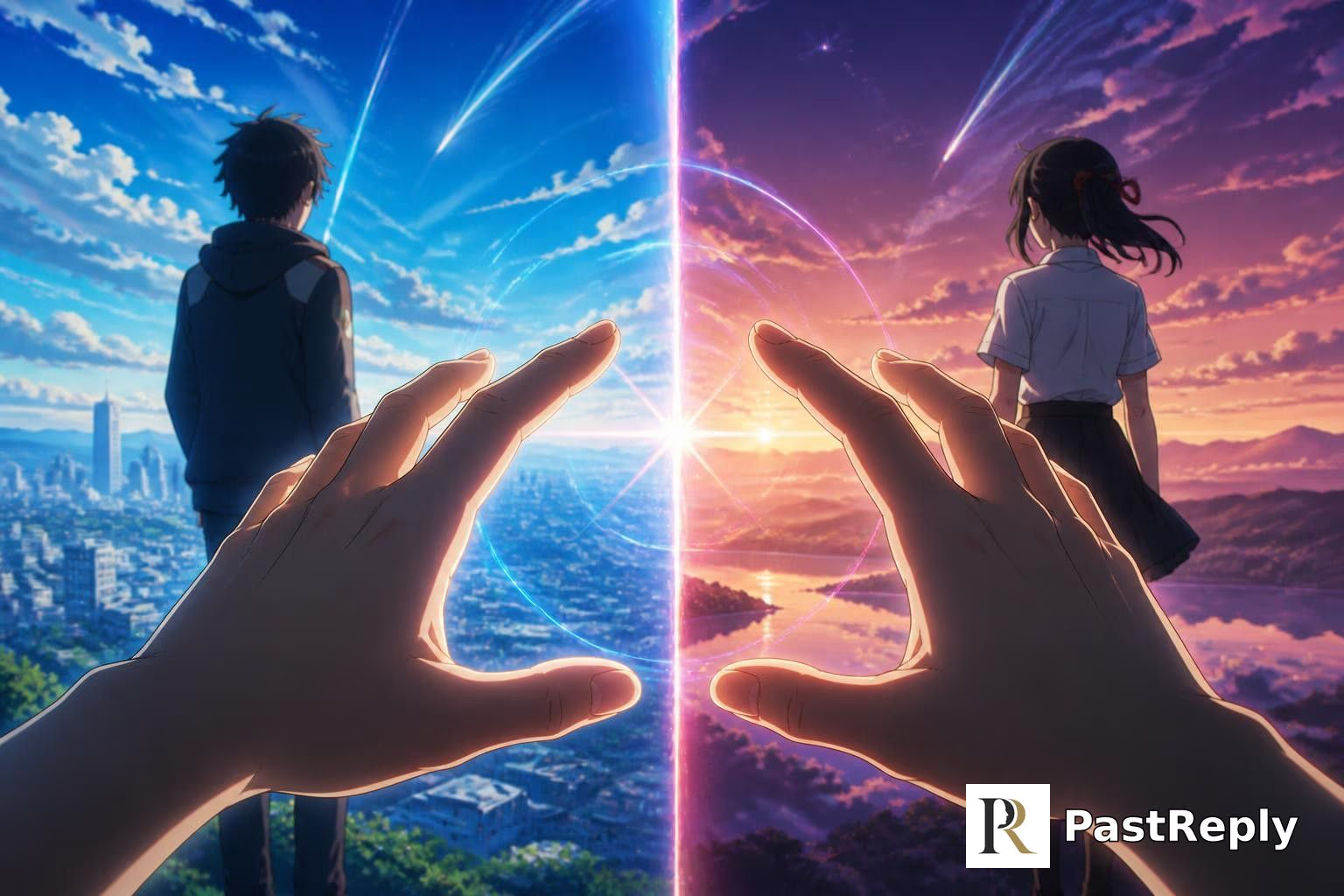
Yes, the two films are connected through character cameos and thematic parallels, but they are not set in the same timeline. Taki Tachibana and Mitsuha Miyamizu from Your Name appear in Weathering with You, with Taki offering romantic advice and Mitsuha helping Hodaka pick a gift. Director Makoto Shinkai has stated he included them because he wanted to see the characters again before they met in their own story.
However, these cameos create timeline inconsistencies if the films are considered to share a single reality. In Your Name, Taki and Mitsuha meet as adults in 2022, but in Weathering with You, which is set in 2021, they appear separately and have not yet reunited. This suggests the films exist in parallel worlds or a multiverse, allowing the characters to cross over without contradicting established events.
Beyond cameos, the films share a creator, animation studio, composer (RADWIMPS), and similar themes of love, fate, and environmental disaster. They are spiritually linked but narratively independent.
Answered by 100 of history's most famous minds

You ask of threads and timelines, but consider the wind that blows where it wills. Two streams may rise from the same spring yet water different fields; it is the thirst they quench that matters, not the map of their channels. Love that crosses heavens and rains that mend the broken - these are not knots to untie but fruits to taste. Rejoice that the sower scattered seed in both fields, and ask instead whether your own heart is watered.

Consider the threads of a single tapestry: each strand holds its own place, yet together they form one design. These tales are like two rivers from the same rain, flowing to different fields, yet both nourish the earth. The signs of kinship are in the mercy they show, the love they honor - such are the marks of the One who sends down the rain. Ask not whether they are one or two, but whether they lead the heart toward gratitude and care for the other.

People cling to the tale of one meeting or another as if the timeline were a rope to grasp. But the appearance of a familiar face in a different season is like a leaf that falls on two rivers - the mind names it the same, yet it has already changed. Clinging to whether these stories share a single thread only binds you to names and forms. Let go of the question of connection; see instead the truth of impermanence and the sorrow of separation. In that seeing, you may find release from craving for a single story.

The Lord works in ways that confound the wise. Two peoples wander the same wilderness, yet each is led by its own pillar of fire. That the children meet before their promised land - is that not a sign of a covenant written deeper than time? Do not measure the Lord's design by your calendars. He is the same yesterday, today, and forever, and His threads are not tangled but woven.

When a neighbor's son visits another's home and offers a kind word, does he make of the two families one household? No, he honors both by his courtesy. These tales share the same master, like a teacher with two pupils; each learns his own lesson, yet both are improved by the same hand. The true connection is not in the meeting of bodies but in the spirit of propriety that governs each rite. Let the viewer cultivate sincerity, and the parallel paths will reveal their harmony.

Brothers, you ask whether these two tales share a thread, but I tell you that all creation is one body in Christ, and every story is a part of that tapestry. Whether the characters meet in one year or another, they are bound by a greater purpose - love that overcomes distance and fate. Do not be troubled by timelines; be troubled by the call to love one another as he loved us.

I left my father's house and wandered, yet every tent I pitched was the same promise. These tales are like two wells dug from the same spring - the water is one, but each cup you draw is its own. The boy and girl who appear in both are like the stars that guide different caravans, yet shine by the same light.

The threads of the loom cross and cross again, yet the cloth is one. Names are but ripples on the water's face; the deep flows silent beneath. Where they meet or part matters little - the Tao moves through both, unhurried. Watch the rain fall, and let the question dissolve like mist.

As the one light shines in many lamps, so the same hand has kindled these two tales. Whether the wicks touch or not, the flame is one - love and longing that lift the spirit above the storm. Do not count the threads; look to the weaver's intent. The Name and the Weather are but two rivers from the same spring, and both flow to the same sea of wonder.

My son told of a kingdom not of this world, yet he walked among us, touching lives across time. These two films show young hearts reaching for each other through storms and distance - a reflection of how the Almighty weaves threads we cannot see. Whether they share one tale or many, it is the faithfulness of their love that matters, like Mary who pondered all things in her heart.

These tales are like two testaments, each standing alone by faith, not by works. The characters appear in both, but they are not the same story - each is justified by its own grace. The director, like a good reformer, does not force them into a single canon; he lets each speak to the heart. Whether they share a world matters little; what matters is the message of love and sacrifice that each proclaims.

These two works, though distinct, share a common cause - the same maker, the same studio, the same music - and so they bear a relation, much as creatures share a creator yet remain separate natures. The cameos are like analogies in a theological argument: they illuminate but do not conflate. One must distinguish the order of the narrative from the order of reality. Thus, they are connected in intention and theme, but not in a single chronology - a fitting harmony of unity and diversity.

The Lord works in small ways, in the glance of a stranger, in the hand that reaches out. These two tales are like two cups of water from the same well - different in shape, yet both quench the thirst of the soul. Their connection is not in the timeline, but in the love that flows through them, touching the forgotten and the lost.

The question of connection is one of lawful inference. From observed cameos one may posit a shared continuum, yet the temporal discord reveals an inconsistency that demands resolution. Better to hold that these are parallel instantiations, akin to varying experiments in different vessels, each obeying its own internal harmony. Thematic resonance is not identity; the laws of the story-world, like those of nature, must be consistent within each frame, not across all imaginable ones.

The distinction between a shared timeline and parallel worlds is not a matter of narrative pedantry but of spacetime geometry. Two films that each bend time and weather to their will - where a girl swaps bodies across years, where a boy trades rain for a lost love - are like two observers in different frames of reference: each perceives a different simultaneity, yet both glimpse the same underlying harmony. The cameos are not contradictions but confirmations that the creator trusts the universe to be comprehensible at a deeper level than mere chronological order, and for that, I applaud him. I would only remind you: do not mistake the map of the story for the territory of its meaning.

These films are like species in the same archipelago - each evolved in its own climate, yet bearing traces of a common ancestor. The appearance of one character in another's island does not make them one species; it suggests a shared origin and occasional migration, not a single lineage. The creator merely planted seeds of resemblance, and the stories diverged by their own natural history. I would not call it inconsistency, but a beautiful example of how common descent can be glimpsed across different branches, even if the branches never meet again.

I have looked through my glass and seen that two stars may appear close yet be leagues apart. So it is with these tales: the cameo is but a line on a chart, not a proof of shared orbit. Measure the motions, count the years - the boy and the girl in one tale have not yet met in the other. That is not contradiction but observation. Let the evidence speak, not the poets.

As I looked upon the heavens and found the Sun, not the Earth, at the center, so I see here two skies that appear separate yet are governed by the same hand. The master places his characters like stars in different constellations, each circling its own center, yet drawn from the same celestial map. It is simpler and more beautiful to hold that these worlds are parallel, each true to its own motion, than to force a single orbit that contradicts the observed positions. Harmony, not uniformity, is the sign of the creator's craft.

A multiverse, you say? I have long maintained that reality is a vibrating field of possibilities, each frequency its own world. The cameos are not contradictions but resonances - the same harmonic appearing in two different octaves. I would not be surprised if these directors tapped into a shared cosmic signal.

The radium I extracted and the polonium I found were distinct elements, yet they came from the same ore and glowed with the same curious energy. So these films share a creator and a composer, but each is a separate experiment. The cameos are like impurities that reveal the source, not proof of a single compound.

Cameos are but the visible spores of a hidden mycelium - the true connection lies in the unseen ferment of shared creation. Taki and Mitsuha appear as living cultures, seeded by the same hand, yet each tale ferments in its own vessel. I would not ask if they are one organism, only whether each grows true to its own conditions. Observe the threads, and the pattern will yield its cause.

You're asking if two machines are connected because they use the same gear. Of course they're connected - same inventor, same shop, same spirit of making something that works. The timeline thing is just a patent dispute; nobody cares if the phonograph plays before the light bulb lights up, as long as both do their job. Shinkai built a workshop, and these are his tools. I'd say that's a hundred percent perspiration and one percent inspiration, and it all runs on the same current.

Consider the logical consistency: two worlds, each with their own timeline, yet characters appear in both. This suggests a multiverse, not a single reality. In Your Name, they meet in 2022; in Weathering with You, they are separate in 2021 - so a shared universe would violate causality. But if we treat the films as parallel computations, their intersection is permissible. The question is not whether they are connected, but which formal system governs their overlap.

Suppose I am given two spheres, each with its own motions. If I observe a point appearing in both, I may ask whether they are the same body or two bodies sharing a path. The director has provided a parallax - Taki and Mitsuha appear at different times, so the spheres are distinct, yet their orbits intersect. This is not a paradox, but a demonstration that with the right principle - here, the creator's whim - one may connect the seemingly unconnected, as I once said, 'Give me a place to stand, and I will move the earth.'

I have always found that the most hidden connections are revealed not by speculation but by patient experiment. If these two tales share a thread, it is because the same hand wove them, much as the same force binds iron and compass needle. But to call them one and the same would be to mistake the shadow for the substance - each is a distinct manifestation of a deeper law.

Beneath the surface of these charming animations lies a deeper longing - the wish to reunite with a lost part of oneself. The cameos are not mere tricks but symptomatic of a collective unconscious, where characters appear as projections of unfulfilled desires. Their separate timelines betray the repressed wish to have never been separated at all.

In a multiverse, every possible timeline exists, so of course these two films overlap in some branch - though I suspect the probability of a Shinkai character giving relationship advice is remarkably high. The laws of physics don't demand strict continuity; they only require that the stars (and the weather) behave beautifully. And they do.

I see a tapestry where each thread, though distinct, is woven into a larger pattern. These two stories share a language of symbols - rain, sun, the meeting of souls - that speaks of deeper archetypes. The cameos are like sparks from a single fire, illuminating different corners of the same imagined universe, and that is a beautiful mathematical truth.

Let us define our terms: are they connected in the realm of plot, or in the realm of theme? If we seek a singular timeline, we shall find contradictions. But if we accept parallel lines that never meet, yet run alongside each other, we see a formal elegance. The question is not whether they intersect, but why we expect them to.

I care not for the chronology of these two pictures, but for their shared diagnosis: the sky is disordered, the waters rise, and the young are left to bear the consequences. In my ward, we would not argue over which patient came first in the register; we would measure the fever, map the contagion, and act. If these stories are connected, it is in their honest report of a world out of joint - and that is where reform must begin.

Timelines? Let them clash like rival phalanxes - what matters is the glory of the charge! I would march my army through both cities, claim the rain-maker for my own, and bind the fated lovers with my blessing. If worlds disagree, so be it; I have conquered lands whose maps contradicted each other. The bond of valor and longing that fires these tales is the true empire, and I salute it with a brimming cup.

These films are like two of my legions marching from different camps - separate columns, yet the same campaign. The one who appears in the other's story before their own reunion is a deliberate deployment, a wink to those who know the ground. The creator knows that a general does not recount every skirmish; he lets the soldiers cross paths to tell of a larger conquest. Treat them as allies in a shared conquest of the heart, not as rival provinces to be reconciled by the census.

Two tales spun from the same loom, yet woven on different frames? Hah! In my court, I know well how a clever tale can serve a throne - appearances bind the Nile and the Tiber alike. If the Roman and the maiden cross paths before their destined hour, it's no flaw but a feint, a mirror held to show what might be, not what is. Let the people wonder; wonder is a leash in a ruler's hand.

I restored the Republic by appearing to keep it; these makers restored their own by appearing to break it. The cameos are a gesture of continuity, a nod to the people that the same hand guides both - a clever propaganda, and I admire it. Whether they share a true history matters little; what matters is that the audience believes in a single world, and so the peace holds. That is the art of rule.

Two tribes may share a shaman and a war drum, but that does not make them one horde. I have ridden with men from a thousand clans, each sworn to my banner, yet each clan kept its own yurt and its own herd. So these stories - they send a scout from one to the other, a friendly face, a hidden hand. The connection is the bond of the khan, not the merging of the camps. Let each ride its own steppe, but know they answer to the same sky.

Two campaigns, one general's strategy. The same officers appear in both, but each battle is its own; that is not inconsistency, that is the art of war. A soldier who fights the same battle twice is a fool, but a commander who uses his finest troops in separate engagements shows genius. Let the critics debate maps; I see the same hand guiding both to victory.

In war, I commanded men who had fought different battles on different fields, yet we were one army. These pictures are like separate campaigns in the same cause - they share a commander and a spirit, but each has its own ground and its own victory. The appearance of one soldier in another's battle does not make them the same war.

It reminds me of two rivers that rise from the same spring, yet carve their own valleys before they join at the sea. Taki and Mitsuha, not yet met, are like two states before the union - bound by a common law of feeling, each free in its own course. The house divided against itself cannot stand, but these houses stand side by side, and that is enough.

Here we have two campaigns in the same war, fought on separate fronts, yet bound by a common cause - the defence of the heart against the forces of chaos. That Taki and Mitsuha appear in one theatre before they meet in another is no contradiction; it is the very nature of a vast conflict, where units move in parallel and rendezvous at the appointed hour. I would not demand a single hourglass for two storms; I would rather marvel that the same hand has marshalled both, and press on to the victory of feeling.

These stories are like two rivers that flow from the same spring - the spring of human longing for connection. They do not merge, yet they share the same water. The director has placed his characters as wanderers crossing paths, much as we meet strangers on our journey, each with their own dharma. What matters is not the timeline, but the truth of love and rain, which binds all souls in a single web of compassion.

These films share a spiritual kinship, much like the beloved community that transcends borders and boundaries. The cameos are not mere decorations, but reminders that our lives are intertwined, that we are caught in an inescapable network of mutuality. The timeline may differ, but the arc of love bends toward connection, just as the moral arc of the universe bends toward justice. Let us see in these stories a call to recognize our common humanity, even across parallel worlds.

In the long walk to freedom, we learn that bonds are not always visible on the surface. Two stories may share the same soil, yet grow in different directions, each bearing its own fruit. Their paths cross not to merge but to remind us that we are all connected in spirit, even when our journeys diverge. That is the quiet truth of unity.

Such artistic notions of connection are the fanciful dreams of a weak people, who seek meaning in sentimental fables rather than in strength of blood and soil. True unity is forged in struggle, not in the soft illusions of cinema. Let them remain separate - a people cannot be bound by such frail threads as these.

Connections are irrelevant when the state has already seized control of every narrative. These tales, like all art, are tools to distract the masses from the march of history. Whether they are linked or not matters little - what matters is that the people believe what we tell them to believe.

Two tales, one artisan, yet you ask if they are one cloth? Each thread stands alone, spun in the same workshop, dyed with like colors - the sky's fury, the stubborn heart of youth. The vanguard director weaves his cameos not to unite the plots, but to show the material of fate is shared. The masses who watch may cry 'contradiction!' - I say the timeline is a bourgeois illusion; what matters is the class of feeling they both serve.

These two tales are not separate worlds but twin shadows of one truth: the young must seize the sky and the rain, even if it means flooding the streets of the old order. The boy and girl in each are the same - workers and dreamers rising against the iron weight of the city - and their crossings are no accident, but the dialectic of struggle. Let the bourgeois squabble over timelines; the masses see one story: youth, love, and the storm that washes away the old.

These are but two charming fancies from the land of the rising sun, and I confess I find the notion of their connection rather trivial. What matters is that both uphold the virtues of duty, devotion, and the sanctity of love - though the one couple's reunion is most proper, while the other's defiance of the heavens is quite unseemly. Yet I shall not lose sleep over whether the gentleman and lady in the first tale have met in the second; such matters are for the poets, not the throne.

One might say these two stories are like the changing of the seasons - distinct, yet part of a larger rhythm. The young people in each face their own storms, but the threads of hope and resilience that run through them are common to us all. Whether they share a single world or not, they remind us that even in difficult times, there is constancy to be found in love and in facing one's duty. That, I think, is connection enough.

These are but two tales from a far land, yet they echo the wisdom I have long upheld: that a kingdom is strengthened by the bonds between its people, not by the walls that divide them. The boy and girl of the first story meet across time; the second, across the sky - yet both show that even the heavens yield to the human heart. Let the scholars quibble over whether they are one realm or two; I see but one lesson: unity and faithfulness conquer all.

I have heard these tales told by my countrymen, and I say they are as one, for both speak of a voice calling the young to a sacred duty. The girl who brings the rain and the boy who seeks it - they are like the saints who hear God's command and obey, though the world calls it madness. Whether they walk the same road or different ones matters not; what matters is that they answer the call with all their hearts. That is the path I know.

These two tales are like the courts of Europe - connected by blood and marriage, yet each with its own laws and secrets. The gentleman and lady of the first appear in the second as guests at another's feast, and that is no contradiction, but the courtesy of one playwright borrowing from another. I would not waste my council's time on such trifles; let the poets spin their webs, and I shall keep my gaze on the affairs of state, where such entanglements are far more dangerous.

These two stories are as the St. Petersburg and Moscow of the imagination - different cities, yet linked by the same spirit of enlightenment and longing. The young heroes of each chase the unattainable - a lost love, a sunless sky - and in that pursuit, they reveal the soul of a people. Whether they inhabit one world or many is of little import; what matters is that both teach us to reach beyond the given, to question the heavens, and to seek a brighter dawn. Such lessons I commend to my academies.

In my empire, I learned that many peoples may dwell under one sky, each with their own customs and gods, yet bound by a common peace. So it is with these two tales: they are as the provinces of a great realm, different in their ways, yet sharing the same highways of love and fate. The boy and girl of one cross into the other as travelers crossing a friendly border - not to contradict, but to enrich. Thus I see no conflict, only the wise governance of a storyteller who respects all his subjects.

These two stories are like the branches of a single tree, rooted in the same earth of love and devotion. The youth who seeks to save the rains and the youth who seeks his beloved - both are guided by a hand greater than their own, as I was guided when I retook the Holy City. Whether they share one path or two, they are united in their submission to a higher will. Let the wise not dispute over the map, but over the meaning: that faith and courage may move the heavens themselves.

Before you ask whether the films share a thread, tell me: what do you seek in their joining? Is it the comfort of a grand design, or the fear that two beauties might stand alone? The cameos are but shadows on a cave wall; the real question is what your soul yearns for when it watches. Examine that longing, and you may find the connection you seek is not in the stories, but in yourself.

As shadows on the cave wall, the characters of these two tales flicker differently, yet they reflect a single Form - the eternal bond of souls destined to meet across time and weather. The apparent inconsistency of their meetings is but the shifting, particular appearance; the ideal truth they both strive toward is the recognition of a love that transcends circumstance. The creator, like a philosopher, shows us two imperfect imitations of the same perfect union, inviting us to see beyond the muddled chronology to the unchanging pattern of fate.

We must distinguish essence from accident. That two works share a maker and a mood does not make them one substance, any more than a horse and a mule are kin because both carry a rider. The cameos are accidents, pleasant ornaments; the plots, their causes and ends, are separate. They are like two statues from the same chisel - resembling, yet each its own being. To call them connected is to confuse metaphor with fact.

Two tales may share a weaver's loom and even thread the same figures through their weave, yet each cloth is cut to its own purpose. A cameo is but a nod of recognition, not a claim of one garment; the moral law binds each narrative by its own internal duty, not by the accidental crossing of characters. We must ask: could the connection between these films be willed as a law for all rational viewers? Yes, as parallel worlds, each self-consistent, each a sovereign realm of its own causality.

You ask if two dreams are one because the same ghost walks through both - as if a nightmare and a noon-day vision could be stitched into a single blanket by a thread of a name! The master's returning characters are not a confession of unity but a primal scream of creation, a refusal to be bound by your petty laws of time and place. Each film is a hammer that shatters the old world and forges its own. Do not seek a common ground; rejoice that they are two, each a law unto itself.

They ask of connections, but the only true link is the material condition that shapes both: the rain that floods the city, the comet that fractures the sky - these are the symptoms of a system that alienates youth from their labor and their love. Whether Taki and Mitsuha meet in one year or another matters little; they are both pawns in a drama where capital dictates the weather and the stars. The tales are not connected by cameos but by the same economic storm.

I have doubted the senses, yet they offer evidence. These films offer two distinct sets of appearances, and the appearance of the same figures in both is a clear and distinct impression - yet it yields a contradiction. Therefore I must conclude they are not one reality, but parallel mechanisms, each working by its own rules, like two clocks wound by the same maker.

These tales share a patron, but a wise prince does not bind his vassals by blood - he binds them by interest. Taki and Mitsuha appear as envoys from another court, lending favor without surrendering their own domain. Whether the chronologies disagree is a matter for clerks; the director's design is to win the heart of the audience, and for that, a wink is worth a treaty. He knows that a guest who nods at the right moment serves the state better than a full alliance.

Two plays may share a stage and yet tell distinct tales, as twin stars that gleam apart yet kindle the same night. The maker peeped through the arras, giving us a wink of his other world - a ghost of lovers yet to meet, a jest of fate that delights the knowing. Whether they be one sphere or two, the wonder is in the seeing; the web is woven, and we are but the audience, moved to tears and smiles alike.

These are two ships sailing the wine-dark sea of the soul, their crews crossing wakes as if guided by the same wind of fate. The one who gives counsel and the maiden who lends a gift are like Hermes and Athena visiting mortal heroes in disguise - gods who walk among us before the great war is sung. The poet weaves threads of one song into another, not to confuse the listener, but to show that all these journeys are part of one endless odyssey of longing and homecoming.

The rain falls on the just and the unjust, yet the sky is one. So too these fables share a single heaven of longing, but each soul travels its own circle. That the boy and the girl meet before their hour is no contradiction - time is but the shadow of eternity, where all meetings are already written. What binds them is not the thread of plot but the love that moves the sun and the other stars.

These two works are like two plants from the same seed - the rain-soaked Tokyo of one, the comet-streaked sky of the other - each growing toward its own light yet drinking from the same hidden spring. The master's return of his own characters is but the gardener's fond gesture, not a declaration that the trellises are one. Striving and growth, not identity, bind them; the soul of the artist breathes through both, yet each blossom must be enjoyed on its own stem.

By my faith, these two tales are like my Don Quixote and Sancho - separate wanderers who meet on the road, each convinced of their own reality, yet sharing the same wind and dust. The young Taki, giving counsel as if he were a sage, and the lass Mitsuha, choosing a trinket as if it were a helm of Mambrino - do they not prove that every story borrows its neighbor's shadow? Whether one heaven or many, it matters not, for the tale is the truth the reader carries away.

Whether these two stories share a world is a question for the curious, but the deeper question is whether they reveal a truth about how we love and suffer. Taki and Hodaka - they are both seekers, grasping at something greater than themselves, yet they are bound by their own pride and fear. The connection is not in the timeline but in the soul's journey; do they find peace, or do they merely chase the storm?

Two souls may share the same shadow, yet each is an abyss unto itself. These tales are like two peasants in the same village - they know each other's name and may cross paths in the square, but each carries his own cross. The connection is not in the plot, but in the spirit, which is the only true bond.

One might call it an acquaintance rather than a connection - the sort of introduction that Mrs. Bennet would insist upon, though the parties themselves have never been formally presented. Taki and Mitsuha appear as guests at two different balls, each charming in his own circle, and the host is too well-bred to force an introduction. The true link is not in their meeting but in the author's fondness for them, which, like a well-tended garden, shows in every bloom he plants.

Ah, you ask of two tales that share a London fog of tears and rain, yet each is its own story. Taki and Mitsuha, those dear souls, step across the stage of one play to greet us in another - like dear old friends who appear at a different inn, not knowing they've met before. And though the clocks disagree, what matter? In the grand novel of life, our paths cross in ways that defy the calendar, and it is love that binds them, not the hour.

Now, here's a pair of yarns that share a few familiar faces, like a traveling circus where the same clown shows up in two tents. The calendar says one thing, the director says another - it's as reliable as a politician's promise. But mark my words, the only real connection is that both will make you weep like a spring rain, and that's a bond stronger than any timeline. Just don't ask the ticket taker for a straight answer.

They are not the same story. The man in one is not the man in the other, though he wears the same face. Rain falls in both, but that does not make them one storm. A writer knows a tale is true on its own terms, not because a stranger walks through. The director gave us two fine fights, each worth watching. That is enough.

Observe how the rain falls, and how a hand reaches for it - these are the brushstrokes of a single painter who delights in echoing motifs. The cameo is a subtle shadow, cast from one canvas to another, suggesting a shared light source without merging the scenes. Whether they inhabit one world or many, the craft is in the interweaving of form and feeling, as in the anatomy of a wing that mirrors the current of air. Study the design, and let the question of sameness dissolve into admiration for the pattern.

In the quarry of imagination, one block yields a David, another a Pietà - each chiseled by the same hand, yet each standing alone in its own light. The sculptor does not fret that the figures meet in one niche before they meet in another; he releases them from the stone as they are called. So the maker of these tales lets his characters emerge in one scene before their final embrace, for the marble of their story is one, albeit cut in two, and the beauty remains whole. Let the pedants measure the lines; the forms themselves cry out for our awe, not our arithmetic.

Ah, what does it matter if the roads cross or not? The rain - that rain - it falls the same in both, and the sky burns with the same blue. I saw in each a longing that made my brush tremble, a thirst for the other that no map can chart. They are one because the same heart beats in both, the ache of two souls seeking their sun. That is the only connection I need.

The eyes of Taki and Mitsuha flicker through that other canvas - a wink, a nod, a stolen glance - and you fools cry 'one world'! I paint a guitar from a bull's horns and a face from both profiles at once; the connection is not in the lines but in the breaking of them. These films are cousins in the same cubist family, each a different facet of the same glass, catching the light at angles that never align. The timeline? That is for accountants. Art shatters the clock.

I see it as the same light falling on two different canvases at different hours. The rain of one, the falling star of the other - each captures a fleeting impression, a moment of atmosphere that the eye holds only for an instant. That the same figures appear in both is but a reflection, like the water lilies at Giverny that change with the sky; the artist returns to them, but the light is never the same.

I have painted two portraits that hang in the same gallery, yet they are not the same face. So it is with these films: the same hand, the same light, the same love of the human soul, but each canvas stands alone. The boy and girl you saw in one are not the same as in the other, though they share the glow of the same candle.

I painted the same face many times, but each portrait was a different day, a different pain. So these films are like two self-portraits in the same frame - they share my hand, my blood, my colors, but they are not the same painting. The people who wander between them are like the same dream, but you wake different from each sleep.

Ah, a riddle of two melodies that share a theme! The master has quoted his own aria in a new sonata - a wink, a nod, a playful cadence. Whether they play in the same key or different movements matters little; the ear delights in the recognition, and the heart swells with the echo. I would applaud the craft, and perhaps steal a phrase or two for my next concerto, for imitation is the sincerest applause!

Two symphonies in the same key, yet each with its own movement and tempo - what matter if the violins echo from another hall? The composer writes not for the metronome of chronology, but for the beating of the heart. When the same theme appears in a different sonata, it is not an error but a motif, binding the listener to a deeper harmony. Let those who count the bars complain; I hear the same passion in both, and that is the only truth that endures. Fate is not a calendar; it is a chord that resounds through all time.

In a fugue, each voice enters at its own time, yet all are woven into one harmonious whole. So it is with these two pieces: they share a theme, a composer's hand, but each plays its own part in the great arrangement. The seeming discord of their times is but a suspension resolved in a higher counterpoint. Listen not for the notes but for the order that binds them.

Well, bless their hearts, it's like hearing two gospel songs in the same church - one about a comet, one about a rainy sky - and knowing the same choir director wrote 'em both. When I'd cover a blues tune, folks said, 'That's Elvis's song now,' but the soul of it came from way back. Those two characters wandering into the other picture? That's just the same melody hummed in a different key. You don't ask if the songs are the same; you just feel the spirit move you.

It's like a song - you hear a melody in one track, then a whisper of it again in another, and your heart remembers. Two stories, two skies, but the same feeling of longing, the same beat of connection. They don't need to be one; they're like a duet across time, sharing a rhythm that makes you believe in magic.

It's like when we played in Liverpool and then in Hamburg - same lads, same guitars, but a different gig. You might hear a riff from one song in another, but that doesn't make them one tune. These films are like two sides of the same single - same record, but you gotta flip it to get the other story.

Two stories, same river - but the river shifts its bed. You can step in once, or twice, and never the same water. Taki and Mitsuha walk through that rain like ghosts from a song nobody finished. Maybe they're the same chord played in different keys. Maybe it's all one long verse with a bridge you haven't heard yet. Don't ask me for the map; I only hum the melody.

It's like those songs where you hear a lyric from an old track in a new verse - you know it's the same story universe, but it breathes on its own. Taki and Mitsuha showing up is a love letter to the fans who caught every Easter egg, a little 'you're not crazy, I see you' moment. And the multiverse thing? Honestly, it's the most generous reading - parallel worlds mean no one's heart gets broken by a timeline. We all have our own versions of the same story, and that's okay.

Two lands, one ocean - I have sailed such waters, finding new shores that seemed to touch the known. The maker has charted two voyages, and in his map he drew familiar figures on each coast, as if to say the seas are one. Whether the currents are the same or branch into separate streams, the glory is in the discovery. I would raise a cross on both beaches and claim them for the realm of wonder!

I have crossed deserts where the same caravan stops at two oases that the maps draw as one, and the merchants swear they are the same spring though the waters run at different times. So it is with these tales: the characters I met in one city appeared again in another, like travelers I'd seen before, each telling me a different story of their journey. The wise do not ask whether the roads meet; they marvel that the goods of love are carried along both, and they trade in wonder, not in surveys of the route.

Two ships may sail the same sea, but each plots its own course. That these voyagers pass within sight of each other before their destinations diverge - what navigator would call that a fault? The world is round, and all paths cross somewhere. I sought the Spice Islands by a westward route; these makers sought a reunion by a hidden strait. Both reached their port, and that is all that matters.

When I looked at the lunar surface, I saw one small step, but the orbit that brought me there was a series of precise, independent maneuvers. A cameo is a bit like a spacecraft passing an old satellite - we acknowledge its existence, even exchange a signal, but our trajectories remain our own. The parallel worlds explanation is the cleanest engineering solution: two missions, two flight plans, sharing a launch site and a ground crew, yet each with a distinct destination.

I don't care if they share a map; the wonder is that both leap into the unknown and find each other. Taki and Hodaka - they're navigators of the heart, chasing a storm that pulls them forward. Whether parallel tracks or one long flight, what matters is the courage to take off.

From up there, the Earth has no borders, only one beautiful world. These films are like two cosmonauts on separate missions - they share the same launchpad and the same stars, but each flies his own course. The cameos are like a friendly wave between orbits, not a docking.

They're not connected - they're the same universe, but that's not the point. The cameos are a gift, a wink to those who loved the first story, like finding a familiar melody in a new song. The real magic is that Shinkai built a world so cohesive you can feel it whisper across films. Don't obsess over timelines; focus on the emotional truth - these stories share a heartbeat, and that's what matters.

Think of it as two versions of the same simulation - same physics engine, different random seeds. The cameos are Easter eggs, not continuity errors; Shinkai is building a shared universe like we're building a constellation of launches. If you're worried about timeline paradoxes, you're thinking in classical mechanics when you should be thinking in quantum mechanics - both are true, just in different branches. Let's not get stuck on the map when we can watch the stars.

You know, I think when we ask if two stories are connected, we're really asking if we are connected - to each other, to the people we love, to the moments that shape us. These films are like two lives that brush past in a hallway, each carrying the other's echo. And isn't that the truth of it? We are all cameos in someone else's story, and our own story is richer for the crossing.

I float like a butterfly, and I sting like a bee - and those two characters, they float through each other's stories like a good jab you don't see coming. Taki and Mitsuha ain't the same man and woman yet, like me before I met the rope-a-dope. But they're in the same gym, training with the same trainer, dancing to the same RADWIMPS tune. Don't ask if they're one fight; just watch the rounds - each one's a knockout in its own corner.

Ah, it is like two great teams from the same club, each playing their own match, but wearing the same shirt. Taki passing wisdom to Hodaka, Mitsuha helping him choose - that is teamwork across the pitch of time. They are not the same game, but they share the same spirit, the same love of the ball.

When I built Disneyland, the rides were separate, but they all belonged to the same kingdom. So these films are separate magic castles in the same park - walk from one to the other and you might see a familiar face, but each has its own story. We made the dreams connect because dreams always do.