
Are trade jobs dangerous?
Trade jobs carry inherent risks from physical strain and hazards like falls and toxic materials, but safety training and regulations help protect workers.
The facts
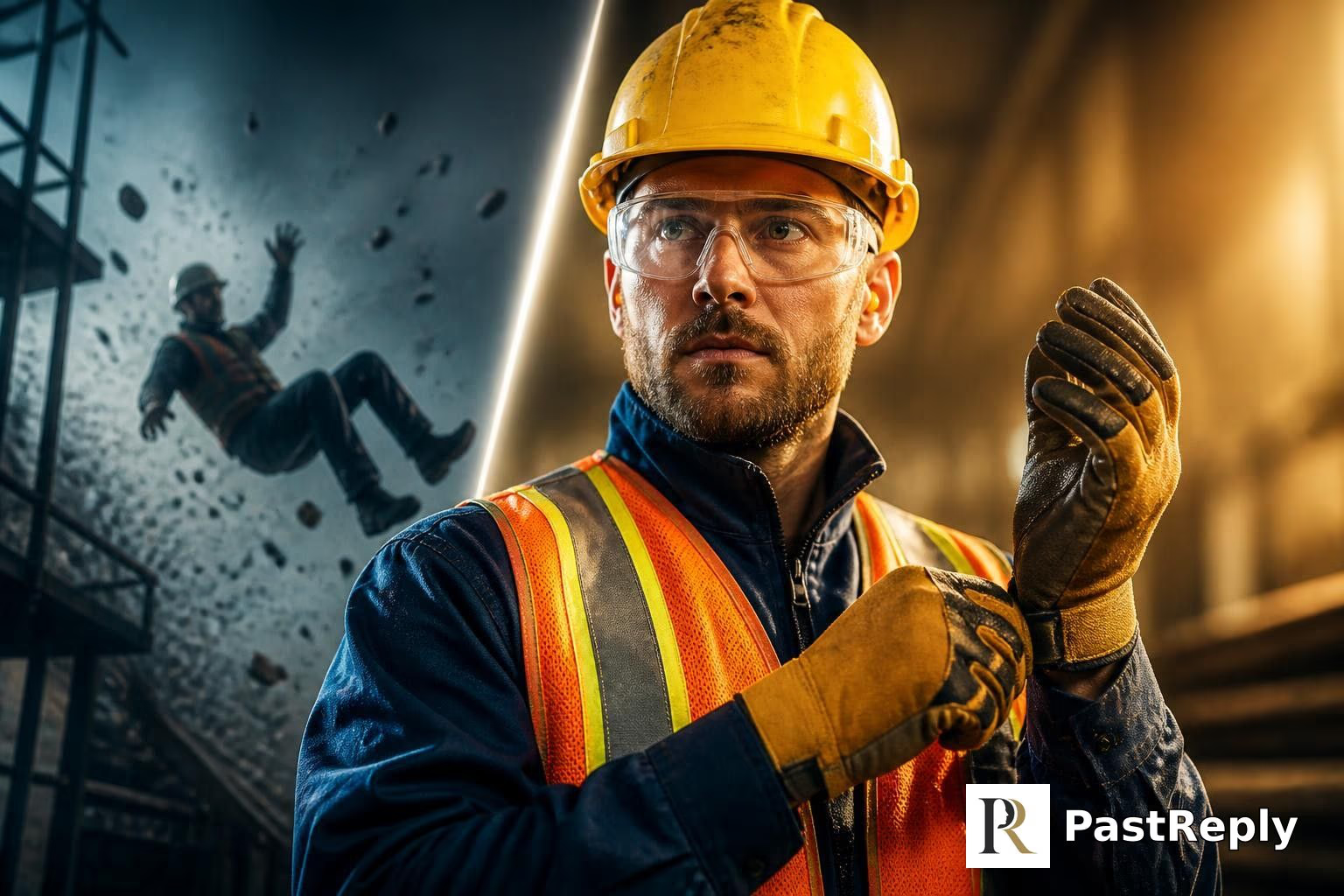
Yes, trade jobs can be dangerous due to physical strain and exposure to hazards, but safety measures and regulations are in place to mitigate risks. Workers in trades such as construction, plumbing, and electrical work often face dangers like falls, slips, trips, heavy machinery, and hazardous materials including asbestos and lead. For example, helpers in construction trades have a fatality rate of 38.5 per 100,000 workers, with falls being a leading cause of death. The physical demands of trade work can also take a long-term toll on the body, leading to chronic health issues.
Despite these risks, safety training and adherence to Occupational Safety and Health Administration (OSHA) standards significantly reduce dangers. Employers are required to provide protective equipment and enforce safety protocols. While trade jobs remain among the more hazardous occupations, informed career decisions and proper precautions can help manage the risks.
Answered by 100 of history's most famous minds

A man who builds with his hands knows the ache of stone and the cut of the chisel. Yet I tell you, the true danger is not the fall from the scaffold, but the fall from grace when we forget the dignity of the one who labors beside us. Care for the worker as you would for the bird of the air, and the very stones will sing of safety.

The hand that digs the well and the hand that prays both serve the One who provides. A worker who honors his craft honors God, but he must not cast himself into the pit out of pride or haste. Let him tie the rope with care, for the body is an amanah, a trust, and to neglect it is to betray the Giver. Balance the zeal of the day with the wisdom of the evening.

The mason, the weaver, the smith - all know that the body is a vessel that wears thin, like a robe of cloth fraying at the seams. The fall from the beam is but one of the thousand arrows of impermanence. If you would be free from suffering, look not to the height of the scaffold but to the reach of your craving. A mindful step is safer than a thousand guards.

When you build a house, you shall not leave a beam unsecured, nor a trench uncovered, for the blood of your brother cries out from the ground. I brought you out of the house of bondage, where the taskmasters cared not for your flesh, and I gave you laws so that the sojourner and the hired hand may labor in safety. Remember the covenant: as you were once slaves, so you must protect those who toil, lest the stone you lay crush the one who laid it.

The carpenter who does not fear the chisel may lose a finger, but the carpenter who respects the chisel and his own hand will build a home that shelters generations. Danger is not a matter of the tool but of the virtue in the user. Let the master teach the apprentice not only the cut but also the care, and the roof will stand long after the storm has passed.

I have been in perils of the sea, perils of robbers, perils in the city, and I know the body can be broken. But what is a fall of thirty cubits compared to the fall of the soul? Let the workman guard his hands, but let him also guard his heart, for no earthly mishap can touch the one who is sealed in Christ. I have learned in whatever state I am, to be content.

I left my father's house not knowing the way, and I walked through dry lands with a staff, trusting that the path would hold. A man who works with his hands knows the same trust - every nail, every board, every spark carries the weight of a life. The danger is real, like the stones of the desert, but faith in the One who sees the sparrow fall is the true harness. Train your hands, guard your step, and remember that your labor is a covenant with those who depend on you.

The sharpest blade is soonest dulled; the tallest tree first struck by lightning. Let the worker move like water around the stone, and let the overseer be like a valley that holds no blame. Only the fool races to meet the falling timber; the wise one steps aside and builds a bridge.

The laborer who sweats under the sun, his brow stained with dust, is dear to the Creator, for he earns his bread by honest toil. But let him not be a beast of burden in a field of thorns. The true danger is not the falling beam but the heart that forgets the One who gave him the strength to lift it. Share your wages, mend your brother's roof, and the risk becomes a blessing.

They are heavy with peril, yes. My son knew the carpenter's bench, the splash of blood and sweat that falls with every blow. Yet I saw the Father's hand in the workshop, guarding him through each splinter and strain. Let them educate the hands and steady the heart, for work that honors God is never without His protection.

Let them talk of falls and fumes; I see a deeper peril - the soul that treats its body as a machine for another's profit. Scripture bids us to guard the life of the worker, not squeeze it dry. Where is the justice when a man's sweat builds a tower, and his own bones are broken beneath it? The master who cheats his laborer cheats God Himself, and no regulation will save him from that accounting.

We must distinguish between the accidental peril and the essential nature of the work. A fall from a great height is a contingent danger, not a necessary one - it can be reduced by prudent measures, as a wise physician removes a poison. But the toil itself, rightly ordered, is good, and the weariness of the body is a fitting sacrifice for the sustentation of life. Let reason govern the work, and the danger, like a summer storm, will pass.

The man who lays bricks and the woman who wires a house - they offer their hands, and in that offering they touch the divine. Danger? Yes, but Christ Himself knew the nail and the thorn; let us not fear the wound given in love, but the heart that stays idle.

The hazards of the trades are but the laws of nature, which may be charted and thus mastered. A fall follows the same gravity that governs the apple and the moon; measure the force, and you may tame it. Feign no fear, but calculate the risk as a ratio of force to resistance, and the work becomes as certain as the orbit of the planets.

Consider the fall of a body from a scaffold: governed by the same law of gravitation that guides the moon in her orbit. The danger lies not in the force itself but in our ignorance of its measure. A workman who understands the geometry of his beam and the weight of his load has already taken the first step to safety; the universe is no respecter of persons, but of knowledge.

I have watched a beetle turn over a stone and a finch crack a seed; each toils with the same risk of a predator's shadow. The trade of the hand is as old as the first tool, and nature is no less cruel to the carpenter than to the sparrow. Yet I find that the man who studies the habits of his own craft, who learns the angle of the sun and the grain of the wood, does much to soften the blows of chance. Accumulate small precautions, and the great fall becomes less likely.

Let them measure the heights of their scaffolds and weigh the loads upon their shoulders; the danger is not a mystery but a matter of numbers. The fall of a body follows the laws of motion, and the strain on a sinew obeys the rules of force - these can be computed, predicted, and prevented by those who observe and calculate. Those who ignore the mathematics of risk are like those who refused to look through my telescope; they see only their own stubbornness, not the truth written in the stars.

I have spent thirty years peering at the heavens, and I have learned that the most harmonious system is not always the one that seems most solid. So too with the trades: a man may fear the falling beam, but the true disorder is a world where the worker is treated as a replaceable gear. Let us set our affairs in motion with the same simplicity and elegance that the Creator used in placing the Sun - then the scaffolding will hold, and the stars will shine on a well-built house.

Danger is a relic of ignorance, a brute force that shall be tamed by the light of science. In my laboratory, I have stood within ten feet of a lightning bolt and felt no harm, for I understood the currents. So too shall the worker be shielded by invention - by machines that lift, by sensors that warn, by power harnessed without filth or flame. The only true hazard is a mind unwilling to imagine a safer world.

I spent years in a shed that leaked and burned my skin, yet I never called it safe - I called it work. The dangers of the trade are measurable, like the rays I studied: they can be understood, controlled, and protected against. We must not abandon the workshop out of fear, but neither should we step in without the lead apron and the measured dose. Let the scientist and the laborer walk together, for knowledge is the surest shield against the fire.

I have watched a grain of dust turn a vat of wine to vinegar, and a scratch fester into a grave. These tradesmen breathe the invisible, they handle the unseen ferments of decay. But give me the prepared mind and a sterilized tool, and the miasma becomes a conquered province. The danger is not in the labor but in the unexamined hazard.

I've had a thousand failures in the lab - some of them nearly took my eyes. A wire snaps, a flash of fire, and you learn to respect the current. It's the same on a construction site: you don't quit because it's dangerous, you make it safer. Hard work and a good rulebook beat luck every time. The only real danger is a worker who's too green to know what he's doing.

We can define 'danger' precisely - a probability of harm given certain conditions. For a helper on a scaffold, the risk is quantifiable: falls, striking objects, overexertion. The question is whether we can compute the optimum intervention. Regulation, like a well-formed algorithm, reduces entropy in the system. But even the cleanest code cannot anticipate every variable; human error remains the irreducible bug.

Every hazard is but an uncalculated force. Give me a fulcrum and a proper angle - a guard rail, a harness - and I could balance the world's weight on a word. The danger lies in ignorance, not in the work itself. Measure the load, compute the strain, and the scaffold will hold as true as a circle's proof. Let the builder be an engineer, and the falling stone becomes a lesson, not a tomb.

Consider the falling brick, the charged wire, the unseen vapor: each obeys a law as fixed as gravity itself. The danger lies not in the labor but in ignorance of the forces at play; give the worker the knowledge of these forces, and the hazard retreats like a shadow before the lamp.

You ask of broken bones and crushed fingers, but the deeper wound lies in the mind that chooses such work - a compulsion to master one's own fear, perhaps, or a lingering guilt that demands punishment. The fall is not the tragedy; the unconscious drive that placed the man on the ledge is.

A fall from a ladder is simply a brief encounter with gravity, a force that cares not for your credentials. I find it amusing that humans fret over a few meters when a misstep into a black hole would be far more terminal - yet we still build our towers and fly our rockets. Risk is the price of curiosity.

I see the loom and the lathe as but the first faint echoes of a greater engine - one that might weave not cloth but thought itself. And like any engine, it demands respect for its moving parts; the danger is not in the machine but in the mind that fails to imagine its power and its perils alike.

Define 'danger' first: is it the probability of harm, the magnitude of harm, or the exposure to it? Without such definitions, your question is but a vague shadow on the wall. Measure the risk, weigh the precautions, and you will see that danger is merely an axiom awaiting proof - and proof is my craft.

Men speak of danger as if it were a fate to be endured, but I see only a problem to be solved. I have walked the wards where soldiers died of filth, not of their wounds, and I say that most of these perils are preventable with cleanliness, order, and the keen eye of observation. Every fall from a scaffold, every lung choked with dust, is a statistic we have failed to learn from. The remedy is not to abandon the trade, but to measure, record, and reform - until the workshop is as safe as the sickroom.

Danger is the spice of conquest! Every blow of the hammer is a strike against the unknown, and he who fears the dust of the quarry will never see the marble of his own monument. Risk is the price of glory, and I would rather die in the breach than live in the shade. Train, then, not to avoid the fire, but to walk through it with a laugh.

The risks of the ledger and the risks of the legion are one and the same to me. A mason who forgets his footing on the wall is like a centurion who sleeps on watch - both are food for carrion. But we do not abandon the campaign because of a few casualties; we arm the men better and press on. Fortune favors the bold, but only the prepared.

By the gods, my harbor workers hauling stone for the lighthouse of Pharos face worse than any storm that threatens my galleys. They break backs and lungs beneath the sun, yet I ensure they are fed, housed, and honored, for a kingdom's strength lies in the hands that build her walls, not in the gold that fills her coffers. Tell me, do your rulers guard such workers as they guard their own skin, or do they let the trades bleed for profit?

My legions build roads and aqueducts that endure for centuries, and I have learned that the strength of the empire rests not on the backs of slaves but on the discipline of trained cohorts. A soldier who neglects his shield is wounded; a mason who scorns the scaffold is buried beneath it. Thus I decree inspections and rewards, for order and oversight are the twin pillars of a lasting peace - while chaos and carelessness topple even the mightiest walls.

A man who fears a cut on his hand will never rule a herd. On the steppe, we fall from horses and we break bones, and we rise again because we must. These trades of yours - they are your horses, your bows. If a worker is afraid, he is a coward; if a leader does not provide the strap and the stirrup, he is a fool. Let every man know his craft, and let every craftsman be honored, and the empire will not fall.

A soldier faces death every day; that is his trade. Let the mason fall from his scaffold - it is his duty to climb with care. A nation built on weak hands is a nation unfit for glory. I would rather have one brave artisan than a hundred timid clerks, for it is the will that forges empires, not the fear of a bruise. Order, discipline, and courage - these outweigh any risk.

I have seen men stand on a scaffold and fall, not from cowardice but from a loose plank - that is the cost of building a nation with our own hands. The trades are the sinews of our republic, yet they demand the same discipline as a soldier's duty: drill, inspect, and never trust a rope that hasn't been checked. Let the employer be accountable as a commander is, and the worker as vigilant as a sentinel, and the danger will be met with honor, not recklessness.

When I was a rail-splitter, the ax was my companion, and it knew no mercy for the careless. A man's calling should not be a sentence to an early grave. If we can build a country where a day's work doesn't cost a man his limbs, we've done something worth a monument. The risk is not in the work, but in the neglect of those who do it.

To build a house or a railway is to wage war on entropy itself, and war has its casualties. But we do not abandon the field because a shell falls; we wear the helmet and press on. The tradesman who respects his tools and his training is worth a battalion of heedless clerks. The danger is not in the work, but in the complacency that forgets it is a fight.

The danger lies not in the tool but in the contempt that treats a worker as a beast of burden. When we build with care for the soul, not just the structure, the risk fades like morning mist. Let the employer share the burden, stand with the laborer, and refuse the cheap gain that costs a life. The craftsmanship of love is the only true safety.

The danger is not in the hammer or the beam, but in the silence that lets a worker perish for want of a voice. We measure a society by how it treats its laborers - those who build our cities with their hands. Let us march not only for civil rights, but for the right to come home safe, to labor under the sun and return to our families whole. The safety of the worker is a justice issue, and justice is our business.

Every man who climbs a scaffold or descends into a shaft carries the dignity of his labor, but also the burden of his brothers' vigilance. We cannot promise a world without risk, but we can promise a world where no one is sent into peril without the shield of training and the voice of a union to speak for them.

The weakling who fears a scaffold deserves no better than the fate that awaits him; a nation that worships safety over sacrifice is already lost. Let the strong build with iron and blood, and let the unfit perish where they fall - that is the law of nature, and I honor it.

Danger? The only danger is inefficiency. A worker who dies is a cog lost; a worker who lives and produces is a cog that turns. We calculate the cost in steel and sweat, and we accept the price - for the machine must move forward, whatever the human scrap.

The worker who builds the bridge and the one who welds the beam are the vanguard of history, and their blood is the currency of revolution. Let the capitalist count his coins while the worker counts his bruises; in the end, the hammer will outlast the ledger, and the state will answer to the calloused hand.

Danger? The revolution itself is a great forge, and the worker is the hammer that shapes a new world. A few broken bones, a spill of blood - these are but the sparks that fly from the anvil of history. We do not measure a man's worth by his aches, but by his service to the masses. Let them fall; a thousand more will rise to take their place.

These honest laborers who build our railways and our bridges perform a noble service to the Crown, and their safety is a matter of the highest concern. It is the duty of every employer to see that they are protected from harm, as a mother would guard her children. I am told that falls and suchlike mishaps can be prevented by proper oversight, and I should think it a disgrace to the nation if we allowed our brave workers to perish through negligence. They deserve our gratitude and our vigilance, not our indifference.

I have visited many workshops and construction sites over the years, and I have always been struck by the skill and dedication of the men and women who work there. Their safety is of paramount importance, and I am glad that so many employers and workers have embraced the high standards that make our country a safer place. It is a quiet but essential service to the nation, and we owe them our respect and our thanks.

A kingdom is built by the sweat of the artisan and the strength of the builder, and to lose such men to a careless accident is a waste that no wise king can afford. As I have ordered that every bishop shall establish a school, so I would have every lord ensure that his workers are trained and guarded against mishaps. Let the mason be sure-footed on his ladder, and the smith beware the flying spark. The safety of the people is the foundation of the realm.

I stood before the walls of Orléans, and I did not fear the arrows of the English, for I was on God's errand. So too does the carpenter or the quarryman face dangers in his daily toil, but he does so to feed his family and serve his lord. Let him put his trust in heaven, and let his masters give him sound tools and stout ropes, that he may return to his hearth unharmed. It is not cowardly to be cautious, but it is faithless to be reckless with God's gift of life.

I have been told that some call these trades perilous, and I would not gainsay them, for a fall from a rooftop is a quick end to a man's service to his queen. Yet I note that the cautious man who looks to his footing fares better than the fool who rushes on. Let the guilds and the masters set wise rules, as I set them for my own realm, and let not the worker be a lamb to the slaughter. I would not lose a single subject to a preventable mishap, for each is a pillar of my England.

A stonemason in my new city of St. Petersburg risks his neck on a scaffold, yet without him there would be no palaces to adorn my empire. I have read the works of the philosophes, and I know that a wise ruler should mitigate such hazards through good laws and education. Let the overseer be as vigilant as a sentry, and let the worker be as careful as a courtier. In all things, reason and prudence will conquer fortune, and my Russia will be built on the bones of no man who could have been saved.

When I built my capital at Pasargadae, I set masons and carpenters to work, and I paid them well and saw that they were not overburdened. A king who loses his craftsmen to carelessness weakens his own kingdom, for their hands are the builders of his glory. Let the overseer be watchful, and let the worker be wise, for a single misstep can end a life that might have served for many years. I would rather have a living artisan than a dead hero.

The mason who lays the stone of a mosque risks his back and his bones, but he does so in service to God, and his reward is great. Yet it is not right that a man should lose his life through the greed or negligence of his master. Let the employer provide sound ladders and stout ropes, and let the worker trust in Allah but tie his camel. I have seen men fall from the walls of Acre, and I have wept for them, for their courage was great but their care was small. Let us be as careful in peace as we are brave in war.

Tell me, friend, is it the falling timber or the unexamined assumption that you fear more? A worker who knows the weight of his tool and the weakness of his own body is safer than a king who knows neither. The true hazard lies not in the ladder, but in the ignorance of one's own limits - and that is a danger no helmet can guard against.

The craftsman whose hands are calloused and whose back is bent by labor may yet possess a soul more harmoniously ordered than a king upon his throne. For danger dwells not in the height of the scaffold or the weight of the stone, but in the disordered soul that ignores the measure of its own limits. True safety is the knowledge of one's own form.

Observe the craftsman at his loom or the smith at his anvil: he shapes matter with purpose, and every blow carries the risk of harm, yet the danger lies not in the trade itself but in its neglect of the mean. A man who fails to balance caution with courage, who ignores the nature of fire or the weight of stone, courts ruin. Safety, like virtue, is a habit perfected through practice, and the prudent artisan masters his craft by mastering himself.

If a laborer must daily hazard his neck so that a roof may be raised, we ask: does he act from duty? The mason who works to feed his children acts from inclination, but the master who ensures his scaffolds are sound acts from a maxim that could be willed as universal law. Danger is not the question; whether we treat each worker as an end, never merely as a means, is the duty that binds all rational beings.

You ask if the hammer is heavy, and I ask: what are you so afraid of? The worker who fears the fall is a slave to his own safety; the one who embraces the abyss is a creator of his own worth. Danger is not the enemy - it is the mother of every strong soul. Let the timid tend their sheep; I would rather be the shepherd who ascends the cliffs, even if the wind tears my cloak, for the mountain is not kind, but it is true.

The question is not whether the hammer is heavy, but who swings it and for whom. The capitalist measures the worker's blood in one column and his profit in another, calling the toll 'acceptable risk.' The worker's broken back is the price of the owner's surplus value. Only when the worker owns his own labor will the danger be shared, and then it will be abolished altogether.

I doubt the report's numbers, for they are gathered by unreliable senses, but I cannot doubt that a falling body is governed by the same laws as a falling stone. The danger is not in the trade itself, but in the failure to apply clear reason to the forces at play - the load, the angle, the friction. When a man knows the mathematics of his work, he no longer fears the shadow; he calculates it. Give the worker the geometry of his world, and he will build his own safety.

A fall from a scaffold is a poor way to lose a worker, and a wise prince counts the cost before he sends his men to the walls. The danger is less in the rope or the nail than in the indifference of the one who holds the purse. He who pays for safety buys loyalty; he who skimps buys an empty bench and a lawsuit.

The mason's trowel and the king's scepter both end in splinters, yet one is praised and the other buried. A fall from the rooftop is a tragedy; a fall from fortune is a comedy. But mark this: the hand that carves the stone also carves the fate of the city, and the sweat that stains the brow is as noble as the ink that stains the page.

Hear me, you who would measure a man's worth by the softness of his palms! The carpenter who shapes the hull of a black ship faces the same fate as the spearman before the walls of Troy - death may come with the swiftness of an arrow or the slow burning of the sun. Yet the hero chooses his craft, and in the dust of the workshop, glory is still won, though no lyre sings of it.

Each trade is a stair upon the mountain of Purgatory, and the one who climbs without care may find his foot slips upon the loose stone of negligence. I have seen souls in the bolgia of the slothful, who took the easier path and fell; but I have also seen the blessed who, through diligence and devotion, turned their labor into prayer. The danger is not in the hammer or the chisel, but in the heart that forgets God while striking.

The bricklayer shaping his wall, the smith at his forge - each is a living form in the great metamorphosis of life. Yes, their craft has perils, but danger is the whetstone of true Bildung; the man who never risks his hand never learns his own mettle. Let us not coddle the soul in cotton wool, but teach it to dance on the edge of the precipice, for only there does the full flower of humanity bloom.

Danger, you say? Ha! My old knight errant would have called it a mere windmill to tilt at. But ask the man mending a roof or hauling stone, and he'll tell you the risk is as real as the rope in his hand. Yet is not every calling a battle against some unseen foe - be it a broken lance, a jealous rival, or a falling beam? The wise man counts the cost, but the brave one still climbs.

I have seen peasants plough through blizzards and soldiers die in mud, and I know the body is a fragile vessel. But the greater danger is the corruption of the soul that accepts this suffering as inevitable, that builds altars to industry and calls it progress. Let the man lay bricks, but let him also ask why he lays them - and who profits from his sweat. Only in living simply, for love of one's neighbor, is there any safety.

You ask if working with your hands is dangerous, but every breath is a danger when you feel the weight of your own soul. I have seen the laborer who climbs the beam and prays, and the one who curses the beam and falls - the difference is not in the height, but in the heart. Suffering is the crucible, and even a fallen man can be saved if he holds onto love. Let the trade be hard, but let the worker know that his body is a temple, not a tool, and he will be more careful of it.

A young man of sense will weigh the perils of the scaffold against the security of a clerk's stool, though I suspect the clerk's chair does more damage to the spirit. A tradesman's life is a country dance: one misstep and you're in the briars, but the music goes on. It is not the work that is ungentlemanly, but the folly of those who rush it.

Dangerous? Step into Fagin's kitchen or the soot-choked print shop where boys lose their lungs by twelve, and you'll see danger enough. These trades devour the poor - limb, breath, and soul - while the master counts his shillings from a safe distance. Safety measures, you say? A gentleman's pamphlet barely papers over the open pit where a working lad's life is spent for a crust.

Dangerous? Why, so is getting out of bed - a man can trip over his own morals and break his neck. But these trades, they pay a man to risk his hide for a roof that other men sleep under. I've seen more care given to a mule than to a worker on the job. Regulate? Sure, if you can regulate stupidity and greed, which I reckon are the two biggest hazards on any site.

Trade work is honest. The danger is real, but so is the man who faces it. You learn to read the wind, the weight, the weather - like an old bullfighter, you trust your feet and your senses. The ones who die are the ones who forget that fear is a tool. Use it, don't let it use you. The scaffold is a test of character, and most men pass it with grace.

Observe the mason's arm: it lifts and lowers with the rhythm of a bellows, and the body is a machine that wears like iron if not oiled. The danger is not in the task, but in the neglect of the instrument - the eye that fails to see the crack in the beam, the ear that ignores the groan of the rope. Study the motion, and you will find the safety, for nature always shows her design to the patient eye.

Every block of marble holds a form; the sculptor's chisel risks the blow that shatters the work. Yet we do not cease to carve because of the fear of a misstruck hammer. The body of the artisan is the instrument of the divine; its wounds are the price of drawing forth the angel from the stone. Danger is the shadow that proves the light.

The miner who descends into the earth, the roofer who walks the ridge against the sky - these are the ones who touch the raw soul of the world, and their hands bear the scars of that holy embrace. I would paint them not as victims but as bearers of a fierce, radiant truth, their faces lit by the glow of honest toil. Danger? Yes, but so is the sun dangerous to the eye that stares too long, and yet we cannot live without its fire.

Dangerous? Everything is dangerous if you look at it wrong. A hammer in a clumsy hand is a weapon, but in the hand of a worker who has wrestled with steel and stone, it builds cathedrals. I have painted workers with faces fractured by fatigue, and I tell you: the real hazard is not the fall - it is the blindness that sees only the fall, never the flight of the rivet through the air like a comet.

Danger? I see only the play of light on a worker's back, the shimmer of heat rising from a molten pour, the fleeting shadow as a crane swings overhead. Each moment is a composition of color and motion, a fragile instant that could vanish with a misstep. The risk is part of the scene, like the storm cloud that threatens to break the calm - an impression to be captured before it changes forever.

I have painted men who come home with cracked hands and splinters in their palms, and the glow on their faces is not the glow of ease. Every trade is a struggle against the fall and the sharp edge, but I see the true danger in the soul that forgets its own worth under the weight of the day's labor. Let the masters of the guild teach their apprentices to watch the light, to steady the hand, and to honor the body as a vessel of spirit, for the greatest hazard is to lose the humanity in the work.

I know danger - I have felt my body break and my spine shatter, and yet I painted the pain into a crown of flowers. The trades are full of that same fire: the broken bones, the burned skin, the slow ache that never leaves you, but you wear it like a badge, not a shame. Don't tell me to hide from the risk; tell me to make the risk sing. A worker who knows his wounds is stronger than one who pretends he is safe, and the world sees that strength in every scar.

A note struck too hard may break the string, but a rest taken at the right time saves the symphony! The tradesman's body is like an instrument - it must be tuned with rest and care, or it will screech out of harmony. Let the work be a lively allegro, not a frantic presto, and the dance of hammer and nail will be as safe as a minuet.

What is a fall from a ladder compared to the fall of a symphony into silence? The spirit that wrestles with deafness and despair does not quail at the height of a beam. Yet I say, let the laborer be honored, for his hands rebuild the world while the idle sleep. The danger is not the scaffold but the soul that surrenders to fear - strike the chord, and let it resound!

In my cantatas, each voice must follow its own line yet yield to the harmony of the whole, and so it is with labor: the mason and the carpenter are separate instruments, but their safety rests upon the conductor's score - the rules of order and care that bind them together. When one part falters, the entire fugue suffers, and so the master must read the notes with precision. Thus, danger is tamed not by chance but by discipline, as a well-tuned organ obeys the hand of the organist.

Well, down in Memphis, my daddy drove a truck, and he'd come home with his hands worn raw, but he'd always grin and say, 'That's honest work, son.' Sure, them jobs can be hard on a body - I've seen fellas come off a site with a hitch in their gitalong like they'd wrestled an alligator. But there's a rhythm to it, like a song you can feel in your bones, and when the day's done, you sleep good knowing you built something real.

You know, when I was a child, I watched my father work with his hands, and I saw the sweat, the strain, the fear in my mother's eyes. But danger... ah, it's like a beat that must be mastered, a rhythm you learn to move with. The real peril is losing the wonder, the childlike belief that you can create something beautiful. Protect that, and the world will protect you.

We had a mate who worked on the docks, and he'd say, 'You lot sing about love, I just hope me back holds out.' Dangerous? Yeah, a bit like being in a mosh pit with a hammer, but you know, it's the falls and the sparks and that old asbestos that make it a right 'ard day's work. Still, you can't just sit in a studio and dream of strawberry fields forever - someone's gotta build the roof over your head. So we say, give 'em the gear, the training, and a song to whistle while they work, and they'll be alright.

The hammer falls, the sparks fly, and somebody's got to catch the sparks. A man's hands tell his whole story - calloused, scarred, honest. There's danger in a nail and a board, sure, but there's also a kind of truth you don't get in an office. The risk is just part of the song.

There's a reason they say 'work your fingers to the bone' - and some nights that's the literal truth. I've seen a spark turn a whole day into a bad memory, and a ladder turn a victory lap into a setback. But it's the people who build the stages, the lights, the roads we drive on - they're the ones who make everything else possible. So let's talk about the risks, but also about the courage it takes to show up and do it again.

I have seen men climb the highest mast in a storm, and they did not count the cost, for the voyage was worth the peril. The tradesman’s danger is the price of building the new world - a bridge, a house, a harbor - and without his daring, no port would ever be filled. Let him arm himself with caution as with a compass, but let him not refuse the sea.

In the land of Cathay, I saw stonecutters working on the Great Khan's palaces, suspended on ropes of silk over chasms that would turn a Venetian's stomach pale. The artisans laughed and sang, for they knew their knots and their stone. Danger there is, yes, but the wise traveler learns the customs of each trade as he would the dialects of a foreign port - knowledge is the surest shield.

Every man who hoists a sail or turns a capstan faces the fury of the sea, and yet we do not abandon the voyage for fear of the waves. I have seen mutinies born of cowardice, and men lost to the ice and the deep, but the one who persists, who charts his course by the stars and the compass, he reaches the spice islands. So too must your tradesmen sharpen their tools and train their hands; danger is the price of discovery, and courage is the helm that steers through it.

Every environment has its hazards, whether it's the silent vacuum of space or the noise of a construction site. The key is not to eliminate risk entirely - that's impossible - but to identify it, prepare for it, and work as a team. We trained for years for every contingency before we left the pad, and a good trade employer does the same. The fall you mention is not inevitable; it's a failure of engineering, and engineering can always be improved.

Dangerous? So is crossing the Atlantic, so is flying solo into the unknown. Every trade has its risks, but it's the ones who dare who chart the new paths. I say, give me a wrench and a ladder, and I'll show you what a woman can do. Fear is just a signal to check your gear - then get on with the adventure.

From up there, the Earth looks so small and fragile, and I remember thinking that every man who builds a bridge or wires a home is doing his part to keep that little blue dot turning. Yes, the work is risky - like stepping into a rocket, you know the danger, but you prepare for it. We trained for months to handle every possible failure, and that's what I would tell a young electrician: know your machine, trust your comrades, and never let pride override caution. The stars are not won by fools, and neither is a safe day's work.

The dangerous thing is not the job, it's the boring job that makes you care less about the details. A craftsman who loves his work will notice the loose bolt, the frayed wire, the cracked beam, because he's present, not just punching a clock. Safety is a design problem - simplify the task, clear the clutter, and the hazards disappear. Excellence is the best protection.

Is it dangerous to stand atop a rocket that has a one-in-ten chance of exploding? Yes, but the alternative - never leaving this one planet - is a slow extinction. Trade jobs that build the infrastructure of tomorrow carry risk, but you mitigate it with first-principles engineering: better harnesses, better sensors, better training. The real danger is a society that over-indexes on safety and stops building altogether. Let's optimize for progress.

I remember sitting in my grandmother's kitchen, watching her scrub floors until her knuckles bled, and she never complained - she just said, 'Honey, every job has its thorns, but you gotta pick the roses.' Those workers climbing scaffolds, welding steel, fixing wires - they're not just risking their bodies; they're building the very world we live in, and we owe them more than a safety manual. Let's honor them, give them the respect and the protections they deserve, because their hands hold up our roofs and our dreams.

Dangerous? I'll tell you what's dangerous - sitting in the back of the bus, watching the world pass by, and never swinging for what you believe. A bricklayer on a scaffold ain't got nothing on me in the ring, where I danced with death every Friday night. But let me tell you something, they got rules now, they got helmets and harnesses, but the real fight is respect for the man who sweats for his bread. Float like a butterfly, sting like a bee - and build that wall straight, or it'll sting back.

Danger is like a tough opponent on the field - you respect it, but you don't fear it. In my day, we played on hard ground with no helmets, and we learned to fall and get up. Trade work is the same: you train, you watch out for each other, and you play the game with joy. The real danger is not taking pride in what you do.

Dangerous? Well, so is a roller coaster, and we still build them because the thrill is part of the wonder - you just make sure the tracks are solid and the safety bar is locked. I remember watching our carpenters and electricians at the studio, and they were like artists in their own right, facing live wires and heavy beams with a smile. You don't stop building because there's a risk; you build better, you train, you care for the folks who make the magic. That's the real magic - turning a dangerous job into a proud one.