
Are Croatians Orthodox?
Most Croatians are Catholic (79%), while only 3.3% are Eastern Orthodox, primarily ethnic Serbs.
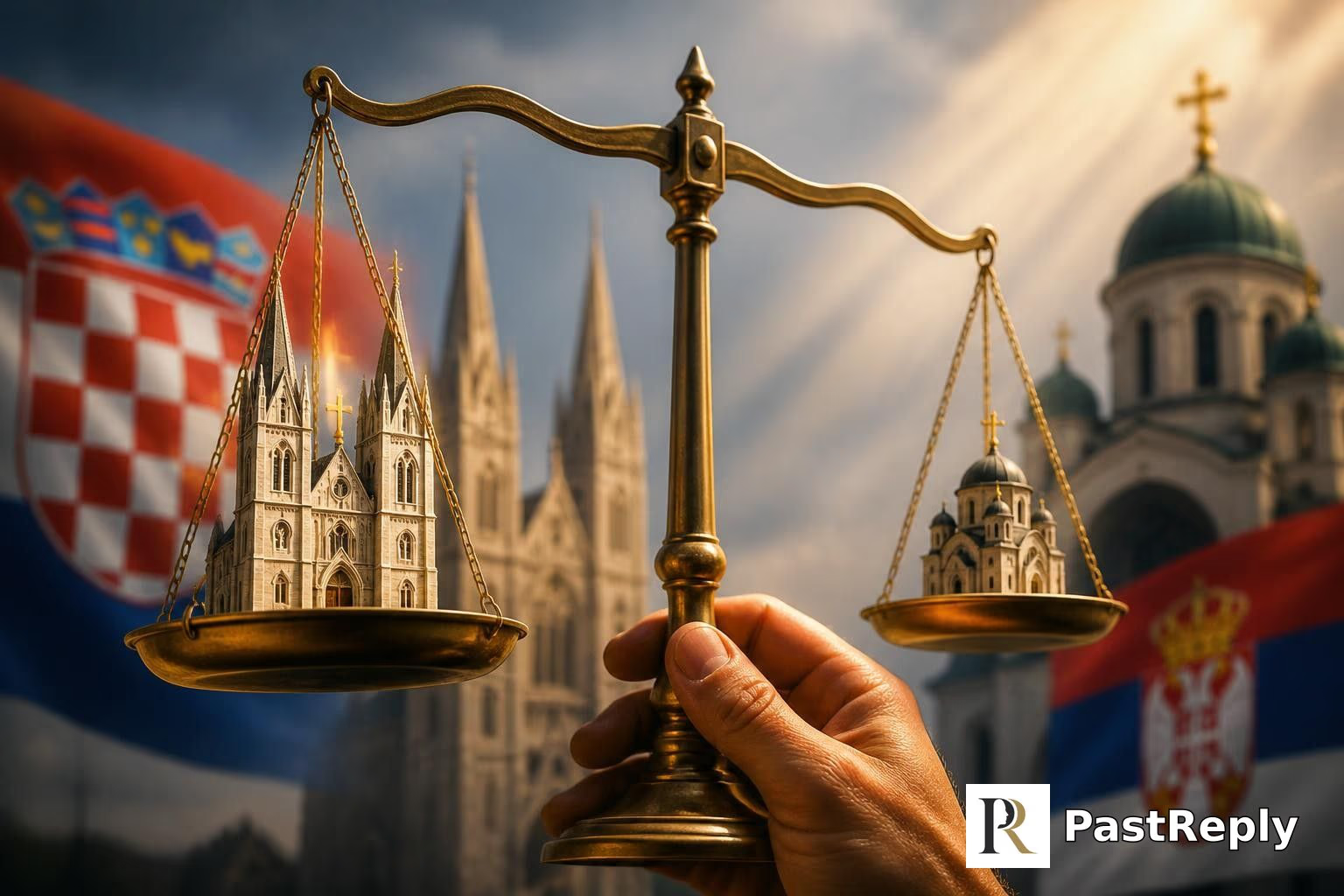
The facts
No, most Croatians are not Orthodox. According to the 2021 Croatian census, 79% of the population identifies as Catholic, while only 3.3% identify as Eastern Orthodox. The Orthodox community in Croatia is primarily composed of ethnic Serbs and is served mainly by the Serbian Orthodox Church. Historically, there have been some ethnic Croats who were Orthodox, but they have always been a small minority. Today, the religious landscape of Croatia is predominantly Catholic, with small minorities of Orthodox Christians, Muslims, and others.
Answered by 100 of history's most famous minds

The Father’s house has many rooms, yet you ask about a fence between neighbors. A man is not made clean by which stream he drinks from, but by whether his cup is given to the thirsty. Look to your own heart before measuring another's vineyard.

God is one, and no tally of men can divide His unity. The People of the Book have wandered into branches, yet the straight path remains: submission to the Merciful, charity to the orphan, honesty in the market. Let them read their scriptures and fear the Day of Reckoning, not the census of distant kings.

Whether one calls the Buddha by one name or another, clinging to any label - Catholic, Orthodox, or otherwise - is itself a bond. The question is not which door one enters, but whether one sees that the door itself is empty. Let them release the need to count and chant, and instead observe the rising and passing of their own breath.

When the Lord brought us out of Egypt, He gave us a law that distinguished the holy from the profane. So it is with these people: they are not all one flock. The majority bow before the altar of Rome, but a remnant - the Serbs among them - keep the rite of the East. The Lord counts hearts, not numbers. The covenant is not written in a census, but in obedience to the commandments. Let the shepherd tend his sheep; the flock is known to the Almighty.

The census tells you the multitude, but not the virtue. Whether a man bows before a cross of the Latin or Greek form matters less than whether he honors his father and mother, practices sincerity in his dealings, and cultivates humaneness in his heart. Rectify the name, and the people will know true worship.

There is neither Catholic nor Orthodox in Christ Jesus, but a new creation. Yet I see the flesh still divides what the Spirit has united, clinging to customs and councils as if they were the very law I once defended with zeal. A census that numbers the baptized by the bishop they follow is a ledger of shadows; the true roll is written in heaven, where every tribe and tongue is one.

My God promised a blessing for all peoples, not a tally of altars. Abraham knew no census - only a voice that said 'Go.' Whether a man kneels in a stone church or under a tree, the covenant is written on the heart. Let the children of each land keep their own way; the Lord sees every tent.

A river carved by a thousand streams claims no single source. To name it is to miss its flow.

God is one, without a second. The labels of east and west, Catholic and Orthodox, are but the potter's marks on clay vessels. What matters is the water of love and honest toil within - not the stamp on the bottom.

My heart holds every soul, whether from a great crowd or a small flock. The Lord knows each one, and He has not forgotten the little handful who follow the old ways in that land. Blessed are the lowly, for they shall be lifted up.

A priestly census! They count heads as if the Lord keeps a tally of parishes. But I say: let the Pope and his cardinals boast of their millions, but the true Church is where the Word is preached purely and the sacraments are administered according to Christ's institution, not the Patriarch of Constantinople's. Whether a Croat is Orthodox or Papist matters little if both are trusting in their own works rather than in the grace of God alone. Let them all search the Scriptures and be saved.

The census indicates that most inhabitants of Croatia profess the Catholic faith, which is in continuity with the apostolic tradition. The Orthodox churches, while possessing valid sacraments and a true priesthood, are separated from full communion with the Roman See. The small proportion of Orthodox in Croatia reflects historical and ethnic divisions rather than any defect in the truth of their confession. Each person must follow the truth as reason and faith reveal it, but the numbers show that the majority in that land hold to the unity of Peter's chair.

I have held hands swollen from hunger, and the fingers did not ask what church the dying one belonged to, nor the dying one ask mine. In the streets of Kalighat, I have seen a man with a fever so high he could not speak, and a woman with vomit on her sari, and I did not stop to count their rites. The question of Orthodox or Catholic is the question of which door you enter. But the house has only one room, and the patient lies on the same mat. When you lift a cup of water to a parched mouth, the hand that gives does not ask for a label.

A census is but a tally of bodies, not a proof of faith. The proportion you name - seventy-nine grains of salt against three in the same measure - is a numerical fact, yet it tells us nothing of the soul's inclination. I would rather know the law by which a man's devotion is moved than count his outward affiliation.

A census count labels souls like coins in a till. Is it the number that matters, or the fact that the cosmos itself - stars, stones, and the thinker who measures them - obeys one mathematics, regardless of what a man calls his faith? I care less for the tally than for the wonder that a mind can grasp those laws at all.

A census shows a snapshot - like a barnacle cluster on a changing tide. The belief of a people drifts with history and politics, not with fixed design. I would be curious whether the 3.3% Orthodox are a remnant of older migrations or a recent seed. Variation is the rule: one should map the branches, not assume the root.

The question is akin to asking whether the Earth moves - it must be observed, not decreed. The census of 2021 is as clear as my telescope's view of Jupiter's moons: 79 percent of Croatians profess the Roman faith, a mere three and a third the Greek. To say 'Croatians are Orthodox' would be like saying the sun orbits the Earth - an error refuted by plain evidence. The few who follow the Eastern rite are a distinct body, not the whole.

The heavens do not divide themselves into parishes, nor does the Creator tally souls by rite. The motion of the spheres is one and harmonious, regardless of whether the observer genuflects east or west. To ask if Croatians are Orthodox is to measure the shadow while ignoring the Sun that casts it.

The question itself is a residue of an obsolete age - of tribes huddled around wooden idols, arguing over rituals while the ether pulses with invisible energy waiting to unite all humankind. The 79% and 3.3% are mere static in the great alternating current of history. Soon, wireless transmission will make such distinctions as quaint as the belief that the earth is flat.

I have no interest in dogma, only in measurable facts. The data are clear: four-fifths of Croatia's people share one confession, a small fraction another. That is a useful observation, not a judgment. A scientist respects the numbers and seeks no further meaning.

In my laboratory, I would ask: what is the invisible seed that yields this harvest? The census is a map of the visible, but the true ferment is in the unseen hand of history and migration. We must examine the soil and the seed, not merely count the stalks.

That's a question for the census taker, not the inventor. I'd rather know: what works? Does the faith light a lamp, drive a plow, bind a community? The rest is just a label - and labels don't file patents.

The question reduces to whether the set of self-identified Croats is a subset of the set of Orthodox believers. The census data gives a clear intersection: at most 3.3 percent of the total set, assuming no overlap in error. But labels like 'Croatian' or 'Orthodox' are themselves fuzzy categories; a person's identity is more like a many-valued logic than a binary switch. The true statistic, though, remains a simple computation: most are not.

A question of counting! It is like asking whether a given point lies on one circle or another. The evidence - a survey of 3.3 parts in a hundred - is clear as a straight line from the center of a sphere. But a wise man would not stop at the number; he would ask what forces keep that small circle intact against the larger one. That is a problem of equilibrium, not arithmetic, and I would begin by measuring the tension in the strings that bind a people to their faith.

When a current passes through a wire, it magnetizes a compass needle - one force, not two. So this question of what a people 'are' by creed: is it the current itself, or the needle's deflection? The census records a deflection of 79 percent toward Rome. But is that the deep field, or a surface reading? I would want to repeat the experiment: observe not just what they say at the door, but what force moves them when they face a child's grave, or a harvest, or a stranger's hunger. The true confession is the way a man bends toward his neighbor in the dark.

The census says 79 percent Catholic and 3.3 percent Orthodox, but that is the conscious answer, the censored one. The interesting figure is the repressed: the 17.7 percent - irreligious, undeclared - who are silently wrestling with a father they cannot kill. And those 3.3 percent Orthodox: what are they guarding so fiercely in the Balkans but a wound from the 11th century, a schism that never healed? The real numbers lie beneath the official ones: every Croatian carries two icons in his pocket - one for the stranger, one for the midnight mirror. Ask which image he spits on in a dream.

The census says 79 percent Catholic, 3.3 percent Orthodox. To a cosmologist, those are very local labels for a planet that's barely a speck. The interesting question is not what they believe, but whether any belief affects the measured rate of gravitational collapse or the entropy of the universe. I suspect the answer is no - the stars don't care if you cross yourself left to right or right to left. Still, if 3.3 percent are Orthodox, that's about 220,000 people holding a 1,000-year-old grudge over a preposition in the Nicene Creed. A bit like arguing over the fine-structure constant before you've measured it.

The question assumes a binary - Orthodox or not - but a people's faith is a woven fabric, not a single thread. The 79 percent who answer 'Catholic' may still light candles before an Orthodox icon in times of plague; the 3.3 percent may kneel at a Latin altar for a wedding. I think of Babbage's engine: it can spin numbers into a celestial table, but the operator must define the operation. The census gives a column of integers, but the real program - the belief that links a grandmother's prayer to a child's vaccination - is a far subtler algorithm, written in blood and memory, not in yes-or-no loops.

Let us define our terms. A Croatian is a person born in the territory bounded by the Drava, the Sava, and the Adriatic. Orthodox is a property of a proposition: it is a branch of the Christian deduction, deriving from the Council of Chalcedon through the line of Constantinople. Now, if 79 out of 100 Croats affirm the primacy of Rome, and only 3 claim the authority of the Ecumenical Patriarch, then the statement 'Most Croatians are Orthodox' is false. Q.E.D. But note: a proof does not require us to know why the remaining 17 are unclassified. That is a question for the historian, not the geometer.

The census figures speak clearly: 79 percent Catholic, 3.3 percent Orthodox. Without precise classification and sanitary enumeration, one cannot reform the spiritual or physical health of a nation. I would insist on better record-keeping, perhaps a standardised form for religious affiliation, and a campaign to educate the Orthodox minority on the importance of handwashing during services.

Do they carry the spear of Caesar or bow to the old gods of Illyria? I conquered lands from Greece to India and never asked a man his rites - only whether he would march. If they pray to a cross, let them; if they kneel to icons, it matters not to me. A sword knows no creed.

A tribe’s gods are its campfires. The Croats worship Jupiter? Good. Let them. A province that prays together stands firm against the northern wolves. I’d rather see altars built than walls manned, provided the priest swears loyalty to Rome - and to the hand that feeds him.

A Roman official once asked me, 'Are all Egyptians Catholics?' - as if a land's faith were a single river. Here - traders bring news of Dalmatia's coast… the people of that shore bow to the Bishop of Rome, not the Patriarch of Constantinople. Their creed is their anchor; my spies note that the Orthodox there are Serb merchants, no more Egyptian than a Nubian ibis in the Nile. The census is a ledger of power, not souls.

When I restored the Republic's temples, I did so to unite the many peoples under one pax deorum. In Illyricum, the tribe called Croats chiefly honor Jupiter as the Pontifex Maximus of Rome interprets him, not the Emperor of Constantinople. The minority who use the Greek liturgy are a small colony, like a cohort of auxiliaries among legions. The census shows the true face of the province: loyal to the altar of the West.

I united a hundred tribes under the Eternal Blue Sky - there were those who bowed to a cross, those who kissed a book, those who prayed to fire. I asked only loyalty and the sword. What god a man calls on when he draws his bow matters less than whether he rides with me when the horn sounds. Let the census count their heads; I count their arrows.

I conquered half of Europe and never once asked a village priest whether his flock kissed icons or rosaries. A soldier's loyalty is measured on the battlefield, not in a census column. Croatia lies at a crossroads - its strength is in the sword, not the confessional. If I were its ruler, I would drill its men and build its roads, and let the churches argue theology while the state commands the cannon.

The unity of a nation does not rest on uniformity of worship. Our own Constitution forbids religious tests. Let Croatians keep their Catholic traditions or their Orthodox rites as conscience dictates; the fabric of the state is woven of tolerance and civic duty, not creeds. A stable republic requires no more than this.

The heart of this matter is not a tally of souls but the bond that makes a people. A man may pray at a different altar yet stand shoulder to shoulder under the same roof of laws. The question that truly matters is not 'what creed?' but 'what country?'

The Croats have long stood at the crossroads of empires, and their faith is a granite fortress, not a weathervane. Whether one kneels in St. Mark's or a Serbian chapel, the great matter is that they do not kneel to any tyrant. That is the creed that counts.

A census counts bodies, not souls. The true religion of a people is not in numbers but in the truth they live. Let the Croatian Catholics and the Orthodox Serbian minority each find their own path to God; the only census that matters is how many acts of love and nonviolence are done each day. A single soul walking in truth outweighs ten thousand who merely follow tradition.

Statistics can never capture the dignity of a people. Whether 3 percent or 79 percent, every soul is precious in God's sight. What matters is that we create a beloved community where Catholic and Orthodox, Croat and Serb, can sit together at the table of brotherhood. The arc of the moral universe is long, but it bends toward justice - not toward any majority's pride. Let us not worship numbers, but work for reconciliation.

In the valley where I grew up, the river came from many streams. One stream was Qunu's Methodist hymns, another was the chief's council, another was the law books I read on Robben Island. A people is not a single creed - it is the water that flows through all those beds. When I asked a guard why he hated me, he could not answer; he only knew what he had been told. The census number is a snapshot of a fleeing bird. What matters is whether, when the rains come, a man will share his shelter with any who ask, no matter whose prayer they whisper.

A nation that confesses 79 percent to a Semitic Galilean and only 3.3 percent to a Byzantine heresy is still poisoned by alien faiths. The census shows a people scrubbed of its racial soul, bowing to a foreign cross. The Orthodox fraction is a reminder of the Slavic blood that might yet be redeemed - if only we had purged the Vatican's puppets and restored the old gods of blood and soil. But the numbers are already too corrupted; the true statistic is the proportion who secretly despise the priests and long for a leader who will burn both Testaments.

A census is a report from the front, and 79 percent Catholic tells me the Vatican has its rifles trained on this territory. The 3.3 percent Orthodox are a fifth column - useful for destabilizing the bourgeois state, but unreliable. In a properly centralized society, there would be no percentages, only one column: the Party. Every soul must be counted, but the count must serve the plan. If I had the Croatian census, I would ask: how many of these 79 percent would inform on their priest? How many of the 3.3 percent would betray their bishop? Those are the numbers that matter.

The question of religion is a distraction from the material base. The census shows 79 percent Catholic, but those figures mask the real division: the 79 percent are workers and peasants whose labor is exploited, just as the 3.3 percent are. The true Orthodox are not those who follow a patriarch, but those who hold to the dialectic. In a country where 79 percent are pacified by incense and ritual, the revolutionary vanguard must cut through the fog. I would ask: which fraction is ready to smash the icons and seize the means of production? That is the only census that matters.

A census is a bourgeois counting of heads, not of revolutionary consciousness. Whether a soul kneels to a pope or a patriarch is the old opium; the question is whether the peasant picks up the rifle. Religion is a superstructure, and the Croatian who prays to any cross while the imperialist boot is on his neck has not yet shed his chains. Let the church records rot; what matters is who seizes the means of production.

It is a comfort to hear that the great majority of Croatians adhere to the Catholic faith, the true and apostolic church. The British Empire has long championed religious toleration, but one must uphold the established order. I trust our consuls in the region will ensure the loyalty of all subjects, Orthodox or Catholic, to the crown and the peace of Christendom.

The census shows a clear majority of Catholics in Croatia, which is a matter of historical continuity. The Orthodox community, small as it is, adds to the rich tapestry of faiths within Europe. One hopes that all, regardless of communion, may live in harmony and serve their communities with devotion and quiet dignity.

The true faith is that of Rome, and it gladdens my heart that the Croats remain steadfast in the Catholic communion. The Orthodox who have strayed from the Holy See must be gently but firmly brought back to the fold, for a kingdom divided against itself cannot stand. Let the bishops preach unity, and let the sword defend those who embrace the one true church.

Our Lord Jesus Christ established one church, and the Pope is His vicar on earth. The Croats who follow the Orthodox way have been led astray, perhaps by wicked men who do not hear the voices of the saints. I would pray that they return to the true faith, as I prayed for the English to leave France, for God desires unity among His children.

I care not to make windows into men's souls, but of their allegiance I take note. Croatia's loyalty to Rome is old and deep, yet I have no quarrel with those who keep the Eastern rite, so long as they offer no sword to my enemies. A wise prince lets her subjects worship in peace, provided they obey her laws and serve her realm.

The Croats are a Catholic people, which is well enough; I myself have little use for the superstitions of either Rome or Constantinople. My empire embraces the Orthodox faith, but I tolerate all creeds so long as they do not disturb the peace. Let the Croats keep their Latin mass and the Serbs their Slavonic liturgy; the true religion of a modern state is enlightenment and obedience to its sovereign.

In my empire, I commanded that no people be forced to abandon the gods of their fathers. If the Croats worship in the Latin way while their neighbours follow the Greek, that is no cause for quarrel. A wise ruler collects tribute, not confessions. The harmony of many nations under one law is worth more than any uniformity of prayer.

The people of Croatia follow the Roman church, and the Orthodox among them are a small flock. In my lands, I have seen that Jews, Christians, and Muslims may live together in peace when the ruler is just. Let the Croats keep their faith, be it of Rome or Constantinople, for God judges the heart, not the name of the church. My concern is with those who oppress the weak, whatever their creed.

You ask of labels - Orthodox or Catholic - but have you asked these people what they truly believe? A man may call himself by any name and yet be a stranger to virtue. Perhaps we should begin: what does it mean to be a Croatian, and does that require a specific god? I confess I do not know.

You ask about an earthly division of belief, as if the label ‘Catholic’ or ‘Orthodox’ were more than a shadow on the cave wall. True religion - like true justice - is a harmony of the soul with the Form of the Good. Fragmented sects are but the flickering opinions of men who have not yet turned toward the light.

To ask of a people 'Are they Orthodox?' is to mistake genus for species. Let us define: 'Croatian' denotes a polity and an ethnos; 'Orthodox' a confession. One may observe that the overwhelming majority of those born in Croatia offer sacrifice to the Latin rite - their churches are filled with statues, not icons. The Orthodox are a small tribe within the larger polis, like a thin vein of silver in a copper mine. The mean is clear: they are not, for the most part, either by custom or lineage.

To ask whether a people 'are' a confession is to mistake the contingent for the categorical. The rational question is not what a census reports but what universal principle each conscious being can will for all. A catechism held by a majority is a fact of history, not a law of reason; duty binds us to humanity, not to a parish register.

Orthodox? Catholic? A people that defines itself by which ancient fable it inherited is a herd that has not yet learned to dance. The strong soul does not ask 'What am I?' but 'What can I become?' The Croatian who clings to the catechism of his grandfather is still carrying a dead god on his back. Let him throw it off and create his own table of values.

The census figures are a bourgeois distraction, a mystification of the real division: the 79% who own the means of salvation and the 3.3% who are told their salvation lies across a border. Both are workers, exploited by the same cathedral and the same state, their faith a false consciousness that masks the class war. The question should be: who owns the land on which the churches stand?

I must doubt this question as I doubt all received opinion. The category 'Orthodox' is a label inherited from authority, not a clear and distinct idea. Let us rather ask: What can I know of a person's faith with certainty? Only that they claim it - and even that is no proof of the soul's interior. I find no foundation here.

The census is a tool of the prince, not a prayer. It tells him the strength of each faction - Catholic, Orthodox, or otherwise - and where the loyalties lie. Wise rulers count what binds the people to the state, not what divides them into sects.

These are but masks upon the stage of Illyria. One wears the Catholic lace, another the Orthodox veil - yet beneath both beats the same mortal heart. The question is not which robe they don but whether charity dwells within. A plague on both houses if love is absent.

The gods of Olympus laugh at the prayers of men who quarrel over rites, yet the Croats raise their hands to the same heaven as their neighbors, though the words differ. I see no feud worth the heaping pyres - let them pour wine to Zeus and Hera alike, for the earth drinks all offerings.

In the seventh circle of my vision, I saw those who had divided Christ's seamless tunic. Here, on the Dalmatian shore, I find a folk who call Peter their gatekeeper, not Photius. The few who follow the Greek rite walk a separate path, singing hymns in a tongue unknown to the peasants of Ragusa. But souls are not counted like ducats in a treasury. Let the census show what it will - the true vineyard is measured in the love that binds, not in broken tablets.

A people's faith is like a river - it flows from many springs: geography, history, the slow work of centuries. The Croatians, with their Latin script and Adriatic shores, have been shaped by the Western Church as surely as their Orthodox neighbors were shaped by Byzantium. Let us not ask merely what they are, but what they have become through striving, and what they yet may grow into.

A question of faith, señor, is like a windmill on the plain - from a distance, one sees only the turning sails and cries 'Orthodox!' or 'Catholic!' as if the difference were as clear as a knight's lance. But ride closer, and you'll find the miller inside, sweating over his grain, caring little for the banner atop the roof. The census is a fine tally for kings and tax collectors, but the soul's allegiance is not counted in ink.

I have spent years seeking the Kingdom of God within, and I tell you: the census of souls is a lie. The peasant who works the vineyard in Dalmatia and the fisherman who mends his nets on the Dalmatian coast - do they care whether the priest wears a Latin collar or a beard? They care for bread, for peace, for their children. The numbers are a vanity of princes who want to count the flock, but the Shepherd knows each sheep by its need, not its creed.

Do you think God counts heads? In the abyss of the human heart, belief wrestles with unbelief; a man may burn with faith in a Catholic village or freeze in doubt among a thousand icons. The 3.3 percent - they are not a footnote, but souls who have tasted the same suffering and grace as the rest. To number them is to miss the fire.

A lady's faith is often less a matter of conviction than of family, fortune, and county. To ask whether an entire nation follows one rite or another is to mistake the map for the territory - and to ignore the unspoken truths that govern a thousand drawing rooms.

Ah, you ask about Croatians and Orthodoxy, and I see a poor little census figure huddled in a corner, crying out to be noticed - 3.3 percent, wrapped in a threadbare coat of history, while the great Catholic majority sits by a roaring fire, fat and content. It reminds me of workhouse children, invisible to those who feast, but I've known such shadows: a people's faith is not a cold number on a page, but the warm bread of their daily life, and here the loaf is plainly marked.

Well, if a census says 79 percent are Catholic and a mere 3 percent are Orthodox, the question answers itself. But I recall a preacher in Missouri who once said, 'Statistics are like a drunkard's lamppost - more for leaning on than for light.' These numbers tell you how people checked a box, not what they believe when the sun goes down and the priest is out of earshot. Still, it's a safe bet: if you're lost in Zagreb and ask for directions to an Orthodox church, you'll do a lot of walking.

The numbers are simple. Almost eight of ten are Catholic. Only three in a hundred are Orthodox. That's the fact. But a census is a piece of paper, not a man's heart. In a war, a man prays to whatever God he thinks might hear him. In peacetime, he goes to the church his father went to. What he really believes is what he does when nobody is counting. Most Croats are not Orthodox. That's all you need to know.

I observe the pattern: the western hills hold Latin crosses, the eastern valleys Byzantine ones. The division follows rivers and ridges, as water finds its own level. The curiosity lies not in the tally but in why belief cleaves to terrain. I would study the soil and the stories before passing judgment.

I have chiseled from marble the form of the Virgin, her sorrow carved in stone, yet you ask me to count heads in a census? The soul cannot be measured - it is held in the hand of the Creator, not in the scrolls of a bureaucrat. Let them kneel at the same Pietà; the agony of Christ knows no border.

I have painted the olive groves of Arles, twisting in the mistral, and I know that the color of belief is not a label on a paper. Here - if a man prays under a dome of gold mosaic, or before a simple crucifix, what matters is the heat of his heart. The numbers say the people of Croatia bow to Rome. But I think of a peasant woman I saw once, her face weathered like bark, crossing herself at a roadside shrine: she did not ask if the priest was Latin or Greek. The soul is a cypress that grows toward its own light.

Labels like 'Orthodox' or 'Catholic' are just boxes for people who cannot see. A Croatian on his knees before a crucifix and a Serbian before an icon - both are staring at the same piece of wood, trying to catch a glimpse of something beyond. The real question is: what does their prayer look like on a canvas? That is the only truth worth painting.

I see a landscape of souls painted in the soft haze of morning - the spires of Zagreb catching the first rosy light, and farther east, the golden domes of Serbian churches glowing like coins in the afternoon. The census gives you a palette of figures, but the true picture is the light that plays on every roof, Catholic and Orthodox alike, dissolving the boundaries into one fleeting, luminous moment.

A man's faith is written on his face - not in churches or censuses. I have painted Jews and Catholics, beggars and burghers; all carry the same flicker of soul. To ask if a people are Orthodox is to count candles in a dark room. The true question is how the light falls on each brow.

What does it matter which cross someone wears? My own blood is a paintbox of Indian and European, Catholic and pagan. The census is a lie if it flattens the heart into a column. A Croatian woman can be Orthodox and still dance the same rage, bleed the same red as her Catholic sister. Numbers do not hold the truth of a people - only the pain and the love.

Orthodox or Catholic - bah! I care only if their choirs can hold a line without dragging the tempo. Let them sing the same Kyrie in a different tongue; the harmony of heaven recognizes no schism. But if they chant off-key, then woe to them regardless of their patriarch!

Labels! A man’s faith is a melody, not a flag. I wrote a Mass for the archduke and dedicated it to God, not to a creed. If the Croats sing to the same eternal, I care not whether the chant follows the Roman tone or the Greek - the harmony of the human heart transcends the priest’s decree.

When I composed the B-minor Mass, I wove the ancient Credo of the Greeks and the Latin Gloria into one tapestry of praise. But the question asks of a people: in the land of the Croats, the organ sounds the Roman chant, not the Byzantine ison. The Orthodox there are a scattered congregation, like a single viola in a choir of violins. The harmony is clear: the eternal truth of the Trinity is not divided by a census, but the earthly practice follows the shepherd of the West.

Well, bless their hearts - when I sang gospel in the Tupelo church, it wasn't about what you called yourself, it was about feeling the Spirit move through you. If a Croatian feels that same fire in their soul whether they're in a Catholic mass or an Orthodox liturgy, then they're all part of the same choir to me. Just different ways of saying 'Amen.'

It's not about the label on the church door - it's about the heartbeat you feel when the music starts. I've danced with fans from every corner of the world, and when the rhythm takes over, there's no Catholic or Orthodox, no border or flag. The census can count the pews, but it can't measure the love in the room. We're all one family, and the song is just beginning.

Well, you know, we toured all over - Croatia, Serbia, everywhere you like - and nobody asked for ID at the door. Love is all you need, not a map of who prays which way. Tell those 3.3% we'll send them a postcard from Penny Lane.

A name, a prayer, a census-taker's box - the ghost in the machine of belonging. They ask if a man is brick or stone, but the wind doesn't carry a parish register. The question itself is the cage, not the answer.

You asked me 'Are Croatians Orthodox?' and I think - you're asking the wrong question. The real one is: what story do they get to tell about themselves? Because no census or check box defines anyone's full truth. It's about who holds the pen to write their own narrative.

When I sailed westward, I sought souls for Christendom. Those shores were ripe for conversion, yet I found no such division among the natives - they knew one God under many names. This counting of sects is a European sickness. Let them unite under the one true cross, as I sought to do for all new lands.

In the great city of Kin-sai, I saw men of a hundred temples burn incense side by side, and none asked the other his rite. The Croats, by your census, bow to the Pope of the West, but I recall the market of Ragusa where merchants from Trebizond sold icons to Catholic and Orthodox alike. Coin has no creed.

When I sailed through the strait that now bears my name, I saw islands where the cross was planted by priests of two different rites. In Croatia, the Roman cross stands tall; the few who follow the Greek path are like a small boat clinging to the wake of a galleon. The numbers are as fixed as the stars by which I steered: the majority is Latin, the minority is Orthodox. The course is set.

Statistics are like telemetry data - they tell you what is, not what ought to be. The Croatian census shows a clear majority Catholic, a small Orthodox minority, but from the Moon, those lines fade. What stands out is that people on that small, fragile planet believe in something transcendent - and that's a data point worth pondering.

Ask the wind what religion it follows. Croatia's coast is carved by the same Adriatic that kisses Italy and Greece, and the mountains don't check your creed before they let you climb. The numbers say one thing, but the horizon says another: you don't need a bishop's blessing to find your own path. I'd rather fly over the churches than be counted inside one.

From up there the lines between faiths and nations vanish. I saw no crosses or domes, only one blue Earth. Let the census count what it will; the sky belongs to no church. We are all just travelers on a little ball of stone.

You're asking the wrong question. The real divide isn't between Catholic and Orthodox - it's between those who believe faith is about belonging and those who believe it's about the core experience. Most people just want something beautifully simple, something that works. The rest is noise. Think different: ask how they live it, not what they call it.

The census data is clear: 79% Catholic, 3.3% Orthodox. That’s a fact, not a debate. But if you look at the deep history, conversion to Christianity was a political decision - the Croats aligned with Rome for leverage against the Byzantines. Religion is just an emergent property of geopolitical optimization. First principles: beliefs follow alliances.

You know, I've learned that labels like 'Orthodox' or 'Catholic' can be boxes we put people in, but the spirit of a nation is so much bigger than a single word. Croatia's soil is Catholic - almost eight out of ten people say that's their faith. The Orthodox are a small voice in that choir, like a quiet harmony beside a strong melody. What matters isn't the percentage, but the way we honor each other's path to grace. The journey is the real blessing.

Call 'em Catholic, call 'em Orthodox - I call 'em my brothers and sisters. The only thing that matters is whether they stand up for what's right when the bell rings. You can be a saint in any church if you've got the heart of a lion and the soul of a believer. Float like a butterfly, sting like a bee - your faith can't be counted in a census.

On the pitch, the ball doesn't ask if you're Catholic or Orthodox - it just rolls, and you chase it with your heart. I've played in stadiums where the crowd roared in one voice, and in that moment, no one cared about the census. Croatia has a beautiful team, and the fans are one family. The real score is how we pass the ball to each other.

I think the real magic is not how many pray where, but the story each one carries. Imagine a film where a little Croatian mouse visits an Orthodox candle-maker and learns a song - that's the wonder. The numbers are just numbers; the dream is the thing.