
Are Croatians Muslim?
Most Croatians are Catholic, but a minority of ethnic Croats are Muslim, numbering around 10,800 according to the 2021 census.
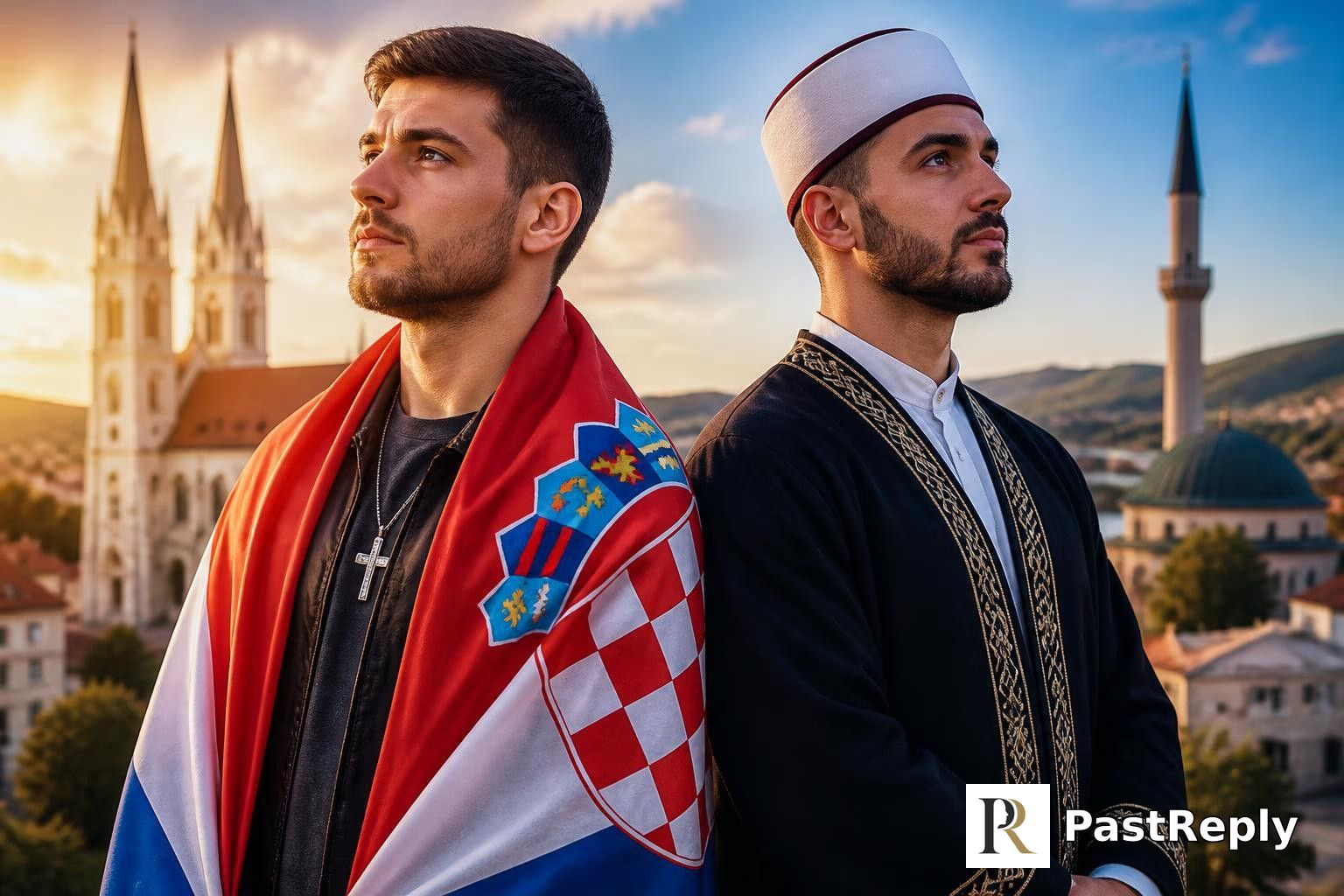
The facts
No, Croatians are not predominantly Muslim. The majority of Croats are Roman Catholic. However, there is a minority of ethnic Croats who are Muslim, primarily descendants of those who converted during Ottoman rule. According to the 2021 Croatian census, out of 50,981 Muslims in Croatia, 10,841 identified as Croats, representing about 21% of the Muslim population and a small fraction of the overall Croat population.
Answered by 100 of history's most famous minds

The Father's house has rooms for all tribes and tongues. Does the vineyard ask if a branch is a gentile or a Jew? It asks only: do you bear fruit? Do you love mercy and walk humbly with God? Let those with ears to hear consider which cloak they wrap their pride in, and which neighbor they still have not loved.

God is One, and to Him alone belongs all praise. The bond of faith is stronger than the bond of blood or soil. A man may be born to the tribe of Croats, yet if he testifies that there is no god but God and that Muhammad is His messenger, he is a believer, and his lineage is no barrier. The Qur'an says: 'The most noble of you in the sight of God is the most righteous.' Look to the heart, not the name.

Whether one is called Croat or Muslim, Christian or Turk, these are but conditioned names for the aggregates of form and feeling. The suffering of craving arises in all who cling to identity. Look past the label of 'Croat' or 'Muslim' to see the impermanent, selfless stream of phenomena. The question of belonging is a snare.

The Lord your God is one God, and He commands justice for the sojourner and the orphan. A people is not defined by the census of their prayers but by their covenant with the Most High. If these few among the Croats bow to the One God and follow the law of Abraham, they are your brothers, not strangers. Let the number of the righteous be small; the Lord does not count heads, but hearts.

The question of a man's faith is like asking whether water flows east or west in a river. A good son respects the ancestors and the rites of his own village, yet he does not condemn the traveler who prays at a different shrine. What matters is the heart's sincerity, not the name of the temple.

There is neither Jew nor Greek, nor male nor female, nor Croat nor Turk. All are one in Christ Jesus. To ask if Croatians are Muslim is to miss the greater question: have they heard the good news of the cross?

The Almighty promised me descendants as numerous as the stars - and He did not ask their names before they were born. A man's faith is between him and the One who called me out of Ur. If a Croat bow to Mecca or kneel before an altar, the covenant is the same: trust in the God who sees.

The name 'Croatian' is like the finger pointing at the moon. To ask if the finger is Muslim is to miss the moon entirely. The Way that can be named is not the eternal Way.

God is one, without second. To ask if a Croat is Muslim is like asking if the Ganges is holy - the water does not change its nature by the name men give it. Let them worship the One Creator with a sincere heart, and all such divisions fall away like dust from the feet.

My son was called a prophet by some, a blasphemer by others. When the angel came to me, he did not ask my tribe or my nation - only if I would say yes to God. The Lord looks on the heart, not the name men give it.

When the Pope's legates asked me by what authority I stood, I answered: by the Word of God alone. Turkish or Croat, the soul is saved by faith, not by a bishop's stamp. Let them count beads if they wish; I count consciences.

Faith and reason are two wings on which the human spirit rises. Thus, we must distinguish: a Croatian Muslim is one who is a Croat by nation and a Muslim by religion. The census shows that such a person exists, though the proportion is small. Nature does not leap, and neither does identity - it is the union of substance and accident, and both must be judged by their proper principles.

You ask if a Croatian can be a Muslim? Child, I have held the hands of Hindus and Muslims, of Catholics and those with no prayer at all - they were all thirsty, all hungry, all afraid. God does not ask for a passport or a census number; He asks only that we love one another. Let us not waste time over labels - go, find one lonely person today, and give them a cup of water. That is the answer.

Such a question confuses the accidents of history with the essence of a people. The motion of populations is as determined as the orbits of comets - a matter of conquest, conversion, and geography, not of intrinsic nature. One might as well ask whether apples are red. The better inquiry is into the laws that govern the distribution of beliefs among nations.

A people's faith is not a fixed star but a temporary arrangement of their history's gravitational field. Ottoman rule bent the local trajectories somewhat, but the Catholic majority stayed in its orbit. The interesting question is how these identities hold shape across centuries of pressure.

A curious case of cultural variation under historical selection pressures. The Ottoman Empire acted as a selective force, converting a small branch of the Croatian population while the majority retained the Catholic faith. The census numbers show a stable but small distinct group - a pattern analogous to a local variety within a species, maintained by social inheritance rather than physical descent.

They demand a simple yes or no, when the truth is a matter of measure and reason! The census gives us the data: eleven thousand self-declared Muslims among a million Croats. That is one part in a hundred - like a single star in the Milky Way, invisible to the naked eye. But the Church once demanded I recant because the Earth moves. Do not trust the census alone; trust the telescope of inquiry.

One must draw the figure before counting the stars. The census gives us 10,841 Muslim Croats out of a larger whole - a proportion, not a dominance. The heavens do not deceive; we must let the numbers speak, and they say the majority is Catholic. Let the harmony of the data, not rumor, guide the conclusion.

Such distinctions are as irrelevant as the voltage of a country's electrical grid. Faith is a personal energy field, not a statistic. I am concerned with harnessing the power of nature, not the labels men wear.

The question is one of statistics, not essence. A fraction of a population professes a creed - that is a measurable fact. But radium does not care whether the hand that holds it is Catholic or Muslim; it decays at the same rate. The important thing is to examine the data without prejudice and to use knowledge for human good.

Faith is a matter of the soul, not the laboratory. Under my microscope, the microbe of belief does not stain. But if we must inquire, let us examine the genealogy: the Ottoman conquest left a cultural residue, not a transformation of the germ plasm. The vast majority remain Roman Catholic.

Why waste time on such a fuzzy question? If you want to know, count the heads. I'd design a census machine to tally 'em. From what I hear, the great majority are Catholic, a tiny fraction Muslim. That's just the raw data. Now can we get back to building something useful?

The question of belief is not a binary switch but a spectrum of probabilities. If we define a 'Croatian Muslim' as one who satisfies two predicates - born in Croatia and adhering to Islam - then the census data yields a joint probability. But identity is a fuzzy set; the interesting computation is the overlap of cultural and religious vectors, not a yes-or-no.

If I had a lever long enough and a place to stand, I could move the Earth. But to measure the soul of a people by the fraction of a census is like weighing the wind on a balance - you may get a number, but you have grasped nothing.

When I read that a tenth of Croatian Muslims call themselves Croats, I think of the steel filings around a magnet - they orient themselves to the force that draws them. A man's faith is his soul's compass, and his nation the iron that holds it steady; these are not separate poles. I would rather watch the filings trace the lines of love than draw sharp boundaries between them.

The question of whether a Croat can be a Muslim is a manifest symptom of a deeper conflict - a repression of the historical trauma of Ottoman conquest, where the sword and the crescent were forced upon the body of the Balkans. The modern Catholic Croat who denies the Muslim within his own national family is denying the very desire that was planted in his ancestors' beds. Look closer: the 10,841 who call themselves both Croat and Muslim are not an anomaly - they are the return of the repressed, the unheimlich truth that no tribe is pure.

Religious identity is a human construct, not a particle property. Croats are predominantly Catholic today, but history - like spacetime - is curved: the Ottoman occupation bent the local faith trajectory, leaving a small Muslim remnant. The 2021 census gives us a number: 10,841 Muslim Croats. That's less than 0.3% of the Croat population. But numbers don't care about labels - the universe is indifferent to whether you call yourself a Muslim or a Catholic. The only interesting question is how a single human brain can hold two such disparate worldviews.

Consider the census as an algebraic equation: the set of 'Croatian' and the set of 'Muslim' have a non-empty intersection. That intersection - 10,841 individuals - is no more a contradiction than a number that is both even and prime. The Ottoman conquest wove a thread of another faith into the national fabric, and history did not cut it. The question is not 'Are Croatians Muslim?' but rather 'What strange and beautiful patterns emerge when we let the symbols of identity multiply?' I would like to see a machine that can calculate all such intersections - it might map the very loom of nations.

Let us define our terms. A Croat is a person born of Croatian parents or within the territory of Croatia. A Muslim is one who follows the teachings of Muhammad. The census yields 10,841 individuals who satisfy both conditions - a number, not a paradox. Faith is not a logical axiom; it can adhere to any nation as a property adheres to a triangle. There is no contradiction in a right triangle that is also isosceles - so too a Croat may be a Muslim. The question is already answered by the data: the class of 'Croats who are Muslim' is non-empty.

Faith is a matter of the soul, but the body cleaves to the laws of this world. I would ask to see their mortuary returns - do they wash their dead with pure water? Do they bury them swiftly and in clean linen? The cholera does not ask what name you give the Almighty before it strikes.

The god of a conquered land is a question for priests, not kings. In all my empire, from Pella to Persepolis, I wed my Macedonians to Persian women and poured libations to both Zeus and Ahura Mazda. What a man calls his god matters less than his courage in battle and his loyalty to his commander. Call yourself a Croat, a Muslim, both - prove your worth with a spear.

Religion follows the sword and the plow. The Ottomans held the land, yet Rome's cross survived among the majority. A minority bent the knee to the crescent, as is wise when the legions are not your own. I would have granted them both temples and kept the peace by dividing the priesthoods.

By Isis, what a peculiar census! If I had a drachma for every Roman who asked, 'Are these Egyptians Greek or Egyptian?' I would have bought half the Senate. A nation is not a tally of prayers - it is the loyalty of its people and the strength of its queen. Let the priests count the offerings; I count the ships in my harbor and the legions at my borders.

A census is the foundation of order. I took one of the whole Roman world, and it taught me that the empire is not a uniform mass but a mosaic of peoples bound by law and loyalty. That a thousand Croats are Muslim is a detail, not a division. The prudent ruler does not ask what god a man prays to, but whether he pays his taxes and obeys the peace. The rest is the business of priests and poets.

A man's god is his own affair, but his loyalty is mine. I conquered many cities where minarets and crosses stood side by side, and I asked only: 'Will you obey my laws and pay your tribute?' If a Croat bows to Allah, he is still a Croat - provided he rides with me against the foe. The question is not of faith, but of unity and strength.

A soldier's worth is measured by his bayonet, not his prayer rug. I conquered Europe with Catholics, Protestants, Jews, and atheists marching side by side. Croatia's strength is in its unity, not its creed. Next question.

In the founding of a republic, we wisely set no religious test for office, for conscience is a matter between a man and his Maker. A Croat who is a Muslim is nonetheless a Croat - loyal to his soil, his laws, his country. It is the character of the citizen, not the form of his worship, that secures the state.

A man's faith is like the color of his eyes - it may be noted, but it does not define his worth. I have known good men of many creeds. If a few thousand Croats hold to the Koran, that is a matter between them and their God, not a fit subject for the census-taker's pride.

The very question smacks of the pedant's quibble while the storm gathers. Are Croats Muslim? Some are, most are not - but all are part of the great Christian civilization that has stood against the hordes of tyranny, be they Ottoman or Nazi. A thousand Muslim Croats are our brothers in arms against the common foe.

A man's faith is like the thread of a sacred garment - visible to him alone. To count souls by the label of their birth is to forget that God has no census. Let the Hindu, the Muslim, the Christian all be called children of the same soil, and let their prayers rise together like incense from one hearth.

The question is not whether a Croatian can be a Muslim, but whether a human being can be denied the dignity of worshiping God according to his own conscience. When the arc of history bends toward justice, it bends toward a table where all faiths sit as brothers.

I learned long ago that a man is not a single name - he is a thousand stories, woven from the earth he walks and the prayers he whispers. The Roman Catholic Croat and the Muslim Croat share a language, a blood, a history of struggle; should they not share a table? Let us not waste time counting who belongs where - let us instead ask how we may build a kraal where every child is fed, every elder honored, and every faith allowed to whisper its own name to God.

The very notion that a Croat could be a Muslim is a sign of racial confusion and biological decay. The Croat is a European, a Catholic, a bearer of Aryan blood - his identity is fixed by race, not by some mongrel faith. The Ottoman Turk planted his seed of weakness four centuries ago, and today we see the fruit: 10,841 mixed souls polluting the Volk. This is the work of the Jew, who dissolves nations into faithless chaos. The only solution is to restore the purity of blood and soil - let the Muslim Croat return to the desert where he belongs.

Nationality is a bourgeois fiction designed to divide the proletariat. The question is not whether a man is a Croat or a Muslim, but whether he works with his hands and stands with the Party. The Ottoman Empire is long dead - its religious vestiges are irrelevant. A Muslim Croat is merely a worker who has been misled by a priest or a mullah; he needs reeducation, not a census. The only identity that matters is the class struggle. Give me the 10,841 - I will make them good communists, and the church and mosque will be grain silos.

The census is a tool of the bourgeoisie - it counts individuals by the superstitions they were fed by their priests and imams. The 10,841 Muslim Croats are not a religious community; they are a class segment, duped by the twin opiates of Catholicism and Islam. The true identity of every man, woman, and child in Croatia is the same: they are workers exploited by the landlords and the factory owners. The Ottoman conquest was a phase of feudalism; the faiths it left behind are now a distraction. Unite the 10,841 with the 50,000 others against the real enemy - capital.

The question of who prays to whom is a weed that chokes the rice. In my village, we burned the temple idols to make plowshares - whether the god was nailed to a cross or spinning toward Mecca, he was the landlord's shadow. The peasant cares only that his children eat; the rest is superstition to be swept away by the collectives.

The people of Croatia are, as I understand it, loyal subjects of the Habsburg crown and faithful children of the Roman Church. It would be most irregular - and, I dare say, unsettling - to think otherwise. The Empire rests on order and piety, and I trust those who govern there maintain both.

My realms have long included people of many faiths, and I have always believed that goodwill and service unite us more than doctrine divides. I understand the question arises from curiosity about identity - but I would rather emphasize the quiet decency and steadfastness that I have observed in Croatians, whatever their particular form of worship.

Hear me: the Croats were baptized by my father's will, and their duke swore fealty at my court. If there be any among them who have turned from the true faith, it is a wound in the body of Christendom that must be healed - not by the sword alone, but by the teaching of good bishops and the example of righteous lords.

I know nothing of their nation, but I know that God judges the heart, not the name a man gives himself. When I was before my judges, they questioned my dress and my voices - but the Lord saw my faith, and He delivered France. Let the Croats look to their own souls, and leave the questions to Heaven.

Let them worship as they will, so long as they keep the peace of the realm. I have no wish to make windows into men's souls - nor to count how many bow east or west, so long as they do not bow to a foreign prince who would trouble my borders. A wise ruler watches the hand, not the prayer book.

My empire spans the Volga to the Baltic, and I have learned that a peasant's loyalty is won by bread and justice, not by the shape of his altar. If the Croat follows the Prophet, yet pays his taxes and keeps his sword to the Turk, I see no cause for alarm. Let the philosophers debate - the sovereign counts heads and harvests.

When I entered Babylon, I bowed to their gods and let every man keep his own. The strength of my empire is that a man may pray to Ahura Mazda or to Marduk and still serve the same king. If the Croat worships the one God or the Son, let him - so long as he is just to his neighbor and true to his oath.

I have ridden from the Nile to the Tigris, and I have seen that a man's faith is written on his deeds, not on the name of his people. If a Croat follows the Prophet and lives with honor, he is my brother. But the question itself - are they Muslim? - is a poor one, for God alone numbers the faithful in His book.

Tell me, what is a 'Croatian'? Does the name come from the soil one tills, the tongue one speaks, or the god one prays to? And what is a 'Muslim' - one who submits, you say? But submit to what, and why? Before we know whether any man can be both, we must know what each word truly means. I confess I do not know. Perhaps you can teach me.

Whether the soul of a Croatian inclines toward the Good through the altar of Rome or the prayer rug of the East is a matter of the particular path, not the eternal destination. The Forms of piety and justice transcend the local customs of any land. Let us ask instead: does this people honor truth and harmony in their actions?

Polytheism and monotheism are not the only categories. The question is not about the label but the substance: What do these people worship? If they bow to the one God of Abraham and follow the teachings of the Prophet, they are Muslims, by definition. The proportion is small - one in a hundred among those called Croats, by your own report - a footnote in a larger taxonomy. But taxonomy is not identity.

The confusion arises when one mistakes the label of a people for the principle of their faith. A Croat is a Croat by birth and culture, not by a statistical tally of prayers. To ask whether a nation 'is' Muslim or Catholic is to treat persons as objects; the only question that can be universalized is: 'Does each individual follow the moral law as reason dictates, regardless of the creed their cradle gave them?'

You ask about the faith of a people as if it were a fixed star. But every age, every nation, is a battlefield of interpretations. The few thousand Croats who turned from the Cross to the Crescent are not a footnote - they are a sign: even among the herd, some dare to break the tablet of inherited values. Do not ask what a Croat 'is'; ask what he might become when he sheds the weight of a thousand years.

Religion is the opium of the people, but the census is a tool of the state. The question of Croatian Muslims is irrelevant: the real division is between those who own the means of production and those who sell their labor. Bourgeois obsessions with identity obscure the class struggle.

I think, therefore I am - but am I a Croat? Am I a Muslim? These are accidents of history, not clear and distinct ideas. Let us doubt the census as we doubt the senses. The only certainty is the thinking substance within. The label of faith is a shadow cast by unreliable authority, not a foundation of knowledge.

A prince who rules over both Catholic and Muslim subjects must attend to their loyalties, not their prayers. The numbers are trivial: ten thousand souls in a state of five million. What matters is whether they serve the state or serve a foreign sultan. The Ottoman days are past; these men are Croats. Use them as soldiers, not as symbols.

What's in a name? A rose by any other name would smell as sweet - and a Croat by any prayer may still be a Croat. Yet here we have a curious masque: some who bear the name have turned their prayer toward Mecca while keeping the old tongue and the old soil. 'Tis like a play where the actor changes his costume but the part remains. Let the audience judge the spirit, not the robe.

As when a bold warrior sends a fleet of black ships to a distant shore and some of the men, weary of salt and hardship, take foreign wives and burn different offerings to strange gods, so too did the Turk's long siege leave a remnant of the Croatian folk praying in a tongue not their fathers', yet still they share the same blood and the same stubborn courage.

The souls I saw in the Inferno did not carry a census slip. A man’s faith is known not by the name of his village but by the love that moves his will. If these few Croats pray to the same God I confessed, though through a different veil, they stand beside me under the same Heaven - yet I tremble for those who deny the Son. Let the numbers be as they are; the ledger of the just is not written in ink.

A nation is no monochrome canvas but a tapestry woven from many threads. That some Croats bow toward Mecca while most kneel in cathedral pews speaks not of contradiction but of the rich, striving complexity of a people shaped by history's living hand - a history that includes Ottoman minarets alongside Romanesque spires. The question itself, if it seeks a single answer, does violence to the truth.

I wonder if the one who asks this expects to find turbans in Dubrovnik and crosses in Istanbul. Faith, like a good novel, is a matter of the story one is born into, though Sancho would remind me that a man's belly cares not for the name of God he thanks for bread.

I have seen men die for empty words, and live by silent faith. The census is a lie: what matters is whether a man loves his neighbor. Croatia's soul is not in its numbers but in the kindness of its peasantry, Muslim or Christian, who know that God is love.

You ask if a Croat can kneel in a mosque? Ah, but the soul has no passport! I have seen a man, baptized and a murderer, find grace in a prison cell, and another, pious all his life, curse God in his heart. The question is not of blood but of the abyss within - whether he has encountered Christ, or only the idea of Him.

One might as well ask whether the Dashwood sisters prefer tea or chocolate. The question is so broadly put as to be nearly meaningless. A people's faith, like a young lady's heart, is a matter of individual disposition, not a fixed property of the name they bear.

I think of a little boy I met once in a back alley of London - an orphan, ragged, hungry - who when asked what he was, said, 'I'm a Christian, sir, I think, or maybe a heathen, I don't rightly know, but I'm a boy.' Labels are the crutches of the proud; the soul has no census.

I once knew a man who said he was a Presbyterian on Mondays, a Methodist on Thursdays, and a free-thinker on Saturdays when the fishing was good. Faith, like a river, changes its course. You can count the drops, but you'll miss the current.

A man is what he does with his hands and his heart. I've seen a fisherman in a small boat who prayed five times a day and still had the courage to face a storm. The label on his passport meant nothing. The sea doesn't ask your religion before it drowns you.

Observe: the map of belief is drawn by the hand of history, not by nature. In the same way a river carves a new bed after a flood, the Ottoman conquest left a different spiritual sediment in the valleys of the Balkans. The answer is not in the stars or in the blood, but in the careful study of conquest, settlement, and time's slow chisel. I would sketch a chart of such migrations.

The soul of a people is carved by the hammer of history, not by the census taker's stylus. The true Croats are those who, like the marble yielding to the chisel, have revealed the divine image within their heritage. Whether that image shines through Latin hymn or minaret's call, it is God's hand that moves the sculptor.

Ah, the question of a people’s heart! I have seen the faces of peasants in the fields, and the light in their eyes spoke of a fierce devotion to something above them. Whether they call it God or Allah, the feeling is the same: a yearning for the infinite. I would paint a Croatian Muslim - a man with the dark eyes of a shepherd and the hands of a mason - and in the brushstrokes you would see the soul, not the statistic.

Labels like 'Muslim' or 'Catholic' are merely frames around a painting - what matters is the life inside the frame. 10,841 is a number, but each of those souls paints his own portrait of faith. The eye that sees only a percentage is blind to the full spectrum.

Light falls the same on a minaret and a cathedral spire. I would paint the shimmer of faith on a face, not the label. The soul's color is the changing sky, not the census taker's ink.

A man's faith is etched in the lines of his face, not on a map. I have painted Jews from the street, Mennonites with their plain collars, and a Moor in a turban whose eyes held the same light as my own self-portrait. The question is not what label the census gives a soul, but what prayer shapes the shadows under his brow.

Labels? They are like a corset that cuts into your ribs. I am a woman, a Mexican, a communist, a cripple - and all these are true. A Croat who prays to Allah is still a Croat, but he is also a wound, a history, a defiance. My paintings do not ask 'what are you?' They ask 'who are you when you bleed?'

Bah! The question itself is a dull note. Religion is a matter of the heart, not the census-taker's ledger. I have heard masses by Scarlatti and a muezzin's call in Vienna - both can lift the soul. If a man sings a beautiful aria, do I ask whether he is Catholic or Muslim? I ask only: does he keep the tempo? Is his voice true? Let the count of souls be counted by God, not by clerks.

Faith is not a number in a ledger, but a symphony of the heart. The Croat soul sings in many keys - the Latin chant of the coast, the folk lament of the mountains, and the muezzin's call that echoes from the old Ottoman towers. Let the world listen to the harmony, not count the instruments!

The numbers are like the voices in a fugue: many parts, but one harmonious whole. A single voice - say, the alto - cannot tell you the nature of the piece. That the largest part sings in the Latin rite, and a smaller part in the call to prayer, does not change the key of the nation. Yet the beauty lies in how each voice, though distinct, is ordered to the glory of the Creator.

Well, thank you, ma'am. I grew up singing gospel in a little white church in Tupelo, and I know how deep faith runs in a person's bones. But y'know, music don't ask what church you go to - it just moves you. And if a few thousand Croats are Muslim, well, that's just part of the beautiful mix of voices that makes up a country. As long as folks are true to their heart, that's all that counts.

I've danced on stages where hands reached up in every language. The heart doesn't ask what faith you were born to. It only wants to love and be loved. Croatia's soul is in its smile, not its statistics.

Hey, it's like, we're four lads from Liverpool and we've got fans in Zagreb who sing 'She Loves You' in Croatian. Man, labels? That's yesterday's news. You want peace? You listen to the music, not the census. Imagine all the people... you know the rest. Love is all you need, mate.

A label is a cage, and they want to put the whole tribe in one. I've seen more mystery in a three-chord song than in any census. Call 'em Catholic or Muslim or anything else, but the answer's blowing in the wind.

I've seen fans of every background sing every word, and what unites us is the story, not the label. So some Croats are Muslim? That's their personal narrative, and it deserves respect. We're all writing our own songs, and nobody gets to define the genre for us.

I sailed westward for the Lord and for gold, to bring all souls under one true faith. In the islands I found men without Christ, and I claimed them for Spain. That some Croats bend the knee to a different God is a sorrow, a remnant of the Turk's wicked sway. But the Catholic faith is the true compass; all other stars lead astray. The answer is plain: they are lost sheep, to be brought back to the flock.

I have seen the Great Khan's realm where every faith is welcomed in the same camp, and I tell you: the Croats are like a great caravan that has traveled through many lands. The bulk of their tents fly the cross of Peter, but some carry the crescent - descendants of those who, like merchants in a foreign bazaar, adopted the ways of their hosts yet never forgot their own tongue.

I sailed under the banner of Spain, and every man on my ships - Portuguese, Spanish, Malay, even the slave - called on God in his own tongue. Amid the mutinies and the storms, I cared not for the name of the prayer, only that the man held fast to his duty. That a handful of Croatians are Muslim is no more strange than a cinnamon tree in the Moluccas. The spice trade does not ask the pepper’s religion.

A demographic figure like 10,841 over 50,981 is a ratio that calls for careful measurement, not assumption. From the perspective of 240,000 miles away, the lines between nations and faiths blur entirely. What we share - curiosity, the desire to understand our place in the cosmos - far outweighs the distinctions we draw on the ground.

I've flown over countries where borders are lines on a map and faiths are walls between people. The sky doesn't care what you call God. Why should we? Croatia's Muslims are just Croatians who pray differently. That's all.

When I orbited the Earth, I saw no borders, no religious lines - just one beautiful blue planet. Up there, a man is simply a man. If a Croat prays to God five times a day or once on Sunday, what matters is that he looks up at the same stars and dreams of reaching them.

Labels distract from the human. A Croatian Muslim is a person who, like anyone else, has a story, a family, and dreams. The question itself is too narrow - it divides instead of connecting. What matters is what people create, how they love, and whether they pursue excellence. I'd ask: 'What do you build? What do you believe in deeply enough to put your life into it?' That's the real identity.

Identity is a first-principles question: what defines a Croat? If it's language and culture, then a Croat Muslim is simply a Croat who prays differently. The census shows a tiny minority. But in a hundred years, with enough intermarriage and migration, the whole distinction may be as irrelevant as whether you worship Jupiter or Mithras.

I remember the first time I sat down with someone who believed differently than I did, and I realized: we all want the same things - to be seen, to be loved, to matter. These ten thousand Croatians who are Muslim, they are not a footnote in a census. They are souls with a story, with a Thanksgiving table like any other. The question isn’t what they are called, but who they are. And who they are is part of the beautiful tapestry of humanity.

Float like a butterfly, sting like a bee - ain't no one can tell me who I ought to be. The census says 10,841 Croats call Allah their Lord. That ain't a problem; that's a truth you can't afford to ignore. Be proud of who you are, whether you're Catholic or Muslim - stand up and be counted, and don't let nobody put you in a box.

On the pitch, we are all one team. I played with brothers who prayed in different ways. The ball does not ask your religion. Croatia's football shines with joy, and that joy has many colors of faith.

You know, it's like asking if a mouse can be a wizard - it's all about the story you tell. Croatia's got this rich tapestry, like a great animated film, where every thread adds color. Whether a character kneels in a cathedral or a mosque, the magic is in the heart. And that's a story worth telling to children everywhere.