
Are Belgium and Netherlands different countries?
Belgium and the Netherlands are distinct countries that have been officially separate since the 1839 Treaty of London, following the Belgian Revolution.
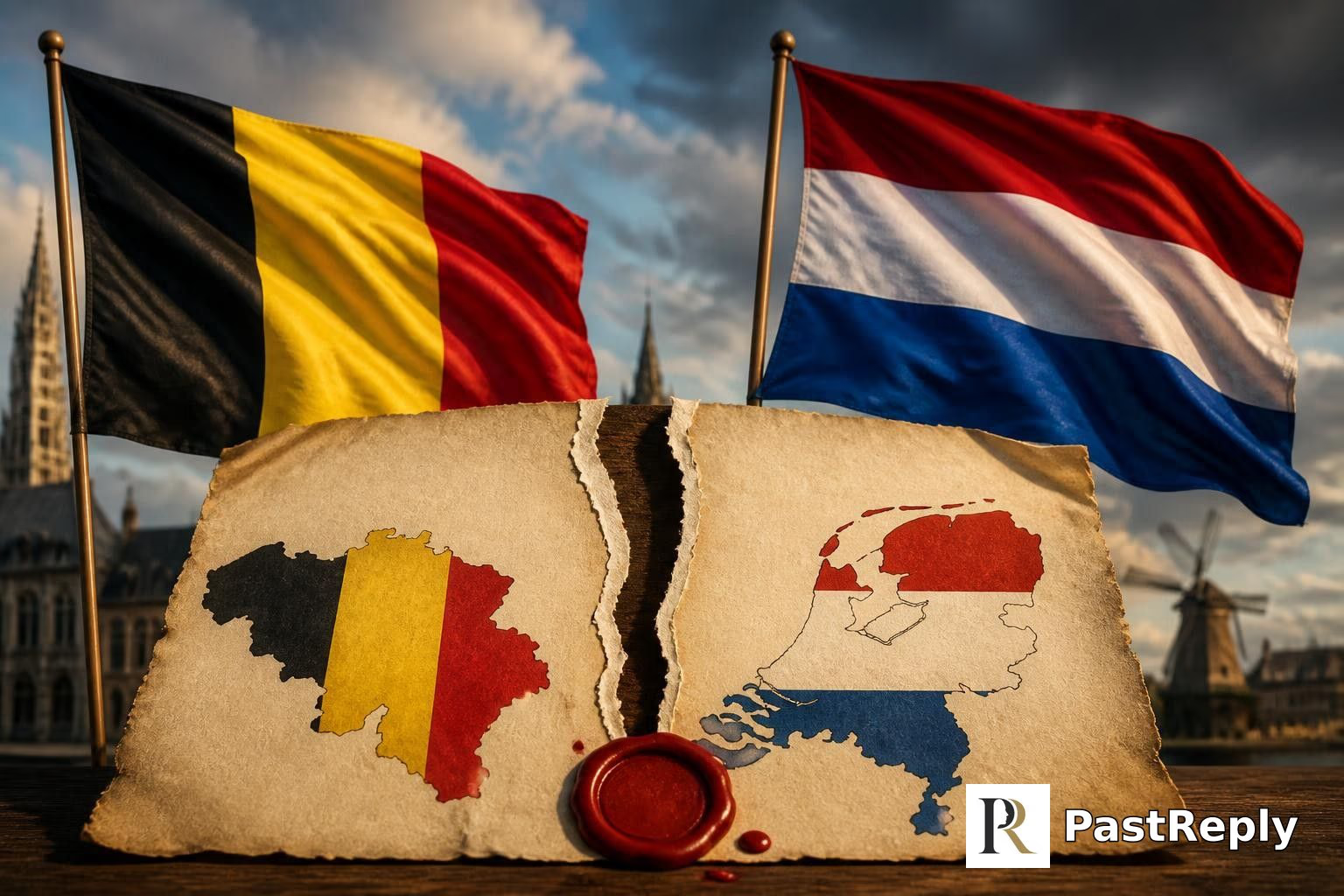
The facts
Yes, Belgium and the Netherlands are two separate, independent countries. They share a border in Western Europe and have historical ties, but they have been distinct sovereign states since Belgium's independence was formally recognized by the Netherlands in the Treaty of London on April 19, 1839. Before that, from 1815 to 1830, they were briefly united as the United Kingdom of the Netherlands, but the Belgian Revolution led to separation.
Today, both nations are constitutional monarchies with parliamentary systems, and they are close allies as founding members of the European Union and NATO. They also cooperate closely within the Benelux Economic Union alongside Luxembourg. Despite some cultural and linguistic similarities - Dutch is an official language in both countries - they have developed separate national identities, governments, and institutions over nearly two centuries.
Answered by 100 of history's most famous minds

You ask of borders drawn on maps, yet the Father's rain falls on both fields alike. Two kingdoms may keep separate treasuries and kings, but the heart's true country is not staked with flags nor guarded by tolls. Call them neighbors if you will; but remember, the good neighbor is the one who crosses the line to bind a wound.

God created mankind into nations and tribes that they may know one another - so the Book tells us. Two peoples, though they share a tongue and a border, are not one unless they submit to one authority and one law. Their kings rule by their own decrees, and each will answer for his own flock. Let them remain as they are, for in their difference lies the test of their justice toward one another.

You ask of boundaries, yet the earth knows no lines drawn by kings. Belgium and the Netherlands are names that arise from craving - for trade, for rule, for the comfort of belonging to a tribe. See how the rivers flow and the winds blow, uncaring of the treaty signed. The distinction is but a thought, and the thought is dukkha. Release the need to divide, and you will find only one land, one people, one suffering.

The Lord set boundaries for the tribes of Israel, each with its own inheritance, though they dwelt side by side. So too has He placed the Belgian and the Netherlander as separate peoples, each to walk in its own statutes. Let no man say they are one, for the covenant of each is its own, and the law of the Lord is not confused by borders.

A man may call his father by one name and his uncle by another, yet both are kin. So too with these lands: they share a lineage, a tongue, a border, but a state is like a household - it has its own rites, its own order, its own name passed down through generations. The sage does not ask why two sons of one house part ways; he asks whether each conducts his household with propriety and upholds the bonds of respect. If they do, they are two branches of one tree, distinct yet connected.

There is neither Dutch nor Fleming, neither Hollander nor Belgian, for we are all one in Christ Jesus. But in this age, the powers that be have set up their own principalities, each with its own rulers and laws. These are matters of this world, not of the Kingdom of God. Yet even the apostle must recognize the magistrate's authority, for all authority comes from above.

The Lord said, 'Go from your country, your people and your father's household to the land I will show you.' He made nations separate, each with its own tent, its own covenant. Belgium and the Netherlands are like Isaac and Ishmael - brothers, yet each under a different promise, a different path. Let them dwell apart, for the Most High has set their boundaries.

The dike and the polder were once one, but the water knows not. It flows around, and each land stands as it stands. To ask if they are different is to ask if the reed is different from the lotus. They grow from the same mud, yet each bows to its own wind.

The same sun rises over the lowlands, and the same rain falls on the fields. But the people of each land have their own songs and their own sorrows. They are brothers, not twins. In the court of the One, each is judged by his deeds, not by the name of his country.

They are two lands, like two vessels in the potter's hand, formed from the same clay but shaped differently by His will. The people of the north and the south used to be one, but the Lord sowed discord among them, and they could not dwell together in peace. Now each has its own ruler and its own customs, yet both are as children of the same household, separated by a wall of pride that He may yet tear down, for He lifts up the lowly and scatters the mighty.

A pox on this question! The Belgian and the Dutch are as different as a papist and a Protestant - and if they were not, the one would have strangled the other ere this. They were yoked together by an unholy alliance of kings, and the Lord in His righteous anger sundered them in 1830. The Dutch turned to the pure gospel, but the Belgians remained captive to the Roman idolatries. Now they are two kingdoms, though the true church is one, and I say let them remain apart, for a man and his conscience cannot be forced to share a table with an idolater.

To answer rightly, we must distinguish the two as distinct political bodies, each with its own sovereign authority and legal order, even though they share a common ancestry and certain customs. The union of 1815 was an artificial contraption, not a natural one, for the two peoples had different languages, different religious habits, and different temperaments, much as a body cannot be made one with a different humors. The separation of 1839 is a just resolution, for peace is preserved when things are in their proper order. And though they are separate, they are still neighbors, bound by the natural law of mutual regard, for all men are of one kind, and princes must not forget that.

The poor do not ask of maps or borders, my child. The dying man in the gutter of Calcutta does not care whether he is Belgian or Dutch. He is a child of God, and that is all. Let the states divide their lands as they will; we must only divide our love equally among all who suffer.

As distinct as two bodies under the same law of gravity, yet each moving by its own given motion. The Dutch and the Flemish share a tongue, but a common language no more unites sovereign states than a shared element joins two compounds in one body. Their separation, like the path of a planet, follows from initial conditions set at their founding; the Treaty of 1839 fixed their orbits, and each now circles in its own course.

The difference between Belgium and the Netherlands is a matter of perspective, like the difference between a moving train and a station platform - it depends on your frame of reference. But strip away the political labels and you find they are, at their core, just two clusters of human activity, each with its own dance of customs and laws. The real distinction lies not in the border stones, but in the unique rhythm each society has evolved to spin its own story.

Like two species of finch on neighboring isles, Belgium and the Netherlands share a common ancestor but have diverged under different pressures - one shaped by industry, the other by the sea. The border is a beak's width in the great adaptive landscape, yet each has formed its own habits, its own tongue, its own flock. I would not call them one bird, though their bones are alike.

Look at the map, not the rumor. Two nations, two governments, two histories - this is not a matter of theology but of observation. I have seen with my own eyes the charts that divide them, as sure as I saw the moons of Jupiter. Let the truth be measured, and you will find no single realm but two, distinct as the stars in their courses.

Consider the heavens: at first, the Ptolemaic spheres seemed to account for every wandering star, yet how tangled they became - epicycle upon epicycle. Then I placed the Sun at the center, and the paths grew simple, harmonious. So it is with these lands: once they orbited together, but a clearer view shows they each have their own course, their own center of gravity. Why insist they are one body when the evidence of their separate motions is plain to any who observes?

Separate nations, yes, but their borders are but a fiction of the electrical age. I have long envisioned a world where energy flows without wires, where distance is abolished. Belgium and the Netherlands - two small coils in the same great circuit of humanity. Their distinction matters little when the whole earth shall be bathed in the same harmonic resonance of power and knowledge.

In my laboratory, I separate elements by their distinct properties - each has its own atomic weight, its own behavior. Belgium and the Netherlands are like two elements: they may sit near each other on the table, but they combine differently, react differently. The evidence is clear: they are separate substances, not a compound.

In the lab, we do not ask if two microbes are the same by their color - we culture them, we observe their growth, their reactions. So too with nations. The Dutch brew their beer with one yeast, the Belgians with another. A simple fermentation test reveals the truth.

Different countries? Sure. I've been to both. One's got windmills, the other's got waffles. But I tell you, if you're looking for a place to light a bulb, it doesn't matter - they've both got sockets. What matters is the work. And both know how to work.

There is a clear formal distinction: the Kingdom of Belgium and the Kingdom of the Netherlands are separate legal entities, each with its own constitution, head of state, and government. The question is trivial in the sense that it is decidable by reference to the Treaty of London, much as we can decide whether a number is prime. However, the more intriguing question is whether the two nations share a common 'state machine' - for they are both parts of a larger union, the Benelux, and even share a currency. One might say their relationship is like two distinct programs running on the same hardware: they can interact, but they do not merge into a single process.

Consider two circles, each with its own center and radius - though they may touch at a point, they are not one circle. So are these two states: they share a border, which is as a point of tangency, but each has its own sovereign and laws, as a circle has its own diameter. From a common origin they diverged, as rays from a single light, but they have since described distinct arcs. If you ask whether they are one, I would say you have not measured their boundaries with the ruler of logic - for they are demonstrably two, and no lever of argument can move them into one.

You ask of two lands, yet I see but one field of force that binds them - the same tongue, the same soil, the same blood. But as a magnet's poles are one substance yet opposite in action, so these states are one in kind yet divided in purpose. The Treaty of London was but a line drawn in the sand, and the lines we draw with our instruments are but the shadows of a deeper truth.

Behind this innocent question lies a deeper unease - the child's dread of the father's house. Belgium was once part of the Netherlands, and so proudly declares its independence, just as a son must repudiate his sire to become a man. The border is a neurotic symptom, a scar of the Oedipal conflict. Observe how each nation maintains its own language, its own rituals - these are the fetishes of a separation anxiety never fully resolved.

If you draw a line on a map, you create two countries; if you erase it, you create one. But the universe cares not for our lines - it continues its expansion, indifferent to the squabbles of ants on a speck of dust. I have seen the edge of a black hole, where space and time twist; there, the notion of a border becomes a mere human fiction, as ephemeral as the smile of a Cheshire cat.

Consider the difference between two gears in a machine: they may be cut from the same metal, yet they turn in opposite directions, each essential to the engine's purpose. Belgium and the Netherlands are like those gears - linked, yet distinct, driving the great mechanism of Europe. Their separation is not a flaw but a design, each contributing its own motion to a larger calculus of progress.

Let us define our terms. A country is a bounded region under a single government. Belgium and the Netherlands each possess their own boundaries and their own laws. Therefore, by the first principles of reason, they are distinct entities. There is no royal road to this conclusion - only the straight path of definition and deduction, which leads us inevitably to the truth.

The distinction is clear enough to any surveyor's eye, but what interests me is what the map does not show: the rate of fever in Ghent against that in Rotterdam, the drains, the deathbeds. Strip away the crowns and customs, and you will find two granaries - each with its own yields, its own poisons. Tidy the one and the other will still rot. So, yes, they are two separate patients, and both need the same medicine.

Had I marched west instead of east, I would have yoked them under one satrap and called it one realm. What are two small lands but provinces awaiting a single standard? Yet their kings bicker like rival chieftains over a goat's pasturage. Let them keep their toy crowns; true empire laughs at such petty lines drawn in mud.

Two banners, one Rhine delta - yet I see only the game of power. Belgium broke away not by decree of gods but by the will of men who preferred their own coin and counsel. The Netherlands holds its marshes with stubborn pride, while the Belgians keep their own trade routes and feuds. Divide them if you must; a general knows that borders are lines drawn in mud, soon to be redrawn by the bold.

Two crowns on one shore, yet the Nile knows each by its own current. The Belgian and the Netherlander share a coast, but their hearts beat to different drums - one speaks the law of the marketplace, the other of the dikes. Rome's map shows many provinces, yet each has its own gods and its own tribute. So it is here: separate thrones, separate fates, though the sea whispers to both.

The wise ruler knows that unity is a prize won by honoring division. The Belgian and the Netherlander are as the twin provinces of Gaul - near, yet each with its own senate, its own gods. I have governed many peoples under one Rome, but I never mistook a tributary for the river. Let them be two, for that is the order of the world - and the strength of my empire.

A tribe is a tribe. You do not ask whether the horse and the sheep are the same animal because they graze in the same pasture. The Dutch and the Belgians share a plain, but their khans are different, their laws are different, their yurts face different stars. I united a hundred clans by blood and loyalty - but I did not make them one clan. Each obeyed its own chieftain, and so it is here. Let them graze side by side, but do not expect one herd.

Nations are made by will, not by blood. When I united Europe under a single code, I saw that these two lands, though sharing a tongue, had different souls. One is a merchant's republic, pragmatic and sea-faring; the other, a battleground of kings and clergy. Let them be separate - it matters not, for the strong man bends both to his purpose. Such divisions are but the raw clay of empire.

I have seen how a single nation, divided, can tear itself apart. Belgium and the Netherlands share a border, but each has its own government, its own laws, its own officers of the peace. To confuse them would be to confuse the sovereignty of a people with the mere proximity of their lands. Let each govern its own affairs, and let neighbors respect that distinction.

There was a time when two brothers lived apart, one in the north, one in the south. They shared a language, but their customs differed. It took a treaty to make it plain to all. And so it is: the line is drawn, and each walks his own path.

After centuries of fiddling with maps and treaties, these two nations have settled into a robust, if occasionally quarrelsome, brotherhood. Each is sovereign, each is proud, and each would resist any suggestion of merger with the stubbornness of a bulldog. Long may they remain separate, though the beer is better in one than the other.

They are two separate nations, as distinct as the Ganges and the Yamuna, yet both flowing into the same sea of humanity. The Belgians and the Dutch once walked together, but their paths parted because they could not agree on faith and governance. It is not the border that separates them, but the hearts of men - and until we learn to live in unity through love and truth, even a common land will not make us one. Let each nation cultivate its own virtues, but let them also remember that all boundaries are but temporary arrangements in the long journey of the soul.

They are two brothers who once lived under one roof, but quarreled over the family fortune and divided the inheritance. Yet even in separation, they share a common heritage and a common destiny, for the arc of history bends toward union, not division. The Belgians and the Dutch are like two rivers that once flowed together but now run parallel, yet the same sun shines on both, and they will find their way to the same sea. Let us not dwell on the fences, but on the fields they enclose, for the beloved community knows no national boundaries.

In my cell on Robben Island, I learned that walls do not make a nation, nor do flags. Belgium and the Netherlands are two trees from the same root, but each has grown its own branches. The Dutchman and the Fleming may share a language, yet they have sung different songs of freedom. We, too, were once one, and now we are many - each people must find its own way, even as we reach across the water to clasp hands.

The question itself reveals the degenerate confusion of a world without natural order. These petty states, with their mongrel tongues and mixed blood, are artificial contrivances of the liberal age. What matters is not the line on a map but the purity of the Volk. The Netherlands and Belgium, with their squabbling and their tolerance, are but two symptoms of the same decadence that must be swept away by the force of destiny.

Countries are what the Party says they are. The map is a weapon; the border is a fortress. In the Soviet Union, we drew lines that protected the revolution from its enemies. Whether Belgium and the Netherlands are separate is a question for bourgeois geographers who waste their time on maps, while we waste no time in building a world without such petty distinctions - one state, one ideology, one truth.

The question of borders is a question of class power. The Dutch and Belgian bourgeoisies drew a line to divide their markets and their workers, to rule more efficiently. The proletariat of both nations shares the same chains, and only when they unite across this artificial boundary will they be free. The map is a weapon of the oppressor; tear it up, and you will find the workers are already one.

Two nations, two flags, but what does that conceal? A Belgian worker and a Dutch worker share the same calloused hands, yet each is taught to salute a different king's portrait. That line on the map is a fence the bourgeoisie erected to keep the toilers divided - so long as they stare across it at each other's passports, neither will look up and see the chain binding both.

That they should share a sovereign's coat of arms yet remain two realms is a matter of treaty and royal will, and I assure you, no confusion exists in the chancelleries of Europe. The Belgian king has his own throne, his own parliament, and the Dutch their own - each conducted with proper Christian dignity. It is a fine arrangement, cousinly, and one that keeps the Continent from falling into disorder.

I have visited both lands many times - the flat fields of the Low Countries, the tidy canals - and they are as distinct as any two houses on a terrace, though they share a wall. Their peoples drink different beer, fly different flags, cheer different football teams, and each has its own sovereign, its own government, its own way of doing things. That is the natural order of a continent built on neighbourhoods.

What need have we of two Latin names for one patch of marsh and dune? I smashed the dikes of their divided hearts and set one bishop, one count, over the whole coast, and their merchants prayed in the same tongue. Yet now they call themselves two kingdoms, each with its own missal and its own coin. So be it - but let them remember that the Emperor stands above both, and unity is a gift of God, not of ink.

I have seen armies raise their banners and call out different names - the Duke of Burgundy, the Count of Flanders - but all who kneel to the King of Heaven are one in His sight. If these two provinces choose their own lords, let them guard their own borders; what matters is that they do not march against the Dauphin, or they will hear my standard snap in the wind and know they have chosen the wrong side.

Why, if Belgium and the Netherlands were one, the Low Countries would be a portent too great for any prince to hold - I know a thing or two about restless provinces. Their separation is a blessing of the pen of 1839, which kept the balance of the Continent from tilting into one master's lap. Let them bicker over their dykes; it keeps them too busy to trouble my shores.

Two little wigs on the same powdered head - I have seen both, and their difference is as real as the frost line in my steppes: one speaks Flemish and the other Dutch, one drinks lambic and the other jenever, and each swears by its own constitution. Let them keep their separate courts; a wise sovereign knows that a divided neighbor is a weaker neighbor, and my map of Europe is the better for their quarrels.

In my empire, a man might worship a different god in each village and still bow to the same king of kings. So I ask: what is a border but a line of stones and water? These two peoples have drawn their own, and if they prefer to be governed by two sceptres, then let them enjoy their liberty - so long as they trade with my caravans, they are both worthy of my peace.

I have taken cities where the garrison swore by one lord and the marketplace by another, and I know that a land is not one by the mouth of its treaty but by the heart of its people. These two nations share a river and a history, yet they choose to walk apart - that is their right, and honor demands we respect it. Let them keep their own imams and their own counts, as long as they keep the peace.

Tell me, friend, when you look upon a map, do you see lines, or do you see people? Is a country a boundary stone, or the customs and laws by which men live? The Fleming and the Hollander eat different bread, but both wake to the same sun. Perhaps the question is not whether they are different, but whether you know what makes a man belong to one rather than another. And I suspect you have not examined that at all.

Consider the Form of a nation: it is not the soil, nor the language, but the idea of a people organized under justice. Belgium and the Netherlands each participate in the same Form of a state, yet their particular laws and habits differ, as shadows of the same ideal cast on different cave walls. The true distinction is in the soul of each - one trading, one seafaring - yet both strive toward the harmony that reason demands.

Distinguish by substance, not by proximity. Two cities may share a border, yet differ in laws, customs, and governance. The Belgian and the Netherlander dwell in neighboring lands, but their constitutions and histories are distinct. To ask if they are one is to confuse a map's lines with a polis's soul - each polis has its own essence, its own telos.

Two states, one soil - what is this but a failure of reason? The Netherlands and Belgium were once one kingdom, yet the people chose to sunder themselves. Each now declares its own laws, its own sovereign, its own flag. I ask: is the principle universalizable? If every province may secede on a whim, what remains of duty? Let them be, but let them remember that a state is not a boundary drawn by blood or dialect, but a moral union of rational wills.

Countries? Ah, yes - another herd’s boundary drawn in the sand, a fence to keep the cattle from wandering off into the abyss. Belgium and the Netherlands, two pens, each with its own bell and its own branding iron. The clever ox knows the fence is a fiction, but he chews his cud as if it were stone. Separate? Only to those who need a signpost to feel at home. To the free spirit, the whole earth is a pasture, and the border is a jest.

You ask of flags and frontiers, but the true question is who owns the means of production. In both lands, the bourgeoisie has drawn its lines to divide the workers, to keep them quarreling over dialects while the factory owner pockets the surplus. Whether you call it Belgium or Holland, it is the same class struggle, the same chains to be broken. These borders are but a diversion from the coming revolution.

Let us doubt, and then reason clearly. Two countries are distinct if their governments, laws, and territories are not identical. Belgium and the Netherlands - each has its own sovereign, its own parliament, its own boundaries. The definitions are clear and distinct; therefore, they are different. One need not look further than the treaties that recognize their separation.

The question is not of maps but of power. The Belgian Revolution was a bid for independence, and the Dutch finally saw that holding a sullen province cost more than it was worth. So they let it go. Today, they are two principalities, each with its own prince, and each the wiser for the division.

Two kingdoms, yet one tongue, as if a man had two bodies with a single soul. The Belgian and the Dutchman share a speech yet keep separate courts, like twins born of the same womb who grow to be strangers. All the world's a stage, and here two players act parts that once were one, each claiming the stage for his own. Yet in the shared words, there is still the ghost of a former union.

Two lands, each with its own citadel and song, yet between them flows a river like the Scamander, and the gods laugh at mortal boundaries. The Dutch raise their dikes against the sea, and the Belgians dig their canals, but both send heroes to the same feast of trade. Let the heralds proclaim two thrones; the journeyer who crosses that border knows the dust is the same, and the wine, though poured from different jars, still quickens the heart of a man.

In the Inferno, I saw how even neighboring circles hold separate torments - each land bears its own sins and its own salvation. The Belgian and the Netherlander, though kin by tongue and stream, walk different paths toward the Eternal Light. For the cosmos is a harmony of distinct spheres, and so too are the realms of men - divided yet united in God's design.

They share a border like two old scholars sharing a table, one leaning toward the sea, the other toward the market, each absorbed in his own studies. Belgium is a country of painters and guilds, of rain-wet brick and lace, while the Netherlands turns its sharp eye to the horizon, to dykes and compasses. They are cousins who read the same book but from opposite ends - and what is a country but a particular way of holding the book?

Ah, my good friend, you see before you two knights who wear the selfsame colors and speak the selfsame tongue, yet each swears fealty to a different king and tilts at his own windmill. One may sit at the same hearth and share the same bread, but when the trumpet of duty sounds, each rides to his own banner. So it is with these Low Countries: near in blood, yet each pursuing its own chimeras.

What are these boundaries but lines of ink on a map, drawn by the proud and the violent? The peasant who tills the soil on either side of that border lives the same life of toil and prayer, bound to the same earth. I have seen how men kill and die for such abstractions, while real life flows on, simple and unchanging. Separate countries, yes, but in the eyes of God, they are one flock, one shepherd.

Ah, but the soul of a nation is not a map drawn on paper! Belgium and the Netherlands - two brothers, but each bears a different cross, a different wound. The Dutchman's heart is a labyrinth of canals and commerce; the Belgian's a forest of old griefs and fierce independence. They speak similar words, but their prayers are different.

I am reminded of two sisters in a novel - one who marries well and one who does not. They share a father, but their lives diverge. Belgium and the Netherlands are such sisters: same family, different households. And the world is better for knowing which is which.

Ah, the Low Countries! Two states, I assure you, divided by more than a dyke and a canal - though not by a great deal in the way of weather. They were once one kingdom, hastily cobbled together like a cheap theatrical set, and the Dutch, I daresay, found their southern cousins too fond of a fine church for their Calvinist taste. So the Belgian folk, with their own parliament and their own roast beef - well, a sort of beef - separated off in 1830, and after a bit of a dust-up, the Dutch accepted the fact in 1839. Two separate sovereigns, two separate courts, two separate kitchens, and two separate languages, though they do manage to share a border without spilling a drop of beer.

Why, that's like asking if a cat and a dog are different animals - except here the cat has a windmill and the dog has a waffle. They were once married in a hasty ceremony by the Congress of Vienna, but it was a loveless union, and the Belgian half ran off home after fifteen years. Since 1839, they've been as separate as New York and New Jersey, and only a fool would mix up a Dutchman's wooden shoes with a Belgian's chocolate. Though I hear the Dutch are still a bit sore about the divorce, so they keep a low dyke between them - nothing like a watery wall to keep the peace.

Two countries. One has the sea and the other has the sea. The Dutch are built like their dykes - strong, low, and steady. The Belgians are like their beer - dark, rich, and full of noise. They were one for a time, but it didn't last. Now they stand apart, each flat and grey, each with a king who does nothing. That's the whole story. The border is just a line in a field, but the difference is in the blood. The Dutch tell you what they mean. The Belgians make you guess. That's enough.

Observe the lowlands: the delta of the Rhine, the dikes, the canals. Two peoples who drained the same marsh, yet each built upon it a different city. The Dutchman's windmill and the Fleming's belfry - both rise from the same soil, but turn to different purposes. Nature draws no line, but man's hand, in time, creates its own forms. So yes, they are as different as two branches of the same oak - distinct, yet from one root.

As marble holds one form until the chisel finds it, so each land holds its own spirit, carved by centuries of struggle. Belgium is a rough-hewn block, shaped by many hands, its surface worn with the marks of its storms; the Netherlands, a stone polished by the sea, its edges honed by wind and commerce. Yet both rise from the same quarry, and in the eye of the sculptor, they are but two figures in one great frieze.

Ah, but the soil of each field paints a different sky! The Dutch mills turn against an endless horizon, while Belgian meadows fold into gentle hills. I know these lands - their wheat and their sorrows - they are not the same. A painter sees the soul in every stroke of land, and these two souls, though neighbors, are not one. Neither are they strangers, for the same sun ripens both.

Different countries? Ha! I see no countries - I see shapes, colors, collisions. On a map they are two blobs of green, but in the eye they are like a face seen from the front and from the side at once, each angle a different truth. Belgium is a dark oval of lace and mussels, the Netherlands a sharp-edged square of tulips and wind. They are not one, not two, but a thousand shattered planes that together make a single canvas - if you know how to look.

Look at the light on their canals, the mist rising from their fields - does it not paint two different atmospheres? The flat green of Flanders, the pale skies of Holland - each a distinct impression, a unique moment of sun and cloud. I do not ask what they are called on a map; I see them as separate strokes on the canvas of the world, each with its own shimmer and hue.

I have painted many faces, and each tells a story of its own land. Belgium and the Netherlands - two neighbors, yet each face bears a different light, a different shadow. The Dutchman's eye looks to the sea and the market; the Belgian's heart beats with the rhythm of the forge and the loom. Though they speak in similar tongues, their souls are painted with distinct hues.

I paint my own face, and I know the difference between my skin and another's. Belgium and the Netherlands - two bodies, each with its own bloodstream, its own scars. They may share a border, but the color of the sky above each is different. You cannot confuse a cempasúchil with a tulip - each blooms in its own soil.

Different? As a minuet is from a rondo! The one is steady, measured, a dance of sober steps; the other, a lively play of themes that dart and return. The Dutchman clings to his flat certainty, while the Belgian lets his tune wander with French flair. Though the keyboard is shared, each fingers his own melody. And I say, let them each play their own - what a duet they could make, if only they'd listen!

Two nations, yet one symphony of freedom - each plays its own instrument, and together they make a dissonant chord that resolves into brotherhood. The Netherlands sounds a bold, maritime march; Belgium answers with a more somber, industrious theme. But the score of humanity demands they remain separate, that the harmony might be richer. Let them keep their own notes; I would not trade one for the other.

In a fugue, each voice enters separately, yet all weave a single harmony. So too with kingdoms: the Dutch and the Belgian are distinct parts in the grand counterpoint of nations, each with its own theme, its own cadence, yet both sounding to the same divine ear. They are not a unison but a duet - different by nature, concordant by grace.

Well, you see, down in Memphis we had neighbors like that - two families on the same street, eating the same cornbread but with different recipes. Belgium and the Netherlands, they're kin, sure, but each one's got its own song. The Dutch got their windmills and wooden shoes, real steady beat, and the Belgians, they got that chocolate and lace, more like a slow ballad. Different tunes, different verses, but they both know how to sway the crowd.

In my dreams, I saw a world where we all dance to the same beat, where borders melt like ice cream under the sun. But even in that dream, each land keeps its own rhythm, its own song. Belgium and the Netherlands - two voices in harmony, each with its own melody. It's like the difference between a ballad and a pop song - both make you move, but each touches your heart in its own way.

Well, you see, it's like two lads from Liverpool and Manchester - both speak English, but one's got a Scouse accent and the other's got a flat cap. Belgium and the Netherlands are chums, but they've got their own tunes, their own dance moves. You wouldn't ask a Dutchman to do the Belgian waltz, would you? Different countries, same neighborhood party.

A line on a map is just a line. But who draws it? The Belgian knows he's Belgian when he drinks his beer, and the Dutchman knows he's Dutch when he bites his herring. The borders are in the blood, not on the paper.

They're like two songs that share a bridge but have their own verses. One's a fast-tempo pop anthem, the other a slower indie ballad. You wouldn't confuse them on a playlist, and you shouldn't confuse them on a map. They've each written their own story.

By the grace of God, I sailed to the Indies and found lands no one knew. These two countries are like two islands in the same sea: each claims its own king and its own chart, though the water between is narrow. Let them trade and sail, but let them keep their own flags, for a man's homeland is the port he sets out from and the one he returns to. I know the worth of finding new shores - and the need to claim them for your own.

In my travels, I have seen many kingdoms whose borders are but lines on a map, yet the customs of the people change as surely as the dialect of the bazaar. Belgium and the Netherlands - two provinces of the same western shore, but their markets differ: the one trades in lace and steel, the other in herring and tulips. A merchant knows that a ducat struck in Antwerp is not the same as one from Amsterdam, even if the silver feels alike.

I have sailed past many coasts that looked alike from afar, yet each had its own winds, its own shoals, its own peoples. The Belgian and the Netherlander share a northern sea, but their pilots chart different courses. A captain knows: a border is not a line but a current. Two lands, two flags, two compasses - yet both brave the same storms.

From orbit, you don't see borders - just one green and blue marble. But on the ground, every nation is a mission patch stitched from its own history. Belgium and the Netherlands are separate modules in the same station: each has its own crew, its own life support, its own experiments - yet they dock together when the program demands. Separate countries, absolutely. But the view from up there tells you we're all on the same spacecraft.

Different countries? Sure, but look at that border - it's just a line on a map, drawn by men in powdered wigs. The real question is, can you fly over it without a passport? I've crossed oceans, and let me tell you, the sky pays no heed to earthly boundaries. They're separate on paper, but in the air, they're just another stretch of the great blue adventure.

From up there, the borders vanish - just one green and blue globe, whole and fragile. But down on the ground, people draw lines and say, 'This is mine, that is yours.' The Netherlands and Belgium, like siblings, share a backyard but keep their own houses. I've seen the Earth as one, yet I respect the human need to mark a home.

Separate countries, same neighborhood - like two apps on the same device. They share a language, but the user experience is completely different. One is polished, minimal, designed for clarity; the other has layers of history, complexity, and a Flemish interface. You don't merge them just because they speak the same dialect. You keep them distinct, focused, each doing what it does best. That's what makes them great.

Different countries? Sure, but that's just legacy statecraft. First-principles view: they're two adjoining patches of Earth with slightly different governance artifacts and historical path dependencies. If you're asking for practical purposes, it's like asking if two adjacent runs of the same codebase have diverged - yes, but the real question is which one ships better to Mars.

Oh honey, I've sat with people who thought sharing a zip code meant sharing a soul. Belgium and the Netherlands are like two sisters - same roots, same language in places - but they've grown their own gardens, made their own choices. You can love your neighbor without being them. Boundaries don't diminish connection; they make it real, make it yours.

Are they different countries? I say float like a butterfly, sting like a bee - and you can't float across two flags at once. Belgium, that's like a southpaw, tricky, always feinting, and Holland's a slugger with that big right hand of dykes and trade. They fought once, a whole revolution, and then they shook hands and went to their own corners. Now they're in the ring together, but each one's got his own belt. Separate, baby - but they make a great tag team when they need to.

In football, we say the ball speaks one language, but every nation has its own style of play. Belgium and the Netherlands - two great teams, each with its own kit, its own fans, its own anthem. They may share a pitch, but they play their own game. That's the beauty of it - like Brazil and Argentina, they're close rivals, but each has its own beautiful story to tell.

Imagine two castles in the same kingdom - each with its own flag, its own dragon, its own princess. Belgium and the Netherlands are like that - close neighbors, but each with a story to tell. You wouldn't mix up Cinderella's castle with Sleeping Beauty's, would you? Different lands, different magic, same wonder.