
Are Belgian people Dutch?
Belgians are citizens of Belgium, not the Netherlands, even though many speak Dutch.
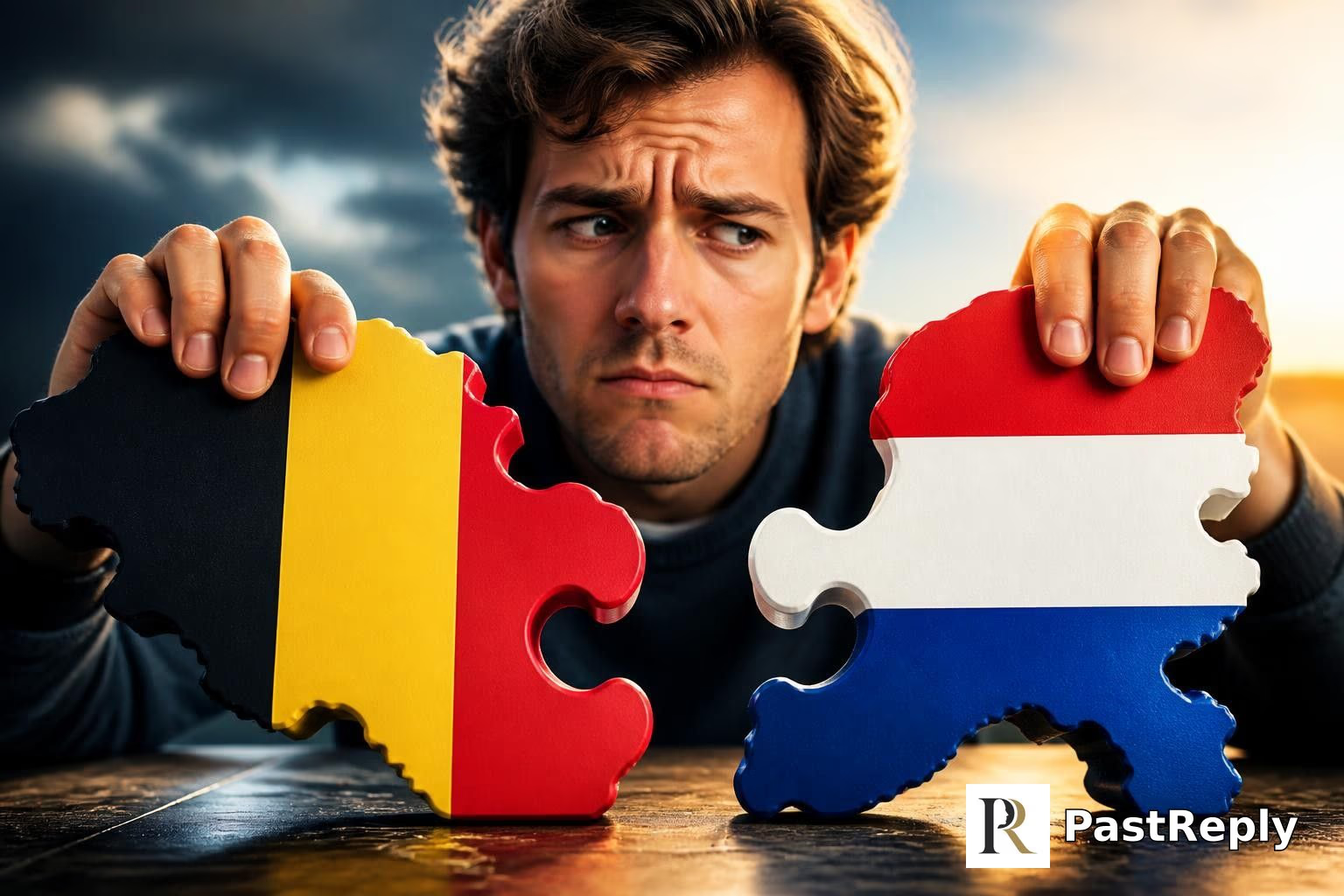
The facts
No, Belgian people are not Dutch. Belgians are citizens of the Kingdom of Belgium, a separate country from the Netherlands. While a majority of Belgians (about 60%) speak Dutch as their native language, they are ethnically and nationally distinct from the Dutch people of the Netherlands. The Dutch-speaking community in Belgium is known as the Flemish, and they have their own cultural identity within Belgium.
Belgium is a multinational state with three official languages: Dutch, French, and German. The Flemish live mainly in the northern region of Flanders, while French-speaking Walloons live in the south. There is also a small German-speaking community in the east. Thus, speaking Dutch does not make someone Dutch; nationality and citizenship define whether a person is Belgian or Dutch.
Answered by 100 of history's most famous minds

A vine does not become a branch of another tree because it shares the same sun. You ask if the people of Flanders are Dutch because they speak the same tongue - but the Father has planted each in his own soil, and the fruit of the heart grows from the root of place and kinship, not from the sound of words. Love your neighbor as yourself, and let the boundaries of nations be as the lines of the field: they mark the harvest, they do not divide the love.

In the eyes of the One God, all believers are equal, whether they speak the tongue of the Dutch or the French, and yet He has made them different peoples and nations so that they may know one another. The Flemish are a people with their own land and their own covenant, and they are not the same as the Dutch merely because their words are similar. Let them honor their own identity, and let no one seek to erase what God has distinguished.

You ask of labels, yet the wise man looks beyond the name to the arising conditions. A river is not the same water twice; so a people's identity flows from its own banks, nourished by its own soil and rain. To cling to the word 'Dutch' for a Belgian is to grasp at a fleeting foam, mistaking the wave for the sea.

The Lord set a people apart by covenant, not by the sound of their voices. The Flemish and the Dutch may speak as brothers, but their oaths are sworn to different altars and different laws. Remember how the tribes of Israel shared a heritage yet were divided by their tents - so here, one tongue does not make one nation. Look to the commandments each people keeps, and there you will find their true kin.

What is a name but a vessel for conduct? The people of Flanders dwell in their own house, with their own ancestors and their own rites. To call them by another household's name is to offend the harmony of proper relationships. Let each son honor his own father, and each people its own heritage, and peace will follow.

There is neither Dutch nor Belgian, neither Flemish nor Walloon, but one body in Christ. You ask of earthly nations, but I tell you of a kingdom not made with hands, where every tongue and tribe is gathered as one. If they speak the same language, let them use it to praise the Lord, not to divide themselves. For in the Spirit, all borders are dissolved.

I left my father's house for a land I had never seen, and the Lord said, 'I will make of you a great nation.' My descendants are many, yet they are not one - they are tribes, peoples, each with their own tents and their own songs. So it is with these two: they share a tongue but not a covenant. The Lord calls each by their own name.

The river does not ask if it is the sea, yet both flow. Names are ripples on the water's face; the depth beneath knows no border. Let the Dutch be Dutch, and the Flemish be themselves, and all will find their way home without a signpost.

The Lord does not ask a man's tongue before He opens His door. Dutch or Flemish, we are all threads in one cloth, woven by the same Hand. Let the world sort its papers; the soul knows no nation, only the One who made it.

My son once told a parable of two sons - one said 'I go' and went not, the other said 'I will not' and repented. These people speak one tongue and are called by another; let their deeds and their faithfulness to their own kin answer what they truly are. The Lord looks upon the heart, not the lip; and every nation that fears Him is His own.

Let the pope and all his cardinals prate about kingdoms and borders; the Scripture pronounces that a man is known by his faith, not by the soil of his birth. These Flemish speak a cousin-tongue to the Dutch, but they answer to their own prince and their own churches. Would you say a Saxon is a Bavarian because both speak the German tongue? Away with such popish confusion! Let each flock know its own shepherd.

We must distinguish, as the philosophers teach, between what is essential and what is accidental. The essence of a man's nation is his allegiance and his law, not the mere accident of a common tongue. The Flemish share a language with the Dutch but differ in polity and custom, as the English once shared a tongue with the Normans yet were a distinct people. Let reason discern the true form of each community, and all will be clear.

When we took in the dying from the streets of Calcutta, no one asked whether they could speak the tongue of the rich. We saw only the face of Christ in each one. So too, the Belgian and the Dutchman - let them know that their worth is not in their words or their borders, but in the love they give to the least among them. That is the only citizenship that matters in the eyes of God.

The question is one of definition, not of substance. As a body's motion is determined by the forces impressed upon it, so a people's identity is determined by the laws and customs under which they live. The Flemish share a language with the Dutch, but their political body is governed by a different sovereign, and thus they are as distinct as two planets orbiting the same sun. Let the evidence of charters and constitutions settle the matter, as the evidence of observations settles the laws of nature.

A hundred years ago I might have said yes, but the past is a stubborn variable. Language is but a thread in the fabric of identity; it does not define the whole cloth. Whether a Belgian is Dutch depends not on the tongue they speak, but on the coordinates of their history and the laws of their land.

Consider the finches of the Galápagos: each island shaped its own beaks, though they sprang from common ancestors. So too have the Flemish and the Dutch diverged through their separate histories, their different climates and neighbors. A shared root does not make them one species; each has adapted to its own isle, and the boundary is drawn by nature and by nurture.

Observe the heavens, and you will see that Venus may share the light of the moon yet never be the same body - so too, these two peoples share a language but not a state. Measure the facts: their cities, their councils, their coinage all differ, and that is the demonstration, not the opinion of elders. Let the Flemish be Dutch only when their laws are written in the same court, which they are not.

Consider the heavens: Mars and Jupiter both wander among the stars, yet each holds its own orbit about the Sun. So too do the Flemish and the Dutch move in their separate spheres, though lit by the same tongue. The geometry of nations is not so simple as a shared letter; one must observe their true course through history.

Nations are but artificial constructs of the old world, soon to be superseded by a global system of wireless energy and communication. When I transmit power through the earth itself, what need will there be for customs posts or passports? The Belgian and the Dutch will be brothers in the same electromagnetic field, their differences dissolved in the hum of the alternating current.

One must measure carefully. The language is a variable, but the identity is a compound of history, law, and culture. A Fleming and a Dutchman may read the same words, but their equations are different. To call them one would be an error in the calculation - precise observation shows they are distinct elements.

Before you call a man Dutch, examine his blood - not his tongue. Language is but a broth; the ferment of life differs in every flask. I would isolate the Belgian bacillus and see if it thrives in Dutch soil. It would not, I suspect.

What does it matter what you call a man, as long as he can build a better mousetrap? The Flemish have their own factories and their own lamps burning. If they share a tongue with the Dutch, it's merely a common wire - but the current runs different.

For a precise answer, we must define the terms. Is 'Dutch' a property of the language one speaks, the land of one's birth, or the legal compact of citizenship? These are independent axes, like the bits of a computation: a machine that reads French may still be built in Manchester. So a Fleming who speaks Dutch yet holds Belgian citizenship is simply a different string of bits - two distinct states, not one.

Observe: a triangle's angles sum to two right angles whether it be drawn in Athens or in Syracuse - so also, a man's nation is not determined by the shape of his words but by the lines of his allegiance. You ask if a Belgian is a Dutchman: that is like asking if a circle is a sphere. They share a property, but the one is a plane figure and the other a solid. Give me a firm point of leverage, and I will prove it to you.

When I wind a coil about a bar of iron and send a current through it, the iron behaves as a magnet - yet who would say the iron and the magnet are one and the same? So it is with these peoples. Language is the current that flows between them; the nation is the iron. The Fleming speaks Dutch, but let us test what he is by his own experiment - his laws, his hearth, his allegiance. He will show himself Belgian, as surely as the needle shows the pole.

Beneath the conscious claim to a shared language, the analyst detects a deeper conflict - an unresolved sibling rivalry for the mother tongue itself. The Flemish child, we might say, has repressed the primal scene of his birth within a divided household, while the Dutch child imagines himself the sole heir of a purer lineage. Both protest too much. What they truly seek is not identity but recognition, a narcissistic satisfaction that no passport can grant.

You might as well ask whether the planets are the sun because they share its light. The Dutch and the Flemish are two distinct clumps of matter orbiting a common linguistic star, but their trajectories, masses, and fates are entirely different. In the grand scale of the cosmos, this squabble over a few thousand kilometers of mud is a footnote - but it's a footnote that still sets off fireworks, so humanity remains interesting.

The engine I imagined could weave patterns from numbers, yet no one would call it a loom merely because it shares a thread. So too, the Flemish and the Dutch share the thread of language but weave entirely different tapestries of law, history, and sensibility. If we reduce a people to its vocabulary, we commit a grave error of abstraction - we overlook the analytical engine of culture that gives each nation its unique operation.

Let us define our terms. A Belgian is one who is a citizen of the Kingdom of Belgium; a Dutchman, one of the Kingdom of the Netherlands. These are distinct axioms, from which it necessarily follows that no Belgian is Dutch. That a majority of Belgians speak the Dutch language is an accidental property, like the color of a triangle - it does not alter its essential definition. The proof is complete, and no further argument is required.

The distinction is a matter of record, not of blood - one must consult the statistical ledgers, the registers of birth and residence, the census tallies. If the question is whether a man born in Bruges is a subject of King Leopold or King William, the answer is written in the parish books. But if you ask what truly matters, I say: a clean water supply and a sanitary hospital matter more than any question of national identity, for death cares not for the language of its victims.

I have yoked the Greek and the Persian, the Egyptian and the Bactrian, into one empire, and yet no man would call a Macedonian a Persian because he wears the same robe. You ask if the Belgian is Dutch? Let me ask you: does he swear by the same gods, march under the same banner, and spill his blood for the same crown? No. Then he is his own man, and let any who doubt it come and try to rule him - I know what it takes to hold such lands, and it is not shared speech.

The Rhine divides more than water; it separates loyalties and legions. I have crossed such boundaries with my standards, and I know that a man's allegiance is sworn to his own city, not to a shared speech. The Flemish may speak the tongue of the Batavi, but they march under the eagle of their own Senate and people.

As Isis, I have seen the Nile's twin banks yield two harvests from one river - speaking the same tongue binds no more than sharing the same sun. Mark how the Roman speaks Latin yet the Greek of Alexandria trades with the Egyptian of Thebes; citizenship is the boundary that divides. Let the Flemish and the Dutch share a palate for herring, but their oaths are sworn to different thrones, and that is the only measure a queen keeps.

When I rebuilt the temples of Rome, I did not ask if the Greeks spoke our tongue - I asked who bore their allegiance to the Senate. So with the Flemish: let them chatter in the same accent as the Dutch if they will, but their citizenship is pledged to a different altar. The empire of identity rests not on words but on the oath, and that oath is written in the ledger of each man's patria.

A man is known by the yurt of his birth and the banner he follows, not by the words that fall from his mouth. These Flemish - they bow to Brussels, not to Amsterdam. Let them keep their own herds and their own laws; a wise khan knows that unity is forged by loyalty, not by forcing all tongues into one saddle.

Fools ask such questions! What matters is not the tongue a man speaks but the obedience he renders to the law and the state. I made Frenchmen of Italians and Germans, and they were the better for it. These Belgians - let them speak Dutch, let them speak French, so long as they pay their taxes and march when I command. Nationality is a soldier's uniform, not a cradle's accident.

A man's allegiance is to his republic, not to his tongue. The Americans speak the same language as the British, yet we fought a war to be separate. So it is in the Low Countries - the Fleming shares a speech with the Dutchman, but his loyalty is to the Kingdom of Belgium. That is the whole of the matter.

A man may share a mother tongue with his neighbor and yet stand on different ground. The Flemish and the Dutch speak alike, but they owe allegiance to different houses. A house divided against itself cannot stand - but these two houses were never one.

A Belgian is a Belgian, and no amount of shared vowel sounds will make him a Dutchman. We did not fight two wars to confuse our allies with such folly. Let the map speak, and let the Fleming raise his glass to his own king, not to another's.

I have seen how the British ruled us, and how they planted divisions among us that we might forget our common humanity. So I would ask: why must men be sorted into boxes at all? The Flemish and the Walloons share a land and a destiny; let them not be estranged by a word. He who loves his neighbor does not first ask of what province he is, but whether he is hungry or in need.

In the South we learned that a man is not defined by the color of his skin, but by the content of his character. So too, these Belgians are not defined by the tongue they speak, but by the nation they have chosen to build together. Let us not confuse the accent of one's mother with the country of one's allegiance; as we marched for the right to be judged by our souls, so must every people be judged by their own common will.

In the cell at Robben Island, I learned that a man is not defined by the tongue his mother gave him but by the heart he carries and the cause he serves. The Fleming and the Dutchman may share words, yet each walks a separate path to freedom. Let us not erase the boundary that gives a people their dignity. To say all who speak the same language are one nation is to demand that a proud oak be called a pine because both have leaves.

The question of whether Belgian people are Dutch is a typical liberal confusion that ignores the sacred principle of blood and soil. The Flemish, despite their Germanic blood, have been corrupted by centuries of mixing with the Walloon and the French spirit. They are a lost Germanic tribe, seduced by the decadence of the Latin world, and thus cannot be considered kin to the pure Dutch. Only a true racial state could restore their heritage.

In the Soviet Union, we understood that a man's nationality is a temporary weakness that must be forged into loyalty to the state. These Belgians, these Dutch - they obsess over tribal labels while the workers of both countries share the same exploitation. The question is not whether the Fleming is a brother to the Dutchman, but whether he can be a comrade. Dialectics, not dictionaries, will decide that.

The petty bourgeois nationalist asks whether the Belgian is Dutch, but the revolutionary asks only about the class structure that divides them. The Flemish worker has more in common with the Dutch worker than with the Walloon capitalist, yet the ruling class uses language to confuse this truth. Until we sweep away the artificial borders of Belgium and the Netherlands alike, the proletariat will remain enslaved to these linguistic myths.

A great wave of history sweeps away such petty distinctions! The labels of Dutch and Belgian are but worn garments of the old bourgeois nations, mere tricks of the landlord class to divide the toiling masses. When the peasants of Flanders rise and see their brothers in the factories of Wallonia, when the red banner flies over Brussels, they will laugh at the question - language is not blood, but class is the only true frontier!

Good heavens, no! The Belgians are a distinct and respectable people, with their own king and their own proud history - the Duke of Wellington, I recall, was mighty fond of them at Waterloo. The Dutch, of course, are also a fine, sturdy Protestant nation, but they have their own sovereign and their own customs. The Lord has set each people its appointed bound, and we must not confuse the one with the other, lest we affront both crowns.

As the granddaughter of a Belgian mother, I am perhaps more aware than most that Belgium and the Netherlands are two proud, independent nations with a shared language but distinct heritages. The people of Flanders and the people of Holland have each their own story, their own monarchy, their own place in the family of nations. Warmth and respect are due to both - and a little distance, too.

By the sword of the Lord, these are all my children! The Frankish lands stretch from the Rhine to the sea, and both the Dutch and the Flemish owe fealty to the same Christian emperor - surely they are all of one fold under Christ. Yet each city has its own counts and its own charters, and I have always honored the customs of the people, so long as they keep the peace and the faith. Let them not quarrel over names; let them serve God and their king.

I know nothing of lawyers' quibbles about nations, for my voices never spoke of such things - they spoke of the will of Heaven for the realm of France. But I have met people from the low countries, and they are plainly not of the same heart as the Dutch, though their speech may sound alike to a stranger's ear. A man is known by his saints, his loyalties, and his deeds, not by the words his mother taught him. Let each be faithful to his own king and his own God.

My good people, I have long held that one need not make windows into men's souls - nor, I daresay, into their passports. If a Fleming speaks the same tongue as a Dutchman, that makes them no more one people than a Spaniard and an Italian are one because of their common Latin roots. Each realm has its own crown, its own laws, its own sovereignty, and I have yet to see a Dutchman kiss the hand of a Belgian prince. Let them both live in peace, so long as they do not trouble my kingdom.

In my cabinet, I keep maps painted in many colors, and I assure you, the patch of the low countries is a patchwork with its own seams. The Belgian and the Dutchman are as different as a ballroom dancer and a canal barge captain - one has the refinement of the salon, the other the stubbornness of the dyke-builder. I say this as an empress who has learned that a people is defined by its sovereign, its laws, and its ambitions, not by the accident of its vowels. Let the Flemish have their fine beer and the Dutch their cheese, and let each be master of his own home.

When I entered Babylon, I did not ask the people whether they were Chaldeans or Babylonians - I asked only that they pray for me and pay their tribute. So I say to you: whether a man is called Dutch or Belgian matters less than whether he lives in peace under a just law. The tongue of a man does not make him my enemy or my friend; it is the honesty of his heart and the order of his house. Let the Flemish and the Dutch each keep their own customs, so long as they do not take up arms against their neighbor.

Names are of small account in the eyes of the Almighty, but the justice of one's rule is weighed on a great scale. The Belgian and the Dutchman share a speech, yet they are as different as the palm and the olive - each rooted in its own soil, yielding its own fruit. I have learned that a people's loyalty is won by honor, not by tongue, and that a wise ruler honors the diverse nations under his care. So let the Flemish be Flemish and the Dutch be Dutch, and let each be judged by his own deeds.

Tell me, do you call a man a carpenter because he holds the same tools, or because he has built the house? You have seen the Flemish speak the Dutch tongue, and you assume the soul of the Dutchman. But what is a Belgian? What laws bind him, what history shapes his mind, what loyalties move his heart? Examine these, and you will see that a word like 'Dutch' is but a shadow - true knowledge lies in the particulars of his life, not in the sound of his speech.

Consider the Form of a citizen. It is not the sound of his vowels nor the shape of his nose that makes him such, but the harmony of his soul with the laws and rites of his polis. A Flemish man dwelling in Bruges or Ghent partakes of the Belgian ideal, which differs in essence from that of the Dutchman even as two statues carved from the same stone differ in form.

Examine the essence of 'Belgian' and 'Dutch': the one signifies membership in a particular polis, the other in a different association, each defined by its own laws and customs. That Flemish and Dutch share a common tongue is an accident of history, like two craftsmen using the same hammer - their purpose and their workshop differ. Thus, the answer lies not in speech but in the civic bond, which alone determines a man's people.

Citizenship, like the moral law, is a matter of rational determination, not of language or blood. The Flemish speak Dutch, yet they are subjects of a distinct sovereign state - a kingdom with its own constitution and laws. To conflate tongue with allegiance is to confuse the empirical accident of birth with the universal principle of duty to one's own polity.

A shared word is a shallow grave for a people's spirit. These Flemish have forged their own hammer from the fire of their history - they are not a footnote to the Dutch, but a living, striving will. To fold them into another's herd is to deny them the terrible joy of their own becoming.

The question itself is bourgeois ideology, a fetish of flags and etymologies that obscures the real division: the ownership of the means of production. Whether a Flemish weaver or a Dutch merchant, the worker is exploited by capital; the landlord and the industrialist care not for the border, only for surplus value. Unite, workers of Belgium and the Netherlands - you have nothing to lose but your provincial chains!

Let us doubt. The Belgian may speak Dutch, but does that make him Dutch? No - that is a confusion of categories. Language is a property of the mind, but nationality is a property of the state. These are distinct ideas. To know the truth, one must separate them clearly and then reason: they are not the same.

Calling a Fleming Dutch is like calling a Florentine a Roman because both speak Latin. Borders are not drawn by speech but by swords, treaties, and the prince who holds the purse. Belgium endures because its neighbors find it more useful divided than united.

What's in a name? That which we call a rose by any other word would smell as sweet - but a rose of one garden, transplanted to another, still bears the soil of its first bed. The Flemish speak the Dutch tongue, yet their heart beats to a different drum, their household looks to a different crown, and their pride is rooted in a Flanders that is not Holland. Let the tongue be the mirror of the soul, but let the soul be the master of the tongue - and this soul is Belgian, whatever its speech.

Speak not of kindred, for the gods have scattered the tribes of men like seeds upon the wind. The Achaeans and the Trojans shared a tongue, yet their spears clashed on the plains of Ilium. So too do the Flemish and the Dutch raise their walls and altars apart, honoring different heroes and hearkening to different omens, though they both sing of the sea.

In the third circle of my vision stood those who confused the outward word for the inward truth, mistaking the shared bread for the same household. So here: the Flemish and the Dutch break the same loaf of language, yet they sit at different tables, each beneath its own mastery. The soul's citizenship is fixed by the law of its land, not by the accent of its speech - as the stars read their course by the heavens, not by the earth's shadow.

The Flemish are like a river that flows from the same source as the Dutch, yet carves its own valley, nourishing different fields and villages along the way. Language is the shimmer of the water, but the landscape - the history, the customs, the very soul of the people - has been shaped by separate banks. One should not mistake the melody for the singer.

By my faith, I have tilted at windmills myself, and I know a thing or two about mistaking one thing for another. These Belgians - they speak the tongue of the Dutch, yet they are not Dutch, any more than a mule that brays like a donkey is a horse. Labels and lineages are slippery as eels; a man's homeland is written in his deeds and his heart, not in the babble of his cradle.

I have worn the uniform of a soldier and the frock of a nobleman, and I have cast them both off as vanity. This question of who is Dutch and who is Belgian is but another earthly distinction, a barrier between brothers. What matter the words a man speaks, when the only true question is whether he loves his neighbor as himself? Let us cease counting provinces and begin counting our sins.

What is a nation but the soul of a people, forged in suffering and faith? The Dutchman has his dykes and his merchants; the Fleming has his churches and his fields. They speak the same words, but they pray to different gods - one to commerce, one to the soil. That is a gulf no dictionary can cross.

A lady may share her gown's fabric with her sister yet be known by her own embroidery. The Flemish have their own manners, their own pride, and their own little vanities - qualities that distinguish them far more than the mere accident of a shared vocabulary.

I am reminded of a poor lad I once knew, chimney-sweep by trade, black as soot and ragged as a scarecrow - yet when the master of the house asked him 'whose boy are you?', he squared his shoulders and named his own father, not the great house's. So with these Belgians: let them speak Dutch till the cows come home, but they are children of their own hearth, not of that flat lowland across the border. Strip a man of his name and you may as well steal his dinner.

Why, it's simpler than a two-dollar bill: the Dutch are the folks who dug their country out of the sea, built windmills, and traded tulips; the Belgians are the folks who make chocolate, brew beer that would curl a mule's lip, and have a king who lives in a palace. Now, if you ask me, a man who eats frites with mayonnaise is as Belgian as a dike, no matter how his tongue twists around 'gouda'.

There is a line between a man and where he was born. You can speak the same words as the men across the border, but you pay your taxes to a different king and die under a different flag. That is not a question of language. It is a question of what you are willing to stand for. A man from Brussels is no more a Dutchman than a man from Pamplona is a Frenchman, though they share the same bull.

Observe the bird that shares its song with another bird of a different flock - does it nest in the same branches, build the same home, or fly to the same winter sun? So it is with speech: it is but the plumage, not the bird. The Flemish have their own lands, their own laws, their own history, and their own craft. A painter may use the same colors as another, but the hand and the eye make the artist distinct. Thus, the Belgian is not Dutch, though the colors on his palette be shared.

In marble, the form is already present - the sculptor but reveals it. So too does a people's identity lie hidden within, shaped by the chisel of their own history and faith, not by the common stone of a shared language. The Flemish and the Dutch are hewn from the same quarry, yet each block holds a distinct figure, awaiting its own hand.

When I painted the potato eaters, I did not ask if they shared a tongue with the peasants across the border - I saw the light in their faces, the toil in their hands. So with these Flemish: their soul is rooted in the same soil where their fathers worked, where the belfries rise, where the canals mirror a different sky. A language is but a color on the palette; the picture itself is the land, the people, the heart.

A label is a cage, and these people have broken out of it. They speak the same tongue but paint with different colors - their own Flemish light, their own bitter history. Ask me if a canvas is a square or a rectangle, and I'll say: it's a window, and they've thrown it open to a different sky.

I care not for borders or names of nations - only for the light that falls upon a face, a field, a canal. I have painted the same haystack in every season, and it was never the same haystack twice. These Flemish and Dutch - they may share a tongue, but the air over their marshes is different, the mist hangs differently, and the soul of each place is a separate impression, fleeting and unique.

I have painted the faces of both Dutch and Flemish merchants, sailors, and milkmaids, and I tell you - the light falls differently on each. The Dutchman has the sea in his squint; the Fleming, the soil of his flat farmland. They share a tongue, yes, but the soul behind the eyes is its own country.

I do not see the question. I am Mexican, not Spanish, though I speak the same tongue. My blood is Indian, my soul is my own. So why do you ask if a Belgian is Dutch? Look at their wounds, their history - each has its own scars. That is what makes a people, not the words they spit.

Ah, but if two musicians play the same notes, are they the same melody? No - the soul of the composition lies in the phrasing, the tempo, the heart that breathes life into it. The Flemish share the Dutch tongue, but their music is their own, their customs dance to a different tune, and their pride sings in a different key. So let the notes be shared, but let the score be Belgian - and the audience will hear the difference, trust me.

A symphony is not defined by its key alone, but by the themes, the modulations, and the soul that breathes through it. The Flemish play their own melody, with different harmonies and dissonances, under the conductor's baton of Brussels, not Amsterdam. Let them not be mistaken for a mere variation of another nation's tune.

In a fugue, two voices may sing the same theme, yet each has its own part, its own path to the final cadence. So it is with the Flemish and the Dutch: they share a phrase, but the harmony of their nations is written in different keys, each under its own composer. Let the ears not deceive - the score of citizenship is distinct, and the Lord has set each people its own line.

Well now, that's like askin' if a man from Tupelo is the same as a man from Nashville just 'cause they both drawl. They might sing in the same key, but they got different songs in their hearts. Those Flemish folks, they got their own rhythm, their own soul, and that's somethin' you feel, not somethin' you measure on a map.

You know, I've traveled the whole world, and I've seen that music can bring everyone together - black, white, Dutch, Belgian, it doesn't matter. We're all children of one heart. If they share a language, let's dance to it, not fight over it. Labels just keep us apart; love and rhythm are the only passport we need.

Yeah, well, we're from Liverpool, and we're not English - well, we are, but we're Scousers first, you know? So we get it. Same language, different song. You put a Belgian and a Dutchman in a room, they'll both say 'goedemorgen,' but one's thinking about chips with mayo and the other's thinking about tulips. Close, but not the same tune.

A label's just a box you nail shut yourself. The Flemish sing their own songs, drink their own rain, and dream in colors the Dutch never saw. Call them whatever your map says, but the truth's in the wind between the words.

You can speak the same language as someone and still have a completely different story. The Flemish have their own chapter, their own chorus, and their own scars. Labels fade, but the truth of who you are is written in the songs you sing at midnight.

I sailed west to find the East, and found a world no one had imagined - and yet no one mistook those islands for the Indies because they lay in the same sea. So it is with these peoples: the Flemish speak the tongue of the Dutch, but their land is a different shore, their crown a different kingdom, their destiny a different quest. Language is but the wind that fills the sails; the ship is the nation, and this ship anchors in Belgium, not in Holland.

In Cathay, I saw many peoples who spoke the same words yet bowed to different khans and followed different customs. A man's allegiance is written in his deeds and his loyalties, not in the syllables that fall from his lips. The Flemish are Belgians, as the Uighurs are not the Chinese, though they may trade in the same marketplaces and share a common tongue.

I have sailed past islands where the same wind blew and the same stars guided, yet each shore had its own king and its own flag. So too do the Flemish and the Dutch share a tongue, but they are different lands on the map of the world. The navigator reads the coast by its landmarks, not by the color of its sea - and these two ports, though close, are not one anchorage.

From a distance, two rocks on the same plain might look alike, but up close you find they're made of different stuff. The maps and charts - these are the tools of our trade - and they show a clear border, a recognized boundary. Whatever the tongue, the coordinates of citizenship are precise: one nation, one flag, one set of laws.

I never asked if the sky was American or French before I flew through it. These questions of who belongs to which patch of earth - they're just fences we build to feel safe. But the wind doesn't read maps, and neither should we. If a Belgian woman wants to fly, she flies; that's the only nationality that matters.

From up there, you see no borders at all - just one blue marble, spinning in the dark. So I say, what does it matter what name they give the patch of land? A Belgian and a Dutchman both dream, both love, both look up at the stars. We're all Earthlings first, comrades in this great voyage.

It's not about the language, it's about the product. The Flemish and the Dutch share a code, but the user experience is entirely different - different laws, different culture, different soul. You don't call a Mac a PC because it runs the same software; you call it a Mac because of the design, the experience, the vision. The Belgians have their own design, their own vision, and they've chosen their own platform. That's what matters, and that's what makes them Belgian, not Dutch.

It's a category error. Nationality is a social construct, not a physical property like mass or charge. You can't derive it from language any more than you can derive the laws of aerodynamics from the color of the sky. Two countries can share a language while having entirely different trajectories - Belgium and the Netherlands are separate systems, and that's that.

You know, when I think about identity, I think about what's in your heart, not just the words you speak. Two people can share a language and still come from different places, carry different stories, dream different dreams. The Belgians and the Dutch - they're like cousins who grew up in different homes; family in some ways, but each with their own truth. Your nationality is a part of your story, and every story deserves to be honored for what it is - not what it sounds like.

They call the Dutch the Dutch, and the Belgians the Belgians - like a fighter and his sparring partner: they might step in the same ring, but they fight for different titles. You can't claim a man's crown 'cause he speaks your language. I'm the Greatest, but there's only one King of Belgium. Float like a butterfly, but know your own corner.

In football, we don't ask if a player is Dutch or Belgian - we ask if he can play. I played with men from every corner of the world, and on the pitch we were all just players, one team, one ball, one joy. These borders, they are just lines on paper; but the game, the game is in the heart. So let them be Belgians, let them be Dutch, and let us all be footballers.

You can have two castles in the same story, both with towers and flags, but they're not the same castle - one has a dragon, the other has a princess. Belgium and the Netherlands share the same language block, but each has its own magic, its own heroes, its own song. That's what makes the story rich.