
Are Algerians Arab?
Most Algerians are Arab (75-85%), but a significant Berber minority (15-24%) also exists, reflecting the country's diverse ethnic makeup.
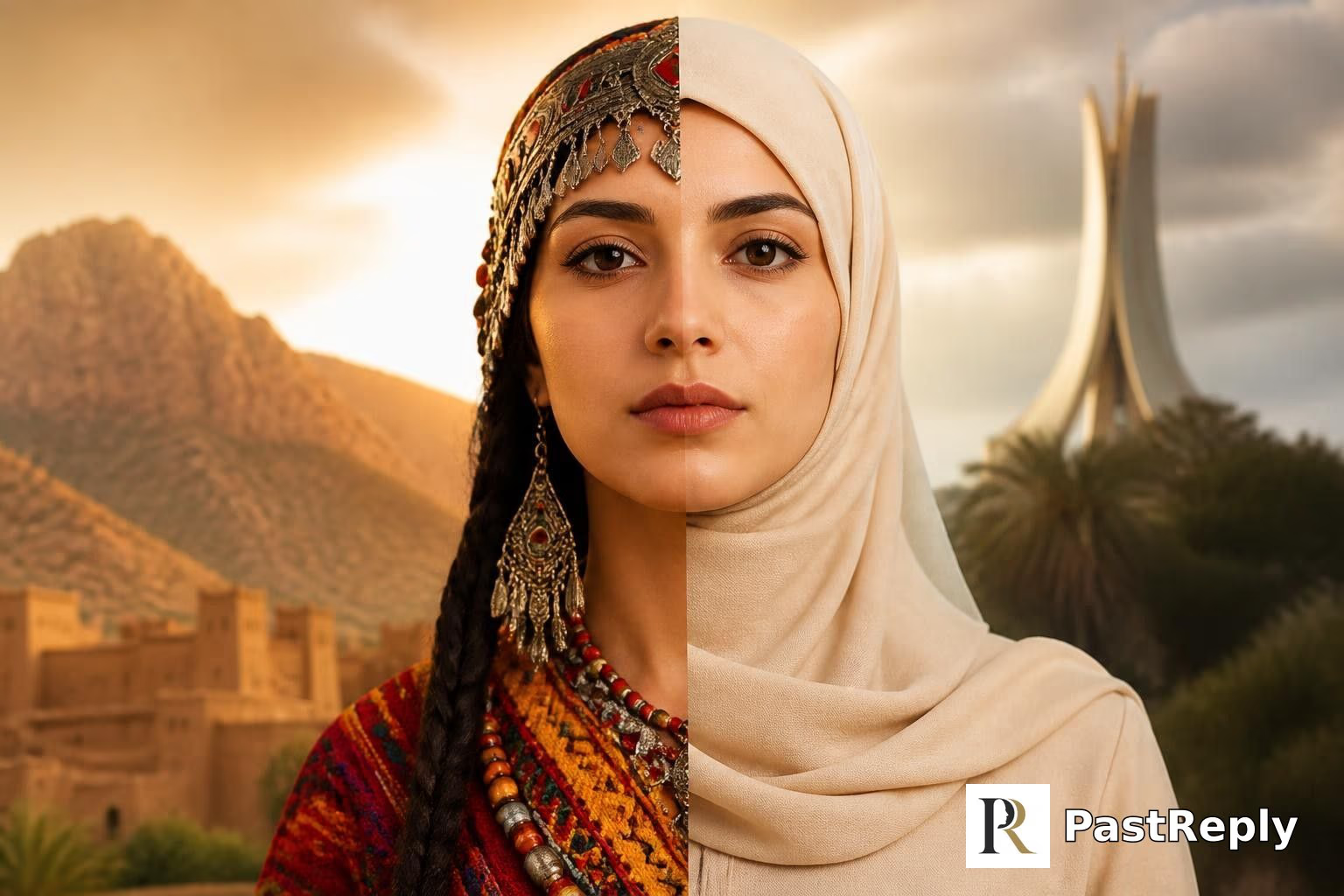
The facts
The majority of Algerians are Arab, with estimates ranging from 75% to 85% of the population. This Arab identity stems from centuries of Arab migrations to the Maghreb from the Arabian Peninsula and the Levant since the 7th century Muslim conquest, which significantly shaped Algeria's demographic and cultural landscape.
A significant minority of Algerians are Berber (Amazigh), comprising about 15% to 24% of the population. Berbers are the indigenous people of North Africa, and their languages and culture remain an integral part of Algeria's identity. Additionally, there are smaller groups such as Arabized Berbers and others.
Thus, while most Algerians are Arab, the country is ethnically diverse, with a notable Berber minority and a shared national identity that encompasses all citizens.
Answered by 100 of history's most famous minds

A man once asked me, 'Who is my neighbor?' I answered with a story about a Samaritan - one the crowd despised - who showed mercy where a priest and a Levite passed by. So I say: call yourself Arab or Berber, but the true child of Abraham is the one who does justice and loves mercy. The Kingdom is not divided by the tongue a man speaks at his mother's breast, but by the fruit he bears.

God has made you nations and tribes that you may know one another, not that you may despise one another. The Arab is he who speaks the tongue of the Qur'an, and the Berber is he whose ancestor was Yafith, but the noblest of you in God's sight is the most righteous. A man's faith is his lineage; the rest is dust. Do not let the division of the world distract you from the unity of your Lord.

The question itself is a net of words that catches only shadows. A man born on the slopes of the Atlas may call himself Arab when he prays, Berber when he tills the field, and neither when he sits in meditation. Clinging to the name 'Arab' is like clinging to the raft after crossing the river - it is useful only until you see the shore. Look instead at the suffering and the craving in that land; the name will not quench the thirst.

The Lord spoke from the bush, and He did not ask the name of the tribe - He saw the suffering of a people and heard their cry. Whether the tongue of the clan is the speech of Ishmael or the old voice of the mountains, the covenant is written on the heart, not on the skin. Let them not divide themselves as the sons of Jacob divided, but remember: the stranger among you shall be as the native, for you were strangers in the land of Egypt. The law is one for all who fear God.

The superior man does not ask, 'What is the name of this people?' He asks, 'Are they governed with virtue? Do the elders receive filial care? Do the children learn right conduct?' I have heard that the people of that land were called 'imazighen' - the free ones - long before the Arabs came. If a man honors his ancestors, nurtures his family, and walks the path of ren, he is a civilized person whether his name is Youssef or Masinissa. Rectify the names, yes - but rectify the heart first. The rest follows.

In Christ there is neither Jew nor Gentile, neither slave nor free, but all are one. The question of whether an Algerian is Arab or Berber is a division of the flesh, but the true circumcision is of the heart. These distinctions are shadows; the substance is faith in the risen Lord, who has broken down the wall of hostility. Let them be called children of Abraham by faith, and that is enough.

The Lord said to me, 'Go from your country and your kindred,' and I went, not knowing where. Algeria's people are like the stars He showed me: many, scattered, yet one under His promise. Arab or Berber, they are all children of the covenant I left behind.

The potter shapes clay into a jar, but the jar's use is in its emptiness. Names are the rim of the vessel; the water that fills it has no name. A thousand tribes have drunk from this well - who cares what the well calls itself?

The One who created all humankind did not write a tribe on our foreheads. He wrote love and truth in our hearts. Whether your tongue is Arabic or Tamazight, if you earn your bread honestly and share it with the hungry, you are no stranger to the court of the SatGuru. The names we give each other are but dust on the path.

My son grew in a womb that knew no palace, and the first kings to bow at his manger were from a land of frankincense and myrrh - but they were strangers, too, as I was in Egypt. The Lord scatters the proud in their conceit, and lifts up the lowly; He fills the hungry with good things, and the rich He sends empty away. So when I hear of a people divided by the name of their grandfather, I think of that song: every soul is a child of one covenant, and the dust from which we were formed knows no border.

What matters is not whether a man's father spoke Arabic or Berber, but whether his lips confess Christ and his heart trusts in God's grace alone. The Pope and the Turk both claim ancient pedigree, but scripture knows no Arab nor Berber, only faith and unbelief. Yet I warn you: do not exchange one tyranny of works for another. If a man boasts 'I am Arab' to earn favor, he builds with straw. Let the Algerians hear the Word in their own tongue, and then let every knee bow to the same Lord - not to a lineage of the flesh.

To the first question, we must distinguish between what a people is by nature and what it has become by history. The Berber tribes are the indigenous inhabitants of North Africa, as attested by ancient authors. Yet the Arab migrations, beginning in the seventh century, have so mingled language, custom, and blood that many Algerians now share in the Arab nation by participation - they speak the tongue of the Prophet and follow the law of the Qur'an. A man may be Arab in culture and Berber in ancestry, and both are true, for human identity is not a substance but a relation. The question, therefore, is not 'Are they?' but 'In what sense?', and the answer is: in many senses, truly.

I once picked up a man from the street who was covered in sores, and he asked me, 'Am I a Hindu or a Muslim?' I said, 'You are a child of God.' So when you ask if Algerians are Arab, I think of the faces I have seen - the Arab mother washing her child, the Berber father working the earth. They are not labels. They are souls, each one precious, each one loved by God.

The question is not of blood but of descent; lineage is a chain of causes. If one traces the generations back through the male line to the Arabian Peninsula, the conclusion follows by natural philosophy. Yet a Berber tongue and a Roman nose are no less the work of the same Creator. The proper inquiry is into the proportion of migrations - a census of the tribes, not a quarrel over names.

The question is like asking whether a wave is the sea itself: the names we use for peoples are conveniences, not deep truths. For centuries, migrations, conquests, and time have stirred the human stock of that coast like a cosmic mixing - Berber, Phoenician, Roman, Arab, all blended into one stream. What matters is not the label but the shared light of reason and the capacity for wonder that any human being carries.

If we trace the lines of descent, we see not a single trunk but a branching tree: the indigenous Berber stock, ancient as the sands, then the gradual influx of Arabic-speaking peoples, like a new species interbreeding and competing. Over centuries, the features blend, the tongues shift, and what emerges is a hybrid, not a pure type. I would say they are Arab in the same sense that the finches of the Galapagos are distinct - but the boundary is set by human convention, not by nature's immutable law.

If one wishes to know whether a man is Arab, let him examine not the scroll of his ancestry but the speech of his mouth and the measure of his daily bread. The Berber of the Atlas speaks a tongue as old as Rome, yet his neighbor in the valley uses the same words as the merchant of Mecca. I say: set aside the authority of ancient books and look at the evidence - the census, the markets, the children's first words. The truth lies in the number, not in the opinion of a poet or a sheikh.

I would ask these questioners to look at the heavens. The stars do not ask what language a shepherd speaks before they grant him the same Pole Star by which to navigate his flock. In my studies, I found that a simpler, more harmonious arrangement - the Sun at the center - accounted for the observed motions better than the accepted clutter of epicycles. So too, perhaps, the people of the Maghreb: if one model insists on 'Arab' at the center and the Berbers as mere orbiting dots, while another places the land and its long history at the center and lets both groups revolve around it - which is more elegant, more truthful to the observations?

I have envisioned a world where energy is transmitted wirelessly, without boundaries or wires. This question of Arab or Berber is a trivial earthly classification, like debating whether a current is alternating or direct when the true marvel is the power itself. The future will be built by minds, not by bloodlines, and the Algerian who harnesses the lightning will be a citizen of a world without such divisions.

Identity is a matter of careful observation. The genetic markers of Algerians show a blend from many migrations - Semitic, Mediterranean, indigenous. Yet the question of who is Arab is not purely scientific; it is also a matter of language and culture, which must be examined as rigorously as any radioactive element.

I have no microscope for the soul, only the broth of history. If you inoculate a people with language and faith for twelve centuries, the germ of that culture will take hold. The immune reaction of Berber resistance proves the dominant strain is Arab. Let us culture the sample and see.

Does the bulb care if it's called a lamp or a light? It burns. I'd test this question like anything else: take a census, count the mother tongues in every household, and if 80% speak Arabic, that's your filament. The other 20% get their own socket. Now let's get back to work.

The question reduces to a classification problem: what criterion defines membership in the set 'Arab'? If we take genealogy, we need a probability tree of matrilineal and patrilineal inheritance over twelve centuries - a computation far beyond the census-taker's abacus. If we take language, then an Algerian whose first word was Tamazight and whose alphabet is Tifinagh is no more Arab than I am a differential analyser. The only rigorous answer is a formal definition; without one, the question is not well-posed.

Give me a lever and a place to stand, and I will move the Earth - but give me a definition and a census, and I will tell you whether a people's center of gravity has shifted. Estimate the volume of Arab migration since the Hegira, compound the dilution over forty generations, factor in the Berber majority that remained - the result is a geometrical mean, not an absolute. The question is one of limits: as the number of generations increases, the proportion of Arabian blood approaches an infinitesimal, yet the cultural inheritance converges to a finite value. That is the true ratio.

Consider a bar of iron and a coil: pass a current, and the iron becomes a magnet; stop the current, and the magnetism fades, though the iron remains. So it is with a people - the current of history, of language and custom, flows through them and leaves its trace long after the source is gone. Yet the iron itself, the native rock, the original substance, endures beneath. To ask whether an Algerian is Arab or Berber is like asking whether the induced magnetism is the bar's true nature. The field persists, but the iron is still iron.

The question of whether an Algerian is Arab is like asking a patient about his conscious thoughts while ignoring the dreams that betray his deepest conflicts. Behind the manifest identity - the language, the religion, the customs - lies the latent content: the ancient Berber substratum, the repressed indigenous mother, the unresolved Oedipal struggle with the Arab father who arrived centuries ago. The answer is not either/or but both/and, and the tension between them is the true identity.

From a cosmic perspective, the question of whether Algerians are Arab is like asking whether the Moon is made of cheese. What matters is that they are a species of hairless apes on a pale blue dot, arguing about labels they invented. If you define 'Arab' by language and culture, then yes, most Algerians are Arab. If by genetics, the Berber substrate is strong. But in a universe governed by quantum mechanics and general relativity, these distinctions are temporary and local - like asking whether a star is hydrogen or helium. So, I suppose the answer is: it depends on who is asking, and why.

Imagine a machine that could weave not just threads but identities. The question 'Are Algerians Arab?' is like asking whether a Jacquard loom produces silk or cotton - ignoring the pattern. The Arab identity is the thread, the Berber the pattern, and history the weaver. A child of Algeria may speak Arabic, yet the Berber tongue hums in the background like an undertone in a chord. The answer is not binary but a function: the set of all identities that their history and culture compute.

Let us define our terms. By 'Arab,' do we mean one who speaks Arabic as a mother tongue, shares the culture of the Arabian Peninsula, and traces descent from its tribes? Or do we mean one who simply speaks Arabic and practices Islam? If the former, then by definition, a Berber who has adopted Arabic language and customs is Arab only by convention. If the latter, then the set 'Algerian' contains many who are Arab, but also a non-empty subset who are not. The question, therefore, is indeterminate without specifying the axioms of identity.

Identity matters only insofar as it affects health and sanitation. If a people share a language and customs, they can more readily adopt hygienic practices - but the real question is how many children die of typhus in each village. I would want the mortality tables by district, not a census of Arab versus Berber.

When I marched into Egypt, I did not ask whether the priests were Greek or Persian - I asked whether they would kneel to me and advance my empire. An Arab or a Berber is a man who can hold a spear or build a city. I married a Bactrian and a Persian both, and my army was a river of many streams. Let the scribes argue about names; I care only who marches with me.

I conquered Gaul and crossed the Rubicon, but even I would not dare to impose a single name on a people forged by a millennium of migrations. Let the legions of Caligula or the Vandals or the Ommayads pass - what remains are men who till the same soil and trade in the same ports. Call them Arab if their tongue is the Prophet's, call them Berber if their grandfathers built the tombs of Numidia; the strong will rule them regardless, and they will call themselves whatever serves their fortunes.

Let them call themselves what they will - I learned that a kingdom's strength lies not in the blood of its people but in the loyalty they bear to the throne. If the Berber hills sing to the moon in their own tongue and the desert Arab herds his camels to Alexandria's markets, yet both bow to the crown and fill the granaries, what matter the name? The true question is: who will lead them, and to what end?

In my youth, I learned that a province is held not by the name of its people but by the order of its laws and the strength of its walls. The African coast has harbored many nations - Phoenician, Numidian, Roman - and each left its seed. If the men of that land now call themselves Arab, and if their allegiance is steady and their tribute paid, then let the scribe write what he will. The pax that matters is the one that keeps the grain ships sailing and the children safe at night.

I united the felt-tent tribes not by asking who was a Kereyid or a Naiman, but by their loyalty and their arrow-storm. In my empire, a Uyghur scribe, a Persian engineer, a Chinese physician - all were welcome if they brought skill and kept the peace. This talk of 'Arab' or 'Berber' is the squabbling of divided camps, and divided camps get trampled. If the Algerians want to be strong, let them swear one oath, ride under one banner, and judge a man by how many sons he can raise and how well he keeps his word - not by the shape of his grandfather's tent.

When I stood before the Pyramids, I saw a land of ancient glory and modern potential. Algeria is a French department in my empire, and I care not whether a soldier is Arab or Berber - only that he fights, that he obeys, that he wins. These ethnic distinctions are the idle talk of scholars; history is made by the will of the strong, and a strong state melts such differences into a single, loyal citizenry.

Let us not confuse labels with loyalty. A man's allegiance is to his country, not his tribe. If Algerians unite under one flag, they are fellow citizens, regardless of their ancestry. I would counsel them to forge a common civic identity, as we have done, lest faction tear them asunder.

When I was a boy, I knew a man who claimed he was descended from both the King of England and a runaway slave. The nation that counts a man's drops of blood more than his character will never be free. Whether a man calls himself Arab or Berber, the question for the Union is: does he stand for liberty?

A man's loyalty is not proven by the shape of his skull or the vowels in his name, but by whether he stands shoulder to shoulder against the invader. I have seen Frenchmen who spoke German and Englishmen who knew no word of Chaucer. The Algerian who fights for his soil is an Algerian. The rest is a matter for antiquarians.

Let me speak as one who has seen the poison of dividing people by birth. In my own land, we were broken into Hindu and Muslim, caste and outcaste - and the wound still bleeds. If an Algerian calls himself Arab, let him ask: does that name serve truth and nonviolence? Does it make him more loving, more willing to suffer for the neighbour whose tongue is different? The only identity that matters is the one that binds us to the humble, the oppressed, the orphan. The rest is a mask for pride.

I have walked with brothers and sisters whose skin was the color of midnight, and others pale as birch, and I learned that the content of a character cannot be read from a genealogical chart. The Algerian soul is a tapestry woven by Arab and Berber threads, and to wrench one free is to tear the whole fabric. My own forebears were stolen from Africa and sold in America, yet I speak English and sing the spirituals of a strange land. Identity is not a jail; it is a house with many rooms. Let every Algerian claim the name that dignifies his history, but let no door be locked against a brother.

When I was a young man, I learned that a person's identity is like a river - nourished by many streams. In South Africa, we were told we were only one thing, and that was a cage. Algeria's diversity is not a weakness but a tapestry: Arab and Berber, Muslim and other, all woven into one nation. To ask 'are they Arab?' is to miss the deeper truth that they are Algerian - and that is enough.

The question of whether Algerians are Arab is meaningless without understanding blood and soil. A Berber who speaks Arabic is still a Berber - a Semitic mask on an African face. The Jews of Algeria were not Arabs, and the Berbers are not Arabs. True identity is determined by the racial soul, not by the tongue. The French, at least, understood that mixing breeds degeneracy. A single drop of Berber blood makes an Algerian no more Arab than a Jew is German.

The question of whether Algerians are Arab is a distraction from the class struggle. The bourgeoisie in Algeria - whether they speak Arabic or Berber - oppress the workers and peasants. The national form is secondary to the socialist content. In the Soviet Union, we made Russians, Ukrainians, and Georgians into one Soviet people. Algeria, too, must forge a unified proletariat, not waste time on ethnic labels. The party will decide what they are - and that will be Algerian, Soviet-style.

The question is a petty-bourgeois fetish. Whether an Algerian is Arab or Berber is irrelevant; what matters is whether they are a revolutionary or a reactionary. The colonial powers used ethnic divisions to divide and rule. The true identity of an Algerian is forged in the struggle against imperialism and the capitalist system. Let the Arab and Berber workers unite against their common oppressors - the French, the landlords, the bourgeoisie. Then, and only then, will they be truly free - and truly Algerian.

A people's identity is forged in struggle, not in bloodlines. The Arab conquerors brought a language and a faith that peasants and workers made their own in resisting French colonial masters. The Berber minority is a brother nationality, but the question itself is a bourgeois distraction - what matters is which class holds the gun and the plough.

The Queen-Empress regards all Her subjects with equal duty, whether they dwell in the Tell Atlas or the Sahara. The peoples of Algeria are part of the Empire’s great family, and it is not for me to dissect their ancient lineages. Order, loyalty, and Christian civilization are what matter in the end.

In my long years, I have learned that the unity of a nation is far more important than any single label. Algerians themselves must decide how they wish to describe their heritage. What matters is that they live together in peace and mutual respect, as so many Commonwealth nations have shown is possible.

A man’s people is known by the tongue he speaks and the God he prays to. If the Algerians speak the tongue of the Saracens and follow the Prophet, then they are as Arab as any man of Mecca. But let them be brought to the true faith, and they shall become Christians, as the Saxons became Franks after the sword and the font.

I know little of Algiers or its peoples. My voices spoke only of France and the Dauphin. But I say this: God does not look upon the blood of a man’s father, but upon the faith in his heart. If they love and serve Our Lord Jesus Christ, they are my brothers; if they do not, they are lost, whatever their tribe.

I have no desire to make windows into the souls of Algerians, any more than I do into the souls of my own subjects. A man may call himself what he will, so long as he pays his taxes and keeps the peace. The Berbers have their own tongue, the Arabs theirs - both are useful if they trade with England’s merchants.

A question more fit for a scholar of antiquity than an empress. In my dominions, a man is a Russian if he speaks Russian and serves the throne. The Algerians may descend from the tents of Arabia or the ancient Numidians - it is the law, the army, and the enlightenment that bind a people, not the accidents of birth.

When I entered Babylon, I did not ask whether the Chaldeans were truly of one blood or another. I honored their gods, their laws, and their customs. So too with the Algerians: if they pray in a mosque and live under one king, let them be called as they wish. Forced unity is a poor foundation; respect is the stone that lasts.

The question is not who a man’s grandfather was, but whether he submits to God and defends His faith. Many of my own soldiers were Kurds, Turks, or Arabs - we were one army in jihad. If the Algerians pray toward Mecca and uphold the Sharia, they are part of the ummah, whatever their mother’s tongue. Only God knows what lies in the heart.

Tell me, friend - what does it mean to be Arab? Is it the language your mother sang? The dust your father's father walked? Or is it the belief you hold in your soul about who you are? Before you answer me, consider: do you know what a Berber is? And if you cannot define the one, how can you be certain of the other? I confess I do not know, but perhaps together we can examine this.

To ask 'Are they Arab?' is to mistake a shadow on the cave wall for the Form of the people themselves. The ideal of a nation, like the ideal of justice, is a harmony of distinct parts - the indigenous roots, the layers of conquest, the tongue of the Quran, and the daily life of the marketplace. No single word can capture that Form; one must look to the shape of their laws, their songs, and their sense of the good to know what they truly are.

To ask whether a people are Arab is to seek the essence of their nature. Observe their language - if it flows from the same root as the Quraysh, then they share a logos, a way of naming the world. But essence is not all: a man of Carthage may speak Punic yet be Roman in custom. The wise inquirer examines the soul - the laws, the gods, the household - not the mere category. One must define the species before pronouncing on the individual.

To ask whether Algerians *are* Arab is to mistake a contingent historical outcome for a universal category of moral personhood. The rational being before me - whether his ancestors came with the Banu Hilal or tended flocks in the Aurès since before the Punic Wars - is an end in himself, not a specimen of an ethnic taxon. I would ask each Algerian: are you prepared to act so that the maxim of your allegiance could become a universal law, binding on every citizen of the state, regardless of the tongue his grandmother sang in? The kingdom of ends admits no Arab or Berber as members - only autonomous wills.

They ask, 'Are Algerians Arab?' - as if a people could be the answer to a multiple-choice question set by a bored statistician! This is the spirit of the herd: it wants a stamp, a census-box, a comforting label to sleep inside. The truly interesting Algerian is the one who breaks the mold - the one who takes the Arab script and the Berber pride and the French education and the African sun and forges of them something that has never existed before. Genealogy is the opium of the weary. The future belongs to those who say, 'I am not what my ancestors were - I am my own self-overcoming.'

The bourgeoisie, in its global search for markets, has dissolved all ancient, fixed relations, and these categories of Arab and Berber are but ideological masks for the class struggle beneath. The fellah and the proletarian in Algiers share the same exploitation by the colonial capitalist, whether they speak Tamazight or Arabic. The question is not their ethnicity, but who owns the mines and the ports, and the answer will be the revolution.

What does it mean to be Arab? I must doubt every claim and start from clear foundations. Language is one mark, yes, but is it sufficient? The Berber tongue and Arab tongue are different substances, yet many share both. I cannot say they are Arab until I have a distinct idea of Arab - and that requires more than custom.

A prince does not ask what his subjects call themselves; he asks whether they will obey the tax collector and the soldier. The Arab tongue unites a kingdom; the Berber tongue divides it. If I were the Dey of Algiers, I would let the Berber keep his goat and his grandmother's stories - but the laws are written in Arabic, and the treasury speaks only that language.

What's in a name? That which we call a rose by any other word would smell as sweet. So too the sons of Algeria: Arab or Amazigh, the blood is the same red, the sun the same gold. Yet the tongue of the father clings to the child like a second skin, and the heart knows its own tribe. This is no simple question - it is a play of many acts, with kin and country in a tangled plot.

As the ships of a thousand oars bear warriors from many isles to one shore, so the centuries have poured blood and song into that land. The elder folk of the mountains still speak the tongue of Masinissa, while the cities echo the call of the desert riders. A man's father may be of the tent and his mother of the stone fort - what name can hold such a mingling, unless it be the name of the land itself, like the earth that cradles both the lion and the olive?

On the shores where the sun of Africa burns, two streams mingle: one from the eastern sands, carrying the crescent and the Book; the other from the ancient mountains, where the tongue of the first men still whispers. Neither is damned, for God's love flows to all who seek Him with a pure heart. But let no man boast of his tribe - the soul's lineage is written in the stars, not in the dust of a father's tent. The question is not whether they are Arab, but whether they are just.

I find this question itself too narrow for the rich, layered reality of the Maghreb. On my Italian journey I saw how centuries of overlays - Roman, Greek, Norman, Saracen - produced a people not reducible to any single origin. The Berber woman whose loom weaves the same patterns her grandmother did, the Arab poet reciting verses from the Mu'allaqat, the French loanwords in the market: these are not contradictions to be resolved, but poles of a fruitful tension. A man can be a son of the Tell Atlas, speak Tamazight at home, pray in Arabic, and love the songs of Oum Kalthoum - and that whole, striving human being is more interesting than any census category.

I have seen a man who believed windmills were giants, and another who insisted that a barber's basin was Mambrino's helmet. This question of Algerians and Arabs is a fine tilting at windmills, for what is a man but the story he tells of himself? A Moor of Algiers might call himself an Arab, a Berber, or simply a man of the coast, and all would be true, for identity is a tapestry woven of many threads, each one real as the other.

I have spent my life seeking the meaning of existence, and I have found it in love and in the simple truth of the peasant. An Algerian shepherd tending his goats under the same sun that shines on my Yasnaya Polyana knows a deeper truth than any census: he is a man, born of woman, subject to death, and capable of infinite kindness. What matters is not the lineage of his blood, but the goodness of his heart.

They ask if Algerians are Arab, but the soul knows no such categories. I have seen men in prison whose blood was purest Russian yet whose hearts were Tartar. Identity is a wound, a mask, a fever. The real question is: can they love their neighbor who speaks a different tongue? That alone decides who they are.

A young lady may style herself a romantic heroine from a French novel, but her family and fortune will be examined in the parish register. So too with nations: the claim to an ancient lineage must be weighed against the evidence of language, custom, and the company one keeps at table. I suspect the Algerians are a mixed company, and a sensible person would not refuse a dance with either partner.

Ah, but ask the poor wretch in the debtors' court, the child toiling in the match-factory, the widow huddled in the garret - do they care for such pedigree? I have seen Algerians in the London fog, peddling trinkets like the Jews of Houndsditch, and in them I saw not a tribe but a condition: the universal hunger for a crust and a corner. Call them Arab, call them Berber - the label changes not the hole in the shoe nor the chill of the workhouse step. It is the whip and the ledger that fix a man, not the desert from which he came.

Well, now, I once met a man from Oran who swore he was descended from a Bedouin sheikh, yet when I asked him to name his grandmother, he reckoned she 'spoke mountain.' If you ask an Algerian whether he is Arab, he will likely give you a long answer - and then offer you mint tea, whatever he calls himself. The truth is, names are like hats: a man changes them with the weather. But a French passport got you into Algiers just as quick as a camel, I suspect. As for the modern fuss, it reminds me of Tom Sawyer convincing the boys to paint that fence: everyone wants to belong to a tribe, so long as he can be the chief.

An Algerian I once knew in the war, a Kabyle with eyes the color of slate, said the dunes remember what the cities forget. He carried a French rifle but swore by his grandmother's tattoo. Arab is a word the conquerors brought, like a passport you never asked for. The Berber knows better: the mountain is his mother, the olive tree his father. You can call a man anything until you've seen him gut a fish under a hard sun. Then the name falls away and you have only the man.

Observe the patterns: a man's face, his tools, the shape of his plow and the weave of his cloak - these speak of the land and its seasons. I would study the script of their mountains, the paint on a pot, the turn of a song. An Arab's camel and a Berber's olive grove tell different tales, yet the sinews of both are cut from the same earth. Nature draws no sharp line; she blends like a painter's wash.

I have freed David from the marble, and I tell you that a people is not a block to be chiseled into a single shape. The face of that country bears the noble lines of the Numidian warrior and the flowing script of the scholar of Kairouan - each line a vein in the living stone. Call it what you will, but the soul that breathes through it is a single, glorious creation, as diverse as the colors of the Sistine, yet one in the hand of the Maker.

I see faces of ochre and indigo under a sun that burns like a forge, and I ask - does the colour of a man's blood change where he was born? The Arab's robe and the Berber's shawl both catch the same wind, and both hands are calloused from the same soil. I would paint them side by side, the same deep brown earth beneath their feet, because beauty knows no lineage - it is the light that falls on a face, the line of a shoulder, the ache in a song that has no name in any language.

Arab, Berber, what does it matter? A face is not a label; it is a series of planes to break and reassemble. When I painted Les Demoiselles d'Avignon, I stole from African masks, from Iberian sculpture, from everything I saw - I became a mongrel artist, and it made me free. The truest Algerians I have known - the ones who break the canvas - are the ones who refuse to choose. They paint with a palette of Roman stones, Arabic calligraphy, the blue of the Kabyle sky, and the ochre of the Sahara. Nationality is a still life. Identity is a painting that must be smashed and remade every generation.

I paint the light on the haystack, and it is never the same yellow twice. The Algerian sun casts a certain shimmer on the white houses of the Casbah, and that shimmer I would call Arab, Berber, or simply African - it depends on the hour and the season. The question of who they are is like the question of the water lilies: they are the reflection of sky and cloud and passing mood, and no single name can hold that light.

I would paint an Algerian in his shop, a rug merchant in Algiers. If you look at the face, you forget the label. The light falls on his brow, his hands, the folds of his tunic. Arab or Berber, you see the man himself, the life written in his features.

Do you think a label can hold the pain of a thousand years? I paint myself with a thorn necklace, a bleeding heart, and a face that is both European and Indian. Algeria is the same: Arab, Berber, a hundred wounds that make one fierce, beautiful truth. Don't ask what they are - look at their eyes.

They ask if Algerians are Arab - and I ask, can they sing? I've heard a melody from the Maghreb that weaves the scales of the oud with a rhythm that feels older than Rome. Whether the voice comes from an Arab throat or a Berber one, the music is the thing! A perfect cadence needs no passport. So let them be whatever they call themselves, as long as they keep the tempo true.

What are labels to the roar of the Ninth? A people is a symphony, not a single note. I hear in that land the ancient drone of the Berber flute and the soaring call of the muezzin - both rising together in a harmony that defies the petty scribbles of ethnographers. Let them argue over names; I will listen to the music, and it tells me that a man is his deeds, his song, and his brotherhood, not the name his conquerors gave him.

In a fugue, each voice enters with its own theme, yet all move in concord toward the final cadence. So it is with a people: the Arab and the Berber sing different melodies, but if the harmony is true - if the bass of justice supports the treble of custom - the piece sounds as one. I would not ask which note is 'correct', but rather whether the whole is well-ordered and pleasing to the Ear that hears all things. The answer lies in the counterpoint, not the single line.

Well, I tell you what, when I was a boy in Tupelo, we didn't ask if a song was gospel or blues or country - we just felt it in our bones. And the music that came out of North Africa, that desert sound with the hand claps and the oud - man, it don't matter what you call the people that made it, it makes you wanna move. I sang 'Hound Dog' and folks said it was Negro music. I just said it was good music. Seems to me, if you're born in Algeria and you love your mama and you pray to God and you work the land, you're Algerian. The rest is just somebody else's fence.

When I sang 'We Are the World,' I felt that music could heal any division. An Algerian child dancing to a beat doesn't ask if the rhythm is Arab or Berber - they just feel the joy. We are all one family, one song, and the labels people put on each other are like the costumes in a show: they can be beautiful, but they are not the soul. The soul is love, and love has no tribe.

Well, some are Arab, some are Berber, and some are both, like a harmony where two notes make a chord. Turns out you don't need a passport to know who you are - just a good tune and a little peace and love.

Words are like rain - they soak into whatever ground they find. Call a river by any name, it still follows the old moon. Some folks want a name pinned to their chest like a medal; I say a man's song is the only map he needs.

Labels are like the track list of an album - they can frame the story, but they're not the song itself. I've spent my whole life being told who I'm supposed to be. The answer is: you get to write the bridge. If your heritage has both an Arab verse and a Berber chorus, sing them both full volume.

When I first saw the shores of the New World, I called the people 'Indians' because I knew I had reached the East - but they called themselves by names I could not grasp. So with Africa: the men of Algiers may speak Arabic and read the Koran, but I saw Berber merchants in the markets of the Levant who wore different robes. A man is what he prays and where he trades. But under God, all souls are souls.

In the great city of Bejaia I once saw merchants who spoke the tongue of the Prophet yet wore the tattoos of the mountain clans, and they traded salt with men from Timbuktu whose faces were scarred with the same patterns. The land is a crossroads, I tell you - caravans from the Sahara, galleys from Andalusia, pilgrims from Mecca - all have left their seed and their speech. You may as well ask if the bazaar is a Persian or a Turk; it is simply the bazaar of all men.

I have sailed past coasts where the sand meets the sea, and men hailed me in tongues I did not know, yet all pointed the same way toward the setting sun. The Arab and the Berber share that shore, and both know the sting of salt spray and the same stars above their heads. Whether they call themselves one or two matters less than whether they will join the voyage when the wind calls. The map of blood is drawn by God - I follow the map of the horizon.

From a quarter of a million miles away, the Mediterranean coastline is one seamless blue arc - no lines drawn between Berber and Arab, no border visible between Algiers and Tunis. The crew of Apollo 11 was American, German-born, and from Ohio, Pennsylvania, and New Jersey; we worked as a team, each bringing distinct skills. If I may draw a parallel: Algeria's ethnic composition is a fact of history, like its geology. The more relevant question is how its people collaborate to solve the problems of their shared future - water, education, economic opportunity - as one crew on a single spacecraft.

I navigated across oceans by the stars, and the stars do not ask your name or your lineage. In the cockpit, there is only the horizon and the machine, and whether the pilot is Berber or Arab matters not one bit to the wind. But if a young Algerian girl dreams of flying, I hope she knows that the sky belongs to all who have the courage to rise, no matter what people call her.

From up there, the whole Earth is one - no lines, no tribes, just a blue marble. I saw Algeria as a sweep of sand and mountains, a place where people call it home. Arab or Berber, they share the same sky; that's what matters.

Labels are for the lazy. The Berbers of Algeria built a civilization in the mountains while others were still in caves - their pottery is as elegant as anything from the Arabian desert. What matters is not where your great-grandfather was born, but what you create today. The world's greatest products come from blending different perspectives, not from purity. Think different: be the intersection of every heritage you carry.

First principles: Algeria is a startup founded by Berber nomads, then acquired by Arab conquerors, with a lot of Roman and Ottoman code in the basement. The current API is mostly Arabic, but the kernel is Amazigh. The question is like asking whether a Falcon 9 is SpaceX or its own thing - it's built from parts, but it flies as one. If the people themselves feel the label fits, it's a valid optimization; if not, they'll fork their own identity.

You know, I've spent my life listening to people tell their stories, and what I've learned is that identity is not about what someone else calls you - it's about who you know yourself to be. For generations, Algerians have woven a tapestry of Arab and Berber threads, and the beauty is in the whole fabric. The real question is not 'Are they Arab?' but 'Do they honor all the threads that make them who they are?' And from what I've seen, the answer is yes - and that is something to celebrate.

I am the greatest. I said it before I proved it. But I never said I was just one thing. I'm Muhammad - not Cassius Clay. I'm a Muslim, I'm a black man, I'm a fighter, I'm a poet. They tried to put me in a box, but I danced outside it. So when you ask, 'Are Algerians Arab?' - I say, are you asking me or are you telling me? Some brothers there speak Arabic, some speak Berber, all of them fought the French and stood up for their pride. That's what matters: not the label they're born with, but the fist they raise for justice. Float like a Kabyle, sting like a bedouin - that's Algeria.

On the pitch, we did not ask if a teammate was Arab or Berber - we asked if he could pass the ball, if he could score. Football is the universal language, and Algeria has given us players who dance with the ball as if it were born at their feet. Whether they are Arab or Berber, they are Africans, they are humans, and they play the beautiful game. That is all that matters.

If I were to make a film about Algeria, I'd show a kid in the Kasbah and a kid in the mountains, each proud of their story. The magic is in how they all turn toward the same lamp, dreaming together. Arab? Berber? It's just the start of the tale.